Skip to content
Soft, cuddly, and endlessly comforting — plush toys are among the most beloved products in the children’s market. Yet beneath their gentle exterior lies a serious concern that parents, buyers, and manufacturers must address with precision: choking hazards.
Every year, thousands of children are treated in emergency rooms due to toy-related choking incidents, with small parts detached from plush toys ranking among the leading causes. Understanding plush toy choking hazard prevention is not just a regulatory obligation; it is a fundamental pillar of responsible product design and supply chain management.
Why Choking Hazards in Plush Toys Demand Serious Attention
Children under three years of age are at the highest risk for choking because they naturally explore objects with their mouths. Plush toys often incorporate decorative components — plastic eyes, sewn-on buttons, small accessories, embroidered accents, and internal sound modules — that can detach under mechanical stress. When a component measures less than 31.7 mm in diameter (the standard small parts cylinder threshold used in most international testing protocols), it presents an immediate aspiration risk for young children.
The danger is compounded by the tactile nature of soft toys. Children pull, stretch, bite, and twist plush items repeatedly during play, generating forces that low-quality attachments cannot withstand. A button eye that passes a casual visual inspection may fail entirely under a 90-newton pull force test — the benchmark mandated by ASTM F963 and EN 71. Effective choking hazard prevention therefore begins long before a toy reaches the shelf.
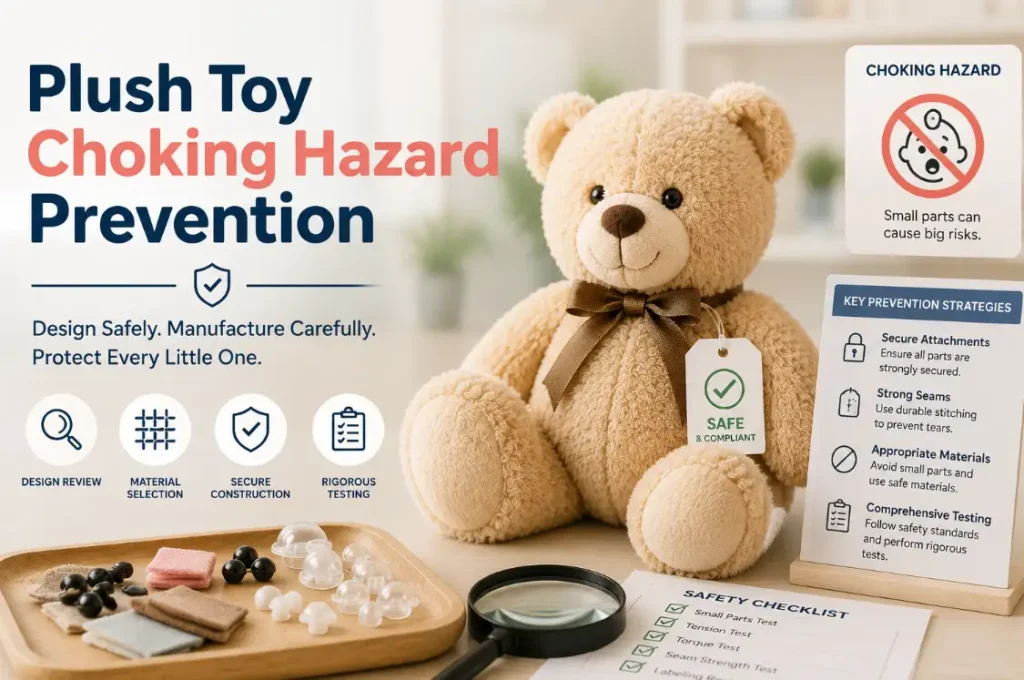
Common Choking Hazard Components in Plush Toys
| Component | Typical Size Risk | Failure Mode | Risk Level |
|---|---|---|---|
| Plastic safety eyes | <25 mm diameter | Washer loosens under pull | High |
| Sewn-on buttons | 5–20 mm | Thread breakage from repeated stress | High |
| Ribbon or bow decorations | Variable | Fraying into ingestion-size strands | Medium |
| Sound module components | Battery <30 mm | Seam failure exposing internals | High |
| Plastic nose pieces | 10–18 mm | Snap-fit failure under torque | High |
| Embroidered appliqués | Frayed edges <10 mm | Thread unraveling over time | Lower |
International Safety Standards That Govern Plush Toy Safety
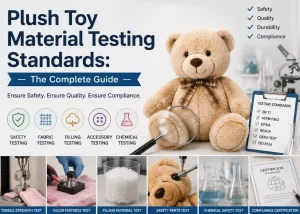
Regulatory frameworks across major markets have established clear testing requirements for children’s soft toys. Compliance with these standards is the primary mechanism by which choking hazard risk is quantified, tested, and controlled throughout the product lifecycle.
In the United States, ASTM F963 — the Standard Consumer Safety Specification for Toy Safety — sets mandatory requirements for all toys marketed to children under 14. For plush toys specifically, it governs small parts testing, bite force simulation, and the pull and torque testing of attachments. The Consumer Product Safety Improvement Act (CPSIA) further mandates third-party laboratory certification before any children’s product can be imported or sold.
In the European Union, EN 71 Part 1 (Mechanical and Physical Properties) defines equivalent requirements, including the small parts cylinder test, the tension and torque test, and the bite test protocol for soft-filled toys. The UK’s UKCA marking post-Brexit follows closely aligned testing criteria.
Major Regulatory Standards for Plush Toy Safety by Market
| Market | Standard | Key Test Requirements | Certification Mark |
|---|---|---|---|
| United States | ASTM F963 / CPSIA | Small parts test, pull/torque ≥90 N, bite simulation | CPC (Children’s Product Certificate) |
| European Union | EN 71-1 | Small parts cylinder, tension test, abuse test | CE Mark |
| United Kingdom | BS EN 71-1 | Equivalent to EN 71 post-BREXIT | UKCA Mark |
| China | GB 6675 | Physical/mechanical safety, small parts | CCC (where applicable) |
| Australia / NZ | AS/NZS 8124-1 | Aligned with ISO 8124 framework | Supplier Declaration |
TIP:
Design for the Pull Test First: When specifying attachment methods for eyes, noses, or decorative components, always design with the 90-newton pull test outcome in mind before finalizing aesthetics. Embroidery or heat-transfer graphics are often safer alternatives to physical attachments for toys intended for children under 36 months.
Design-Stage Prevention: Building Safety Into the Prototype
The most cost-effective point to prevent choking hazards is during the initial design and prototype development phase. Material selection, construction method, and component specification decisions made at this stage determine whether a finished plush toy will pass regulatory testing — or fail at the point of market entry.
Choosing Safe Attachment Methods
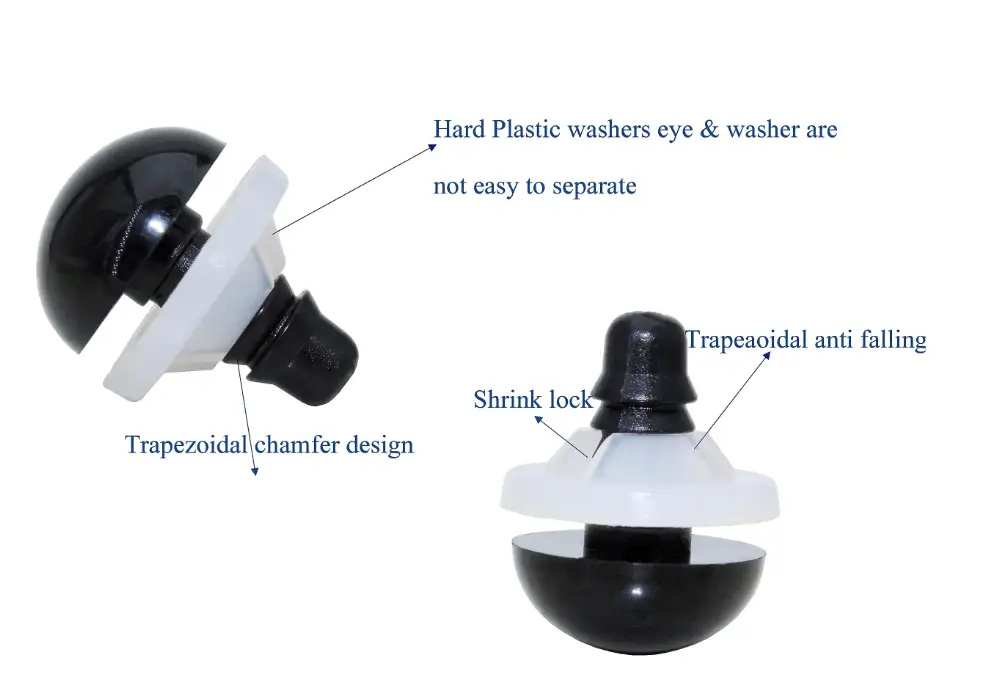
Safety eyes with locking washers are widely used in plush toy manufacturing, but they must meet specific torque and tensile strength thresholds to pass abuse testing. The locking washer must engage securely behind the fabric backing, and the stem length must match the combined thickness of the outer fabric and internal stuffing layer. For products explicitly targeted at infants and toddlers under 36 months, the safest design approach eliminates hard physical attachments entirely in favor of embroidered or screen-printed facial features.
Seam strength is equally critical. All external seams on a plush toy must withstand the pull forces generated during realistic play. Seam stitching density, thread tensile strength, and seam allowance width all contribute to the overall structural integrity of the finished product. Internal components — including sound modules, weighted pellets, and bean-bag filling materials — must be enclosed within secondary inner pouches to prevent access through seam failure.
Recommended Attachment Methods by Child Age Group
| Age Group | Recommended Method | Components to Avoid | Testing Priority |
|---|---|---|---|
| 0–18 months | Embroidery, fabric appliqué only | All hard plastic parts, buttons, ribbons | Bite test, pull test, small parts |
| 18–36 months | Locked safety eyes (deep washer), embroidery | Detachable accessories, open wire frames | Pull/torque, abuse test |
| 3–6 years | Safety eyes, stitched decorations | Button sizes <32 mm, loose ribbons | Small parts cylinder, tension test |
| 6+ years | Standard sewn attachments | Battery compartments without screw locks | Electrical safety, small parts |
Stuffing Material and Internal Component Safety
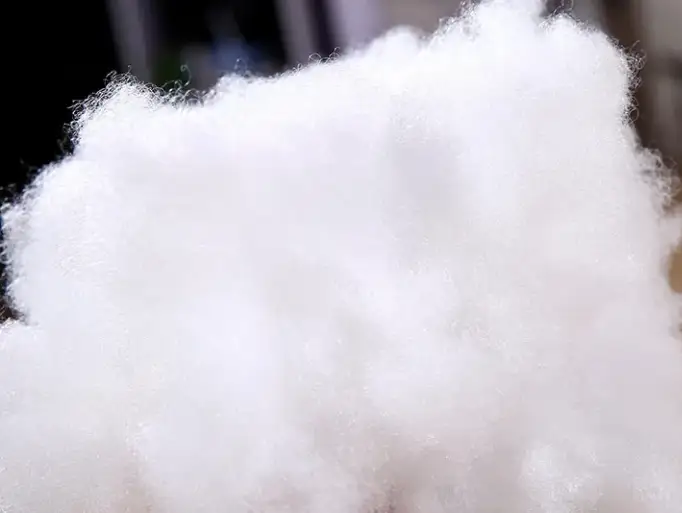
The fill material inside a plush toy must itself be non-hazardous in the event of seam rupture. Polyester fiberfill is the industry standard for most plush applications, as individual fibers above a minimum length are generally not classified as small parts. However, pellet-fill materials — used for weighted plush toys — present a significant choking risk if the outer fabric fails. Any pellet used in a plush toy intended for children under 3 years must be enclosed in a tightly sewn inner liner with a minimum seam strength exceeding the outer shell’s pull test threshold.
TIP:
Use Dual-Barrier Construction for Pellet Fill: When incorporating pellet or bean-bag filling into plush toys for young children, always use a two-layer containment system: a stitched inner mesh pouch inside a sewn inner fabric bag, both enclosed within the final outer shell. This dual-barrier design provides redundant protection against accidental pellet exposure if any single seam fails during abuse testing or extended play.
Quality Control Protocols During Mass Production
Design-stage safety measures only hold value if they are consistently implemented and verified throughout the manufacturing process. A robust quality control framework for plush toy safety addresses incoming material inspection, in-process checks, and pre-shipment final inspection.
Quality Control Checkpoints for Plush Toy Choking Hazard Prevention
| QC Stage | Key Checks | Tool / Method | Frequency |
|---|---|---|---|
| Incoming materials | Safety eye washer lock strength, pellet size, thread tensile rating | Pull gauge, small parts cylinder, calipers | Per batch |
| In-process assembly | Eye/nose attachment torque, seam stitch density, inner pouch closure | Torque wrench, stitch counter, visual | Hourly sampling |
| Pre-stuffing check | Seam allowance integrity, inner liner stitching | Visual + pull test | 100% of units |
| Finished goods inspection | Full abuse simulation, small parts cylinder, pull/torque on all attachments | Calibrated pull tester, cylinder gauge | AQL sampling per order |
| Pre-shipment audit | Label accuracy (age warning), third-party lab report verification | Document review + spot testing | Per shipment |
Incoming material inspection must verify that safety eyes meet the washer engagement specification defined in the product’s technical file. Pull gauges calibrated to 90 newtons are the standard tool for on-line pull testing. Seam stitch density — typically 7 to 9 stitches per centimeter for structural seams — should be verified using a stitch counter at regular intervals during sewing operations.
Age grading labels carry legal weight in most markets. A plush toy carrying a “Not suitable for children under 36 months — choking hazard” warning must have been verified through small parts testing to determine that components could be released during abuse. Incorrect age grading can result in regulatory enforcement action and product recalls, which underscores the importance of third-party laboratory testing as a mandatory step in the compliance workflow.
TIP:
Align Age Warning Labels With Lab Test Results: Never assign an age grading label based on market assumptions or visual complexity alone. The age warning printed on a plush toy’s hang tag and packaging must correspond directly to the outcome of small parts testing and pull/torque testing conducted by an accredited third-party laboratory. This protects both the end consumer and ensures compliance with CPSIA, EN 71, and equivalent regulatory frameworks.
Labeling, Documentation, and Traceability Requirements
Regulatory compliance for plush toy safety extends beyond the physical product to encompass a complete documentation trail. For U.S. imports, CPSIA requires a Children’s Product Certificate (CPC) issued by the importer or domestic manufacturer, referencing specific third-party test reports from CPSC-accepted laboratories. For EU market entry, a Declaration of Conformity and the supporting technical file — including EN 71 test reports, risk assessment, and design documentation — must be maintained and made available to market surveillance authorities upon request.
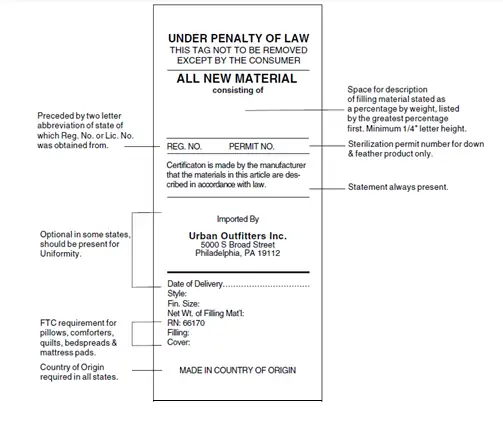
Traceability systems link individual production batches to their corresponding quality records, enabling rapid identification of affected units if a safety issue is identified post-shipment. Batch coding on inner labels or RFID tagging of cartons are increasingly adopted practices for high-volume plush toy production runs. This level of traceability is not simply a best practice — in the event of a recall, it is the operational mechanism that limits the scope and cost of the remediation.
Required Safety Documentation by Destination Market
| Document | Required For | Issued By | Validity |
|---|---|---|---|
| Children’s Product Certificate (CPC) | US market (CPSIA) | Importer / Brand Owner | Per product / model |
| Declaration of Conformity (DoC) | EU / UK CE / UKCA marking | Manufacturer or Authorized Rep | Per product version |
| EN 71-1 Test Report | EU / UK market entry | Accredited third-party lab | 3 years (or design change) |
| ASTM F963 Test Report | US market entry | CPSC-accepted lab | Per production batch |
| Technical Construction File | EU (mandatory for CE) | Manufacturer | 10 years post-market |
Frequently Asked Questions
What is the small parts cylinder test and why does it matter for plush toys?
The small parts cylinder test is a standardized assessment used to determine whether a detached component from a toy poses a choking risk to children under 3 years of age. The cylinder — defined in ASTM F963 and EN 71 — has an internal diameter of 31.7 mm and a depth of 57.1 mm, replicating the approximate dimensions of a young child’s throat.
Any component that fits entirely within the cylinder is classified as a small part and triggers an age restriction of at least 36 months. For plush toys, this test is applied to any part that can be detached during pull, torque, bite, or drop testing. Components such as plastic safety eyes, snap-fit noses, and decorative buttons are routinely subjected to this assessment during third-party compliance testing.
What pull force must plush toy attachments withstand to pass safety testing?
Under both ASTM F963 and EN 71, attachments on plush toys for children under 3 years must withstand a minimum pull force of 90 newtons (approximately 20 lbf) applied along the axis of greatest weakness for a sustained period. Torque testing requires the component to resist a rotational force of 0.34 Nm without detaching or loosening. These thresholds simulate the forces a young child might realistically generate while manipulating or biting a soft toy.
Safety eyes that fail to engage their locking washers properly, or buttons attached with insufficient thread density, are common failures at this stage. Manufacturers must verify that their attachment specifications and assembly processes consistently meet these thresholds, not just in pre-production samples but throughout the full production run.
Are weighted plush toys with pellet fill safe for young children?
Weighted plush toys — including those filled with plastic pellets, glass beads, or poly pellets — can be safe for young children provided they incorporate appropriate containment design and pass mandatory seam strength testing. The primary risk is pellet exposure through seam failure, as most pellets measure well below the 31.7 mm small parts threshold and present an acute choking hazard.
Best practice is to enclose all pellet filling within a dual-barrier inner containment system (an inner mesh pouch inside a fabric inner bag) before insertion into the outer shell. Age grading labels must reflect the outcome of abuse and seam integrity testing — most pellet-fill plush toys are age-graded at 3 years and above, and this restriction must be clearly communicated on both the product label and packaging.
What are the safest design alternatives to plastic safety eyes for infant plush toys?
For plush toys intended for infants and children under 18 months, the safest design approach is to eliminate all hard plastic attachments in favor of embroidered or woven features. Embroidered eyes, noses, and mouths are stitched directly into the fabric surface and cannot detach as discrete small parts. Heat-transfer printed facial features are another low-risk option, though print durability must be verified under wet and dry rub testing to ensure the ink layer does not flake off in ways that could create secondary ingestion risks.
Fabric appliqué — a piece of contrasting fabric stitched flat onto the toy’s surface — is also widely used and safe when seam integrity is maintained. These alternatives allow plush toys to achieve expressive character design without introducing the regulatory complexity and choking risk associated with physical eye hardware.
How often should plush toy designs be retested after initial compliance certification?
Retesting is required whenever a product undergoes a material design change, a change in manufacturing process, a change in raw material supplier, or a change in component specification — even if the visual appearance of the finished toy remains identical. Under CPSIA, the importer must issue a new Children’s Product Certificate referencing updated test reports whenever any such change occurs. EN 71 compliance in the EU is similarly tied to the technical construction file, which must be updated to reflect any design modification.
Beyond regulatory triggers, many quality-focused buyers implement annual surveillance testing as part of their supplier qualification programs, particularly for best-selling SKUs that remain in production across multiple seasons. This ongoing testing cadence helps detect manufacturing drift — gradual changes in assembly quality or material substitution — before a safety issue reaches consumers.