Skip to content
Understanding how to pass plush toy safety testing is essential for ensuring product compliance, protecting consumers, and avoiding costly delays in the manufacturing process. Plush toy safety testing is not a final checkbox — it is an integrated engineering discipline that begins at the design stage and extends through every layer of the supply chain.
Brands, importers, and manufacturers who understand the regulatory framework, material requirements, and laboratory protocols involved in safety certification gain a measurable competitive advantage: fewer production holds, faster market entry, and stronger buyer confidence. This guide covers the full testing pathway, from applicable standards to pre-shipment inspection protocols, with actionable guidance for every stage of the production cycle.
Why Plush Toy Safety Testing Matters
Soft toys occupy one of the most heavily regulated product categories in consumer goods. The primary reason is their end user: infants and children under 14 years of age who interact with plush products through mouthing, pulling, squeezing, and throwing.
Regulatory agencies in North America, Europe, and Asia-Pacific have developed distinct but overlapping requirements that address physical hazards, chemical content, flammability, and labeling. Passing safety testing is legally mandatory in most target markets — and practically necessary for retail distribution in all major channels, including e-commerce platforms that now mandate certification documentation at the listing stage.

Beyond legal compliance, rigorous safety testing reduces product liability exposure and builds brand equity. A documented test report from an accredited third-party laboratory communicates quality assurance to B2B buyers and directly supports negotiation leverage with major retail accounts.
Global plush toy regulatory standards by market
| Market | Primary Standard | Regulatory Body | Scope |
|---|---|---|---|
| United States | ASTM F963 / CPSIA | CPSC | Children’s products 0–12 years |
| European Union | EN 71 (Parts 1–3, 9) | RAPEX / Member States | Toys for children under 14 |
| United Kingdom | UK Toy Safety Regulations 2011 | OPSS / Trading Standards | Post-Brexit equivalent of EN 71 |
| Canada | Canada Consumer Product Safety Act | Health Canada | All ages, emphasis on infant toys |
| Australia | AS/NZS 8124 / ISO 8124 | ACCC | Children under 14 |
| China (export) | GB 6675 / CCC Mark | SAMR / CNCA | Mandatory for domestic; voluntary export |
Understanding the Core Testing Categories
Plush toy safety assessments typically fall into four major testing categories: mechanical and physical testing, chemical testing, flammability testing, and labeling and age-grading compliance. Most accredited laboratories offer a single submission package that covers all four, but understanding each domain independently helps manufacturers anticipate failure points and build preventive controls into the production process.
Mechanical and Physical Safety
Physical testing evaluates whether a plush toy’s construction can withstand the mechanical forces a child is likely to apply during normal and foreseeable use. The assessments are conducted using standardized tension, torque, compression, and abuse testing protocols. For infant and toddler products — typically defined as toys intended for children under 36 months — the standards are considerably more stringent, as mouthing behavior introduces choking and suffocation risks.
Key mechanical test methods for plush toys
| Test | Standard Method | Applied Force / Condition | Pass Criterion |
|---|---|---|---|
| Small parts (bite test) | EN 71-1 / ASTM F963 §4.6 | Cylinder check after flexing | No part fits entirely into small-parts cylinder (≤3 years) |
| Eye and nose pull | EN 71-1 §8.4 | 90 N tension for 10 seconds | No detachment or deformation |
| Seam strength | EN 71-1 §8.7 | 70 N applied to seam | No rupture or stuffing exposure |
| Sharp points and edges | EN 71-1 §8.9 / ASTM F963 §4.7 | Visual + probing tool | No accessible sharp point or edge after abuse |
| Filling material | EN 71-1 §8.2 | Wash cycle + opening test | No pellets, granules, or hard fill accessible |
Design Tip
Specify minimum seam stitch density at the design stage — typically no fewer than 8 stitches per centimeter for high-stress joints such as limb attachment points. Reinforce with double-lock or bar-tack stitching wherever pullout force is likely to concentrate, such as ears, tails, and button attachments.
Chemical Content Testing
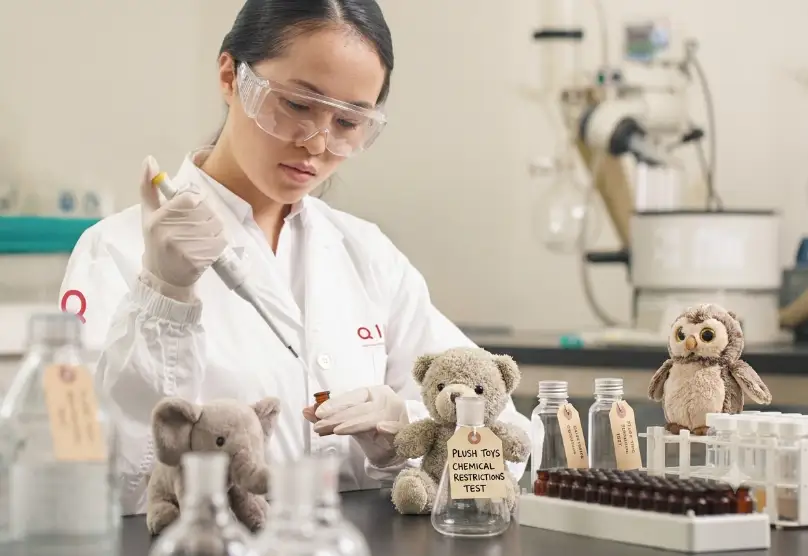
Chemical testing evaluates the presence of restricted substances in materials that come into contact with children. This is arguably the most complex area of plush toy compliance because it requires proactive material management across the entire supply chain — including fabrics, dyes, stuffing materials, glues, coatings, and decorative elements such as sequins, printed patches, and embroidery threads.
Restricted chemical substances in plush toy materials
| Substance Group | Relevant Standard | Common Source | Limit (typical) |
|---|---|---|---|
| Lead content | CPSIA Section 101 | Dyes, coatings, accessories | ≤100 ppm total lead |
| Phthalates | CPSIA / EN 71-9 | PVC accessories, vinyl labels | ≤0.1% per phthalate type |
| Formaldehyde | Oeko-Tex Standard 100 | Fabric finishing agents | ≤75 mg/kg (baby products) |
| Azo dyes | EN 71-9 / REACH | Fabric dyes | ≤30 mg/kg per amine |
| Nickel | EN 71-9 / REACH Annex XVII | Metal zippers, buttons | ≤0.5 μg/cm²/week release |
| pH value (fabric) | Oeko-Tex / ISO 3071 | Washing/dyeing processes | 4.0–7.5 (infant skin contact) |
The most practical approach to chemical compliance is selecting pre-certified materials from suppliers who hold current Oeko-Tex Standard 100, GOTS, or equivalent third-party fabric certifications. Tracing chemical content through reactive dyes and finishing agents to the fiber level is labor-intensive without supplier certificates, and batch-level variability means a certificate alone is not a substitute for periodic spot testing.
Sourcing Tip
Request dye lot certificates and chemical safety data sheets (SDS) from all fabric suppliers before bulk production begins. For products targeting the EU market, verify that all polyester fibers, nylon trims, and foam fills are REACH-compliant and that your supplier can provide substance declarations covering SVHC (Substances of Very High Concern) at concentrations above 0.1% w/w.
Flammability Requirements for Stuffed Toys
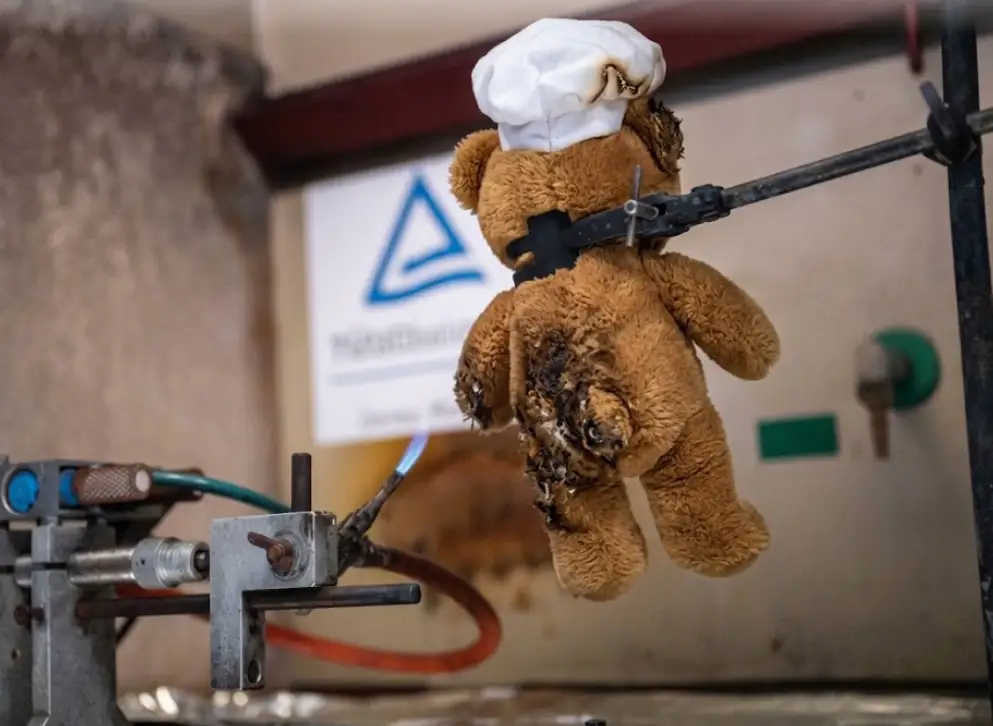
Plush toys — particularly large stuffed animals and toys with long-pile fabrics — are assessed for flammability behavior under both surface and bulk ignition conditions. The applicable tests vary by destination market but generally involve exposing fabric samples to a standardized flame source and measuring the rate of flame spread.
Flammability test requirements by major standard
| Standard | Test Method | Fabric Type Covered | Acceptable Result |
|---|---|---|---|
| EN 71-2 | Surface flash and propagation | All fabrics with raised pile> 2 mm | No surface flash; propagation ≤100 mm/s |
| ASTM F963 §4.2 | Fabric burn rate | Loose fabric components | Burn rate ≤ 9 cm/s |
| 16 CFR Part 1500.44 | Extremely flammable test | Protruding fiber content | Not classified as extremely flammable |
| BS 5665 / UK TR | Equivalent to EN 71-2 post-Brexit | All toy types with textile | Same as EN 71-2 criteria |
Long-pile fabrics such as faux fur and Sherpa fleece carry elevated flammability risk due to their high surface-area-to-mass ratio and loose fiber structure. Manufacturers should validate flame-retardant properties at the greige fabric stage and after any wet processes, since dyeing and washing can alter the fiber surface and change combustion behavior. Inherently flame-resistant fibers — such as modacrylics — can be used in pile constructions where compliance with EN 71-2 would be difficult to achieve through finishing chemistry alone.
Pre-Testing Preparation: The Internal Quality Protocol
Third-party laboratory submission is typically the final confirmation step. The real compliance work happens internally, during material sourcing, prototype development, and pre-production quality audits. Manufacturers who treat testing as an end-of-line activity rather than an integrated process discipline experience higher failure rates, longer correction cycles, and greater cost exposure.
Prototype and Pre-Production Inspection
A structured pre-production inspection (PPI) protocol should be established before any laboratory samples are submitted. The PPI evaluates construction fidelity — whether the production sample matches the approved prototype — and verifies that all materials, trim components, and labeling meet specification. Any deviation at the pre-production stage is far less costly to correct than a deviation discovered in a third-party test report after bulk production has started.
Pre-production inspection checklist for plush toy compliance
| Inspection Area | What to Check | Documentation Required |
|---|---|---|
| Fabric and fill materials | Fiber content verification, Oeko-Tex or equivalent cert validity | Supplier material cert, SDS |
| Trims and accessories | Eye, nose, button construction, wire or hard element presence | Component specification sheet |
| Labeling | Age warning, fiber content, country of origin, CE or UKCA mark | Label artwork approval |
| Seam construction | Stitch density, reinforcement at attachment points | Sewing specification sheet |
| Filling distribution | Hardness, lumpiness, exposed edges after stuffing | Stuffing specification |
| Surface decoration | Print adhesion, embroidery thread security, sequin attachment | Decoration approval sample |
Selecting an Accredited Testing Laboratory
Not all testing laboratories carry accreditation for every standard or market. Accreditation is granted by national bodies such as A2LA and NVLAP in the United States, UKAS in the United Kingdom, and DAkkS in Germany. The laboratory must be specifically accredited under ISO/IEC 17025 for the test methods being requested — general ISO 17025 accreditation does not automatically confer scope for toy safety testing. For multi-market submissions, it is often efficient to work with a global testing network (such as SGS, Intertek, Bureau Veritas, or TÜV Rheinland) that can issue reports valid across multiple regulatory frameworks from a single submission.
Efficiency Tip
When exporting to both the US and EU simultaneously, submit a combined test package that covers ASTM F963, CPSIA, and EN 71-1/2/3 in a single laboratory engagement. Many accredited labs offer bundled toy safety packages that reduce per-test cost by 20–35% compared to separate market submissions. Confirm that the relevant customs and retail compliance teams in each destination market accept the lab’s report format.
Age Grading, Labeling, and Documentation Requirements
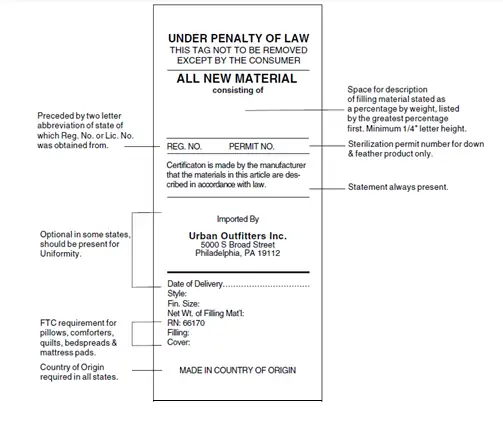
Labeling is a compliance deliverable, not an afterthought. Errors in age grading or required warning language can result in product recalls independently of whether the physical product passes all mechanical and chemical tests. Age grading also determines which test protocols apply: products for children under 36 months face the most restrictive requirements across all major standards.
Required Label Elements
While specific language varies by market, the following elements are required across most major regulatory frameworks: minimum age recommendation or safety warning symbol, manufacturer or importer identity and address, fiber content and fill material declaration, country of origin, and market-specific conformity marking (CE for EU, UKCA for UK). For the US market, CPSIA requires a General Certificate of Conformity (GCC) or Children’s Product Certificate (CPC) to accompany every shipment, and the certificate must reference the specific test report that supports each claimed compliance point.
Mandatory labeling elements by destination market
| Requirement | US (CPSIA) | EU (EN 71) | UK (UKTR) | Australia (AS/NZS) |
|---|---|---|---|---|
| Age warning | Required (≤3 years: choking hazard) | Required (symbol + text) | Required | Required |
| Conformity mark | CPC / GCC documentation | CE mark | UKCA mark | No mandatory mark |
| Manufacturer ID | Required on product and packaging | Required | Required | Required |
| Fiber content | Required (FTC Textile Rule) | Required | Required | Required |
| Country of origin | Required (CBP marking rules) | Not legally required (but common) | Recommended | Required |
Managing Test Failures and Corrective Action
Receiving a failed test report is a recoverable situation when the failure analysis is handled systematically. The first step is to identify whether the failure is a material failure, a construction failure, or a design failure — each has a distinct corrective pathway and different implications for timeline and cost.
Material failures — such as excess lead, phthalates, or azo dyes — require substituting the non-compliant material with a certified alternative and resubmitting the affected components. Construction failures — such as inadequate seam strength or small-parts release — are resolved through updated sewing specifications or component redesign. Design failures — such as a functional but inherently non-compliant feature — may require structural rework of the prototype and a full new test cycle.
Process Tip
Always request a detailed failure analysis report from the laboratory rather than a simple pass/fail notification. Understanding whether a seam failure occurred at 62 N versus 70 N — or whether a chemical limit was exceeded by 10% versus 200% — determines the appropriate scale of the corrective response. Over-engineering a correction wastes cost and time; under-engineering it produces another failure.
Ongoing Compliance: Annual Testing and Material Change Management
Initial product certification does not constitute permanent compliance. Most standards require periodic retesting when materials change, when suppliers change, or on an annual basis for ongoing market access. Retail accounts increasingly require certificate renewal documentation as a condition of continued purchase orders. A compliance calendar that tracks certificate expiration dates, material change triggers, and regulatory update cycles is essential for manufacturers maintaining a multi-SKU plush line.
Changes that trigger mandatory retesting include: fabric or fill supplier substitutions, dye lot changes that alter fiber chemistry, trim component redesigns affecting small-parts risk, and label updates that change age grading. Regulatory changes — such as updates to CPSIA chemical limits or revisions to EN 71 — may trigger retesting obligations even without any change to the physical product.
Frequently Asked Questions
How long does plush toy safety testing typically take from sample submission to receiving a final report?
Standard laboratory turnaround for a comprehensive plush toy safety test package — covering EN 71 Parts 1, 2, and 3 or ASTM F963 plus CPSIA chemical testing — is typically 10 to 20 business days from sample receipt, depending on the scope of chemical testing selected.
Expedited service is available at most major accredited laboratories for an additional fee and can reduce turnaround to 5 to 8 business days. Chemical analysis for restricted substances, particularly migration testing for heavy metals and formaldehyde extraction, tends to be the rate-limiting step. Planning for a minimum of three weeks from sample dispatch to report delivery is a reasonable baseline for production scheduling purposes.
Do I need separate test reports for the US and EU markets, or can one report cover both?
A single test report cannot simultaneously satisfy US and EU requirements because the two regulatory frameworks have different test methods, different pass/fail criteria, and different documentation formats. However, a single laboratory submission can generate two separate reports — one addressing ASTM F963 and CPSIA, and one addressing EN 71 — from the same physical sample set.
This combined submission approach is cost-efficient and is routinely offered by global accredited testing providers. The Children’s Product Certificate required for the US market and the Declaration of Conformity required for the EU CE mark are also separate documents, each referencing their respective test report.
Which part of EN 71 is most likely to cause a failure for a standard stuffed animal?
EN 71 Part 1 (mechanical and physical properties) generates the highest failure rate for plush toys, particularly in three areas: small-parts release after abuse testing, accessory pull-out force (eyes, noses, buttons), and seam integrity under tension. Eyes and noses attached with posts and washers are a frequent failure point when the post is too short to meet minimum retention force requirements after the standard abuse protocol.
EN 71 Part 2 (flammability) is a common secondary failure area for products using long-pile fabrics such as faux fur, which can exhibit rapid surface flame propagation. Chemical failures under Part 3 (migration of certain elements) or Part 9 (chemical compounds) are less frequent when suppliers are using properly certified materials but can occur with low-cost trims, coatings, and unverified dye lots.
Is Oeko-Tex Standard 100 certification sufficient to demonstrate chemical compliance for toy safety purposes?
Oeko-Tex Standard 100 is a strong baseline indicator of chemical safety and covers a broad range of restricted substances including formaldehyde, pH, heavy metals, pesticide residues, and several azo dyes. However, it is a fabric certification rather than a toy safety certification, and it does not automatically satisfy the toy-specific chemical requirements under EN 71-9 (chemical compounds in toys) or the full CPSIA restricted substance scope.
For regulatory compliance purposes, Oeko-Tex certificates on fabric and fill materials substantially reduce the chemical risk of a finished product, but a product-level chemical test report from an ISO/IEC 17025-accredited laboratory remains necessary to support a CE Declaration of Conformity or a US Children’s Product Certificate. In practice, Oeko-Tex-certified materials rarely fail toy chemical testing, making them a highly efficient risk-reduction tool in the supply chain.
At what point in the production process should samples be submitted for third-party testing?
Samples submitted for third-party testing should be production-representative — meaning they must be made using the same materials, constructions, and processes as the bulk production run. Testing a prototype that differs from production in any material or structural respect produces a certificate that does not legally cover the finished goods.
The standard practice is to produce a small pre-production run of 30 to 50 units using confirmed production materials and then submit a minimum of 3 to 6 units per sample type for laboratory testing. If any material, component, or construction method changes after testing, the scope of the change must be evaluated to determine whether retesting is required. Most regulatory frameworks require that the test sample be representative; claiming certification coverage over a materially different production batch is a compliance and liability risk.