Skip to content
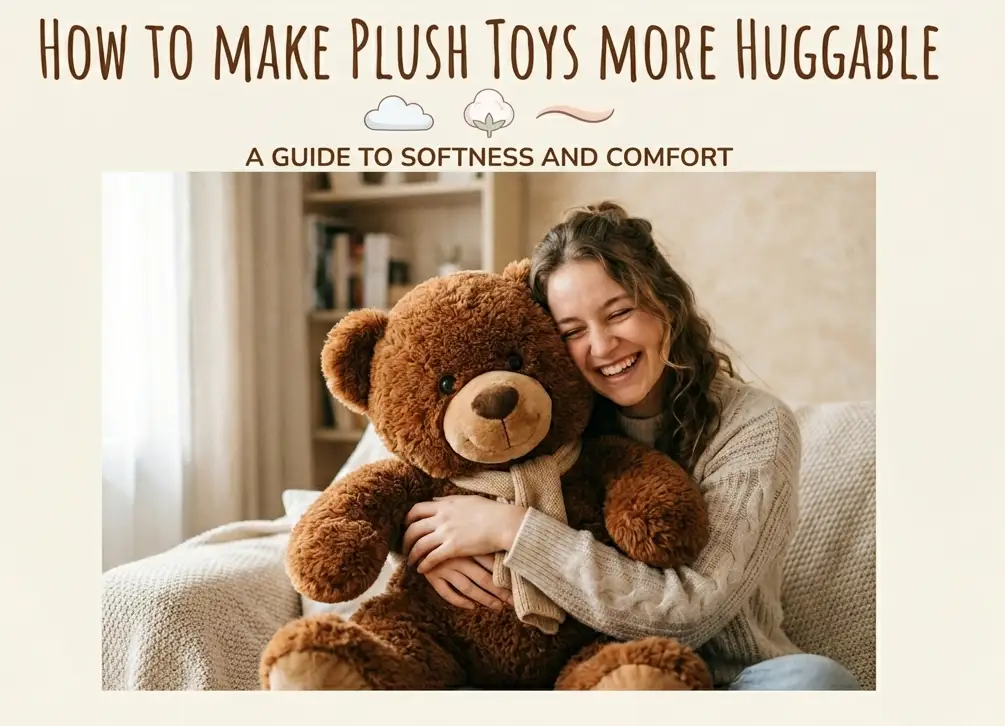
To make plush toys more huggable, designers must carefully balance softness, shape, stuffing, and fabric selection to create a comforting and irresistible cuddling experience. Huggability is not an accident. When someone picks up a plush toy and instinctively squeezes it, the response they feel—whether the toy compresses warmly and bounces back, or feels dense and reassuring, or collapses and stays flat—is the direct result of deliberate engineering decisions made long before production began.
Fill weight, fabric pile height, body geometry, seam tension, and even the ratio of the toy’s width to its depth all contribute to a sensory experience that either earns a repeat hug or sends the toy to the back of the shelf.
This guide breaks down every variable that determines plush toy huggability: the material science of fill and fabric, the geometry of squeeze-friendly shapes, the role of weight distribution, and the production techniques that lock all of these properties in at scale. Whether you are designing a first toy or refining an existing product line, understanding what the hand actually feels during a hug—and how to engineer for it—is the most direct path to a product people genuinely love.
What Physical Properties Define Huggability in a Plush Toy?
Huggability is a composite sensory property. It combines tactile softness (how the surface feels against skin), compression response (how the toy gives under squeeze pressure and how quickly it recovers), thermal feel (whether the fabric surface feels warm or cool on initial contact), and ergonomic fit (whether the toy’s shape naturally fills the arms during a hug). All four properties can be engineered independently, and all four interact with each other in the final product.
The most measurable of these properties is compression response, which is governed primarily by fill density and fill material grade. A toy with too little fill compresses immediately and gives nothing back—there is no resistance to create the satisfying push-and-return feeling of a genuinely huggable object. A toy overfilled to maximum firmness provides resistance but no warmth or give, which reads more as a rigid object than a comfort item. The ideal huggable toy sits in a narrow band between these extremes, with a compression behaviour that engineers call progressive resistance: soft at first contact, firming through mid-squeeze, and recovering smoothly when pressure is released.
Compression Response Profiles by Fill Density
| Fill Density (g/L of toy volume) | Compression Behaviour | Recovery Speed | Perceived Feel | Best Application |
|---|---|---|---|---|
| Under 18 g/L | Collapses immediately, minimal resistance | Very slow (5–10 sec) | Limp, unsatisfying, “empty” | Flat plush, plush blankets, pillow characters |
| 18–28 g/L | Soft initial give, light mid-squeeze resistance | Moderate (2–4 sec) | Plush, cloud-like, very gentle | Infant comfort toys, sleep companions |
| 28–40 g/L | Progressive resistance, clear push-back feel | Fast (under 2 sec) | Satisfyingly full, huggable, resilient | Core character plush, retail standard, gift toys |
| 40–55 g/L | Firm resistance throughout squeeze cycle | Immediate | Dense, structured, weighted feel | Display plush, poseable figures, weighted sensory toys |
| Above 55 g/L | Minimal compression, near-rigid surface | Immediate | Hard, object-like, not comforting | Not recommended for huggable toys |
Tip: The 28–40 g/L fill density window is the professional benchmark for standard huggable plush. If your factory quotes by fill weight rather than density, calculate target fill weight by multiplying the toy’s internal volume (in litres) by your target g/L figure. A 25 cm bear with approximately 0.9 L internal volume at 34 g/L should receive roughly 30–31 g of fill.
Which Fill Materials Produce the Best Huggable Texture?
Fill material is the single most impactful variable in huggable plush toy design, and the differences between grades are far more significant than most first-time buyers expect. The base material used in the vast majority of commercial plush toys is polyester fiberfill, commonly called PP cotton in manufacturing contexts. However, PP cotton is not a single product—it spans a wide quality range from low-grade single-crimped fibre to premium silicone-coated, multi-crimped variants that behave fundamentally differently under compression.

Standard PP cotton uses a single-crimp fibre that compresses well initially but loses loft relatively quickly with repeated use. After 50–100 cycles of squeezing and releasing, standard fill begins to clump and flatten, reducing huggability over the toy’s life. Premium PP cotton uses a conjugate or spiral-crimped fibre structure with a silicone coating that prevents fibres from matting together. This grade maintains loft and recovery performance far longer and produces a noticeably different tactile sensation—smoother and more uniform—even at the same fill density.
PP Cotton Fill Grade Comparison for Plush Toy Huggability
| Fill Grade | Fibre Structure | Silicone Coating | Loft Recovery (after 100 squeezes) | Clumping Risk | Relative Cost Index |
|---|---|---|---|---|---|
| Economy (Grade C) | Single-crimped, uniform | None | 60–70% | High | 1.0× |
| Standard (Grade B) | Bi-crimped blend | Partial | 75–85% | Moderate | 1.3–1.5× |
| Premium (Grade A) | Spiral/conjugate-crimped | Full silicone | 90–96% | Low | 1.8–2.2× |
| Ultra / Siliconised hollow | Hollow-core spiral fibre | Full silicone | 95–99% | Very low | 2.5–3.0× |
| Recycled PET (GRS) | Bi-crimped from rPET | Partial | 78–88% | Moderate | 1.6–2.0× |
For brands targeting the premium gift or collector plush market, the upgrade from Grade B to Grade A fill typically adds $0.15–$0.40 to the unit cost of a standard 25–30 cm toy while delivering a noticeable quality difference that consumers feel immediately in-store. This cost-to-perception ratio makes fill grade one of the highest-ROI quality investments available in plush design.
How Does Fabric Selection Affect the Hugging Experience?
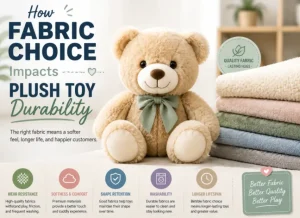
The outer fabric is the first thing a person feels when they pick up a plush toy. Before a single squeeze has occurred, the surface texture, temperature response, and visual pile depth have already begun shaping the emotional response. This makes fabric selection not just an aesthetic decision but a direct driver of huggability perception.
Pile Height, GSM, and Tactile Softness
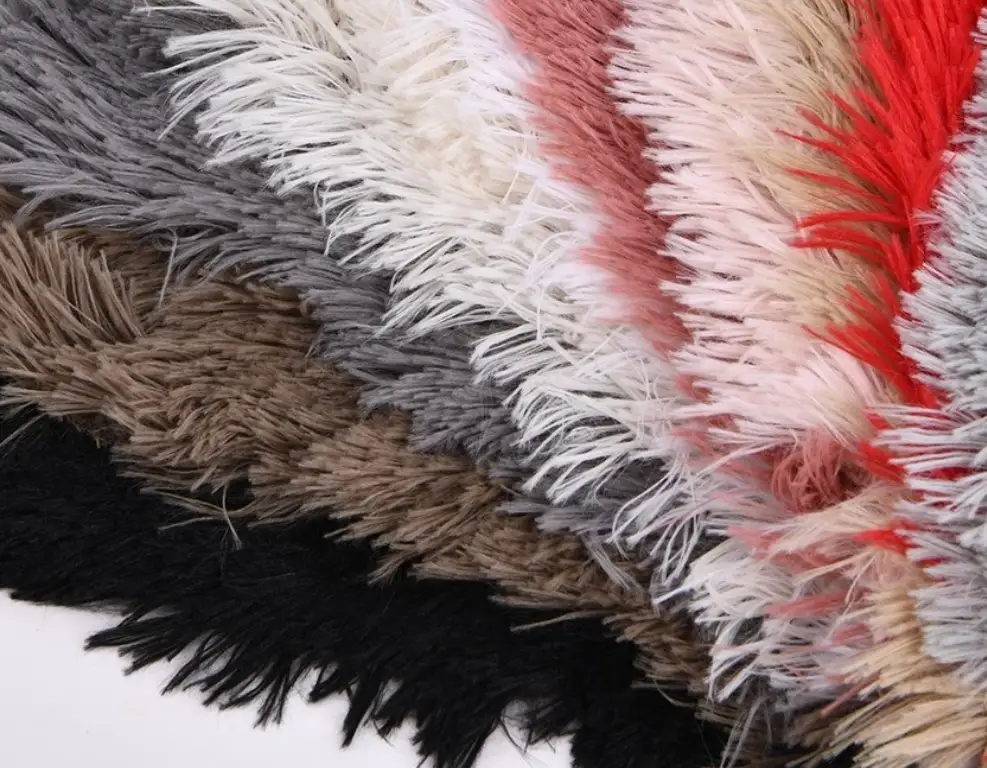
Shorter pile fabrics—minky, velboa, and short-pile plush in the 1–6 mm range—produce a smooth, skin-like surface feel that many people describe as immediately warm and calming. This is partly tactile and partly thermal: shorter pile fabrics have higher contact area with the hand, which registers as warmth. Longer pile fabrics (12 mm and above) produce a more dramatic visual softness cue and create the satisfying sensation of fingers sinking into texture, but the actual thermal contact is lower, and the structural definition of the toy’s form is harder to maintain.
GSM (grams per square metre) adds a layer of weight and density to the outer shell that affects how the toy feels during a hug. Higher GSM fabrics (350 g/m² and above) feel more substantial and premium in hand even before compression, while lower GSM fabrics can feel thin and underwhelming against the fill, particularly when the seams are visible at stretch points.
Tip: When pairing fabric with fill grade, match the investment level. A premium silicone-coated fill paired with a low-GSM economy fabric creates a disconnect: the compression response is excellent, but the surface feel undercuts the quality signal. For a cohesive huggable experience, target GSM 300–380 minky or short-pile plush with Grade A fill for the core body panels.
Fabric Type vs. Huggability Sensory Profile
| Fabric Type | Pile Height | GSM Range | Thermal Feel | Hug Texture | Recommended Use |
|---|---|---|---|---|---|
| Minky / Minkee | 1–2 mm | 280–350 | Warm, skin-like | Smooth, plush, velvety | Baby toys, sleep companions, lap blankets |
| Short pile plush | 3–6 mm | 300–400 | Warm | Soft, tactile, slightly fuzzy | Standard character plush, animal designs |
| Medium pile plush | 7–12 mm | 380–500 | Neutral | Cloud-like, finger-sinking | Premium retail toys, lifestyle plush |
| Long pile / shaggy | 12–30 mm | 450–650 | Cool (less contact) | Dramatic, textural, expressive | Novelty toys, collector plush, display items |
| Velboa | 0.5–1.5 mm | 200–280 | Neutral to warm | Smooth, cool-to-warm transition | Flat plush, vintage-style, embroidery-focused |
Does the Shape of a Plush Toy Affect How Huggable It Feels?
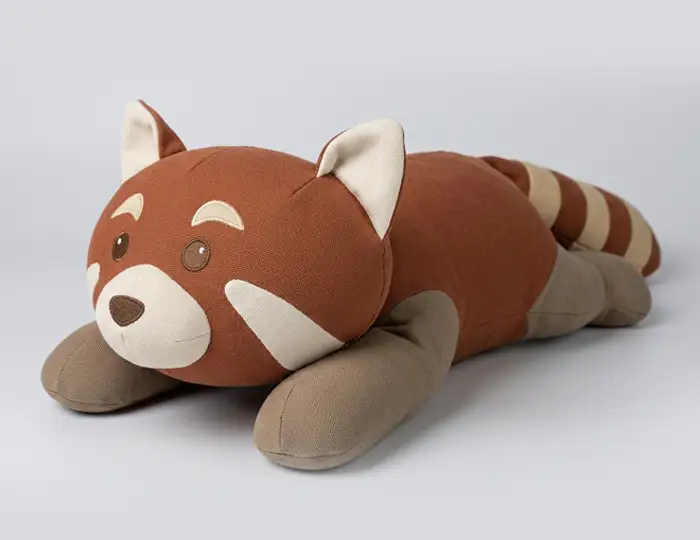
Body geometry is the most underappreciated dimension of huggability. A toy can have perfect fill density and premium fabric and still feel awkward to hug if its shape does not naturally fit the arc of a human arm. The most huggable plush toy shapes share a common geometry: a compact, rounded body with moderate width-to-depth ratio, softened protrusions (limbs and head attachments that compress rather than resist), and an overall mass distribution that sits low in the centre of the toy.
Ergonomic Shaping Principles for Maximum Comfort
The classic teddy bear shape—a round torso, a spherical head attached close to the body, and four short, rounded limbs—has remained the default of the plush toy industry for over a century, not because of tradition but because it is geometrically optimised for being held. The torso fills the forearm space, the head rests naturally against the shoulder or chin, and the limbs drape rather than protrude. Designs that deviate significantly from this ergonomic template—very flat bodies, elongated limbs, asymmetric weight distribution, or large protruding elements—consistently score lower on repeat hugging behaviour in consumer research.
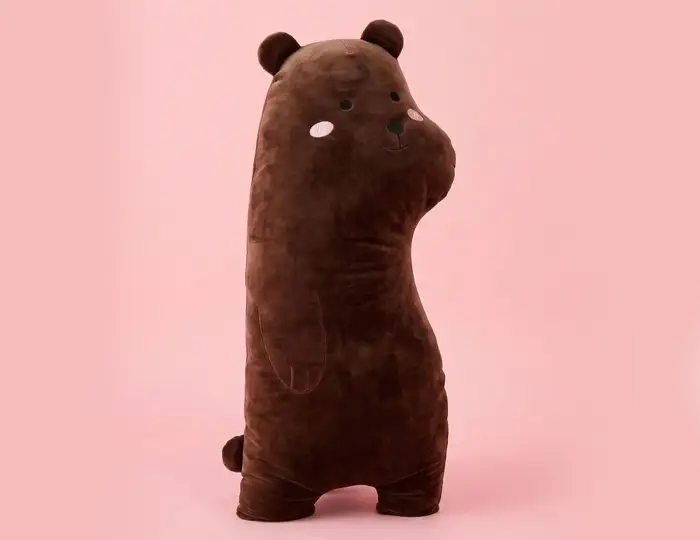
The width-to-depth ratio of the toy’s torso is a particularly reliable predictor of perceived huggability. Toys where the torso depth (front to back) is at least 60% of the torso width compress into a comfortable arc when embraced. Flat designs where depth is below 30% of width have no compression range in the hug axis and feel more like cushions than companions.
Consumer preference testing across multiple plush toy categories consistently shows that toys with a torso depth-to-width ratio of 0.6:1 or greater are rated as significantly more huggable than flatter designs—even when fill quality, fabric, and visual design are held equal. Shape geometry alone can shift huggability preference scores by 20–35%.
Can Weighting and Ballast Improve the Hugging Experience?
Weighted plush toys represent one of the fastest-growing segments in the softgoods category, driven primarily by the sensory toy and therapeutic comfort markets. The principle is simple: adding a controlled amount of weight to a plush toy increases the proprioceptive feedback during a hug—the body senses the toy’s weight pressing back—which many people find calming, grounding, and more satisfying than an ultra-light alternative.
Weighting is achieved through several methods. The most common is the addition of plastic pellets (PE or PP beads) in a sealed inner pouch positioned in the lower body or base of the toy. This adds weight without changing the outer compression properties of the fill. A second method—used in premium sensory designs—integrates glass microbeads into a quilted inner liner that distributes weight more evenly across the toy’s body. Both methods require careful attention to inner pouch construction: the weight medium must be fully enclosed in a double-sewn or heat-sealed inner bag that cannot breach during normal use or washing.
Weighting Methods for Huggable Plush Toys
| Weighting Method | Medium | Typical Added Weight | Distribution | Wash Safe | Cost Impact |
|---|---|---|---|---|---|
| Pellet pouch (base) | PE / PP plastic beads | 80–200 g | Base / lower body | Yes (sealed pouch) | Low (+$0.30–0.80) |
| Pellet pouch (distributed) | PE / PP beads, multiple pouches | 150–400 g | Torso, limbs, head | Yes (sealed pouches) | Moderate (+$1.00–2.00) |
| Glass microbead liner | Borosilicate microbeads | 200–600 g | Even across body | Yes (quilted liner) | High (+$2.50–5.00) |
| Sand fill blend | Fine sand in sealed inner | 100–300 g | Base-heavy | Not recommended | Low (+$0.20–0.60) |
| Steel shot pellets | Stainless micro-pellets | 100–500 g | Targeted zones | Yes (sealed liner) | High (+$3.00–7.00) |
Tip: For toys intended for children under 36 months, avoid all pellet-based weighting methods regardless of pouch construction quality. Regulatory standards in most markets prohibit small-part filling media in toys for this age group. For infant and toddler huggable toys, the only compliant path to added weight is increasing fill density within the upper range of standard PP cotton fill.
Frequently Asked Questions
What fill density is ideal for a huggable plush toy?
The sweet spot for most standard retail plush is 28–40 g of PP cotton per litre of internal toy volume. This range produces progressive resistance on squeeze—soft at first touch, firming through compression, and recovering quickly on release. Below 18 g/L the toy feels limp; above 55 g/L it becomes rigid and loses comfort value.
Is minky fabric better than short pile plush for huggability?
Both perform well but differently. Minky (1–2 mm pile) gives a warmer, skin-like surface feel with high contact area—ideal for infant and sleep toys. Short pile plush (3–6 mm) adds a soft fuzz texture that reads as more playful and classic. For adult comfort plush, minky combined with Grade A fill is generally the higher-quality combination; for children’s character toys, short pile plush offers better durability and embroidery detail retention.
How do weighted plush toys improve the hugging experience?
Weight increases proprioceptive feedback—the body senses the toy pressing back during a hug, which many people find calming and reassuring. Effective added weight for a 30–40 cm toy typically falls in the 150–300 g range, distributed across the lower body and torso. Above 500 g total toy weight, most users report fatigue rather than comfort during extended holding.
Does body shape really affect how huggable a plush toy feels?
Yes, significantly. Toys with a torso depth-to-width ratio of at least 0.6:1 compress naturally into the curve of a hugging arm. Very flat designs (depth below 30% of width) have no meaningful compression range in the hug axis and score consistently lower on comfort in consumer testing. Rounded forms with soft, draping limbs outperform angular or elongated designs on every huggability measure.
What is the difference between Grade A and Grade B PP cotton fill?
Grade A fill uses a spiral or conjugate-crimped fibre with full silicone coating, maintaining 90–96% loft recovery after 100 squeeze cycles. Grade B uses a bi-crimped blend with partial coating, recovering at 75–85%. The practical difference is longevity: Grade A toys stay huggable for years of daily use; Grade B toys begin to flatten and clump noticeably within 6–18 months of regular use.
Can a plush toy be too soft to be huggable?
Yes. A toy that collapses completely on contact with no resistance to compression gives no feedback to the person hugging it—there is nothing to squeeze against. Huggability requires some level of progressive resistance. The softest truly huggable toys maintain at least 18–22 g/L fill density and use high-loft fibre grades that still return to shape quickly, even if the initial compression is very gentle.