Skip to content
The Plush Toy Final Inspection Checklist is a crucial step in ensuring every product meets strict quality, safety, and finishing standards before it reaches customers.
A complete final inspection checklist for plush toys — pre-inspection preparation, safety testing requirements, construction and stitching quality, fabric and cosmetic checks, packaging and labeling compliance, AQL sampling, and how defects are classified and handled before shipment.
What Is a Final Inspection Checklist for Plush Toys and Why Does It Matter?
A final inspection checklist for plush toys is a structured set of criteria used to evaluate a finished production batch — typically drawn as a statistical sample rather than every unit — against safety standards, construction quality benchmarks, cosmetic requirements, and packaging specifications before the goods are released for shipment. It is the last quality gate before a plush toy leaves the factory, and it is also the point where a defect is cheapest to catch: after shipment, the same defect becomes a customs hold, a retailer chargeback, a product recall, or a safety incident, each of which carries a cost that dwarfs the price of catching the issue on the inspection table.
Buyers who treat final inspection as a formality — a document to be filed rather than a process to be understood — are making the same mistake as a buyer who compares plush toy quotations on unit price alone without accounting for the cost differences hidden inside the number. A passing inspection report is only meaningful if the checklist behind it actually covers the failure modes that matter for the specific product, the sampling plan behind it is statistically sound, and the person conducting it has both the training and the incentive to report defects honestly rather than to simply get the shipment approved.
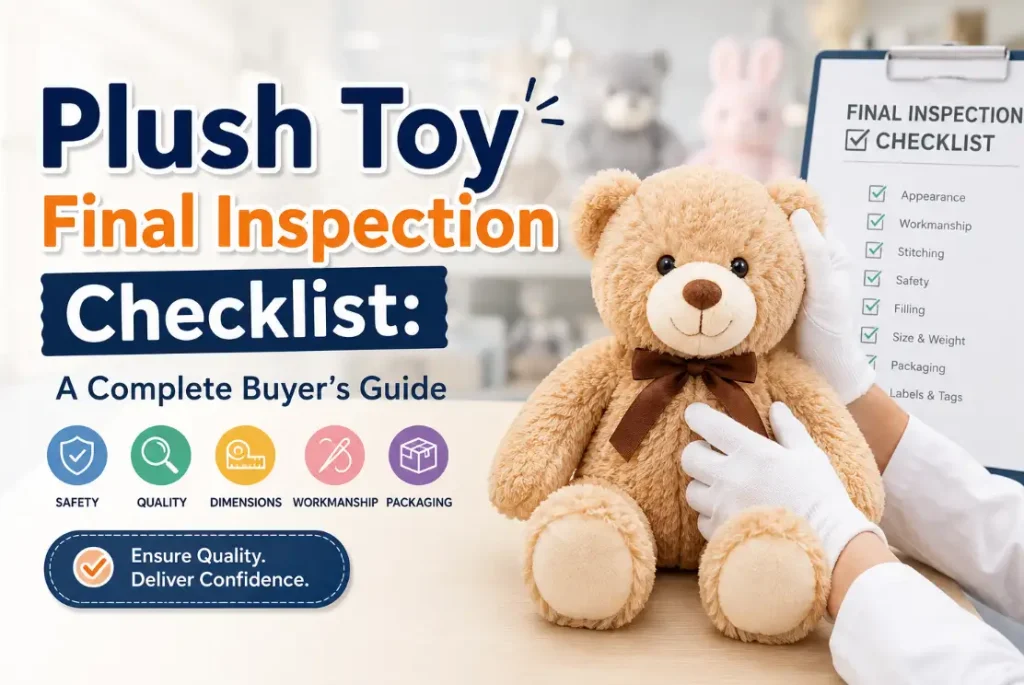
This guide covers what should happen before an inspector ever picks up a sample, the safety checks that form the non-negotiable core of any plush toy inspection, the construction and stitching checks that determine whether a toy survives normal use, the fabric and cosmetic checks that determine whether a toy matches what was approved, the packaging and labeling checks required before goods can legally ship, how AQL sampling determines whether a batch passes or fails, and what should happen when defects are actually found.
What Documentation and Pre-Inspection Preparation Should Happen Before Final Inspection?
Proper pre-inspection preparation requires the approved sample, the signed technical specification, the purchase order quantity breakdown, and any prior test reports to be available and cross-referenced before a single unit is pulled from the finished goods for sampling — because an inspection conducted without these reference points can only evaluate whether the batch is internally consistent, not whether it actually matches what the buyer approved and ordered.
The approved sample — sometimes called the golden sample or the pre-production sample — is the single most important reference document in the entire inspection process, because it is the physical, tangible standard against which color, fabric hand-feel, stuffing firmness, and overall proportion are judged. A final inspection conducted without the approved sample physically present, relying instead on photos or a written description, introduces a level of subjectivity into color and texture judgment that a side-by-side physical comparison eliminates almost entirely.
Why the Purchase Order Quantity Breakdown Matters More Than Buyers Often Assume
Final inspection is not only about defect rates — it is also about confirming that the finished goods quantity, size breakdown, and color or style assortment actually match what was ordered. A batch that passes every quality and safety check but ships with the wrong ratio of sizes or colors relative to the purchase order creates a fulfillment problem that is just as costly as a quality defect, and one that a checklist focused purely on physical defects will not catch unless quantity and assortment verification is built into the inspection scope from the start.
Pre-Inspection Reference Documents and What Each One Verifies
| Document | What It Verifies | Risk If Missing |
|---|---|---|
| Approved (golden) sample | Color, fabric feel, proportion, stuffing firmness | Subjective color/texture judgment, inconsistent standards |
| Signed technical specification | Dimensions, materials, construction details, tolerances | No objective standard for dimensional or material checks |
| Purchase order quantity breakdown | Total quantity, size ratio, color/style assortment | Fulfillment mismatch despite passing quality inspection |
| Prior lab test reports | Confirms safety testing already completed on this specification | Uncertainty over which safety tests are still outstanding |
| Packaging and labeling artwork | Barcode accuracy, required warnings, market-specific labeling | Compliance failure at destination customs or retail |
Tip: Request that the approved golden sample be shipped to the inspection location — not just described in an email or shown in a photo — for any order where color accuracy or fabric hand-feel is a meaningful part of the specification. Photos consistently fail to capture subtle color shifts and fabric texture differences that are immediately obvious in a side-by-side physical comparison.
What Safety Checks Must Be Included in a Plush Toy Final Inspection?
Safety checks form the non-negotiable core of any plush toy final inspection and typically include a mechanical pull test on all attachments, a small parts and choking hazard assessment, needle and sharp point detection, flammability testing, and chemical compliance verification — because unlike a cosmetic defect, a safety failure in a plush toy is not a quality issue that can be resolved through a price adjustment or a partial rework; it is a hazard that can cause real physical harm to the child using the product.
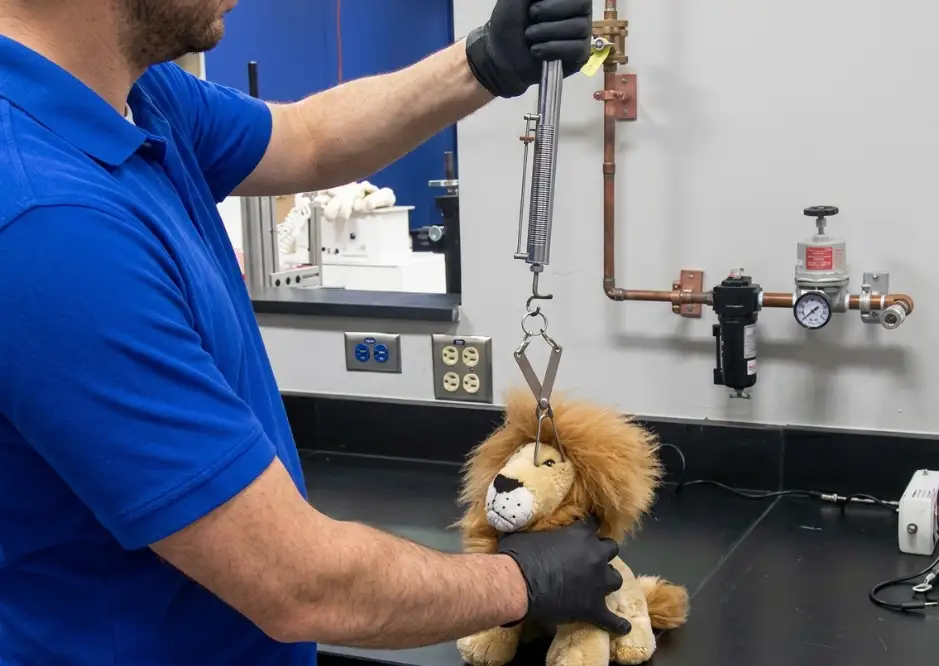
The mechanical pull test, sometimes called a tension test, applies a specified force to any component that could detach — eyes, noses, bows, embroidered patches with hard backing, safety joints — for a defined duration, to confirm the attachment can withstand the stress a child might realistically apply during normal or foreseeable rough play. This test is one of the most frequently cited failure points in plush toy safety recalls, precisely because a component that looks securely attached during casual handling can still fail under the sustained pulling force a toddler is capable of applying.
Needle Detection and Metal Contamination Screening
Needle detection screening, performed with a metal detector calibrated to a sensitivity appropriate for the toy’s size and fill material, checks for broken sewing needle fragments that can become embedded in stuffing during production and pose a serious internal injury risk if undetected. Because a broken needle fragment is small, non-visible once inside a filled toy, and statistically rare on any single unit, needle detection screening is one of the few checks in a plush toy inspection where testing every single unit in the batch — rather than a statistical sample — is standard practice rather than optional rigor.
Flammability and Chemical Compliance Testing
Flammability testing evaluates how quickly the fabric surface burns when exposed to a small flame under controlled conditions, with most major markets setting a maximum burn rate threshold that plush toy fabrics must not exceed. Chemical compliance testing screens for restricted substances — heavy metals in dyes and paints, phthalates in any plastic components, formaldehyde in certain fabric treatments — against the specific regulatory thresholds of the destination market, since these thresholds vary meaningfully between regions and a product compliant for one market is not automatically compliant for another.
Core Safety Tests Included in Plush Toy Final Inspection
| Test | What It Screens For | Typical Sampling Approach |
|---|---|---|
| Mechanical pull/tension test | Attachment security of eyes, noses, bows, joints | Statistical sample per AQL sampling plan |
| Needle detection | Broken needle fragments embedded in stuffing | 100% of units, using a calibrated metal detector |
| Small parts / choking hazard | Detachable components below the small parts size threshold | Statistical sample combined with construction review |
| Flammability test | Fabric surface burn rate under flame exposure | Lab test on sample units, per market-specific standard |
| Chemical compliance (heavy metals, phthalates, formaldehyde) | Restricted substance levels in dyes, plastics, and fabric treatments | Lab test on sample units, per destination market regulation |
Tip: Confirm which specific regulatory standard (and which market) the pull test, flammability test, and chemical compliance thresholds are being measured against — a plush toy that passes testing against one market’s toy safety standard is not automatically compliant with a different market’s requirements, even when the test names sound similar.
What Physical and Construction Quality Checks Are Part of Final Inspection?
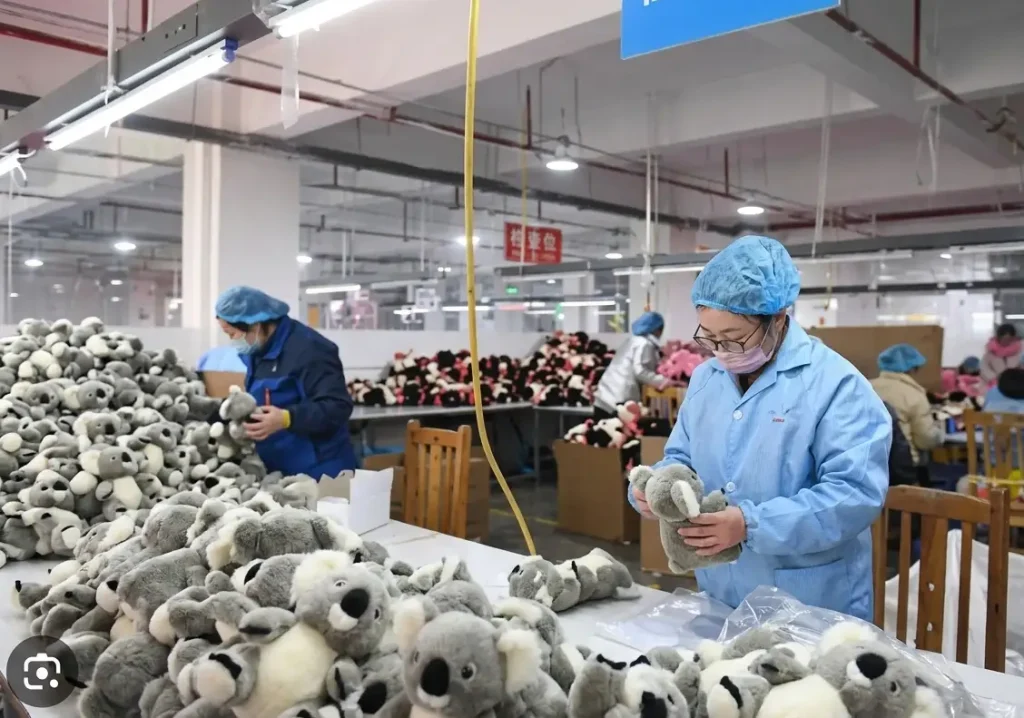
Physical and construction quality checks evaluate stitching integrity, seam strength, stuffing distribution and firmness, joint movement where applicable, and overall structural soundness — the set of characteristics that determine whether a plush toy holds together and feels right through normal handling, washing, and years of a child’s use, independent of whether it passes the specific safety tests already discussed.
Stitching inspection looks at stitch density (stitches per inch), consistency of tension, and whether seams are double-stitched or reinforced at high-stress points such as limb joints and neck seams, since these are the locations most likely to experience repeated stress during play and the locations where a stitching shortcut is most likely to eventually fail. Stuffing inspection checks for even distribution — no lumps, no thin spots, no shifted fill — and appropriate firmness for the specific product, since both underfilling and overfilling create a tactile quality that differs noticeably from the approved sample even when every safety test passes cleanly.
Why High-Stress Seam Locations Deserve Disproportionate Inspection Attention
Not all seams on a plush toy carry equal risk. A seam along a flat back panel experiences comparatively little stress during normal handling, while a seam at a limb joint, a neck attachment point, or anywhere a child is likely to grab and pull experiences repeated, concentrated stress over the product’s service life. An inspection process that applies uniform scrutiny across every seam, without weighting attention toward these higher-stress locations, risks passing units where the low-stress seams look fine but the high-stress seams — the ones actually likely to fail in the field — received the same cursory glance as everything else.
Construction Quality Checkpoints and What Failure Typically Indicates
| Checkpoint | What Is Evaluated | Common Root Cause of Failure |
|---|---|---|
| Stitch density and tension | Stitches per inch, consistent tension, no skipped stitches | Worn sewing equipment, inconsistent operator technique |
| Seam reinforcement at joints | Double-stitching or reinforcement at high-stress seams | Construction shortcut not matching the approved specification |
| Stuffing distribution | Even fill, no lumps, no thin spots, correct firmness | Inconsistent filling process, insufficient fill weight per unit |
| Joint movement (if applicable) | Smooth articulation without excessive looseness or stiffness | Incorrect joint hardware tension during assembly |
| Overall shape and proportion | Match to the approved sample silhouette and proportions | Pattern drift, inconsistent stuffing, fabric stretch variance |
Tip: When training or briefing an inspector, explicitly flag the highest-stress seam locations on the specific product being inspected — limb joints, neck seams, any attachment point a child is likely to grab — rather than relying on a generic “check all seams” instruction. Targeted attention on the seams most likely to fail catches more real defects than uniform, generic scrutiny spread evenly across low-risk and high-risk seams alike.
How Do You Inspect Fabric, Color, and Cosmetic Quality?
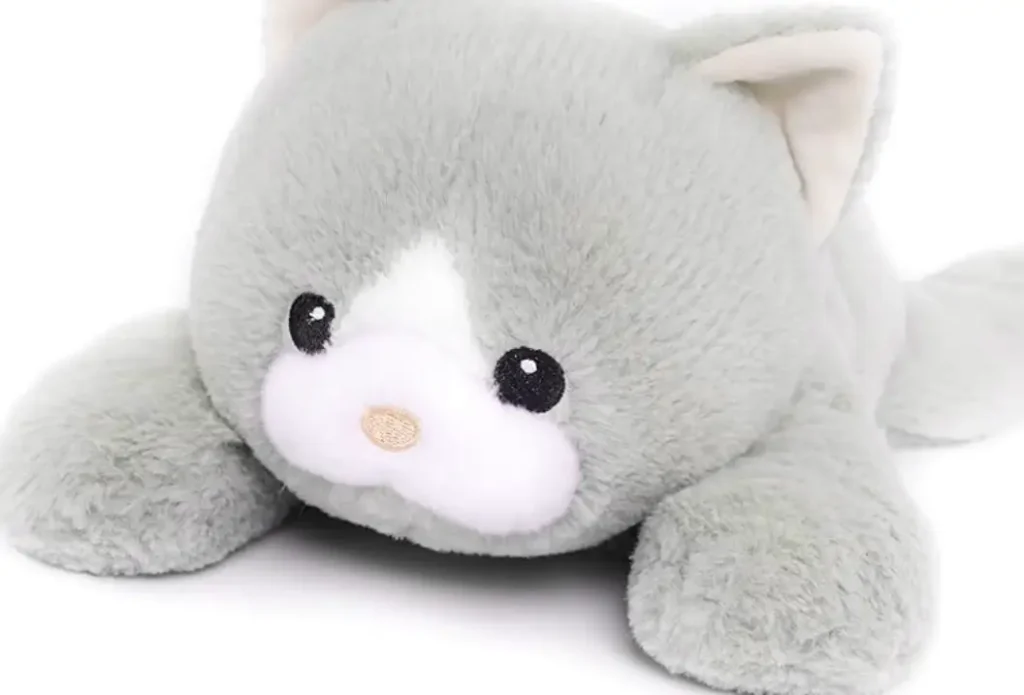
Fabric, color, and cosmetic quality inspection compares the finished units against the approved golden sample under standardized lighting for color accuracy, checks fabric weight (GSM) and hand-feel against specification, and evaluates print, embroidery, and fur-direction consistency across the batch — because a plush toy’s commercial value is inseparable from how closely it matches the specific look and feel that was approved during development, independent of whether it is structurally sound or safety-compliant.
Color evaluation should be conducted under consistent, standardized lighting — ideally a color-matching light booth, or at minimum consistent daylight-equivalent lighting rather than incandescent or fluorescent shop lighting that can shift perceived color noticeably. Comparing units to the approved sample under inconsistent lighting conditions is one of the most common sources of disputed color inspection results, since a genuine color shift and a lighting-induced perception difference can look identical to an inspector working under poor or inconsistent lighting.
Why Fabric Weight (GSM) Consistency Is a Cosmetic and a Cost Issue Simultaneously
Fabric weight, measured in grams per square meter (GSM), affects both the tactile quality of a plush toy’s surface and its raw material cost, which creates a structural incentive for a supplier under margin pressure to quietly substitute a lower-GSM fabric that looks similar in a quick visual check but feels noticeably thinner and less substantial in hand. Checking fabric weight against the approved specification — using a simple GSM sample cutter and scale, or comparing hand-feel directly against a retained fabric swatch from the approved sample — is a straightforward verification step that catches this specific substitution risk before it reaches the inspection table as a subjective “it feels a bit different” impression that is easy to dismiss without objective backup.
Print, Embroidery, and Fur Direction Alignment
Printed or embroidered details — facial features, brand marks, decorative patterns — need to be checked for placement accuracy, alignment symmetry, and color fidelity against the approved sample, since even a well-executed print or embroidery process can drift in registration over a long production run if tooling is not periodically re-checked. Fur direction and pile consistency matter specifically for plush toys with directional fabric nap, where fabric panels cut and sewn with inconsistent nap direction create a visibly patchy, uneven surface appearance that is immediately noticeable even to a buyer without any technical fabric background.
Fabric and Cosmetic Inspection Checkpoints
| Checkpoint | What Is Evaluated | Common Failure Mode |
|---|---|---|
| Color accuracy | Match to the approved sample under standardized lighting | Dye lot variation, inconsistent lighting during inspection |
| Fabric weight (GSM) | Match to specified fabric weight and hand-feel | Lower-GSM fabric substitution under cost pressure |
| Print/embroidery placement | Registration accuracy, symmetry, color fidelity | Tooling drift over a long production run |
| Fur/pile direction consistency | Uniform nap direction across fabric panels | Inconsistent panel cutting orientation during production |
| Overall surface finish | No visible stains, snags, shedding, or matting | Handling damage, inadequate quality control during assembly |
What Packaging and Labeling Checks Are Required Before Shipment?
Packaging and labeling checks confirm that barcodes scan correctly and match the intended product, that all legally required warnings and age-grading labels are present and accurate for the destination market, that poly bags meet suffocation-hazard safety requirements, and that carton packing configuration matches the shipping specification — a set of checks that are easy to treat as secondary to product quality but that can independently block a shipment at customs or trigger a retailer compliance rejection even when the toy itself is flawless.
Barcode verification should include an actual scan test, not just a visual check that a barcode is printed, since a barcode that looks correct visually can still fail to scan due to printing resolution issues, incorrect encoding, or a mismatch between the printed barcode and the product’s actual SKU in the buyer’s system. Warning label and age-grading verification need to be checked against the specific destination market’s requirements, since choking hazard warnings, age-appropriateness labeling, and required regulatory markings vary meaningfully between regions, and a label set correct for one market is not automatically correct for another.
Why Poly Bag Safety Requirements Are Frequently Overlooked
Poly bags used in individual product packaging or as an inner protective layer are subject to suffocation-hazard safety requirements in many markets, typically requiring either ventilation holes of a minimum size and spacing or a minimum material thickness that reduces the risk of the bag sealing against a child’s face. This requirement is frequently overlooked during packaging design because it applies to the packaging rather than the toy itself, but a compliance failure here creates exactly the same kind of regulatory and safety exposure as a defect in the product.
Packaging and Labeling Verification Checklist
| Checkpoint | What Is Verified | Risk If Skipped |
|---|---|---|
| Barcode scan test | Barcode scans correctly and matches the intended SKU | Retailer receiving rejection, inventory system mismatch |
| Warning and age-grading labels | Correct, market-specific required warnings are present | Customs hold, regulatory non-compliance |
| Poly bag suffocation safety | Ventilation holes or minimum thickness per market requirement | Safety hazard, regulatory non-compliance |
| Carton packing configuration | Units per carton, carton marking, and shipping specification match | Logistics and fulfillment errors at the destination |
| Country-of-origin and compliance marking | Required country-of-origin and safety certification marks are present | Customs delay or rejection at the destination port |
How Is AQL Sampling Applied During Plush Toy Final Inspection?
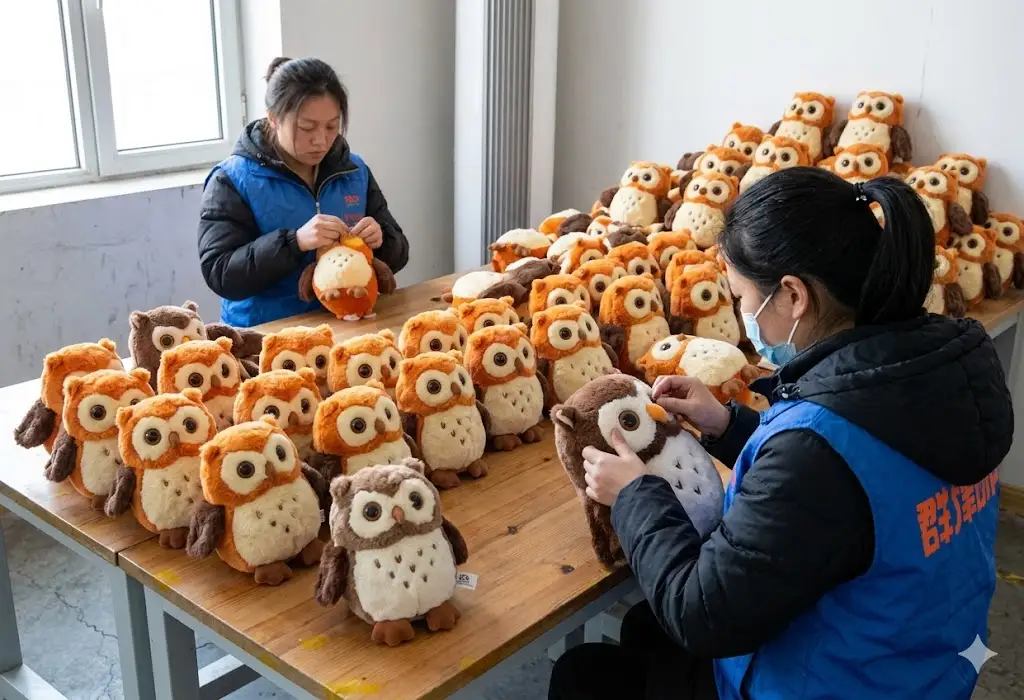
AQL (Acceptable Quality Limit) sampling is applied during plush toy final inspection by selecting a statistically determined sample size from the total batch quantity, based on standardized sampling tables, and evaluating that sample against separately defined limits for critical, major, and minor defects — allowing a full production batch to be evaluated for quality without requiring 100% inspection of every unit, while still providing a statistically meaningful basis for accepting or rejecting the batch.
Critical defects — those that pose an immediate safety hazard, such as a sharp point, a detachable small part below the choking hazard threshold, or a failed pull test — typically have an acceptance number of zero, meaning even a single critical defect found in the sample is grounds for batch rejection regardless of how small the sample size is relative to the total batch. Major defects, such as a significant color mismatch or an incorrectly attached component that has not yet failed a pull test, are allowed a small number of occurrences within the sample before the batch is rejected. Minor defects, such as a slightly uneven stitch or a small cosmetic imperfection unlikely to affect function or safety, are allowed a somewhat larger number of occurrences.
Typical AQL Defect Classification and Acceptance Approach
| Defect Classification | Definition | Typical Acceptance Number |
|---|---|---|
| Critical | Poses an immediate safety hazard to the end user | Zero — any occurrence typically rejects the batch |
| Major | Significantly affects usability, function, or marketability | Small fixed number, per selected AQL level (commonly 2.5) |
| Minor | Cosmetic or minor imperfection unlikely to affect function | Larger fixed number, per selected AQL level (commonly 4.0) |
Why the Chosen AQL Level Should Match the Product’s Risk Profile
Buyers sometimes default to a single AQL level across every product category without considering that a plush toy intended for infants carries a meaningfully different risk profile than a decorative plush item intended for older children or adult collectors, and the AQL level selected for sampling should reflect that difference. A tighter AQL level for major and minor defects — accepting fewer defects within the sample before rejecting the batch — is generally appropriate for products with higher safety sensitivity or brand visibility, even though it increases the statistical rejection risk for the same underlying batch defect rate.
What Happens When Defects Are Found During Final Inspection?
When defects are found during final inspection, the response depends on defect classification and rate: any critical defect typically halts the shipment and requires 100% re-inspection or sorting of the affected batch before any units can be released, while major or minor defect rates below the AQL acceptance threshold are generally logged and monitored without blocking shipment, and rates exceeding the threshold require either a full re-inspection after rework or a renegotiation of the batch’s disposition with the buyer.
A well-run final inspection does not stop at pass/fail — it documents defect patterns with enough specificity that a supplier can address the actual root cause rather than simply reworking the specific units that were sampled and flagged. A defect logged only as “stitching issue” provides far less corrective value than one logged as “inconsistent stitch tension at neck seam, observed on units from a specific production line or shift,” because the second version points directly toward where a process correction should be targeted.
Tip: Request that inspection reports document defect location and suspected cause in addition to defect count and classification. A report that simply states how many defects were found provides far less value for preventing recurrence than one that identifies where on the product and where in the production process the defects are concentrated.
How Do You Build a Reliable Final Inspection Report?
A reliable final inspection report combines objective sampling data — sample size, defect counts by classification, AQL result — with photographic evidence of any defects found, a record of which specific tests were performed and their results, and a clear overall pass/fail determination stated against the specific AQL level and sampling standard that was applied, rather than a vague general quality impression without supporting data.
Photographic documentation is particularly valuable because it allows a buyer who was not physically present for the inspection to independently assess whether a flagged defect is actually significant enough to warrant the classification it was given, rather than relying entirely on the inspector’s written description and judgment. For any inspection conducted by a third party or by inspection personnel not directly employed by the buyer, having photographic evidence attached to every logged defect is one of the simplest ways to build confidence that the report reflects what was actually observed rather than a generic template filled in with minimal real inspection effort behind it.
The most useful inspection reports also retain a consistent format across production runs and suppliers, which allows a buyer to track defect trends over time — whether a specific defect type recurs across multiple shipments, whether overall defect rates are improving or worsening, and whether a particular supplier consistently performs better or worse against the same checklist than an alternative. This trend visibility is difficult to build if each inspection report uses a different format, a different level of detail, or different terminology for describing the same underlying defect types.
Tip: Standardize the inspection report format and defect terminology across all suppliers and production runs, even when using different inspection personnel or third-party inspection services. Consistent reporting format is what makes long-term defect trend analysis possible; without it, every inspection report becomes an isolated data point rather than part of a comparable historical record.

Frequently Asked Questions
What is the difference between a critical, major, and minor defect in plush toy inspection?
A critical defect poses an immediate safety hazard to the end user — a sharp point, a detachable small part, a failed pull test — and typically results in automatic batch rejection even if only one unit in the sample shows the defect. A major defect significantly affects the product’s usability, function, or marketability, such as a substantial color mismatch or a component that is loose but has not yet failed testing, and is allowed a small number of occurrences within the sample before the batch is rejected. A minor defect is a cosmetic or small imperfection unlikely to affect function or safety, such as a slightly uneven stitch, and is allowed a somewhat larger number of occurrences before rejection. The specific acceptance numbers for major and minor defects depend on the AQL level chosen and the sample size drawn from the batch.
Does passing needle detection mean a plush toy is completely free of metal contamination risk?
Needle detection screening significantly reduces but does not completely eliminate metal contamination risk, since detector sensitivity has practical limits related to fragment size, orientation, and the density of the surrounding stuffing material, and a detector calibrated too sensitively for the product may produce excessive false positives that slow production without improving actual detection reliability. Regular calibration checks using reference test pieces of known size are standard practice to confirm the detector is actually performing at its rated sensitivity throughout a production run, rather than assuming a detector that passed calibration once at the start of the day remains accurate for the entire shift.
Why might two different plush toy batches from the same specification show different inspection results?
Different inspection results between batches of the same specification can result from raw material lot variation (a different dye lot affecting color, a different fabric roll affecting GSM or hand-feel), production line or shift differences in operator technique and equipment condition, or seasonal humidity and temperature variation affecting fabric behavior and adhesive performance during assembly. This is precisely why final inspection is conducted on every batch rather than relied upon only for the first production run — a specification approved once does not guarantee identical results indefinitely without ongoing verification.
Should final inspection be conducted at the factory or after goods arrive at the destination market?
Final inspection is generally most effective when conducted at the factory before shipment, because defects caught at this stage can still be corrected, reworked, or the batch can be rejected before shipping costs, customs duties, and transit time have already been incurred. Inspection after goods arrive at the destination market still has value as a final verification step, but by that point the options for addressing a significant defect are far more limited and expensive — return shipping, destruction, or accepting a discounted, defective batch — compared to catching the same issue at the factory before goods ever leave.
How is fabric weight (GSM) actually measured during a plush toy inspection?
Fabric weight is typically measured by cutting a fabric sample of a known, standardized area — often using a circular GSM sample cutter — weighing it on a precision scale, and calculating the weight per square meter from that measurement, which allows a direct, objective comparison against the specified GSM value on the technical specification. This measurement is more reliable than hand-feel comparison alone, since hand-feel judgment can vary between inspectors and can be influenced by fabric finishing treatments that affect texture without necessarily changing the underlying fabric weight.
What sample size is typically drawn for final inspection on a large plush toy production batch?
Sample size for final inspection is determined by standardized AQL sampling tables based on the total batch quantity, with larger batches requiring proportionally larger samples but at a diminishing rate relative to batch size — meaning the sample size for a batch of 10,000 units is not ten times larger than the sample size for a batch of 1,000 units. The exact sample size depends on which sampling table and inspection level is selected (general inspection levels I, II, or III being most common), with Level II representing the standard, most commonly used sampling rigor for routine production inspection unless a specific reason calls for a tighter or looser sampling approach.