Skip to content
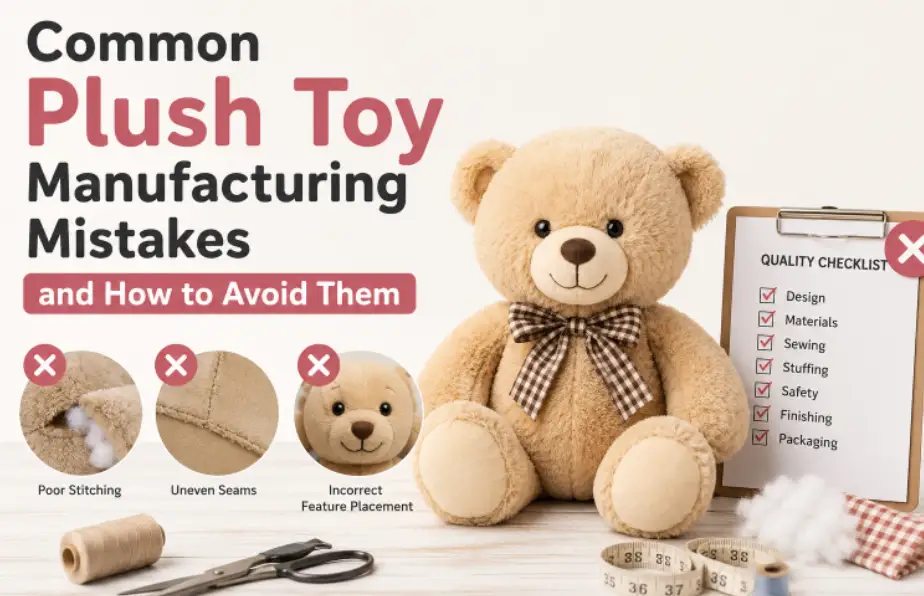
Common Plush Toy Manufacturing Mistakes and How to Avoid Them is a practical guide to improving product quality, reducing production defects, and ensuring a smoother, more efficient manufacturing process from design to final assembly.
Most plush toy production problems are not random. They trace back to specific, repeatable mistakes made at predictable stages of the sourcing and manufacturing process — material selection, design development, supplier evaluation, compliance planning, quality control, and logistics. This guide walks through the mistakes that recur most often and the specific practices that prevent them.
Every plush toy brand that has sourced products more than once has a story about something that went wrong — a shipment held at customs over a missing test report, a batch with inconsistent stuffing density, a character whose face looked subtly different from the approved sample, an invoice with charges that were never mentioned in the original quote. These stories tend to be told as bad luck. They are almost never bad luck. They are the predictable result of a specific mistake made earlier in the process, often weeks or months before the problem became visible.
Understanding plush toy manufacturing as a sequence of decision points — material selection, design development, supplier evaluation, pre-production planning, in-process quality management, compliance verification, and logistics execution — makes it possible to see exactly where the most common and most costly mistakes originate. Each mistake in this guide is tied to the specific stage where it occurs and the specific practice that prevents it, because prevention is only actionable when it is attached to a specific point in the process rather than treated as a general aspiration.
This guide is organized around the categories of mistakes that account for the overwhelming majority of plush toy sourcing problems: material selection mistakes, design and development mistakes, supplier evaluation mistakes, compliance and safety mistakes, production and quality control mistakes, and logistics and shipping mistakes. Within each category, the goal is not simply to list what goes wrong but to explain why it goes wrong and what a buyer or factory should do differently.
It is worth noting at the outset that these mistake categories rarely occur in isolation. A supplier selected primarily on unit price is statistically more likely to also cut corners on material certification, skip counter sample verification, and run a thinner quality control system — because the same cost pressure that produces an aggressively low quote tends to produce shortcuts across multiple stages of the process simultaneously. Recognizing this clustering effect is useful because it means that fixing the earliest mistake in the chain — usually supplier selection — often prevents several of the mistakes further down the process from occurring at all.
Why Do the Same Plush Toy Manufacturing Mistakes Keep Repeating Across the Industry?
The same plush toy manufacturing mistakes repeat across the industry because they are structurally easy to make, and their consequences are often delayed. A buyer who skips a material compliance check does not see the consequence immediately — production proceeds normally, samples look fine, and the problem only surfaces weeks later when a compliance test fails, or a customer reports an issue. This delay between the mistake and its consequence is what allows the same mistakes to recur across different buyers, different factories, and different product lines, even though each mistake is, in principle, easy to avoid once its pattern is understood.
Mistakes in plush toy manufacturing cluster around a small number of root causes: skipping a verification step to save time or cost, assuming a supplier or process detail without confirming it directly, treating cost as the only meaningful comparison factor, and failing to document standards clearly enough for them to be enforced. Almost every specific mistake discussed in this guide is a variation on one of these four root causes, applied to a different stage of the manufacturing process.
A useful way to think about these root causes is that each one removes a specific piece of information that would otherwise have prevented the mistake. Skipping verification removes the information needed to confirm a standard was actually met. Unconfirmed assumptions substitute a guess for a fact. Cost-only comparison discards every piece of information except price. And undocumented standards remove the shared reference point that both buyer and supplier would need to agree on whether something is acceptable. Framed this way, mistake prevention is fundamentally an information problem — and every prevention practice described later in this guide works by restoring the specific piece of information that a common mistake removes.
Cost of Common Manufacturing Mistakes by Discovery Stage
| Discovery Stage | Typical Mistake Categories Found Here | Relative Cost to Fix | Typical Delay Introduced |
|---|---|---|---|
| Quote comparison | Missing specifications, unclear assumptions | Very Low | None to 2 days |
| Material approval | Uncertified fabric, wrong filling grade | Low | 3–7 days |
| Sample review | Design or construction mismatch | Low–Medium | 1–2 weeks |
| Mid-production (IPQC) | Stuffing drift, embroidery position drift | Medium | 1–3 days |
| Final inspection | Batch-wide defects, compliance gaps | High | 1–3 weeks |
| After delivery | Customer complaints, compliance failures, recalls | Very High | Weeks to months |
This pattern — the same category of mistake becoming dramatically more expensive the later it is discovered — is the single most important idea in this guide. Every mistake discussed below is, at its root, a decision that was either made too late or verified too loosely at a stage when correction would have been inexpensive.
Tip: Build a simple pre-production checklist that lists every decision point where a mistake is common — material approval, counter sample sign-off, compliance documentation, first-off inspection — and require a written confirmation at each point before moving forward. Most costly mistakes happen not because no one knew the standard, but because no one formally confirmed it was met before production advanced to the next stage.
What Are the Most Common Material Selection Mistakes in Plush Toy Manufacturing?
Material selection mistakes are the single largest source of downstream plush toy production problems because materials determine 40 to 60 percent of total product cost and virtually all of a product’s feel, appearance, durability, and compliance status. A mistake made in material selection cannot be fully corrected by good production practices later — a factory can sew a poorly specified fabric with excellent technique and still produce a product that feels wrong, fades quickly, or fails a compliance test.
The most common material selection mistakes are choosing fabric or filling based on a swatch or photo without a physical sample review, assuming a lower-cost material alternative is equivalent to the specified one without verifying its compliance and performance characteristics, failing to confirm the compliance certification status of every material component, and not accounting for how a material will perform after the specific finishing processes — dyeing, washing, printing — the design requires.

These mistakes are especially easy to make because material differences are often invisible at the point of decision. A slightly lower-grade fabric and a fully compliant, higher-grade fabric can look nearly identical in a small swatch sample under casual lighting, and a filling substitution frequently produces a product that still passes a basic visual check even though its density, loft recovery, or chemical composition differs meaningfully from the specification. The mistake is rarely a deliberate compromise on the buyer’s part — it is more often the result of not asking the specific question that would have revealed the difference before it became embedded in a full production run.
Common Material Selection Mistakes and Their Consequences
| Mistake | Why It Happens | Typical Consequence |
|---|---|---|
| Approving fabric from a photo instead of a physical swatch | Time pressure, remote sourcing | Color, texture, or pile height mismatch discovered too late |
| Substituting a filling grade without disclosure | Cost-cutting by the supplier, unclear specification | Shape retention issues, compliance risk |
| Skipping compliance certification verification | Assuming “standard” materials are automatically compliant | Failed lab testing, blocked shipment |
| Ignoring batch-to-batch material variation on reorders | Treating reorders as identical to the first order | Visible inconsistency across production lots |
| Not testing how fabric performs after dyeing or washing | Approving raw material without process simulation | Color bleeding, shrinkage, or texture change after finishing |
Why Photo-Based Fabric Approval Fails
Fabric color, pile height, and texture cannot be reliably judged from a photograph because camera color rendering, screen calibration, and lighting conditions all distort the visual information a photo conveys. A buyer who approves a fabric selection from a supplier’s photo — rather than requesting a physical swatch reviewed under standard D65 lighting — is making a material decision based on information that is known to be unreliable for exactly the attributes that matter most for a plush toy’s finished appearance.
The correction is straightforward but frequently skipped under time pressure: request a physical swatch card for every fabric under consideration, compare it under consistent lighting, and retain the approved physical swatch as the reference standard against which incoming production material will later be checked.
The Hidden Cost of Undisclosed Filling Substitution
PP cotton filling varies significantly in density, loft recovery, and cleanliness between grades, and a supplier under cost pressure may substitute a lower-grade filling without explicitly flagging the change — particularly on reorders, where the assumption that “nothing changed” is common on both sides. The consequence is a product that feels different from the approved sample, loses shape faster, or, in more serious cases, fails a compliance test for contamination or chemical content.
Specifying filling grade explicitly in the product specification document and requesting a filling density test report with every production batch rather than only the first order closes this gap.
Not Testing Materials Through the Finishing Process
A fabric that looks and feels correct in its raw, undyed state can behave very differently after it goes through the dyeing, washing, or printing processes a specific design requires — shrinking unexpectedly, bleeding color onto adjacent panels, or losing the soft hand-feel that made it an attractive choice in the first place. Buyers who approve a raw material sample without requesting a sample that has gone through the full finishing process, the production run will use are approving a material that may not represent what actually ships.
The corrective practice is to request finishing-process samples specifically — a dip-dyed or washed swatch, not just the raw fabric — whenever the design calls for a finishing step beyond basic cutting and sewing. This is a small additional request at the sampling stage that prevents a much larger and more visible problem from surfacing in a completed production batch.
What Design and Development Mistakes Cause Costly Rework Later?
Design and development mistakes are dangerous specifically because they are invisible until they are expensive — a pattern grading error, an unclear tech pack measurement, or a skipped counter sample review does not stop production from proceeding, but it produces a finished batch that does not match what the buyer actually wanted. Because these mistakes are baked into the production setup itself, they replicate identically across every unit produced until someone catches them.
The most common design and development mistakes are moving to bulk production without a formal counter sample approval, providing incomplete or ambiguous measurement tolerances in the tech pack, underestimating the number of sample revision rounds a complex design will require, and failing to specify construction details — seam type, panel order, stuffing sequence — that affect how faithfully the finished product matches the original concept.

Design and Development Mistakes and Their Root Causes
| Mistake | Root Cause | Downstream Impact |
|---|---|---|
| Skipping the counter sample review | Time pressure, assuming bulk material matches the sample | Bulk batch color or density deviates from the approved sample |
| Incomplete tech pack tolerances | Assuming standard tolerances apply without stating them | Dimensional disputes and inconsistent QC pass/fail decisions |
| Underestimating the revision rounds needed | Optimistic timeline planning | Launch delays and rushed final approval |
| Vague construction instructions | Relying on verbal or informal communication | Operator interpretation errors, inconsistent output |
| No embroidery coordinate reference | Approving position visually rather than with measurements | Facial feature drift across the production run |
Why the Counter Sample Cannot Be Skipped
The counter sample is the specific checkpoint that verifies bulk production materials, patterns, and processes reproduce the approved development sample before full production volume is committed. Skipping it under schedule pressure is one of the most consequential mistakes in the entire manufacturing process, because it removes the only verification step positioned to catch the specific defects that only appear when bulk materials are used — dye lot color shifts, machine-stuffed density differences from hand-stuffed samples, and embroidery position changes between sampling and production equipment.
A counter sample review typically adds three to five days to a production schedule. The cost of skipping it, when a mismatch is discovered in final inspection or after delivery, is measured in full batch rework or rejection — a cost multiple of the days saved by skipping the step.
What a Complete Tech Pack Actually Requires
A tech pack that lists only overall dimensions and a reference photo leaves too much room for interpretation on a product as construction-dependent as a plush toy. A complete tech pack specifies panel-by-panel measurements with numeric tolerances, seam allowance, and stitch type for each construction element, stuffing density target by body section for characters with varying firmness across different parts, embroidery or print position defined by coordinates relative to a fixed reference point, and accessory placement and attachment method for every safety-relevant component such as eyes, noses, and joints.
Buyers frequently underestimate how much of this detail is necessary because a simpler product category — a printed T-shirt, for example — can be fully specified with far less construction detail. Plush toys are three-dimensional, hand-assembled products with many interacting components, and the level of specification detail needs to reflect that complexity rather than the specification habits carried over from simpler product categories.
Tip: Write measurement tolerances into the tech pack as explicit numbers — for example, “height: 30cm ± 1cm” — rather than relying on the phrase “as per sample.” Vague tolerance language is one of the most common sources of quality disputes, because it gives the factory and the buyer no shared, measurable standard to resolve a disagreement.
What Sourcing and Supplier Selection Mistakes Do Buyers Make?
Supplier selection mistakes occur earlier in the process than any other category discussed in this guide, and they are also the hardest to correct once production has started, because switching suppliers mid-program is expensive and disruptive. A mistake in supplier selection does not just affect a single order — it establishes the baseline quality, communication, and reliability standard for the entire ongoing relationship.
The most common supplier selection mistakes are choosing a supplier based primarily on unit price without evaluating total cost, skipping a factory capability or QC system assessment before placing a first order, failing to verify references with existing clients, and not clarifying MOQ, payment terms, and lead time reliability before comparing quotes on a like-for-like basis.
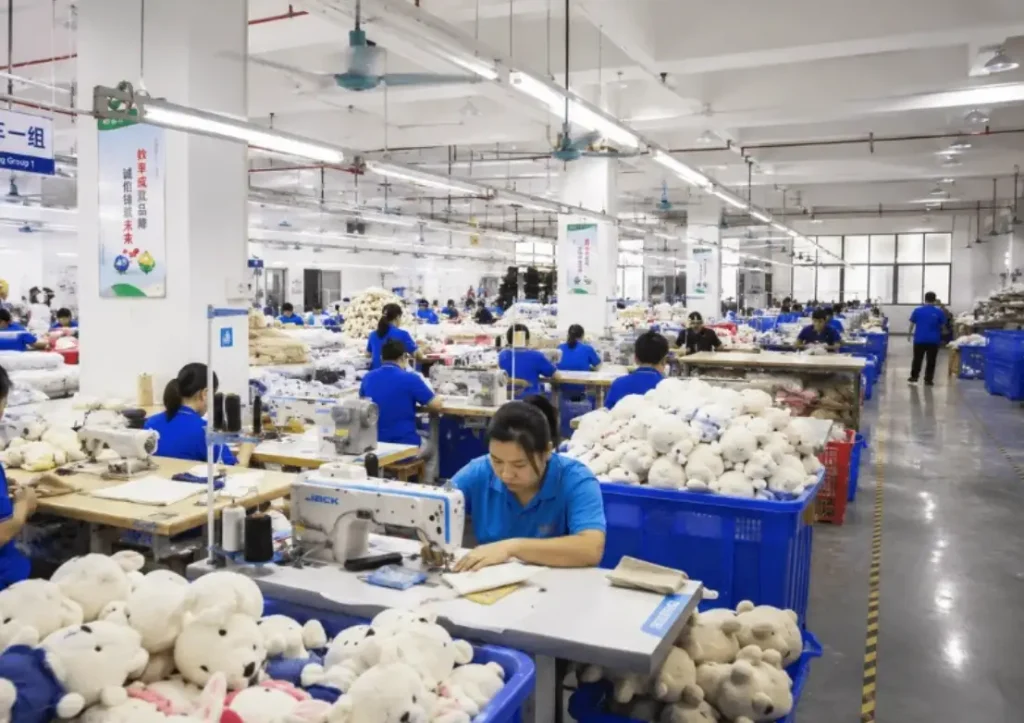
Each of these mistakes shares a common feature: the information needed to avoid them is almost always available on request, but buyers frequently do not ask for it because a quotation and a sales conversation feel like sufficient due diligence. A supplier’s willingness to provide detailed, specific answers to direct questions about QC systems, references, and capacity is itself one of the most informative signals available — because factories with genuinely strong operations are typically comfortable sharing this information, while those with weaker practices tend to respond with vague reassurance instead.
Supplier Selection Mistakes and Warning Signs
| Mistake | Warning Sign to Watch For | Better Practice |
|---|---|---|
| Comparing suppliers on unit price alone | Quotes with no material specification or itemized costs | Build a total cost comparison across development, compliance, and QC |
| Skipping a factory or QC system check | Reluctance to share QC documentation or process details | Request documented IQC, IPQC, and FQC protocols before ordering |
| Not checking references | No verifiable existing clients in a similar product category | Ask for two to three reference contacts and actually call them |
| Overlooking MOQ and payment term mismatches | Vague answers about minimum order or deposit requirements | Get MOQ, tiered pricing, and payment terms in writing before comparing |
| Ignoring current capacity utilization | Universally available timelines regardless of when asked | Ask directly what percentage of capacity is committed for the next 60 days |
The Reference Check Buyers Skip Most Often
Reference checks are one of the highest-value, lowest-cost verification steps available in supplier selection, and they are also one of the most frequently skipped — usually because buyers assume a supplier’s self-reported claims about lead time, defect rate, and communication quality are sufficient. Speaking directly with an existing client and asking specifically about actual delivery timelines, actual defect rates, and how the factory communicated when problems occurred produces information that no quotation or sales conversation reveals.
The specific value of a reference check is that it surfaces the gap between what a factory claims and what it actually delivers — a gap that is consistently more informative than any other single piece of due diligence a buyer can perform before placing a first order.
Why Capacity Utilization Predicts Reliability
A factory’s current capacity utilization is one of the strongest available predictors of whether a quoted lead time will actually be met. Buyers who do not ask about capacity utilization are missing a data point that directly determines whether the factory has the flexibility to absorb normal production variability — material delays, sampling revisions, QC corrections — without missing the committed delivery date.
What Compliance and Safety Mistakes Put Buyers at Risk?
Compliance mistakes carry the highest severity of any mistake category in this guide, because a compliance failure can block a shipment entirely, trigger a recall, or create legal liability — consequences that go beyond the commercial cost of a quality defect. Compliance mistakes are also unusually easy to make because a non-compliant product can look, feel, and function identically to a compliant one; the difference is only detectable through laboratory testing.
The most common compliance and safety mistakes are treating compliance testing as optional or as something to arrange only if a customer specifically requests it, using uncertified materials without verifying documentation, scheduling compliance testing too late in the production timeline to allow for correction if a test fails, and not understanding which specific standards — ASTM F963, EN71, CPSIA, REACH — apply to the buyer’s specific target market.
A related and less obvious compliance mistake is assuming that a product approved for one market is automatically acceptable for another. A plush toy that passes EN71 testing for the European market is not automatically compliant with CPSIA requirements for the United States, because the two standards test different chemical and mechanical parameters using different methodologies and thresholds. Buyers who sell into multiple markets need a testing plan mapped to each specific market’s requirements rather than a single test result applied broadly across all of them.
Compliance Mistakes and What They Expose Buyers To
| Mistake | What It Exposes the Buyer To | Prevention Practice |
|---|---|---|
| Treating testing as optional | Market entry rejection, platform delisting, legal liability | Budget and schedule compliance testing as a standard project cost |
| Using uncertified materials | Chemical non-compliance, failed lab testing | Require valid certification documentation for every material |
| Testing too late in the schedule | No time to correct a failed result before the shipping deadline | Schedule testing immediately after the sample or early bulk production |
| Not identifying applicable standards | Testing against the wrong standard for the target market | Confirm the required standards for each specific country of sale |
| Assuming one test covers all markets | Non-compliance in secondary markets with different requirements | Map required tests to each market where the product will be sold |
The Real Cost of a Failed Compliance Test
When a product fails a required safety test — heavy metal content, phthalate concentration, small parts and pull testing, flammability — the consequences compound quickly: the affected batch cannot ship, the non-compliant material must be identified and replaced, units must be reworked or scrapped, and the corrected product must be retested before it can be released. Depending on order size and the nature of the failure, this sequence typically adds thousands of dollars in direct cost and weeks of schedule delay to a project that had already been budgeted and planned.

This entire cost sequence is avoidable through compliance-first material sourcing — using certified materials from verified sources for every product intended for a regulated market, and scheduling the required tests early enough in the production timeline that a failed result can still be corrected before the shipping deadline.
Tip: Request compliance test reports and material certifications before bulk production begins, not after. A test scheduled on finished goods close to the shipping date leaves no room to correct a failure without missing the delivery window — while the same test run on early bulk output leaves time to identify and fix the root cause.
What Production and Quality Control Mistakes Lead to High Defect Rates?
Production and quality control mistakes are the most operationally visible category in this guide because they occur on the factory floor during the manufacturing process itself and directly determine the defect rate of the finished batch. Unlike material or compliance mistakes, which are largely determined before production starts, production and QC mistakes accumulate continuously throughout the manufacturing run — which means the longer a mistake goes uncorrected, the more units it affects.
The most common production and QC mistakes are relying exclusively on final inspection instead of monitoring quality throughout production, skipping the first-off inspection that catches process setup errors while only a handful of units are affected, allowing inspection intervals that are too long to catch quality drift before it accumulates, and not requiring documented work instructions for operations where technique variation between operators commonly produces defects.
Production and QC Mistakes and Their Effect on Defect Rate
| Mistake | Effect on Defect Rate | Corrective Practice |
|---|---|---|
| Relying only on the final inspection | Defects replicate across the full batch before detection | Implement IQC, IPQC, and FQC as a continuous system |
| Skipping the first-off inspection | Process setup errors affect hundreds or thousands of units | Inspect the first 3–5 completed units against the counter sample |
| Long IPQC intervals | Production drift accumulates undetected | Set shorter intervals for high-precision operations |
| No documented work instructions | Operator-to-operator technique variation | Provide written, technique-specific instructions per operation |
| No third-party verification on first orders | Undetected gap between factory-reported and actual quality | Commission independent pre-shipment inspection |
Why Final-Inspection-Only Quality Control Fails
A quality strategy that relies solely on final inspection allows every upstream mistake — material deviation, pattern error, stuffing drift, embroidery position error — to be produced across the entire batch before any corrective action is possible. By the time final inspection identifies a defect, the cost of the affected production has already been fully incurred, and correcting it means reworking or rejecting units rather than preventing the defect from occurring in the first place.
The correction is to treat final inspection as the last line of defense rather than the primary quality mechanism — supported by incoming material inspection, pre-production checks, and interval-based in-process monitoring that catch problems while only a small number of units are affected.
The Overlooked Role of Documented Work Instructions
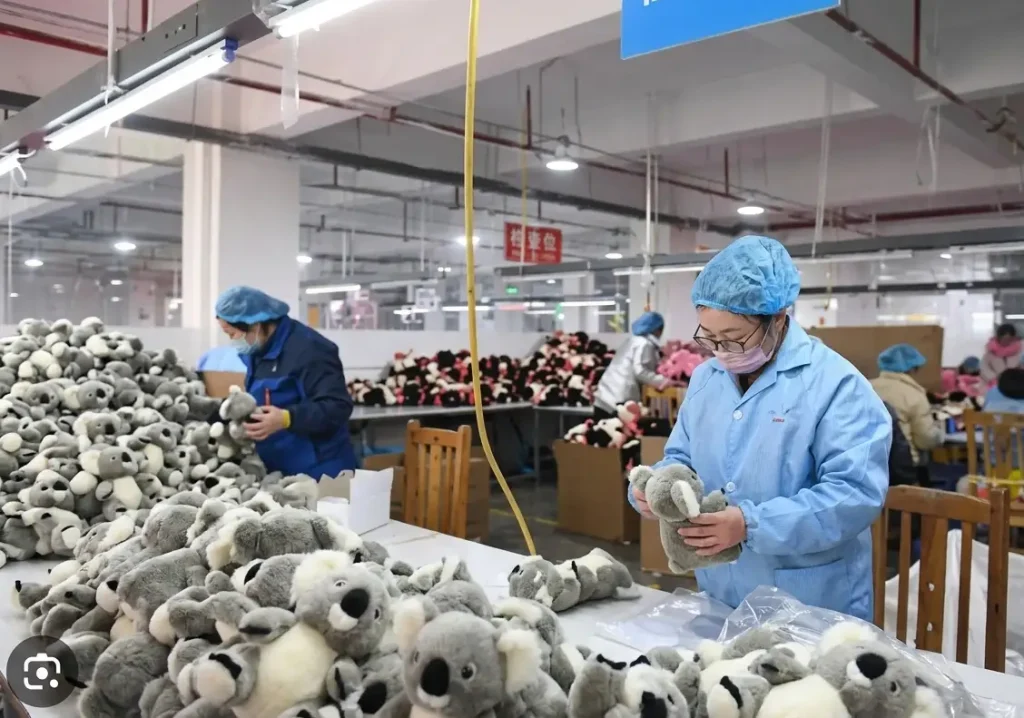
Plush toy production relies heavily on manual operator technique at nearly every stage — cutting, sewing, stuffing, accessory attachment, and finishing all depend on human skill rather than fully automated machinery. When technique guidance is communicated verbally or left to individual operator judgment rather than documented explicitly, the natural result is variation between operators and between shifts, even when every operator is working in good faith and at a reasonable skill level.
A written work instruction for each production operation — specifying, for example, the exact stuffing sequence for a complex body shape or the required pull-test force for accessory attachment — removes this variation by giving every operator the same reference standard. Factories that develop these instructions for every new design, rather than relying on operator memory and informal training, consistently show fewer technique-related defects on new production runs than those that do not.
Stuffing Density and Embroidery Position — The Two Highest-Visibility Drift Categories
Among all production-stage defects, stuffing density inconsistency and embroidery position drift are the two categories most likely to be immediately noticed by end customers, because they directly affect a plush toy’s shape and facial expression. Both are prevented in the same way: a documented target standard (weight range for stuffing, coordinate positions for embroidery), verified at first-off inspection, and re-checked at defined intervals throughout the production run rather than assessed only by visual comparison to the previous unit.
Tip: Ask for photographic first-off inspection reports as a standard part of production communication, not just a verbal confirmation that “production has started.” A photo of the first completed units next to the approved counter sample takes a supplier minutes to produce and gives the buyer direct visibility into whether the production setup matches the approved standard.
What Logistics and Shipping Mistakes Increase Cost and Delay?
Logistics and shipping mistakes occur at the very end of the manufacturing process, but they can undo the value of every quality decision made earlier by adding unplanned cost, customs delay, or damage that only becomes visible after the product has left the factory. Because logistics decisions are often treated as administrative rather than strategic, they receive less scrutiny than material or production decisions — which is precisely why mistakes in this category are so common.
The most common logistics and shipping mistakes are misunderstanding incoterms and assuming a quoted price includes costs it does not, underestimating the customs documentation and testing requirements for the destination market, choosing a shipping method based on cost alone without accounting for lead time reliability, and packing plush toys in ways that do not account for compression damage during long transit.
Logistics mistakes are particularly frustrating for buyers because they occur after every material, design, compliance, and production decision has already been made correctly — meaning a well-executed product can still arrive late, damaged, or with unexpected costs purely because of a planning gap in the shipping stage. Treating logistics planning with the same level of upfront attention given to material and design decisions, rather than as an afterthought once production is nearly complete, closes this gap.
Logistics and Shipping Mistakes and Their Cost Impact
| Mistake | Typical Cause | Cost or Delay Impact |
|---|---|---|
| Misunderstanding Incoterms (FOB vs CIF vs EXW) | Not clarifying what is included in the quoted price | Unexpected freight, insurance, or origin charges |
| Missing destination market documentation | Not researching import requirements in advance | Customs hold, storage fees, delayed release |
| Choosing a shipping method based on cost alone | Ignoring reliability differences between carriers and modes | Missed seasonal or retail delivery windows |
| Inadequate compression packaging | Standard packaging is not adjusted for plush toy volume and softness | Crushed or misshapen units on arrival |
| No tariff or duty pre-calculation | Assuming landed cost equals FOB or ex-works price | Budget overruns discovered at customs clearance |
Why FOB and CIF Confusion Is So Common — and So Costly
Free On Board (FOB) and Cost, Insurance, and Freight (CIF) terms define very different cost and risk allocations between buyer and supplier, and confusing the two is one of the most common and most expensive logistics mistakes in plush toy sourcing.
Under FOB terms, the buyer arranges and pays for international freight and insurance from the port of origin; under CIF terms, the supplier arranges and includes these costs in the quoted price. A buyer who assumes a CIF-level scope of coverage while actually contracting under FOB terms will discover the gap only when an unplanned freight invoice arrives — often after the goods are already in transit and there is no opportunity to renegotiate.
Clarifying the specific incoterm in writing for every quotation and confirming exactly what is included and excluded under that term prevents this category of mistake entirely and should be treated as a mandatory step before any purchase order is finalized.
Packaging for Compression and Long Transit
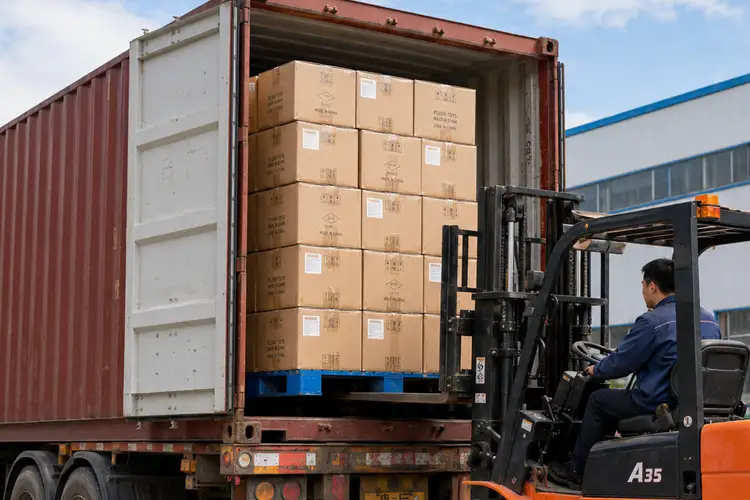
Plush toys are unusually vulnerable to compression damage during ocean freight because they are lightweight, soft, and often packed in large volumes relative to their weight — conditions that make them susceptible to crushing or shape distortion if packaging is not specifically designed for the stacking pressure of a full container load. A packaging specification that works well for a small parcel shipment may be inadequate for a 20-foot or 40-foot container load stacked for several weeks in transit.
How Can Buyers Build a Mistake-Prevention System Into Their Sourcing Process?
Every mistake category discussed in this guide shares a common structural solution: moving verification earlier in the process, documenting standards explicitly rather than relying on assumptions, and treating each decision point as a checkpoint that must be formally confirmed before production advances to the next stage. Building this discipline into a sourcing process converts an ad hoc, reactive approach to quality into a systematic one that prevents the majority of costly mistakes before they occur.
A mistake-prevention system for plush toy sourcing combines a documented product specification with measurable tolerances, a supplier evaluation process that includes reference checks and QC system review, a compliance testing schedule that runs early enough in the timeline to allow correction, a production monitoring cadence that includes first-off and interval inspection, and a logistics plan that clarifies incoterms and documentation requirements before the purchase order is finalized.
A Practical Mistake-Prevention Framework by Sourcing Stage
| Sourcing Stage | Key Prevention Practice | Mistake Category Addressed |
|---|---|---|
| Quote comparison | Require itemized costs and material specifications | Supplier selection mistakes |
| Material approval | Physical swatch review and certification verification | Material selection mistakes |
| Sample development | Written tolerances and mandatory counter sample sign-off | Design and development mistakes |
| Pre-production | Compliance testing is scheduled early, and documentation is confirmed | Compliance and safety mistakes |
| Production | First-off inspection plus interval IPQC reporting | Production and QC mistakes |
| Shipping | Incoterm clarity and destination documentation check | Logistics and shipping mistakes |
None of the individual practices in this framework is complex or expensive to implement on its own. What makes the framework effective is applying it consistently, at every stage, on every order — rather than applying it selectively only after a mistake has already caused a costly problem once.
Tip: Keep a simple running log of every quality or logistics issue encountered across past orders, noting which stage the root cause traced back to. Over two or three orders, this log reliably reveals which specific checkpoint in your own process is weakest — giving you a far more targeted place to invest prevention effort than a generic checklist alone.

Frequently Asked Questions
What is the single most common mistake that new plush toy buyers make?
The most common mistake among buyers sourcing plush toys for the first time is comparing supplier quotes on unit price alone without verifying that the underlying material specifications, compliance inclusion, and production standards are actually equivalent. Two quotes that look like they are for the same product frequently reflect very different assumptions about fabric grade, filling quality, and whether compliance testing is included — and the lower-priced quote often turns out to be more expensive once these differences are accounted for. Requesting a complete, itemized quotation and confirming material and compliance assumptions explicitly before comparing prices prevents this mistake in nearly every case.
How early in the process should compliance testing be planned to avoid delays?
Compliance testing should be planned and scheduled at the same time the product specification is finalized, well before bulk production begins — not treated as a final step before shipment. Running required tests on early bulk production output, rather than only on finished packed goods close to the shipping date, leaves enough time to identify a failed result, correct the root cause, and retest before the delivery deadline. Waiting until the end of the production schedule to test removes this buffer entirely and turns a manageable correction into a shipment-blocking crisis.
Is it necessary to hire a third-party inspector for every plush toy order, or only for larger ones?
Third-party inspection is most valuable for first orders with a new supplier, for larger-volume orders where the financial exposure is significant, and for products with complex compliance requirements — situations where the buyer has limited independent visibility into actual production quality. For smaller, ongoing orders with a supplier that has an established, verified track record of accurate self-reported quality results, the marginal value of third-party inspection on every single order is lower, though periodic spot-check inspections remain a reasonable practice even in established relationships. The decision should weigh order value and risk exposure against the modest cost of independent verification.
How many sample revision rounds should a buyer expect before approving a plush toy design for production?
Most plush toy designs require one to three sample revision rounds before reaching an approved standard, though the specific number depends heavily on design complexity, how clearly the original brief and reference materials were specified, and the sampling accuracy track record of the specific factory. Simple, standard-shape designs with clear reference images often achieve approval in a single round, while complex character designs with detailed facial features or multiple fabric panels more commonly require two to three rounds. Asking a supplier’s existing clients specifically how many revision rounds their comparable designs required is the most reliable way to estimate this for a new project.
What is the most reliable way to verify that a supplier’s quoted lead time is realistic?
The most reliable verification method is a combination of reference checks and a direct question about current capacity utilization. Asking an existing client not what the factory claims its lead time is, but what the actual delivery timeline was on a recent order, reveals the gap between quoted and actual performance that is common across the industry. Asking the factory directly what percentage of its production capacity is currently committed for the next sixty days provides an additional data point — a factory running near full capacity has little buffer to absorb normal production variability without falling behind the quoted schedule, while one with more available capacity has meaningfully more flexibility to meet its stated timeline.