Skip to content
Computerized Embroidery in Plush Toy Manufacturing enables manufacturers to create precise, durable, and visually appealing designs while improving production efficiency, consistency, and brand customization. Facial features are the first thing a customer notices on a plush toy, and computerized embroidery is the process that determines whether those features stay consistent from the first unit to the last. This guide covers how computerized embroidery works, the machines and materials involved, common defects, and how position accuracy is maintained across a full production run.
Computerized embroidery replaced hand embroidery as the standard method for adding facial features, brand marks, and decorative detail to plush toys because it delivers something hand stitching cannot reliably match at scale: exact, repeatable stitch placement across thousands of identical units.
A character’s expression is defined almost entirely by the position, size, and angle of its eyes and mouth, which means even a small embroidery placement error is immediately visible to an end customer in a way that many other production variances are not. This guide explains how computerized embroidery works from digital design to finished stitch, what equipment and materials are involved, and how manufacturers keep facial features consistent across a full production run.
Embroidery occupies an unusual position in plush toy manufacturing: it is often a small fraction of total unit cost, yet it disproportionately determines how a customer perceives the overall quality of the finished product. A plush toy with excellent fabric, filling, and construction can still be judged as low quality if its embroidered eyes sit slightly off-center or its stitched smile looks uneven — which is why embroidery deserves a level of process control and inspection attention that goes beyond what its cost share alone would suggest.
What Is Computerized Embroidery in Plush Toy Manufacturing?
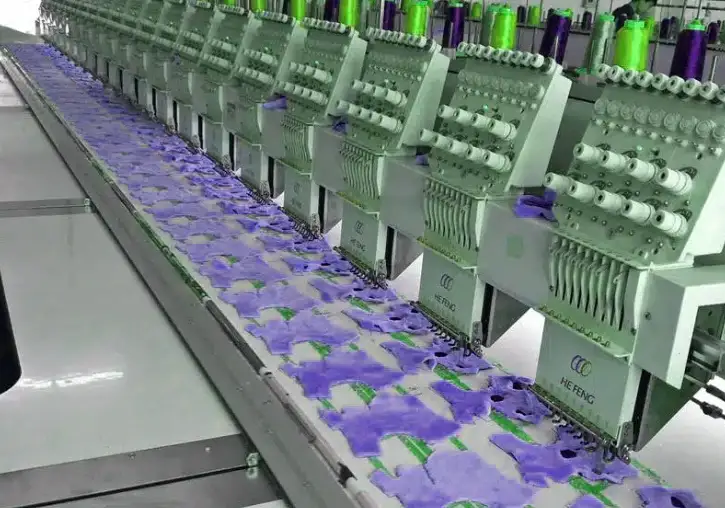
Computerized embroidery is the process of stitching a design onto plush fabric using a machine that follows a digital stitch file, rather than a manually operated needle guided by hand. The digital file — created through a process called digitizing — controls exact needle position, stitch type, thread color changes, and stitch density, allowing the same design to be reproduced identically across every unit in a production run without depending on individual operator skill for placement accuracy.
This shift from hand-guided to computer-guided stitching is what makes high-volume plush toy production with complex facial embroidery commercially viable. A design that would take a skilled embroiderer several minutes to stitch by hand, with natural variation between units, can be reproduced by a computerized machine in a fraction of the time, with placement accuracy measured in fractions of a millimeter.
Computerized embroidery machines also make design complexity economically viable at scale in a way manual stitching does not. A design with fine shading, multiple thread colors, and intricate detail work requires the same programmed stitch sequence whether the machine is producing the tenth unit or the ten-thousandth, whereas the same level of detail attempted by hand would require proportionally more skilled labor time for every additional unit produced. This is why computerized embroidery has become the default method for facial detail and branding across nearly all mid- to high-volume plush toy production.
How Computerized Embroidery Works: From Digitizing to Finished Stitch
Computerized embroidery moves through three distinct stages before a finished stitched panel reaches the sewing line: digitizing the design into a machine-readable stitch file, preparing the fabric and stabilizer for stitching, and running the machine through the programmed stitch sequence. Each stage introduces its own opportunities for error, which is why embroidery quality control needs to address the full sequence rather than only inspecting the finished stitch.
Digitizing the Design
Digitizing converts a flat design — typically a vector illustration of a character’s eyes, nose, or mouth — into a stitch file that specifies needle path, stitch type, and thread color sequence for the embroidery machine to follow. This is a skilled, largely manual step performed by a digitizer who determines stitch direction and density to reproduce the design’s shape and shading accurately on fabric, which behaves very differently from the flat vector artwork the design started as.
A poorly digitized file is one of the most common sources of embroidery quality problems, because errors introduced at this stage — incorrect stitch density, wrong stitch type for the fabric pile height, or inaccurate proportions — are reproduced identically on every single unit the file is used to stitch. Reviewing and approving a physical stitched sample from the digitized file, not just the on-screen digital preview, is the only reliable way to catch these errors before they scale across a full production run.
Digitizing quality also depends heavily on the digitizer’s familiarity with plush fabric specifically, as opposed to embroidery experience on flat woven goods such as apparel. Plush fabric pile height, stretch, and thickness all affect how a given stitch density and underlay will actually sit once stitched, and a digitizer working primarily with flat fabric may not account for these differences correctly on a first attempt. Requesting digitizing services from someone with specific plush toy or similarly textured fabric experience reduces the number of revision rounds typically needed to reach an approved stitch file.
Stitch Types Used in Plush Toy Embroidery
Different stitch types serve different purposes in plush toy embroidery: satin stitches produce smooth, glossy coverage well suited to compact shapes like eyes and small facial details, fill stitches cover larger areas with a textured, even density suited to larger design elements, and running stitches create fine outline or detail lines used for whiskers, eyebrows, or decorative accents. Selecting the correct stitch type for each design element affects both the finished appearance and how well the embroidery holds up to repeated handling and washing.

Stitch density — how tightly packed the individual stitches are within a given area — is a related setting that interacts closely with stitch type selection. Too dense a stitch count on a soft, stretchy plush fabric can cause the fabric to pucker or the finished panel to feel unnaturally stiff, while too sparse a stitch count can leave gaps that reveal the underlying fabric color or allow the design to fray more easily with wear. Digitizers typically adjust stitch density specifically for the fabric weight and pile height of the production material, which is another reason approving a design against a generic sample fabric rather than the actual production fabric can produce a mismatch at bulk production.
Tip: Always request a physical stitched sample on the actual production fabric before approving a digitized file, not just a digital rendering. Pile height, fabric stretch, and thread sheen all affect how a design actually looks once stitched, in ways a screen preview cannot show.
Why Computerized Embroidery Matters for Plush Toy Quality and Consistency
Computerized embroidery matters most for plush toy quality because facial feature consistency is one of the most visible and most scrutinized attributes of a finished product, and manual stitching cannot reliably reproduce exact placement across large production volumes. A customer comparing two units of the same character side by side will notice even small differences in eye position or mouth shape well before they notice most other manufacturing variances, which makes embroidery consistency disproportionately important to perceived quality relative to its share of total production cost.
Computerized Embroidery vs. Manual Hand Embroidery
| Attribute | Computerized Embroidery | Manual Hand Embroidery |
|---|---|---|
| Placement consistency across units | High, machine-repeatable | Variable, operator-dependent |
| Production speed at volume | Fast, minutes per unit | Slow, not practical at scale |
| Design complexity capability | High, including fine detail and shading | Limited by operator skill and time |
| Setup cost and time | Digitizing fee and machine setup required | Minimal setup, higher per-unit labor cost |
| Best fit | Medium to high volume production | One-off or very low-volume custom pieces |
The trade-off is that computerized embroidery requires an upfront digitizing investment and machine setup time that manual stitching does not, which means it is most cost-effective at the production volumes typical of commercial plush toy manufacturing rather than for one-off custom pieces.
Embroidery Machine Types and Their Capabilities
Plush toy manufacturers use different embroidery machine configurations depending on production volume, design complexity, and the number of thread colors a design requires. Single-head machines are common for sampling and low-volume runs, while multi-head machines allow the same design to be stitched on multiple panels simultaneously, and multi-needle machines allow automatic thread color changes within a design without manual rethreading.
Embroidery Machine Types Used in Plush Toy Production
| Machine Type | Typical Use Case | Key Advantage |
|---|---|---|
| Single-head, single-needle | Sampling, prototyping, very small runs | Low setup cost, fast changeover between designs |
| Single-head, multi-needle | Small to medium runs with multiple thread colors | Automatic color changes without manual rethreading |
| Multi-head, multi-needle | Medium to high volume production | Simultaneous stitching across many panels at once |
| Chenille/specialty embroidery machines | Textured or raised-effect designs | Distinct decorative texture not achievable with flat stitching |
Tip: Match the embroidery machine configuration to actual order volume rather than defaulting to the highest-capacity equipment available. A design with only two thread colors running on a small order does not need a full multi-head, multi-needle setup, and matching equipment to the job keeps setup time and cost proportional to the order.

Thread, Backing, and Stabilizer Materials for Plush Embroidery
Plush fabric presents a specific embroidery challenge that flat woven fabric does not: its pile and stretch characteristics can cause stitches to sink into the fabric or distort during stitching if the fabric is not properly stabilized first. Backing and stabilizer materials — placed behind the fabric before stitching begins — hold the fabric flat and prevent distortion, and selecting the wrong stabilizer for a given pile height or fabric weight is a common source of embroidery quality problems.
Common Stabilizer Types for Plush Toy Embroidery
| Stabilizer Type | Best Suited For | Removal Method |
|---|---|---|
| Cut-away stabilizer | High-pile or stretchy plush fabric | Trimmed away after stitching, remains partially in place |
| Tear-away stabilizer | Lower-pile, stable fabric with simpler designs | Torn away cleanly after stitching |
| Water-soluble stabilizer | Fine detail work, freestanding lace-style elements | Dissolved in water after stitching |
| Topping (placed on top of the pile) | Very high-pile fur fabric | Torn or dissolved away, prevents stitch sink-in |
Thread selection also affects both appearance and durability. Polyester embroidery thread is the most common choice for plush toys due to its colorfastness, strength, and resistance to fading through repeated washing, while rayon thread offers a higher sheen, often used for premium decorative detail but with somewhat lower durability under heavy washing.
Common Embroidery Defects and How to Prevent Them
Most embroidery defects in plush toy production trace back to a small number of recurring causes: incorrect stabilizer selection for the fabric type, digitizing errors that reproduce identically across every unit, tension settings that are not calibrated for the specific thread and fabric combination, and inconsistent hooping or fabric feeding during the stitching process.
Common Plush Toy Embroidery Defects and Corrective Actions
| Defect | Likely Cause | Corrective Action |
|---|---|---|
| Puckering or fabric distortion around stitching | Wrong or insufficient stabilizer for fabric pile | Match stabilizer type to fabric pile height and stretch |
| Stitches sinking into high-pile fabric | No topping stabilizer is used on fur-type fabric | Add a water-soluble topping layer before stitching |
| The thread breaks during stitching | Incorrect tension or poor-quality thread | Recalibrate tension; verify thread quality specification |
| Inconsistent facial feature position across units | Inconsistent hooping or fabric placement | Use placement templates or fixtures for consistent hooping |
| Color mismatch between panels | Thread dye lot variation | Confirm thread dye lot consistency across the full order |
Tip: Use a placement template or fixture — a simple guide that marks exact hooping position relative to a pattern piece — for every embroidered panel rather than relying on an operator’s visual judgment. This single practice prevents the majority of facial feature position drift seen across large production runs.
Embroidery Position Accuracy and Facial Feature Consistency
Facial feature position accuracy is typically verified against a coordinate reference established during the approved counter sample, with acceptable tolerance defined as a specific measurable distance — for example, eye position within two millimeters of the approved reference point — rather than assessed through visual comparison alone. Establishing this numeric tolerance during sample approval gives both the factory and the buyer a shared, measurable standard for resolving any disagreement about whether a unit’s embroidery placement is acceptable.
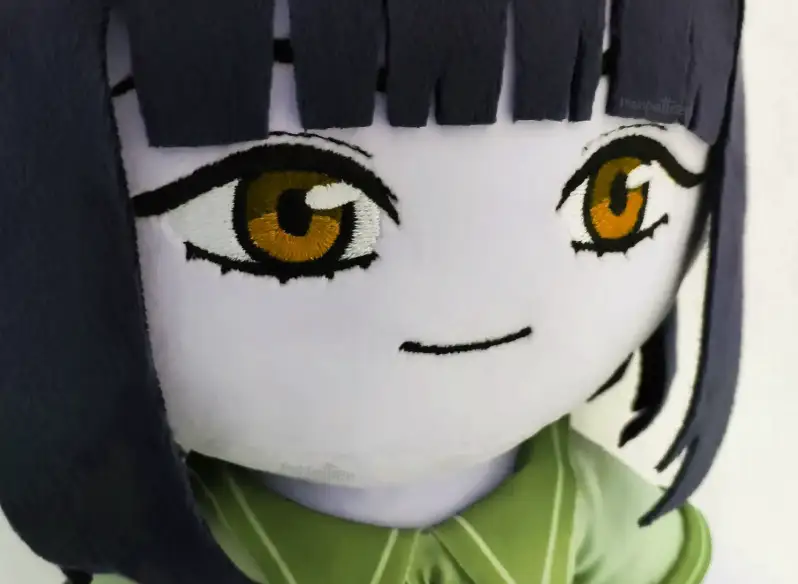
First-off inspection of embroidered panels, checked against the approved counter sample before full production proceeds, is the single most effective checkpoint for catching a hooping, digitizing, or tension problem before it replicates across an entire production run. Because embroidery machines run the same programmed file repeatedly, an error caught after only a handful of units affects a small number of pieces; the same error caught only at final inspection can affect the entire batch.
Tip: Define facial feature position tolerance in numeric terms — a measurable distance from a fixed reference point — during sample approval, not just through visual comparison. A numeric standard removes ambiguity when evaluating whether a production unit’s embroidery placement passes or fails inspection.
Frequently Asked Questions
How is computerized embroidery different from screen printing for plush toy facial features?
Computerized embroidery creates raised, textured stitching using thread, which gives facial features a dimensional, tactile quality and generally higher perceived durability than a flat printed design. Screen printing applies ink directly to the fabric surface, producing a flatter finish that is typically faster and less expensive for very simple designs but less durable under repeated washing and handling compared to embroidery. The choice between the two often comes down to design complexity, budget, and how much tactile texture the design calls for.
Does computerized embroidery work on all types of plush fabric?
Computerized embroidery can be applied to most plush fabric types, but fabric pile height and stretch characteristics significantly affect which stabilizer and stitch settings are required to achieve a clean result. Very high-pile fur fabric requires additional stabilization, such as a topping layer, to prevent stitches from sinking into the pile, while lower-pile, more stable fabrics generally require less specialized preparation. The fabric type should always be confirmed with the digitizer and embroidery operator before finalizing stitch settings.
How long does the digitizing process typically take for a new plush toy design?
Digitizing time varies with design complexity, but a straightforward facial design with a small number of elements typically takes a digitizer a few hours to complete, while more complex designs with fine detail, shading, or multiple thread colors can take longer. Buyers should build digitizing time into the overall development schedule as a distinct step, separate from sample sewing time, since digitizing must be completed and a physical stitched sample approved before bulk embroidery can begin.
Can embroidery placement really vary enough between units to be noticeable to customers?
Yes, and this is one of the most common quality issues reported in plush toy production. Even a placement deviation of a few millimeters in eye or mouth position can visibly change a character’s expression, and because customers instinctively focus on facial features when evaluating a plush toy, this type of deviation is noticed far more readily than many other production variances of similar physical magnitude. This sensitivity is exactly why numeric position tolerances and first-off inspection are considered essential rather than optional quality control steps for embroidered plush designs.
Is hand embroidery ever a better choice than computerized embroidery for plush toys?
Hand embroidery can be a reasonable choice for one-off custom pieces, very low-volume artisan products, or design elements that specifically call for the irregular, handcrafted look that machine stitching does not replicate. For any production run beyond a small number of units, however, computerized embroidery is almost always the better choice, because it delivers placement consistency and production speed that manual stitching cannot match once volume increases beyond a handful of pieces.
What causes thread color to look slightly different between production batches?
Thread color variation between batches is most commonly caused by dye lot differences, where thread purchased at different times, even under the same color name and number, can show a subtle but noticeable color shift due to normal variation in the dyeing process. Confirming that all thread for a given order comes from the same dye lot and retaining a physical thread sample from the approved sample stage for comparison against production thread is the most reliable way to catch this before it affects a finished batch.