Skip to content

Everything marketing teams, retail buyers, and brand managers need to know about developing custom plush toys for promotional programs, corporate mascots, retail product lines, and branded merchandise.
What Are Custom Plush Toys for Businesses?
Custom plush toys for businesses are soft toy products developed specifically to represent a brand, mascot, character, or promotional concept, produced for commercial rather than purely consumer-driven purposes. Unlike off-the-shelf plush purchased from a catalog of existing designs, business-oriented custom plush toy manufacturing starts from a brand’s own intellectual property — a mascot character, a product silhouette, a logo shape, or a licensed design — and carries it through pattern development, prototyping, and production as an original soft toy.
The category spans a wide range of commercial applications: promotional giveaways at trade shows and retail openings, branded merchandise sold in company stores or e-commerce shops, corporate mascots used in marketing and events, loyalty program gifts, and licensed collaboration plush tied to media properties or sports franchises. Each of these use cases carries different priorities around unit cost, minimum order quantity, safety compliance, and turnaround time, which is why the first step in any custom plush toy manufacturing program is clarifying exactly how the finished product will be used and distributed.
Because business-driven plush programs are usually judged first on brand accuracy — does the mascot’s proportions, color, and expression match the approved brand guidelines — before any other quality metric, the design and sampling phase tends to receive disproportionate attention compared to standard consumer plush development, where a wider range of stylistic variation is often acceptable.
Custom plush toy manufacturing for businesses also differs from consumer plush programs in how success is measured internally. A marketing team evaluating a promotional plush giveaway cares about cost per unit at a specific event budget and how effectively the item reinforces brand recall, while a retail buyer developing a branded plush product line is focused on margin structure, sell-through rate, and how the item performs against comparable products already on the shelf. Understanding which of these lenses applies to a given program early in the process helps align design decisions, material choices, and production volume with the actual business outcome the plush toy is meant to support.
Tip: Before starting a custom plush toy program, clarify internally whether the finished product will be classified as a children’s toy, a promotional item for general audiences, or a collectible/decorative product. This single decision determines which safety standards apply and shapes nearly every downstream material and design choice.
Why Businesses Invest in Custom Plush Toys
Custom plush toys deliver a combination of tactile brand engagement and long shelf life that few other promotional products can match. A branded plush mascot sits on a desk, a shelf, or a child’s bed for months or years after distribution, providing sustained brand visibility that a printed flyer or a disposable giveaway item cannot replicate. For consumer-facing brands, licensed and branded plush lines also generate direct retail revenue, turning what might otherwise be a pure marketing expense into a standalone product category with its own margin structure.
Beyond direct brand marketing, custom plush toys serve several adjacent business functions: employee recognition and company store merchandise, fundraising and charity partnership products, conference and trade show premiums designed to drive booth traffic, and character-driven storytelling tools used by educational or children’s media brands to extend a property beyond its original format.
Character-driven mascots in particular offer a compounding marketing benefit that a static logo cannot replicate: once a plush mascot exists as a physical product, it can appear in social media content, event photography, packaging illustrations, and customer-generated content in ways that build recognition well beyond the original point of distribution.
Several consumer brands have found that a well-designed mascot plush becomes a recurring feature in customer photos and reviews long after the initial promotional campaign has ended, extending the effective marketing lifespan of the initial production investment far beyond what a one-time giveaway budget would typically justify.
Common Business Use Cases for Custom Plush
Understanding where a custom plush program fits within this landscape shapes almost every subsequent decision in the manufacturing process, from material selection to compliance requirements to minimum order quantity negotiations.
Common Business Applications for Custom Plush Toys
| Use Case | Typical Distribution Channel | Primary Design Priority |
|---|---|---|
| Promotional giveaways | Trade shows, retail openings, event booths | Low unit cost; fast turnaround; simple construction |
| Retail branded merchandise | E-commerce, company stores, third-party retail | Premium finish; packaging presentation; brand accuracy |
| Corporate mascot plush | Internal events, marketing campaigns, media appearances | Exact brand-guideline accuracy; durability for repeated handling |
| Employee and loyalty gifts | Direct distribution, recognition programs | Mid-tier quality; moderate customization; modest MOQ |
| Licensed character collaborations | Retail, direct-to-consumer, media tie-in campaigns | Strict licensor approval process; premium materials |
The Design and Development Process for Custom Plush
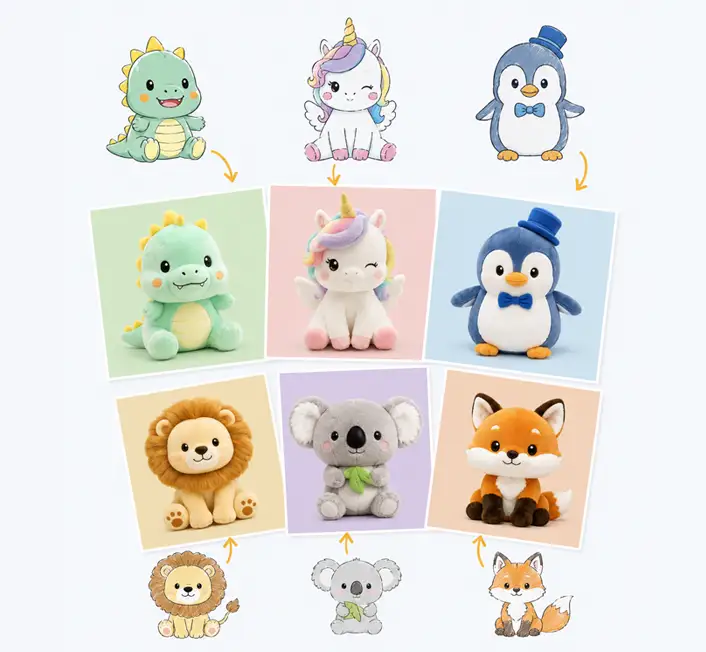
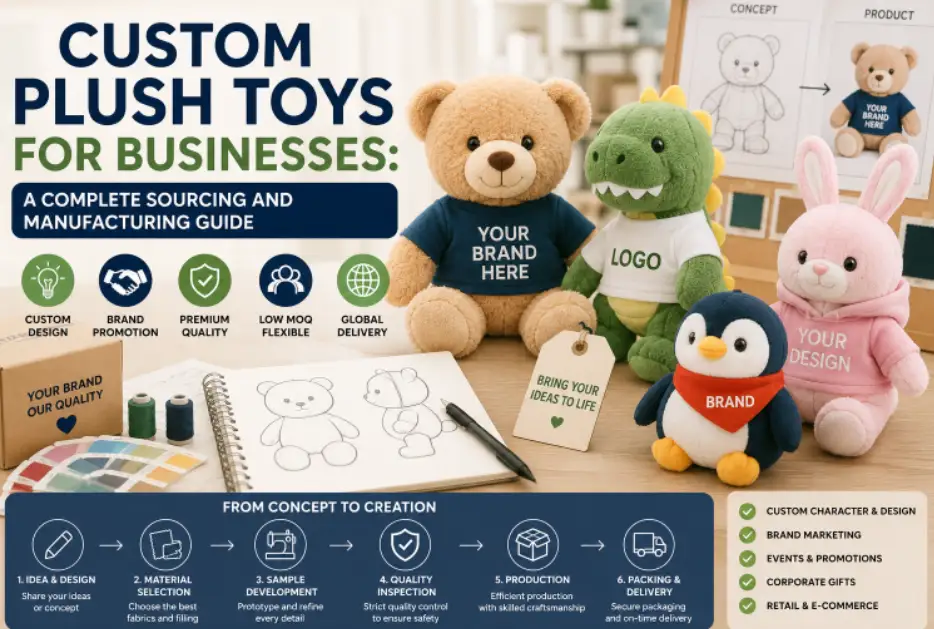
Custom plush toy development for business clients generally follows a structured sequence: concept sketch and reference gathering, 2D pattern development, a first prototype sample, one or more rounds of revision, and a final pre-production sample used to lock the design before bulk manufacturing begins. Because business clients are translating an existing brand asset — often a 2D logo or illustrated mascot — into a three-dimensional soft toy, this translation step deserves particular attention, since a character that reads clearly as a flat illustration does not always translate directly into a convincing plush silhouette.
Translating 2D Brand Assets into 3D Plush Form
Experienced plush designers typically produce several silhouette and proportion studies before committing to a final pattern, testing how the character’s key identifying features — ear shape, color blocking, facial expression — read once rendered in fabric and filling rather than flat vector artwork. Features that work perfectly in a 2D logo, such as a very thin limb or a sharply pointed extremity, often need to be reinterpreted for plush construction, since thin fabric-and-fill structures are both harder to manufacture consistently and more prone to premature wear or breakage during normal handling.
Tip: Request a 3D digital sculpt or a rough foam mockup before committing to a sewn prototype sample. Catching proportion or silhouette issues at the digital or foam-mockup stage is significantly faster and cheaper than discovering them after a full fabric prototype has already been sewn and shipped for review.
Brand Guideline and Color Accuracy Review
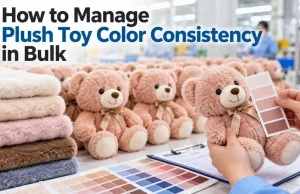
Because custom plush toys for businesses represent a brand identity, color accuracy against approved brand guidelines is typically non-negotiable in a way that goes beyond standard consumer plush color approval. Pantone-matched lab dips, side-by-side comparison against official brand color swatches under multiple lighting conditions, and sign-off from brand or legal stakeholders — not just the product development team — are standard steps in a well-run corporate plush approval process.
Licensed character programs add a further layer of review beyond internal brand approval, since the licensor — whether a media property owner, a sports league, or a partner brand — typically requires its own formal sign-off at each major development milestone, from initial sketch through final pre-production sample. Building licensor review cycles into the overall project timeline from the outset, rather than treating them as an afterthought layered onto an already-tight production schedule, prevents the kind of last-minute delays that frequently derail licensed plush launches tied to a fixed release date.

Materials and Customization Options for Business Plush Programs
Material and customization choices for custom plush toys directly affect both unit cost and perceived quality and should be selected deliberately based on the program’s use case rather than defaulted to whatever a factory proposes as a standard option.
Materials and Customization Options for Custom Plush Toys
| Element | Common Options | Business Impact |
|---|---|---|
| Body fabric | Short-pile plush, faux fur, fleece, minky | Drives hand-feel quality and per-unit fabric cost |
| Filling material | Polyester fiberfill, weighted pellets, bean-bag style filling | Affects huggability, shelf presence, and shipping weight/cost |
| Branding method | Embroidery, screen print, woven label, printed hang tag | Embroidery offers the highest durability; printing offers a lower cost for detailed logos |
| Accessories | Scarves, hats, bandanas, removable costumes | Adds perceived value and merchandising flexibility across seasons/campaigns |
| Sound or motion modules | Recorded audio message, simple movement mechanisms | Increases engagement but adds cost and electrical safety testing |
Embroidery is generally preferred over printing for logo and facial detail work on business plush intended for long-term use or resale, since embroidered detail resists fading and wear far better than screen-printed graphics over repeated handling and washing. Printed detail remains a cost-effective option for highly detailed artwork or short-run promotional plush where long-term durability is less critical than achieving a low unit price at a modest order quantity.
Filling choice deserves equal consideration alongside the more visible branding and fabric decisions. Standard polyester fiberfill remains the default for most huggable character plush due to its low cost, washability, and hypoallergenic properties, while weighted pellet or bean-bag style filling is often selected for character plush intended to sit upright on a shelf or desk without additional support, a common requirement for corporate mascot plush displayed in office or retail settings rather than handled primarily by children.
Safety Compliance for Business Custom Plush Programs
Safety compliance requirements for custom plush toys depend heavily on the intended audience and distribution channel — a distinction that businesses new to plush sourcing sometimes overlook until compliance questions surface late in the program. A plush toy sold at retail or given away at an event where children are reasonably likely to receive it is generally treated as a children’s product and must meet the applicable toy safety standards for its destination market, regardless of whether the business considers it primarily an adult-facing promotional item.
Compliance Requirements by Business Plush Use Case
| Use Case | Typical Compliance Treatment | Key Standards to Consider |
|---|---|---|
| Retail products marketed to children | Full children’s toy safety compliance is required | CPSIA, ASTM F963 (US); EN71, REACH (EU) |
| General promotional giveaways (mixed audience) | Toy safety compliance recommended as best practice | ASTM F963 or EN71, depending on distribution region |
| Adult-only corporate/collectible plush | General product safety standards; toy-specific rules may not apply | General consumer product safety regulations; regional labeling rules |
| Plush with electronic components | Additional electrical and battery safety testing required | Battery compartment security, electrical safety standards |
Even when a program is not strictly classified as a children’s toy, many businesses choose to meet children’s safety standards voluntarily as a risk-management practice, since promotional and giveaway products frequently end up in the hands of children regardless of the original target audience the business had in mind. This is particularly relevant for character mascot plush distributed at public events, where the business has limited control over who ultimately receives the product.
Multi-market distribution adds further complexity to compliance planning. A custom plush program shipping to retail partners across North America, the European Union, and other regions simultaneously must satisfy the strictest applicable requirement across all target markets, since a single production run is rarely cost-effective to split into region-specific compliance variants. Confirming the full list of destination markets before finalizing materials and components — rather than discovering a compliance gap after production has already begun — is one of the most effective ways to avoid a costly late-stage material substitution or retest cycle.
Tip: When in doubt about whether your custom plush program needs to meet children’s toy safety standards, default to compliance. The cost of testing to a children’s safety standard is almost always lower than the reputational and liability risk of a non-compliant product reaching a child, especially for a branded item carrying your company’s name and image.
Minimum Order Quantity, Pricing, and Production Timelines
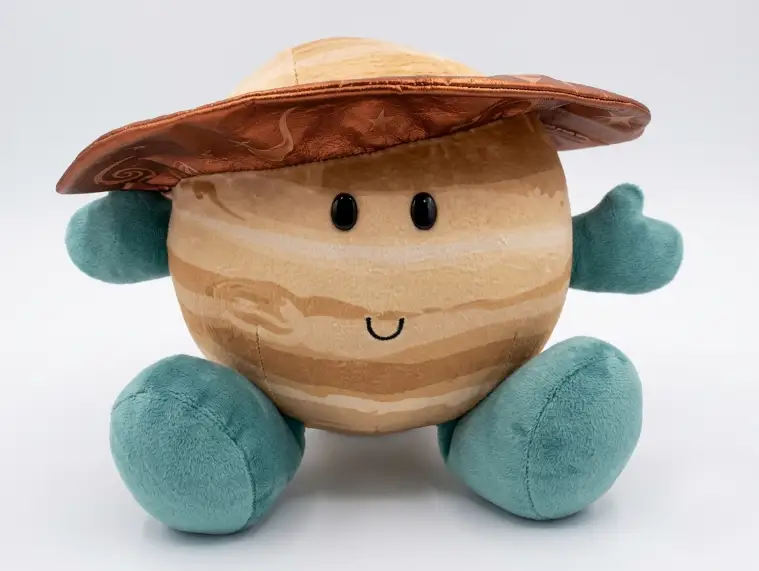
Minimum order quantity and unit pricing for custom plush toys are shaped by several interacting factors: the complexity of the character design, the number of distinct fabric colors and materials required, the branding method selected, and whether the program requires dedicated tooling for components such as safety eyes or accessory molds.
Key Cost and Timeline Drivers for Custom Plush Programs
| Factor | Lower-Cost / Faster Option | Higher-Cost / Slower Option |
|---|---|---|
| Design complexity | Simple silhouette; few fabric pieces per panel | Multi-piece pattern; complex appendages or accessories |
| Branding method | Screen print or hang tag | Multi-color embroidery; woven jacquard labels |
| Order volume | Higher volume reduces per-unit cost | Small test-market runs carry higher per-unit pricing |
| Sampling rounds | Reusing existing pattern blocks with color/logo changes | Fully custom character requiring multiple prototype iterations |
| Compliance testing | Standard testing package for a known material set | Additional testing for electronics, novel materials, or multiple markets |
A rough planning benchmark for a moderately complex custom plush character, from initial concept approval to bulk shipment ready for distribution, typically runs eight to fourteen weeks, though simpler designs built from existing pattern blocks can move faster, and highly complex characters with multiple accessories or electronic components can extend well beyond that range. Businesses planning a launch tied to a fixed date — a product release, an event, or a seasonal campaign — should build in buffer time for at least one round of sample revisions, since first prototypes rarely require zero changes.
Freight mode also factors meaningfully into total program cost and timeline. Ocean freight remains the lowest-cost shipping option for bulk plush orders but adds several weeks of transit time on top of the manufacturing schedule, while air freight compresses delivery time significantly at a substantially higher per-unit cost. Programs with a hard deadline and limited schedule buffer sometimes split a shipment, sending an initial smaller batch by air to guarantee an on-time launch quantity while the bulk of the order follows by ocean freight at a lower blended cost.
Quality Control for Business Plush Programs
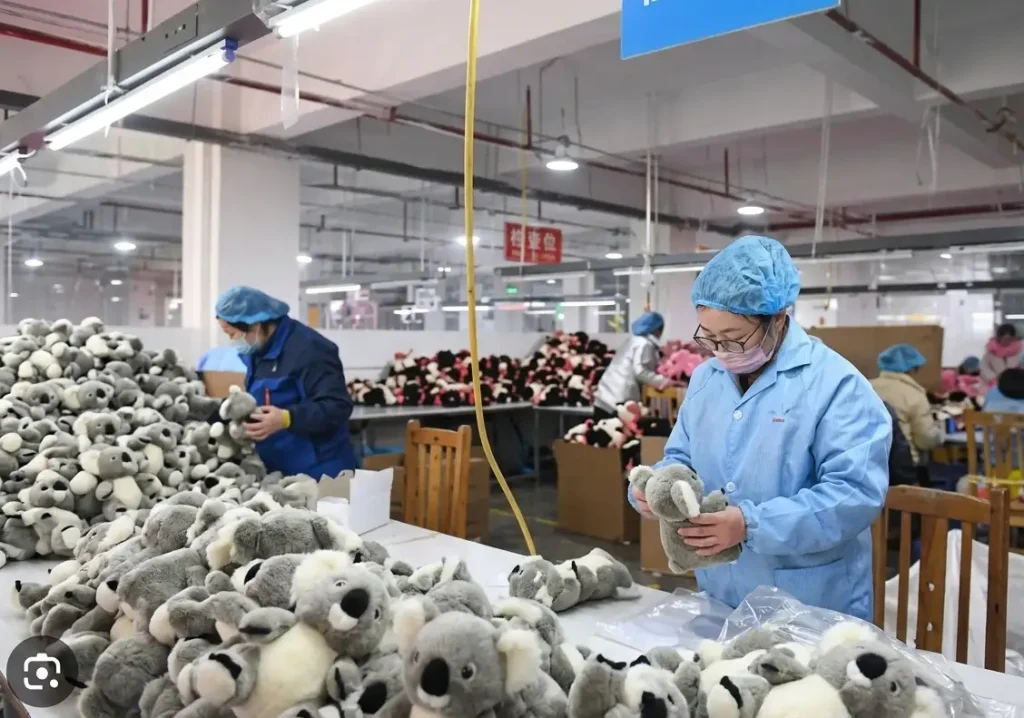
Quality control for custom business plush follows standard soft toy inspection principles — stitching strength, filling consistency, safety component attachment — with an added layer of brand-accuracy verification specific to commercial programs.
Because a defective or off-brand plush toy carries reputational risk beyond the cost of the physical unit itself, many businesses request an additional pre-shipment inspection report specifically documenting brand compliance — color measurements against approved Pantone references, logo placement tolerances, and photographic documentation of a statistically representative sample — separate from the standard textile safety and durability inspection report. This dual-track inspection approach gives marketing and brand stakeholders documented assurance alongside the manufacturing quality data that a compliance or sourcing team typically reviews.
Quality Control Checkpoints for Custom Business Plush
| Checkpoint | What Is Verified | Why It Matters for Business Programs |
|---|---|---|
| Brand color accuracy | Fabric and print colors match approved Pantone references | Off-brand color is an immediate rejection criterion for corporate clients |
| Logo and detail placement | Embroidery/print position matches approved artwork proof | Misaligned or distorted branding undermines the promotional purpose |
| Seam and stitch strength | Pull-test resistance meets durability thresholds | Prevents premature failure during extended promotional or retail use |
| Safety component security | Eyes, noses, and attachments pass pull-force requirements | Critical for any program with potential child exposure |
| Packaging and presentation | Box or bag structural integrity and print quality | Reinforces brand perception at the point of distribution or sale |
Packaging and Brand Presentation
Packaging decisions for custom business plush should match the product’s distribution context. A trade show giveaway typically ships in simple poly bags to keep unit cost low and minimize packaging waste for a product intended primarily as a handout. Retail-bound branded plush, by contrast, usually warrants a printed header card, hang tag, or branded box, since the packaging itself becomes part of the retail shelf presentation and the customer’s unboxing experience.
Including a branded hang tag with a short character backstory or company message — even on a relatively simple promotional plush — meaningfully increases the perceived value of the item and provides an additional, low-cost surface for reinforcing key brand messaging beyond the plush toy itself.
For programs distributed internationally, packaging must also account for multilingual labeling requirements and region-specific safety warning text, which varies depending on the destination market’s regulatory framework. Coordinating packaging artwork revisions across multiple language variants alongside the core product development timeline is worth planning for early, since packaging text approval frequently becomes a bottleneck near the end of a program if it is treated as a final-stage task rather than a parallel workstream running alongside plush sample development.
Choosing a Manufacturing Approach for Custom Plush Programs
Businesses developing a custom plush program generally choose between working with an existing pattern library — selecting a base body shape close to their desired character and customizing color, branding, and accessories — or commissioning a fully original design built from scratch.
Pattern-block customization typically offers faster turnaround and lower minimum order quantities, making it well suited to promotional programs or businesses testing a new character concept before committing to a larger retail launch. Fully original development offers maximum brand accuracy but generally requires higher MOQ and longer lead time to account for the additional pattern engineering and prototyping work involved.
Whichever approach is chosen, requesting production samples from actual bulk-production tooling and materials — rather than relying solely on a hand-finished prototype sample — before authorizing full production remains one of the most reliable ways to confirm that the finished goods will match approved expectations at scale.
For businesses planning to launch a custom plush program regularly — a seasonal mascot refresh, an annual conference giveaway, or an ongoing retail character line — establishing a consistent pattern block and material specification from the first program onward pays dividends across future cycles. Reusing a validated base pattern for subsequent seasonal variants (a summer outfit swap, a holiday accessory update) is significantly faster and less expensive than redeveloping the core character from scratch each time, while still allowing meaningful seasonal refresh through targeted accessory and color updates.

Frequently Asked Questions
1. What is the typical minimum order quantity for custom plush toys?
Minimum order quantity varies significantly based on design complexity and whether the program uses an existing pattern block or requires a fully original character. Programs built from existing pattern shapes with color and branding customization typically carry lower minimum order quantities than fully custom characters requiring new tooling for safety eyes, noses, or molded accessories. Businesses should discuss pattern reuse options with their manufacturer early if a smaller test-market quantity is the priority.
2. Do promotional plush toys given away at events need to meet toy safety standards?
In many cases, yes. If there is a reasonable likelihood that children will receive the item — which is common for public event giveaways — the plush toy is generally treated as a children’s product and should meet applicable toy safety standards such as ASTM F963 or EN71, even if the business’s primary target audience was adults. Many businesses choose to meet these standards as a risk-management practice regardless of the originally intended audience.
3. How long does it take to develop a custom plush toy from concept to finished product?
A moderately complex custom plush character typically takes eight to fourteen weeks from initial concept approval to a bulk shipment ready for distribution, including design, sampling, revisions, and production. Simpler designs built from existing pattern blocks can move faster, while highly detailed characters with multiple accessories or electronic components often require additional time for prototyping and compliance testing.
4. What is the difference between embroidered and printed branding on custom plush toys?
Embroidery stitches the logo or detail directly into the fabric, offering superior durability against fading and wear over repeated handling, making it well suited to products intended for long-term use or retail resale. Printing applies graphics to the fabric surface, which is more cost-effective for highly detailed or multi-color artwork but generally wears faster than embroidery over time, making it better suited to shorter-run or lower-durability promotional programs.
5. Can a company logo or 2D mascot be turned into an accurate plush toy design?
Yes, though the translation from a flat 2D logo or illustration into a three-dimensional plush toy typically requires design adaptation, since features that read clearly in a flat graphic — very thin limbs, sharply pointed details — do not always translate directly into a durable, manufacturable plush silhouette. Experienced plush designers usually produce proportion studies or a foam/digital mockup to confirm the character reads correctly in three dimensions before committing to a sewn prototype.
6. What quality control steps are unique to business-branded plush compared to standard plush toys?
In addition to standard soft toy quality checks such as stitching strength and filling consistency, business branded plush programs place additional emphasis on brand color accuracy against approved Pantone references and precise logo or embroidery placement matching the approved artwork proof. Off-brand color or misaligned branding is typically treated as a rejection criterion in corporate plush programs, since it undermines the core purpose of the product.
7. Is it cheaper to use an existing pattern design or commission a fully custom plush character?
Using an existing pattern block and customizing color, branding, and accessories is generally faster and less expensive than commissioning a fully original character, since it avoids the additional pattern engineering and multi-round prototyping typically required for a brand-new design. Fully custom development delivers the highest brand accuracy but usually comes with a higher minimum order quantity and longer lead time to account for the additional design work involved.