Skip to content
How to Create Plush Toys for Your Brand starts with a clear concept, the right manufacturing partner, and a well-planned production process to turn your unique ideas into high-quality custom plush toys.
A practical, step-by-step reference covering concept design, material selection, sampling, safety compliance, and production planning for brands developing a custom plush toy line from scratch.
Creating plush toys for a brand is the process of turning a character concept, mascot, or product idea into a physical, huggable object that carries a brand’s identity into a customer’s home. It spans creative design, technical pattern development, material sourcing, safety compliance, and production management, and it requires coordination between design intent and manufacturing reality at every stage. A plush toy that looks perfect as a flat illustration can fail entirely as a three-dimensional object if proportions, seam placement, and stuffing behavior are not considered from the earliest concept stage.
This guide walks through the complete process of creating plush toys for a brand, from the first concept sketch to bulk production, covering the design decisions, material choices, sampling stages, and compliance requirements that determine whether the finished plush toy matches the brand’s vision and meets the safety standards required to sell it.
What Does It Mean to Create a Plush Toy for a Brand?
Creating a plush toy for a brand means developing an original soft toy product, from concept through finished production unit, that represents a brand’s character, mascot, or product identity in physical form. Unlike sourcing an existing stock plush design, brand plush toy development typically starts from a two-dimensional character reference, illustration, or product photo and works through pattern development, sample rounds, and material selection to produce a three-dimensional plush that is both huggable and recognizably on-brand.

This distinguishes custom plush development from simply private-labeling an existing catalog item. A brand creating its own plush toy is making decisions about silhouette, proportion, fabric texture, embroidery detail, and construction method that directly shape how the character is perceived once it exists as a physical object — decisions that a stock plush purchase does not offer.
Why Do Brands Invest in Creating Custom Plush Toys?
Brands invest in custom plush development because a well-designed plush toy creates an emotional and physical connection with customers that flat merchandise, such as apparel or printed goods, generally cannot replicate. A plush toy is held, hugged, displayed, and often kept for years, giving it a longer-lasting presence in a customer’s life than most other branded products.
Brand Differentiation and Emotional Connection
A custom plush toy differentiates a brand from competitors relying on generic or stock merchandise, and it builds an emotional connection in a way that is difficult to achieve through other product categories. Character-based brands, entertainment properties, and mascot-driven companies use plush toys specifically because the format allows a character to exist as a tangible, three-dimensional object that customers physically interact with, reinforcing brand recall far beyond a single purchase moment.
Revenue and Licensing Opportunities
Beyond emotional connection, plush toys represent a distinct revenue category with margin structures and purchase patterns that differ from a brand’s core product line. Plush toys are frequently positioned as impulse purchases, gift items, or loyalty rewards, and for brands with established intellectual property, licensed plush programs can generate ongoing royalty revenue with comparatively low operational involvement once the initial product development is complete.
Strategy Tip: Before starting design work, define whether the plush toy is intended as a primary retail product, a promotional or gift-with-purchase item, or a limited collectible release. Each positioning changes the acceptable cost structure, minimum order quantity, and level of design complexity that makes commercial sense, and clarifying this upfront prevents costly redesigns later in development.
The Plush Toy Development Process: From Concept to Finished Product
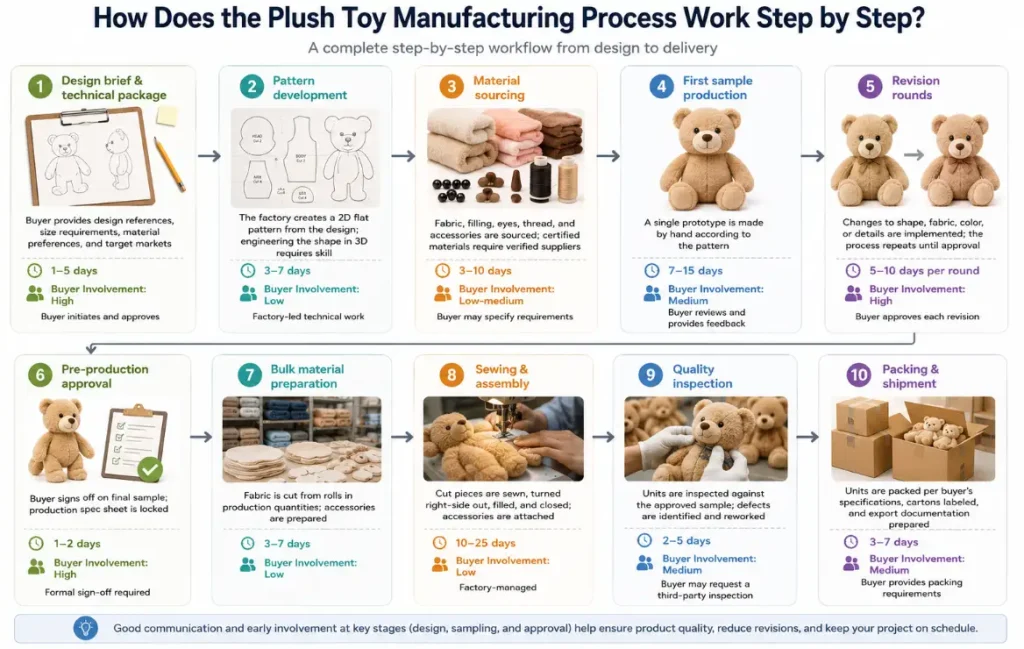
The plush toy development process moves through a consistent sequence of stages regardless of the character or product being developed: concept and design brief, technical pattern development, sampling and revision, safety compliance validation, and bulk production. Understanding this sequence helps a brand plan realistic timelines and identify where design decisions have the most influence on the finished product.
Concept and Design Brief Development
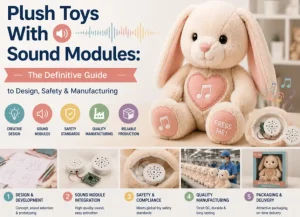
The design brief translates a brand’s creative vision into information a pattern maker can actually work with: reference art or photography, target size, desired fabric texture and colorway, key proportions, and any special features such as sound modules, weighted bases, or articulated limbs. A design brief that only includes a character illustration, without dimensional guidance or fabric preference, forces the pattern maker to make assumptions that may not match the brand’s intent, increasing the number of sample revisions required later.
Technical Flat and Pattern Development
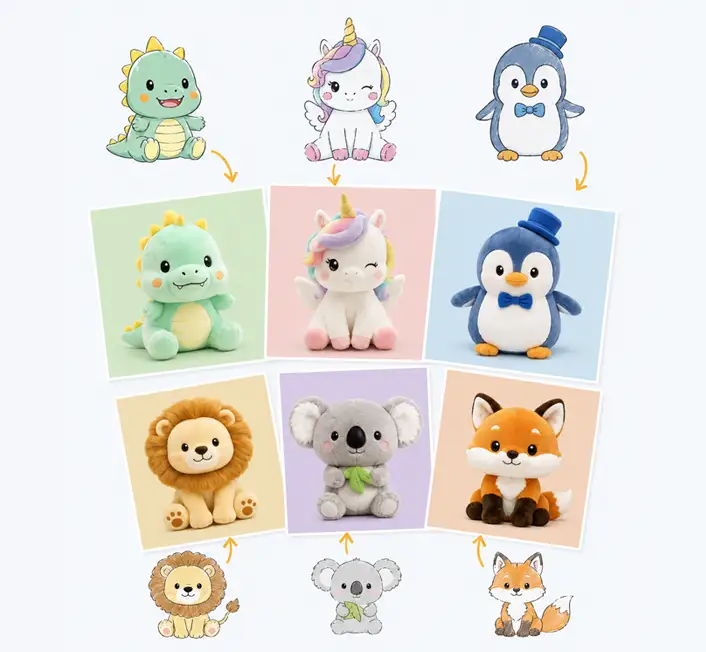
Pattern development is the process of converting a two-dimensional character design into a set of fabric panels that, when cut and sewn together, produce the intended three-dimensional silhouette. This stage requires translating flat, often stylized character proportions — large heads, short limbs, exaggerated features — into a pattern that reads correctly once filled with stuffing, since fabric behaves very differently under tension and fill pressure than a flat illustration does.
Sampling and Prototyping
Sampling produces a physical prototype from the developed pattern, allowing the brand to evaluate proportion, fabric feel, color accuracy, and construction quality before committing to bulk production. This stage typically involves multiple rounds, since the first sample rarely matches the design brief exactly on every dimension, and revisions to seam placement, stuffing density, or embroidery detail are a normal and expected part of the process rather than a sign of a flawed initial pattern.
Bulk Production and Quality Control
Once a sample is approved, the pattern, materials, and construction specification are locked and scaled into bulk production, with quality control checkpoints applied throughout the run to confirm that mass-produced units consistently match the approved sample. Skipping a formal sample approval step before bulk production is one of the most common and most costly mistakes brands make, since any unresolved design or material issue is then replicated across the entire production quantity rather than caught and corrected at the prototype stage.
Plush Toy Development Timeline by Stage
| Development Stage | Typical Duration | Key Output |
|---|---|---|
| Design brief and reference gathering | 3–7 days | Approved creative direction and specifications |
| Pattern development and first sample | 10–18 days | Initial physical prototype |
| Sample revision rounds (per round) | 7–12 days each | Refined prototype closer to final approval |
| Pre-production sample and material lock | 5–10 days | Approved reference for bulk production |
| Bulk production | 25–45 days (volume-dependent) | Finished production units |
| Final inspection and quality sign-off | 2–4 days | Shipment-ready approved goods |
Choosing Materials for a Brand Plush Toy
Material selection determines the finished plush toy’s texture, durability, cost, and compliance status, making it one of the most consequential decisions in the entire development process. The outer fabric, filling material, and any decorative or functional accessories must be selected together, since each affects how the others perform once assembled into a finished product.
Outer Fabric Selection
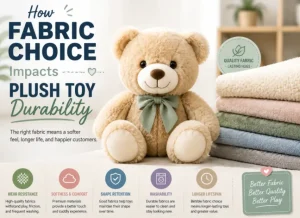
Outer fabric choice affects the plush toy’s tactile quality, visual appearance, and durability, and different fabric types are suited to different character styles and price points. Short-pile plush fabrics suit sleek, modern character designs and simplify embroidery detail, while long-pile or minky-style fabrics create a softer, cuddlier feel often preferred for baby-safe or comfort-oriented products.

Filling Material and Density
Filling material determines how the finished plush toy feels when held and how well it holds its shape over time. Polyester fiberfill is the most widely used filling for standard huggable plush due to its softness, washability, and cost efficiency, while PP cotton and specialty fillings such as microbeads or weighted pellets are selected for specific tactile effects, including a more structured shape or added weight for comfort-oriented or sensory products.
Common Plush Toy Materials and Their Applications
| Material | Typical Use | Key Characteristics |
|---|---|---|
| Short-pile plush fabric | Character plush with defined facial features | Clean embroidery detail, moderate softness |
| Long-pile / minky fabric | Cuddly, comfort-oriented plush | Very soft hand feel, higher fabric cost |
| Polyester fiberfill | General-purpose stuffing | Lightweight, washable, cost-efficient |
| PP cotton filling | Structured shape retention | Firmer feel, holds pose better than fiberfill |
| Weighted pellet filling | Sensory or comfort plush | Added heft, requires reinforced inner lining |
| Safety eyes and noses (plastic/embroidered) | Facial features | Pull-tested for safety compliance where used |
Material Tip: Request physical fabric swatches and a small filled test pouch before committing to a fabric and filling combination, rather than approving based on a written specification or a photo alone. The way a fabric drapes and the way a filling settles inside it are very difficult to judge accurately without handling a physical sample, and this is one of the lowest-cost verification steps available before full sampling begins.
Design Elements That Determine Whether a Plush Toy Succeeds
Beyond material selection, several specific design decisions consistently separate plush toys that succeed commercially from those that underperform, regardless of the underlying character or brand strength. These elements are frequently overlooked by brands designing their first plush product because they are less visible in a flat character illustration than in the finished three-dimensional object.
Proportions, Huggability, and Physical Comfort
Huggability — how comfortable and satisfying a plush toy feels to hold — is determined by proportion, size, stuffing density, and the ratio of soft, rounded surfaces to any rigid or textured elements. A character with sharp angular features that work well in a flat illustration often needs to be softened and rounded in the physical pattern to avoid feeling uncomfortable or visually “off” once translated into fabric and filling.
Surface Detail: Embroidery, Printing, and Applique
Facial features and surface details can be executed through embroidery, screen printing, applique, or a combination of methods, and each approach carries different costs, durability, and visual outcomes. Embroidery is generally the most durable and premium-feeling option for facial features and is standard for safety-sensitive elements like eyes on products intended for young children, since it eliminates small parts that could present a choking hazard.
Color Accuracy and Fabric Matching
Color accuracy between a brand’s approved color palette and the physical fabric used in production is a common source of miscommunication, since fabric dye lots vary and screen colors do not always translate predictably to physical materials. Providing a Pantone reference or a physical color swatch, rather than relying on a digital color code alone, significantly improves the likelihood that the first sample matches the intended brand colors.
Design Tip: Build a small reference library of pinch-test photos — close-up images showing how a similar fabric and filling combination looks when gently pinched or squeezed — before finalizing the fabric specification. This helps confirm the finished plush will read as soft and huggable rather than overly firm or under-filled, a detail that is difficult to assess from fabric swatches alone.
Safety Compliance and Testing Requirements for Plush Toys
Plush toys sold in regulated markets such as the United States and the European Union must meet mandatory safety standards before they can legally enter the market, and compliance is not optional regardless of order volume or product positioning. Understanding which standards apply to a target market and building compliance into the development process from the earliest stages prevents costly late-stage redesigns or shipment holds.

Key Standards by Market
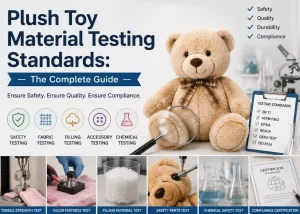
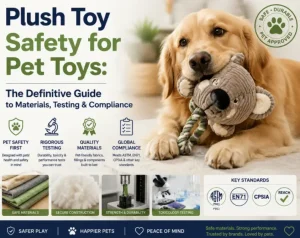
In the United States, plush toys must comply with ASTM F963 and the Consumer Product Safety Improvement Act (CPSIA), which govern mechanical hazards, flammability, and chemical content, including lead and phthalate limits. In the European Union, EN71 governs mechanical, physical, flammability, and chemical safety, while REACH regulates the broader chemical substance content of materials used in the finished product.
Plush Toy Safety Standards by Target Market
| Standard | Governing Market | What It Covers |
|---|---|---|
| ASTM F963 | United States | Mechanical hazards, small parts, flammability, sharp points/edges |
| CPSIA | United States | Lead content, phthalate limits, tracking labels |
| EN71 (Parts 1–3) | European Union | Mechanical/physical, flammability, chemical migration |
| REACH | European Union | Restricted chemical substances in materials |
| AS/NZS ISO 8124 | Australia/New Zealand | Mechanical, flammability, and chemical safety |
Pull Testing and Small Parts Compliance
Any attached component — plastic eyes, noses, bows, or accessories — must pass pull testing to confirm it cannot be detached with the force a child could reasonably apply, since a detached small part presents a choking hazard. Products intended for children under three years old face additional restrictions on small parts entirely, which is why embroidered facial features are frequently required rather than attached plastic components for products in this age category.
Compliance Tip: Confirm the target age grading for the plush toy before finalizing the design, since age grading directly determines which construction methods and materials are permissible. A product designed with attached plastic safety eyes cannot simply be re-labeled for a younger age group later; the construction itself must change, which means age grading needs to be settled during the design brief stage, not after samples are already approved.
The Sampling Process: What to Expect and How Many Rounds Are Normal
The sampling process is where a brand’s design intent is tested against manufacturing reality, and understanding what each sample round is meant to accomplish helps set realistic expectations for timeline and revision count. Most custom plush toy designs require two to four sample rounds before reaching final approval, with more rounds typically needed for complex characters, articulated features, or non-standard construction methods.
Typical Plush Toy Sample Rounds and Their Purpose
| Sample Round | Primary Purpose | Common Revisions Requested |
|---|---|---|
| First sample | Validate overall proportion, silhouette, and construction feasibility | Size adjustment, proportion correction, fabric swap |
| Second sample | Confirm color accuracy, embroidery detail, and stuffing density | Color matching, filling density adjustment |
| Third sample (if needed) | Fine-tune remaining details and finalize construction | Minor seam or detail refinement |
| Pre-production (golden) sample | Lock the final reference standard for bulk production | Sign-off only; no further design changes expected |
Treating the pre-production sample as a firm reference standard — rather than continuing to request changes after it is approved — keeps the development timeline predictable and gives the production team a clear, unambiguous benchmark for quality control during bulk manufacturing.
Sampling Tip: Provide written, itemized feedback for every sample round rather than verbal or informal comments, and keep a dated record of each round’s approved and rejected elements. This creates a clear audit trail that prevents previously resolved issues from resurfacing in later rounds and gives both the brand and the development team a shared reference point when evaluating the next sample.
Working with a Manufacturer: MOQ, Lead Time, and Cost Structure
Minimum order quantity, lead time, and cost structure vary significantly depending on design complexity, material choices, and order volume, and understanding these variables helps a brand plan a realistic launch budget and timeline. Complex characters with multiple fabric panels, special features, or non-standard materials generally carry higher minimum order quantities and per-unit costs than simpler designs using standard materials.
Factors That Influence Minimum Order Quantity
Minimum order quantity is primarily driven by the fixed costs of production setup — pattern cutting dies, embroidery digitization, and machine changeover — which must be amortized across the order volume to reach a commercially viable per-unit price. A simple, single-fabric plush design can often be produced at a lower minimum order quantity than a design requiring multiple fabric types, applied accessories, or custom packaging inserts.
Cost Drivers Beyond the Unit Price
Total project cost includes more than the per-unit production price: sampling fees, any custom tooling or embroidery digitization charges, compliance testing costs, and packaging development all contribute to the total investment required to bring a plush toy to market. Brands evaluating quotes from different sources should request an itemized breakdown of these components rather than comparing unit price alone, since two quotes with similar unit prices can carry very different total project costs once these additional factors are included.
Sourcing Tip: Ask for a complete itemized quote that separates unit price, sampling fees, tooling or digitization charges, and compliance testing costs before comparing options. A lower unit price paired with higher sampling and compliance fees can easily produce a higher total project cost than a slightly higher unit price with those costs already included.
Packaging and Branding Elements to Consider
Packaging is an extension of the plush toy’s brand presentation and, for retail products, plays a direct role in purchase decisions on the shelf or in an online listing photo. Packaging decisions include whether the product ships in a simple polybag, a printed header card, a branded box, or a hang-tag configuration, and each option carries different cost and presentation implications.

Hang tags and sewn-in labels are also where required compliance information — age grading, care instructions, country of origin, and safety warnings — must appear, making label design a compliance requirement as well as a branding opportunity. Coordinating packaging design with the compliance requirements identified earlier in development, rather than treating labeling as an afterthought, avoids last-minute packaging redesigns after bulk production is already scheduled.
Common Mistakes Brands Make When Creating Plush Toys
Several mistakes recur consistently across brands developing their first plush toy product, and most of them are avoidable with earlier planning rather than requiring additional cost or complexity to fix. Recognizing these patterns in advance helps a brand structure its development process to avoid them.
Common Plush Toy Development Mistakes and How to Avoid Them
| Common Mistake | Why It Happens | How to Avoid It |
|---|---|---|
| Skipping physical fabric swatches | Relying on digital references alone | Request physical swatches before pattern development |
| Underestimating sample revision rounds | Assuming the first sample will match the brief exactly | Budget for 2–4 rounds in the timeline from the start |
| Finalizing age grading too late | Treating compliance as a final-stage checklist item | Confirm the target age group during the design brief stage |
| Approving bulk production without a golden sample | Time pressure to meet a launch date | Always lock a pre-production reference sample first |
| Comparing suppliers on unit price alone | Unit price is the most visible number in a quote | Request an itemized total cost breakdown for comparison |
Budgeting for a Custom Plush Toy Program
A realistic plush toy development budget accounts for design and sampling costs, compliance testing, per-unit production cost at the target order volume, and packaging development, rather than focusing exclusively on the anticipated per-unit price at bulk volume. Brands launching their first plush product frequently underestimate the pre-production investment required before any sellable units exist, which can create cash flow surprises if not planned for from the outset.
Building in a contingency for at least one additional sample round beyond the minimum expected and for potential compliance retesting if an initial material choice does not pass testing produces a more resilient budget than planning for the worst-case scenario only. Programs that plan for these realistic contingencies from the start experience fewer disruptive budget surprises during development than those that assume every stage will proceed on the first attempt.
Frequently Asked Questions
How long does it typically take to develop a custom plush toy from concept to finished product?
A typical custom plush toy development timeline runs eight to fourteen weeks from an approved design brief to shipment-ready bulk production, depending on design complexity, the number of sample revision rounds required, and the production volume ordered. Simple, single-fabric designs with minimal revisions can move faster, while characters with multiple fabric types, special features, or several rounds of color correction generally extend toward the longer end of this range.
What information should be included in a design brief before starting plush toy development?
A complete design brief should include reference art or photography of the character, target finished size, preferred fabric texture and colorway with a Pantone reference if possible, key proportion notes, any special features such as sound modules or weighted elements, and the target age grading for the finished product. Providing this information upfront reduces the number of sample revision rounds needed, since the pattern maker has clear guidance rather than having to make assumptions about ambiguous elements of the design.
How many sample revision rounds should a brand expect before a plush toy design is finalized?
Most custom plush toy designs require two to four sample rounds before reaching final approval: an initial sample to validate proportion and construction, a second round to confirm color and stuffing density, and in some cases a third round to fine-tune remaining details, followed by a pre-production golden sample that locks the final reference standard. Complex characters with articulated features or non-standard materials often require additional rounds beyond this typical range.
What safety certifications does a plush toy need to be sold in the United States and the European Union?
Plush toys sold in the United States must comply with ASTM F963 and the Consumer Product Safety Improvement Act, covering mechanical hazards, flammability, and chemical content limits, including lead and phthalates. Plush toys sold in the European Union must comply with EN71 for mechanical, physical, flammability, and chemical migration safety, along with REACH regulations governing restricted chemical substances. Products sold in both markets typically need to meet both sets of standards, which can affect material selection and construction method from the earliest design stage.
What is the difference between embroidered and printed facial features on a plush toy, and which is better?
Embroidered facial features are stitched directly into the fabric using thread, producing a durable, textured result that typically withstands washing and handling better than printed alternatives and is generally required for safety compliance on products for very young children since it avoids small attached parts. Printed features are applied using screen printing or heat transfer, which can achieve more detailed or gradient color effects at a lower cost but may fade or crack over repeated washing. The better choice depends on the character’s design complexity, target age group, and expected product lifespan, with embroidery generally preferred for premium, long-lasting, or young-child-safe products.
How is the minimum order quantity determined for a custom plush toy design?
Minimum order quantity is primarily determined by the fixed setup costs of production, including pattern cutting preparation, embroidery digitization, and machine changeover, which must be spread across enough units to reach a commercially reasonable per-unit price. Designs using standard materials and simpler construction generally support lower minimum order quantities than designs requiring multiple fabric types, custom accessories, or specialized features, since the latter carry higher fixed setup costs that need a larger volume to amortize efficiently.
Can a brand skip the sampling stage and go directly to bulk production to save time and cost?
Skipping the sampling stage is possible but is not advisable, since it removes the only opportunity to catch proportion, color, material, or construction issues before they are replicated across an entire bulk production run. The cost of correcting a design or material problem discovered during bulk production — through rework, partial scrap, or a delayed relaunch — is consistently higher than the cost and time of an additional sample round, making the sampling stage a cost-saving step in practice rather than an optional expense to eliminate.