Skip to content
Everything product developers, brand teams, and sourcing managers need to know about light-up plush toys — from LED circuit design and fabric diffusion to safety compliance, assembly, and cost drivers.
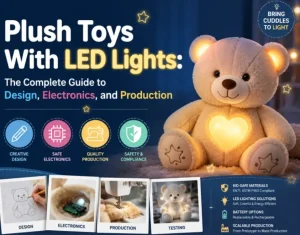
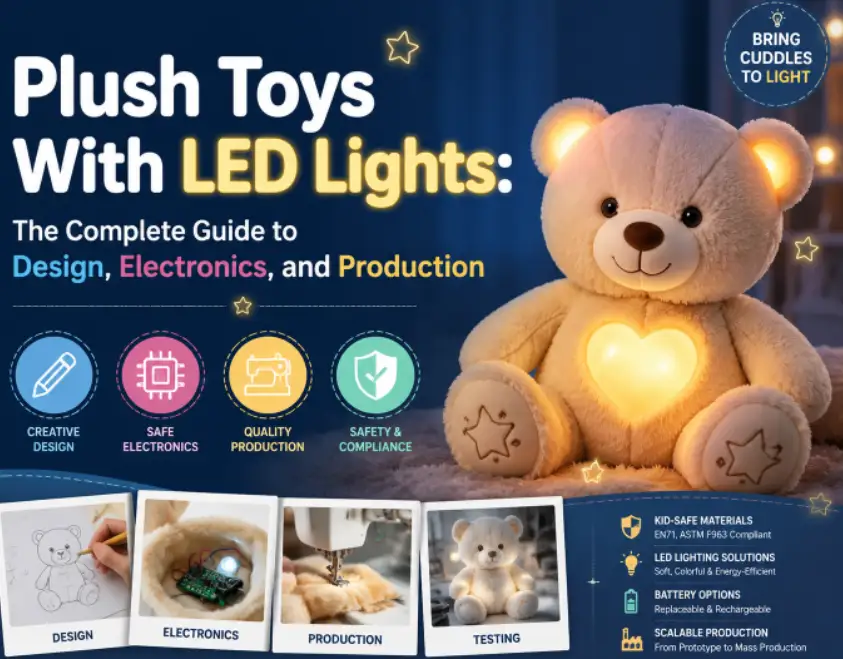
Plush toys with LED lights combine soft-goods manufacturing with embedded electronics to create a stuffed animal, pillow, or character that glows, flashes, or changes color on demand. The category spans simple nightlight companions for toddlers to sensor-driven, color-cycling collectibles sold at retail and through licensing programs.
Because a light-up plush toy is really two products fused into one — a sewn textile shell and a small electronic lighting circuit — designing and manufacturing one successfully requires coordination between fabric selection, circuit engineering, battery safety, and compliance testing that a standard plush toy never has to address.
This guide walks through how LED lighting systems function inside plush toys, which fabrics and fills work best with internal light sources, the safety standards that govern battery-powered children’s products, and the manufacturing steps that separate a reliable light-up plush from one prone to premature failure.
What Is a Light-Up Plush Toy?
A light-up plush toy is a soft toy with an embedded LED module — typically one to a dozen individual LEDs, a small driver circuit, a power source, and an activation mechanism — sewn or pocketed inside the plush body so that light diffuses through the outer fabric. The lighting element is usually housed in a sealed or semi-sealed compartment separate from the polyester fiberfill, both to protect the electronics from crushing and to keep stuffing material away from heat-generating components.
Most light-up plush toys fall into one of three functional categories: ambient nightlight plush designed for a soft, steady or slow-fading glow; interactive plush that reacts to sound, motion, or touch with a lighting response; and novelty or seasonal plush where LEDs are a decorative feature layered onto an otherwise conventional stuffed toy. The engineering requirements differ across all three, which is why light-up plush toy manufacturing typically starts with a clear definition of how the light should behave before fabric or fill decisions are finalized.
How LED Lighting Systems Work Inside Plush Toys
An LED plush lighting system is built around four functional layers: the light source itself, the driver circuit that controls brightness and pattern, the power supply, and the activation input. Understanding how these layers interact is the starting point for any light-up plush toy design brief, because the choice made at each layer constrains what is possible at the next.
Core Electronic Components in a Light-Up Plush Toy
| Component | Function | Common Design Consideration |
|---|---|---|
| Surface-mount LED chips | Generate the light source, typically warm white, RGB, or color-cycling | Low heat output and low current draw to remain safe against fabric and fill |
| Driver/control PCB | Regulates current, runs lighting patterns, and manages activation logic | Board size must fit within a soft, flexible cavity without creating a hard lump |
| Battery holder and cells | Supplies power, usually AAA/AA replaceable cells or a sealed rechargeable pack | Compartment must be tamper-resistant and screw-secured for products intended for young children |
| Activation switch or sensor | Triggers the light, via push button, tilt switch, sound sensor, or pressure pad | Sensor placement must be reachable through fabric without creating a firm pressure point |
| Light diffusion layer | Spreads and softens the LED point-source light through the fabric | Fabric weight, weave density, and color all affect how evenly light travels |
| Wire harness and strain relief | Connects components while surviving repeated flexing and hugging | Wire gauge and routing must tolerate compression without fatigue fracture |
Power Sources: Replaceable Batteries vs. Rechargeable Modules
Most light-up plush toys use a removable battery pack housed behind a screw-secured cover, which is the configuration most compliance frameworks favor because it prevents small children from accessing button cells or lithium cells without a tool. Rechargeable lithium polymer packs are increasingly used in premium or higher-priced interactive plush, offering longer run time per charge and a lower long-term cost per use, but they add a charging port, additional circuit protection, and typically a higher unit cost due to battery certification requirements.
The choice between disposable and rechargeable power directly affects the target price point, the compliance testing scope, and the expected product lifespan, so it is usually the first electronics decision made in a light-up plush toy development brief.
Circuit Design Considerations for Soft-Goods Integration
Designing a lighting circuit for a plush toy is not the same discipline as designing one for a rigid electronic product, because every component must survive being squeezed, dropped, sat on, and repeatedly bent along with the fabric that surrounds it. Rigid PCBs are typically kept as small as possible and positioned in a location on the body that receives the least mechanical stress, such as the chest or back cavity rather than a limb, while flexible printed circuits are increasingly used for designs that need the LED array to follow a curved or irregular body shape without adding a hard, noticeable lump under the fabric.
Current limiting is another point of attention specific to plush applications: because the LED module sits close to fabric and fill, the driver circuit is typically designed to keep operating current low enough that even a sustained short circuit cannot generate meaningful heat, rather than relying solely on a fuse or protection circuit to catch a fault after it occurs. This conservative approach to current draw is one of the reasons light-up plush toys can be certified as safe for extended, unsupervised play in a way that many other battery-powered electronics cannot.
Types of LED Lighting Effects Used in Plush Toys
Not all light-up plush toys glow the same way, and the choice of lighting effect has a direct impact on circuit complexity, battery life, and unit cost. The four effect families below cover the large majority of light-up plush products currently in production.

Comparison of Common LED Effect Types in Plush Toy Design
| Effect Type | Typical Use Case | Circuit Complexity | Approx. Battery Life Impact |
|---|---|---|---|
| Steady glow (single color) | Nightlight companions, sleep-aid plush | Low | Longest run time; lowest current draw |
| Slow fade/breathing pattern | Calming or sleep-training plush | Low to moderate | Slightly reduced vs. steady glow due to driver overhead |
| Color-cycling RGB | Novelty and collectible plush | Moderate | Moderate reduction; more LEDs typically active |
| Sound- or motion-reactive | Interactive plush that responds to hugs, claps, or movement | High | Highest draw due to always-listening sensor circuitry |
Sound-reactive and motion-reactive lighting effects require an always-on microphone or accelerometer circuit, which draws a small standby current even when the LEDs are off. This standby draw is one of the most common reasons interactive light-up plush toys report shorter battery life than their steady-glow counterparts, even when the LED brightness settings are identical.
Design Tip: If battery life complaints are a concern for your target age group, specify an auto-sleep timeout (commonly 15–30 minutes of inactivity) in the control circuit brief. This single feature reduces standby drain more than almost any other design change on interactive plush.
Materials and Fabric Selection for Light-Up Plush
Fabric choice determines how evenly and how brightly the internal LED light reaches the outside of a light-up plush toy, which makes material selection an optical decision as much as a tactile one. Dense, tightly woven plush fabrics such as heavy minky or high-pile faux fur block more light and require brighter or more numerous LEDs to achieve a visible glow, while lighter-weight, more loosely woven plush fabrics and lower-GSM fleece diffuse light more efficiently but offer a less plush hand-feel.
Matching Fabric Weight to Light Diffusion Requirements
As a general guideline, light and medium-pile plush fabrics in the 280–380 GSM range diffuse LED light reasonably well while retaining an acceptable soft-goods texture, whereas fabrics above roughly 450 GSM typically require either a translucent fabric panel over the light source or a higher-output LED to compensate for light loss through the material. Solid, saturated fabric colors also absorb more light than pastel or white tones, which is why many nightlight-style plush toys use lighter belly panels or face panels specifically positioned over the LED module.
Fill selection matters as well. Standard polyester fiberfill is largely opaque and is packed away from the light module in a separate compartment, while any fill placed directly over an LED window should be a lower-density, more translucent fiberfill to avoid dulling the glow.
Design Tip: Request fabric swatches lit from behind with a sample LED before finalizing color and pile height. A light-diffusion test at the swatch stage catches glow-through problems before an entire production run is cut and sewn.
Safety Standards and Compliance for Light-Up Plush Toys
Light-up plush toys are regulated as both toys and electronic products, which means they must satisfy textile and choking-hazard toy safety requirements in addition to electrical and battery safety requirements. Compliance scope depends heavily on the target market and the intended age grading of the product, since battery accessibility rules in particular are far stricter for toys intended for children under three.
Key Compliance Areas for Light-Up Plush Toy Manufacturing
| Compliance Area | What It Covers | Common Testing Reference |
|---|---|---|
| General toy safety | Sharp points, small parts, fiber content, flammability of the fabric shell | ASTM F963 (US), EN 71 (EU), similar national toy standards |
| Battery accessibility | Battery compartment must resist opening by a child without a tool | Screw-secured or locking compartment design; torque and drop testing |
| Electrical and electronic safety | Circuit insulation, short-circuit protection, overheating limits | IEC 62115 (electric toys) and equivalent regional standards |
| Chemical and material safety | Restricted substances in fabric, plastics, and electronic components | CPSIA lead/phthalate limits (US), REACH (EU), similar frameworks |
| Labeling requirements | Age grading, battery type and disposal warnings, country-of-origin marking | Varies by destination market; often the most overlooked step |
Age grading has an outsized effect on compliance cost and design freedom. Products graded for children under three generally cannot include button-cell batteries at all in many jurisdictions unless the compartment meets an enhanced security standard, and small decorative elements near the LED window must pass the same small-parts cylinder testing applied to the rest of the toy. This is why light-up plush toy briefs should specify the intended age grade at the very start of development, rather than treating it as a late-stage labeling decision.

Compliance Tip: Request third-party test reports for the LED module and battery holder independently of the finished-plush test report. A component-level electrical test catches circuit issues earlier and more cheaply than waiting for a full finished-product test cycle.
Manufacturing Process: From Concept to Production
Producing a light-up plush toy follows the same broad development arc as any soft toy — design, sampling, testing, and mass production — but with an additional electronics workstream running in parallel from the concept stage onward. Skipping ahead to sewing before the electronics layout is confirmed is one of the most common causes of rework in light-up plush development.
Design and Prototyping
Development typically begins with a concept sketch showing where the LED module, wiring path, and battery compartment will sit inside the character’s body, since these placements constrain the plush pattern before any fabric is cut. A functional electronics prototype — often a breadboard or hand-wired sample — is built and tested for brightness, color accuracy, and current draw before it is integrated into a sewn sample, which avoids discovering circuit problems only after a full soft-goods sample has already been produced.
Electronics Integration
Once the circuit is validated, the LED module and driver board are encapsulated, typically in a soft, sealed pouch or a light plastic housing, to protect components from moisture, crushing, and the friction of repeated handling. The wire harness connecting the LED module to the battery compartment is routed along seam allowances where possible, secured with strain-relief stitching or clips at stress points such as the neck and limb joints where a plush toy is most frequently bent or pulled.
Assembly and Quality Control
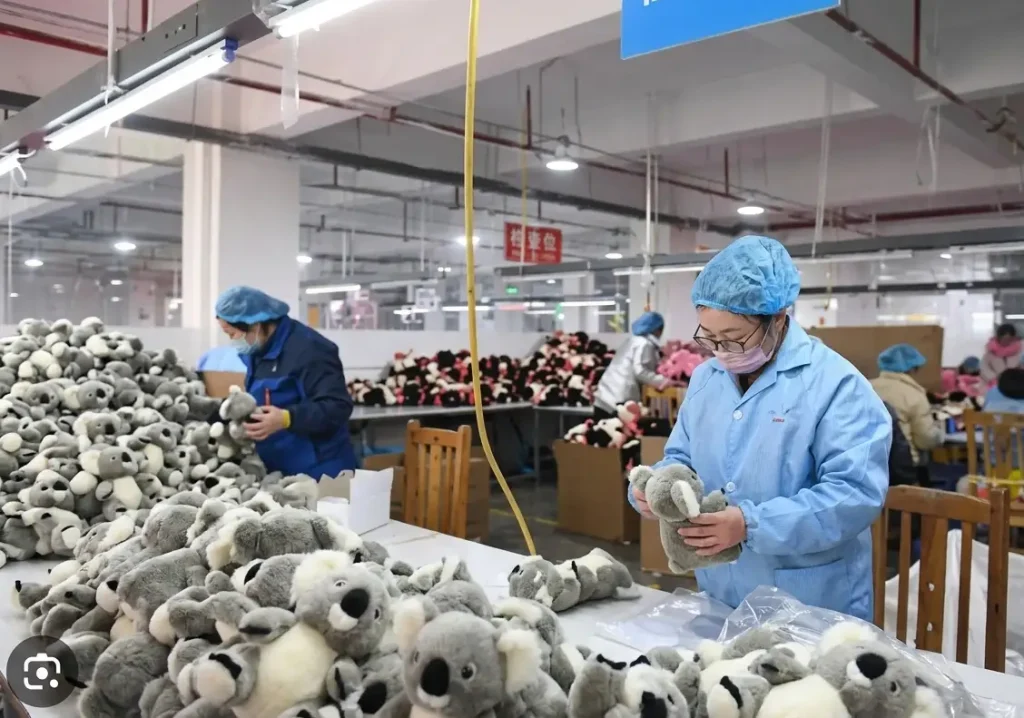
During assembly, the electronics module is inserted before final closing stitches, and functional testing — confirming that the light activates correctly, that brightness is consistent, and that the battery compartment locks securely — is typically performed on every finished unit rather than on a sample basis only, since a non-functioning light is a highly visible defect to an end customer. Additional in-line checks confirm stitch security around the electronics pocket, since this seam experiences more repeated stress than a standard plush seam and is a common point of long-term failure if under-reinforced.
Production Tip: Build 100% functional light-testing into the final QC checkpoint rather than relying on sample-based AQL sampling for the electronics function alone. Fabric and stitching defects can reasonably be sampled, but a dead LED unit reaching a customer is a much higher-visibility failure than a minor stitching flaw.
Battery Life, Durability, and Common Defects
Because light-up plush toys combine a textile product with an electronic one, their failure modes span both categories. Understanding the most frequent defect types helps buyers write clearer inspection criteria and helps factories target the highest-risk points in the assembly process.
Common Defects in Light-Up Plush Production and Their Root Causes
| Defect | Typical Root Cause | Preventive Action |
|---|---|---|
| LED fails to light | Cold solder joint, loose connector, or battery contact corrosion | 100% functional testing before packing; reinforced connector housings |
| Dim or uneven glow | Fabric too dense over the light window, or LED positioned off-center | Diffusion testing at swatch stage; fixed jig for LED placement |
| Battery compartment cracks or loosens | Thin plastic housing or under-torqued screws during assembly | Impact-tested housing material; torque spec verification in QC |
| Wire fatigue / intermittent light | Repeated flexing at the neck or limb without adequate strain relief | Strain-relief stitching at all flex points; stress-cycle testing on samples |
| Short battery life vs. spec | No auto-sleep timeout; oversized or always-on sensor circuit | Auto-sleep timer in firmware; standby current measurement during development |
Wire fatigue at flex points deserves particular attention because it is the defect most likely to appear only after weeks or months of normal handling rather than during initial inspection, which makes it a common source of post-shipment return claims if strain relief is not engineered in from the start.
Development Tip: Run a mechanical flex-cycle test on any early sample — repeatedly bending the neck, arm, or leg seam containing the wire harness several thousand times — before finalizing the wire routing. This single test surfaces most long-term wire-fatigue failures long before mass production begins.
Cost Factors for LED Plush Toy Manufacturing
Light-up plush toys cost more per unit than an equivalent non-electronic plush, and the gap is driven primarily by the electronics bill of materials, additional assembly labor, and expanded compliance testing rather than by the fabric or fill itself. The LED module, driver circuit, battery holder, and wiring typically represent the single largest cost addition, with pricing scaling based on LED count, whether the lighting is single-color or RGB, and whether a sensor-based activation system is included.
Assembly labor increases as well, since inserting, connecting, and functionally testing an electronics module takes measurably longer per unit than closing a standard plush toy. Compliance testing adds a further layer of fixed cost that is largely independent of order volume, meaning the compliance cost per unit falls sharply as order quantities rise — a key reason light-up plush programs are typically more cost-efficient at higher minimum order quantities than at very small trial runs.
Tooling and jig costs for consistent LED placement, along with the cost of a dedicated battery-compartment mold if a custom housing shape is required, are typically one-time development costs that are amortized across the production run rather than recurring per-unit charges.
Customization requests also influence cost in ways that are easy to underestimate at the quoting stage. A request for a custom color-changing sequence, a branded lighting pattern tied to a specific character or campaign, or a non-standard battery compartment shape usually requires additional firmware programming or tooling work beyond what a factory’s existing light-up plush platform already supports.
Buyers evaluating quotes across multiple manufacturers should confirm whether a quoted unit price assumes an existing, previously validated lighting module or a newly engineered one, since the two scenarios can carry very different development timelines and non-recurring engineering charges even when the finished plush toy looks similar on paper.
Common Applications of LED Light-Up Plush Toys
Light-up plush toys serve several distinct end uses, and the intended application should shape lighting brightness, battery life targets, and safety grading from the outset of development. A nightlight companion intended for a dark bedroom has almost the opposite lighting requirement from a promotional plush meant to stand out under bright retail or event lighting, which is why defining the primary use case early prevents costly redesign later in development.
- Sleep and nightlight companions — soft, low-brightness, steady or slow-fade lighting designed to comfort a child at bedtime without overstimulating.
- Gift and seasonal plush — color-cycling or novelty lighting effects tied to holidays, character licensing, or gifting occasions where visual impact matters more than long battery runtime.
- Interactive and educational plush — sound- or touch-reactive lighting used to reinforce cause-and-effect learning or simple bonding play patterns for younger children.
- Promotional and event plush — branded light-up plush produced for trade shows, sports events, or retail promotions, where visibility in low-light settings is the primary design goal.
- Collector and premium plush — higher-end lighting effects, sometimes app- or remote-controlled, aimed at older children and adult collectors rather than infants or toddlers.
Current Trends Shaping Light-Up Plush Toy Design
Light-up plush toy design has moved noticeably toward smaller, lower-profile electronics as component miniaturization has improved, allowing lighting modules to sit inside smaller characters and thinner limbs without the stiff, bulky feel that older designs were known for. Where early light-up plush relied on a single fixed lighting pattern, newer designs increasingly offer multiple selectable modes through a single button, giving one physical product several distinct play or comfort experiences without adding manufacturing complexity.
App-Connected and Remote-Controlled Lighting
A smaller but growing segment of the category adds Bluetooth or infrared connectivity, allowing a companion app or handheld remote to control color, pattern, and timing rather than relying on a single onboard button. This approach is typically reserved for premium or collector-oriented products because it adds meaningful cost and compliance scope — wireless modules introduce their own electromagnetic compatibility testing requirements on top of the standard toy and battery safety testing already required for a light-up plush toy.
Sustainability Considerations in Electronic Plush
Because light-up plush toys combine textile and electronic waste streams, end-of-life disposal is a more complex question than for a standard plush toy. Designs that make the electronics module removable, rather than permanently sewn in, are increasingly favored because they allow the battery and circuit board to be separated from the fabric shell for proper electronic waste disposal, and they simplify repair or battery replacement over the life of the product rather than requiring the entire toy to be discarded when a single component fails.
Choosing a Manufacturing Partner for Light-Up Plush Toys
Because a light-up plush toy sits at the intersection of soft-goods and electronics manufacturing, not every plush toy factory has in-house capability to design, source, and test the lighting circuit. When evaluating a manufacturing partner, buyers typically look for evidence of prior light-up or sound-module plush production, an in-house or closely partnered electronics engineering function capable of validating circuit design rather than only assembling purchased modules, and a documented functional-testing process applied to finished units rather than samples alone.
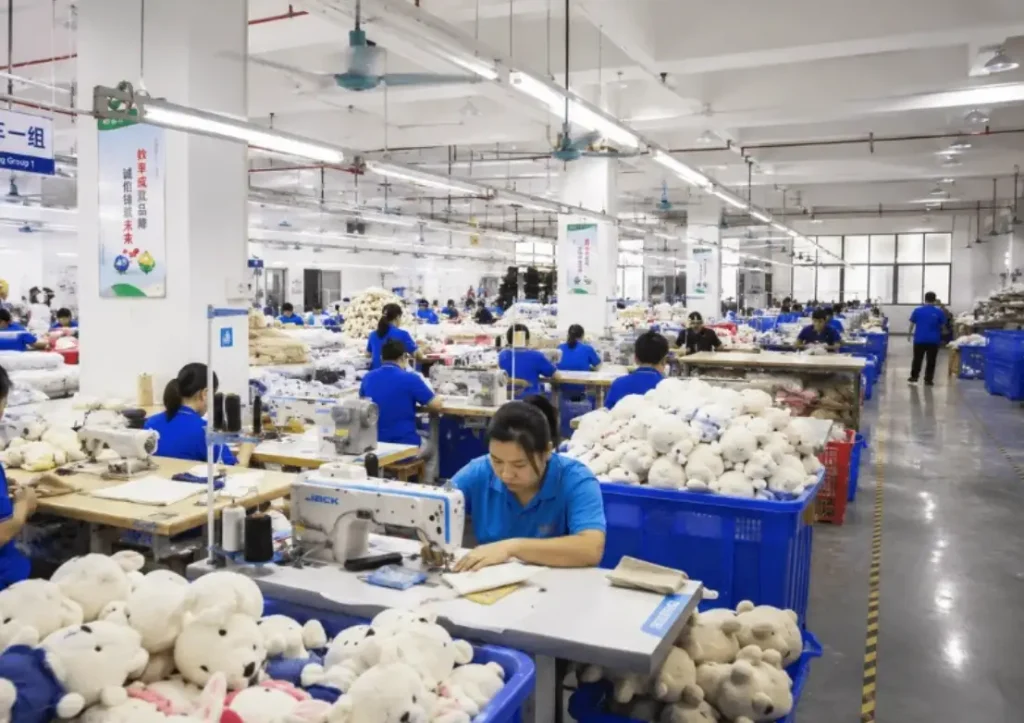
Requesting a functioning pre-production sample — not a static mockup or a rendering — before committing to a full production run remains the single most reliable way to confirm that a prospective manufacturing partner can deliver consistent lighting performance, secure battery compartments, and durable wire routing at scale.
It is also worth asking how a prospective partner handles design changes discovered during sampling. Because a light-up plush toy involves two interdependent development tracks — the soft-goods pattern and the electronics module — a change to one frequently requires an adjustment to the other, such as widening a seam to accommodate a slightly larger battery housing or repositioning a wire channel after a fabric change. A manufacturing partner with genuine light-up plush experience should be able to explain how these cross-dependencies are typically resolved before a buyer commits to tooling and a production schedule.
Frequently Asked Questions
1. How do LED lights stay safe inside a soft, huggable plush toy?
LED chips used in plush toys operate at low current and generate very little heat compared to household lighting, so they do not pose a burn risk when properly encapsulated. The light module is sealed inside its own compartment, separated from the fiberfill, and the battery housing is built to resist crushing and impact. Combined with low operating temperatures and secured wiring, this design keeps the electronics safe under normal hugging, squeezing, and repeated handling.
2. What is the typical battery life of a light-up plush toy?
Battery life varies widely depending on the lighting effect and activation method. A simple steady-glow plush on replaceable batteries can often run for many hours of continuous use, while sound- or motion-reactive plush with an always-on sensor circuit typically draws more power in standby and delivers shorter run time per battery set. Adding an auto-sleep timeout that shuts the light off after a period of inactivity is the most effective way to extend practical battery life without changing the LED brightness.
3. Can light-up plush toys be washed?
Most light-up plush toys are not fully machine washable because the electronics, battery compartment, and wiring are not waterproof. Care instructions typically recommend spot cleaning the fabric surface with a damp cloth while keeping the electronics compartment dry, or removing a detachable electronics module before any washing if the design supports it. Manufacturers should specify clear, tested care instructions on the product label rather than leaving washing guidance to guesswork.
4. Are LED light-up plush toys safe for babies and toddlers?
Light-up plush toys can be made suitable for younger children, but the design requirements are stricter than for older-age products. Battery compartments intended for children under three generally need enhanced tamper-resistant closures, button-cell batteries are restricted or prohibited in many markets for this age group, and all trims, LED windows, and decorative elements must pass small-parts testing. Buyers developing plush for infants and toddlers should confirm age-grading requirements with their compliance team before finalizing the electronics design, not after.
5. What fabrics work best for even LED light diffusion?
Lighter-weight, medium-pile plush fabrics generally diffuse LED light more evenly than dense, high-pile faux fur, and lighter fabric colors transmit more light than dark, saturated tones. Many designs place the light source behind a lower-GSM panel, such as a belly or face section, specifically to balance a soft overall texture with a bright, even glow where it matters most. Testing fabric swatches lit from behind before finalizing color and pile height remains the most reliable way to confirm diffusion performance.
6. How long do the LED components inside a plush toy typically last?
The LED chips themselves have a very long operational lifespan and are rarely the failure point in a light-up plush toy. In practice, product life is usually limited by mechanical factors such as wire fatigue at flex points, battery compartment wear, or connector corrosion rather than by the LEDs burning out. This is why strain relief, connector quality, and housing durability receive more engineering attention during development than the LED component itself.
7. What safety certifications should a light-up plush toy have?
A light-up plush toy generally needs to satisfy both general toy safety requirements, such as ASTM F963 in the United States or EN 71 in the European Union, and electrical toy safety requirements such as IEC 62115, in addition to chemical restrictions like CPSIA or REACH depending on the destination market. Because the product combines textile and electronic risk categories, buyers should confirm that test reports cover both the finished plush and the electronic module specifically, rather than assuming a standard plush toy test report is sufficient.
8. What causes a light-up plush toy to stop working after a period of use?
The most common causes are wire fatigue from repeated bending at the neck or limbs, loose or corroded battery contacts, and cold solder joints on the driver circuit that were not caught during functional testing. Fabric and stuffing rarely cause electronic failure directly; the electronics compartment itself is almost always the source of a working-to-non-working transition. Reinforced strain relief at flex points and full functional testing before packing address most of these failure modes before products reach the customer.
9. How much more does it cost to manufacture a plush toy with LED lights compared to a standard plush toy?
The added cost comes primarily from the electronics bill of materials — the LED module, driver circuit, battery holder, and wiring — along with additional assembly labor for insertion and functional testing, and expanded compliance testing scope. The size of the increase depends heavily on the lighting complexity, with simple single-color steady-glow modules adding the least cost and sensor-based, color-cycling, or app-controlled systems adding the most. Compliance testing is largely a fixed cost, so the added cost per unit decreases as order volume increases.