Skip to content
How We Manage Your Custom Plush Toy Projects from the first design idea to final delivery, with clear communication, professional sample development, careful production, strict quality control, and reliable project management at every stage.
Starting a custom plush toy project is easy. Finishing one on schedule, on budget, and to the standard you approved is much harder. Between the first sketch and the final carton leaving the dock, a typical order passes through design review, pattern making, several sample rounds, fabric sourcing, cutting, embroidery, sewing, stuffing, finishing, quality inspection, safety testing, packing, and shipping. Every stage has its own people, its own risks, and its own opportunities for a small misunderstanding to grow into an expensive problem.
Buyers who have run custom plush projects before usually agree that a factory’s sewing skill is only half of the equation. The other half is project management: the discipline of turning a brief into a controlled sequence of decisions, approvals, and handoffs that everyone involved can see. When project management is weak, even a technically capable factory delivers late, ships the wrong revision, or produces toys that drift away from the approved sample. When it is strong, problems are caught early, changes are priced before they happen, and the buyer always knows exactly where the order stands.
This guide explains how professional plush toy manufacturers manage custom projects from kickoff to after-sales follow-up. It covers project structure, brief alignment, sampling control, communication, material approval, production tracking, quality checkpoints, risk and change handling, and shipment release — with practical tables and seven tips you can apply when evaluating any supplier.
What Does Custom Plush Toy Project Management Actually Involve?
Custom plush toy project management is the structured process of planning, coordinating, documenting, and controlling every stage of a custom plush order — from the buyer’s initial brief to final delivery — so that scope, cost, quality, and timeline stay aligned with what the buyer approved. It is not a single job title or a weekly email. It is a system of defined phases, named owners, written approvals, and shared records that turns a creative idea into a repeatable manufacturing outcome.
A plush toy is an unusually difficult product to manage because it combines creative, textile, and safety-critical elements in one object. The design is visual and emotional, the construction is handcraft-intensive, the materials come from multiple suppliers, and the finished product must pass strict safety rules in the markets where it will be sold. A change to one element — a longer pile fabric, a larger embroidered eye, a different filling weight — can ripple through pattern dimensions, sewing time, packaging size, and test results. Project management exists to make those ripples visible before they become surprises.
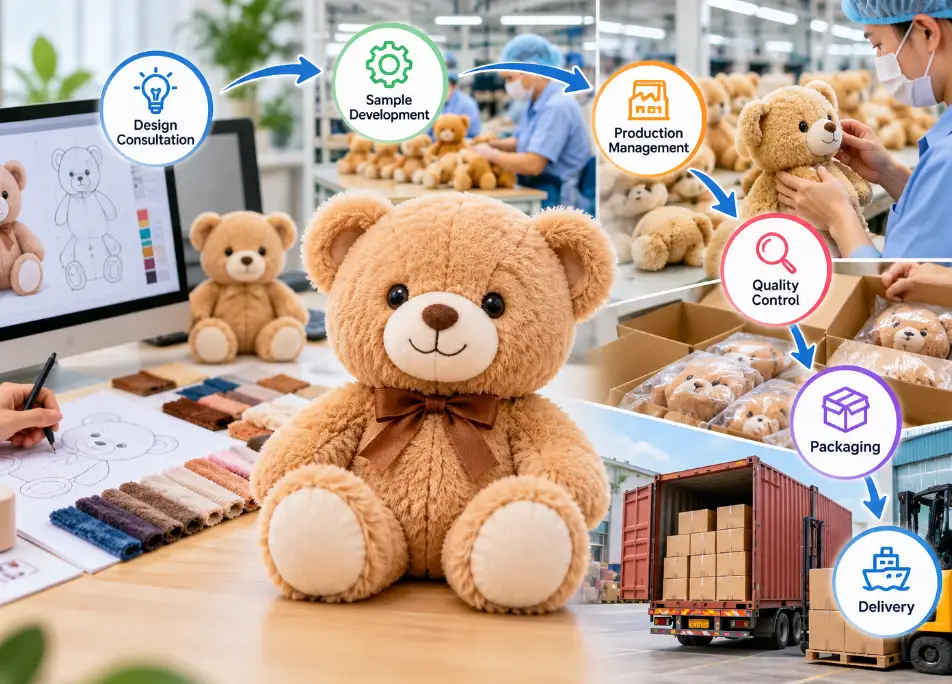
Well-run projects are divided into clear phases. Each phase has an input, an owner, a deliverable, and a gate that must be passed before the next phase begins. Gates are what separate a managed project from a loosely coordinated one, because they prevent unapproved work from flowing downstream where it is far more expensive to correct.
The Nine Phases of a Managed Custom Plush Toy Project
| Phase | Main Activities | Gate Before Moving On | Typical Duration |
|---|---|---|---|
| 1. Kickoff and brief | Requirements review, feasibility check, scope definition | Signed project brief | 2–4 days |
| 2. Design and pattern | Artwork conversion, pattern drafting, construction planning | Approved pattern and spec sheet | 4–7 days |
| 3. Sampling | Prototype building, revision rounds, photo and physical review | Written sample approval | 10–25 days |
| 4. Material sourcing | Fabric, filling, accessory, and packaging procurement | Material approval and test reports | 7–15 days |
| 5. Pre-production | Production sample, line setup, worker briefing | Pre-production sample sign-off | 5–8 days |
| 6. Mass production | Cutting, embroidery, sewing, stuffing, finishing | In-line inspection passed | 20–35 days |
| 7. Final inspection | AQL inspection, function checks, needle detection | Inspection report accepted | 2–4 days |
| 8. Packing and shipping | Carton packing, labeling, booking, documentation | Shipment release approval | 3–7 days |
| 9. After-sales follow-up | Delivery confirmation, feedback review, reorder planning | Project closure notes | Ongoing |
The durations above are typical ranges rather than promises, and they overlap in practice — material sourcing often begins while sampling is still being finalized. What matters is that every phase has a visible end point. If a buyer cannot tell which phase their order is currently in and what is needed to move to the next one, the project is not being managed; it is merely being processed.
How Does a Strong Project Kickoff and Brief Alignment Set the Foundation?
A strong project kickoff aligns the buyer and the factory on scope, specifications, budget, timeline, and compliance requirements before any material is purchased or any pattern is drawn. It converts a rough idea — a character illustration, a reference toy, a mood board — into a written brief that both sides have read, questioned, and signed. Most disputes that appear late in a plush project can be traced back to something that was assumed rather than written down during kickoff.
The kickoff process begins with a feasibility review. Not every design can be produced as drawn. Thin limbs may not hold stuffing evenly, small embroidered details may not survive at the requested scale, and certain color gradients may require printing rather than embroidery. A project manager who identifies these issues on day one saves the buyer weeks of failed samples. The goal is not to say no to creativity but to say yes with a clear plan for how the design will actually be built.
Kickoff also settles the questions that most often go unasked: which markets will the product be sold in, and therefore which safety standards apply? What is the target unit price and order quantity? What is the launch date, and is it fixed or flexible? Who on the buyer’s side has authority to approve samples and changes? Answering these early prevents the common situation where an approval is given by someone who later turns out not to have authority to give it.
Project Brief Checklist for Custom Plush Toy Orders
| Brief Element | What Should Be Specified | Risk If Left Vague |
|---|---|---|
| Design reference | Artwork files, turnarounds, reference photos, size in centimeters | Sample differs from the intended character |
| Target market | Country or region of sale and age grading | Wrong safety standard applied to materials |
| Materials | Fabric type, pile height, filling type, eye and accessory type | Cost and feel differ from expectations |
| Quantity and colorways | Total units, split by style or color, reorder expectation | Pricing and MOQ mismatch |
| Budget | Target unit price and acceptable range | Design over-engineered for the budget |
| Timeline | Launch date, hard deadlines, seasonal windows | Late delivery discovered too late to fix |
| Packaging | Hang tag, polybag, box, barcode, carton marks | Rework or repacking before shipment |
| Approval authority | Named approvers and their contact channels | Conflicting instructions from different people |
Tip: Write the brief as if a stranger will build it.
Assume the person reading your brief has never spoken to you and cannot ask questions. Include measurements in centimeters, name the target market, attach reference photos from several angles, and state which details are non-negotiable and which are flexible. A brief that survives this test protects you when staff changes on either side, when the project is transferred between departments, or when a reorder is placed a year later. If a supplier asks few or no questions after receiving your brief, treat that as a warning rather than a compliment. Thorough factories ask many questions at the start precisely because they know what each unanswered question costs later.
How Are Design Conversion, Pattern Making, and Sampling Managed?
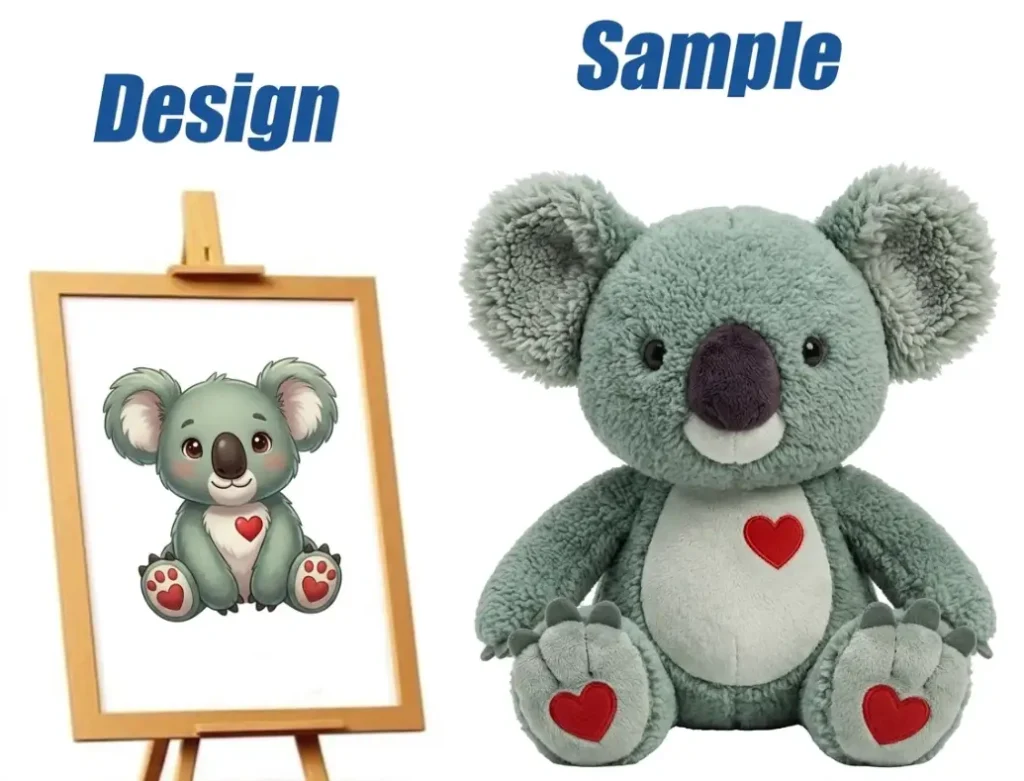
Design conversion, pattern making, and sampling are managed through a controlled loop in which every sample round has a defined purpose, a written feedback list, and a limit on the number of open changes. Sampling is where most of a plush project’s time and cost is decided, so it is also where discipline pays off most. Without structure, sampling turns into an open-ended conversation in which each round produces new opinions instead of fewer problems.
Design conversion comes first. A flat illustration must be translated into a three-dimensional form, and that translation involves judgment: where the seams will fall, how the face will be shaped, how much stuffing each section needs. An experienced pattern maker drafts the pieces, calculates seam allowances, and decides the sewing order. These decisions are recorded on a specification sheet that becomes the reference document for the rest of the project. When the specification sheet is complete, the first sample is a test of a plan rather than a guess.
Structuring Sample Rounds With Clear Objectives
Each sample round should answer a specific question. The first round typically tests overall shape and proportion. The second refines facial expression, embroidery detail, and fabric choice. The third confirms finishing details, labels, and accessories. Mixing all of these questions into every round makes feedback vague and prevents anyone from knowing whether the project is converging. A project manager who labels each round by its objective keeps the review focused and shortens the path to approval.
Consolidated Feedback and Version Control
Feedback should reach the factory as one consolidated list per round, not as a stream of separate messages. Every item on the list is numbered, marked with a photo or measurement where possible, and tracked until it is closed. Sample versions are labeled and physically tagged so that nobody confuses the second round with the third. This may sound bureaucratic, but plush factories often run dozens of projects at once, and unlabeled samples are one of the most common sources of production errors.
Sample Round Control Framework
| Sample Round | Primary Objective | Typical Review Focus | Exit Criteria |
|---|---|---|---|
| Proto sample 1 | Shape and proportion | Silhouette, size, limb position, overall character match | Form accepted with a numbered change list |
| Proto sample 2 | Face, details, and fabric | Embroidery accuracy, eye placement, pile direction, color | Face and color approved |
| Proto sample 3 | Finishing and accessories | Labels, ribbons, hang tags, seam quality, filling feel | Full specification confirmed |
| Pre-production sample | Production readiness | Built from production materials on the production line | Signed as the quality benchmark |
The pre-production sample deserves special attention. Unlike earlier prototypes, which are often built by specialist sample makers, the pre-production sample is built from bulk-purchased materials by the same team that will run the mass production line. If it matches the approved prototype, that is strong evidence the factory can reproduce the design at volume. If it does not, the difference must be resolved before mass production starts. The signed pre-production sample then becomes the physical benchmark against which every finished unit is judged.
Tip: Cap open change requests and freeze the design.
Agree in advance on how many sample rounds are included and what counts as a change to the approved design. Once the third round is approved, declare the design frozen and route any later change through a written change request that states the cost and schedule impact. Buyers often worry that freezing limits creativity, but the opposite is true: a frozen design frees the factory to plan materials and labor with confidence. Unlimited revisions feel flexible during sampling and become expensive during production because late changes disrupt cutting plans, purchased fabric, and line schedules that were built around the earlier version.

How Is Communication Structured Between Buyer and Factory?
Communication is structured through a single named project contact, a fixed reporting rhythm, and a shared record of decisions. Its purpose is to make sure the buyer never has to chase information, and the factory never has to guess what the buyer wants. Time zones, language differences, and multiple stakeholders make plush projects especially prone to communication gaps, so the structure has to be deliberate rather than casual.
A single point of contact is the foundation. When a buyer speaks to sales, then design, then production, then shipping, each person holds only a fragment of the picture, and instructions get lost between handoffs. A dedicated project manager gathers those fragments, translates them into internal tasks, and returns consolidated answers. The buyer gets one voice; the factory gets one clear set of instructions.
The reporting rhythm matters just as much as the contact. During sampling, short updates every few days are enough. During mass production, a weekly progress report with photos gives the buyer visibility without creating noise. At key milestones — material arrival, cutting complete, sewing complete, final inspection — the factory sends a milestone notice with evidence. The goal is that the buyer is informed by default rather than only when they ask.
Communication Cadence by Project Stage
| Project Stage | Update Frequency | Content of Update | Response Expectation |
|---|---|---|---|
| Kickoff | Daily until brief is signed | Questions, feasibility notes, draft brief | Within one working day |
| Sampling | Every 2–3 days | Progress photos, open questions, revised timeline | Within one working day |
| Material sourcing | Weekly | Order status, swatch photos, test report status | Within two working days |
| Mass production | Weekly plus milestone notices | Percentage complete, line photos, defect notes | Within one working day for issues |
| Inspection and shipping | Daily | Inspection findings, packing photos, booking confirmation | Same working day |
The Decision Log
Beyond regular updates, a well-managed project keeps a decision log — a running record of every approval, change, and agreement, with dates and names. When a question arises later about who approved a fabric substitution or when a deadline was moved, the log provides the answer in seconds. Without it, the answer depends on memory, and memory is an unreliable project management tool. The decision log also makes handovers painless when a team member is absent, because anyone can read the record and understand the current status.
Tip: Confirm every verbal or chat decision in writing.
Calls and instant messages are useful for speed, but they leave no reliable record. After any conversation that changes a specification, timeline, or price, send a short written summary and ask for confirmation. For example: “As discussed, the ear fabric changes to the 10 mm short pile version, and delivery moves three days later. Please confirm.” This habit takes less than a minute and eliminates the majority of disputes about what was agreed. It also protects both sides equally, because a confirmed message shows exactly what each party understood at the time the decision was made.
How Are Material Sourcing and Approval Controlled?
Material sourcing and approval are controlled through a specification-based purchasing process in which every fabric, filling, thread, eye, and accessory is matched to the approved sample, checked on arrival, and released for production only after passing defined gates. Materials typically account for a large share of a plush toy’s cost, and they are also the most common source of hidden compliance problems, so this stage carries both financial and safety weight.
The process begins with material specification. Every component is named by type, grade, and supplier, and the procurement team purchases against that specification rather than a general description. “Soft white plush fabric” is not a specification; “white short pile polyester plush, 10 mm pile, approved swatch reference” is. The same precision applies to filling, which affects weight and shape retention, and to safety eyes and noses, which are tested for pull strength.
When materials arrive, they are inspected before they enter the cutting room. Fabric is checked for color match against the approved swatch under standard lighting, for pile direction, and for visible flaws. Filling is checked for cleanliness and consistency. Accessories are checked for size and finish. Any lot that fails is quarantined and replaced, because it is far cheaper to reject a roll of fabric than to discover the problem in a finished carton.

Material Approval Gates for Custom Plush Toy Projects
| Material | What Is Checked on Arrival | Compliance Evidence | Release Condition |
|---|---|---|---|
| Outer fabric | Color match, pile height, direction, flaws | Chemical and flammability test reports where required | Matches approved swatch and report on file |
| Filling | Cleanliness, fiber consistency, weight per unit | Material safety documentation | Weight and quality within tolerance |
| Safety eyes and noses | Size, finish, locking washer fit | Pull test results | Sample pull test passed |
| Thread and embroidery yarn | Color match, strength, colorfastness | Colorfastness data | Passes rub and color checks |
| Labels and hang tags | Content accuracy, spelling, placement | Label content reviewed against market rules | Buyer proof approved in writing |
| Packaging | Dimensions, print quality, barcode readability | Packaging material declaration if required | Matches approved packaging sample |
Managing Substitutions and Shortages
Even well-planned projects sometimes face a material shortage or a supplier delay. The difference between a managed project and an unmanaged one is how substitutions are handled. In a managed project, no substitution happens silently. The factory identifies the problem, proposes an alternative with a physical swatch and a cost and schedule impact, and waits for the buyer’s written approval. In an unmanaged project, the substitution is made quietly and discovered only when the goods arrive. The first approach may cost a few days; the second can cost an entire shipment.
Tip: Approve physical swatches, not screen colors.
Screens display color differently from one device to another, and plush fabric adds another variable because pile direction and height change how light reflects. Ask for physical swatches of every visible fabric and thread, approve them in writing, and have the factory keep a matching reference set under a labeled seal. During mass production, inspectors compare bulk fabric against that reference set rather than against memory or a photograph. If color is critical to your brand, request a lab-dip style comparison for the key shades and record the approved reference number in the project brief so that reorders can match the original exactly.
How Is Production Scheduled, Tracked, and Kept On Time?
Production is scheduled, tracked, and kept on time through a backward-planned timeline, milestone checkpoints for each production stage, and early-warning reporting that flags a slipping stage while there is still time to recover. Plush production is sequential and labor-intensive, so a delay in cutting or embroidery flows straight through to sewing, finishing, and shipping unless it is caught early.
Scheduling starts from the delivery date and works backward. Shipping and inspection time is subtracted first, then finishing, sewing, embroidery, cutting, and material arrival. This backward plan reveals whether the requested delivery date is realistic and where the tightest constraints lie. If the plan shows no slack, the project manager raises the issue at kickoff rather than promising a date that cannot be met.
During production, each stage has a checkpoint with a planned completion date and a measured output. Cutting is tracked by pieces cut against the plan. Embroidery is tracked by pieces completed per day. Sewing is tracked by finished bodies, and finishing is tracked by stuffed and closed units. Because each stage feeds the next, the project manager watches for imbalances — for example, sewing running faster than embroidery supplies parts — and reallocates capacity before a bottleneck forms.
Production Milestone Tracking Sheet
| Milestone | Planned Date Logic | Evidence Provided to Buyer | Early-Warning Trigger |
|---|---|---|---|
| Materials received and passed | Before cutting start | Arrival photos, incoming inspection note | Any lot rejected or delayed |
| Cutting complete | About 20% into production window | Cut piece counts, cutting photos | Output below 90% of daily plan |
| Embroidery complete | About 35% into production window | Embroidery batch photos | Rework rate above agreed limit |
| Sewing complete | About 65% into production window | Line photos, in-line defect summary | Two consecutive days behind plan |
| Stuffing and finishing complete | About 90% into production window | Finished goods photos, weight checks | Weight variance outside tolerance |
| Final inspection | Before packing release | Inspection report with photos | AQL result at or near rejection |
Building Buffer Into the Schedule
Reliable schedules include deliberate buffer. Plush production depends on material delivery, seasonal labor availability, and, for some destinations, testing turnaround times, all of which can vary. Professional planners add a small buffer to the most variable stages rather than compressing every stage to its theoretical minimum. A schedule with buffer may look slightly longer on paper, but it is far more likely to be met, and a met schedule is worth more to a buyer than an ambitious one that slips.

Tip: Ask for milestone photos, not just percentages.
A message saying “production is 60 percent complete” tells you very little. Photos of cut pieces, embroidered panels, sewn bodies, and finished units tell you a great deal, because you can judge the workmanship as well as the progress. Ask your supplier to send dated photos at each milestone, ideally including a close-up of details that matter most to you, such as the face, the seam line, or the label. This costs the factory almost nothing to provide, and it gives you early evidence of quality problems while correction is still cheap. Factories that resist sharing milestone photos are often hiding either poor progress or poor workmanship.
How Is Quality Controlled Throughout the Project, Not Just at the End?
Quality is controlled throughout the project by placing inspection checkpoints at every stage where a defect can be introduced, rather than relying on a single final inspection. In plush manufacturing, many defects — a misplaced eye, an uneven seam, a color mismatch — cannot be economically fixed once the toy is stuffed and closed. Catching them at the stage where they occur is the only way to keep rework and waste low.
Quality control begins with incoming material inspection and continues through cutting accuracy checks, embroidery review, in-line sewing inspection, stuffing weight checks, and finishing review. Each checkpoint compares the work in progress against the signed pre-production sample and the specification sheet. Inspectors record defects by type so that recurring problems can be traced to their source — a worn cutting die, an untrained operator, or a poorly adjusted machine — and fixed permanently.
Final inspection follows a recognized sampling standard, most commonly AQL, in which a statistically defined number of units is drawn from the finished lot and checked against acceptance limits for critical, major, and minor defects. For plush toys, critical checks include broken needle and metal detection, secure attachment of eyes, noses, and small parts, and seam strength. These checks matter not only for quality but for child safety, which makes them non-negotiable.
Quality Control Checkpoints Across the Plush Production Flow
| Checkpoint | What Is Inspected | Common Defects Caught | Action If Failed |
|---|---|---|---|
| Incoming materials | Fabric, filling, accessories, packaging | Color variation, flaws, wrong specification | Reject and replace lot |
| Cutting | Piece dimensions, pile direction, marking | Wrong direction, size deviation | Recut before sewing begins |
| Embroidery | Position, density, thread color, edges | Skipped stitches, off-center faces | Rework or scrap the panel |
| In-line sewing | Seam allowance, stitch density, symmetry | Loose seams, uneven limbs | Stop line and correct process |
| Stuffing and closing | Filling weight, firmness, closure quality | Lumps, weight variance, open seams | Adjust stuffing standard, reopen units |
| Safety checks | Needle detection, pull tests on small parts | Broken needles, loose eyes or noses | Quarantine and re-inspect the batch |
| Final AQL inspection | Random sample from the finished lot | Cosmetic, dimensional, and labeling defects | Sort, rework, and re-inspect if rejected |
Independent Verification
Internal quality teams are valuable, but many buyers also want independent verification before goods ship. A managed project makes this easy by scheduling the final inspection with enough time for a third-party inspector to attend and by sharing the specification sheet and approved sample in advance. Factories that welcome outside inspection are demonstrating confidence in their process; those that discourage it are signaling the opposite. Either way, the buyer should be able to see a documented inspection result before any shipment leaves the factory.
Tip: Keep the signed pre-production sample as the single quality benchmark.
Every dispute about quality becomes simpler when both sides can point to the same physical object. Ask the factory to produce two identical signed pre-production samples: one stays with you, and one stays on the production floor. Inspectors then judge finished units against that sample rather than against verbal descriptions. Add a short list of tolerances — for example, weight within a stated range and dimensions within a stated percentage — so that “matches the sample” has a measurable meaning. This small step removes ambiguity, speeds up inspection decisions, and gives you a clear basis for acceptance or rejection when the goods are ready.
How Are Risks, Changes, and Delays Managed When Things Go Wrong?
Risks, changes, and delays are managed by identifying likely problems at kickoff, assigning owners and responses in advance, and running every change through a documented request that states its effect on cost, quality, and schedule. No plush project runs without surprises. The difference between a controlled surprise and a crisis is whether a response was planned before the problem appeared.
Risk management starts with a simple exercise: listing what could realistically go wrong on this specific project and deciding what will be done if it does. A complex embroidered face may cause sampling delays. A special fabric may have a long lead time. A peak season may tighten labor capacity. A new safety test may take longer than expected. For each risk, the project manager records the likelihood, the impact, and the planned response. Most risks never occur, but the ones that do are handled in hours instead of days.
Change management follows a similar logic. Changes are inevitable — buyers refine designs, markets shift, retailers request new packaging — and a good process welcomes them while making their consequences visible. Each change request states what is changing, why, who approved it, what it costs, and how it moves the schedule. The buyer decides with full information, and the factory proceeds with a clear instruction instead of a hopeful assumption.

Common Project Risks and Planned Responses
| Risk | Early Warning Sign | Planned Response | Owner |
|---|---|---|---|
| Sample rounds exceed plan | Same issues repeated across rounds | Consolidate feedback, add pattern review, freeze design | Project manager |
| Fabric delay | Supplier misses confirmed ship date | Approve alternate lot or reschedule cutting | Procurement lead |
| Color mismatch in bulk | Incoming lot differs from reference swatch | Reject lot, request replacement dyeing | QC lead |
| Capacity shortfall | Sewing output below plan for two days | Add shifts or transfer work to a trained line | Production manager |
| Test failure | Lab report shows non-conformance | Identify cause, replace material, retest | Compliance lead |
| Late buyer change | Change request after design freeze | Quote cost and delay, proceed after written approval | Project manager |
| Shipping space shortage | Booking not confirmed by cargo cutoff | Use alternate carrier or split shipment | Logistics coordinator |
Handling Delays Honestly
When a delay is unavoidable, the most valuable thing a project manager can do is report it early and honestly, together with a recovery plan. A buyer who learns of a five-day slip three weeks before the deadline can adjust marketing plans, negotiate with retailers, or authorize air freight for part of the order. A buyer who learns of it a few days before the deadline has no options left. Transparent reporting turns delays from betrayals into manageable events, and it is one of the strongest indicators of a trustworthy manufacturing partner.
Tip: Demand a written recovery plan whenever a delay is reported.
An apology is not a plan. When your supplier reports a delay, ask for three things in writing: the cause, the corrected delivery date, and the specific actions being taken to recover lost time. Useful actions include adding shifts, moving work to another line, splitting the shipment so that part of the order arrives on time, or upgrading a portion of the freight. Ask also what will be done to prevent the same cause from affecting future orders. A supplier who can answer these questions clearly has real control of the process, and a supplier who cannot is showing you how the next delay will be handled.
How Are Packing, Shipping, and After-Delivery Support Handled?
Packing, shipping, and after-delivery support are handled through a formal shipment release process, in which the goods, the documents, and the packing are all verified against the approved brief before the cargo leaves the factory, followed by a structured follow-up after arrival. Many projects that were managed well for months lose their advantage in the last week because packing and shipping were treated as afterthoughts.
Packing is planned during pre-production, not after the goods are finished. The carton size, the number of units per carton, the carton weight, the labeling, and the shipping marks are all specified in advance, because they determine freight cost and receiving efficiency at the destination. Vacuum compression or careful polybag packing can reduce volume significantly, but it must be tested first so that toys recover their shape after unpacking. Barcodes and labels are scanned and verified before cartons are sealed.
Shipping documentation is prepared in parallel. The commercial invoice, packing list, test report copies, and any required certificates are reviewed for accuracy against the purchase order, because inconsistent documents can hold goods at customs. Once the shipment is booked, the buyer receives tracking information and estimated arrival dates. After delivery, the project manager confirms receipt, asks for feedback on quality and packing, and records lessons learned for the next order.

Shipment Release Checklist
| Checklist Item | Verification Method | Responsible Party | Release Requirement |
|---|---|---|---|
| Final inspection result | Inspection report reviewed against AQL limits | QC lead | Accepted with no open critical defects |
| Carton marks and labels | Photos of sample cartons checked against brief | Packing supervisor | Matches approved carton layout |
| Quantity and split by style | Packing list reconciled with count sheet | Logistics coordinator | Exact match with purchase order |
| Test reports and certificates | Documents matched to product and lot | Compliance lead | Complete set on file for target market |
| Freight booking | Carrier confirmation checked against cargo cutoff | Logistics coordinator | Booking confirmed with margin before cutoff |
| Buyer approval to ship | Written confirmation from named approver | Project manager | Approval received and logged |
Buyers who want this level of control without building their own project team need a manufacturing partner whose process is already structured this way. Ken Wang Toys manages every custom plush order through a named project manager, a written brief and specification sheet, gated sample approvals, milestone photo reporting, in-line and final quality checkpoints, and a documented shipment release. Our teams keep a decision log for every project, quote changes before they are executed, and report risks early with a recovery plan attached.
Because pattern making, sampling, material sourcing, production, and inspection are coordinated under one management system, buyers receive a single point of contact instead of a chain of handoffs. Ken Wang Toys also keeps approved samples, material references, and project records so that reorders can match the original order precisely, which makes repeat production faster and more predictable for brands, retailers, and online sellers.
Conclusion
Managing a custom plush toy project well is less about heroic problem solving and more about ordinary discipline applied consistently. A signed brief, a controlled sampling loop, a single point of communication, approved materials, tracked milestones, layered quality checks, planned responses to risk, and a formal shipment release are not exotic techniques. They are the basic structure that lets a creative idea become a reliable product.
For buyers, the practical lesson is to evaluate suppliers on how they manage projects, not only on how they sew. Ask to see a sample project brief, a milestone report, an inspection report, and a change request. The quality of those documents will tell you more about your future experience than any price quotation or showroom tour. A supplier who runs a visible, documented process gives you the one thing that matters most in a custom order: the confidence that what you approved is what you will receive, on the date you were promised.
Frequently Asked Questions
Q1. Who is responsible for approving samples and design changes on the buyer’s side?
The buyer should name one primary approver and, if needed, one backup at kickoff. Having several people give separate instructions is one of the most common causes of conflicting feedback and wasted sample rounds. The named approver confirms each sample in writing, signs off on the pre-production sample, and authorizes any change request. If your organization requires input from design, marketing, and compliance teams, gather that input internally and send the factory a single consolidated response.
Q2. How many sample rounds should a buyer expect for a custom plush toy?
Most custom projects need two to four rounds before the design is approved, with the exact number depending on complexity. Simple shapes with clear reference material may be approved in two rounds, while characters with intricate embroidery, unusual proportions, or special fabrics often need more. A managed process keeps the count low by writing a full specification sheet before the first sample, consolidating feedback into one numbered list per round, and freezing the design once the third round is approved.
Q3. What should a weekly production progress report include?
A useful report shows the current stage, the percentage completed against plan, the quantity finished at each stage, any defects found and how they were handled, and the expected completion date. It should be supported by dated photos of the work in progress, ideally including close-ups of key details. If anything is behind schedule, the report should state the cause and the recovery action rather than waiting for the buyer to ask. Reports that contain only percentages, with no photos or explanations, provide little real visibility.
Q4. How are changes handled after the design has been approved?
Changes after approval go through a written change request that describes the modification, states its effect on unit cost and delivery date, and requires the buyer’s written approval before work begins. If materials have already been purchased or cutting has started, the request also states the cost of scrapped or reworked items. This process does not prevent changes; it makes their consequences visible so the buyer can decide whether the change is worth the price and the delay.
Q5. What can buyers do if their launch date is fixed and cannot move?
State the fixed date in the brief and ask the project manager to build a backward schedule from it during kickoff. That schedule will show whether the date is realistic and where the tightest constraints sit. Options for protecting a fixed date include simplifying the design, approving materials earlier, starting production on part of the order first, splitting shipments, or using faster freight for a portion of the goods. Discussing these choices at the start is far more effective than requesting them after a delay has already occurred.
Q6. Should buyers arrange third-party inspection, and when should it happen?
Third-party inspection is recommended for first orders, high-value orders, and orders for regulated markets. The best timing is when production is at least 80 to 100 percent complete, and most units are packed, so that the sample drawn represents the whole lot. Give the inspector the specification sheet, the signed pre-production sample reference, and the AQL limits in advance. Schedule the inspection before the freight booking cutoff so that any rework can be completed without missing the shipping window.
Q7. How does project management differ for repeat orders?
Repeat orders are faster because the approved specification sheet, pre-production sample, material references, and lessons from the first order are already on file. The kickoff can focus on what has changed — quantity, colorways, packaging, or delivery date — rather than rebuilding the whole brief. However, repeat orders still need material re-approval and a fresh check of any updated market regulations, because supplier lots and compliance rules can change between orders. Keeping a clean project record from the first order is what makes reorders smooth.