Skip to content
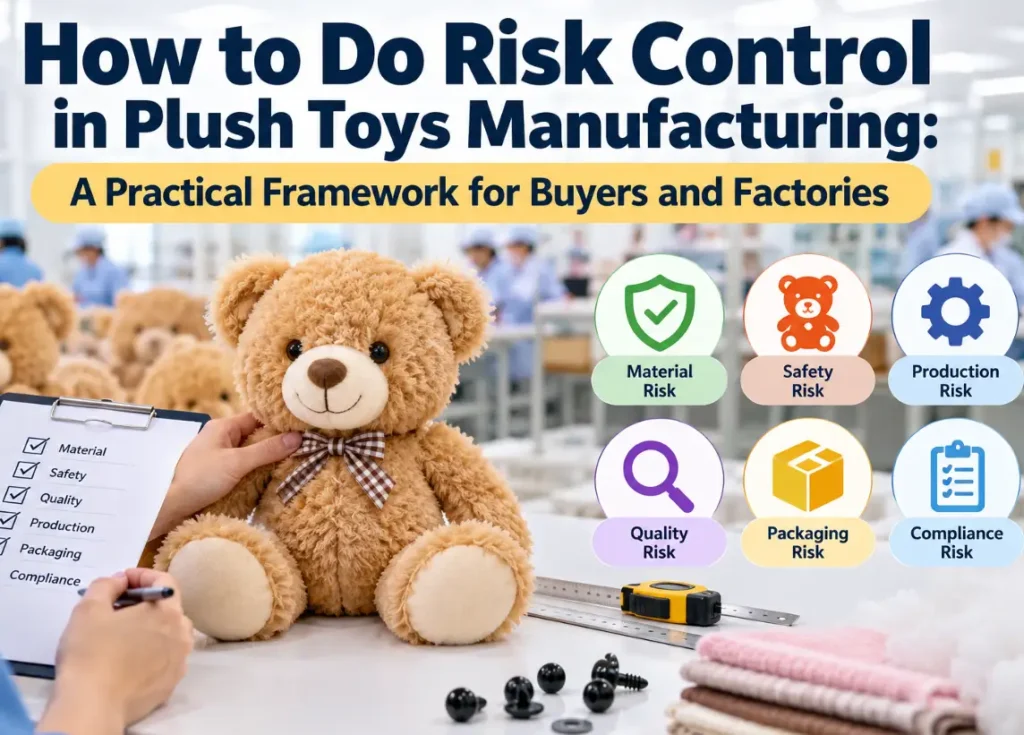
How to Do Risk Control in Plush Toys Manufacturing starts with identifying potential risks in materials, design, production, safety, quality, and packaging, then applying proper inspections, testing, supplier controls, and process checks to prevent defects, ensure compliance, protect children, and maintain consistent product quality.
A step-by-step guide to identifying, scoring, and controlling the risks that most often derail plush toy projects, from fabric supply and design changes to safety compliance, production drift, shipping delays, and payment disputes.
Risk control in plush toy manufacturing is the structured process of identifying what could go wrong in a project, estimating how likely and how damaging each problem would be, and putting specific safeguards in place before that problem reaches the production line, the shipping container, or the end customer. It turns quality and delivery from hopes into managed outcomes.
Plush toys are more exposed to risk than many other consumer products. A single toy combines fabric, filling, thread, embroidery, plastic or metal accessories, labels, and packaging from several suppliers. The product is custom-made, so it passes through repeated design and sampling rounds. It is usually sold to children, so safety regulations are strict, and demand is highly seasonal, so schedule slips are expensive. A wrong dye lot, a missing label, a loose eye, or a late trim can each trigger rework, delayed shipment, a failed test, or a platform delisting.
This guide explains a practical five-step framework: identify, assess, control, monitor, and respond. It shows how buyers and factories can apply it to materials, design, safety, production, logistics, and commercial terms, and it provides checklists, scoring tools, and tables that can be adapted to any custom plush project.
What Is Risk Control in Plush Toy Manufacturing and Why Does It Matter?
Risk control in plush toy manufacturing means managing every event that could damage product quality, safety, delivery, cost, or brand reputation, and it matters because the cost of a problem grows sharply the later it is discovered. A fabric mismatch found at incoming inspection costs a replacement roll. The same mismatch found after cutting costs the fabric and the labor, and found after shipment it costs returns, refunds, and customer trust.
Risk control differs from quality control. Quality control checks whether a product meets a standard, while risk control asks a wider question: what could stop the project from meeting the standard, on time, at the agreed cost, and in compliance with the law? It covers suppliers, schedules, contracts, and documents as well as stitching and stuffing. Effective programs use both, with risk control deciding where inspection effort should be concentrated.
Risk control also protects relationships. When both sides know in advance which risks exist and who owns each one, disagreements become shared problem-solving instead of blame, and the factory can raise concerns early without fear of losing the order. That trust is itself a powerful control.
The table below groups the main risk categories found in plush toy projects, showing where each usually starts and what it can cost.
Main Risk Categories in Plush Toy Manufacturing
| Risk Category | Typical Example | Likely Impact | Where It Usually Starts |
|---|---|---|---|
| Material and supply chain | Dye lot mismatch, late trims, price spikes | Color deviation, delay, cost overrun | Purchasing and incoming inspection |
| Design and sampling | Unclear tech pack, repeated changes | Extra sample rounds, wrong bulk product | Design brief and approval |
| Safety and compliance | Small parts, failed migration test, wrong label | Blocked shipment, recall, legal exposure | Material choice and testing plan |
| Production and quality | Stuffing drift, loose eyes, seam failure | Rework, rejected lots | Production line and inspection |
| Schedule and capacity | Peak-season overload, holiday shutdown | Missed retail window | Order planning |
| Logistics | Carton damage, customs hold, port delay | Damaged or late goods | Packing and shipping method |
| Commercial and payment | Weak contract, unclear tolerance, disputes | Financial loss, weak remedies | Purchase agreement |
| Intellectual property | Design leakage, unauthorized copies | Loss of exclusivity | File sharing and tooling control |
How Do You Identify the Main Risks Before Production Starts?
Risk identification is the step of listing everything that could realistically go wrong in a specific project before any commitment is made, and it works best when it is done systematically by project stage rather than from memory. Every plush project moves through the same stages, so a checklist for each stage catches most recurring problems.
The strongest identification method combines three inputs. The first is history: past defect reports, delay records, and customer complaints show which failures repeat. The second is the product itself: a weighted plush, an electronic plush, a large mascot, or a product with many small accessories each carries different risks. The third is the destination: a toy sold in the European Union, the United States, or through an online marketplace faces different testing, labeling, and packaging demands. Reviewing all three before quotation turns vague concerns into named, manageable items.
Workshops help. A short meeting between the buyer, the merchandiser, the pattern maker, the QC lead, and the purchasing team, held before the sample is approved, usually exposes risks that no single person would notice alone, such as a fabric with a long lead time or an accessory that cannot pass a pull test.
Risk Identification Checklist by Project Stage
| Project Stage | Questions to Ask | Documents to Review |
|---|---|---|
| Brief and quotation | Is the target market defined? Are quantity, age grade, and deadline realistic? | Brief, target market list, retailer requirements |
| Design and sampling | Is every material, size, and tolerance written down? What can change later? | Tech pack, artwork, sample comments |
| Pre-production | Are bulk materials confirmed? Are tests booked? Are labels approved? | Material approvals, test plan, label proofs |
| Production | Where can drift occur? Who can stop the line? | Work instructions, inspection records |
| Pre-shipment | Does the batch match the approved sample and test report? | Final inspection report, packing list |
| After delivery | Are complaints tracked and traced to a cause? | Customer feedback, corrective action log |
Tip: Start Every Project With a One-Page Risk Brief
Before the first sample is made, write a single page that names the target market, the age grade, the three riskiest materials or components, the fixed deadline, and the main compliance requirements. Share it with the factory and ask them to add risks they see from experience. This short document keeps the whole team aligned, exposes hidden assumptions early, and becomes the seed of the risk register. It takes less than an hour to prepare and often saves weeks of correction later. Revisit the brief whenever the target market, quantity, or deadline changes, because a shifted assumption is one of the fastest ways for a once-safe plan to become risky without anyone noticing.
Documentation is the final piece of identification. Each risk should be written as a short cause-and-effect sentence, for example, “If bulk fabric comes from a different dye lot, the finished color may not match the approved sample.” This wording makes the risk specific enough to assign an owner and design a control for it.

How Do You Assess and Prioritize Plush Manufacturing Risks?
Risk assessment is the process of scoring each identified risk by how likely it is and how severe its consequences would be, so that limited attention and money go to the risks that matter most. Without scoring, teams tend to spend time on visible but minor issues, such as a cosmetic thread, while quietly ignoring rare but serious ones, such as a detachable eye on a toy for infants.
A simple two-factor method works well. Each risk receives a probability score and a severity score from one to five, and the two are multiplied to give a priority score from one to twenty-five. Higher scores receive earlier and stronger controls. Some factories add a third factor, detection, which asks how likely the problem is to be caught before it reaches the customer. This is the logic of failure mode and effects analysis, where severity, occurrence, and detection are multiplied into a risk priority number.
Risk Scoring Scale for Plush Toy Projects
| Score | Probability | Severity |
|---|---|---|
| 1 | Rare, has not happened before | Cosmetic issue, no customer impact |
| 2 | Unlikely, occurred once | Minor rework, no delay |
| 3 | Possible, occurs occasionally | Rework or short delay |
| 4 | Likely, occurs on many projects | Lot rejection, major delay, high cost |
| 5 | Almost certain | Safety hazard, failed compliance, recall |
The scores are then recorded in a risk register, a living document that lists each risk, its score, its owner, and its control. Priority bands can be defined, for example, one to five as low, six to eleven as medium, twelve to nineteen as high, and twenty or above as critical. One override rule is essential: any risk with a severity of five is treated as high priority regardless of its score, because a low probability does not justify tolerating a possible injury.
Sample Risk Register Extract for a Custom Plush Project
| Risk | P | S | Score | Priority | Owner | Main Control |
|---|---|---|---|---|---|---|
| Bulk fabric dye lot differs from approved color | 4 | 3 | 12 | High | Purchasing | Lot-controlled swatch approval |
| Safety eye loosens under pull test | 2 | 5 | 10 | High (severity rule) | Production | Torque and pull checks each hour |
| Broken needle fragment remains in toy | 1 | 5 | 5 | High (severity rule) | QC | Needle control and detection |
| Wrong care label or missing content | 3 | 3 | 9 | Medium | Merchandiser | Label proof sign-off |
| Trim supplier delivers late | 3 | 3 | 9 | Medium | Purchasing | Early order and second source |
| Peak-season line capacity shortage | 4 | 4 | 16 | High | Planner | Capacity booking and buffer |
Tip: Score Severity First, Then Probability
When time is short, sort the register by severity before anything else. Product safety, legal compliance, and child injury risks must be controlled even when they seem unlikely, because the consequences cannot be repaired with a discount or a replacement shipment. Only after severity-five risks have named owners and written controls should the team work down the list by total score. This order prevents the common mistake of solving many small, easy problems while a rare but dangerous one remains open. Record the reason for each severity score in one short sentence, so that the logic can be reviewed later and new team members can understand why a risk was ranked the way it was.
How Do You Control Material and Supply Chain Risks in Plush Production?
Material and supply chain risk control is the set of practices that make sure every fabric, filling, accessory, and label arriving at the factory matches the approved specification, arrives on time, and comes with the documents needed for compliance. Materials define the baseline of every finished toy, and no later inspection can fully repair a wrong input.
The most common material risk is batch variation. Plush fabric is dyed in lots, and even the same color code can differ visibly between lots in shade, pile height, or hand feel. Control begins with an approved reference swatch and a rule that every new roll or lot is compared against it under standard lighting before cutting. For large orders, the fabric for one product should come from as few lots as possible and be tracked by lot number, so that any deviation can be traced and isolated.

Supply continuity is the second risk. A single-source trim, a specialty fabric, or an imported component can stop the whole line when it is late. Controls include ordering long-lead items first, agreeing on a backup supplier for critical parts, and holding a small safety stock of common accessories. Price risk is managed by fixing material prices in the quotation for a defined period and by agreeing in advance how large price changes will be handled.
Compliance documents belong in the same process. Dyes, fillings, and accessories that contain restricted substances create risks that no visual inspection can detect, so certificates and test reports should be requested and checked before materials enter production, not after the toy is finished.
Material and Supply Chain Risks and Controls
| Risk | Control | Evidence to Keep |
|---|---|---|
| Dye lot or color deviation | Compare each new lot with the approved swatch under standard light | Signed swatch, lot number record |
| Pile height or hand feel variation | Measure pile and check texture on receipt | Incoming inspection report |
| Filling density or contamination problem | Check loft, cleanliness, and weight per bale | Filling inspection record |
| Accessory size or strength fault | Dimension check and pull test on samples | Component approval sheet |
| Late delivery of critical trims | Order early, use a second source for key items | Purchase order confirmations |
| Restricted substances in materials | Require supplier test reports and re-test when suppliers change | Certificates and laboratory reports |
Tip: Approve Bulk Material, Not Just the Development Swatch
A swatch approved during sampling proves only that a good color and texture existed once. Ask the factory to send a swatch cut from the actual bulk roll, or the first bulk lot, and approve it in writing before cutting begins. Keep one sealed reference piece at each side and record the lot number. If the supplier later changes dye lots, the reference makes the difference measurable rather than arguable. This single step prevents many of the color disputes that appear only after production is finished. Ask for a written commitment that the same dye lot will be used for the full quantity where possible, and agree in advance what happens if a second lot is unavoidable.
How Do You Control Design and Sampling Risks?
Design and sampling risk control is the practice of turning a creative idea into a precise, agreed specification so that the bulk product matches what the buyer expects. Many plush disputes are not caused by poor workmanship but by an unclear or changing brief, where two parties held different pictures of the same toy.
The technical package, or tech pack, is the main control. It should define dimensions and tolerances, fabric and color references, filling weight, stitching standards, embroidery positions, accessory specifications, label content, and packaging. Anything not written down is an assumption, and assumptions become disputes. The sample is then judged against the tech pack rather than against memory or opinion.
Change control is the second element. Every design change after approval, such as a new eye size, a different fabric, or an extra accessory, affects cost, schedule, and safety. A simple change log, with the date, the change, the reason, and the approval, prevents the situation where the bulk product follows an outdated version. Sample stages should be clearly named, from prototype to pre-production sample to top-of-production sample, and only the approved pre-production sample should be used as the bulk standard.
Design and Sampling Risks and Controls
| Risk | Control | Approval Point |
|---|---|---|
| Incomplete or unclear tech pack | Use a full template with tolerances and references | Before first sample |
| Design changes after approval | Maintain a signed change log | Any time a change is requested |
| Sample not representative of bulk | Make the pre-production sample with bulk materials | Before mass production |
| Safety hazard in the design | Review small parts, attachments, and age grade at design stage | Before sample approval |
| Embroidery or shape variation | Set coordinates and reference photos for key features | With the pre-production sample |
| Excessive sample rounds | Collect all comments in one consolidated list per round | After each sample review |
How Do You Control Product Safety and Compliance Risks?
Safety and compliance risk control is the discipline of making sure the plush toy is physically safe for its age group and meets the legal requirements of every country where it will be sold. It is the highest-severity risk area because failures can lead to blocked shipments, marketplace removal, recalls, fines, and harm to children.
The first control is deciding early who the toy is for. Age grading determines which requirements apply, since products for children under three face stricter rules on small parts, attachments, and fillings. The second control is the test plan: which standards apply, which laboratory will test, which samples are needed, and how long the tests take. Testing should be done on production-representative samples, using the final fabrics, threads, accessories, and dyes, because a test on an early prototype does not prove that the finished product complies.
Typical requirements include mechanical and physical safety, flammability, and chemical limits under European standards in the EN 71 series, and the ASTM F963 toy standard together with the Consumer Product Safety Improvement Act in the United States. The US system also requires a Children’s Product Certificate based on testing by an accepted laboratory, and tracking information on the product and packaging. Requirements change over time, and the European Union is updating its toy safety framework, so the current version should always be confirmed with the laboratory before finalizing a test plan.

Physical controls matter as much as certificates. Safety eyes and noses must resist pull and torque forces, seams must resist stress, and small hazardous items such as broken needles must be prevented and detected through needle control and metal detection before packing.
Safety and Compliance Risk Map for Plush Toys
| Requirement Area | Typical Market | Risk if Missed | Control |
|---|---|---|---|
| EN 71 series (mechanical, flammability, chemical) | European Union and related markets | Blocked import, retailer rejection | Test final material samples at an accredited laboratory |
| ASTM F963 and CPSIA requirements | United States | Refused sales, penalties, recall | Test and issue Children’s Product Certificate |
| Small parts and age grading | All major markets | Choking hazard for young children | Design review and small parts check |
| Restricted chemicals (heavy metals, phthalates, certain dyes) | All major markets | Failed chemical test | Supplier reports and periodic re-testing |
| Labels and tracking information | Market specific | Non-compliant product, customs delay | Approve label proofs before printing |
| Needle and metal fragments | All markets | Injury risk and recall | Needle control log and detection before packing |
| Attachment strength of eyes and accessories | All markets | Detached parts, choking hazard | Pull and torque tests in production |
Tip: Book Testing Early and Test the Finished Toy
Laboratory testing often takes one to two weeks or more, and failures require re-testing after correction, so testing should be scheduled before bulk production rather than after it. Send a sample made with final bulk materials, not a prototype, and include all colors and material variants that differ. Keep the report linked to the approved sample version. If a supplier changes any material later, treat the change as a trigger to re-test. Early testing turns a possible last-minute shipment blockage into a manageable early correction. Ask the laboratory for a clear list of required sample quantities, and order extra pieces so that a retest never has to wait for another production batch.
How Do You Control Production and Quality Risks on the Factory Floor?
Production risk control is the set of checks and stop rules that keep output within the approved standard throughout a run, so that drift is caught while only a few units are affected. It relies on prevention at each stage rather than a single inspection at the end.
The classic structure has three layers. Incoming quality control checks materials, in-process quality control checks the line at defined intervals, and final quality control samples the finished batch, often under an acceptable quality limit plan based on international sampling standards. Common practice is to inspect at general level II with a tighter limit for major defects than for minor ones, and zero tolerance for critical safety defects.
The first-off inspection is the most valuable control on the line. The first completed units are checked against the approved sample before the run continues, and any setup error, such as a wrong stuffing weight or a shifted embroidery position, is corrected while only a handful of units exist. After that, interval checks monitor weight, seam quality, embroidery position, and accessory strength. A written stop-the-line rule, giving inspectors authority to pause production when a defect exceeds the agreed limit, keeps problems from being multiplied across thousands of units.
Production Stage Risks and Controls
| Stage | Key Risk | Control | Suggested Frequency |
|---|---|---|---|
| Cutting | Wrong panel size or grain direction | Pattern check, cut-piece sampling | Every set of cut lots |
| Sewing | Weak seams, misaligned panels | Seam and alignment checks | Every 60–90 minutes |
| Embroidery | Position and thread tension drift | Coordinate measurement against standard | Every 50 embroidered units |
| Stuffing | Under- or over-filled units | Weight and firmness check | Every 150–200 units |
| Accessory attachment | Loose eyes or noses | Pull and torque test | Every 1–2 hours |
| Finishing | Loose threads, stains, needles left inside | Visual check and metal detection | Every batch before packing |
| Final inspection | Batch not matching approved sample | Sampling inspection by agreed limit | Each shipment lot |
Tip: Give the Line a Stop Rule and Use First-Off Approval
Ask the factory to send photos and measurements of the first complete units and to wait for your approval, or at least your written acknowledgement, before continuing the full run. Agree in advance on what defects trigger a stop, such as any safety-critical defect or a defined percentage of major defects in a sample. A clear stop rule removes hesitation on the line, because operators and inspectors know that stopping is expected rather than punished. The cost of a short pause is small compared with the cost of reworking a whole batch. Also agree who receives the alert and how quickly they must reply, since a stop rule is only useful when the decision can be made within hours rather than days.

How Do You Control Delivery, Logistics, and Schedule Risks?
Schedule and logistics risk control means planning for delays before they occur and choosing packing and shipping methods that protect the goods and the deadline. Plush toys are bulky, seasonal, and easily damaged by moisture, so delays and damage are common failure points even when production goes well.
Schedule risk begins with the calendar. Peak production months before major gift seasons, national holiday shutdowns, and long fabric lead times can all compress the real working time. A reliable plan works backwards from the required in-store or warehouse date, adds time for testing, inspection, transport, and customs, and then adds a buffer. Booking production capacity early, confirming material arrival dates, and setting weekly progress reports allow small slips to be seen while they can still be recovered.
Logistics risk is controlled through packing design and shipping terms. Cartons should be strong enough for stacking, sealed against moisture, and marked clearly. Vacuum compression can reduce volume but must be tested so that fabrics recover their shape. The chosen trade term decides who bears risk at each stage of transport, and cargo insurance should be considered for high-value shipments. Shipping documents must be accurate, since errors in descriptions, labels, or product classification cause customs holds.
Schedule and Logistics Risks, Planning Buffers, and Escalation Triggers
| Risk | Typical Planning Buffer | Escalation Trigger |
|---|---|---|
| Long fabric or trim lead time | Order at design approval, add 1–2 weeks | Supplier confirmation not received by agreed date |
| Peak-season capacity shortage | Book capacity weeks ahead | Line loading above agreed level |
| Holiday shutdown | Complete critical steps before closure | Materials not on site before closure |
| Extra sample or test rounds | Allow at least one spare round | Second failed sample or test |
| Port or carrier delay | Add transit margin to delivery date | Booking not confirmed by cutoff |
| Carton damage or moisture | Use tested packing and sealed cartons | Damage found in packing test or pre-shipment check |
Communication rhythm supports every logistics control. A weekly status message that covers production progress, material arrival, test status, and the planned booking date gives the buyer time to react, and it gives the factory a clear channel to warn about problems before they become delays.
How Do Contracts, Payment Terms, and IP Protection Reduce Commercial Risk?
Commercial risk control is the use of clear contracts, staged payments, and protection of designs to limit financial loss and disputes. Even a well-run factory can miss a deadline or a standard, and a good agreement ensures that both sides know what happens next.
The purchase agreement should reference the approved sample, the tech pack, the quality standard, the inspection method, the delivery date, and remedies for lateness or defects. Definitions matter: what counts as a major defect, what acceptable limit applies, and who pays for re-testing and rework. Vague wording is the source of most disputes, while measurable terms allow quick, objective decisions.
Payment structure is a practical lever. A common approach is a deposit at order confirmation and the balance after passing final inspection and before shipment, which keeps the buyer’s leverage until quality is verified. Buyers who share original artwork should also protect it with a non-disclosure agreement, clear ownership language, and an agreement that molds, patterns, and artwork will not be used for other customers. Limiting file sharing to what each department needs also lowers leakage risk.
Contract Clauses That Reduce Commercial Risk
| Clause | Risk Addressed | What to Specify |
|---|---|---|
| Reference standard | Disputes about what was ordered | Approved sample, tech pack version, tolerance |
| Inspection and acceptance | Unclear pass or fail decisions | Sampling plan, defect classes, right to third-party inspection |
| Payment milestones | Paying before quality is verified | Deposit, balance after final inspection |
| Delivery and delay remedies | Missed retail window | Ship date, allowed delay, compensation or shipping upgrade |
| Change control | Unapproved design or material changes | Written approval required for any change |
| Confidentiality and IP | Design copying or misuse | NDA, ownership, no reuse of patterns or artwork |
| Corrective action | Repeated defects | Root cause, action, and verification timeline |
Tip: Tie Payments to Verified Evidence
Structure the agreement so that money moves after evidence, not promises. Release the deposit after the pre-production sample is approved, and release the balance after the final inspection report and required test report are received and match the order. Write in the agreement which documents count as evidence, such as photos of first-off units, inspection reports, and test certificates. This arrangement keeps both parties motivated to solve problems early and gives the buyer a fair, documented reason to pause payment if quality slips. Add a short clause on how disputed units are handled, including who pays for re-inspection, so that a disagreement does not freeze the whole shipment while it is resolved.

How Do You Monitor Risks and Build a Contingency Plan?
Risk monitoring is the regular review of the risk register and key indicators during the project, and a contingency plan is the prepared response for when a risk becomes a real problem. Controls only work if they are watched, and a plan prepared in advance is far faster than improvisation under pressure.
Monitoring uses a small set of indicators reviewed on a fixed rhythm, for example, weekly during production. Useful indicators include material lot rejection rate, first-off pass rate, defect rate from interval checks, on-time completion of milestones, number of open corrective actions, and test results status. Each indicator should have a trigger that prompts action, so that a rising trend is treated as a warning rather than a surprise.
Contingency plans should cover the events with the highest scores: a failed test, a late material, a line stoppage, a damaged shipment, or a supplier problem. For each, the plan names who decides, what alternatives exist, and how the customer is informed. When a problem occurs, the response follows a fixed sequence: contain the affected units, find the root cause, correct the process, verify that the fix works, and update the register so the lesson is not lost.
Risk Monitoring Indicators and Example Escalation Triggers
| Indicator | What It Shows | Example Trigger for Action |
|---|---|---|
| Incoming material rejection rate | Supplier and material stability | Repeated rejection from the same supplier |
| First-off pass rate | Quality of line setup | Failure on the second first-off attempt |
| Interval inspection defect rate | Production drift | Rising trend across two consecutive checks |
| Milestone on-time rate | Schedule health | Any critical milestone late by several days |
| Test status | Compliance readiness | Any failed or delayed test result |
| Open corrective actions | Follow-through on problems | Action overdue beyond agreed date |
Tip: Keep a Lessons-Learned Log After Every Order
At the end of each project, hold a short review and record three things: what went wrong, why it happened, and what control will prevent it next time. Add the new control to the tech pack template, the checklist, or the contract terms so that the lesson becomes part of the process rather than a memory held by one person. Over several orders, this log turns your risk register from a generic list into a precise picture of your own products, suppliers, and markets, and steadily lowers the number of surprises. Share the relevant lessons with the factory as well, because a risk that both sides understand is prevented much more reliably than one that only the buyer remembers.
Our Advantage in Plush Toy Risk Control
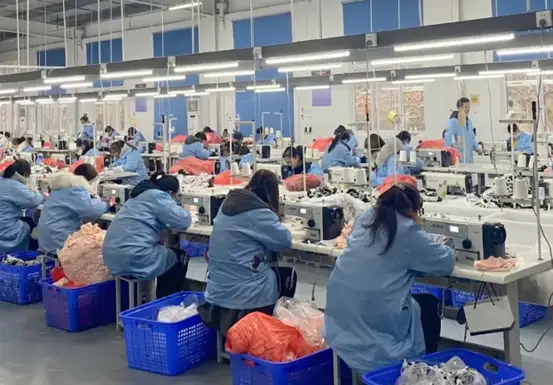
Managing risk well requires a factory that treats prevention as part of daily operations rather than as a final inspection. Ken Wang Toys builds risk control into each custom project from the first review: we prepare a project risk brief with the buyer, confirm materials and label content before cutting, coordinate laboratory testing against the target market, and use incoming, in-process, and final quality checks with first-off approval and needle control before packing.
Milestone photos and inspection records keep buyers informed during production, and any deviation is handled through root cause analysis and documented corrective action. By combining clear communication, documented approvals, and disciplined production control, Ken Wang Toys helps buyers reduce surprises and protect their launch dates and brand reputation.
Conclusion
Risk control in plush toy manufacturing is not a single inspection or a certificate. It is a way of running a project: identify what can go wrong at each stage, score risks so that the most serious receive attention first, put specific controls in place for materials, design, safety, production, logistics, and commercial terms, and keep watching the indicators that show whether those controls are working.
Buyers who use this framework gain earlier warning, fewer disputes, and stronger leverage. Factories that use it deliver more consistent quality and more reliable schedules. The most successful plush programs treat risk control as a shared responsibility, supported by clear documents, honest communication, and a habit of learning from every order.
FAQ
Q1: What is the biggest risk in plush toy manufacturing?
The highest-severity risk is product safety and compliance, since failures can harm children, block shipments, and force recalls. In day-to-day projects, the most frequent risks are unclear specifications, material batch variation, and schedule pressure. A good program controls all three, but always places safety-critical items first, because their consequences cannot be repaired with a replacement order.
Q2: How often should a plush project risk register be updated?
Review it at every major milestone and at least weekly during production. Update it whenever a design change, material change, supplier change, test failure, or schedule slip occurs. A register that is written once and never revisited gives false comfort, while a living register shows which controls are working and which risks are rising.
Q3: Is third-party inspection worth it for small orders?
Often yes, especially for a first order with a new factory, a product for young children, or a large retail commitment. An independent inspector checks the batch against the agreed standard without a conflict of interest. For repeat orders with a proven factory, a lighter approach such as photo and report review may be enough, and the decision should follow the risk score rather than the order size alone.
Q4: How can a buyer reduce risk when working with a new plush factory?
Start with a pilot order, review the factory’s quality system and testing records, request references, and approve a pre-production sample made with bulk materials. Use staged payments, agree measurable quality terms in writing, and arrange independent inspection before shipment. Increase order size gradually as the factory proves consistent performance across quality, schedule, and communication.
Q5: What extra risks come with custom or licensed character designs?
Custom and licensed designs add intellectual property risks, approval workflows, and tighter appearance standards. Design leakage, unauthorized copies, and license terms must be handled through non-disclosure agreements, controlled file sharing, and clear ownership language. Licensor approvals can also add time, so the schedule should include realistic review rounds, and the design must match the approved artwork closely.
Q6: Who is responsible for risk control, the buyer or the factory?
Both share it. The factory controls materials, workmanship, and production processes, while the buyer controls the brief, the approvals, the target market requirements, and the commercial terms. Problems usually arise in the gaps between the two, such as an unclear specification or a late approval, so clear roles and regular communication are as important as technical controls.
Q7: What should be done when a risk becomes an actual problem?
Contain the problem first by holding affected materials or units, then identify the root cause using records and inspection data. Correct the process, verify with new samples or checks that the fix works, and inform all parties about schedule or cost effects. Finally, update the risk register and contracts or checklists so that the same problem is prevented on future orders.