Skip to content
A practical guide for brand owners, importers, and sourcing teams on defining color standards, controlling dye lots, measuring Delta E, and keeping every unit in a large plush order visually identical.
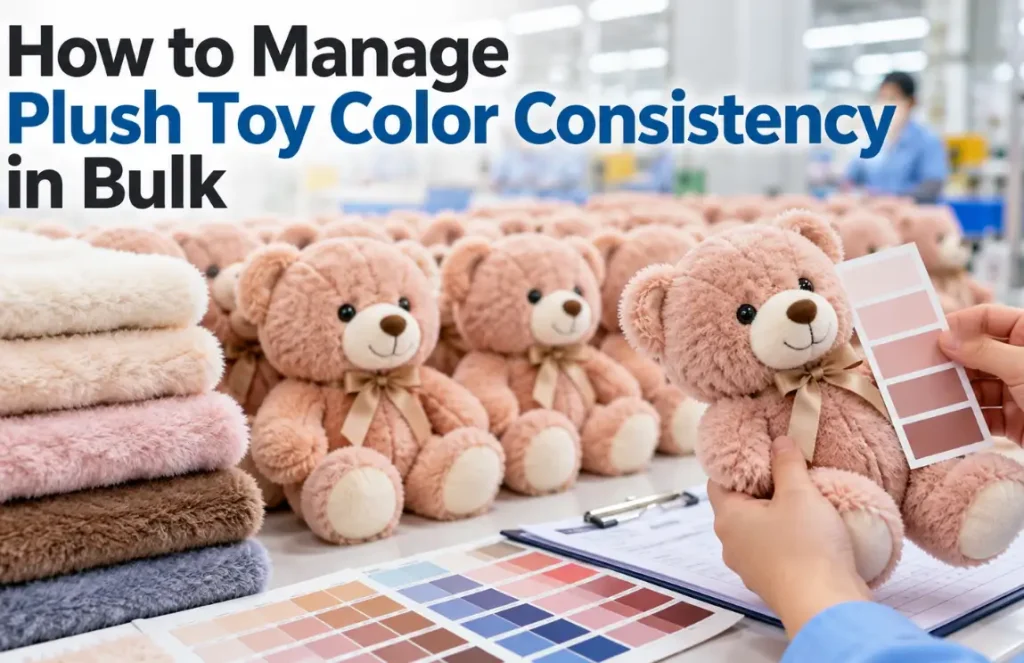
Color is the first thing a customer notices on a plush toy and one of the hardest things a production team can control at scale. A single sample can be matched to a reference swatch in minutes. A bulk order of 20,000 units is a different problem entirely, because it draws on dozens of fabric rolls, multiple thread spools, several sewing lines, and accessories delivered in separate batches over many weeks.
Buyers who have received a shipment where the brown bears in one carton looked noticeably warmer than those in the next understand the cost. Retail buyers reject mixed shelves, e-commerce customers post photos of mismatched pairs, and licensors withdraw approvals when brand colors drift. These problems rarely come from one dramatic mistake. They come from many small, unmanaged variables that compound across a long production run.
This guide explains how to manage plush toy color consistency in bulk, from writing a measurable color standard before fabric is ordered to inspecting finished goods under controlled light. It covers dye lot strategy, component matching, objective measurement, in-line inspection, pile direction control, and colorfastness testing, with reference data that buyers and quality teams can apply directly to their orders.
Why Is Color Consistency So Hard to Maintain in Bulk Plush Toy Production?
Color consistency in bulk plush toy production is the ability to keep every unit in an order within an agreed color tolerance of the approved standard, regardless of which fabric roll, dye lot, sewing line, or production date it came from. It is difficult because a plush toy is not a single colored surface. It is an assembly of pile fabric, thread, eyes, noses, ribbons, labels, and filling, each made by a different supplier with its own process variation.
Pile fabric adds a further challenge. A flat printed card reflects light from one plane, but plush pile scatters light through thousands of fibers whose height, density, and direction all change how the color appears. The same dye formula can look visibly different on a short velboa and on a long faux fur, and the same fabric can appear lighter or darker depending on which way the pile lies.
Major Sources of Color Variation in Bulk Plush Toy Production
| Variation Source | How It Creates Color Difference | Where It Is Controlled |
|---|---|---|
| Dye lot differences | Different dye baths produce slightly different shades even with the same formula | Fabric sourcing and lot approval |
| Roll-to-roll and edge-to-center shading | Uneven dye uptake across a single roll or between rolls from one lot | Incoming fabric inspection |
| Pile direction | Fibers lying in opposite directions reflect light differently | Cutting layout and pattern marking |
| Component supplier differences | Thread, eyes, and ribbons are made by separate suppliers with separate standards | Component approval and tolerance sheets |
| Lighting during evaluation | Colors shift under different light sources, causing disputed judgments | Standard light booth and fixed illuminant |
| Finishing and brushing | Heat, shearing, and brushing change pile appearance after dyeing | Finishing process specification |
| Storage and aging | Light, humidity, and time cause slow shade drift in stored fabric | Warehouse conditions and rotation |
The Compounding Effect of Multiple Components
Each variable alone may stay within tolerance. The trouble starts when several drift in the same direction. A fabric lot that is slightly warm, paired with embroidery thread that is slightly yellow and a nose that is slightly red, produces a toy that looks clearly different from the approved sample even though no single component failed inspection. Managing color in bulk therefore means controlling the system, not only the individual parts.
Time adds another layer. Large orders are produced over several weeks, and conditions change during that period. Dye house water quality, ambient humidity, machine maintenance cycles, and even operator shifts all influence how consistently materials are processed. Fabric that was approved on the first day of cutting may sit in a warehouse for weeks before it is used, while accessories arrive in separate shipments from other suppliers. Without a written control plan, every handoff in this chain is an opportunity for small, unrecorded changes to enter the product. A disciplined buyer therefore treats color as a managed variable from the first purchase order through the final carton, rather than as a quality attribute checked once at the end of production
How Do You Define Color Standards Before Bulk Production Begins?
A color standard is the agreed reference that every production unit will be judged against. It must be defined before fabric is ordered, because every later decision, from dye lot approval to final inspection, depends on it. A standard that exists only as a verbal description or a photo on a phone screen cannot be enforced.
A complete color standard combines three layers: a physical reference, a numerical reference, and a written tolerance. Together they remove ambiguity, so a disagreement between buyer and factory becomes a measurement question rather than an opinion.
Components of a Complete Plush Toy Color Standard Package
| Element | Content | Purpose |
|---|---|---|
| Physical master swatch | Approved fabric swatch on the actual pile fabric, sealed and labeled | Primary visual reference for all evaluation |
| Backup swatch sets | At least three identical sets: one for the buyer, one for the factory, one retained as an arbitration copy | Prevents loss or fading of the only reference |
| Numerical color data | L*a*b* values measured on the master, with illuminant and observer angle recorded | Enables objective Delta E comparison |
| Pantone reference | TCX or TPG code noted as a guide only | Common language for communication |
| Tolerance statement | Maximum Delta E per color, with stricter limits for brand-critical colors | Defines pass and fail in writing |
| Approved sample record | Signed pre-production sample with dated photos under standard light | Links the standard to the finished product |
Why Pantone Alone Is Not Enough
Pantone codes are valuable for communication, but they were designed for paper and standardized textile swatches, not for pile fabric. A Pantone number tells a dye house which color family to target. It does not tell them how that color will look on a 20 mm faux fur versus a 3 mm short plush. The physical swatch on the production fabric is always the true reference, and the Pantone code is only its label.
Writing Tolerances That Can Be Enforced
Tolerances should be expressed numerically and assigned by color importance. A licensed character color or a logo color may require a tight Delta E limit, while a secondary body color on a large pile fabric may allow a wider one. Stating the instrument, illuminant, and measurement method in the same document prevents arguments about how the number was obtained.
Tip: Lock a Three-Part Color Standard Before Ordering Fabric
Never rely on a single reference. Before the factory places any fabric order, confirm that you hold a physical swatch on the real pile fabric, a recorded L*a*b* reading with the illuminant noted, and a written Delta E tolerance for each color. Seal one swatch set as an arbitration copy and store it in a dark, dry place so it does not fade. When a dispute arises later, you can open the sealed copy, measure both items, and settle the question in minutes instead of weeks. This single habit prevents more color arguments than any other step in the process. Share the standard with every party in the chain, including the fabric mill, the thread supplier, and the inspection team, so that nobody is working from a different interpretation of the same color.

How Does Dye Lot Management Control Fabric Color Variation?
Dye lot management is the practice of controlling which fabric batches enter production, how they are approved, and how they are used. A dye lot is the quantity of fabric dyed in one continuous process. Variation between lots is the largest single cause of color drift in bulk plush orders, because even well-run dye houses cannot reproduce a shade identically from one bath to the next.
The safest approach is to source the entire order, plus a reserve, from a single dye lot. When the quantity is too large for one lot, the second best approach is to use a small number of approved lots and blend them in a controlled way. Every lot should be approved against the master swatch before it is released to cutting.
Dye Lot Strategy by Order Size
| Order Scale | Recommended Fabric Strategy | Key Control |
|---|---|---|
| Small orders | Single dye lot for the whole order with a 3%–5% reserve | Approve one lot swatch against the master |
| Medium orders | One lot preferred; maximum two lots if unavoidable | Keep each lot to separate production batches |
| Large orders | Multiple lots planned in advance with a lot sequence schedule | Shade sorting and lot-matched assembly |
| Repeat orders | Request a lab dip against the original master and the previous bulk reference | Compare new lot to both references |
| Rush orders | Avoid stock-mix fabric from different sources | Reject unlabeled or mixed lots |
Shade Sorting and Lot Segregation
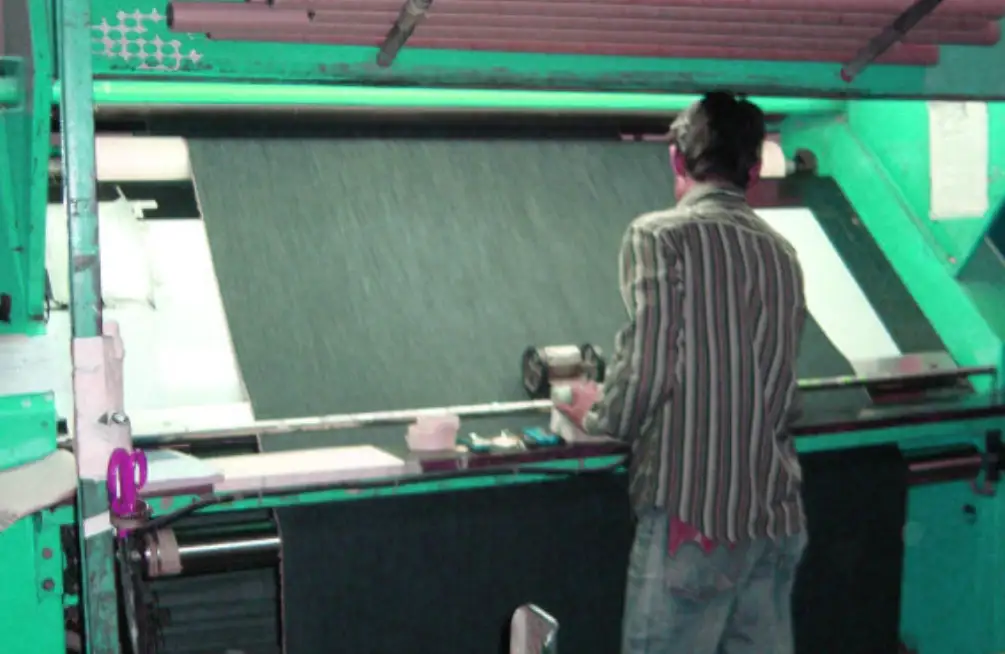
When multiple lots are unavoidable, shade sorting prevents visible differences inside the shipment. Rolls are inspected under standard light and grouped into shade families. Each family is cut and sewn together, and finished toys are packed by lot into separate cartons. A buyer who receives a carton from one lot and another carton from a slightly different lot will rarely notice the difference. A buyer who receives toys from both lots mixed inside the same carton will notice immediately.
Lot numbers should travel with the fabric through cutting, sewing, and packing. Without lot traceability, a quality team that finds a color issue cannot determine which units are affected and is forced to hold the entire shipment.
Tip: Order Fabric in One Dye Run and Reserve Extra Yardage
Calculate total fabric consumption, add a reserve for cutting loss and rework, and place a single fabric order so the dye house can run the whole quantity in one lot. A small reserve of roughly three to five percent costs far less than the rejected units that result from running short and ordering a second lot. Require the fabric supplier to label every roll with the lot number, and refuse any roll that arrives unlabeled. Ask for a lot-specific swatch before cutting begins so you can approve or reject the shade while it is still only fabric. If the dye house must split the order, agree on the lot sequence in writing before dyeing starts.
How Do Thread, Accessories, and Fillings Affect Overall Color Matching?
Outer fabric gets most of the attention, but color mismatch frequently comes from the smaller components. Embroidery thread, sewing thread, plastic eyes and noses, ribbons, printed labels, and even filling whiteness all contribute to how a finished toy reads. A bear with a perfectly matched body and a nose that is two shades too orange will still look wrong beside the approved sample.
Each component category needs its own approval record and tolerance, because each is produced by a different process. Molded plastic parts depend on masterbatch consistency. Thread depends on dye lot. Ribbons depend on weaving and finishing. Treating them all as one color problem hides where the drift actually occurs.
Color Risk and Control Approach by Plush Toy Component
| Component | Main Color Risk | Recommended Control Approach |
|---|---|---|
| Outer pile fabric | Dye lot and pile direction variation | Lot approval, shade sorting, pile marking |
| Embroidery thread | Spool-to-spool dye variation; sheen differences | Buy full order from one thread lot; approve against fabric |
| Sewing thread | Visible contrast at seams on dark or bright fabrics | Match to fabric under standard light |
| Plastic eyes and noses | Masterbatch variation between molding runs | Approve one molded batch; retain retention samples |
| Ribbons and trims | Weaving and finishing differences between batches | Single-batch purchase; compare to master ribbon |
| Fiber filling | Yellowish tone in low-grade filling visible through light fabrics | Specify whiteness; inspect filling before use |
| Labels and hangtags | Print color drift on brand marks | Press proof approval for each print run |
Metamerism Between Different Materials
Metamerism occurs when two materials appear to match under one light source and visibly differ under another. It is especially common between pile fabric, plastic, and thread, because each absorbs and reflects light using different pigments and dyes. A nose that matches the fabric under warm factory lighting may clash under the cool white lights of a retail store. Evaluating components under at least two light sources reveals the problem before it reaches the shelf.
Tip: Approve Every Component Together Under More Than One Light Source
Place fabric, thread, eyes, noses, and ribbons side by side against the approved sample and view them under a daylight source and a retail-style store light. Components that look identical in one environment but shift apart in the other are metameric and should be re-sourced. Record the approved batch of each component, including supplier and batch number, so repeat orders use the same material. Assemble a physical reference toy from approved components and keep it as the final benchmark. Revisit these approvals whenever a supplier changes a material, a machine, or a production site, since small process changes often shift color without any warning.

What Lighting Conditions and Measuring Tools Support Objective Color Evaluation?
Objective color evaluation requires a controlled light environment and a calibrated instrument. Without both, judgments depend on the time of day, the windows in the room, and the eyes of whoever happens to be inspecting. A standard light booth and a spectrophotometer replace these variables with consistent, repeatable conditions.
A light booth typically offers several illuminants. D65 simulates average daylight and is the default for most color approval. TL84 simulates the fluorescent lighting common in retail stores in many regions, and an incandescent source simulates warm home lighting. Viewing the same sample under each reveals metamerism and confirms that the color holds up across the environments where the toy will actually be seen.
A spectrophotometer measures color as L*a*b* coordinates, and the difference between two readings is expressed as Delta E. Because pile fabric is uneven, handheld readings should be taken consistently: the same pile direction, the same pressure, the same aperture, and an average of several readings taken at different positions on the sample.
Delta E Interpretation Guide for Plush Toy Color Approval
| Delta E Range | Typical Visual Perception | Suggested Use in Plush Production |
|---|---|---|
| 0 to 0.5 | Virtually imperceptible | Excellent match; achievable on flat or short-pile materials |
| 0.5 to 1.0 | Visible only to trained observers in direct comparison | Target for brand-critical and licensed colors |
| 1.0 to 2.0 | Noticeable side by side, hard to notice separately | Common acceptance range for standard production colors |
| 2.0 to 3.5 | Clearly perceptible difference | Acceptable only for large pile fabrics with buyer approval |
| Above 3.5 | Obvious difference in color | Reject or escalate for corrective action |
Combining Numbers and Visual Judgment
Delta E is a strong tool, but it does not replace human judgment. Pile fabric can pass numerically while appearing different because of texture, sheen, or pile lay. The most reliable approach uses the instrument to screen for numerical drift and the light booth to confirm that the visual impression still matches the standard. When the two disagree, the buyer and factory should discuss the discrepancy rather than defaulting to one method.
Tip: Use the Spectrophotometer to Screen and the Light Booth to Confirm
Measure every incoming fabric lot and every component batch with a spectrophotometer, then confirm borderline results visually in a light booth under D65 and a store-style source. Take at least three readings at different positions with the pile lying in the same direction, and record the average. Write the instrument model, illuminant, and observer setting into the standard so that both sides measure the same way. Calibrate the instrument at the start of every inspection session, because an uncalibrated device produces confident but meaningless numbers. Train inspectors to use identical sample preparation each time, including flattening the pile gently and avoiding fingerprints or lint on the measurement area.
How Should Bulk Production Be Inspected for Color at Each Stage?
Color inspection works best when it is distributed across the production flow rather than concentrated at the end. A color problem found in the fabric warehouse costs almost nothing to correct. The same problem found after sewing means rework or scrap, and the same problem found after shipment means returns and lost trust. Inspecting at multiple checkpoints moves detection earlier, where correction is cheapest.
Color Inspection Checkpoints Across Bulk Plush Toy Production
| Stage | What Is Checked | Method | Action on Failure |
|---|---|---|---|
| Incoming fabric | Lot approval, roll shading, lot label | Spectrophotometer plus light booth | Reject lot or request replacement |
| Incoming components | Thread, eyes, noses, ribbons against master | Side-by-side comparison under D65 | Return batch; re-approve before use |
| Pre-cutting | Shade grouping and pile direction layout | Visual check of laid-up fabric | Re-spread or re-sort rolls |
| First piece after sewing | Assembled toy against approved sample | Light booth comparison with signed sample | Hold line until corrected |
| In-line checks | Random units from each sewing line | Visual check against reference toy | Isolate affected bundles |
| Final inspection | Random sample from finished lots | Sampling plan with color as a defined defect | Rework or reject by lot |
| Pre-shipment | Carton-level lot consistency | Open random cartons; confirm lot labeling | Repack by lot before release |
Setting a Sampling Plan for Color Defects
Final inspection should follow a recognized statistical sampling plan, such as the ISO 2859-1 or ANSI/ASQ Z1.4 tables, with color mismatch classified clearly in the inspection criteria. Buyers should state in advance whether a visible shade difference counts as a major defect, because ambiguity at this stage causes disputes at the end. Inspectors need the master swatch and the signed reference toy on the table, not a memory of what the color should look like.
Keeping Lots Together Through Packing
Packing is the last place where color consistency can be lost. Cartons should be packed by lot, labeled with the lot number, and kept in sequence when loaded. A shipment that is color-consistent inside each carton but varies between cartons is usually acceptable. A shipment that mixes shades inside a single carton is not.
Tip: Keep Every Piece of One Toy From the Same Fabric Lot
The most noticeable color defect is not a difference between two toys but a difference inside one toy, such as ears cut from one lot and a body cut from another. Require that all pattern pieces for a single toy be cut from fabric of the same lot and, where possible, the same roll. Use bundle tickets that carry the lot number through sewing so operators never combine pieces from different lots. This rule costs very little to enforce and eliminates the two-tone toy problem entirely. Add a spot check at the cutting table where a supervisor confirms lot labels on each stack before bundles are released to the sewing lines.
How Do Cutting, Pile Direction, and Sewing Practices Prevent Visible Shade Differences Inside One Toy?
Pile direction is the most underestimated cause of apparent color variation in plush production. When pile lies downward, it reflects light one way, and when it lies upward, it reflects light another. Two pieces cut from the same roll can look like different colors on a finished toy if they are sewn with opposite pile directions. This effect is physical, not a dyeing problem, and no dye adjustment can fix it.
Every pattern piece should carry a pile direction arrow, and the cutting layout should place all pieces consistently. Spreading fabric all in one direction, rather than alternating face-to-face layers, keeps the pile lay uniform across the lay-up. Operators who cut and sew must understand that the arrow on the pattern is a color control, not only a fit instruction.
Sewing introduces further risk. Seams that pull fibers to the inside can reveal base fabric that is a different shade from the pile tips, especially on dark colors with light backing. Stuffing density also changes how pile stretches, which in turn changes how color appears at the surface. A lightly stuffed section can look darker than a tightly stuffed one because the pile lies closer together. Grooming or brushing finished seams with the pile direction restores a uniform appearance and removes the visible line along seams.
Tip: Mark Pile Direction on Every Pattern Piece and Audit Cutting Layouts
Print a pile direction arrow on every pattern piece and train cutters to follow it without exception. Audit the first cutting layout of every new order and photograph the laid-up fabric so you can verify that all pieces face the same way. During first-piece approval, compare the finished toy under a light booth from several viewing angles, because pile direction errors often appear only when the toy is rotated. Specify a final grooming step for seams so the fibers blend evenly across joins. Keep one correctly assembled toy at the line as a visual guide so operators can compare their work against it throughout the shift.
How Do Colorfastness, Migration, and Storage Affect Color Consistency After Production?
A toy can leave the factory matching the standard and still arrive looking different. Colorfastness describes how well a color resists change under washing, rubbing, light, and perspiration. Poor fastness causes fading, staining, and color transfer between a toy and its packaging or between adjacent colors on the same toy. For plush products sold to children, these failures are also a product quality and safety concern.
Testing for fastness should happen on production-representative materials before bulk fabric is released. Testing a lab dip on a different base fabric than the one actually used does not predict the behavior of the finished toy. Dark reds, bright blues, and saturated purples are the highest-risk colors for bleeding, and light-colored fabrics sewn beside them are the most exposed to staining.
Colorfastness Tests Relevant to Bulk Plush Toy Color Stability
| Test Area | What It Evaluates | Common Reference Method | Typical Rating Scale |
|---|---|---|---|
| Washing fastness | Color loss and staining after laundering | ISO 105-C06 or AATCC 61 | Grey Scale 1 to 5 |
| Rubbing (crocking) | Dry and wet color transfer by friction | ISO 105-X12 or AATCC 8 | Grey Scale 1 to 5 |
| Perspiration fastness | Color change and staining from simulated sweat | ISO 105-E04 or AATCC 15 | Grey Scale 1 to 5 |
| Light fastness | Fading under light exposure | ISO 105-B02 or AATCC 16 | Blue Wool Scale 1 to 8 |
| Saliva fastness | Color transfer when exposed to saliva simulant | DIN 53160 or similar | Pass or fail by grey scale |
| Storage stability | Shade drift during warehouse storage and transit | Retention sample comparison over time | Delta E against retained swatch |
Storage and Transit Conditions
Warehouse conditions affect color more than most buyers expect. Finished toys stored under strong light can fade at exposed edges, and humid storage can encourage dye migration between touching colors. Cartons stacked near windows or loading docks experience temperature and light cycles that accelerate drift. Specifying dark, dry storage and keeping retention samples from each lot allows the quality team to confirm whether any change happened before or after shipment.

Tip: Test Fastness on the Actual Production Fabric and Keep Retention Samples
Run washing, rubbing, and perspiration tests on swatches cut from the approved bulk fabric lot, not on a convenient substitute. Pay special attention to dark and saturated colors placed next to white or pastel fabrics on the same toy. Keep a retention sample from every production lot, sealed and dated, so you can compare against it if a customer reports fading months later. If a complaint arrives, the retention sample shows whether the color changed after shipment or was already off at the factory. Store retention samples in the same conditions every time, away from light, so they remain a trustworthy reference for as long as the product stays on sale.
How Do You Build a Color Management System That Works Across Repeat Orders?
Consistent color across a single order is a production achievement. Consistent color across repeat orders is a management system. Repeat orders face the added difficulty that fabric must be dyed again, often months later, and a new dye lot will never match the old one perfectly. The only reliable way to stay consistent is to treat the color standard as a controlled document that outlives any one order.
A working system keeps the master swatch, the numerical L*a*b* data, the tolerance statement, and the approved component list together in a single color file for each product. Each new order begins with a lab dip compared to the original master, not to the previous production run, because comparing each batch only to the last one allows small drifts to accumulate until the product no longer resembles the original.
Tracking basic metrics also helps. Recording the Delta E of every incoming lot, the number of color-related rework events, and the share of lots approved on the first submission reveals trends before they become failures. A supplier whose Delta E results creep upward over successive orders is signaling process drift that deserves a conversation. Reviewing these numbers after every order turns color from a recurring surprise into a managed variable.
Communication is the final layer. Buyers who share the end-use environment, such as retail lighting or photography conditions for online listings, help the factory choose tolerances that match real viewing conditions. Factories that share lot traceability records and measurement data make problems easier to diagnose and fix. Regular review meetings after each shipment, where both sides look at measurement records, inspection findings, and customer feedback, keep the standard alive and give the production team clear targets for the next order. Over several cycles, this routine builds shared expectations that reduce disputes and shorten approval times.
Conclusion
Managing plush toy color consistency in bulk is not about finding a factory that never makes a color error. It is about building a process in which errors are measured early, contained to a single lot, and corrected before they reach finished goods. The strongest programs combine a three-part color standard, controlled dye lot sourcing, component-level approval, objective measurement under standard light, staged inspection, and disciplined pile direction control.
Each element is inexpensive compared to the cost of a rejected shipment or a damaged retail relationship. Buyers who define their standards numerically, insist on lot traceability, and keep retention samples give their production partners the information they need to deliver consistent results. Color consistency is a shared discipline, and it is achievable on every order when both sides treat it as one.
FAQ
Q1: What Delta E tolerance should I specify for a bulk plush toy order?
For most standard production colors on pile fabric, a Delta E of roughly 1.0 to 2.0 against the approved master is a common and realistic range. Brand-critical colors, such as a licensed character color or logo color, should be held tighter, often at 1.0 or below. Long-pile fabrics are harder to measure and to match, so buyers sometimes agree to a slightly wider limit on secondary colors. Whatever value is chosen, write it into the specification together with the instrument, illuminant, and measurement method.
Q2: Can I accept more than one dye lot in a single order?
Yes, but it requires control. Each lot should be approved separately against the master, shade-sorted, and kept together through cutting, sewing, and packing so that toys from different lots are never mixed inside one carton. A single lot is always safer, and buyers should ask for one wherever the quantity allows. When multiple lots are unavoidable, plan the lot sequence in advance and require lot labels on every roll and carton.
Q3: Why does the same fabric look different on two toys of the same design?
The usual cause is pile direction. If the pile lies downward on one toy and sideways on another, they reflect light differently and appear to be different colors even when cut from the same roll. Differences in stuffing density and seam grooming can also change the apparent shade. Marking pile direction on every pattern piece and specifying a final grooming step addresses most of these cases.
Q4: How should color be evaluated in a light booth?
Evaluate the sample and the master side by side, at the same angle, under a daylight illuminant such as D65 first, then under a retail-style source such as TL84. Viewing under both shows whether the two items are metameric. Use a neutral gray surround, avoid bright clothing that reflects onto the samples, and allow a few seconds for the eye to adjust before judging. Record the illuminant used with every decision so the result can be repeated.
Q5: Is a Pantone code enough to guarantee the right color?
No. Pantone codes were developed for paper and standard textile swatches, and they do not account for pile height, density, or fiber type. They are useful as a communication shortcut but should always be paired with a physical swatch on the actual pile fabric and recorded L*a*b* data. The physical swatch is the real reference, and the Pantone code is only its label.
Q6: What should I do if bulk color is off but the sample was approved?
Start by comparing the bulk against the signed sample and the sealed arbitration swatch, using both the spectrophotometer and the light booth. Identify whether the difference comes from a fabric lot, a component, or a pile direction problem by checking lot numbers and bundle tickets. Contain the affected lots, request corrective action from the production partner, and decide whether rework, partial acceptance with a price adjustment, or replacement is appropriate. Having numerical tolerances in writing makes this conversation far shorter.
Q7: How can I keep color consistent when I reorder months later?
Treat the original master swatch and L*a*b* data as the permanent reference, not the last production run. Request a lab dip for the new fabric order and approve it against the original master before bulk dyeing begins. Re-use the same approved components, keep a color file for each product, and compare incoming Delta E results over time to catch slow drift. Retention samples from earlier orders are valuable for confirming that the new order matches the previous shipments your customers already own.