Skip to content

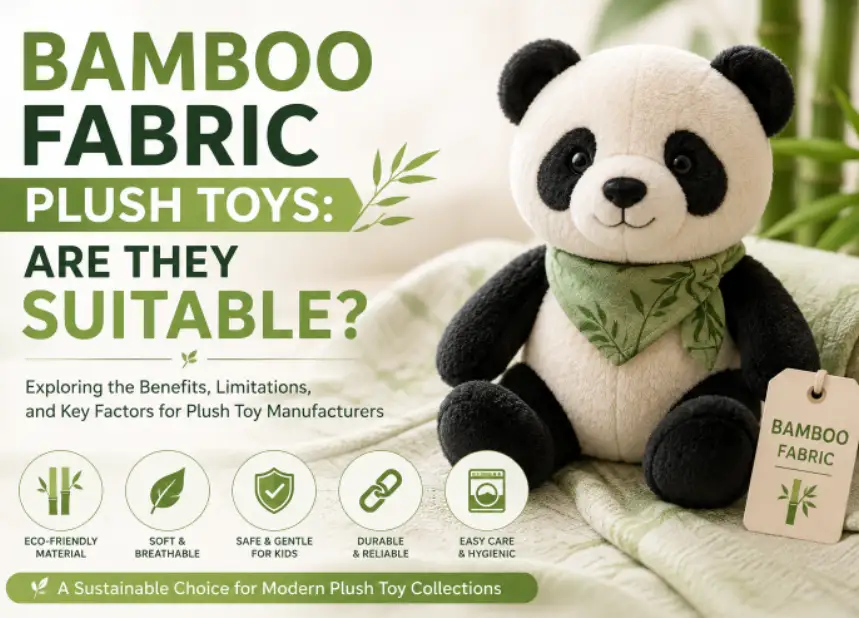
Bamboo Fabric Plush Toys offer a soft, breathable, and eco-conscious option for plush products, but their suitability depends on durability, safety, processing requirements, and the intended use of the finished toy.
A practical suitability guide for toy brands, buyers, and product developers evaluating bamboo fabric — covering material properties, safety and certification requirements, durability, cost, and which plush toy categories bamboo fabric genuinely fits.
Bamboo fabric shows up in plush toy sourcing conversations more often every year, almost always framed the same way: a buyer has seen bamboo marketed as a sustainable, hypoallergenic, ultra-soft alternative to conventional plush fabrics, and wants to know whether it is actually suitable for a specific plush toy program — or whether the marketing language is running ahead of what the material can actually deliver in a mass-produced, safety-tested, repeatedly-washed children’s product.
The honest answer is that bamboo fabric is genuinely suitable for some plush toy applications and genuinely unsuitable for others, and the difference comes down to specifics that a general “is bamboo good or bad” framing tends to obscure — which bamboo textile process was used, what the finished product category actually requires in terms of durability and wash resistance, what safety and labeling regulations apply, and what the true landed cost comparison looks like against the polyester and cotton fabrics bamboo is usually being compared to.
This guide works through each of these questions in detail so that a toy brand or buyer can reach a specific, defensible answer for their own product — rather than a generic yes or no based on marketing copy from a single fabric supplier.
The guide is organized to move from the ground up: first defining what bamboo fabric actually is and how the different processing methods differ, then evaluating the specific material properties that determine plush toy performance, then identifying where those properties translate into genuine product fit or genuine mismatch, and finally covering the safety, cost, manufacturing, and market-positioning factors that turn a materials-level suitability judgment into a workable sourcing decision.
What “Bamboo Fabric” Actually Means in Plush Toy Manufacturing
The term “bamboo fabric” is used loosely across the textile industry, and understanding which specific process a supplier means by it is the first and most important step in any suitability evaluation, because the different processes produce genuinely different materials with different properties, different costs, and different regulatory treatment.
The overwhelming majority of commercially available “bamboo fabric” is bamboo viscose (also called bamboo rayon) — a regenerated cellulose fiber produced by chemically dissolving bamboo pulp and extruding it into fiber form, a process that is chemically similar to how conventional rayon or viscose is produced from wood pulp. A much smaller share of bamboo textiles is bamboo linen, produced through a mechanical process that preserves more of the bamboo’s original fiber structure, and Lyocell-process bamboo, which uses a closed-loop solvent system considered more environmentally favorable than standard viscose processing.
Types of Bamboo Fabric Used in Textile and Plush Applications
| Bamboo Fabric Type | Production Process | Typical Use in Plush Toys |
|---|---|---|
| Bamboo viscose/rayon | Chemical dissolution of bamboo pulp, extruded into fiber | Most common; used for plush outer fabric and bamboo-blend fleece |
| Bamboo lyocell | Closed-loop solvent process, lower chemical discharge | Occasional premium eco-line plush fabric |
| Bamboo linen | Mechanical fiber extraction, minimal chemical processing | Rare in plush; coarser hand-feel less suited to soft toys |
| Bamboo-cotton blend | Bamboo viscose fiber blended with cotton during spinning | Common for plush toy fabric seeking bamboo softness with cotton durability |
Regulatory bodies in several markets require bamboo viscose to be labeled as “rayon from bamboo” or “viscose from bamboo” rather than “bamboo” alone, since the finished fiber is chemically regenerated cellulose rather than the raw bamboo plant material.
Tip: Before evaluating any bamboo fabric supplier’s suitability claims, ask specifically which process they use — viscose, lyocell, linen, or a blend — and request the actual fiber content label they intend to use on the finished product. A supplier that answers vaguely or insists that “bamboo fabric” is a single, simple material is a signal to look more closely, since the process used materially affects softness, durability, environmental impact, and regulatory labeling requirements, and a supplier who does not distinguish between them may not be tracking those differences carefully through their own supply chain either.
Key Fabric Properties Relevant to Plush Toy Suitability
Whether bamboo fabric suits a specific plush toy application depends on a defined set of material properties, each of which matters differently depending on the product category, target age group, and expected use pattern. Evaluating bamboo fabric against these properties directly, rather than against a general reputation for being “eco-friendly” or “soft,” produces a much more useful suitability assessment.
Bamboo Viscose Fabric Properties Relevant to Plush Toys
| Property | Bamboo Viscose Performance | Relevance to Plush Toys |
|---|---|---|
| Softness / hand-feel | Very high; often compared favorably to fine cotton or silk | Directly relevant for infant comforters and huggable plush |
| Moisture absorption | High; absorbs more moisture than polyester | Relevant for drool-heavy infant use; affects dry time after washing |
| Wet strength | Lower than dry strength; fiber weakens when saturated | Important consideration for repeated washing durability |
| Abrasion resistance | Moderate; lower than polyester minky or high-durability fleece | Relevant for toys expected to withstand heavy chewing or dragging |
| Pilling resistance | Generally good, better than many synthetic plush fabrics | Affects long-term surface appearance after repeated washing |
| Colorfastness | Good with proper dyeing process; can vary by supplier | Relevant for bright, saturated plush toy color requirements |
| Antibacterial/odor resistance | Naturally higher than most synthetics, though this fades with washing over time | Marketed benefit for infant products; effect diminishes with fabric age |
Two of these properties deserve particular attention because they are the source of most bamboo fabric suitability disputes in plush toy production: wet strength and abrasion resistance. Bamboo viscose fiber is measurably weaker when wet than when dry, which matters directly for a product category — plush toys — that is frequently machine washed throughout its use life. And its abrasion resistance, while adequate for gentle handling, is lower than polyester-based plush fabrics under the kind of sustained dragging, chewing, and rough play that many plush toys, particularly those aimed at toddlers, are actually subjected to.
Where Bamboo Fabric Is Genuinely Suitable for Plush Toys
Given these properties, bamboo fabric performs well in specific plush toy categories where its strengths — softness, moisture management, and a genuine sustainability story — matter more than its relative weaknesses in wet strength and abrasion resistance.
- Infant comforters and lovies. Small, low-abrasion plush items held close to an infant’s face benefit directly from bamboo’s exceptional softness and moisture-wicking properties, and are typically washed gently rather than subjected to heavy mechanical stress.
- Newborn and nursery-focused plush lines. Products marketed specifically to parents prioritizing natural fiber content and sustainability messaging find a genuine, defensible fit with bamboo fabric, provided the durability expectations are set appropriately for this product tier.
- Premium eco-positioned gift plush. Higher-price-point plush toys where sustainability credentials are a core purchase driver, and where the buyer’s expectation is a premium, gentle-use item rather than a heavy-play toy subjected to daily rough handling.
- Bamboo-cotton blend plush for general soft toys. Blending bamboo viscose fiber with cotton in the fabric’s spinning stage retains much of bamboo’s softness while meaningfully improving wet strength and abrasion resistance compared to 100% bamboo viscose fabric.

Tip: If sustainability positioning is the primary driver behind a bamboo fabric request, consider a bamboo-cotton blend rather than 100% bamboo viscose before finalizing the fabric specification. A blend in the range of 30% to 50% bamboo content typically retains a noticeably softer hand-feel than pure cotton while significantly closing the wet-strength and abrasion-resistance gap that pure bamboo viscose has against polyester plush fabric. This approach often satisfies eco-positioning marketing claims — many blends still qualify for “bamboo-enhanced” or “bamboo-blend” labeling — while meaningfully reducing the durability risk on a mass-produced plush line.
Where Bamboo Fabric Is Not the Right Choice for Plush Toys
Just as important as identifying where bamboo fabric fits is identifying where it does not, because applying it to the wrong product category is the most common source of post-launch quality complaints in bamboo plush programs.
Plush Toy Categories Where Bamboo Fabric Is Typically Not Recommended
| Product Category | Why Bamboo Fabric Is a Poor Fit | Better Alternative |
|---|---|---|
| Heavy-play toddler plush (dragged, chewed, thrown daily) | Lower abrasion resistance leads to visible wear faster than polyester | Polyester minky or high-durability plush fleece |
| Bath or water-play plush toys | Reduced wet strength and slower dry time create hygiene and durability risk | Quick-dry polyester or specialized bath-toy synthetic fabric |
| Outdoor or pet-adjacent plush products | Lower resistance to sustained abrasion and UV exposure over time | Heavy-duty synthetic or reinforced polyester fabric |
| Ultra-low-cost mass market plush | Bamboo fabric cost premium is difficult to justify at minimum price points | Standard polyester plush at established low-cost price points |
| Plush requiring frequent industrial or commercial laundering | Repeated high-heat, high-agitation washing accelerates fiber degradation | Polyester or polyester-cotton blend plush built for commercial laundering |
Tip: Before committing a bamboo fabric plush design to production, run an accelerated wash-cycle test specifically simulating the product’s expected real-world laundering frequency — not just the single wash-test cycle often used for general safety compliance. Run the sample through at least ten to fifteen wash-and-dry cycles at the temperature setting realistically expected from consumers, and evaluate seam integrity, surface pilling, and color retention afterward. Bamboo viscose fabric that performs acceptably after two or three washes can show noticeably more wear than a polyester equivalent by the tenth cycle, and catching this during sampling is far cheaper than catching it through customer return data after launch.
Bamboo Fabric vs Other Common Plush Toy Fabrics
A direct, side-by-side comparison against the two fabrics bamboo is most often positioned against — polyester plush (including minky) and conventional cotton — makes the tradeoffs concrete rather than abstract.
Bamboo Viscose vs Polyester Plush vs Cotton: Direct Comparison
| Factor | Bamboo Viscose | Polyester Plush (Minky) | Cotton |
|---|---|---|---|
| Softness | Very high | High, especially high-pile minky | Moderate to high, depends on weave/pile |
| Durability/abrasion resistance | Moderate | High | Moderate to high |
| Wet strength | Lower | High; largely unaffected by moisture | Good |
| Colorfastness/dye vibrancy | Good | Excellent; holds saturated colors very well | Good |
| Relative material cost | Moderate to high premium | Low; the plush industry’s cost baseline | Moderate |
| Environmental positioning | Strong, if sourced and processed responsibly | Weak; petroleum-based, limited biodegradability | Moderate; depends on farming and processing method |
| Hypoallergenic marketing claim strength | Strong; commonly marketed this way | Weak to neutral | Moderate |
Cost and performance figures vary meaningfully by supplier, fiber blend ratio, and finishing process; the comparison above reflects typical relative positioning rather than fixed figures.
This comparison makes clear why bamboo fabric has found a real, sustained niche in plush toys rather than displacing polyester as the industry default: it wins decisively on softness and sustainability positioning, both of which matter enormously in specific market segments, but it does not win — and is not trying to win — on abrasion resistance or raw material cost, both of which matter more in the mass-market, heavy-play segment that polyester plush continues to dominate.
Safety and Certification Requirements for Bamboo Plush Toys
Bamboo fabric plush toys are subject to the same core toy safety regulations as any other plush toy — there is no regulatory exemption or reduced testing requirement simply because the fabric is marketed as natural or eco-friendly. In fact, bamboo fabric introduces a few certification and labeling considerations specific to the material that a general plush toy safety checklist may not fully cover.
Key Safety and Certification Considerations for Bamboo Plush Toys
| Requirement Area | What It Covers | Bamboo-Specific Consideration |
|---|---|---|
| Fiber content labeling | Accurate description of fabric composition on the finished product label | Many markets require “rayon from bamboo,” not “bamboo,” on the label |
| General toy safety standards (CPSIA, EN71, ISO 8124) | Small parts, flammability, mechanical safety, chemical limits | Applies identically regardless of fabric type; no bamboo exemption |
| Chemical residue testing | Screening for residual processing chemicals in the finished fabric | Bamboo viscose processing uses chemical solvents; residue testing matters |
| OEKO-TEX or equivalent textile certification | Independent verification of harmful substance limits in the finished textile | Widely used to support bamboo fabric’s eco-friendly marketing claims |
| Colorfastness and dye safety testing | Ensures dyes used do not transfer or contain restricted substances | Applies the same as any dyed plush fabric; verify dye supplier compliance |
Tip: Request the specific chemical processing documentation from your bamboo fabric supplier, not just a general sustainability statement, before finalizing a bamboo plush toy program intended for infant products. Because bamboo viscose is produced through a chemical dissolution process, the specific solvents and their disposal method materially affect both the environmental claims a brand can honestly make and the residual chemical testing results on the finished fabric. A supplier unable or unwilling to provide this documentation, or one relying solely on a generic “eco-friendly bamboo” claim without supporting test data, represents a meaningful compliance and marketing-claim risk that is worth resolving before committing to a production order.
Cost Considerations: Is Bamboo Fabric Worth the Premium?
Bamboo fabric typically carries a real material cost premium over standard polyester plush fabric, and understanding the size of that premium — and what it buys — is central to determining suitability for a specific product’s price point and positioning.

Typical Relative Cost Positioning of Plush Toy Fabrics
| Fabric Type | Relative Material Cost | Typical Retail Positioning |
|---|---|---|
| Standard polyester plush | Baseline (lowest) | Mass market, value-tier plush |
| Polyester minky (high-pile) | Slightly above baseline | Mid-tier plush, gift and premium mass-market lines |
| Cotton plush fabric | Moderate premium over polyester | Natural-fiber-positioned mid-to-premium plush |
| Bamboo-cotton blend | Moderate to meaningful premium | Eco-positioned mid-to-premium plush |
| 100% bamboo viscose | Highest of the common plush fabric options | Premium eco lines, infant comfort items, gift plush |
The suitability question in cost terms is not simply “can we afford bamboo fabric” but “does our target customer pay a premium specifically for the softness and sustainability story bamboo fabric provides.” For brands positioned in the value or mass-market tier, the cost premium is very difficult to pass through to the end customer, and bamboo fabric suitability drops sharply regardless of its material properties. For brands positioned in the premium, gift, or sustainability-focused tier, the same cost premium is often readily absorbed by a customer base actively seeking the material story bamboo fabric provides, and suitability rises accordingly.
It is also worth modeling the cost premium at the finished-goods level rather than only at the raw fabric level, since fabric is typically only one component of a plush toy’s total bill of materials alongside stuffing, trims, safety eyes or embroidery, and packaging. A meaningful bamboo fabric premium at the raw material stage can translate into a comparatively modest increase in total finished unit cost once blended across the full bill of materials, particularly for larger or more complex plush designs where fabric represents a smaller share of total cost. Running this full bill-of-materials calculation, rather than reacting to the raw fabric price difference alone, frequently produces a more favorable cost picture than an initial fabric-only comparison suggests.
Market Demand and Buyer Perception: What Retail Data Suggests
Beyond the material science and safety compliance questions, a complete suitability evaluation should also account for how end customers and retail buyers actually perceive and respond to bamboo fabric claims on plush toys, since a technically well-executed bamboo plush product still needs a receptive market to justify its cost premium.
Sustainability-forward parents and gift buyers — the core audience most likely to seek out bamboo fabric plush specifically — tend to respond most strongly to concrete, verifiable claims rather than general “eco-friendly” language. A product description that specifies the exact bamboo fiber type, cites a specific third-party certification, and explains in plain terms what that certification actually verifies tends to outperform generic sustainability marketing in both retail conversion and customer trust, based on patterns observed across natural-fiber product categories more broadly. This has a direct implication for bamboo plush sourcing: the value of the certification and documentation work discussed earlier in this guide is not purely a compliance exercise; it is also a genuine driver of the premium pricing that makes bamboo fabric’s cost structure work at retail.
Buyer Segments Most Likely to Respond to Bamboo Plush Positioning
| Buyer Segment | Primary Motivation | Positioning That Resonates Most |
|---|---|---|
| New and expecting parents | Perceived gentleness and safety for infant skin | Softness claims paired with certification, hypoallergenic framing |
| Sustainability-conscious gift buyers | Environmental values alignment with the purchase | Specific renewable-resource and processing-method claims |
| Premium/boutique retail buyers | Product differentiation from mass-market plush assortment | Natural fiber story combined with distinctive design |
| Value-focused mass-market buyers | Price and durability for everyday play use | Bamboo positioning generally does not resonate strongly here |
This segmentation reinforces a point made earlier in this guide from a different angle: bamboo fabric’s suitability is not purely a materials-engineering question; it is a market-fit question that must be evaluated jointly with the product’s intended retail channel and target buyer. A bamboo plush toy correctly matched to its buyer segment — an infant comforter sold through a boutique or direct-to-consumer sustainability-focused brand, for instance — tends to perform well on both durability expectations and cost justification. The same fabric applied to a mass-market toddler toy sold primarily on price competes in a segment where its core strengths are largely invisible to the buyer and its cost premium is a pure disadvantage.
Manufacturing Considerations When Working with Bamboo Fabric
Beyond the fabric itself, several production-floor considerations affect whether a bamboo plush program runs smoothly or generates unexpected quality issues, and toy brands sourcing bamboo plush for the first time benefit from raising these specifically with their manufacturing partner rather than assuming bamboo fabric behaves identically to polyester on the production line.
- Stitching and seam behavior. Bamboo viscose fabric has a different drape and stretch behavior than polyester minky, which can affect seam tension and requires machine operators experienced with the material to avoid puckering or seam distortion.
- Stuffing compatibility and washability. The stuffing material paired with a bamboo fabric shell should be selected with the fabric’s wash-cycle behavior in mind — a stuffing material that clumps or shifts under bamboo’s moisture-retention characteristics can create an uneven, lumpy feel after repeated washing even if the fabric itself performs acceptably.
- Dye lot consistency. Because bamboo viscose absorbs dye somewhat differently than polyester, color consistency across dye lots deserves closer quality control attention, particularly for multi-color plush designs where a visible shade mismatch between fabric pieces is more noticeable.
- Embroidery and surface decoration. Bamboo fabric’s softer, looser weave can behave differently under embroidery tension than a tighter synthetic weave, sometimes requiring adjusted stabilizer backing to avoid puckering around embroidered facial features or logos.

Tip: When transitioning an existing polyester plush design to a bamboo fabric version rather than designing a bamboo product from scratch, request a full production sample rather than assuming the pattern and construction methods will transfer directly. Bamboo fabric’s different drape, stretch, and seam behavior can require pattern adjustments — slightly different seam allowances, adjusted stuffing density, or a modified stitch type — that only become apparent once the actual fabric is run through production, not when reviewing a swatch or a small test piece. Experienced manufacturers, Ken Wang Toys included, generally recommend a dedicated bamboo-fabric production sample before finalizing tooling and packaging for a converted product line.
A Decision Framework: Is Bamboo Fabric Right for Your Plush Toy?
Bringing the material properties, safety requirements, cost positioning, and production considerations together into a structured framework allows a brand to reach a specific, defensible suitability decision for their own product rather than relying on general bamboo fabric reputation.
Bamboo Fabric Plush Toy Suitability Decision Framework
| Question | If Yes | If No |
|---|---|---|
| Is the product a low-abrasion category (comforter, lovey, gentle-use plush)? | Bamboo fabric is a strong fit | Consider a bamboo-cotton blend or polyester instead |
| Does the target customer actively value sustainability/natural-fiber positioning? | Bamboo’s cost premium is more likely to be justified | Cost premium may be difficult to recover at retail |
| Will the product be washed frequently and at high temperature? | Consider blend fabric or reinforced construction | 100% bamboo viscose is more likely to perform acceptably |
| Is the product intended for heavy, rough, daily toddler play? | Recommend polyester or a durability-reinforced blend instead | Bamboo fabric’s durability profile is less of a concern |
| Can your supplier provide chemical processing and certification documentation? | Proceed with confidence in compliance and marketing claims | Resolve documentation gaps before committing to production |
Common Mistakes When Evaluating Bamboo Fabric for Plush Toys
Treating “Bamboo” as a Single, Uniform Material
Because bamboo viscose, bamboo lyocell, bamboo linen, and bamboo blends have meaningfully different properties, evaluating “bamboo fabric” as a single category rather than identifying the specific process and blend ratio in question is one of the most common sources of mismatched expectations between a brand and its fabric supplier.
Applying Bamboo Fabric to the Wrong Product Category by Default
Choosing bamboo fabric primarily because of its marketing appeal, without checking it against the specific durability and wash-frequency demands of the product category, leads directly to the quality complaints that give bamboo plush a reputation for premature wear — a reputation that is really a mismatch problem, not an inherent material flaw, since bamboo fabric performs well within its actual suitable range.
Underestimating the Regulatory and Labeling Complexity
Assuming that “bamboo” can be used directly on a fiber content label without verifying local labeling requirements is a compliance risk that has resulted in real regulatory action against textile brands in multiple markets; the “rayon from bamboo” or “viscose from bamboo” labeling requirement is not optional in jurisdictions that enforce it.
Skipping Extended Wash Testing Before Committing to Production
Relying on a single wash-cycle safety test, rather than an extended, realistic wash-cycle simulation matched to the product’s expected use pattern, allows durability issues to surface only after the product has shipped and customers have begun reporting problems — a far more expensive way to discover a fabric-product mismatch than catching it during sampling.
Assuming All Bamboo Suppliers Produce Equivalent Fabric Quality
Bamboo viscose fabric quality varies meaningfully between suppliers based on fiber source quality, spinning consistency, and finishing process, in the same way conventional cotton or polyester fabric quality varies by mill. Brands that select a bamboo fabric supplier based primarily on price, without requesting comparative samples and running the same extended wash and abrasion testing across candidate suppliers, sometimes discover that the specific supplier’s fabric underperforms the general reputation bamboo fabric has in the market — a supplier-quality problem rather than a bamboo-material problem, but one that is easy to conflate with the material itself if the sourcing process does not separate the two.
Tip: When comparing bamboo fabric suppliers, request identical test swatches from at least two or three candidates and run them through the same standardized wash, abrasion, and colorfastness testing side by side, rather than evaluating each supplier’s samples independently against a general impression of what bamboo fabric should perform like. Side-by-side testing under identical conditions is the only reliable way to isolate genuine supplier quality differences from normal batch-to-batch variation, and it frequently reveals a meaningfully wider quality spread between bamboo fabric suppliers than buyers expect going in, given how uniform the raw “bamboo fabric” category can appear from marketing materials alone.
Conclusion: Bamboo Fabric Is Suitable — Within a Defined Range
Bamboo fabric is neither a universal upgrade over conventional plush fabrics nor an overhyped material that toy brands should avoid — it is a genuinely well-suited option for a specific, identifiable range of plush toy applications, and a poorly suited option outside that range. The material’s real strengths — exceptional softness, strong moisture management, and a defensible sustainability story when properly documented — make it an excellent fit for infant comforters, gentle-use plush, and premium eco-positioned product lines. Its real limitations — moderate abrasion resistance, reduced wet strength, and a meaningful cost premium — make it a poor fit for heavy-play toddler plush, bath toys, and value-tier mass-market products.

The suitability question, properly answered, is never “is bamboo fabric good” in the abstract. It is “does this specific product’s durability requirements, target customer, price positioning, and regulatory environment align with what bamboo fabric — in the specific process and blend ratio under consideration — actually delivers.” Brands that answer this question with the structured framework in this guide, rather than a general impression drawn from bamboo’s popularity in adjacent textile categories like apparel and bedding, consistently make better-informed sourcing decisions and avoid the durability complaints that arise from applying bamboo fabric outside its genuinely suitable range.
Frequently Asked Questions
Q1. Is bamboo fabric genuinely hypoallergenic for plush toys marketed to sensitive-skin infants?
Bamboo viscose fabric is commonly marketed as hypoallergenic and does tend to be gentle on skin due to its smooth fiber structure and moisture-wicking properties, but “hypoallergenic” is not a strictly regulated claim in most markets, and actual skin sensitivity responses vary by individual. For products specifically marketed toward sensitive-skin infants, pairing the bamboo fabric claim with independent OEKO-TEX or equivalent textile certification provides a more defensible, evidence-backed basis for the marketing claim than relying on bamboo’s fiber properties alone.
Q2. Can bamboo fabric plush toys be safely machine washed and dried like standard plush toys?
Yes, but with more care than standard polyester plush. Bamboo viscose fabric is generally best washed on a gentle or delicate cycle in cool-to-warm water and air-dried or tumble-dried on low heat, since high-heat drying accelerates fiber degradation more noticeably in bamboo viscose than in polyester. Providing clear, bamboo-specific care instructions on the product label — rather than the generic wash instructions used for standard plush — meaningfully improves the fabric’s real-world durability performance over the product’s use life.
Q3. Why do some bamboo fabric plush toys pill or show wear faster than expected?
Premature pilling or wear in bamboo plush toys is most commonly caused by a mismatch between the fabric and the product’s actual use pattern — applying bamboo viscose to a heavy-play toddler product, washing at higher heat and agitation than the fabric tolerates well, or using a lower-quality bamboo viscose blend without adequate reinforcement. It is rarely an inherent flaw in bamboo fabric itself; it is typically a signal that the fabric was applied outside the durability range it is genuinely suited for, or that wash care instructions were not followed or not clearly provided.
Q4. Is bamboo fabric more environmentally friendly than polyester plush fabric overall?
Generally yes on renewability grounds, since bamboo is a fast-growing, renewable plant resource compared to polyester’s petroleum origin, but the full environmental picture depends heavily on the specific processing method. Bamboo viscose production uses chemical solvents that, if not responsibly managed and disposed of, offset some of the raw material’s environmental advantage, while bamboo lyocell’s closed-loop solvent process is considered more environmentally favorable. Brands making environmental claims should verify the specific processing method and, where possible, support the claim with third-party certification rather than relying on bamboo’s general reputation as a sustainable material.
Q5. What blend ratio of bamboo to cotton is typically used in plush toy fabric, and why?
Common bamboo-cotton blend ratios in plush toy fabric range from roughly 30% to 60% bamboo content, with the remainder cotton. Lower bamboo percentages prioritize durability and cost control while retaining a noticeably softer hand-feel than pure cotton, while higher bamboo percentages prioritize softness and sustainability marketing strength at some cost to wet strength and abrasion resistance. The right ratio for a specific product depends on where that product sits on the durability-versus-softness tradeoff discussed throughout this guide.
Q6. Does bamboo fabric cost significantly more to produce as a finished plush toy compared to polyester?
Yes, typically. The raw fabric cost premium for bamboo viscose over standard polyester plush fabric is usually the largest single cost driver, though additional factors — more careful production handling, extended wash testing, and certification costs if pursuing eco-certification — can add further cost. The overall finished product cost premium for a bamboo plush toy compared to a directly equivalent polyester version commonly falls in a moderate-to-significant range, which is why bamboo fabric suitability depends so heavily on whether the target market and price positioning can absorb that premium.