Skip to content
BPA-Free Materials in Plush Toys are becoming increasingly important as parents, brands, and retailers prioritize product safety, regulatory compliance, and healthier choices for children. Understanding how BPA-free materials are used in plush toy manufacturing can help businesses create safer, higher-quality products while meeting global market expectations.
Concern over chemical exposure in children’s products has grown steadily over the past two decades, and plush toys have not been exempt from that scrutiny. While bisphenol A (BPA) is most commonly associated with hard plastics — water bottles, food containers, and baby bottles — it can appear in the accessory components, dyes, coatings, and plastic hardware attached to stuffed animals.
For parents choosing products and for sourcing professionals building a compliant product line, understanding where BPA risks arise in plush toy production, and how the industry addresses them, is increasingly essential knowledge.
This article covers the chemistry behind BPA, the specific material categories in plush toys where it may be present, the regulatory frameworks governing its use, and the verification steps that distinguish genuinely BPA-free products from those that simply carry the claim.
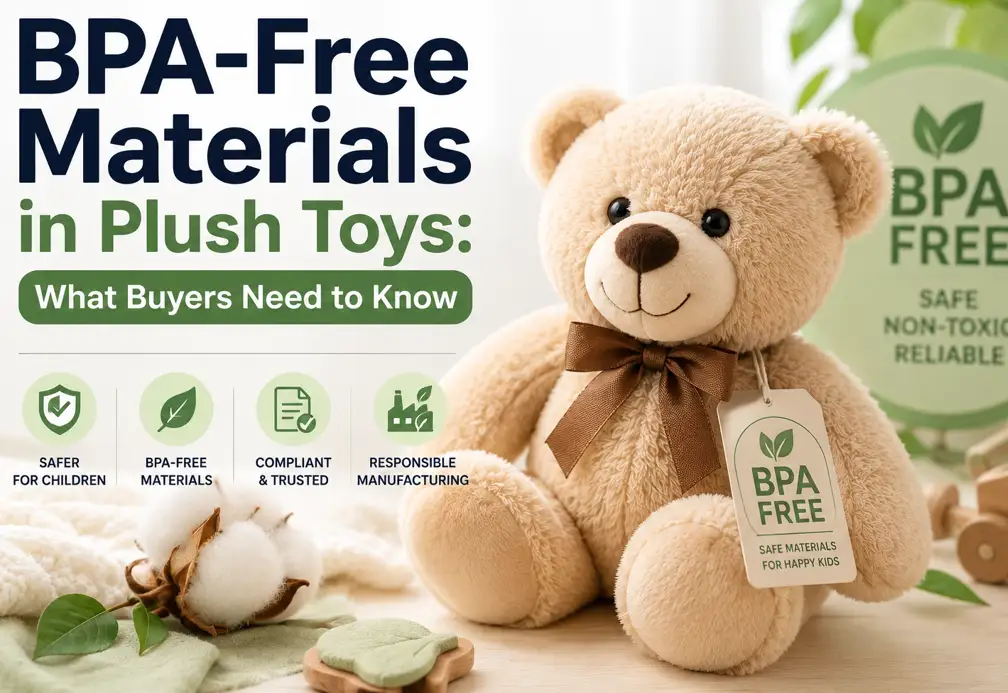
Understanding BPA and Why It Matters in Soft Toys
Bisphenol A is an industrial chemical that has been used since the 1960s in the production of polycarbonate plastics and epoxy resins. Its relevance to child health stems from its classification as an endocrine-disrupting compound — a substance that can interfere with hormone signaling pathways even at low concentrations. Research across regulatory bodies in North America, the European Union, and Japan has linked BPA exposure to developmental concerns, particularly in infants and young children whose endocrine systems are still maturing.
The pathway of BPA exposure in plush toys is primarily through oral contact — mouthing, chewing, or sucking on attached plastic components such as safety eyes, nose buttons, squeaker mechanisms, or decorative accessories. Secondary exposure through skin contact with printed or coated fabric surfaces is a lower but non-negligible concern, particularly in products intended for infants who spend extended periods in direct contact with soft toys.
Where BPA Can Appear in Plush Construction
Not all parts of a stuffed toy present the same BPA risk profile. The shell fabric — typically a polyester velboa or minky textile — does not contain BPA under normal manufacturing conditions. The risk is concentrated in specific material categories that are often overlooked during standard quality checks.
BPA Risk Assessment by Plush Toy Component
| Component | Material Type | BPA Risk Level | Common Safer Alternative |
|---|---|---|---|
| Safety eyes/nose buttons | Polycarbonate plastic | High | BPA-free ABS plastic; embroidery |
| Squeaker mechanisms | Polycarbonate or PVC | Medium–High | BPA-free PE or PP squeakers |
| Decorative ribbons/closures | Coated woven fabric | Low–Medium | Uncoated or water-based coated ribbon |
| Printed graphics on fabric | Plastisol ink (PVC-based) | Low–Medium | Water-based or phthalate-free inks |
| Hang tags/attachment hardware | Polycarbonate clip or coated card | Low | Paper hang tags; BPA-free plastic clips |
| Outer shell fabric | Polyester/acrylic pile | Negligible | N/A — not a BPA risk category |
Tip
When specifying BPA-free requirements in a product brief, list each accessory component separately rather than applying a blanket claim to the whole toy. Different components require different material substitutions, and a precise specification prevents ambiguity during factory audits and third-party testing.
Regulatory Standards Governing BPA in Toy Products
BPA is regulated differently across major consumer markets, and the variation is significant enough to affect how product specifications are written for global distribution. Understanding which standard applies in each target market is a prerequisite for sourcing compliant plush toys.
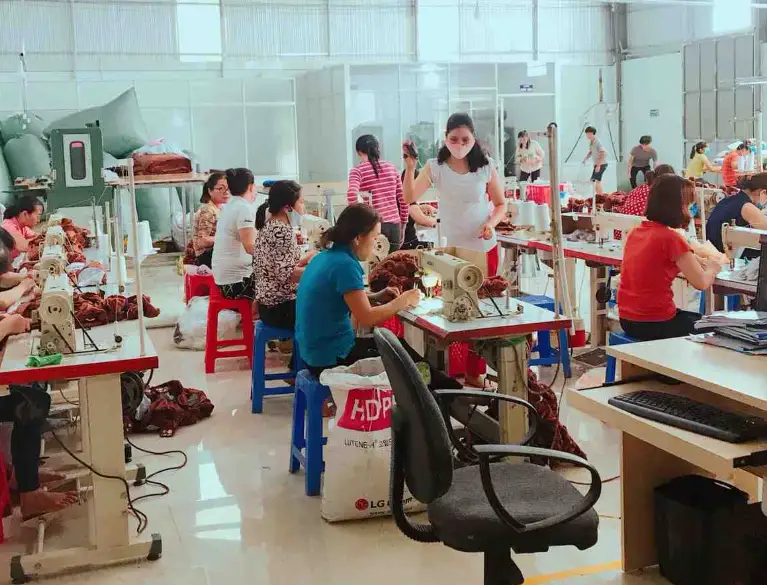
In the United States, the Consumer Product Safety Improvement Act (CPSIA) does not ban BPA outright in toys, but it mandates third-party testing for any toy intended for children under 12. Chemical substance restrictions for toys fall primarily under the authority of individual state regulations — California’s Proposition 65, for example, lists BPA as a chemical known to cause reproductive harm and requires product warnings above specific exposure thresholds. The European Union has taken a more direct approach under REACH Regulation and the EU Toy Safety Directive (2009/48/EC), imposing specific migration limits for chemical substances in materials that come into contact with children’s mouths.
BPA Regulatory Status in Major Plush Toy Export Markets
| Market | Applicable Regulation | BPA-Specific Restriction | Verification Required |
|---|---|---|---|
| European Union | REACH / EN 71 / 2009/48/EC | Migration limits under EN 71-3; BPA restricted in thermal paper under REACH | Accredited lab testing |
| United States | CPSIA; CA Prop 65 | No federal ban; CA warning threshold applies | CPSC-approved third-party lab |
| United Kingdom | UK Toy Safety Regulations 2011 | Mirrors EU approach (post-Brexit alignment) | UKAS-accredited lab |
| Canada | Canada Consumer Product Safety Act | BPA banned in baby bottles; toy restrictions pending | Health Canada–recognized lab |
| Australia / New Zealand | AS/NZS 8124 | Chemical migration limits under Part 3 | Accredited third-party lab |
The Role of REACH in Material Specification
For plush toys exported to the European Union, REACH Regulation (Registration, Evaluation, Authorisation and Restriction of Chemicals) is the most comprehensive framework for chemical substance management. It imposes restrictions on substances of very high concern (SVHCs), a list that is updated regularly and currently includes a number of bisphenol compounds. Suppliers sourcing plastic components for EU-bound plush products must be able to provide documentation confirming that their materials comply with the current SVHC candidate list, which goes beyond BPA alone to cover related bisphenol analogues increasingly used as substitutes.
BPA-Free Plastic Alternatives Used in Plush Accessories
Replacing polycarbonate plastic components in plush toys requires selecting alternative polymers that offer comparable physical performance — hardness, color stability, impact resistance — without relying on BPA as a polymerization monomer. The most widely adopted alternatives in the toy industry are acrylonitrile butadiene styrene (ABS), polypropylene (PP), and high-density polyethylene (HDPE), all of which can be molded into the small-format shapes required for safety eyes, nose buttons, and squeaker housings.
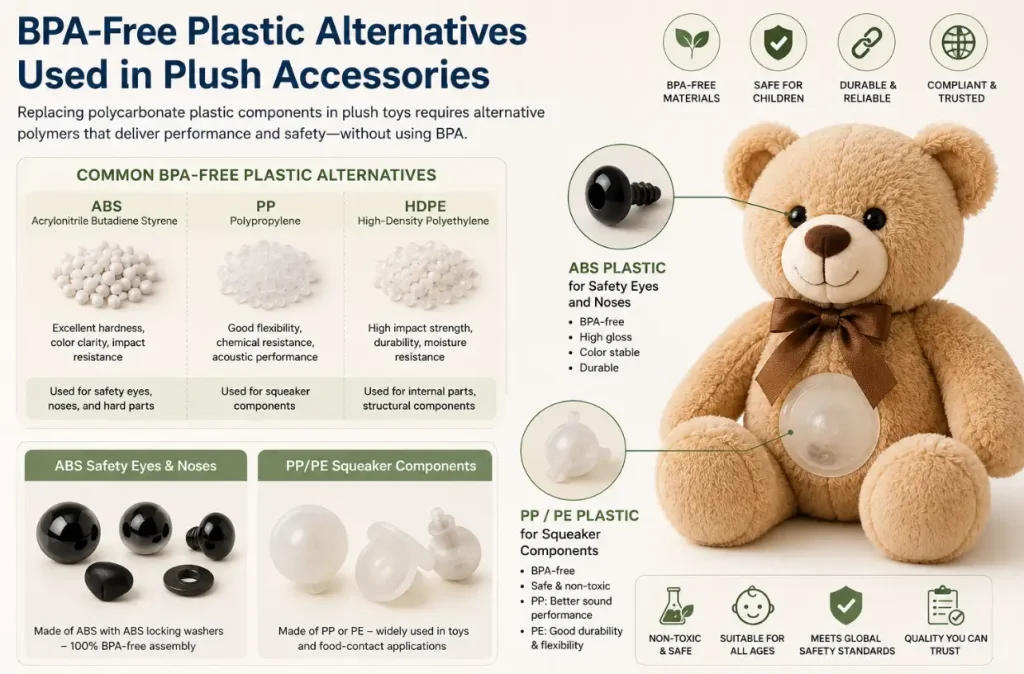
ABS plastic for safety eyes and noses
ABS does not use BPA in its synthesis and offers excellent surface hardness and color clarity — properties essential for the glossy appearance expected in plush safety eyes. It is the dominant replacement material for polycarbonate-based components in toys intended for children’s markets. ABS safety eyes manufactured for the toy industry typically come with locking washers in the same material, ensuring the entire assembly is BPA-free.
PP and PE for squeaker components
Internal squeaker mechanisms in plush toys are commonly made from polypropylene or polyethylene, both of which are inherently BPA-free and have long safety track records in food-contact applications. PP squeakers offer slightly better acoustic properties than PE alternatives and are the preferred specification for products where squeaker volume and clarity matter to the end user.
BPA-Free Plastic Alternatives: Performance Comparison for Plush Accessories
| Material | BPA-Free | Typical Applications | Key Advantages | Limitations |
|---|---|---|---|---|
| ABS | Yes | Safety eyes, noses, clips | High surface clarity, rigid, colorable | Not food-grade certified |
| Polypropylene (PP) | Yes | Squeakers, closures | Food-safe, flexible, durable | Lower surface gloss than ABS |
| HDPE | Yes | Squeakers, small structural parts | Chemical-resistant, food-safe | Limited color range |
| PLA (bioplastic) | Yes | Eco-positioning accessories | Renewable sourcing, compostable | Heat-sensitive, higher cost |
| Recycled PP / PE | Yes (if verified) | Squeakers, closures | Lower environmental impact | Requires contamination verification |
Tip
When reviewing supplier material declarations for plastic components, request a Substance of Concern (SoC) declaration that covers not just BPA but also bisphenol S (BPS) and bisphenol F (BPF) — two common chemical analogues used as BPA substitutes that are now under increasing regulatory scrutiny in EU and US markets.
How BPA-Free Claims Are Verified in Production
A BPA-free claim on product packaging or a spec sheet is only as reliable as the testing infrastructure behind it. Self-declaration by a supplier without independent verification has limited credibility in today’s compliance-driven procurement environment. Robust verification involves a combination of material-level documentation and finished-product chemical testing.
Third-Party Laboratory Testing
The most reliable method of verifying a BPA-free claim is third-party chemical testing by an accredited laboratory. For plush toys, this typically involves extracting chemical content from the specific components of concern (plastic eyes, noses, squeakers) using solvent extraction or migration testing protocols, then analyzing the extract for bisphenol compounds using gas chromatography-mass spectrometry (GC-MS) or liquid chromatography-mass spectrometry (LC-MS). Both methods can detect bisphenol A at concentrations in the parts-per-billion range — well below the thresholds required by regulatory limits in any major market.
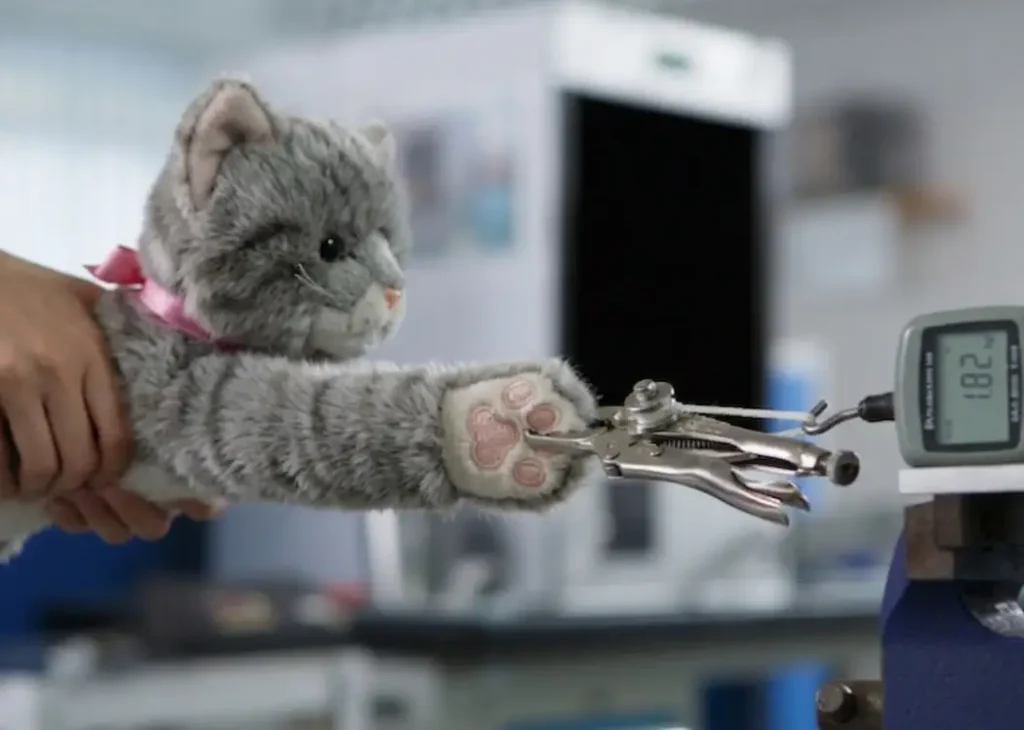
Testing should be performed per production lot rather than relying on a single baseline test report, as material substitutions at the supplier level can introduce non-compliant materials without the buyer’s knowledge. Annual retesting of high-risk components is a prudent minimum standard for any brand with ongoing plush toy programs.
Material Safety Data Sheets and Declarations of Conformity
In addition to finished-product testing, buyers should require material safety data sheets (MSDS or SDS) for all plastic components supplied to the factory, along with a Declaration of Conformity (DoC) from the component supplier confirming that the material does not contain restricted bisphenol compounds. These documents form part of the technical file required for CE marking in the EU and are increasingly expected by US retail buyers as part of standard product compliance documentation.
BPA-Free Verification Methods: Comparison by Reliability and Application
| Verification Method | Reliability | Best Used For | Limitation |
|---|---|---|---|
| Third-party GC-MS / LC-MS testing | Very High | Finished product certification | Cost; lead time for results |
| Supplier Declaration of Conformity | Medium | Pre-production material approval | Self-declared; requires trust in supplier |
| Material Safety Data Sheet (SDS) | Medium | Component-level documentation | May not cover trace chemical content |
| OEKO-TEX STANDARD 100 certification | High (for textiles) | Fabric and accessory screening | Does not cover hard plastic components |
| Factory audit (chemical management) | Medium | Supplier process verification | Snapshot only; requires follow-up |
Sustainability and BPA-Free: The Overlap with Eco-Certification
BPA-free material selection increasingly intersects with broader sustainability positioning in plush toy product development. Several third-party certification frameworks address chemical safety and environmental impact simultaneously, making them relevant to brands pursuing both compliance and sustainability credentials.
OEKO-TEX STANDARD 100 is the most widely recognized textile certification for harmful substance exclusion. It tests finished articles against a comprehensive list of restricted substances — including various bisphenol compounds — and applies to every component of the certified article, including threads, buttons, and accessories. For plush toys, OEKO-TEX certification on the finished product provides strong consumer-facing evidence of chemical safety across both fabric and accessory materials, although its scope for rigid plastic parts (safety eyes, squeakers) is more limited than for textile components.
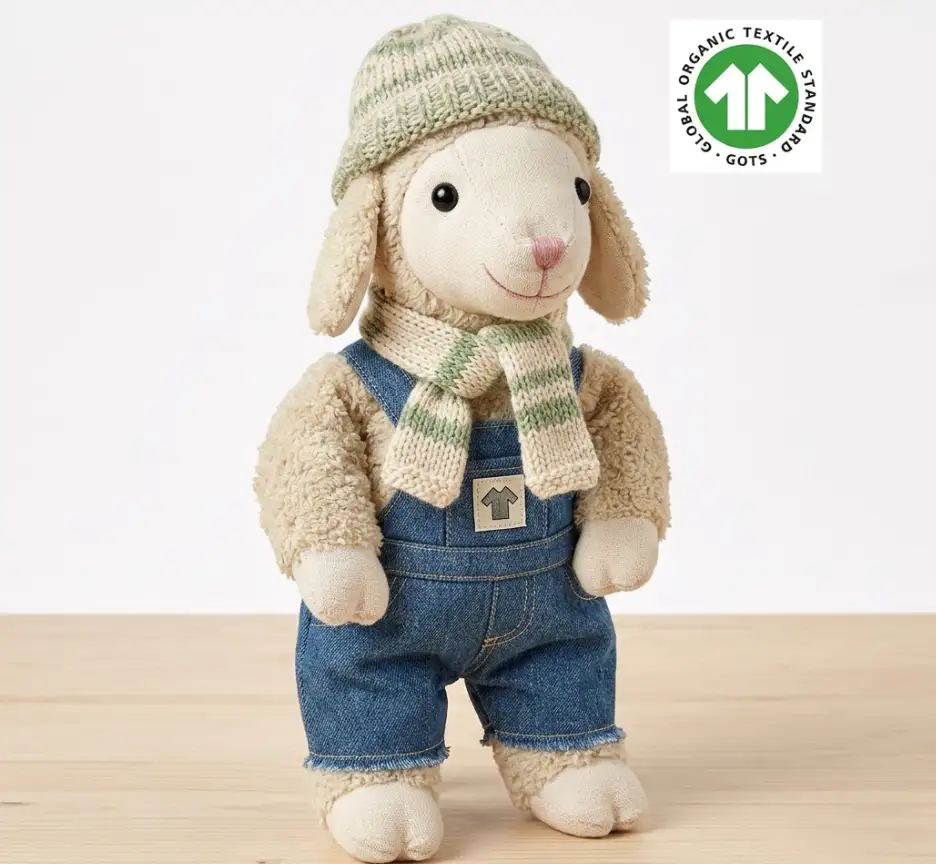
The Global Organic Textile Standard (GOTS) and MADE SAFE certification offer additional frameworks with explicit BPA exclusion requirements, and both carry meaningful market recognition among health-conscious consumer segments in North America and Europe. Products positioned in the organic baby or natural toy category increasingly carry one or more of these certifications as a baseline market entry requirement.
Frequently Asked Questions
Does the fabric of a plush toy contain BPA?
Standard polyester plush fabric — velboa, minky, or sherpa — does not contain BPA under normal manufacturing conditions. BPA risk in plush toys is concentrated in hard plastic accessory components such as safety eyes, nose buttons, and squeaker mechanisms, not in the textile shell or polyester fiberfill.
What plastic should replace polycarbonate in plush toy accessories?
ABS (acrylonitrile butadiene styrene) is the most widely used BPA-free alternative for rigid accessory components such as safety eyes and noses. Polypropylene (PP) and high-density polyethylene (HDPE) are preferred for squeaker mechanisms. All three are free of bisphenol A and have established safety track records in children’s product applications.
Is BPA banned in toys in the European Union?
The EU does not maintain a single blanket ban on BPA in all toy components, but it restricts bisphenol A under REACH regulation (including the SVHC candidate list) and imposes chemical migration limits under EN 71-3. Thermal paper containing BPA is restricted under REACH Annex XVII. In practice, toys sold in the EU must meet migration limits that effectively require BPA-free materials for any components that may contact a child’s mouth.
How can buyers verify a supplier’s BPA-free claim?
The most reliable method is third-party chemical testing — specifically GC-MS or LC-MS analysis of the specific plastic components in question — conducted by an accredited laboratory. Supplier Declarations of Conformity and MSDS documentation are useful supporting evidence but should not replace independent testing for components with direct oral-contact potential.
Are BPA substitutes like BPS and BPF also restricted?
Regulatory restriction of bisphenol analogues is evolving. BPS and BPF are under active review by the European Chemicals Agency (ECHA) and are candidates for inclusion on the REACH SVHC list. Some major retail buyers have already extended their restricted substance lists to include these analogues. Requesting a full bisphenol panel (covering BPA, BPS, and BPF) in chemical testing reports is increasingly recommended practice.
Does OEKO-TEX certification confirm a plush toy is BPA-free?
OEKO-TEX STANDARD 100 certification tests for a wide range of harmful substances, including bisphenol compounds in textile and accessory components, providing strong evidence of chemical safety across fabric and soft materials. However, its coverage of rigid molded plastic parts (such as hard safety eyes) is more limited, and a full BPA-free claim for hard components should still be supported by component-specific chemical test reports.