Skip to content
A practical breakdown of what cotton fabric brings to plush toy manufacturing — where it outperforms synthetic alternatives, where it falls short, and how buyers and designers can plan around both.
Cotton is one of the oldest textile fibers used in soft toy production, and it remains a common choice whenever a brand wants a plush item to feel natural, breathe well, and appeal to parents who read fabric labels closely. But cotton is not a universal upgrade over synthetic plush fabrics — it comes with real trade-offs in durability, shrinkage, cost, and moisture handling that a design or sourcing team needs to plan for before committing to a production run.
This guide walks through what cotton plush toys actually are, the fabric variants used across the industry, the specific benefits cotton delivers, the limitations that catch first-time buyers off guard, and the manufacturing and quality-control practices that determine whether a cotton plush toy performs well once it reaches a child’s hands.
Demand for cotton plush has grown alongside broader consumer interest in natural-fiber textiles, clean-label baby products, and lower-impact packaging. That shift has pushed cotton from a niche, craft-market material into a mainstream option that mid-size and large plush brands now request alongside standard synthetic fabric lines. Understanding where cotton genuinely improves a product — and where it simply adds cost without a matching performance benefit — is the difference between a successful natural-fiber launch and a line that generates returns over shrinkage or durability complaints.
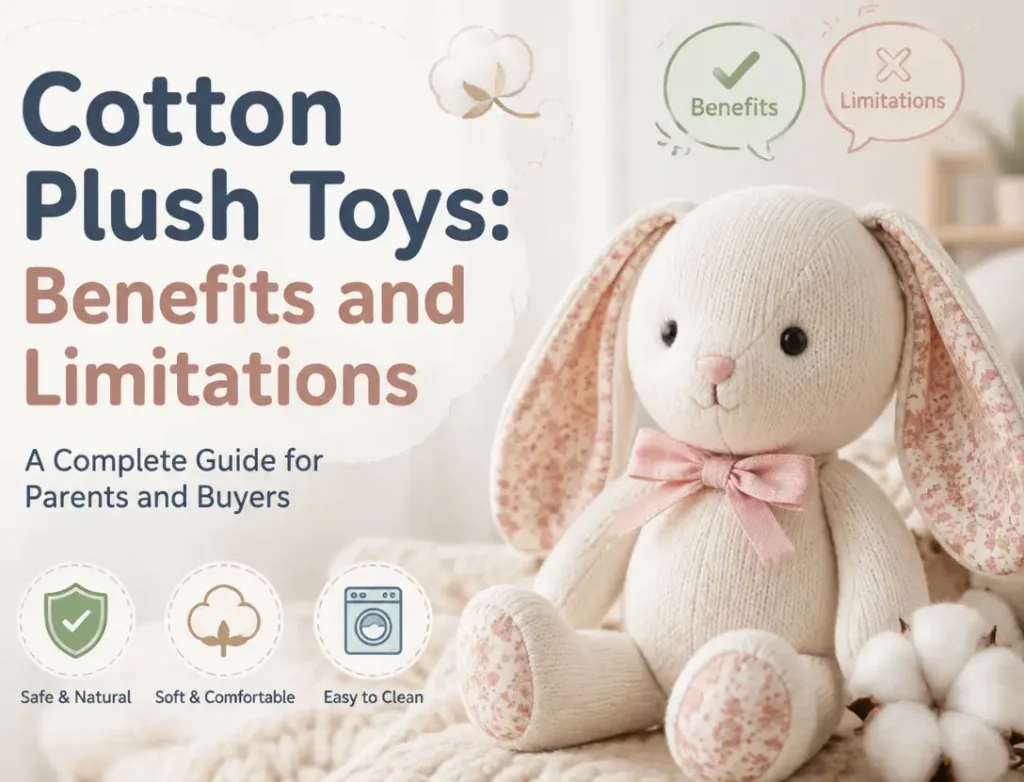
What Are Cotton Plush Toys?
A cotton plush toy is a stuffed item where the outer shell fabric is made primarily or entirely from cotton fiber, rather than the polyester-based minky, PV plush, or acrylic fabrics that dominate mass-market soft toy production. The stuffing inside can still vary — polyester fiberfill, cotton batting, bamboo fiber, or PP cotton (a shorthand term the industry uses for polypropylene fiberfill, not actual cotton) are all common regardless of what the outer shell is made from.
Cotton is a natural cellulose fiber harvested from the cotton plant, spun into yarn, and woven or knitted into fabric. In plush manufacturing, it typically appears in one of three forms: woven cotton canvas or muslin for structured toy bodies, knitted cotton jersey or interlock for softer huggable items, and cotton velour or terry for a fuzzier, plush-like hand feel that approximates synthetic minky without using petroleum-based fiber.
The term “cotton plush toy” is used loosely across the industry, and it is worth clarifying what it does and does not guarantee. A cotton shell does not automatically mean the whole product is natural fiber — stuffing, thread, trims, printed graphics, and safety eyes or noses are frequently synthetic even on a 100% cotton shell. Buyers who want a fully natural-fiber product need to specify each component individually rather than assuming a “cotton plush” label covers the entire construction.
Types of Cotton Fabric Used in Plush Toy Manufacturing
Not all cotton fabric behaves the same way once it is cut, sewn, and stuffed. The weave or knit structure determines stretch, softness, and how the fabric holds up to repeated washing, and choosing the wrong variant for a given design is one of the most common early mistakes in cotton plush development. A woven cotton that looks appropriate on a swatch card can behave very differently once it is pattern-cut around curved seams and packed with stuffing, so most experienced buyers request a small stuffed sample rather than approving fabric from a flat swatch alone.
Cotton Canvas and Muslin
Woven, tightly constructed, and relatively stiff compared to knit fabrics. Cotton canvas holds printed or embroidered detail well and is often used for the base body of rag-doll-style plush or toys where structure matters more than softness, such as sitting animals with a defined silhouette.
Cotton Velour and Cotton Terry
Brushed or looped cotton fabrics designed to mimic the soft, dense hand-feel of synthetic plush. Cotton velour is the closest natural-fiber substitute for minky fabric, though it is generally less dense and less uniformly soft than a comparable polyester pile.
Organic Cotton Knit and Interlock
Stretchy, breathable, and the most common choice for baby-safe plush lines marketed on natural or organic positioning. Organic cotton knit is grown and processed under GOTS (Global Organic Textile Standard) or similar certification, which restricts pesticide use and synthetic dye processes.
Cotton Fabric Variants Used in Plush Toy Production
| Fabric Type | Construction | Hand Feel | Typical Application | Relative Cost |
|---|---|---|---|---|
| Cotton canvas/muslin | Woven | Firm, structured | Toy bodies, rag dolls, printed panels | Low-moderate |
| Cotton velour | Brushed woven or knit | Soft, short pile | Huggable plush, character toys | Moderate |
| Cotton terry | Looped knit | Textured, absorbent | Bath toys, teething plush | Moderate |
| Organic cotton interlock | Double knit | Smooth, stretchy | Infant comforters, baby rattles | Moderate-high |
| Cotton flannel | Woven, napped | Soft, matte | Lining, small accessory plush | Low-moderate |
Cost tiers are relative to standard PV plush and minky fabric used in synthetic plush production, not absolute pricing.
Tip: If a design brief calls for a “cotton plush” look but the toy needs deep, dense pile similar to minky fabric, specify cotton velour rather than cotton knit — the difference in hand-feel between the two is significant and often surprises buyers who expect all cotton plush to feel the same.
Key Benefits of Cotton Plush Toys
Cotton earns its place in plush manufacturing for reasons that go beyond marketing language. The following benefits are the ones that most consistently show up in buyer feedback and product testing, and they explain why cotton continues to hold a defined niche even in a market dominated by synthetic plush fabric.
Breathability and Temperature Comfort
Cotton fiber is naturally porous, which allows it to absorb and release moisture more readily than synthetic fibers. For plush toys that children sleep with or hold against their skin for long periods, this translates into less heat buildup and a cooler, drier surface compared to polyester-based plush, which tends to trap warmth and moisture against the body.
Hypoallergenic and Skin-Friendly Properties
Cotton does not generate the static charge that synthetic fibers can, which reduces dust and lint attraction over the life of the toy. It is also less likely to trigger contact irritation in children with sensitive skin, and organic cotton variants avoid the synthetic dyes and finishing chemicals that are more common in polyester plush production.

Biodegradability and Environmental Positioning
Cotton is a natural cellulose fiber and breaks down under normal composting conditions far faster than polyester, which can persist in landfill environments for decades. Brands building sustainability messaging around a plush line frequently lead with this point, particularly when the toy is paired with natural fiber stuffing rather than polyester fiberfill.
Natural Softness and Tactile Appeal
Cotton has a distinct hand-feel that many consumers associate with quality and comfort — a softness that comes from the fiber itself rather than from a synthetic pile finish. This is part of why cotton remains popular for infant comforters and baby-safe plush lines, where tactile experience is a primary purchase driver.
Dye Absorption and Color Vibrancy
Cotton fiber absorbs both reactive and natural dyes well, producing rich, even color saturation without requiring the heat-set dye processes used on polyester. This also makes cotton a strong substrate for hand-printed or block-printed designs, which are harder to achieve cleanly on synthetic plush fabric.
Safety Profile for Infant-Facing Products
Because cotton is a natural fiber with a long safety track record in infant textiles, it is often the default choice for products aimed at the 0-12 month age range, where regulatory bodies and parents alike scrutinize fabric composition closely.
Suitability for Sensory-Focused and Special-Needs Products
Cotton’s matte, low-static surface makes it a common choice for sensory plush toys and comfort items designed for children with tactile sensitivities. Unlike synthetic pile fabrics, which can feel slick or generate friction that some children find aversive, cotton’s more neutral texture is frequently specified for sensory-integration product lines and for comfort items used in clinical or therapeutic settings.
Tip: For infant-facing plush lines, pair a cotton or organic cotton shell with a certified hypoallergenic polyester fiberfill rather than raw cotton stuffing. Cotton stuffing compresses and clumps faster than polyester fiberfill after repeated washing, which undermines the “soft feel” the outer fabric is meant to deliver.
Limitations and Challenges of Cotton Plush Toys
Cotton’s natural-fiber advantages come with equally real drawbacks. Buyers who move from synthetic plush to cotton plush without adjusting expectations or manufacturing specifications often run into the following issues, usually after the first production run rather than during sampling, when small defects are easiest and cheapest to catch.
Shrinkage and Dimensional Instability
Cotton fiber shrinks when exposed to heat and moisture, particularly during machine washing and tumble drying. Unless the fabric is pre-shrunk (sanforized) before cutting, finished plush toys can shrink 3-5% or more after their first wash, which distorts proportions on character-accurate designs and can loosen or tighten seams unevenly.
Lower Durability Compared to Synthetic Fibers
Cotton fiber is weaker than polyester and abrades faster under repeated friction, such as a child dragging a plush toy across the floor or chewing on an ear or limb. Cotton plush toys generally show visible pilling, thinning, or fraying sooner than a comparable polyester plush item under the same handling conditions.
Moisture Retention and Mold Risk
The same absorbency that makes cotton breathable also means it holds onto moisture longer than synthetic fiber. If a cotton plush toy gets wet — from drool, spills, or bath play — and is not dried thoroughly, the fabric and any natural-fiber stuffing inside can develop mold or mildew, especially in humid climates or when stuffing density is high.
Higher Production Cost
Cotton fabric, particularly certified organic cotton, typically costs more per kilogram than standard PV plush or minky fabric, and cotton’s shrinkage tendency adds pre-treatment steps to the production process that synthetic fabric does not require. Combined, these factors generally push cotton plush unit costs above equivalent synthetic plush items.
Colorfastness and Fading Over Time
While cotton absorbs dye well initially, it is more prone to fading from UV exposure and repeated washing than solution-dyed synthetic fibers, where color is embedded in the fiber itself during extrusion. Bright, saturated colors on cotton plush can noticeably dull after a season of regular use and washing.

Limited Density and Plush Texture
Even cotton velour struggles to match the dense, uniform pile of synthetic minky fabric, which is engineered specifically to maximize tactile plushness. Designers working with cotton often need to compensate with heavier stuffing density or double-layer construction to achieve a comparably plump, huggable silhouette.
Fabric Supply and Lot-to-Lot Consistency
Cotton is an agricultural commodity, and its fiber quality varies by growing region, harvest year, and weather conditions in ways that synthetic fiber, produced under controlled industrial conditions, does not experience. This can create small but noticeable variation in color depth, fabric weight, and texture between production lots, which is a more frequent quality-control concern for cotton plush than for synthetic plush sourced from a consistent polyester feedstock.
Cotton Plush vs. Polyester Plush: Side-by-Side Comparison
| Attribute | Cotton Plush | Polyester (PV/Minky) Plush |
|---|---|---|
| Breathability | High | Low-moderate |
| Softness/pile density | Moderate | High |
| Shrinkage risk | Moderate-high (untreated) | Very low |
| Abrasion resistance | Lower | Higher |
| Colorfastness | Moderate | High |
| Moisture drying time | Slower | Faster |
| Biodegradability | High | Low |
| Relative unit cost | Higher | Lower |
Ratings reflect general industry patterns; specific fabric grades and finishing treatments can shift individual attributes.
Cotton vs. Synthetic Plush: When to Choose Which
The right fabric choice depends heavily on the product category, target age group, and how the toy will actually be used. A decision that works for an infant comforter may be the wrong call for a play-heavy character plush aimed at toddlers.
Fabric Selection Guide by Product Category
| Product Category | Recommended Fabric | Reasoning |
|---|---|---|
| Infant comforters / lovies | Organic cotton knit | Skin-contact safety, breathability, low chemical exposure |
| Bath and teething plush | Cotton terry | Absorbency and textured surface for oral exploration |
| High-play character plush (toddler+) | Polyester minky or PV plush | Durability under heavy handling and frequent washing |
| Licensed collectible plush | Polyester plush with cotton accents | Consistent color and texture over long shelf life |
| Sustainability-positioned product lines | Organic cotton shell + recycled polyester fill | Balances biodegradability with fill durability |
Tip: Blended fabrics — cotton face with a synthetic backing, or cotton-polyester yarn blends — are worth requesting a sample of before committing to 100% cotton. A blend can retain much of cotton’s breathability and hand-feel while significantly improving shrink resistance and durability.
Common Applications of Cotton Plush Toys in the Market
Cotton plush shows up most often in product categories where its natural-fiber properties directly support the way the toy is used, rather than as a blanket substitute across an entire catalog.
- Newborn and infant comforters — small, easily washable shapes designed for skin contact and sleep association, where breathability and low chemical exposure matter more than long-term abrasion resistance.
- Bath and water-play toys — cotton terry’s absorbency and textured surface suit teething and splash-play products, provided drying protocols are built into the care instructions.
- Eco-conscious gift and boutique lines — smaller-batch plush sold through natural-goods retailers or direct-to-consumer channels, where organic cotton and biodegradability support the brand’s positioning.
- Sensory and therapeutic comfort items — used in clinical, educational, or special-needs contexts where a specific fabric texture is part of the product’s function.
- Limited-edition or artisan plush — cotton canvas and muslin’s print and embroidery clarity make it a common substrate for hand-finished or small-batch character designs.
Mass-market character plush aimed at heavy daily play, by contrast, still leans toward synthetic fabric in most price-competitive categories, since durability and washability under frequent use outweigh the natural-fiber appeal for that use case.
Manufacturing Considerations for Cotton Plush Toys
Producing cotton plush at scale requires a few process adjustments that synthetic plush fabric does not demand.
Pre-Shrinking Treatment
Reputable factories run cotton fabric through a pre-shrinking (sanforizing) process before cutting patterns. Skipping this step is the single most common cause of post-wash sizing complaints on cotton plush products.
GSM (Fabric Weight) Selection
Grams per square meter (GSM) determines how substantial the fabric feels and how well it holds shape once stuffed. Lightweight cotton fabric under 200 GSM tends to look thin once stuffed and stretched over seams, while heavier cotton fabric above 300 GSM adds structure but also adds cost and reduces flexibility for tightly curved seams.
Stitching and Seam Reinforcement
Because cotton fabric has less inherent stretch and recovery than knit synthetic plush, seams on cotton plush toys benefit from reinforced double-stitching at stress points — limb joints, ear attachments, and tail bases — to offset the fiber’s lower tensile strength. Sewing tension also needs adjustment when switching a production line from synthetic to cotton fabric, since cotton’s lower stretch can cause puckering or thread breakage if tension settings calibrated for knit synthetic plush are left unchanged.
Stuffing Compatibility
Pairing cotton shell fabric with polyester fiberfill rather than natural cotton batting is standard practice, since polyester fiberfill resists compression and moisture retention far better over repeated washing cycles. Some brands request cotton or bamboo-fiber stuffing specifically to keep the entire product natural-fiber for marketing purposes, but this choice should be made with the durability trade-off clearly communicated to the buyer, since natural-fiber stuffing typically needs replacement or refluffing sooner than polyester fill under identical use conditions.
Cotton Fabric Weight (GSM) Guide by Toy Type
| Toy Type | Recommended GSM Range | Notes |
|---|---|---|
| Infant comforter / small plush | 150-200 GSM | Lightweight, flexible, gentle drape |
| Mid-size character plush | 220-280 GSM | Balances structure and softness |
| Large sitting or standing plush | 280-350 GSM | Holds shape under stuffing pressure |
| Printed panel or applique sections | 200-260 GSM | Stable surface for embroidery and print |
Tip: Always request a washed sample, not just an unwashed swatch, before approving cotton fabric for production. Shrinkage, color shift, and pile flattening only become visible after at least one full wash-and-dry cycle.
Quality Control and Testing for Cotton Plush Toys
Shrinkage Testing
Standard practice is to measure fabric panels before and after a simulated wash cycle, typically expressed as a shrinkage percentage in both warp and weft directions. Fabric exceeding roughly 3% shrinkage in either direction generally needs a pattern size adjustment or a more aggressive pre-shrinking treatment before cutting proceeds. This test should be repeated whenever the fabric supplier, dye lot, or finishing process changes, since shrinkage behavior is not a fixed property of “cotton” in general but varies by how a specific fabric batch was woven, dyed, and finished.
Colorfastness Testing
Colorfastness to washing, rubbing (crocking), and light exposure is tested against standardized grey-scale ratings. Cotton plush intended for frequent washing, such as bath toys, needs a higher colorfastness threshold than display or collectible plush.
Chemical and Safety Compliance
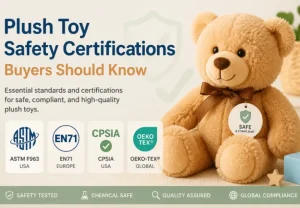
Cotton fabric and any dyes or finishing agents applied to it are tested for restricted substances under frameworks such as CPSIA, EN71, or REACH, depending on the target market. Organic cotton claims additionally require GOTS or OCS certification documentation to be verifiable through the supply chain.
Physical Durability Testing
Because cotton fabric has lower inherent tensile strength than synthetic plush, seam-pull testing and abrasion testing take on added importance during pre-production approval. Pull testing checks that attached components such as ears, tails, and safety eyes withstand a specified force without detaching, while abrasion testing (commonly Martindale testing) measures how many rub cycles the fabric surface tolerates before visible wear appears — a useful benchmark for comparing a proposed cotton fabric against the synthetic fabric it may be replacing.
Tip: Ask for third-party lab reports covering both the fabric and the dye lot actually used in production, not a generic certificate for “cotton fabric” in general. Dye chemistry and finishing agents vary by batch and can affect compliance results independently of the base fiber.
Fiber Content Labeling and Regulatory Requirements
Most consumer markets require accurate fiber content disclosure on textile products, including plush toys, and cotton plush is subject to the same rules as any other cotton garment or home textile. Labels typically need to state the fiber composition of both the outer shell and the stuffing as a percentage, and blended fabrics — such as a cotton-polyester face fabric — must disclose both fibers rather than defaulting to whichever one dominates.
Organic claims carry an additional layer of scrutiny. Marketing a product as “organic cotton” without valid GOTS, OCS, or an equivalent regional certification is treated as a labeling violation in most major markets, and enforcement has increased as organic textile claims have become more common in the toy category. Buyers sourcing organic cotton plush should request the certificate, the transaction certificate tied to the specific fabric lot, and confirmation that the certification covers the finished toy rather than just the raw fiber.
Care and Maintenance Recommendations
Cotton plush toys generally require gentler laundering than synthetic plush to avoid accelerating the shrinkage and pilling issues described above. Care instructions printed on the product label matter more for cotton plush than for synthetic plush, since the margin for error between “safe wash” and “damaging wash” is narrower for natural fiber.
- Wash in cold or lukewarm water rather than hot, which significantly slows further shrinkage after the initial pre-shrink treatment wears off.
- Air-dry flat or on a low tumble-dry setting instead of high heat, which both reduces shrinkage risk and protects color saturation.
- Avoid prolonged direct sunlight exposure during drying, since UV light accelerates fading on cotton fabric more noticeably than on solution-dyed synthetic fiber.
- Spot-clean where possible for toys with electronic components, embroidery, or printed detail that may not tolerate full immersion washing.

Cost Factors in Cotton Plush Toy Production
Several variables drive the price gap between cotton and synthetic plush beyond raw fabric cost. Organic or certified cotton carries a premium tied to certification audits and traceability requirements throughout the supply chain.
Pre-shrinking treatment adds a processing step and associated labor cost that synthetic fabric skips entirely. Lower fabric yield efficiency is also common, since cotton’s tendency to shift and stretch during cutting can increase waste compared to more stable knit synthetics. Finally, smaller minimum order quantities for specialty cotton fabrics, such as GOTS-certified organic cotton in specific colorways, often carry higher per-meter pricing than the large-volume synthetic fabric rolls used in mainstream plush production.
Buyers evaluating cotton against synthetic plush on cost alone should also factor in return and rework rates. A cotton plush product that ships without adequate pre-shrinking or colorfastness testing can generate higher post-sale complaint and return volume than the modest upfront savings from skipping those steps would justify, which is why most experienced buyers treat pre-production testing as a cost-control measure rather than an optional add-on.
Balancing Cotton’s Strengths Against Its Trade-Offs
Cotton plush toys are not a strictly better or worse choice than synthetic plush — they are a different set of trade-offs suited to specific product categories, age groups, and brand positioning. The natural-fiber benefits of breathability, hypoallergenic performance, biodegradability, and dye vibrancy make cotton a strong fit for infant comforters, sensory products, and sustainability-driven boutique lines.
The durability, shrinkage, moisture-retention, and cost limitations make synthetic plush the more practical choice for heavy-play, price-sensitive, or high-volume character products. The most reliable path to a successful cotton plush product is matching the fabric choice to the product’s actual use case, then building pre-shrinking, colorfastness, and physical durability testing into the production process from the start rather than treating them as afterthoughts.
Frequently Asked Questions
Are cotton plush toys safer than polyester plush toys?
Cotton plush toys are not automatically safer, but they do carry a lower risk of skin irritation for children with sensitive skin, and organic cotton variants avoid many of the synthetic dyes and finishing chemicals used in some polyester plush production. Safety ultimately depends more on compliance testing, stuffing material, and construction quality than on fiber type alone — a well-tested polyester plush toy can be just as safe as a well-tested cotton one.
Do cotton plush toys shrink after washing?
Yes, cotton fiber shrinks when exposed to heat and moisture unless the fabric has been pre-shrunk (sanforized) before the toy is cut and sewn. Untreated cotton fabric can shrink 3-5% or more on the first wash, which is why reputable manufacturers run cotton fabric through a pre-shrinking process and recommend cold-water washing with low-heat or air drying afterward.
How do cotton plush toys compare to minky or PV plush in softness?
Standard cotton fabrics generally feel less dense and plush than synthetic minky or PV plush, which are engineered specifically to maximize pile density and tactile softness. Cotton velour comes closest to replicating that feel among cotton fabric types, but most designers still find synthetic plush fabric delivers a plumper, more uniform hand-feel straight off the roll.
Can cotton plush toys develop mold or mildew?
Cotton fiber retains moisture longer than synthetic fiber, so a cotton plush toy that gets wet from drool, spills, or bath play and is not dried thoroughly can develop mold or mildew, particularly in humid climates. Thorough air-drying after any wet exposure, along with avoiding overly dense natural-fiber stuffing that traps moisture, significantly reduces this risk.
Why do cotton plush toys typically cost more than synthetic plush toys?
Cotton fabric, especially certified organic cotton, generally costs more per kilogram than standard polyester plush fabric, and it requires additional processing steps such as pre-shrinking that synthetic fabric does not need. Lower cutting yield efficiency and smaller minimum order quantities for specialty cotton colorways add further cost, which together push finished cotton plush toys above comparable synthetic plush pricing.
What stuffing material works best with a cotton plush shell?
Polyester fiberfill is the most common pairing with a cotton outer shell, since it resists compression, retains loft, and dries faster than natural cotton batting after repeated washing. Raw cotton stuffing tends to clump and flatten over time and holds onto moisture longer, which works against the durability and hygiene goals most cotton plush products are designed around.
Is organic cotton plush worth the extra cost for a product line?
It depends on the target market and positioning. Organic cotton plush carries genuine appeal for buyers focused on sustainability, infant safety, and chemical transparency, and GOTS or OCS certification gives that positioning credible backing with retailers and end consumers who specifically look for that documentation. For play-heavy or highly price-sensitive product categories, however, the durability and cost advantages of synthetic plush fabric often outweigh the marketing benefit of an organic cotton claim, so the decision should be driven by the product’s actual buyer rather than by fabric trends alone.