Skip to content
How safety construction, fabric and filling choices, feature complexity, and testing requirements should change as a plush toy’s target age group moves from infants through toddlers, school-age children, and adult collectors.
Designing plush toys for different age groups means matching construction methods, fabric and filling choices, feature complexity, and safety testing to the developmental stage of the intended user — a decision that shapes everything from seam strength and small-parts attachment to fabric texture and overall size, well before a single unit reaches production.
What Age-Appropriate Plush Toy Design Actually Means
Age-appropriate plush toy design is the practice of aligning a toy’s physical construction, material selection, and feature set with the developmental capabilities and risk profile of its intended age group. A toy built for a newborn nursery and a toy built for an adult collector may look similar on a shelf, but the underlying design decisions — seam reinforcement, filling type, surface texture, attachment method for eyes and noses, even overall size and weight — differ substantially once the intended user is defined precisely.
The starting point for any plush toy design brief should be the target age grade, not the character concept or fabric choice. Age grade determines which safety standards apply, which small-parts rules govern attachment methods, and which construction techniques are appropriate before a single design decision about color, texture, or silhouette is made. Treating age grading as an afterthought — something confirmed only once a design is nearly finished — is one of the most common and costly mistakes in plush toy product development, since it frequently forces a late-stage redesign of stuffing, attachments, or fabric.
This guide walks through how design priorities shift across the major plush toy age segments — infants and toddlers, preschool and young children, school-age children, and teens and adult collectors — along with the safety testing, fabric, and construction implications that follow from each.
It is worth noting that age grade is not always a single clean category. Many product lines are designed to sit at the boundary between two segments, such as a toy marketed for “ages 3 and up” that will realistically still be handled by younger siblings, or a licensed character toy sold to both school-age children and adult fans of the same franchise. In these boundary cases, the safer and more practical approach is to design and test to the requirements of the youngest realistic user rather than only the labeled target age, since actual usage rarely respects packaging text as precisely as a design brief assumes it will.
Why Age Grading Drives Every Downstream Design Decision
Age grading is not a marketing label added after a plush toy is designed; it is a classification that determines which construction rules, small-parts standards, and testing protocols legally and practically apply to the product. A toy labeled and marketed for children under three years old is held to substantially stricter small-parts, choking-hazard, and mouthing-resistance standards than a toy marketed for older children or adult collectors, and the construction has to reflect that from the earliest prototype.
It helps to think of age grading as setting the constraint boundary within which every other design decision has to fit, rather than as one input among many that gets balanced against aesthetics or cost. A character concept, fabric palette, or feature idea that works well within an older age grade’s constraints may simply not be achievable within a younger age grade’s constraints at all, no matter how the construction is adjusted — in which case the concept itself needs to change, not just the execution.
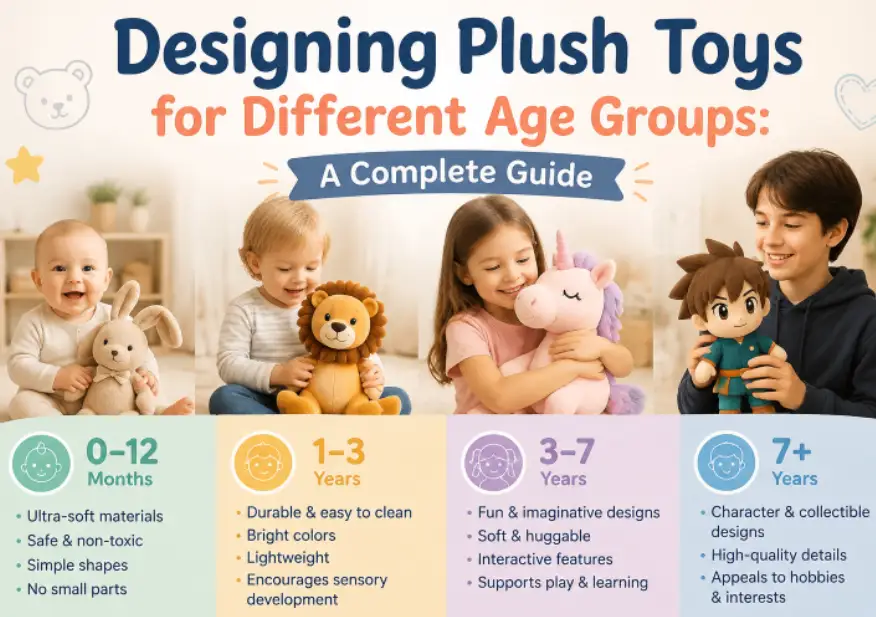
Plush Toy Age Grade Categories and Core Design Implications
| Age Segment | Primary Design Priority | Key Construction Implication |
|---|---|---|
| Infants (0–12 months) | Mouthing safety, softness, minimal features | No small attached parts; embroidered or printed facial features only |
| Toddlers (1–3 years) | Choking-hazard avoidance, durability under rough handling | Reinforced seams; securely locked attachment methods for any small components |
| Preschool (3–6 years) | Sensory engagement, simple interactivity | Larger, well-secured features; introductory sound or texture elements |
| School-age (6–12 years) | Character detail, play durability | More intricate embroidery and appliqué; higher-tension attachment testing |
| Teens & adult collectors | Display quality, material premiumness | Fine detailing, articulation, or premium fabrics with less emphasis on rough-play durability |
Notice that design priority shifts from pure safety minimalism at the youngest end of the spectrum toward detail and premium finish at the oldest end, with durability under active play peaking in the middle years when children interact with plush toys most physically. Understanding where a specific product sits on this curve should inform every subsequent material and construction decision.
Tip: Confirm the intended age grade in writing before pattern development begins, and treat any later request to extend the same design to a younger age group as a full safety re-review rather than a simple label change — the construction requirements are genuinely different, not just the packaging text.
Designing for Infants and Toddlers (0–3 Years)
Plush toys aimed at infants and toddlers carry the strictest safety requirements of any age segment, because this age group explores objects primarily through mouthing and because motor coordination is not yet developed enough to avoid choking hazards reliably. Every design decision at this stage should be evaluated first against safety criteria and only afterward against aesthetic or play-value criteria.
Safety-First Construction for Mouthing and Grasping
Facial features on infant and toddler plush toys should be embroidered, printed, or otherwise permanently integrated into the fabric rather than attached as separate small components such as plastic eyes or noses. Any component that can be gripped, pulled, or worked loose over repeated mouthing and washing cycles represents an unacceptable risk in this age segment, which is why leading safety standards for this category effectively push designers toward flat, integrated surface decoration rather than dimensional attachments.
Seam construction also carries more weight in this age group than in any other. Double-stitched or reinforced seams, along with a securely closed stuffing opening, reduce the risk of a seam failing under the sustained chewing, pulling, and washing that an infant plush toy is likely to experience over its lifespan. Corner and limb seams, where stress concentrates during grasping, deserve particular reinforcement attention during pattern and construction planning.

The stuffing closure itself deserves specific attention in infant products, since this is the seam most likely to see repeated mechanical stress from grasping, pulling, and being carried by a limb. A lock-stitched or bar-tacked closure, checked as part of routine quality control rather than assumed to be consistent across every unit, closes one of the more common gaps between a design specification and what actually reaches a nursery shelf.
Fabric and Filling Choices for Infant Safety
Fabric selected for infant plush toys should prioritize softness, colorfastness under frequent washing, and resistance to fraying at cut edges, since infant plush toys are washed far more frequently than toys aimed at older age groups. Filling material should be selected for both softness and washability, and any filling prone to clumping or losing loft after repeated laundering should be avoided for this segment even if it performs acceptably in older-age-group products.
Construction and Attachment Requirements by Age Group
| Age Segment | Facial Feature Method | Seam Requirement | Small Parts Policy |
|---|---|---|---|
| Infants (0–12 months) | Embroidered or printed only | Double-stitched, reinforced at stress points | No detachable small parts permitted |
| Toddlers (1–3 years) | Embroidered preferred; securely locked attachments if used | Reinforced, pull-tested to age-appropriate force standard | Any small component must pass pull/torque testing at required force |
| Preschool (3–6 years) | Embroidered or securely bonded appliqué | Standard reinforced construction | Small components permitted with standard attachment testing |
| School-age (6–12 years) | Embroidery, appliqué, or attached components | Standard construction with play-durability testing | Standard small-parts testing applies |
| Teens & adult collectors | Attached components, articulation, embellishments permitted | Construction tuned to display use rather than rough handling | Small-parts rules generally relaxed for products clearly marketed to this age group |
Tip: When in doubt about whether a proposed feature crosses into small-parts territory, design and test it as if it were a small part. It is far cheaper to over-engineer an attachment during sampling than to redesign an entire product line after a compliance failure surfaces during testing or, worse, after the product has already shipped.
Designing for Preschool and Young Children (3–6 Years)
Once a plush toy targets preschool-age children, motor coordination and cognitive engagement have developed enough that design can move beyond pure safety minimalism into simple interactivity, while still respecting the fact that this age group continues to explore toys physically and sometimes still mouths objects during play.
This transitional quality makes the preschool segment one of the more design-sensitive categories to work in. A feature that would be perfectly safe on a school-age product can still represent unacceptable risk on a preschool product if it has not been evaluated against the more conservative standards this younger, still-developing age group requires. Designers moving from a school-age brief into a preschool brief should treat every previously approved feature as needing re-validation rather than assuming a slight age reduction carries no construction consequences.
Interactive and Sensory Features
Preschool-age plush toys are where sensory and light-interactive elements typically first appear appropriately — varied fabric textures, simple embedded sound modules, or basic crinkle and squeaker elements that reward exploration without introducing a genuine choking or entrapment hazard. Any embedded sound or electronic component at this age still needs to be secured well beyond the force a child’s grip and pulling can realistically apply, and housings need to be sealed against both moisture from drooling or spills and against a curious child working a seam open out of persistent interest.
Size also becomes a more flexible design variable at this stage. Infant plush toys are generally kept compact for easy grasping and carrying, while preschool-age plush toys can range more widely in size, including larger floor or bed companions, since the choking-hazard concerns around overall toy size are less acute than they are for detachable small components.
Any embedded sound or electronic component in a preschool-targeted plush toy needs the housing seal and battery-access security to be treated as first-order design requirements from the earliest prototype stage, not as details finalized only after the fabric design has already been locked in.
Designing for School-Age Children (6–12 Years)
By school age, children handle plush toys more independently and more physically than younger age groups, often incorporating them into active imaginative play, travel, and sustained daily companionship. Design priorities shift from primarily protective to a blend of durability and character detail, since children in this age range respond strongly to recognizable, well-detailed characters and increasingly notice quality differences between products.
Character Complexity and Durability Under Active Play
School-age plush toys can support more intricate embroidery, multi-color appliqué, and articulated limbs than younger-age-group products, since the audience’s fine motor exploration is less likely to result in accidental component detachment through mouthing. That said, this age group also subjects plush toys to genuinely rigorous physical play — being dragged, thrown, used as pillows, and carried through daily activity — which means seam and attachment durability testing should reflect realistic active-play stress rather than only the gentler handling assumed for infant products.

Character licensing also plays a larger role in this age segment than in younger or older ones. A school-age child recognizes and evaluates a licensed character plush against the source material with a level of scrutiny that a toddler will not apply, which raises the bar for facial proportion accuracy, color matching, and embroidery detail. Balancing this appetite for detail against durability requirements — since more intricate embroidery and smaller appliqué pieces can introduce additional points of potential failure under active play — is one of the defining design tensions of the school-age segment.
Design Feature Suitability by Target Age Group
| Feature | Infants/Toddlers | Preschool | School-Age | Teens/Adults |
|---|---|---|---|---|
| Embroidered facial features | Required | Suitable | Suitable | Suitable |
| Attached plastic eyes/nose | Not suitable | Suitable with testing | Suitable with testing | Suitable |
| Embedded sound/electronics | Not suitable | Suitable with sealed housing | Suitable | Suitable |
| Articulated limbs/joints | Not suitable | Limited use | Suitable | Suitable, often expected |
| Fine detailing, glitter, sequins | Not suitable | Not recommended | Suitable with secure bonding | Suitable |
| Premium/delicate fabrics (mohair, minky blends) | Limited use | Limited use | Suitable | Preferred |
Tip: Pull-test school-age product attachments at a meaningfully higher force threshold than the minimum required for younger age grades, since real-world play — being swung, dragged, and gripped tightly during rough-and-tumble play — routinely exceeds standard laboratory test forces for this age group.
Designing for Teens and Adult Collectors
Plush toys marketed to teens and adult collectors occupy a distinct design space, since the primary use case shifts from active physical play toward display, gifting, and emotional or nostalgic value. This does not mean safety and construction quality become irrelevant — durability and attachment security still matter for a product that will be handled and displayed for years — but the specific design priorities shift toward premium materials, fine detail, and faithful character or aesthetic reproduction.
Premium Materials and Display-Grade Finishing
Adult-collector plush toys frequently use higher-grade fabrics — dense minky blends, faux fur with realistic pile characteristics, or specialty materials chosen for visual and tactile premiumness rather than washability or mouthing resistance. Facial and surface detailing can be significantly more intricate, since this audience values faithful character reproduction and often inspects construction quality closely before purchase. Packaging and presentation also carry more design weight in this segment, since collector-oriented products are frequently purchased as gifts or kept in original packaging for display.
Articulation — wire-reinforced limbs, weighted bases, or jointed construction that allows a plush toy to hold a specific pose — is far more common in the collector segment than in any product designed for younger children, where internal wire or rigid components introduce injury risk that is unacceptable for active play. When articulation is included, the internal reinforcement needs to be fully encased and tested for edge sharpness and fabric wear at the points where the reinforcement flexes repeatedly, since a wire that eventually breaks through the fabric surface after repeated posing represents both a safety and a quality failure.
Tip: Even for adult-collector products with relaxed small-parts requirements, maintain genuinely secure attachment methods rather than purely decorative security. Collector products are handled repeatedly over long ownership periods, and a component that works loose after years of handling damages long-term brand and product reputation even without a safety incident.
Safety Standards and Testing Requirements Across Age Groups
Safety testing intensity generally decreases as target age increases, but it never disappears entirely, and every plush toy — regardless of intended age group — should be evaluated against the standards applicable to its labeled age range and its most likely actual user, since products are not always used exactly as labeled.
Core Safety Test Categories Applied by Age Grade
| Test Category | What It Evaluates | Most Stringent Age Grade |
|---|---|---|
| Small parts / choking hazard | Whether any component fits within a small-parts test cylinder if detached | Under 3 years |
| Pull and tension testing | Force required to detach eyes, noses, bows, and other components | Under 3 years, tapering through school-age |
| Flammability | How the fabric and filling respond to an ignition source | All age grades, with specific thresholds by category |
| Chemical and heavy-metal screening | Presence of restricted substances in fabric, filling, dyes, and components | All age grades, particularly mouthing-prone products |
| Seam and stitch strength | Resistance to seam failure under sustained mechanical stress | Under 3 years and heavy-play school-age products |
Chemical and flammability screening apply broadly across nearly every age segment, since these risks are not limited to younger children in the way that choking hazards are. Pull and tension testing, by contrast, is where the sharpest tapering by age occurs — the force threshold a component must withstand before failing is set considerably higher for younger age grades than for products clearly intended for teen or adult use.
Testing requirements also vary meaningfully by export market, which adds a layer of complexity beyond age grading alone. A product tested and approved to one region’s standard is not automatically compliant in another region, even when the labeled age grade is identical, since specific test methods, acceptable force thresholds, and restricted-substance lists differ across regulatory frameworks. Products intended for multiple export markets should be tested against the most stringent applicable standard for each market rather than assuming a single test report covers every destination.
Balancing Softness, Durability, and Cost Across Age Segments
Fabric and filling selection is where age-appropriate design intersects most directly with production cost, since softer, more washable materials suited to infant products are not always the same materials that deliver the durability or premium hand-feel expected at older age segments. Matching material choice to age segment, rather than defaulting to a single standard fabric and filling across an entire product range, keeps both safety performance and perceived quality aligned with what each audience actually expects.
Fabric and Filling Selection Priorities by Age Segment
| Age Segment | Fabric Priority | Filling Priority | Washing Frequency Consideration |
|---|---|---|---|
| Infants (0–12 months) | Softness, low-shed, colorfastness under frequent washing | Retains loft after repeated laundering; hypoallergenic options preferred | Very high — weekly or more |
| Toddlers (1–3 years) | Durable, washable, resistant to fraying at cut edges | Washable, firm enough to resist matting under handling | High |
| Preschool (3–6 years) | Varied textures for sensory engagement; still washable | Balanced softness and shape retention | Moderate |
| School-age (6–12 years) | Broader pile heights and textures for character accuracy | Shape retention prioritized over ultra-softness | Lower than younger segments |
| Teens & adult collectors | Premium hand-feel — dense minky, realistic faux fur | Firm, consistent density for display posing | Rare to none |
Infant and toddler products generally call for washable, low-shed fabrics and filling that maintains loft after repeated laundering, since these products are cleaned far more often than products aimed at older age groups. A filling that clumps or flattens permanently after a handful of wash cycles is a poor choice for this segment even if it performs perfectly well in a product that will rarely, if ever, see a washing machine.
School-age products can prioritize a broader range of textures and pile heights suited to character accuracy, since washing frequency is typically lower and durability under handling matters more than laundering resilience. Teen and adult collector products can prioritize visual and tactile premiumness most heavily, since these products are rarely laundered at all and are valued primarily for how they look and feel on a shelf or in a display case. This does not mean durability is irrelevant at the collector end of the spectrum — a premium fabric that pills or mats after light handling still reflects poorly on perceived quality — but the durability standard being tested for shifts from repeated mechanical play stress toward long-term shelf and handling stability.

Cost considerations follow a similar pattern but do not move in a single consistent direction across the age spectrum. Infant products often require specific certifications and hypoallergenic material sourcing that can add cost despite using relatively simple, unadorned construction. Adult-collector products add cost through premium fabric sourcing and more labor-intensive detailing rather than through certification requirements. School-age and preschool products frequently sit in the middle of the cost range, balancing moderate material cost against moderate labor complexity for embroidery and appliqué work.
Tip: Build a simple internal reference chart mapping approved fabrics, fillings, and attachment methods to each age segment your product range covers. This prevents a designer from unintentionally specifying an adult-collector-grade material or attachment method on a product actually intended for a much younger age group.
Common Mistakes When Designing Across Age Groups
The most frequent and costly mistake in age-appropriate plush toy design is finalizing the character concept, fabric, and features before the target age grade is firmly confirmed, which forces a late redesign once the actual safety requirements become clear. A closely related mistake is assuming that a successful design for one age group can simply be resized for another without re-evaluating attachment methods, seam requirements, and material choices — a toddler-safe embroidered face does not automatically become the right choice for a school-age character line, and a detailed collector-grade attachment is rarely appropriate to scale down to an infant product.
A third common mistake is treating age labeling as a marketing decision made independently from the engineering and safety review, rather than as the constraint that should have shaped the design from the outset. Age grade should be confirmed with whoever owns compliance and testing before creative development begins in earnest, not used afterward to select which warning label to print on the packaging.
A fourth mistake worth naming separately is underestimating how differently the same age group behaves across product categories. A school-age child may handle a small keychain-style plush very differently from a large companion-style plush of the same character, and testing one format does not automatically validate the other, even when both carry the same age label. Each distinct product format — regardless of how closely it shares a character or fabric palette with an already-approved product — deserves its own construction and testing review rather than inheriting approval by association.
Taken together, these recurring mistakes share a common thread: age-appropriate design works best when it is treated as a constraint defined at the very start of a project, revisited whenever a product is resized, reformatted, or extended to a new market, and never assumed to transfer automatically from one product to a related one simply because they share a character, fabric, or general silhouette.
Frequently Asked Questions
What is the biggest design difference between infant plush toys and toys for older children?
The biggest difference is the treatment of facial features and any potentially detachable component. Infant and toddler plush toys should use embroidered or printed facial features rather than attached plastic eyes or noses, because any small component that can work loose during mouthing or grasping represents a choking hazard for this age group. Toys designed for school-age children and older can safely incorporate attached components, provided those attachments pass pull and tension testing appropriate to the intended age grade.
At what age can attached eyes and noses safely be used on a plush toy?
There is no single universal age cutoff, since requirements vary by the applicable safety standard and market, but attached small components generally become acceptable once a product is clearly designed and tested for children old enough that choking-hazard concerns around small detachable parts are reduced — commonly framed around the three-year threshold used across many toy safety frameworks. Even above that threshold, attached components still need to pass pull and tension testing at the force level appropriate to the labeled age grade.
Why does fabric choice change so much between age groups?
Fabric choice changes primarily because washing frequency, mouthing risk, and expected use context differ sharply across age groups. Infant products are washed frequently and need fabric that holds up to repeated laundering without shedding or losing texture, while adult-collector products are rarely washed and can prioritize premium hand-feel and visual accuracy instead. Designing with the actual expected use pattern of the target age group in mind, rather than a single default fabric standard, keeps both safety and perceived quality aligned with what each audience needs.
How do seam and stitch strength requirements differ by age group?
Seam and stitch strength requirements are generally strictest for products aimed at children under three years old and for heavily played-with school-age products, since both groups subject plush toys to sustained mechanical stress through mouthing, pulling, dragging, or active play. Products aimed at teens and adult collectors, which are handled more gently and primarily displayed rather than actively played with, can meet slightly less demanding mechanical stress requirements, though seam quality still matters for long-term durability and customer satisfaction.
Can the same plush toy design be sold across multiple age groups?
A single design can sometimes be adapted across age groups, but it typically requires deliberate re-engineering of specific elements — swapping attached eyes for embroidered ones on a younger-age variant, for example, or adjusting size and filling density — rather than selling the identical construction under different age labels. Marketing the same physical product to multiple age groups without adjusting construction to meet the strictest applicable standard for the youngest labeled audience creates significant compliance and safety risk.
What role does size play in age-appropriate plush toy design?
Size interacts with age-appropriate design primarily through choking-hazard and handling considerations rather than through a single fixed rule. Very small plush toys intended for infants need careful evaluation to ensure the entire product, if a child were to attempt to fit it in their mouth, does not present a choking risk on its own. For older age groups, size becomes more of a play-value and cost consideration, with larger companion-style plush toys common in preschool and school-age product lines.
Do electronic or sound-enabled plush toys require different design considerations by age group?
Yes. Any embedded sound module, light, or other electronic component needs its housing sealed against both moisture and curious handling, and the battery compartment needs to resist a child’s ability to open it, with the required resistance level generally set higher for younger target age groups. Preschool and school-age products can support more elaborate interactive features than infant or toddler products, where electronic components should be minimized or avoided entirely if they cannot be secured to the standard required for that age segment.
How should a design team confirm the correct age grade before starting a new plush toy project?
The target age grade should be confirmed explicitly with whoever owns compliance and safety testing before creative or pattern development begins, rather than assumed from the character concept or sales channel alone. Documenting the confirmed age grade at the start of the project — and treating any later request to extend the product to a younger audience as a full safety and construction re-review — prevents the common and costly scenario where a design finalized for one age group has to be substantially reworked after testing reveals it does not meet the requirements for how it is actually being marketed.