Skip to content
How Factories Control Plush Toy Filling Quality through material selection, filling density, weight control, stuffing methods, and inspection ensures every plush toy has consistent shape, softness, and durability.
A practical, technical look at how professional plush toy factories manage filling density, fiber selection, weight consistency, and safety compliance across large production runs.
Plush toy filling quality control is the set of material selection, weighing, injection, and inspection procedures a factory uses to make sure every stuffed toy has consistent softness, shape retention, weight, and compliance with international safety standards. While filling looks like a simple step from the outside, it is one of the most tightly monitored stages of plush production, because inconsistent filling is the single most common reason finished toys get rejected during quality inspection or returned by buyers after sale.
A toy that feels slightly under-filled in one batch and overstuffed in the next signals a factory without a real filling control system. Buyers sourcing plush toys for retail, promotional, or private-label programs need to understand what a disciplined filling process actually looks like, because the difference between a huggable, well-shaped plush and a lumpy, uneven one almost always traces back to how filling was measured, injected, and inspected on the factory floor.
What Filling Quality Control Actually Means on the Production Floor
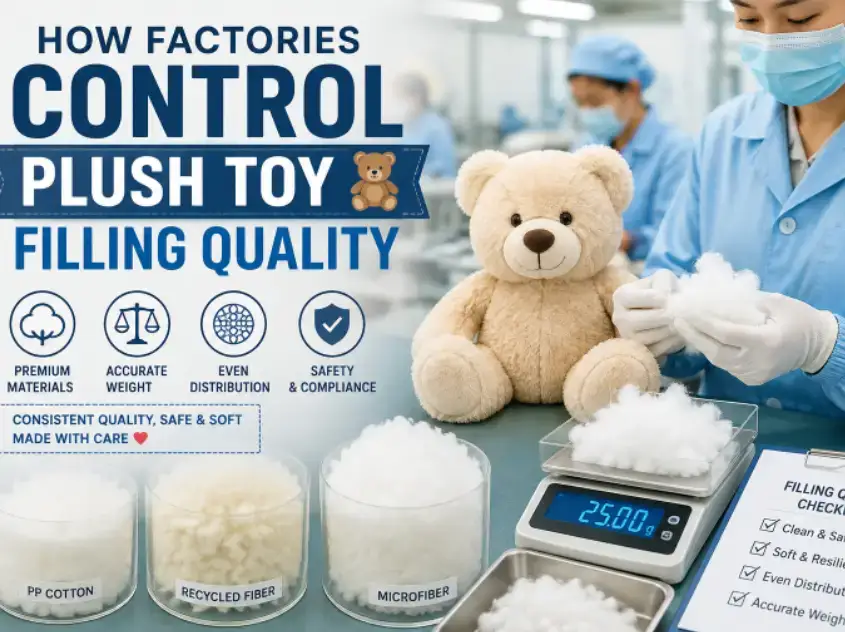
Filling quality control is not a single inspection at the end of the line. It is a chain of checkpoints that starts before the fiber even reaches the stuffing station and continues through final packing. A well-run plush toy factory treats filling density as a measurable specification, not a visual guess, and every operator on the stuffing line works from a documented target weight range rather than “by feel.”
In practice, this means three things happen consistently: the filling material is sourced and tested for consistency batch to batch, each toy is filled to a target weight with a defined tolerance, and finished pieces are checked against that target before they move to sewing closure and final packing. Skipping any one of these three steps is usually where filling defects start.
Common Plush Filling Materials Compared
| Filling Material | Typical Use | Softness | Washability | Relative Cost |
|---|---|---|---|---|
| Polyester (PP) fiberfill | General plush, mascots, gift toys | Medium-soft, springy | Machine washable | Low |
| Micro-denier polyester fiber | Premium huggable plush | Very soft, silky feel | Machine washable | Medium |
| Recycled PET fiberfill | Eco-marketed plush lines | Medium, slightly firmer | Machine washable | Medium |
| Plastic pellets / PP beads | Weighted plush, beanbag-style toys | Firm, moldable | Spot clean recommended | Low-medium |
| Glass or steel micro-beads | Sensory weighted plush | Dense, structured | Spot clean only | High |
| Cotton or natural fiber blend | Organic-marketed plush | Firm, less resilient over time | Machine washable, low heat | High |
How Factories Control Fiber Filling Density
Filling density is usually expressed as a weight range per toy, tied to the toy’s size and the shape it needs to hold. A 25 cm sitting bear and a 25 cm flat cushion plush will use very different density targets even though they are the same height, because one needs to hold a rounded three-dimensional shape and the other just needs even softness across a flat surface.
Factories typically set a target weight with a plus-or-minus tolerance, often in the range of 3 to 5 percent for standard soft toys and tighter for premium or licensed product lines. Operators at the stuffing station work from a printed or digital spec card showing the target grams of fiber for each body part, since a plush toy is rarely filled as a single unit — the head, torso, arms, and legs are usually filled and weighed separately before final assembly.
Tip: Ask your factory for the actual filling weight tolerance in grams, not just a percentage. A 5 percent tolerance on a 40-gram toy head is meaningless in practice, but the same percentage on a 400-gram body part can produce a very noticeable difference in firmness between two units from the same order.
Why Density Varies by Body Part
Ears, paws, and tails are typically filled more loosely so they stay flexible and don’t become stiff or misshapen. The torso and head carry most of the structural filling because they need to hold their shape without collapsing. Factories that skip this differentiation and fill every part at the same density tend to produce plush toys that look either overstuffed in the extremities or too flat in the body.
Typical Filling Density Standards by Product Type
| Product Type | Approx. Fill Ratio (fiber weight to toy volume) | Firmness Target | Common Tolerance |
|---|---|---|---|
| Standard sitting plush (20–35 cm) | Medium density | Soft with shape retention | ±5% |
| Flat / lying plush (cushion-style) | Low-medium density | Even, pillow-soft | ±5% |
| Standing/display plush | Medium-high density | Firm enough to stand unsupported | ±3% |
| Weighted/sensory plush | High density (pellet or bead core) | Firm, evenly distributed weight | ±2% |
| Large jumbo plush (60 cm+) | Medium density, layered filling | Soft outer, supportive inner | ±5% |
The Filling Process Step by Step
Understanding the actual sequence of operations makes it easier to see where quality control checkpoints belong. A typical filling workflow on a production line moves through preparation, injection, weighing, shaping, and closure.
Fiber Preparation and Conditioning
Before fiber reaches the stuffing machine, it is opened and conditioned to remove clumping. Compressed fiberfill that comes straight from the bale is dense and uneven; running it through an opener or carding step fluffs the fiber to a consistent loft so that every gram of material occupies a predictable volume. Skipping this step is one of the most common causes of lumpy, unevenly filled plush later in the process.
Humidity plays a bigger role here than most buyers expect. Polyester fiber absorbs some ambient moisture, and fiber that has been sitting in a humid storage area will pack differently than fiber conditioned in a dry environment, even from the same original bale. Factories in humid climates often account for this by storing filling material in a climate-controlled area close to the production floor, rather than in an open warehouse, so the fiber reaching the stuffing station behaves predictably from one shift to the next.
Injection or Manual Stuffing
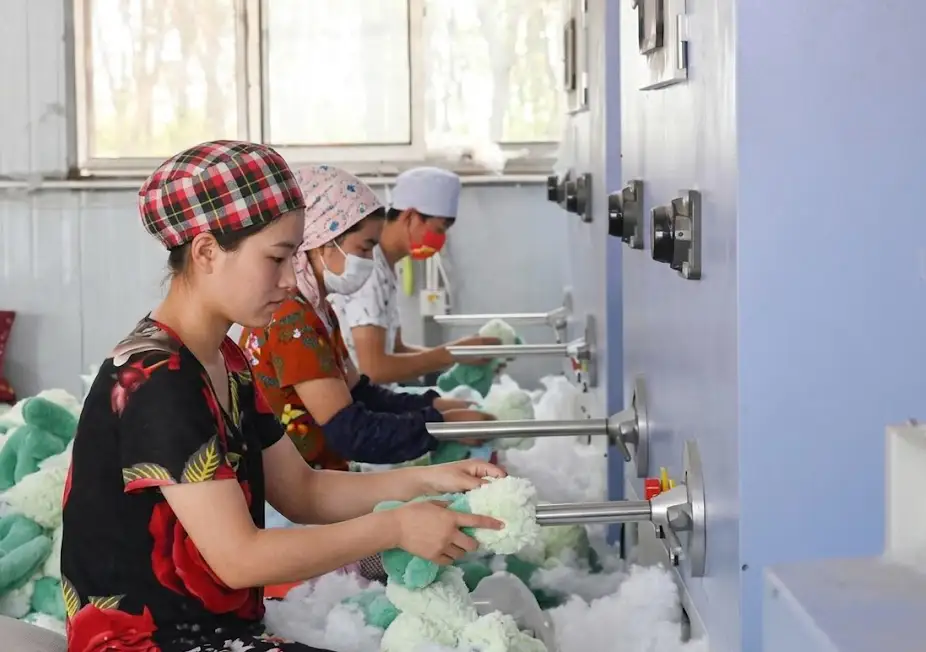
Depending on the factory’s equipment and order volume, filling is done either with a pneumatic stuffing machine that blows a measured volume of fiber into the shell, or manually by trained operators using a stuffing tool and a scale. Machine stuffing is faster and more consistent for high-volume runs of simple shapes, while manual stuffing is often preferred for complex shapes, small details, or premium plush where a worker needs to feel and adjust the distribution by hand.
In-Process Weight Checks
After stuffing but before the toy is sewn closed, many factories perform a spot weight check against the target spec. This is the last point where filling can be added or removed without unpicking a seam, so it is treated as a critical checkpoint rather than an optional step.
Shaping and Distribution
Once weight is confirmed, the operator manually shapes the toy by hand to push filling into corners, ears, paws, and any narrow extensions where fiber tends to bunch up during machine injection. This shaping step is largely manual even in highly automated factories, because machines are not yet good at distributing fiber evenly into irregular three-dimensional shapes.
Final Closure
The last opening is hand-stitched or machine-stitched closed using a ladder stitch or similar technique that keeps the seam invisible and prevents filling from shifting or leaking out during use.
Tip: If you’re touring a factory or reviewing production photos, look specifically at the stuffing station. A station with a digital scale sitting next to every stuffing tool is a strong sign of disciplined weight control; a station where operators are filling purely by hand-feel with no scale in sight is a warning sign for inconsistent output.
Common Filling Defects and How Factories Prevent Them
Most filling-related quality complaints fall into a small number of recurring categories. Recognizing these patterns helps buyers ask sharper questions during factory audits and sample review.
Common Filling Defects, Causes, and Prevention Methods
| Defect | Common Cause | Prevention Method |
|---|---|---|
| Lumpy or uneven texture | Fiber not opened/conditioned before stuffing | Mandatory fiber carding step before stuffing station |
| Underfilled extremities (ears, paws) | Machine injection missing narrow cavities | Manual finishing pass after machine stuffing |
| Overstuffed, hard-feeling body | No weight target or tolerance defined | Documented weight spec per body part with scale checks |
| Inconsistent weight across a batch | Different operators using different amounts by feel | Standardized spec cards and periodic operator calibration checks |
| Filling shifting or bunching after wash | Loose fiber not anchored, no internal stitching | Internal tack stitches on large plush to hold filling in zones |
| Seam leakage of filling | Weak or incomplete closure stitch | Reinforced ladder stitch closure and pull-test inspection |
Weight and Density Testing Methods Used in QC
Quality control teams verify filling consistency using a mix of quantitative and tactile testing. Weight verification is the most objective method: a sample of finished toys from each batch is weighed and compared against the approved spec sheet, with any unit outside tolerance flagged for rework or root-cause review.
Firmness testing is more subjective but still standardized in well-run factories. Inspectors are trained to apply a consistent hand-press test at defined points on the toy — typically the torso, head, and one limb — and compare the resistance against an approved reference sample kept on the QC bench. This reference sample, sometimes called a “golden sample,” is the physical benchmark every unit in the run is compared against for both look and feel.
Visual and tactile checks are supplemented with a squeeze-and-release test to catch trapped air pockets or uneven pockets of density that a scale alone would not reveal, since two toys can have identical total weight but very different internal distribution.
Tip: Request a golden sample alongside your production order, not just a pre-production sample for approval. Ask the factory to keep it on the QC bench for the entire run and confirm in writing that random units are checked against it, not only against a written weight number.
Filling Testing Methods and What Each One Catches
| Testing Method | What It Measures | When Performed |
|---|---|---|
| Digital scale weight check | Total fiber weight vs. target spec | In-process and pre-shipment |
| Hand-press firmness comparison | Density consistency vs. golden sample | Random sampling during production |
| Squeeze-and-release check | Trapped air pockets, uneven distribution | Post-stuffing, pre-closure |
| Seam pull-test | Closure strength, filling leak risk | Pre-shipment inspection |
| Drop and shape recovery test | Fiber resilience and shape memory | Sample approval stage |
Filling Safety and Compliance Standards
Filling material is regulated as closely as fabric and trims because it comes into direct or near-direct contact with the end user, especially with children’s products. The three standards buyers encounter most often are EN71 in the European Union, ASTM F963 in the United States, and CPSIA requirements enforced by the CPSC. Each sets limits on fiber cleanliness, flammability, and the presence of banned or restricted materials such as certain recycled fibers that have not been properly sanitized.

Factories exporting to multiple markets typically qualify their filling material against the strictest applicable standard first, then run additional market-specific documentation on top of that baseline. This is more efficient than re-qualifying fiber separately for every destination market and reduces the risk of a compliant-for-one-market batch accidentally being shipped to a market with stricter rules.
Beyond regulatory compliance, hygiene control during filling matters just as much. Filling material is stored in sealed, elevated containers away from the factory floor, and stuffing stations are kept covered when not in active use to prevent dust, insects, or contamination from entering open fiber bales.
Filling-Related Requirements Across Major Safety Standards
| Standard | Region | Filling-Related Focus |
|---|---|---|
| EN71 Parts 1–3 | European Union | Mechanical safety, flammability, chemical migration limits |
| ASTM F963 | United States | Flammability, sharp points, small-parts/choking risk from loose fill |
| CPSIA | United States | Lead and phthalate limits, third-party testing requirements |
| ISO 8124 | International | Mechanical, physical, and flammability safety of toys |
| GB 6675 / GB 6944 | China (domestic and export reference) | General safety and age-grading requirements for toys |
Quality Control Checkpoints Across the Production Line
A defensible filling QC system does not rely on a single inspection at the end. It is built as a series of checkpoints spread across the line, each catching a different type of problem before it compounds.
Incoming Material Inspection
Every batch of fiberfill or filling pellets is checked on arrival for loft, cleanliness, and odor before it is approved for use. Material that has absorbed moisture during storage or shipping is typically rejected, since damp fiber compresses unevenly and can develop odor or mildew inside a sealed toy.
In-Process Spot Checks
During the stuffing shift, a QC technician pulls random units at set intervals — often every 30 to 60 minutes — and checks them against the weight spec and golden sample. This catches drift early, before an entire shift’s output falls out of tolerance.
Pre-Closure Final Check
Immediately before the seam is closed, a final visual and weight check confirms the toy is ready for stitching. This is the last opportunity to correct a filling issue without unpicking finished work.
Pre-Shipment Inspection
A final sampling pass, often aligned with AQL (Acceptable Quality Limit) sampling standards, checks a statistically representative sample of the finished, packed order against the full spec sheet — filling included — before goods are released for shipment.
Tip: When reviewing a factory’s quality report, check whether filling weight is listed as its own line item with actual measured values, not lumped into a generic “appearance passed” checkbox. Specific, recorded numbers are a much stronger signal of real process control than a general pass/fail note.
Special Considerations for Weighted, Washable, and Eco Plush
Weighted plush toys, often used for sensory or comfort products, add a layer of complexity because they combine a soft outer fill with a dense inner core of pellets or beads. Factories producing weighted plush use double-bagged inner pouches to keep the weighted material fully contained and separately test the inner pouch seam strength in addition to the outer toy seam, since a failure at the inner pouch is invisible from the outside until it’s too late.
Washable plush needs filling that maintains its loft after repeated laundering. Factories validate this during sample approval with a multi-cycle wash test, checking that the toy returns to close to its original shape and firmness rather than clumping or flattening permanently.
Eco-marketed plush using recycled fiber requires an extra layer of documentation, since recycled fiberfill must be traceable to a certified source and tested to confirm it meets the same cleanliness and safety thresholds as virgin fiber. Buyers should ask specifically for recycled content certification rather than accepting a general “eco-friendly” label without supporting documentation.
There is also a practical performance trade-off worth understanding before committing to an eco fiber line at scale. Some recycled fiber grades have a slightly shorter resilience life than premium virgin polyester, meaning the plush may lose a small amount of loft after many wash cycles compared to a virgin-fiber equivalent. This is not a defect in itself, but it is worth discussing with the factory during sample approval so expectations are aligned with the intended use case, particularly for products marketed as long-lasting keepsakes rather than everyday play toys.
Tip: For weighted plush specifically, ask the factory to confirm the inner pouch is sewn with a lock-stitch or double-stitch seam and tested separately from the outer plush shell. This single detail is one of the biggest differentiators between a well-made weighted plush and one that risks pellet leakage.

The Role of Operator Training in Filling Consistency
Equipment and specifications only work if the people running the stuffing station are trained to follow them consistently, shift after shift. Experienced factories treat filling as a skilled task, not an entry-level one, and new operators typically spend a training period working under supervision before they are approved to fill orders unsupervised. During this period, a trainer periodically weighs and hand-checks the trainee’s output against the golden sample to confirm the feel and weight are landing within tolerance, not just close by eye.
Training also covers how to read a spec card correctly, since a single order can include several product variants with different weight targets for the head, body, and limbs. An operator who confuses specs between two similar-looking styles running on the same line at the same time is a common, avoidable source of batch-to-batch inconsistency. Clear labeling at each workstation, along with spec cards that stay physically attached to the work bin rather than memorized, reduces this risk significantly.
Skilled operators also develop a tactile sense for filling that complements the scale readings. A scale confirms total weight, but an experienced worker can feel whether that weight is distributed correctly through the toy or has bunched unevenly in one section. This is part of why the most reliable factories pair digital weight verification with trained manual inspection rather than relying on either method alone.
Filling Consistency Across Multiple Production Batches
A single well-controlled batch is not proof that a factory can hold that same standard across a full order that ships in several production runs, sometimes weeks or months apart. Fiber suppliers can shift loft and density slightly between shipments even within the same material grade, and a factory without a re-verification step at the start of each new batch can end up shipping product that technically matches on paper but feels noticeably different in hand from an earlier shipment.
To manage this, disciplined factories re-check incoming fiber against the original approved sample every time a new lot of raw material arrives, rather than assuming all fiber from the same supplier performs identically. If a new fiber lot tests looser or denser than the reference, the operators are given an adjusted fill amount to compensate, so the finished toy still matches the original approved firmness even though the raw material weight per unit volume has shifted.
Buyers running repeat orders over time can protect themselves by requesting that the factory retain a physical reference sample from each production run, not just the original approval sample. Comparing a new shipment against the most recent prior shipment, in addition to the original approved sample, is often a more sensitive way to catch gradual drift than comparing only against a sample that may be a year or more old.
How to Evaluate a Factory’s Filling QC System Before You Order
Buyers evaluating a new manufacturing partner can get a reasonably accurate read on filling discipline before committing to a full production order. Reviewing the pre-production sample against a written weight spec, asking to see the actual QC checklist used on the floor, and requesting photos or video of the stuffing station in operation are all low-cost ways to verify claims before volume commitment.
It is also worth asking how the factory handles out-of-tolerance units. A factory with a mature process will have a documented rework procedure — reopening the seam, adjusting fill, and re-closing — rather than simply accepting minor variance as unavoidable. The existence of a rework process, and records showing it gets used, is itself a sign of active quality management rather than passive inspection.
A short factory audit checklist can make this evaluation more concrete during a visit or video call. Useful questions to ask include: what is the documented weight tolerance for this specific product, how often are in-process spot checks performed during a shift, is a golden sample kept at the stuffing station or only in a separate QC office, and what happens procedurally when a unit fails the weight check. Vague or generalized answers to these specific questions are usually a more reliable warning sign than the appearance of the factory floor itself.
Finally, consistency across a full production run matters more than the quality of a single approved sample. A strong sample can be produced by a factory’s most skilled worker under close attention; the real test is whether unit 50 and unit 5,000 of the same order feel the same in your hand. Requesting mid-production photos or a small mid-run sample shipment, rather than waiting until the entire order is complete, gives buyers a chance to catch drift while there is still time to correct it.
Frequently Asked Questions
What filling material is best for baby-safe plush toys?
Polyester fiberfill, particularly micro-denier polyester, is the most common choice for baby-safe plush because it is hypoallergenic, machine washable, and free of the natural fibers that can trap moisture or attract dust mites. It also compresses and recovers well through repeated washing, which matters for products that will be laundered frequently. Whatever material is used, it should carry documentation confirming it passed the relevant flammability and chemical safety testing for the target market, since “soft” and “safe” are not the same claim.
How much filling does a standard plush toy need?
There is no single universal number, because filling weight depends on toy size, shape, and the firmness the design calls for. A small 20 cm sitting plush might use somewhere in the range of 30 to 60 grams of fiber, while a large 60 cm jumbo plush can use several hundred grams distributed across multiple body sections. The right approach is not to memorize a general figure but to work from a body-part-by-body-part weight spec developed during sample approval, since that spec is what production should be measured against.
Why do some plush toys feel lumpy even when new?
Lumpiness almost always traces back to fiber that was not properly opened or conditioned before it was stuffed into the toy, meaning clumps of compressed fiber went in instead of evenly fluffed material. It can also happen when a machine-stuffing process misses the manual shaping step needed to redistribute fiber into corners and extremities. A factory with a disciplined process addresses this at the fiber preparation stage rather than trying to fix it after the toy is already sewn shut.
How do factories keep filling weight consistent across a large order?
Consistency comes from a documented weight spec per body part, digital scales at the stuffing station, and regular spot checks throughout the production shift rather than relying on operator experience alone. Some factories also rotate periodic calibration checks where a supervisor re-verifies that operators are still filling within tolerance, since fatigue and shift changes are common points where drift creeps in. Recording actual measured weights, not just pass/fail marks, gives both the factory and the buyer a traceable record if a quality issue comes up later.
Is weighted plush filling regulated differently from standard fiberfill?
Weighted filling materials such as plastic pellets, glass beads, or steel beads face additional scrutiny because of choking and containment risk, particularly for products intended for children. Factories producing weighted plush typically use a sealed inner pouch to fully separate the weighted material from the outer plush shell, and that inner pouch is tested for seam strength independently. Age grading and labeling requirements can also differ for weighted products, so buyers should confirm the intended market’s specific rules before finalizing a weighted plush order.
Can plush toy filling be recycled or eco-friendly material?
Yes, recycled polyester fiberfill made from post-consumer PET bottles is widely used in eco-marketed plush lines and can meet the same safety and performance standards as virgin fiber when properly sourced and tested. The key is documentation: recycled content should be traceable to a certified supplier and the finished fiber batch should pass the same cleanliness and safety testing as any other filling material before it’s approved for production. Buyers should ask for that certification directly rather than accepting a general eco-friendly claim at face value.
Filling quality is one of the clearest signals of how seriously a factory takes process control overall. A factory that measures, records, and enforces filling weight and density with the same discipline it applies to stitching and fabric inspection is very likely applying that same rigor across the rest of production. For buyers, the filling process is a small but revealing window into the manufacturing standards behind the finished toy.