Skip to content

How to Control Plush Toy Filling Quality is essential for ensuring consistent softness, shape retention, durability, and safety in plush toy manufacturing. High-quality filling directly affects a toy’s appearance, comfort, weight distribution, and overall customer satisfaction. Poor stuffing techniques can cause uneven filling, lumps, deformation, or excessive firmness.
To maintain consistent quality, manufacturers must carefully select suitable filling materials, control stuffing density, optimize filling techniques, and conduct thorough quality inspections. This guide explores practical methods for controlling plush toy filling quality, helping manufacturers and brands produce soft, durable, safe, and high-quality custom plush toys that meet customer expectations.
Filling is the part of a plush toy that nobody sees and everybody feels. The moment a buyer, a retail shopper, or a child picks the toy up, the filling answers a series of unspoken questions. Is it soft or lumpy? Does the head hold its shape or flop sideways? Does the body spring back after a squeeze, or stay dented? Is the weight what the product page promised? Fabric, embroidery, and color get most of the attention in design reviews, but filling decides whether a finished product feels premium or cheap in the hand.
Filling defects are also among the most common complaints in plush sourcing. Lumpy limbs, hollow heads, flattened bellies, clumping after washing, stray odors, uneven firmness from one unit to the next, and in the worst cases, metal fragments or foreign debris inside the product. These problems are rarely random. Almost every one of them traces back to a specific, controllable point in the production process: the filling material that was chosen, the weight that was specified, the technique used at the stuffing station, the way the seams and pattern were engineered, or the cleanliness of the material before it ever entered the line.
Controlling plush toy filling quality means treating filling as a measurable specification rather than an operator’s feel. When the material grade, fill weight, density distribution, cleanliness, and safety requirements are written down, tested at defined checkpoints, and recorded, filling stops being the most variable element of the product and becomes one of the most predictable.
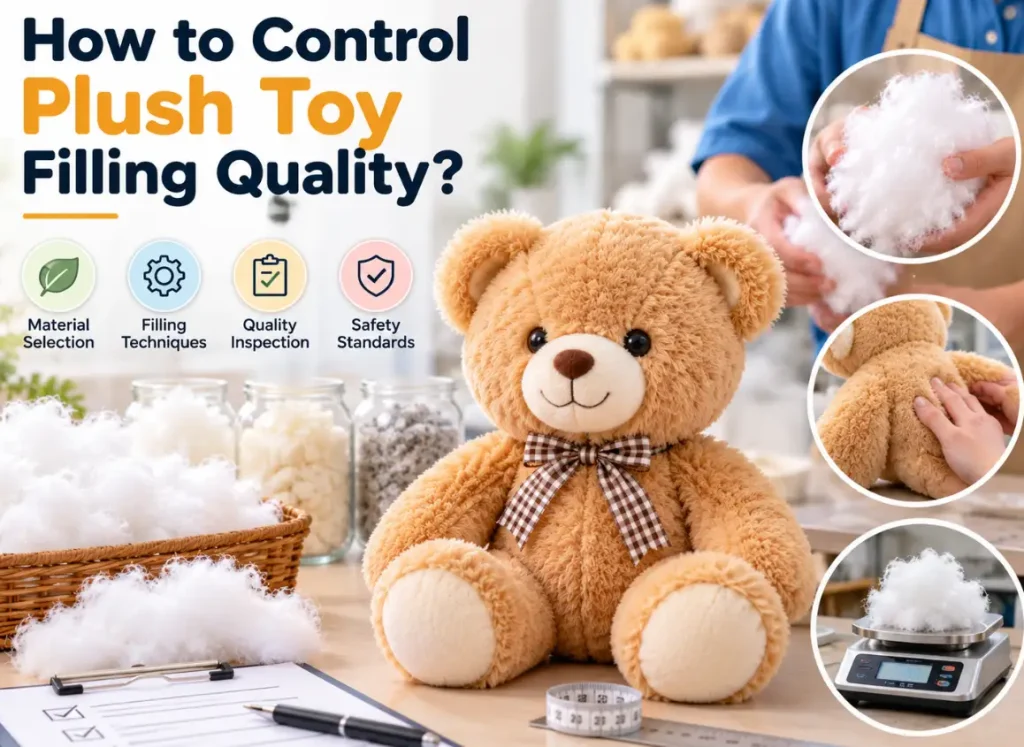
This guide explains how to do exactly that. It covers how filling quality is defined, how the main filling materials differ, how incoming inspection and weight standards work, how stuffing technique and seam design interact with filling, what safety and compliance rules apply, how in-process monitoring catches defects early, and how buyers can specify and verify filling quality before a single unit ships.
What Is Plush Toy Filling Quality and Why Does It Define the Finished Product?
Plush toy filling quality is the degree to which the stuffing material inside a plush toy meets defined standards for material grade, weight, density distribution, resilience, cleanliness, and safety — consistently, unit after unit and batch after batch. It is not a single property. A toy can be filled with an excellent material and still fail because the weight is wrong, or be filled to the correct weight and still feel poor because the density is uneven. Genuine filling quality requires every dimension to be under control at the same time.
Filling defines the finished product because it determines the three-dimensional form that the fabric and design are meant to express. A character’s cheeks, belly, and limbs only look the way the designer intended if the filling supports them correctly. The same pattern and the same fabric produce visibly different products when the filling is under-stuffed, over-stuffed, or inconsistent. Filling also drives the tactile experience, the product weight that shipping costs are calculated on, and the long-term durability of seams and surface pile.
Core Dimensions of Plush Toy Filling Quality
| Quality Dimension | What It Describes | Typical Measurement Method | Consequence When Out of Control |
|---|---|---|---|
| Material grade | Fiber type, denier, finish, and loft of the filling | Supplier specification, lot certificate, sample testing | Different feel, poor recovery, early flattening |
| Fill weight | Total weight of filling placed in each unit | Scale measurement against target and tolerance | Under-stuffed or over-stuffed products, shape variation |
| Density distribution | How evenly filling is spread across head, body, and limbs | Sectional weighing, hand-feel comparison to a standard sample | Lumps, hollow areas, uneven firmness |
| Resilience | Ability to recover shape after compression | Compression and recovery test | Dents, flattening, poor shelf appearance |
| Cleanliness | Absence of dust, debris, and foreign matter | Visual inspection, magnet check, metal detection | Contamination, safety risk, customer complaints |
| Odor and hygiene | Absence of chemical or musty smell | Sensory check at receiving and after pressing | Odor complaints, rejected shipments |
| Shape retention | Ability of the finished toy to hold its intended form | Comparison with approved counter sample over time | Sagging heads, collapsed limbs, warped silhouettes |
| Safety compliance | Meeting applicable toy safety and chemical requirements | Laboratory testing and documentation review | Failed tests, blocked shipments, recalls |
Why Filling Quality Is Hard to See and Easy to Get Wrong
Filling is sealed inside the product before anyone inspects it, which makes it the one major component that cannot be verified by looking at the finished toy. A fabric color mismatch is visible at a glance. A filling weight deviation of ten percent is not, until it has been repeated across thousands of units and the shape differences become obvious on the shelf. Because the problem is hidden, factories that do not measure filling directly tend to rely on operator judgment, and operator judgment drifts across shifts, across people, and across the length of a production run.
The Commercial Cost of Poor Filling
Poor filling quality is expensive in ways that rarely appear in the original quotation. Unevenly filled toys generate higher return rates and negative reviews on e-commerce platforms, where customers describe the product as “flat,” “lumpy,” or “not as pictured.” Over-filled units increase product weight and freight cost while straining seams. Contaminated or non-compliant filling can result in failed laboratory tests, detained shipments, and write-offs of entire production runs. In every case, the cost of controlling filling at the source is far lower than the cost of correcting its failures after shipment.
Which Filling Materials Are Used in Plush Toys and How Do They Differ?
The most widely used plush toy filling is polyester fiberfill, commonly called PP cotton in the manufacturing trade, a soft synthetic fiber valued for its loft, low cost, washability, and consistent behavior in machine stuffing. Other materials — fiber balls, shredded foam, pellets, beads, and natural fibers — are used where a product needs a different feel, weight, or sustainability profile. Choosing the right filling is the first and most influential filling quality decision, because no amount of process control can make an unsuitable material perform correctly.
Common Plush Toy Filling Materials Compared
| Filling Material | Feel and Performance | Typical Application | Main Quality Risk |
|---|---|---|---|
| Standard polyester fiberfill (PP cotton) | Soft, lightweight, good loft, easy to machine-fill | General plush toys, teddy bears, character plush | Clumping if low grade, flattening over time |
| Siliconized fiber | Slippery, silky, higher resilience and softness | Premium plush, pillows, cushions | Higher cost, odor if finish is poor |
| Fiber balls (clusters) | Fluffy, fluid, moldable, pillow-like | Cushions, travel pillows, squishy plush | Inconsistent ball size, shifting inside the toy |
| Shredded foam or memory foam pieces | Dense, slow-recovery, supportive | Neck pillows, premium cushions | Dust, uneven chunk size, heavier weight |
| Plastic pellets (PE) | Heavy, granular, weighted feel | Weighted plush, bean-bag style toys | Containment failure, uniformity of pellet size |
| Glass beads | Heavy, smooth, dense, quiet | Weighted plush, premium weighted products | Surface roughness, size variation, seam stress |
| Natural fills (cotton, wool, buckwheat hulls) | Natural feel, breathable, distinct texture | Eco-focused or specialty products | Moisture, odor, pests, and compliance documentation |
| Recycled polyester fiber (rPET) | Similar to standard fiberfill when well processed | Sustainability-focused product lines | Variable cleanliness, color, and loft between lots |
Matching the Filling to the Product Type
Different product categories place different demands on filling. A classic teddy bear needs resilient, evenly distributed fiber that supports a defined shape and recovers from hugging. A travel pillow needs a fluid, moldable fill such as fiber balls that conforms to the neck. A weighted plush needs a heavy granular fill contained in reinforced compartments. A premium collectible may use higher-grade siliconized fiber to achieve a softer, more luxurious hand-feel. Starting from the product’s intended use and working backward to the filling material avoids the common mistake of defaulting to the cheapest available fiber for every project.
Blended and Layered Filling Systems
Many well-engineered plush toys use more than one filling material. A common approach is to use dense fiber in structural areas such as the neck and base, softer siliconized fiber in the face and cheeks, and pellets in a separate inner pouch in the lower body for a seated, weighted feel. Blended systems can deliver performance that no single material achieves, but they also multiply the quality variables. Each component needs its own weight specification, its own containment method, and its own inspection checkpoint, otherwise the blend ratio drifts from unit to unit.

Tip: Lock the Filling Specification in Writing Before Sampling Begins
Name the filling material, grade, and finish in the tech pack rather than writing “PP cotton” and leaving the rest open. A complete filling specification states the fiber type, denier range, whether it is siliconized, the target loft or recovery performance, and the required compliance documents. If a supplier substitutes a cheaper fiber after the sample is approved, the finished product will feel different even though nothing on the surface has changed. A written specification also gives both sides an objective reference when a quality dispute arises. Ask the factory to confirm in writing that the bulk filling matches the specification used for the approved counter sample, and request a retained filling sample from each lot for later comparison.
How Does Incoming Inspection Protect Filling Quality Before Production Starts?
Incoming inspection protects filling quality by verifying that every lot of filling material meets the written specification for type, loft, cleanliness, moisture, odor, and documentation before it is released to the production line. A filling defect caught at the receiving dock costs a rejected delivery. The same defect caught after stuffing costs the labor, fabric, and packaging already invested in every unit that contains the material.
Incoming Filling Inspection Checklist
| Inspection Item | Method | Acceptance Reference | Frequency |
|---|---|---|---|
| Fiber type verification | Lot certificate review, simple burn test, supplier traceability | Matches specified polymer and grade | Every lot |
| Loft and compression recovery | Compress a standard weight of fiber and measure recovery height | Within approved loft range | Every lot |
| Cleanliness | Visual spread-out inspection, magnet pass, sieve check for pellets | No visible debris, dust, or metallic particles | Every lot, multiple bales |
| Moisture content | Moisture meter or weight-loss method | Within supplier and factory limit | Every lot, especially in humid seasons |
| Odor | Sensory check of opened bales | No chemical, musty, or smoky smell | Every lot |
| Bale weight and labeling | Scale check and label review | Matches purchase documentation | Every delivery |
| Compliance documents | Certificate and test report review | Valid, current, and relevant to target market | Every new supplier and annually |
Lot-to-Lot Variation: The Silent Source of Reorder Problems
Filling quality can drift between lots even from the same supplier. Fiber loft changes with the production batch, moisture changes with storage conditions, and cleanliness changes with how bales are handled in transit. A factory that inspects filling only for a new product, and not for reorders, leaves a significant risk unmanaged. The most common reason a reorder feels different from the original order is not a change in design or fabric, but an uninspected change in filling.
Storage and Handling as Part of Filling Control
Filling that passes inspection can still be compromised afterward. Bales stored directly on a concrete floor absorb moisture. Open bales left near cutting tables collect fabric dust and thread fragments. Material kept near chemical storage can pick up odor. Good filling control extends to the warehouse: raised pallets, covered storage, dry and ventilated rooms, first-in first-out rotation, and clear separation of approved and unapproved material. These practices cost little and prevent a category of contamination that no downstream inspection can fully reverse.
Tip: Test Every Filling Lot, Not Just the First One
Ask the factory how filling is inspected on reorders, not only on new products. Every incoming lot should be checked against the retained approved sample for loft, cleanliness, moisture, and odor before release. The check takes minutes: compress a standard weight of fiber, measure how high it recovers, spread a handful on a white surface to look for debris, and smell it. Record the result against the lot number so that any later complaint can be traced to a specific delivery. Buyers who request incoming filling records as part of production reporting quickly find out whether this discipline exists or whether filling is simply accepted on trust.
How Do Fill Weight and Density Standards Keep Every Unit Consistent?
Fill weight and density standards keep every unit consistent by replacing subjective judgment with a measurable target: a specified weight of filling for each product, with an allowed tolerance, verified on a scale throughout the production run. Fill weight is the most direct and practical control for filling quality because it is simple to measure, difficult to dispute, and closely correlated with shape and feel. If the filling weight is controlled, the density follows.
The target weight for a product is established during sampling. When the approved development sample reaches the correct shape, softness, and firmness, it is opened or weighed during construction, and the exact filling quantity is recorded as the standard for production. That figure, together with a tolerance, becomes a core line in the tech pack. Without it, bulk production depends on whatever each operator believes “full” looks like.
Illustrative Fill Weight Targets and Tolerances by Product Size
| Approximate Product Height | Illustrative Fill Weight Range (Standard Fiberfill) | Typical Tolerance | Notes |
|---|---|---|---|
| 15–20 cm | 25–60 g | ±8% | Small products need tighter absolute control because a few grams change the shape |
| 25–35 cm | 80–160 g | ±6% | Common size for retail plush; sectional weighing recommended |
| 40–50 cm | 180–350 g | ±5% | Head and limb weights should be specified separately |
| 60 cm and above | 450–900 g | ±5% | Multi-stage stuffing needed to avoid settling and uneven density |
These figures are illustrative only. The correct target weight for any product depends on its design volume, fabric stretch, intended firmness, and filling grade, and should always be derived from the approved sample rather than copied from a general table.
Sectional Weighing for Complex Shapes
Total weight alone does not guarantee a correctly shaped product. A toy can reach the right total weight with too much filling in the body and not enough in the head. For products with distinct sections — head, torso, arms, legs, tail — the most reliable method is to specify a weight for each section and pre-weigh the filling portions before stuffing. Pre-weighed portions remove guesswork from the operator, speed up the process, and make deviations immediately visible.
Why Over-Stuffing Is Not a Safe Default
Some factories treat extra filling as a safe way to avoid complaints about flat products. In practice, over-stuffing creates its own defects: seams are stressed beyond their design strength, fabric stretches and shows gaps between pile and stitching, the toy feels hard rather than soft, and the added weight increases shipping cost. It also reduces the margin of safety on seam strength tests. A defined weight with a defined tolerance protects against both under-stuffing and over-stuffing, which is why the tolerance range matters as much as the target.

Tip: Weigh the Filling, Not Just the Finished Toy
Finished toy weight includes fabric, accessories, labels, and packaging inserts, all of which vary slightly and can mask a filling deviation. The reliable control is to weigh the filling itself, either by using pre-weighed portions or by checking a sample of units that are opened or weighed before closing. Set a standard fill weight with a tolerance, record it in the tech pack, and require the stuffing station to keep a simple log of spot-check weights at fixed intervals. A scale costs very little compared with the rework generated by a run of inconsistent units. Buyers can ask for a weight log or a photograph of the scale check as part of first-off and mid-production reports.
How Does Stuffing Technique Affect Shape, Softness, and Uniformity?
Stuffing technique affects shape, softness, and uniformity because the same quantity of filling can produce very different products depending on the sequence, the amount of fiber placed in each area, how well the fiber is opened and fluffed beforehand, and how firmly it is packed. Technique is the human and machine side of filling quality, and it is where specification either becomes reality or is lost in practice.
Plush factories use two broad approaches. Machine stuffing uses an air-driven machine that blows pre-opened fiber into the product through a nozzle, delivering speed and consistent density for large runs and simple shapes. Hand stuffing places fiber manually, giving more control over complex shapes, small appendages, and detailed facial contours. Many products combine both: machine stuffing for the main body and hand finishing for the head, extremities, and shaping adjustments.
Stuffing Zones, Technique, and Common Defects
| Stuffing Zone | Recommended Technique | Common Defect | Control Method |
|---|---|---|---|
| Head and face | Hand-placed fiber in small portions, pressing into cheeks and snout first | Hollow cheeks, lopsided face, wrinkles around eyes | Compare to counter sample, check face symmetry |
| Neck | Firmer packing to support the head | Head that droops or rotates | Neck firmness check, hold-up test |
| Arms and legs | Fill from the tip toward the body in several stages | Empty tips, lumpy middles, limp limbs | Sectional weight, hand-feel check along the limb |
| Torso | Machine fill followed by hand shaping | Flat belly, uneven chest, hard center | Fill weight check, squeeze test |
| Ears, tail, small appendages | Light hand fill, minimal compression | Over-filled appendages, strained seams | Visual inspection, seam check |
| Base or sitting area | Firm fill or inner pouch for stability | Toy that tips or cannot sit upright | Sit-stability test on flat surface |
| Closing seam area | Even fill leaving no strain at the opening | Bulging or puckered closing seam | Visual check of closure, pull test |
Fiber Preparation: The Overlooked First Step
Compressed fiber straight from the bale performs poorly. It contains dense clumps that become hard lumps in the finished product. Proper preparation involves opening the fiber in an opening machine or by hand so that it becomes light, even, and airy before it reaches the stuffing station. Well-opened fiber flows evenly through machines, fills small areas without bridging, and produces a consistent hand-feel. Skipping or rushing this step is one of the most common causes of lumpy toys, and it is one of the cheapest to prevent.
Operator Skill and Standardized Work Instructions
Even with machines, stuffing quality depends on operator skill. Experienced operators develop a consistent sense of how much fiber to place in each area and how to shape the product while filling. That experience is valuable, but it is also fragile, because it leaves the factory when the operator does. Documented work instructions that specify fill sequence, portion sizes, and shaping steps for each product capture the technique in a form that new operators can learn and supervisors can check. Specialization also helps: operators who stuff the same product category every day achieve more consistent results than those rotated through unrelated tasks.
Tip: Stuff From the Extremities Inward, in Stages
The most reliable stuffing sequence starts at the points furthest from the opening — paw tips, ear tips, the end of the tail, the top of the head — and works inward in several small portions rather than one large push. Filling the extremities first prevents hollow tips and ensures the fiber is distributed from the outside of the shape toward the center. Use small, fluffed portions, pressing each into place before adding the next, and finish with the largest areas such as the torso. Write this sequence into the work instruction for each product, and photograph the correct result at the station so operators can compare their output against a visual standard throughout the shift.
How Do Seams, Fabric Stretch, and Pattern Design Interact with Filling?
Seams, fabric stretch, and pattern design interact with filling because the fabric shell and the filling work as a single structural system: the filling pushes outward, and the fabric and seams hold it in. If the shell is too tight, too stretchy, or poorly stitched for the planned fill, no stuffing technique can produce a good result. Filling quality is therefore partly a design and construction question, not only a stuffing question.
Different fabrics respond to filling differently. A stretchy short-pile fabric expands under pressure, so a given fill weight produces a rounder, softer shape and a looser surface. A low-stretch woven or dense long-pile fabric holds its dimensions more rigidly, so the same weight produces a firmer, more defined silhouette. Pattern makers account for this by adjusting panel size, seam allowances, and gussets so that the shell reaches its intended shape at the target fill weight, not before and not after.
How Construction Factors Interact with Filling
| Construction Factor | Interaction with Filling | Recommended Adjustment |
|---|---|---|
| Fabric stretch | High-stretch fabric expands and may distort under heavy fill | Reduce fill weight or reinforce stretch direction in pattern |
| Pile height | Long pile hides seams but can trap fiber and add bulk | Adjust seam allowance and test fill appearance on sample |
| Seam allowance | Narrow allowances fail earlier under filling pressure | Specify allowance by fabric type and fill load |
| Stitch density | Low density lets filling push through or open seams | Specify stitches per unit length and verify in production |
| Gussets and inserts | Create volume; affect how fill distributes | Include gusset volume in fill-weight calculation |
| Fiber migration (leakage) | Fine fiber can escape through weak seams or loose weaves | Use proper thread, tight stitches, and inner lining where needed |
| Closing method | Hand-closed seams may loosen under fill pressure | Use secure ladder stitch and test closing seams |
Seam Strength Under Filling Load
A seam that looks perfect on an empty shell can fail when the toy is stuffed and handled. Filling places a constant outward load on every seam, and handling adds sudden pulls and squeezes. Seam strength should therefore be tested on stuffed units, not just on flat fabric samples, using a pull test that applies controlled force to the most stressed areas. This is especially important for children’s products, where seam failure can expose the filling and create a safety hazard, and for weighted plush, where dense fill increases the load.
Preventing Fiber Leakage and Beard Migration
Loose fiber escaping through seams or the fabric surface is a common cosmetic and functional defect. Known as fiber leakage or bearding, it appears as small tufts of filling poking through stitching or the pile. It is controlled by using appropriate needle size and thread, maintaining correct stitch density, avoiding overly open fabric weaves for the planned filling, and in some cases adding an inner lining or fabric liner around the filling. Catching it early in sampling is far cheaper than discovering it after bulk production.
Tip: Test Seams on a Fully Stuffed Sample, Not on an Empty Shell
Approve the pattern and seam construction only after the sample has been stuffed to the specified fill weight and then handled. Squeeze it, pull on the limbs and ears, and examine every seam for fiber showing through or stitches opening. Pay special attention to the closing seam, the neck joint, and areas where several panels meet. If any seam shows strain at the correct fill weight, adjust the seam allowance, stitch density, or pattern before bulk production begins rather than reducing the filling to hide the weakness. Reducing the fill to protect a weak seam changes the product the customer approved. Fixing the construction preserves both shape and strength.

What Safety and Compliance Requirements Apply to Plush Filling?
Safety and compliance requirements for plush filling cover the physical safety of the finished toy, the chemical safety of the materials, the cleanliness of the stuffing, and the market-specific rules for stuffed articles. Because plush toys are often used by young children, regulators treat filling as a safety-critical component, and a filling problem that would be only cosmetic in other products can become a legal and recall issue in toys.
Requirements vary by destination market. The European Union relies on the EN 71 series of toy safety standards, with additional chemical rules under REACH. The United States applies ASTM F963 as a mandatory toy standard under federal rules, with the Consumer Product Safety Improvement Act setting limits on substances such as lead and certain phthalates and requiring children’s product certification. Several US states also regulate stuffed articles specifically, with registration and law-label requirements for the materials used inside them. Other markets apply their own national standards, so the target market should be defined before the filling is chosen.
Common Compliance Areas Relevant to Plush Filling
| Requirement Area | What It Covers | Typical Reference | How It Is Verified |
|---|---|---|---|
| Mechanical and physical safety | Seam strength, small parts, filling containment, accessory security | EN 71-1, ASTM F963 | Laboratory testing of finished units |
| Chemical safety of materials | Limits on heavy metals and other restricted substances in materials | EN 71-3, ASTM F963, CPSIA | Laboratory test reports on filling and components |
| Restricted chemicals in fibers | Controls on hazardous substances in textile materials | REACH, OEKO-TEX type certification | Supplier certificates and independent testing |
| Cleanliness of stuffing | Absence of dirt, debris, and foreign objects in filling | Market regulations for stuffed articles and factory standard | Incoming inspection and finished product checks |
| Stuffed article registration and labeling | Material content disclosure and law labels in some regions | State or national stuffed article rules | Label review and registration records |
| Metal and needle detection | Absence of broken needles and metal fragments in finished product | Industry practice and buyer requirements | Metal detector pass on every unit |
| Flammability | Resistance of materials to ignition and flame spread | Market flammability requirements for toys | Laboratory testing of materials and units |
Metal Detection as a Non-Negotiable Control
Broken needles are a real hazard in any sewing operation. A needle fragment hidden inside a stuffed toy can injure a child, and a single incident can end a brand. For that reason, reputable plush factories pass every finished unit through a metal detector before packing, and many buyers require it explicitly. The detector should be tested at the start of every shift with a standard test piece, and a record kept of the checks. A needle control program — counting needles issued and returned, and investigating any missing or broken needle immediately — complements detection by preventing the fragments from entering a unit at all.
Documentation as Part of Filling Control
Compliance cannot be proven by physical inspection alone. A filling that looks clean can still contain restricted substances that only a laboratory can detect. Maintaining current test reports and certificates for every filling material, linked to specific lots where possible, is therefore part of filling quality control. When a regulator, a retailer, or a marketplace requests proof, the supplier who can supply organized documentation within hours avoids delays that can cost a selling season.
Tip: Require Metal Detection on 100% of Finished Units and Record It
Make metal detection a written requirement, not an assumption. Every finished plush toy should pass through a calibrated detector before it is sealed in a carton. Ask the factory to verify detector sensitivity at the start of each shift, at breaks, and at the end of the shift using a standard test piece, and to keep a signed log of each verification. Pair this with a needle control procedure at the sewing and stuffing stations. Buyers should request photographs of the detection station and a copy of the log in production reports. A factory that already runs this system will provide the records immediately; one that does not will usually reveal it at this first request.

How Does In-Process Monitoring Catch Filling Defects Early?
In-process monitoring catches filling defects early by checking fill weight, shape, firmness, and cleanliness at fixed intervals during production, so that drift is detected after a handful of units rather than after the entire run. Filling quality is especially prone to drift because machines settle, operators tire, and fiber characteristics change from bale to bale. A monitoring system that checks often enough keeps the effect of each deviation small.
The most valuable single check is the first-off inspection. Before volume production begins, the first three to five complete units are compared against the approved counter sample for shape, firmness, fill weight, and seam condition. This check catches setup errors — a mis-set stuffing machine, wrong fiber lot, or incorrect portion size — at the moment they affect the fewest possible units. After that, scheduled interval checks maintain the standard through the run.
Typical Filling Defects, Causes, and Prevention
| Filling Defect | Likely Cause | Preventive Control |
|---|---|---|
| Lumpy or hard spots | Unopened fiber, compressed clumps, rushed stuffing | Fiber opening step, work instructions, hand-feel check |
| Hollow or empty areas | Insufficient fill in extremities, wrong sequence | Extremities-first sequence, sectional weights |
| Under-stuffed, flat product | Fill weight below target, machine setting drift | Scale spot checks, machine calibration |
| Over-stuffed, hard product | Excess fill, no upper tolerance enforced | Upper weight limit, seam stress check |
| Uneven firmness between units | Operator variation, inconsistent portions | Pre-weighed portions, standard sample at station |
| Fiber visible through seams | Low stitch density, wrong needle or thread | Stitch density check, needle selection, inner lining |
| Odor in finished product | Poor-quality or damp filling, storage contamination | Incoming odor check, dry storage, lot rejection |
| Foreign matter inside | Contaminated fiber, dirty workstations, needle fragments | Cleanliness checks, workstation hygiene, metal detection |
| Shape collapse over time | Low-resilience fiber, insufficient density | Resilience testing, density specification |
Setting Check Intervals That Match the Risk
Check frequency should reflect how quickly each variable can drift. Fill weight on a machine-stuffed line is worth checking every 100 to 200 units, because machine settings can shift without anyone noticing. Hand-stuffed complex products benefit from shorter intervals and more frequent supervisor review, since individual technique varies. Transitions deserve their own checks: each new filling bale, each new operator, and the first units after any break or machine adjustment. Intervals that are too long, such as one check per shift, allow thousands of units to accumulate before a deviation is found.
Why Records Matter as Much as Checks
A check that is not recorded cannot be audited, trended, or used to resolve a dispute. Weight logs, first-off reports with photographs, and metal detection records turn quality control from a claim into evidence. They also reveal patterns: a weight reading that creeps downward every afternoon points to operator fatigue, while a spike after every bale change points to lot variation. Factories that review their own records and act on the patterns improve steadily, while those that merely collect them do not.
Tip: Keep the Approved Counter Sample at the Stuffing Station
Place the signed counter sample, tagged with its fill weight, directly at the stuffing line and make it the daily reference. Operators and supervisors can then compare every few units against the physical standard by sight and by hand, which is far more reliable than relying on memory or a written description of “firm” or “soft.” Add a laminated photo sheet showing acceptable and unacceptable examples of the main defects: hollow tips, lumpy torso, asymmetrical face. Combined with a scale and a weight log, the counter sample converts subjective judgment into a shared standard. When a deviation appears, the stuffing line can stop and correct it within minutes rather than hours.
How Can Buyers Specify and Verify Filling Quality?
Buyers can specify and verify filling quality by writing measurable requirements into the product specification, approving a stuffed counter sample against those requirements, requesting evidence at defined production milestones, and using independent inspection where the risk justifies it. Filling control is a shared responsibility. The factory operates the process, but the buyer defines the standard, and a clear standard is the foundation of every reliable result.
Buyer Filling Specification and Verification Checklist
| Specification Item | What to Write | Verification Evidence |
|---|---|---|
| Filling material and grade | Fiber type, denier range, finish, loft or recovery requirement | Lot certificate, retained sample, incoming inspection record |
| Target fill weight and tolerance | Total and sectional weights with plus/minus tolerance | Weight log and photos of scale checks |
| Firmness and shape standard | Reference to approved counter sample with photographs | First-off report compared with counter sample |
| Cleanliness requirement | No visible debris; no metallic contamination | Incoming cleanliness check, metal detection log |
| Seam and containment requirement | Seam strength test on stuffed units, no fiber leakage | Pull test results, visual inspection records |
| Compliance requirement | Target market standards and test reports required | Laboratory reports, certificates, labeling approval |
| Inspection and acceptance criteria | Sampling level, defect classes, acceptable quality limit | Pre-shipment inspection report |
| Corrective action process | Written root cause and fix for any filling defect found | Corrective action report and follow-up verification |
Using the Counter Sample as the Contractual Reference
Words such as soft, plump, or firm mean different things to different people. A stuffed counter sample, signed by both parties and accompanied by its recorded fill weight, removes the ambiguity. It becomes the physical definition of the correct filling quality: any unit that looks, feels, and weighs like the counter sample passes, and any unit that does not is a deviation. Tying the purchase agreement to the counter sample and its weight specification makes quality disputes objective, because both sides measure the shipment against the same reference.
Choosing the Right Level of Independent Inspection
Independent pre-shipment inspection adds assurance, particularly for first orders, high-volume orders, or products with complex filling systems such as weighted plush. An inspector can weigh opened units against the specified tolerance, test seams on stuffed samples, check metal detection records, and compare shape and firmness against the counter sample. For repeat orders from a proven factory with consistent records, a lighter-touch approach built on supplier reports and periodic audits may be sufficient. The principle is to match the intensity of verification to the risk and the track record.
Requiring Corrective Action, Not Just Replacement
When a filling defect is found, replacing the affected units solves the immediate problem but not the cause. A mature quality relationship requires the factory to identify the root cause — an unopened fiber lot, a drifting machine, an untrained operator — to implement a specific fix, and to confirm with data that the problem has stopped. Factories that follow this cycle steadily reduce their defect rates. Those that simply apologize and ship replacements tend to repeat the same defect on the next order.
Conclusion
Controlling plush toy filling quality is not a matter of adding more filling or relying on skilled operators. It is a system built from specific, connected controls: a written filling specification, inspected and traceable materials, a measured fill weight with a tolerance, a defined stuffing sequence, seams engineered for the filling load, verified safety and compliance, and interval monitoring that catches drift early.
Each control addresses a particular cause of filling defects, and together they turn the least visible part of the product into one of the most predictable. The economics support the effort. Every filling issue prevented at the specification or incoming stage costs a fraction of the same issue discovered after stuffing, and a fraction again of one discovered after shipment.
For buyers, the practical path is clear: define the standard in measurable terms, approve a stuffed counter sample, ask for weight logs and metal detection records, and choose manufacturing partners who treat filling as an engineered specification rather than a matter of feel. Applied consistently, these practices produce plush toys that feel the same on the thousandth unit as on the first.
FAQ
Q1: How much filling does a plush toy need?
There is no universal quantity, because the correct amount depends on the product’s size, design volume, fabric stretch, intended firmness, and filling grade. The right method is to derive it from the approved development sample: once the sample reaches the shape and softness the design calls for, the filling weight is recorded and becomes the production target. As a rough illustration, a small 20 cm toy may use somewhere around 25 to 60 grams of standard fiberfill, while a 60 cm toy may use several hundred grams, but these are only orientation figures. Always specify the target weight and a tolerance in the tech pack, and verify it with a scale during production rather than relying on appearance.
Q2: Is polyester fiberfill safe for plush toys intended for babies and young children?
High-quality polyester fiberfill is the most widely used filling for children’s plush toys and can meet applicable safety standards when it is clean, free from restricted substances, and properly contained inside securely sewn seams. Safety depends less on the fiber type itself than on the compliance documentation, the cleanliness of the specific lot, and the strength of the finished product’s seams. For toys aimed at babies and toddlers, buyers should require test reports for the target market, verify seam strength on stuffed units, and confirm metal detection on every unit. Where products carry additional features such as small accessories, those must be assessed separately.
Q3: Why do some plush toys become lumpy after washing, and how can this be prevented?
Lumpiness after washing usually results from low-grade fiber that mats under agitation, fiber that was not properly opened before stuffing, or washing and drying methods that compress the filling. Prevention starts with better filling: higher-quality or siliconized fiber with good resilience resists clumping far better than basic fiber. Properly opened and evenly distributed stuffing also reduces the starting points for lumps. For products marketed as washable, the factory should test finished units through the care-label washing cycle and compare shape, firmness, and seam condition with the original. Clear care instructions on the label further reduce misuse that damages the filling.
Q4: Can machine stuffing match the quality of hand stuffing?
For simple shapes and large volumes, machine stuffing can deliver equal or better consistency than hand stuffing, because the machine applies a repeatable amount of well-opened fiber at a controlled pressure. For complex characters, small appendages, and detailed facial contours, hand finishing is usually still needed to shape the product precisely. The most effective approach in many factories is a combination: machine stuffing for the main body to achieve consistent density and speed, followed by hand adjustment of the head and extremities. Either method requires calibration, a written standard, and weight checks to maintain quality over the run.
Q5: What fill weight tolerance is reasonable for plush production?
A common practice is a tolerance of roughly plus or minus five to eight percent of the target fill weight, with tighter control on small products where a few grams change the shape visibly. The appropriate figure depends on the product’s size, complexity, and sensitivity to shape variation. Very tight tolerances raise production cost, while very loose ones allow visible inconsistency between units. The key is to specify the tolerance explicitly in the tech pack, apply it to both the upper and lower limits, and verify it through scale checks. A defined range protects against both under-stuffing and over-stuffing.
Q6: How can a buyer check filling cleanliness and odor without laboratory equipment?
Several practical checks are available. On samples and production units, open a sample unit and spread the filling on a clean white surface to look for dust, fabric scraps, thread fragments, and debris. Pass a strong magnet through the filling to detect ferrous particles. Smell the filling and the finished product for chemical, musty, or smoky odors, ideally after the unit has been closed in a bag for a few hours so that any smell concentrates. These checks do not replace laboratory testing for chemical compliance, but they quickly reveal contamination and hygiene problems that would otherwise reach customers.
Q7: Are recycled fiber fillings as reliable as virgin polyester for plush toys?
Recycled polyester fiber can perform very similarly to virgin fiber when it is well processed and consistently cleaned, and it appeals to brands that want a sustainability story. The main concern is consistency: recycled material can vary more between lots in cleanliness, color, and loft, and it requires stronger incoming inspection. Documentation also matters, both for proving recycled content claims and for confirming that the material meets safety requirements in the target market. Buyers who choose recycled filling should request lot-level test reports, set the same weight and resilience specifications as for virgin fiber, and approve a stuffed counter sample made from the actual recycled material.