Skip to content
Everything product developers, toy brand teams, and sourcing managers need to know about interactive plush toy manufacturing — from electronic module integration and sound/motion sensor selection to material compatibility, safety compliance, and production workflow.
What Is Interactive Plush Toy Manufacturing?
Interactive plush toy manufacturing is the specialized production discipline that combines traditional soft toy construction — fabric, filling, and stitching — with embedded electronic components that add sound, motion, light, or connected functionality to the finished product. A well-executed interactive plush toy responds to touch, sound, or motion in a way that feels seamless to the end user, while concealing the electronic module, wiring, and battery housing entirely within the soft goods construction.
Unlike a standard plush toy, interactive plush toy production must reconcile two very different manufacturing traditions at once: the soft, forgiving world of textile assembly and the rigid, tolerance-driven world of electronics assembly. A sound module, motion sensor, or RFID chip has fixed dimensions, fixed weight distribution, and specific handling requirements that a sewing line is not naturally built around. Getting this integration right — durable, safe, cost-effective, and pleasant to hold — is what separates a genuinely well-engineered interactive plush toy from one that rattles, fails early, or feels like an afterthought bolted onto a soft toy.
This guide walks through every stage of interactive plush toy manufacturing — component selection, material compatibility, design for manufacturability, safety and compliance testing, sound and motion technologies, quality control, and the production workflow — with reference data developers can apply directly to a new interactive plush toy program.
Core Electronic Components in Interactive Plush Toy Design
Before addressing the soft goods construction, it is essential to understand the electronic components that define interactive plush toy functionality. Most interactive plush toys rely on some combination of a sound module, a motion or pressure sensor, a battery pack, and — increasingly — a Bluetooth or NFC connectivity chip that links the toy to a companion app.
Sound Modules and Voice Chips
Sound modules are the most common interactive feature in plush toy manufacturing, ranging from simple single-button sound chips that play a fixed audio clip to programmable voice chips capable of dozens of recorded phrases triggered by different interaction points. Recordable sound modules, which allow a parent or child to record a custom message, add a layer of manufacturing complexity around microphone placement and moisture protection that fixed-clip modules do not require.
Motion, Pressure, and Tilt Sensors
Motion and pressure sensors detect how a child is physically interacting with the plush toy — a squeeze, a shake, a hug, or being turned upside down — and trigger the corresponding sound, vibration, or light response. Pressure sensors embedded behind the paw or belly panel are the most common configuration, since these are the most natural and frequent points of contact during play.
Battery Packs and Power Management
Battery selection and battery compartment design carry the highest safety weight of any decision in interactive plush toy manufacturing, since battery compartments intended for children’s products are subject to strict mechanical security requirements that prevent a child from accessing the batteries without a tool. Replaceable coin-cell batteries require the most robust compartment security, while rechargeable lithium-polymer packs with sealed, non-removable housings are increasingly preferred for premium interactive plush toys.
Interactive Plush Toy Electronic Component Reference
| Component | Typical Function | Key Integration Consideration |
|---|---|---|
| Fixed-clip sound module | Plays pre-recorded audio on button press or sensor trigger | Speaker placement relative to fabric density and pile height |
| Recordable voice module | Allows custom message recording and playback | Microphone port must remain unobstructed by fabric or filling |
| Pressure/squeeze sensor | Detects hugging, squeezing, or paw contact | Sensor placement behind high-contact panels (belly, paw, ear) |
| Tilt/motion sensor | Detects shaking, flipping, or movement | Requires a rigid mounting point to avoid false triggers from loose filling |
| Bluetooth/NFC module | Connects toy to a companion mobile app | Antenna orientation affected by metallic components nearby |
| Battery pack (coin cell or LiPo) | Powers all electronic functions | Compartment security, weight distribution, recharge port sealing |
| Vibration motor | Adds tactile feedback (purring, heartbeat effect) | Mounting stability to prevent motor migration inside filling |
Component selection should be finalized before pattern development begins, since module dimensions directly influence panel sizing and seam allowances.
Tip: Request the exact dimensions, weight, and connector type of every electronic module before finalizing the plush pattern. A module swapped late in development — even one that looks similar on a spec sheet — frequently requires a different cavity size, changing seam placement and potentially reopening tooling for any rigid housing components.
Material Selection for Interactive Plush Toys
Material selection in interactive plush toy manufacturing must account for a requirement that standard plush toys never face: compatibility with embedded electronics. Fabric, filling, and internal housing materials all interact differently with sound transmission, sensor sensitivity, and battery compartment durability than they would in a purely soft, non-electronic product.
Outer Fabric and Acoustic Transparency
The outer fabric of an interactive plush toy affects how clearly sound from an internal speaker reaches the listener, a property sometimes described as acoustic transparency. Dense, long-pile fabrics muffle sound output more than short-pile or woven fabrics, which means sound module volume and equalization settings often need adjustment based on the specific fabric selected — a detail that is frequently overlooked until the first working sample reveals the audio is too quiet.
Filling Materials and Sensor Interference
Filling density and type affect motion and pressure sensor sensitivity directly. Overly dense filling around a pressure sensor can dampen the signal to the point that light squeezes go undetected, while overly loose filling around a tilt sensor can create false triggers from filling shift rather than genuine motion. Calibrating sensor sensitivity against the actual filling density used in production — not a bare prototype — is a necessary step that is easy to skip under development time pressure.

Internal Housing and Protective Layers
A rigid or semi-rigid internal housing — typically a soft-shell plastic or reinforced fabric pouch — protects the electronic module from the mechanical stress of squeezing, washing, and drops. This housing must be shaped to avoid creating a hard, uncomfortable lump under the outer fabric while still providing enough rigidity to prevent circuit board flex or connector fatigue over the toy’s expected lifespan.
Material Compatibility Reference for Interactive Plush Components
| Material Element | Interactive Function Impact | Design Recommendation |
|---|---|---|
| Short-pile plush (under 5mm) | High acoustic transparency for sound modules | Preferred over ears, mouth, or speaker-adjacent panels |
| Long-pile plush (10mm+) | Muffles sound output; softer sensor response | Reserve for non-speaker panels; increase module volume setting |
| PP cotton filling (standard density) | Balanced sensor sensitivity and shape retention | Standard choice for pressure sensor zones |
| Low-density filling | Higher sensor sensitivity; softer feel | Use directly around pressure sensor pads |
| Semi-rigid internal housing | Protects module from squeeze and drop stress | Contour edges to avoid a perceptible hard lump |
| Moisture-resistant liner (near mouth/speaker) | Protects electronics from drool and surface cleaning | Recommended for toys marketed to children under 5 |
Fabric and filling choices should be tested with the actual electronic module installed, not assessed on soft goods alone.
Tip: Test sound and sensor performance on a fully assembled sample using production-intended fabric and filling, not a bare circuit board on a workbench. Acoustic transparency and sensor sensitivity change meaningfully once fabric, filling, and stitching are added, and a module that performs well in isolation can underperform once fully embedded.
Design for Manufacturability of Interactive Features
Design for manufacturability in interactive plush toy production centers on one central challenge: integrating a rigid or semi-rigid electronic module into a soft, flexible, and repeatedly handled product without creating stress points, wire fatigue, or assembly bottlenecks on the sewing line.
Wire Routing and Strain Relief
Wire routing between the battery pack, sound module, and any sensors or motors must be planned with generous strain relief — extra wire length and secured routing paths that prevent tension on solder joints and connectors when the toy is squeezed, stretched, or shaken. Wires routed too tightly, or without a secure anchor point, are one of the most common causes of early-life interactive plush toy failure, since repeated flexing at a stress point eventually fractures a solder joint or wire strand.
Access Panel and Seam Placement
Every interactive plush toy requires an access point for battery replacement, and this access panel must be positioned where it is both reachable for maintenance and secure enough to prevent unauthorized access by a young child. Standard approaches include a zippered panel with a safety lock slider, a screwed access plate sewn into a fabric pouch, or a Velcro-secured flap reinforced with a hidden screw closure — the specific choice depending on the target age range and the regulatory requirements that apply to it.

Assembly Sequencing for Electronic Integration
The order in which soft goods assembly and electronic integration occur significantly affects both defect rates and rework cost. Installing the electronic module too early in the sewing sequence risks damage from subsequent stitching operations near the module; installing it too late can make final closure stitching difficult around a now-rigid internal shape. Most interactive plush toy production lines insert the module after the outer shell is substantially complete but before the final closure seam, with a dedicated inspection step immediately following module insertion.
Tip: Build a dedicated inspection checkpoint immediately after electronic module insertion and before final closure stitching. Catching a wiring fault, loose connector, or misaligned sensor at this stage costs a few seconds of rework; catching the same fault after the toy is fully sewn and stuffed typically means unpicking a finished seam.
Safety and Compliance for Electronic Plush Toys
Safety and compliance requirements for interactive plush toys are more extensive than for standard plush toys, since the addition of batteries, small electronic components, and in some cases connectivity features introduces hazard categories that purely soft toys do not present. Compliance testing for an interactive plush toy typically spans both the standard toy safety standards — ASTM F963, EN71, and equivalent regional standards — and additional electrical and battery-specific requirements.
Battery Compartment Security Requirements
Battery compartment security is the single most scrutinized safety element in interactive plush toy compliance testing. Regulatory standards require that battery compartments accessible to children be secured by either a screw fastener or a mechanism requiring two simultaneous independent actions to open, specifically to prevent a young child from accessing small batteries that present a serious ingestion hazard.
Electrical and Small Parts Testing
Beyond battery access, interactive plush toys undergo small parts testing on every internal component that could become accessible if the outer fabric or seams fail — the speaker cone, sensor housing, or connector — since a component that is safely internal under normal use must still be evaluated for the scenario where the outer construction is compromised through abusive use testing.
Safety and Compliance Checklist for Interactive Plush Toy Components
| Compliance Area | What Is Evaluated | Applicable Standard Reference |
|---|---|---|
| Battery compartment security | Resistance to opening by a child without a tool | ASTM F963, EN71-1, IEC 62115 |
| Small parts / choking hazard | Internal components released under abusive use testing | ASTM F963, EN71-1, CPSIA |
| Electrical safety | Overheating, short circuit, and insulation performance | IEC 62115 |
| Sound level limits | Maximum decibel output at close and sustained range | EN71-1 acoustic requirements |
| Flammability | Surface flammability of fabric surrounding electronics | ASTM F963, EN71-2 |
| Chemical compliance | Restricted substances in fabric, filling, and casing plastics | CPSIA, EN71-3, REACH |
Interactive plush toys typically require a broader test battery than non-electronic plush toys due to added electrical and acoustic requirements.
Tip: Confirm sound output decibel limits early in sound module selection, not after a sample is built. EN71-1 sets close-range and sustained sound exposure limits that some off-the-shelf sound modules exceed at maximum volume, which can require a firmware-level volume cap rather than a hardware change late in development.
Sound, Motion, and Connectivity Technologies in Interactive Plush Toys
The technology layer of interactive plush toy manufacturing has expanded considerably beyond simple sound-on-squeeze mechanisms, now commonly including app connectivity, gesture recognition, and multi-sensor response logic that allows a single toy to react differently depending on how it is handled.
Sound Technology Options
Sound technology ranges from basic single-clip modules through multi-track programmable chips to full recordable modules with onboard storage. The choice affects both unit cost and the manufacturing complexity of speaker placement, since higher-fidelity sound modules typically require a larger speaker diaphragm and more careful acoustic chamber design within the plush construction.
Motion Recognition and Gesture Response
More advanced interactive plush toys use accelerometer-based motion recognition to distinguish between different types of handling — a gentle rock, a firm shake, or being turned upside down — and trigger correspondingly different responses. This level of gesture response requires more sophisticated onboard processing than a basic tilt switch and adds cost, but produces a noticeably more engaging play experience that supports premium positioning.
App Connectivity and Companion Features
Bluetooth-connected interactive plush toys that pair with a companion mobile app introduce an entirely separate development workstream — firmware, app software, and cloud backend, where applicable — running in parallel with the physical toy development. Connectivity features also introduce data privacy considerations, particularly for products marketed to children, that must be addressed in both the app design and the toy’s data handling practices.

Interactive Technology Tiers and Manufacturing Implications
| Technology Tier | Typical Features | Manufacturing Complexity |
|---|---|---|
| Basic | Single sound clip on squeeze or button press | Low — minimal wire routing, single sensor |
| Standard interactive | Multiple sound triggers, pressure and tilt sensing | Moderate — multi-point wiring, sensor calibration |
| Advanced interactive | Gesture recognition, vibration feedback, recordable audio | High — precision sensor placement, firmware tuning |
| Connected | Bluetooth/NFC app pairing, cloud-linked content | Highest — antenna design, app/firmware co-development |
Higher technology tiers generally require earlier and closer collaboration between the electronics engineering team and the soft goods pattern development team.
Quality Control and Testing for Interactive Plush Toys
Quality control for interactive plush toys must validate two distinct dimensions of the product simultaneously — the soft goods construction quality that applies to any plush toy, and the functional performance of every electronic feature across repeated use, drops, and, where relevant, exposure to moisture during normal play and cleaning.
Functional Testing Protocols
Functional testing verifies that every sound, motion, and connectivity feature performs as designed across a statistically meaningful sample of finished units, not just the engineering prototype. This typically includes button and sensor activation testing across a defined number of cycles, battery life verification under normal use patterns, and confirmation that sound output remains within specification across the full range of the toy’s expected temperature and humidity exposure.
Durability and Drop Testing
Durability testing for interactive plush toys includes drop testing onto hard surfaces to confirm that internal components remain securely mounted and undamaged, along with cyclical squeeze testing that simulates months of repeated hugging and handling to identify wire fatigue or connector loosening before it reaches the consumer.
Wash and Moisture Exposure Testing
Many interactive plush toys are marketed with removable electronic modules specifically to allow the fabric shell to be washed separately, and validating this removal-and-reinsertion process for ease of use and continued function after multiple wash cycles is an essential quality control step that is sometimes overlooked when the primary testing focus is on the electronics themselves.
Interactive Plush Toy Quality Control Test Matrix
| Test Category | What Is Verified | Typical Sample Size / Frequency |
|---|---|---|
| Sound/sensor activation cycling | Consistent trigger and playback across repeated use | 500–1,000 activation cycles per unit tested |
| Drop testing | Component security and housing integrity after impact | 1.0m drop, multiple orientations, per AQL sample |
| Battery life verification | Actual operating hours against stated specification | Full discharge cycle on representative sample |
| Wash/moisture cycle testing | Module removal ease and function after cleaning | 3–5 wash cycle simulations on sample units |
| Wire fatigue/squeeze cycling | Connector and solder joint integrity over time | 1,000+ squeeze cycles on representative sample |
Sample sizes and cycle counts should be adjusted upward for products intended for extended retail life or premium price positioning.
Production Process and Assembly Workflow for Interactive Plush Toys
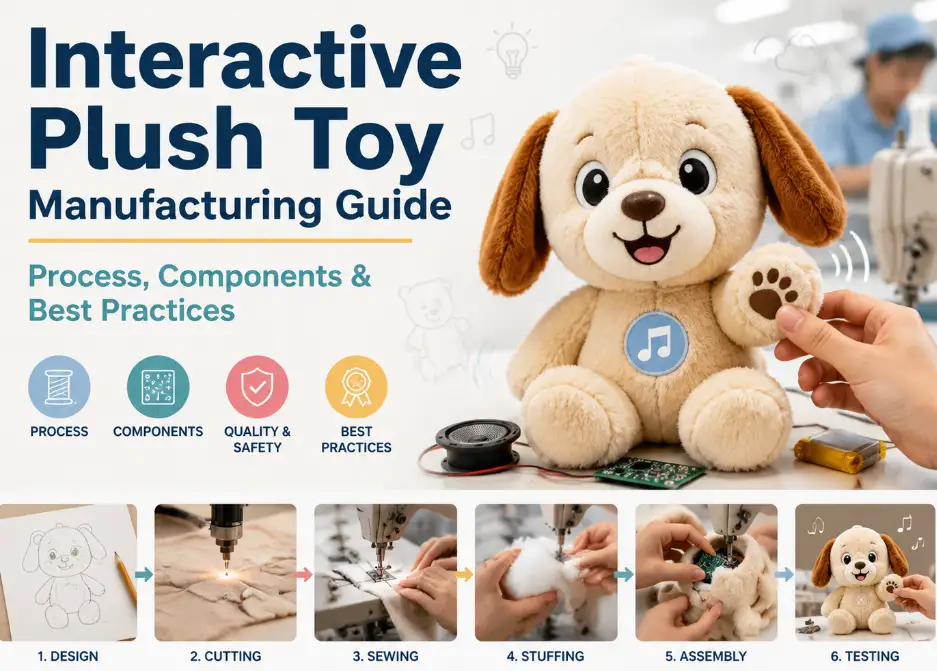
The production workflow for interactive plush toys follows the same broad soft toy manufacturing stages as any plush product — cutting, sewing, stuffing, and closing — but inserts a dedicated electronics integration stage between shell assembly and final closure, along with functional testing checkpoints that a standard plush toy production line does not require.
A typical interactive plush toy production sequence begins with fabric cutting and panel sewing to produce the outer shell, followed by installation of any internal housing or protective liner for the electronic module. The electronic module, pre-tested at the component supplier stage, is then inserted along with its wiring and battery pack, with an immediate functional check confirming activation before the shell is closed. Filling is added around the module with density calibrated to avoid dampening sensor response, and the final closure seam is completed before the unit passes to end-of-line functional and visual inspection.
End-of-line inspection for interactive plush toys typically checks both standard plush toy quality points — seam integrity, filling distribution, embroidery and accessory attachment — and functional points specific to the electronics, including sound clarity, sensor responsiveness, and battery compartment security. Units failing functional inspection at this stage are routed to a rework station rather than being scrapped outright, since most functional failures at this point trace back to a loose connector or misaligned sensor that can be corrected without discarding the soft goods construction.

Coordinating the electronic module supplier and the plush toy assembly line as a single, aligned production schedule is one of the more underappreciated success factors in interactive plush toy manufacturing. Modules arriving without pre-testing at the component supplier stage push functional failure detection later into the process, where correction is more expensive and more disruptive to the sewing line’s throughput. Establishing an incoming quality check on every batch of modules before they reach the sewing floor — confirming activation, sound output, and battery compartment fit against a reference sample — catches a batch-level component issue before it is embedded into dozens or hundreds of finished units.
Cost Factors in Interactive Plush Toy Manufacturing
Interactive plush toy manufacturing carries a meaningfully different cost structure than standard plush toy production, driven primarily by the electronic component cost itself, the additional labor required for module integration and functional testing, and the broader compliance testing scope described earlier in this guide. Buyers evaluating interactive plush toy quotations should expect the electronic component and integration labor to represent a substantially larger share of total unit cost than fabric and filling — a reversal of the cost structure typical of non-electronic plush toys, where materials usually dominate.
Technology tier is the single largest cost driver within the electronics category, since a basic single-sound-clip module costs a fraction of a gesture-recognition or app-connected module, and this cost difference compounds through the additional labor, testing, and firmware development that higher technology tiers require. Order volume also affects interactive plush toy economics more significantly than it does standard plush production, since firmware development, tooling for any custom housing components, and compliance testing are largely fixed costs that amortize favorably at higher volumes but weigh heavily on smaller trial orders.
Labor cost per unit is also structurally higher for interactive plush toys than for standard plush production, since module insertion, wiring, and functional testing each require dedicated line time that a non-electronic plush toy does not incur. Buyers evaluating a first interactive product should budget for this labor premium explicitly rather than assuming it will be absorbed within the same per-unit labor allowance used for a standard plush toy program, since doing so consistently understates the realistic unit cost during early pricing conversations.
Tip: When comparing quotations for an interactive plush toy program, request the electronics, labor, and compliance testing costs as separate line items rather than a single bundled unit price. This makes it possible to identify exactly where cost differences between suppliers originate, rather than comparing an opaque total that may reflect very different underlying technology tiers or testing scope.
Frequently Asked Questions
Q1. What makes interactive plush toy manufacturing different from standard plush toy production?
Interactive plush toy manufacturing adds an entire electronics integration layer on top of standard soft toy construction — sound modules, motion or pressure sensors, battery packs, and in some cases connectivity chips — each of which must be embedded into a soft, flexible product without creating discomfort, safety hazards, or premature failure. This requires coordinated engineering across textile assembly and electronics assembly disciplines, additional compliance testing beyond standard toy safety standards, and a production workflow with dedicated electronics integration and functional testing stages that standard plush toy lines do not include.
Q2. How is battery compartment safety handled in interactive plush toys for young children?
Battery compartment security is addressed through mechanical design specifically intended to prevent a young child from accessing the battery without a tool or without performing two independent, simultaneous actions to open the compartment. Common approaches include a screw-secured access panel, a sliding lock mechanism requiring simultaneous pressure and slide motion, or a fully sealed rechargeable pack with no user-accessible battery at all. The appropriate approach depends on the target age range and the specific regulatory requirements — such as ASTM F963 and EN71-1 — that apply to the product’s intended markets.
Q3. How does fabric choice affect sound quality in an interactive plush toy?
Fabric density and pile height directly affect how clearly sound from an internal speaker module reaches the listener, a property referred to as acoustic transparency. Dense, long-pile fabrics muffle sound output more than short-pile or tightly woven fabrics, which means the same sound module can perform noticeably differently depending on which fabric it sits behind. Because of this, sound module volume and equalization settings should be tuned using the actual production fabric, not assessed on the bare module or on a different fabric than the final product will use.
Q4. Can the electronic components in an interactive plush toy be removed for washing?
Many interactive plush toys are specifically designed with a removable electronic module — accessed through a secured panel, pouch, or zippered compartment — so that the fabric shell can be machine washed or hand washed separately from the electronics. This design choice must be validated during quality control by confirming that the module can be removed and reinserted repeatedly without damaging the access panel, wiring, or connector, and that fit and function are preserved after multiple wash cycles of the fabric shell.
Q5. What sound and motion technologies are commonly used in interactive plush toys today?
Interactive plush toys use a range of technologies spanning basic single-clip sound modules triggered by a button or squeeze sensor, multi-track programmable sound chips offering varied responses, recordable audio modules that allow custom message playback, pressure and tilt sensors that detect hugging or handling, vibration motors that add tactile feedback, and increasingly, Bluetooth or NFC connectivity modules that pair the toy with a companion mobile app for extended content or personalization. The appropriate technology tier depends on the target price point, the intended age range, and the play experience the product is designed to deliver.
Q6. What compliance testing is required specifically because of the electronic components in an interactive plush toy?
Beyond the standard mechanical, flammability, and chemical testing that applies to any plush toy under ASTM F963, EN71, or equivalent standards, interactive plush toys require additional testing specific to their electronic components — battery compartment security testing, electrical safety testing under standards such as IEC 62115, and sound output level testing to confirm decibel limits are not exceeded at close range or over sustained exposure. Products with connectivity features may also require additional testing or documentation related to wireless emissions and, where applicable, data handling practices for products marketed to children.