Skip to content
A complete production reference for B2B buyers: materials, safety standards, durability engineering, MOQ planning, QC systems, and supplier evaluation — built for brands sourcing pet toys at scale.
Pet plush toys are not children’s toys made in slightly larger sizes. They are a distinct product category with their own engineering requirements, safety standards, material specifications, and quality benchmarks — requirements that are meaningfully different from the standards that govern children’s plush in almost every dimension that matters for production sourcing.
Buyers who enter pet plush toy manufacturing without understanding these distinctions consistently encounter the same set of problems: products that fail durability benchmarks within weeks of use, safety complaints that generate platform delistings, and production batches where the materials used bear little resemblance to what was specified in the original brief. The consequences are expensive, and they are preventable.
This guide covers every production decision that determines whether a pet plush toy succeeds in the market — from material selection and construction engineering to safety compliance, sampling, quality control, and supplier evaluation. It is written for B2B buyers who are either entering the pet plush category for the first time or evaluating whether their current sourcing approach is producing the outcomes their product and brand require.
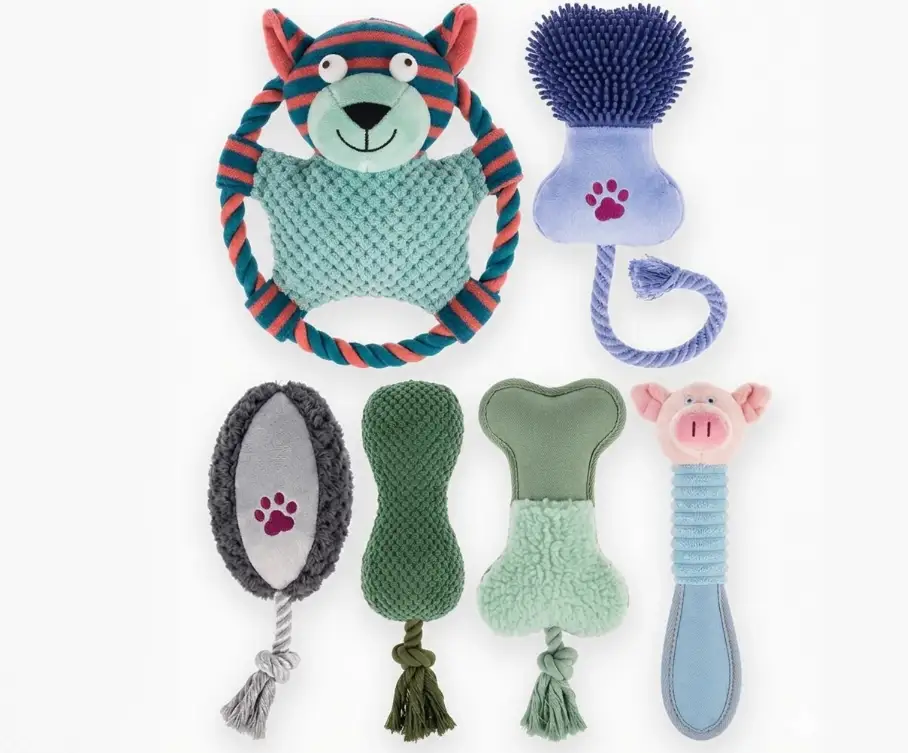
What Makes Pet Plush Toy Manufacturing Different From Children’s Plush?
Pet plush toy manufacturing is fundamentally different from children’s plush toy manufacturing because the end user’s interaction pattern — how a dog or cat physically engages with a toy — creates mechanical stress loads that are categorically more severe than the handling patterns of human children. A medium-sized dog engaging with a plush toy applies bite forces between 150 and 400 PSI depending on breed, combined with pulling, shaking, and carrying behaviors that stress seams, fabric surfaces, and filling containment in ways that children’s plush construction is not designed to withstand.
This difference is not marginal. It is structural. Construction approaches that are entirely adequate for children’s plush — standard lockstitch seams at 6–8 stitches per centimeter, single-layer fabric panels, standard PP cotton fill with no containment layer — produce pet plush toys that fail within hours to days of use under normal pet interaction. The failure modes are both commercial — returns, negative reviews, brand damage — and safety-relevant, since filling materials, accessory components, and fabric fragments ingested by animals can cause serious veterinary consequences.
Understanding what makes pet plush manufacturing different is therefore not a fine-tuning exercise — it is the prerequisite for producing products that perform adequately in their intended use environment.
Pet Plush vs. Children’s Plush: Core Manufacturing Differences by Production Parameter
| Parameter | Children’s plush standard | Pet plush requirement | Reason for difference |
|---|---|---|---|
| Seam stitch type | Standard lockstitch, single row | Double-stitched or reinforced seam, often bar-tacked at stress points | Pet bite and pull forces exceed standard seam tensile limits |
| Seam stitch density | 6–8 stitches/cm | 10–14 stitches/cm minimum at structural seams | Higher density increases seam resistance to point loads |
| Outer fabric weight | 150–220 gsm typical | 220–350 gsm for moderate durability; 350 gsm+ for heavy chewer targeting | Heavier fabric resists surface abrasion and puncture |
| Filling containment | Single-layer outer shell only | Inner canvas or Oxford lining recommended; filling pouch construction for high-durability tier | Contains filling if outer shell is breached — reduces ingestion risk |
| Accessory attachment | Plastic safety eyes with washers, pull-tested to EN71 | Embroidered features preferred; if plastic used, recessed and locked with secondary stitch ring | Detachable plastic accessories present choking and ingestion hazard |
| Thread tensile strength | Standard polyester thread, 40-weight typical | Bonded nylon or heavy-duty polyester, 30-weight or heavier | Higher tensile strength resists thread breakage under pull loads |
| Safety standard reference | ASTM F963, EN71, CPSIA | No mandatory standard — ASTM F963 sometimes cited as reference; brand-defined durability specs required | Pet product regulatory framework is less prescriptive than children’s toy regulation |
Design brief tip: When briefing a manufacturer on a pet plush toy, specify the target animal species, size category (toy breed/medium / large / giant), and chewing behavior profile (gentle mouthing/moderate chewer / aggressive chewer) in your design brief. These three parameters drive the construction specification more directly than any single material choice.
What Materials Are Used in Pet Plush Toy Manufacturing, and How Do You Choose the Right Ones?
Material selection in pet plush toy manufacturing determines the durability ceiling of the finished product more than any other single production variable. The outer fabric, fill material, thread, and accessory choices made at the specification stage set an upper limit on the performance outcomes that production quality control can achieve — superior construction cannot fully compensate for materials that are inadequate for the end-use demands of the product.
Pet plush materials must satisfy two partially competing requirements: they must be durable enough to withstand pet interaction under the target use scenario, and they must be safe if ingested in small quantities, since no fabric or fill system fully eliminates the possibility of material reaching an animal’s digestive system under heavy use. This means material evaluation for pet plush cannot focus on durability alone — it must address the toxicological profile of every material that could plausibly be ingested.
Outer Fabric Options and Their Performance Profiles
The outer fabric of a pet plush toy is the primary durability barrier. It determines abrasion resistance, puncture resistance, and the resistance to surface pilling and degradation that affects the toy’s appearance integrity over its useful life. Four fabric families are most commonly used in pet plush manufacturing, each with distinct performance and cost profiles that suit different product positioning and durability targets.
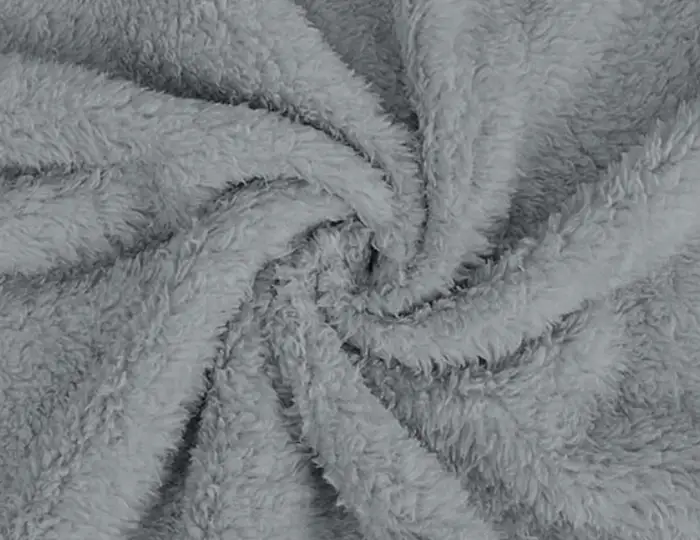
Outer Fabric Comparison for Pet Plush Toy Manufacturing
| Fabric type | Typical GSM range | Abrasion resistance | Pet safety profile | Best suited for |
|---|---|---|---|---|
| Short-pile polyester plush | 200–280 gsm | Moderate — surface pilling under sustained chewing | Low toxicity polyester fiber; fiber ingestion risk under aggressive chewing | Gentle-to-moderate chewer targeting; standard retail price point |
| Canvas-backed plush | 280–380 gsm | High — canvas backing resists puncture and surface delamination | Low toxicity; backing layer adds containment benefit | Medium-large breed targeting; mid-range durability positioning |
| Oxford nylon outer | 300–420 gsm (210D–420D) | Very high — nylon weave resists cutting and abrasion significantly better than polyester plush | Non-toxic; minimal fiber shedding | Aggressive chewer lines; premium durability positioning |
| Cotton canvas | 250–350 gsm | High — dense natural fiber weave resists surface damage | Natural fiber; low ingestion toxicity concern; biodegradable | Eco-positioned pet brands; natural/organic product lines |
| Fleece (anti-pill grade) | 180–260 gsm | Low-moderate — anti-pill treatment extends surface life but still limited | Low toxicity; soft hand-feel preferred by some pet owners | Cat toys; small breed gentle use; companion/comfort positioning |
Fill Material Selection: The Critical Safety Variable
Fill material selection in pet plush toys carries higher safety stakes than in children’s plush because fill ingestion by animals is a more predictable outcome. A child who pulls filling from a toy is typically identified and the situation managed; a dog who has ingested filling material may not show symptoms until veterinary intervention is required. This means that the toxicological safety profile of fill materials — not just their loft, weight, and cost properties — must be explicitly evaluated in the sourcing specification.
Fill Material Options for Pet Plush Toys: Safety, Performance, and Cost Comparison
| Fill material | Safety if ingested | Loft / feel | Cost index | Common use case |
|---|---|---|---|---|
| Standard PP cotton (polyester fiberfill) | Low acute toxicity; GI obstruction risk if ingested in large quantity | High loft, good shape recovery | Low (baseline) | Gentle chewer toys; standard positioning |
| Virgin PP cotton, 7D fiber | Same as standard PP cotton; finer fiber | Very high loft; ultra-soft feel | Low–medium (+10–20%) | Luxury feel positioning; cat toys |
| Recycled PET fill | Low acute toxicity; same GI consideration | Moderate loft; compresses over time | Low–medium | Eco-positioned pet brands |
| Natural kapok fiber | High — natural cellulose fiber, passes through digestive system | Moderate loft; slightly heavier feel | Medium (+30–50%) | Natural / organic pet product lines |
| No fill (flat construction) | Not applicable — no fill to ingest | Flat profile; crinkle or squeaker materials sometimes added | Low (reduced material) | Squeaker flat toys; fetch toys; puppy toys |
| Compressed cotton batting | Moderate — lower loose fiber count than PP | Dense; less loft than PP cotton | Medium | High-durability interior construction; filling pouch systems |
Material specification tip: Request a material safety data sheet (MSDS) or equivalent toxicological summary for any fill material used in your pet plush products. This documentation is not always required by pet product regulations, but it is a necessary component of product liability risk management — particularly for brands selling through veterinarian-adjacent retail channels where safety credibility is commercially important.
How Is Durability Engineered Into Pet Plush Toys at the Production Stage?
Durability in pet plush toys is not a material property — it is a construction outcome. The same fabric, used with different seam construction, stitch density, reinforcement placement, and accessory attachment method, produces products with dramatically different durability outcomes under identical use conditions. This means that material selection, while important, is a necessary but not sufficient condition for durable pet plush toy production. Construction engineering is what translates material potential into actual product performance.
The key construction variables that determine durability in pet plush manufacturing — seam construction, stitch density, reinforcement location, accessory integration method, and fill containment architecture — must each be specified in the production brief rather than left to factory default practices. Factory default construction practices are calibrated to minimize production cost, not to maximize durability. Absent specific client requirements, a factory will apply standard children’s plush construction to a pet plush order — not because of negligence, but because the brief did not specify otherwise.
Seam Engineering: The Primary Durability Determinant
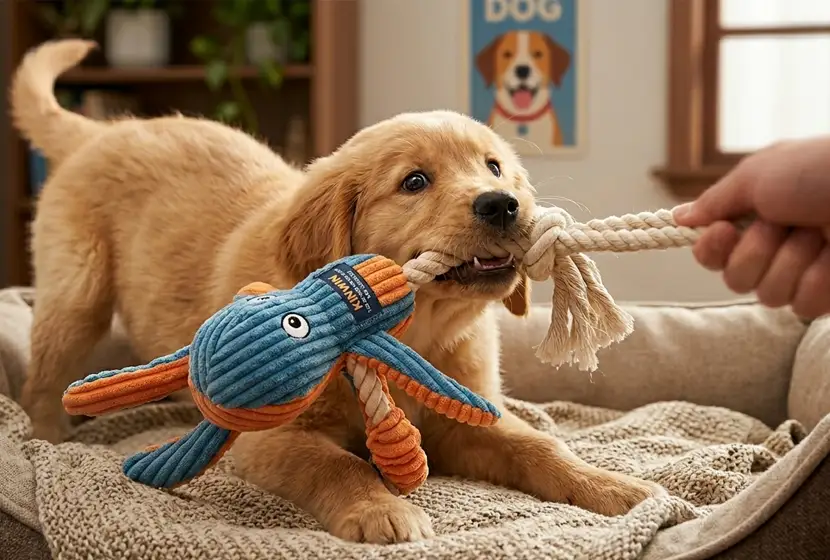
Seam failure is the most common durability complaint across all pet plush product categories. It is also the most preventable. Seam durability is determined by three independently controllable variables: stitch type, stitch density, and reinforcement placement at stress concentration points. Each of these variables can be specified in the production brief and verified in sampling without requiring any change to the fabric or fill specification.
Seam Construction Specifications by Pet Plush Durability Tier
| Durability tier | Target use case | Stitch type | Stitch density | Reinforcement specification |
|---|---|---|---|---|
| Standard | Cats; small breeds; gentle interaction | Single lockstitch | 8–10 stitches/cm | No additional reinforcement required |
| Reinforced | Medium breeds; moderate chewing | Double lockstitch or single with overlock | 10–12 stitches/cm | Bar tacks at limb-body junctions; double seam at tail |
| Heavy duty | Large breeds; active chewing | Double-stitched all seams; overlock on all edges | 12–14 stitches/cm | Bar tacks + reinforcement patch at all stress points; internal canvas lining |
| Extreme durability | Power chewer breeds; working dogs | Triple-stitched primary seams; zigzag secondary layer | 14+ stitches/cm | Full internal Oxford liner; filling pouch construction; all attachment points double-locked |
Accessory Integration: Eliminating Detachment Hazards
Accessories — eyes, noses, buttons, ribbons, and decorative trims — represent the highest-risk component category in pet plush toy construction because they are specifically targeted by dogs for removal and present direct ingestion hazards when detached. The approach to accessory integration in pet plush must therefore be fundamentally different from children’s plush: the goal is elimination of detachable components wherever design permits, and maximum attachment security where decorative features are necessary.
Embroidered eyes, noses, and mouth features are the preferred solution for pet plush toys in all durability tiers. Embroidery eliminates the detachment hazard entirely by integrating the feature into the fabric surface. Where plastic components are commercially necessary — for certain product styles or brand requirements — they should be recessed into a fabric recess that prevents direct access, secured with a secondary stitch ring around the perimeter of the washer, and specified with a minimum pull-test requirement of 25–35 Newtons in the production quality standard.
What Safety Standards Apply to Pet Plush Toys, and How Do Buyers Ensure Compliance?
Pet plush toy safety compliance operates in a significantly less prescriptive regulatory environment than children’s toy compliance. No single mandatory standard governs pet plush toys in the way that ASTM F963 governs children’s toys in the United States or EN71 governs them in the European Union. This regulatory gap does not mean safety compliance is unimportant — it means that the safety standard for a pet plush product is largely defined by the brand and enforced through the sourcing specification rather than by external mandatory requirements.
The practical implication for buyers is that the absence of a mandatory standard transfers the responsibility for safety specification from regulators to the brand. Brands that do not explicitly define the safety requirements in their production brief and verify them through testing are not operating in a less safety-critical environment — they are operating in a more safety-critical one, because the safety net of mandatory compliance testing is not present.
Chemical Safety: The Non-Negotiable Baseline
Even in the absence of a mandatory pet toy safety standard, chemical safety requirements apply to pet plush products through general product safety legislation in major markets. In the United States, the CPSC’s general product safety authority under the Consumer Product Safety Act covers pet products. In the European Union, REACH chemical restrictions apply to any product placed on the market. In both markets, demonstrating that materials meet baseline chemical safety thresholds — heavy metals within acceptable limits, restricted azo dyes absent, phthalates within limits — is a necessary condition for responsible market participation regardless of the absence of a toy-specific mandatory standard.
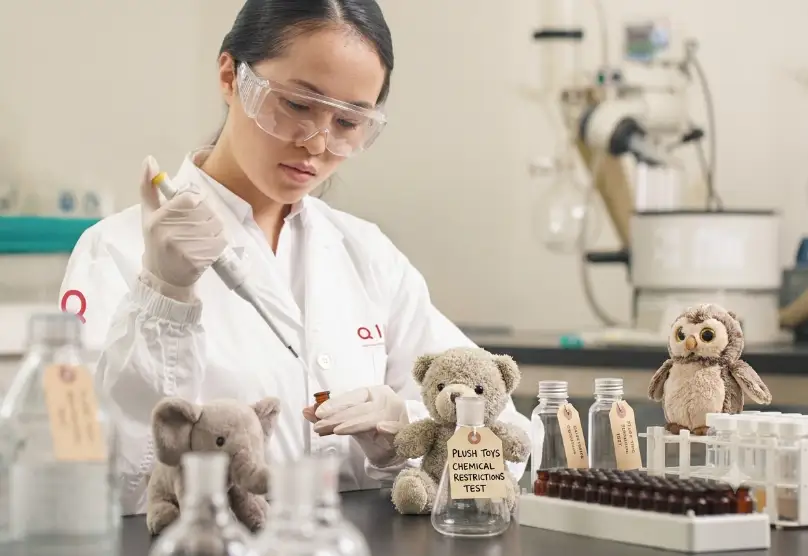
Safety Testing Framework for Pet Plush Toys: Recommended Testing by Market and Risk Category
| Test category | Applicable standard/reference | What it covers | Priority for pet plush |
|---|---|---|---|
| Chemical safety — fabric | REACH (EU); CPSA Section 15 (US); OEKO-TEX Standard 100 | Heavy metals, azo dyes, formaldehyde, phthalates, pH | High — mandatory in EU; strongly recommended in US |
| Chemical safety — fill | REACH; brand-defined specification | Extractable chemical residues in fill material | High — fill ingestion by pets is a foreseeable scenario |
| Accessory pull test | ASTM F963 Section 8.4 (reference); brand-defined spec | Resistance of eyes, noses, and attachments to pull force | Critical — primary detachment hazard for pets |
| Seam strength test | ISO 13935 (textile seams); brand-defined pet durability spec | Tensile strength of sewn seams under load | High — seam failure is primary durability failure mode |
| Flammability | 16 CFR Part 1610 (US); EN ISO 14116 (EU) | Flame spread rate of textile surface | Medium — relevant for retail channel requirements |
| Colorfastness | ISO 105-C06 (wash); ISO 105-X12 (rub) | Color transfer to pet skin/coat and surfaces under wet/dry rubbing | Medium — color transfer to light-coated animals is a consumer complaint driver |
| Squeaker function test | Brand-defined — squeaker audibility and compression range | Consistent squeaker response within specification range | Medium — inconsistent squeaker is a top consumer complaint category |
Compliance tip: For pet plush toys sold through major US retail chains (PetSmart, Petco, Target, Amazon), individual retailer compliance requirements often exceed general market minimums. Request a copy of the retailer’s vendor compliance manual before finalizing your production specification — retailer-specific requirements for chemical testing, labeling, and packaging frequently drive the compliance standard for the entire product program.
How Does the Sampling Process Work for Custom Pet Plush Toys?
The sampling process for custom pet plush toys follows the same sequential logic as children’s plush sampling — design brief, pattern making, first sample, evaluation, revision, and mass production approval — but with additional engineering verification steps at two critical points: the durability assessment stage and the safety accessory review stage. These two additional checkpoints exist because the performance requirements of pet plush toys are not fully verifiable through visual inspection of the sample alone.
A pet plush sample that passes visual evaluation against the design brief may still fail in use if seam construction does not meet the durability specification or if accessory attachment strength falls below the pull-test threshold. The sampling process for pet plush therefore requires both the visual approval process that any custom plush development requires and a functional performance verification step that is specific to the pet product category.
The Pet Plush Sampling Sequence
The full pet plush sampling sequence from design brief to mass production approval typically spans four to ten weeks depending on design complexity, the number of revision rounds required, and whether the sample involves custom-developed materials or fabric that requires lead time from the mill. Understanding each stage in this sequence — what the factory does, what the buyer should do, and what the most common problems are — is the prerequisite for managing the process efficiently.
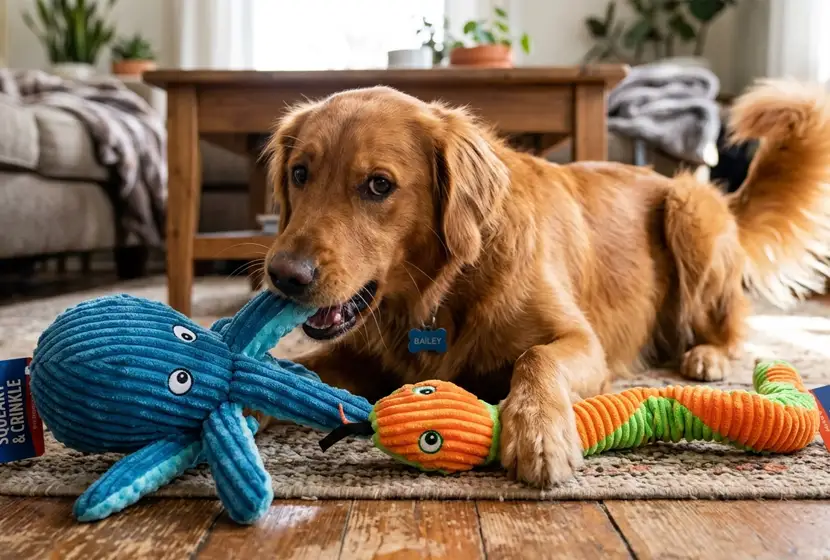
Pet Plush Toy Sampling Process: Stages, Timelines, and Buyer Actions
| Stage | Typical duration | What happens at this stage | Common problems and how to prevent them |
|---|---|---|---|
| Design brief submission | 1–3 days (buyer) | Buyer provides reference images, size specification, target animal species and size category, durability tier requirement, material preferences, and accessory approach | Insufficient brief leads to factory misinterpretation; specify durability tier and target animal explicitly |
| Factory design review | 2–5 days | Factory assesses feasibility, identifies materials, flags construction concerns, and confirms pricing | Factories may not flag durability concerns proactively — ask explicitly whether the construction proposed meets the durability tier specified |
| Pattern making and material sourcing | 3–7 days | Pattern maker develops flat patterns from reference; materials are sourced from approved supplier list | Off-spec material substitution — request material sample swatches before construction begins |
| First sample construction | 7–14 days | First physical prototype built to approved pattern with specified materials | First sample frequently deviates from brief — plan at least one revision round into the project timeline and budget |
| Buyer evaluation and durability check | 3–5 days (buyer) | Visual evaluation against design brief; functional durability verification (seam pull test, accessory pull test, stuffing compression) | Buyers who skip functional verification and approve on appearance only discover construction problems after bulk production |
| Revision and counter sample | 5–10 days per round | Factory implements approved revisions; counter sample produced for final confirmation | Scope creep across multiple revision rounds inflates cost — consolidate all feedback before requesting revision |
| Mass production approval | 1–2 days (buyer) | Counter sample approved as golden sample (production standard); factory scales to bulk production | Golden sample not retained by both parties — always retain two approved samples: one for factory reference, one for buyer QC comparison |
How Do MOQ, Pricing, and Cost Structure Work for Pet Plush Toy Orders?
Pet plush toy pricing follows the same cost structure logic as children’s plush — with material cost, labor cost, overhead, and margin combining into the unit price — but with two important differences that systematically affect the cost comparison between pet plush and children’s plush at equivalent order volumes. First, the material cost component is higher for pet plush due to heavier fabric weights, reinforced thread, and additional construction layers. Second, the labor content per unit is higher because reinforced seam construction and additional quality verification steps add time to the production cycle.
The result is that like-for-like comparison of pet plush and children’s plush quotations at the same unit size typically shows a 20–40% unit cost premium for the pet plush equivalent — a premium that reflects genuine additional material and labor investment rather than margin expansion. Buyers who attempt to source pet plush at children’s plush price points by omitting the reinforced construction specification are not finding a better deal; they are removing the construction features that make the product viable in its intended use case.
MOQ Planning for Pet Plush Products
Minimum order quantities for custom pet plush toys from Chinese manufacturers typically range from 300 to 1,000 units per design depending on product complexity, customization level, and factory scale. Factories with dedicated pet product lines sometimes offer lower MOQs for re-order quantities once tooling and sampling costs have been amortized. Understanding how MOQ interacts with unit cost, sampling investment, and total project cost is essential for accurately assessing the economics of a new pet plush product launch.
Pet Plush Toy Cost Structure and MOQ Interaction: Typical Parameters by Order Tier
| Order parameter | Small order (300–500 units) | Mid-range order (500–2,000 units) | Volume order (2,000+ units) |
|---|---|---|---|
| Typical MOQ acceptance | Some factories accept; specialized pet-focused manufacturers more flexible | Standard acceptance across most capable factories | Full factory engagement; strongest negotiating position |
| Unit price range (25 cm medium complexity) | $6.50–$12.00 FOB | $4.80–$8.50 FOB | $3.50–$6.50 FOB |
| Sampling cost amortized per unit | $0.60–$1.80 | $0.20–$0.60 | $0.05–$0.20 |
| Compliance testing amortized per unit | $1.20–$3.00 | $0.30–$1.20 | $0.10–$0.30 |
| Total landed cost range (including freight, duties) | $9.00–$18.00 | $6.50–$13.00 | $4.50–$9.00 |
| Suggested retail price positioning | $18–$40 (premium specialty) | $14–$28 (mid-market) | $9–$20 (mass market or broad distribution) |
Pricing negotiation tip: When requesting quotations for pet plush toys, specify the durability tier explicitly and ask the factory to provide a separate line item for the reinforced construction cost differential relative to standard construction. This creates transparency around where the construction premium originates and prevents the factory from reducing the construction specification to hit a target price without disclosure.
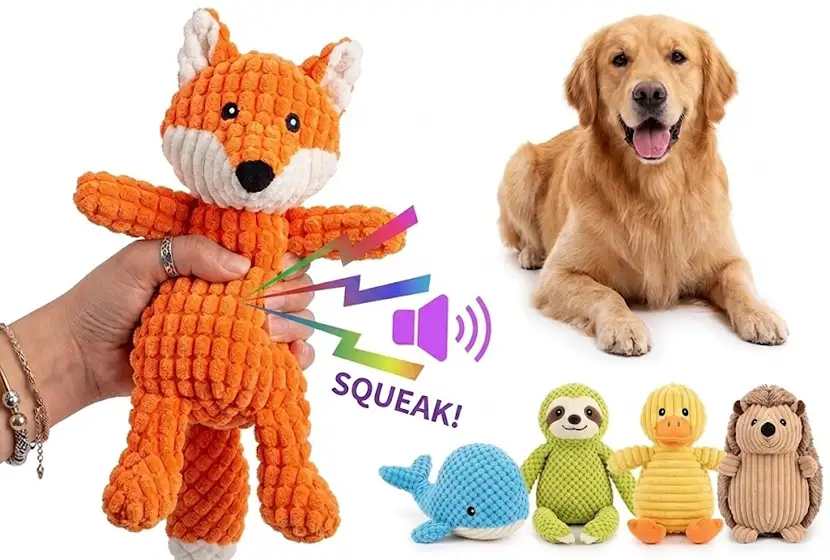
What Quality Control System Should a Pet Plush Toy Manufacturer Have in Place?
Quality control for pet plush toys requires a QC system architecture that addresses both the standard quality parameters of plush toy production — appearance consistency, color accuracy, fill density, label placement, and packaging — and the pet-product-specific parameters that determine whether the product performs safely and durably in use. A factory whose QC system is designed exclusively for children’s plush will systematically miss the pet-specific quality variables that most affect commercial outcomes in the pet product category.
The minimum effective QC system for a pet plush toy manufacturer consists of four distinct inspection stages: incoming material inspection, pre-production construction verification, in-process quality monitoring, and final outgoing inspection. Each stage addresses a different category of quality risk, and each stage must include the pet-specific verification criteria that distinguish pet plush from standard plush quality management.
Pet-Specific QC Parameters by Inspection Stage
Quality Control Checklist for Pet Plush Manufacturing: Stage-by-Stage Verification Criteria
| QC stage | Standard plush checks | Pet-specific additional checks | Acceptable outcome |
|---|---|---|---|
| Incoming material | Fabric color vs. approved swatch; fill weight; label print quality | Fabric GSM vs. spec; thread gauge vs. spec; fill fiber toxicology documentation present; plastic accessory pull-force certification | All materials match approved specifications; documentation on file |
| Pre-production | First-off visual approval against golden sample; fill density check; label placement | Seam stitch density count (stitches/cm); bar-tack presence at all specified stress points; accessory recessing confirmation; inner lining layer present if specified | First-off units pass all visual and construction checks before production begins |
| In-process (IPQC) | Appearance consistency; color consistency; seam closure completeness | Seam pull test sample check (minimum 3 units per 100 produced); squeaker function check; fill weight consistency across units; stitch density spot check | Defect rate below AQL 2.5; immediate correction when out-of-spec units detected |
| Final outgoing | Full appearance check; labeling; packaging; unit count; carton marking | Accessory pull test (100% or statistical sample per AQL); seam integrity check on random sample; fill consistency palpation check; squeaker function; colorfastness rub test on selected units | Zero critical defects (accessory detachment, structural failure); major defects below AQL 1.0 |
Third-Party Inspection for Pet Plush Orders
Third-party pre-shipment inspection is strongly recommended for pet plush toy orders, particularly for buyers placing first orders with a new manufacturer, launching new product designs, or shipping to retail partners whose compliance requirements include independent inspection documentation. Third-party inspection provides an independent verification that the finished goods match the approved sample and specification — a verification that the manufacturer’s own QC system, however robust, cannot provide with the same independence.
Frequently Asked Questions
What is the minimum order quantity for custom pet plush toys from Chinese manufacturers?
The minimum order quantity for custom pet plush toys from Chinese manufacturers typically ranges from 300 to 1,000 units per design, with most factories positioned at 500 units as a standard entry point. The specific MOQ a factory is willing to accept depends on several factors: the complexity of the product design, whether the order uses existing fabric and fill inventory or requires custom-sourced materials, the factory’s overall scale and production scheduling flexibility, and whether the order is a first-order or a re-order of an established design. Buyers at lower order volumes — 200–400 units — should specifically target manufacturers who have built their business model around smaller-batch custom production rather than attempting to negotiate standard volume factories below their operational MOQ.
The economics of pet plush production at very low volumes are challenging regardless of the factory’s flexibility, because sampling costs, compliance testing costs, and tooling costs are fixed regardless of order quantity and impose a significant per-unit overhead at small volumes that affects total project viability.
How do I specify the right durability tier for my pet plush product in a supplier brief?
Specifying the correct durability tier begins with defining three parameters about your target end user: the animal species and size category (toy breed, small, medium, large, or giant breed for dogs; standard for cats), the interaction profile (gentle mouthing, moderate chewing, or active/aggressive chewing), and the expected product life target in months under the described use scenario.
These three parameters, stated explicitly in the production brief, give the factory the information needed to design the appropriate construction specification rather than defaulting to standard construction. If you are uncertain about the appropriate durability tier, requesting that the factory produce samples at two construction levels — standard and reinforced — and conducting your own destructive durability test between the two samples is the most reliable way to identify the construction minimum your product requires. Durability assessment through buyer-conducted pull testing, seam stress testing, and simulated use observation is more reliable than relying on factory assurances about construction adequacy.
Are squeakers safe for dogs in pet plush toys, and how should they be specified in production?
Squeakers in pet plush toys present a manageable safety risk that is primarily determined by the containment architecture around the squeaker rather than by the squeaker component itself. A squeaker accessed and ingested by a dog — which is a foreseeable scenario for any dog that successfully breaches the outer shell of a plush toy — presents a choking and intestinal obstruction hazard. The appropriate production response is to specify a double-containment approach: the squeaker is enclosed in a separate inner fabric pouch stitched inside the toy before the outer shell is closed, creating an additional containment barrier that a dog must breach separately after accessing the outer fill.
All-plastic squeakers should be produced without sharp burr edges, verified through a visual and tactile inspection at the QC stage. The squeaker material specification should confirm non-toxic plastic (typically polyethylene or polypropylene) and request a material composition confirmation from the squeaker component supplier. Squeaker function consistency — audibility and compression range within specification — should be included in the final outgoing QC checklist because inconsistent squeaker response is among the top consumer complaint categories for pet plush toys across all major retail platforms.
What certifications or documentation should I request from a pet plush toy manufacturer before placing a bulk order?
Before placing a bulk order for pet plush toys, buyers should request the following documentation from any prospective manufacturer: a current factory audit certificate (BSCI, SEDEX, or equivalent social compliance audit); OEKO-TEX Standard 100 or REACH compliance documentation for the outer fabric and fill materials to be used in production; a material safety data sheet or toxicological summary for the fill material; accessory pull-test documentation confirming that eyes, noses, and other attachments meet the pull force specification relevant to your durability tier; and evidence of prior production experience in the pet product category, either through product references or existing pet-product client references. If the order involves squeakers, request material composition documentation for the squeaker component.
For orders destined for major retail partners, request a copy of the factory’s third-party audit report and confirm that the factory is on the retailer’s approved vendor list or is prepared to undergo the retailer’s qualification process. A factory that is unable to provide this documentation or is resistant to documentation requests is not adequately positioned to supply a commercially responsible pet plush product program.
How long does it typically take to develop and produce a new custom pet plush toy from concept to shipment?
The total timeline from design concept to shipment for a new custom pet plush toy typically ranges from 10 to 18 weeks, with the variance driven primarily by the number of sampling revision rounds required and the complexity of the material specification. The sampling phase alone — from brief submission to mass production approval — typically spans 4 to 8 weeks for a product requiring one or two revision rounds and up to 12 weeks for complex designs or products where material sourcing introduces lead time.
Following sample approval, bulk production for pet plush toys typically requires 25 to 40 production days depending on order volume and factory capacity utilization, with additional lead time for any custom packaging or printed materials. Buyers should plan conservatively — adding 2 to 3 weeks buffer beyond the factory’s quoted timeline — for first orders with a new manufacturer, since relationship establishment, communication calibration, and production scheduling at a new factory consistently adds time that is not reflected in quoted lead times.
For seasonal or retail-committed launches, working backward from the required in-warehouse date and planning the development timeline accordingly — rather than allowing development time to float and compressing the schedule at the production stage — is the most reliable approach to on-time delivery.
Conclusion
Pet plush toy manufacturing is a category where the gap between a product that performs and one that fails is determined almost entirely by the specificity of the buyer’s production specification and the quality systems of the manufacturer engaged to fulfill it. The regulatory environment is permissive, the default factory practices are calibrated for standard plush rather than pet durability, and the end users are animals whose interaction patterns are systematically more demanding than human children’s.
Buyers who understand the material requirements, construction engineering standards, safety documentation needs, and quality verification framework specific to the pet plush category are positioned to source products that perform reliably, withstand platform scrutiny, and build the kind of repeat purchase and review profile that sustains a pet brand. Those who apply generic plush sourcing practices to a pet product brief consistently encounter the durability failures, safety complaints, and supplier performance gaps that this guide is designed to prevent.
The framework presented here — spanning material selection, durability engineering, safety compliance, sampling management, cost structure, and quality control — provides the specification and evaluation foundation that pet plush sourcing at any scale requires to produce outcomes worth the investment.