Skip to content
Everything product developers, quality managers, and sourcing teams need to know about chemical safety testing for plush toys — restricted substances, flame retardant compliance, laboratory methods, and certification.
Plush toy chemical testing requirements determine whether a soft toy is legally sellable and, more importantly, safe for the children who will chew, hug, and sleep with it. This guide walks through the restricted substances, regulatory standards, laboratory test methods, and certification steps that govern chemical safety compliance for plush toys sold in major global markets.
What Are Chemical Testing Requirements for Plush Toys?
Chemical testing requirements for plush toys are the set of laboratory evaluations and substance limits that a finished plush toy — including its fabric, dyes, filling, printed graphics, and any attached trims — must satisfy before it can be legally sold in a given market. These requirements exist alongside and separately from mechanical safety testing such as pull and torque testing or small parts evaluation, and they specifically address the risk of chemical exposure through skin contact, mouthing, or ingestion.
Because plush toys are marketed heavily to infants and young children who routinely place soft toys in their mouths, regulators apply some of the strictest chemical exposure limits in the toy category to plush and textile-based products, particularly for substances with known toxicological effects such as heavy metals, phthalates, and certain flame retardant chemicals.
Chemical testing requirements also differ meaningfully from the safety testing categories that many product teams are more familiar with, such as mechanical strength, small parts, and cord length evaluation. Mechanical testing largely depends on physical construction and can often be verified through inspection or measurement.
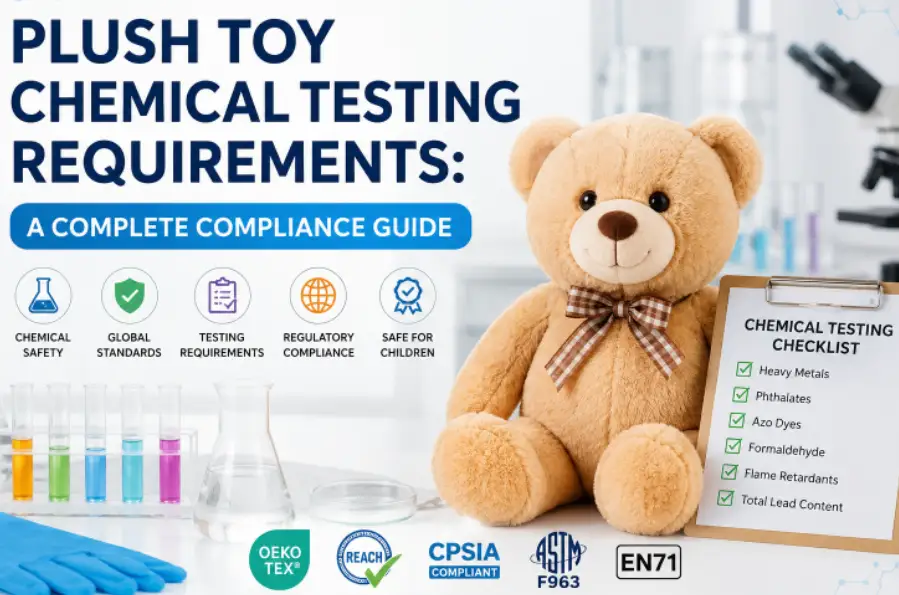
Chemical compliance, by contrast, cannot be assessed visually or by touch — a fabric, dye, or filling material that looks, feels, and performs identically to a compliant version may still contain restricted substances at levels that only laboratory analysis can detect. This distinction is why chemical testing sits at the center of most plush toy recall events, rather than mechanical failures, which are typically easier for manufacturers to catch internally before a product reaches market.
Tip: Chemical compliance should be verified at the component level — fabric, filling, dye, thread, and any plastic or metal trim — rather than only on the finished assembled toy. A single non-compliant component, such as a printed graphic ink, can fail an entire finished-product test even when every other material passes independently.
Why Chemical Testing Matters for Plush Toys
Chemical testing is not a formality layered on top of toy design; it is a core safety function that directly protects children from exposure to substances linked to developmental, hormonal, and carcinogenic health effects.
Health Risks of Untested Chemicals in Children’s Plush
Children under three years old are considered a particularly vulnerable population for chemical exposure because of their smaller body mass relative to exposure dose, their tendency to mouth objects, and their developing organ systems. Substances such as lead and cadmium can accumulate in the body over repeated low-level exposure, while certain phthalate plasticizers have been associated with endocrine disruption. Untested or non-compliant plush materials create a direct and largely invisible risk pathway, since chemical contamination is not detectable through visual inspection or normal quality checks.
Regulatory Drivers Across Major Markets
Toy safety regulation has become increasingly harmonized in its general approach — restricting heavy metals, phthalates, and certain flame retardants — while differing in specific substance lists, permitted limits, and testing protocols between jurisdictions. This divergence means that a plush toy compliant in one market cannot be assumed compliant in another without verifying the applicable regional requirements directly.
Major Regulatory Frameworks Governing Plush Toy Chemical Safety
| Region | Primary Standard | Scope |
|---|---|---|
| United States | ASTM F963 / CPSIA | Heavy metals, phthalates, flammability, mechanical safety |
| European Union | EN 71 (Parts 2, 3, 9-11) / REACH | Flammability, migration of elements, restricted chemical substances |
| United Kingdom | UK Toys (Safety) Regulations | Aligned closely with EN 71 post-Brexit, with UKCA marking |
| Canada | Canada Consumer Product Safety Act (CCPSA) | Heavy metals, phthalates, flammability |
| China (export) | GB 6675 / GB 6675.4 (chemical requirements) | Migration of elements, restricted substances for domestic and export goods |
Restricted and Regulated Substances in Plush Toys
A relatively consistent core group of substances is restricted across most major toy safety frameworks, though specific limits and test methods vary by jurisdiction.
Heavy Metals
Heavy metal testing evaluates the migration of elements such as lead, cadmium, mercury, arsenic, antimony, barium, chromium, and selenium from accessible plush toy materials, including dyed fabric, printed surfaces, and any metal or painted trims. Migration testing simulates the amount of a substance that could be absorbed by the body under realistic use conditions, which is a different — and generally more protective — measurement than simply testing total substance content in the raw material.
Phthalates and Plasticizers
Phthalate testing is most relevant to any plastic components used on a plush toy, such as safety eyes, noses, buttons, or clear packaging elements, since phthalates are plasticizing chemicals used to soften PVC and similar plastics. Most major markets restrict a defined list of phthalate compounds to concentrations below 0.1% by weight in accessible plasticized components, with lower limits or additional scrutiny applied to parts intended for mouthing by children under three.
Azo Dyes, Formaldehyde, and Other Restricted Substances
Certain azo dyes used historically in textile coloring can break down under normal conditions into aromatic amines associated with carcinogenic risk, and these specific dyes are restricted or banned outright in most major markets. Formaldehyde, sometimes present as a residual byproduct of certain fabric finishing or wrinkle-resistance treatments, is also subject to strict migration limits, as is the use of certain organotin compounds and short-chain chlorinated paraffins in some flame retardant or plasticizer formulations.

Commonly Regulated Substances in Plush Toy Materials
| Substance | Typical Source in Plush Toys | Common Regulatory Limit |
|---|---|---|
| Lead | Dyes, pigments, painted or coated trims | Generally below 90 ppm in surface coatings; substrate limits vary by market |
| Cadmium | Pigments in dyed fabric or plastic components | Typically restricted below 75–130 ppm depending on jurisdiction |
| Phthalates (DEHP, DBP, BBP, and related) | Plasticized PVC eyes, noses, and accessory parts | Below 0.1% by weight in accessible plasticized material |
| Formaldehyde | Certain fabric finishing and wrinkle-resistant treatments | Typically below 20–75 ppm depending on age grading and market |
| Restricted azo dyes | Textile dyeing of plush fabric | Banned or restricted below 30 ppm for specified aromatic amines |
Tip: Request substance-specific migration test reports rather than a general “chemical safety pass” summary from your testing laboratory. A general pass statement does not tell you which specific substances were tested, what limits were applied, or whether a borderline result exists that could fail under a different market’s stricter threshold.
Flame Retardant Chemical Testing
Flammability compliance is one of the most frequently misunderstood areas of plush toy chemical testing because it involves both a physical performance requirement and, in many cases, a chemical composition question.
Flammability Performance Standards
Flammability testing for plush toys evaluates how quickly and in what manner a fabric surface burns when exposed to a controlled ignition source, typically measured as flame spread rate across a defined sample length within a specified time window. Most plush toys are designed to pass flammability requirements through fiber selection and fabric construction rather than through added flame retardant chemical treatment, since inherently slow-burning fibers avoid the chemical compliance questions associated with topical treatments.
Flame Retardant Chemical Safety Concerns
When flame retardant chemicals are used, whether as a fabric treatment or as an additive within filling or foam components, those specific chemical formulations must themselves be evaluated for toxicological safety, since some legacy flame retardant chemistries — including certain brominated and chlorinated compounds — have been restricted or phased out in multiple markets due to bioaccumulation and health concerns. This makes flame retardant chemical testing a two-part requirement: confirming that the toy passes flammability performance testing, and separately confirming that any chemical treatment used to achieve that performance is itself compliant with restricted substance lists.
Flammability and Flame Retardant Testing Reference
| Test Element | What It Evaluates | Typical Method Reference |
|---|---|---|
| Surface flash and flame spread | Speed and pattern of flame spread across the fabric surface | 16 CFR 1610 / EN 71-2 |
| Filling material flammability | Ignition resistance of internal stuffing material | ASTM F963 flammability section |
| Flame retardant chemical identification | Confirms which flame retardant compound, if any, is present | GC-MS / LC-MS chemical analysis |
| Restricted flame retardant screening | Confirms the absence of banned brominated or chlorinated flame retardants | Targeted substance screening per applicable market list |
Testing Methods and Laboratory Procedures
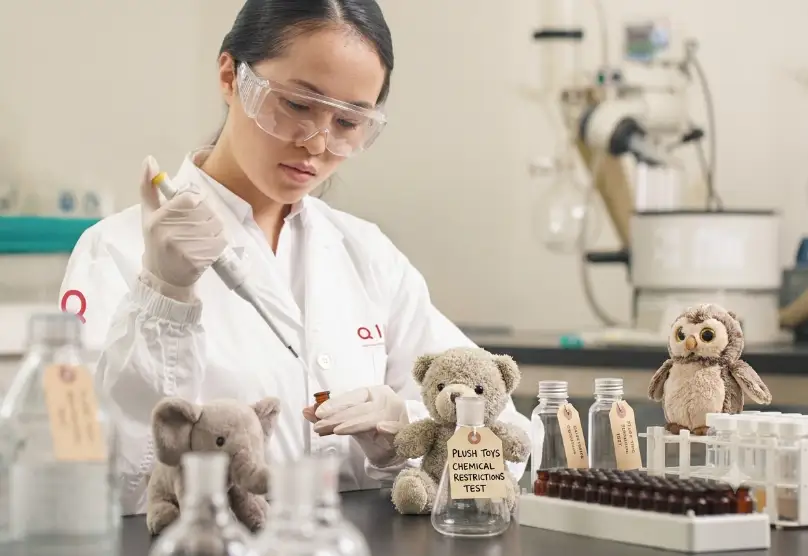
Chemical testing for plush toys is performed by accredited third-party laboratories using standardized extraction and analytical methods designed to simulate realistic exposure pathways rather than simply measuring total chemical content.
Sample Preparation and Migration Extraction
Migration testing typically involves extracting a representative sample of the accessible material — fabric, dye, or plastic trim — in a simulated bodily fluid such as dilute hydrochloric acid to approximate stomach acid conditions, then measuring the concentration of target elements that migrate into the extraction solution. This approach reflects a more realistic exposure scenario than total content testing, which measures everything present in the material regardless of whether it would actually be released during normal use.
Analytical Techniques
Heavy metal migration is most commonly measured using inductively coupled plasma optical emission spectrometry (ICP-OES) or mass spectrometry (ICP-MS), which can detect elements at extremely low parts-per-million or parts-per-billion concentrations. Organic substances such as phthalates, formaldehyde, and azo dye breakdown products are typically measured using gas chromatography-mass spectrometry (GC-MS) or high-performance liquid chromatography (HPLC), depending on the specific compound class being evaluated.
Common Laboratory Test Methods for Plush Toy Chemical Compliance
| Method | Substance Class Detected | Typical Sensitivity |
|---|---|---|
| ICP-OES / ICP-MS | Heavy metals (lead, cadmium, mercury, arsenic, and others) | Parts-per-million to parts-per-billion |
| GC-MS | Phthalates, flame retardant compounds, and some azo dye byproducts | Parts-per-million |
| HPLC | Formaldehyde, certain dyes, and pigment compounds | Parts-per-million |
| Colorimetric formaldehyde extraction | Free and released formaldehyde in fabric | Parts-per-million |
Tip: Retain chemical test reports for every dye lot and filling batch used in production, not just an annual reference sample, since regulators and retailers can request lot-specific documentation during a compliance audit or after a consumer complaint. Batch-level records are far more defensible than a single historical test result applied broadly across an entire production run.
Certification, Documentation, and Ongoing Compliance
Passing a single laboratory test is not the same as maintaining ongoing chemical compliance. A complete compliance program combines periodic third-party testing with documented quality controls at the factory level to catch material or process changes that could introduce non-compliant substances between formal test cycles.
Certifications and Documentation Relevant to Plush Toy Chemical Compliance
| Document / Certification | Purpose | Typical Validity |
|---|---|---|
| Children’s Product Certificate (CPC) | Required declaration of US regulatory compliance for children’s products | Reissued when material, supplier, or design changes |
| EN 71 Test Report | Documents compliance with EU toy safety chemical and physical requirements | Typically 1–3 years, or upon material change |
| OEKO-TEX Standard 100 | Confirms fabric and dye freedom from harmful substances above the defined limits | Annual mill certification, verified against lot testing |
| Material Safety Data Sheet (MSDS) | Documents the chemical composition and hazard information for raw materials | Updated when formulation changes |
| Factory Quality Control Record | Internal documentation of incoming material chemical spot-checks | Ongoing, per production batch |
Common Compliance Failures and How to Avoid Them
The most frequent causes of chemical compliance failures in plush toys are not exotic contamination events but predictable process gaps: an unapproved dye substitution made without retesting, a trim component sourced from a new supplier without chemical verification, or a filling material batch drawn from recycled feedstock without confirming the source material’s chemical history. Each of these scenarios can be prevented through a documented approval process that requires chemical testing sign-off before any material substitution is authorized for production, rather than relying on the assumption that a similar-looking replacement material carries equivalent chemical properties.
Tip: Treat any unapproved material substitution — even one that appears cosmetically identical, such as a replacement dye shade or an alternate trim supplier — as a compliance event requiring new chemical testing before production proceeds. Chemical composition cannot be verified visually, and the cost of retesting a substitute material is far lower than the cost of a recall.
Building an Internal Chemical Compliance Program
Manufacturers that consistently pass chemical compliance audits generally share a common trait: chemical testing is treated as a built-in stage of the product development and production process rather than a final check performed only before shipment. Establishing this discipline internally reduces both the frequency of failed tests and the cost of late-stage corrective action.
Approved Materials Lists
An approved materials list documents every fabric, dye, filling, thread, and trim component that has been chemically tested and verified compliant for a given target market, along with the specific test report and expiration date associated with each entry. Requiring design and sourcing teams to select components exclusively from this list — and requiring new testing before any component is added — closes the most common gap that leads to compliance failures: informal or undocumented material substitutions made during production without a corresponding retest.
Incoming Material Spot Checks
Beyond formal third-party laboratory testing at defined intervals, many manufacturers implement lower-cost screening tools, such as handheld X-ray fluorescence (XRF) analyzers, to spot-check incoming fabric, dye, and trim shipments for elevated heavy metal content before those materials enter production. While XRF screening is not typically accepted as a substitute for accredited laboratory migration testing in a formal compliance filing, it serves as an effective early-warning tool that can flag a problematic material batch before it is committed to a full production run.
Coordinating Testing Across Multiple Target Markets
For manufacturers selling into more than one regulatory region, coordinating chemical testing across markets from the outset — rather than testing separately and sequentially for each market after the fact — can meaningfully reduce total testing cost and lead time. Because core substance categories such as heavy metals and phthalates overlap significantly between major frameworks, a single comprehensive test panel designed to satisfy the strictest applicable limits across all target markets often costs less in aggregate than running narrower, market-specific test rounds independently for each region.

Frequently Asked Questions
What chemical tests are required for plush toys sold in the United States?
Plush toys sold in the United States must comply with the Consumer Product Safety Improvement Act (CPSIA) and ASTM F963, which together require testing for lead content and migration, restricted phthalate compounds in accessible plastic components, and flammability performance for fabric and filling materials. Manufacturers or importers must also issue a Children’s Product Certificate confirming that the toy has been tested by a CPSC-accepted laboratory and meets all applicable requirements before the product can be legally sold or imported.
How is heavy metal testing performed on plush toy fabric and trims?
Heavy metal testing on plush toys typically uses a migration extraction method, where a sample of the accessible material is exposed to a simulated stomach acid solution to measure how much of a given element would realistically be released and absorbed during normal use, including mouthing. The resulting extraction solution is analyzed using inductively coupled plasma techniques capable of detecting elements such as lead, cadmium, and arsenic at extremely low concentrations, with results compared against the specific migration limits defined by the applicable market’s toy safety regulation.
Do all plush toy components need to be tested, or just the outer fabric?
All accessible components of a plush toy generally require chemical testing, not just the outer fabric. This includes filling material, printed or embroidered graphics, thread, safety eyes and noses, ribbons, zippers, and any electronic or battery components if present. Regulators evaluate the finished product as a whole, and a component that is individually compliant does not guarantee that the fully assembled toy will pass testing, particularly if dyes, adhesives, or coatings interact during the manufacturing process.
What is the difference between total substance content testing and migration testing?
Total substance content testing measures the complete amount of a given chemical present within a material, regardless of whether that chemical would actually be released during normal use. Migration testing, by contrast, measures only the portion of a substance that would realistically transfer to a child’s body under simulated use conditions, such as mouthing or skin contact. Most toy safety regulations rely primarily on migration limits because they more accurately reflect actual exposure risk, though some jurisdictions apply total content limits for specific high-concern substances as an additional layer of protection.
Are flame-retardant chemicals required in plush toys?
Flame retardant chemical treatment is not automatically required for plush toys; what is required is that the finished toy passes applicable flammability performance testing, which many plush toys achieve through inherently slow-burning fiber selection and fabric construction rather than through added chemical treatment. When flame retardant chemicals are used, the specific compound must be verified as compliant with restricted substance lists, since several older flame retardant chemistries have been banned or restricted in major markets due to health and environmental concerns.
How often should plush toy materials be retested for chemical compliance?
Plush toy materials should be retested whenever there is a change to fiber source, dye formulation, supplier, filling material, or trim component, since chemical composition cannot be assumed to remain constant across material substitutions even when the visual appearance is unchanged. Beyond change-triggered retesting, many regulatory frameworks and retailer compliance programs also require periodic retesting on a defined schedule, commonly annually, to confirm ongoing compliance even when no known material change has occurred.
What happens if a plush toy fails chemical testing after it has already been sold?
If a plush toy is found to be non-compliant with chemical safety requirements after it has entered the market, the manufacturer or importer is typically required to notify the relevant regulatory authority and, depending on the severity and nature of the violation, may be required to issue a recall, stop-sale, or corrective action plan. Regulators in most major markets also maintain public recall databases, and non-compliance findings can trigger increased scrutiny of future shipments from the same manufacturer, making proactive chemical testing significantly less costly than post-market corrective action.