Skip to content
Today, we’ll explore the world of plush toy heat transfer printing. Walk into any toy aisle or browse any custom merchandise platform, and you will notice that today’s plush toys carry a level of graphic detail that embroidery and screen printing simply cannot achieve — photorealistic faces, gradient fur patterns, licensed character artwork reproduced at full color fidelity. Heat transfer printing is the technology behind most of that detail.
It has quietly transformed the way plush toys are decorated, enabling small-batch customization and high-resolution imagery on soft goods that were once limited to flat-tone graphics sewn in thread. This guide explains how heat transfer printing works on plush fabrics, what differentiates the main process variants, and what manufacturers and buyers need to understand about durability, safety, and material compatibility.
What Heat Transfer Printing Actually Does to Plush Fabric
The basic mechanism of image transfer to pile fabric
Heat transfer printing is a broad term covering several distinct processes that share one common step: a graphic is first printed onto a carrier substrate — typically a release paper or film — and then bonded to the target fabric surface using a combination of heat and pressure.
On flat woven fabrics, this is straightforward, but plush fabric introduces a complication: the pile. Plush textiles are pile fabrics, meaning their surface consists of loops or cut fibers standing upright from a base weave. The pile creates a three-dimensional surface that compresses under the heat press platen and partially springs back after the pressure is released.
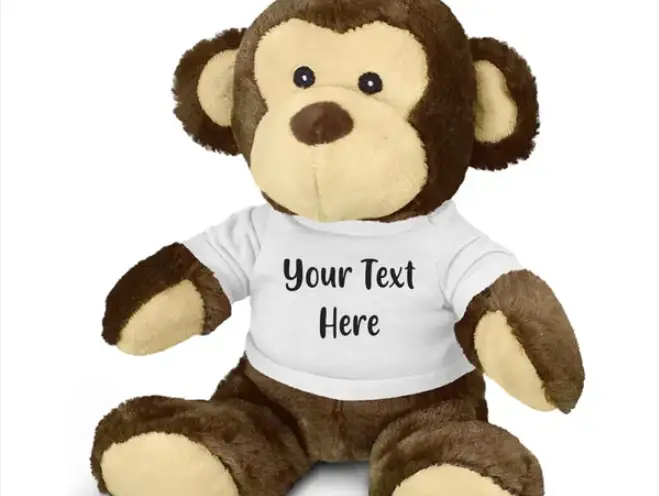
The consequence is that the transferred image sits on the tips and sides of the pile fibers rather than on a flat surface. This affects perceived sharpness, color saturation, and especially wash durability. Fine detail in the artwork — thin lines, small text, intricate edge transitions — can appear soft or slightly diffused on high-pile fabrics because the graphic is contoured around individual fibers rather than applied to a continuous planar surface. For photographic imagery and gradient fills, this effect is minimal, and the result looks excellent. For crisp geometric linework at small sizes, careful artwork preparation and pile management are essential.
Sublimation vs. plastisol vs. CAD-cut heat transfer
Not all heat transfer processes are the same, and the correct choice depends heavily on the fiber content of the plush fabric. Dye sublimation is the dominant process for polyester plush — the most common base material in plush toy manufacturing. In sublimation, heat causes the dye to convert directly from solid to gas (sublimate), and the gas molecules penetrate the polyester fiber structure and bond within it.
The result is a print that is part of the fiber rather than sitting on top of it: it cannot crack, peel, or feel stiff, and it withstands repeated washing with minimal color loss. Sublimation requires a minimum of approximately 80 percent polyester content in the substrate; it produces no meaningful results on cotton, wool, or high-cotton blends.
Plastisol heat transfers use a PVC-based ink system printed onto release paper and transferred under heat and pressure. The ink film bonds to the fabric surface as a layer above the fibers. Plastisol transfers are substrate-agnostic — they adhere to cotton, polyester, and blends — but they create a raised, slightly rubbery feel on the fabric surface and are more prone to cracking and delamination over time, particularly on soft goods that experience repeated flexing.
CAD-cut transfers (sometimes called HTV, or heat transfer vinyl) involve cutting a design from a colored polyurethane film and heat-bonding the cut piece to the fabric. HTV is limited to flat-color designs with no gradients and is rarely used for detailed plush toy decoration, though it appears in name labels, simple logos, and accent details.
Heat transfer method comparison for plush toy decoration
| Method | Compatible fibers | Color range | Durability | Best application |
|---|---|---|---|---|
| Dye sublimation | Polyester (≥80%) | Full CMYK + photographic | Excellent — dye bonds within fiber | Photo-realistic faces, gradient patterns |
| Plastisol transfer | Cotton, poly, blends | Full color, spot color | Good; may crack over time | Cotton plush, mixed-fiber fabrics |
| CAD-cut HTV | Most fabric types | Solid colors only | Good for flat areas | Simple logos, labels, accents |
| Inkjet heat transfer paper | Cotton or poly variants | Full color | Moderate; wash-sensitive | Short runs, prototyping |
Material Compatibility and Fabric Selection
Why polyester dominates plush toy production
The overwhelming majority of commercial plush toys are manufactured from polyester pile fabric — specifically minky (also called microfiber plush), sherpa, or standard short-pile polyester. The reasons are practical: polyester is inexpensive, easy to dye, dimensionally stable, machine washable, and — critically for heat transfer printing — sublimation-compatible. A polyester plush toy can carry a full-color photorealistic print that survives hundreds of wash cycles without significant fading, all produced in a single automated press operation that takes seconds per panel.

Minky fabric, with its ultra-fine 1–3 mm pile and very soft hand feel, is the preferred substrate for premium custom plush because its short, dense pile minimizes the diffusion effect on printed detail. Longer-pile fabrics such as faux fur (pile lengths of 5–25 mm) are significantly more challenging to print on because the pile compresses irregularly under the press platen and the image must bridge substantial gaps between fiber tips. High-pile faux fur printing is possible but requires lower press pressure, careful temperature calibration, and acceptance of a softer, more diffused graphic result.
Plush fabric types and their heat transfer printing characteristics
| Fabric type | Typical pile length | Fiber content | Print quality notes |
|---|---|---|---|
| Minky / microfiber plush | 1 – 3 mm | 100% polyester | Excellent — fine detail, sharp edges, vibrant color |
| Short-pile polyester plush | 3 – 6 mm | 100% polyester | Very good — slight softening of fine edges |
| Sherpa/loop pile | 4 – 8 mm | Poly or poly/cotton | Good for bold graphics; avoid fine linework |
| Velboa / velvet plush | 2 – 4 mm | 100% polyester | Good — low pile aids uniformity |
| Faux fur (long pile) | 10 – 25 mm | Poly or acrylic | Challenging — diffuse result; bold graphics only |
| Cotton terry/fleece | 2 – 5 mm | Cotton or cotton blend | Sublimation not viable; use plastisol or HTV |
Pre-treatment and surface preparation
Surface preparation before heat transfer printing is essential for consistent adhesion and color fidelity. Fabric must be free of moisture — even ambient humidity absorbed by the pile can cause steam formation under the press platen, leading to color migration, blistering, or incomplete transfer. A pre-press at low temperature with the platen open slightly (sometimes called a pre-press or moisture removal step) drives off residual moisture before the actual transfer.
Fabric must also be free of silicone-based fabric softeners and finishing agents, which create a release surface that prevents proper dye penetration in sublimation or adhesion in film-based transfers. In high-volume production, fabric lots are tested before printing to verify sublimation receptivity using a standard test print and color measurement.
The Printing and Transfer Process Step by Step
Artwork preparation and color management
Artwork intended for sublimation printing must be prepared with the understanding that colors shift during the sublimation process. Sublimation inks appear dull and muted on the transfer paper because the dye has not yet activated — the vivid colors only emerge when heat converts the dye to gas, and it bonds within the polyester fiber.
Accurate color prediction requires ICC color profiles specific to the ink set, paper, printer, and fabric combination being used. Without proper color management, there is a significant risk of hue shifts — particularly in flesh tones, pastels, and brand-critical colors. For licensed character artwork, where Pantone-accurate color matching is contractually required, color management is not optional.
Artwork is typically prepared at a minimum resolution of 150 DPI at the final print size, though 200–300 DPI is recommended for facial features on small toys where fine detail is visible at close range. Files are output as mirrored images because the transfer is applied face-down against the fabric — a detail that is easy to overlook and immediately apparent when the transfer is peeled back.
Press parameters: temperature, pressure, and dwell time
The three controllable variables in the heat press operation — temperature, pressure, and dwell time — must be optimized for each fabric and transfer combination. Too low a temperature produces incomplete transfer with dull, patchy color. Too high a temperature crushes the pile permanently, scorches fibers, and in extreme cases degrades the dye.

Dwell time interacts with temperature: a lower temperature can achieve equivalent transfer completeness with a longer dwell, which is sometimes preferable for delicate fabrics. Pressure must be sufficient to maintain intimate contact between the transfer paper and the fabric surface throughout the dwell, but excessive pressure permanently crushes pile and creates a stiff, matted area visible in the finished toy.
Typical heat press parameters for sublimation on polyester plush
| Fabric type | Temperature (°C) | Dwell time (seconds) | Pressure setting |
|---|---|---|---|
| Minky / microfiber plush | 180 – 195 | 40 – 60 | Light to medium |
| Short-pile polyester plush | 185 – 200 | 45 – 65 | Light to medium |
| Velboa | 175 – 190 | 35 – 55 | Light |
| Sherpa (poly) | 180 – 195 | 50 – 70 | Light — pile sensitive |
| Faux fur (long pile) | 170 – 185 | 55 – 75 | Very light; use foam pad |
Post-transfer handling and quality inspection
Immediately after the press cycle, the transfer paper is peeled back — either hot or cold depending on the paper type. Hot peel papers are removed while the fabric is still hot, which is faster for production throughput but requires care to avoid stretching the fabric. Cold peel papers are allowed to cool before removal, which generally produces sharper edge definition and more consistent color but adds handling time.
After peeling, the printed panel is inspected for color completeness, edge sharpness, ghosting (a secondary faint image caused by paper slipping during the press), and pile condition. Panels that pass inspection are cut and assembled into the toy body in the same workflow as non-printed panels.
Safety, Compliance, and Care Considerations
Toy safety standards and ink formulations
Plush toys intended for children — particularly those under 36 months — are subject to rigorous safety regulations in all major markets. In the United States, ASTM F963 and CPSC requirements govern chemical migration from surface coatings and printed materials.
In Europe, EN 71-3 sets migration limits for heavy metals and other regulated substances in materials accessible to children. Sublimation dyes, when properly cured and bonded within the polyester fiber, present a very low migration risk because the dye is physically trapped within the polymer matrix rather than sitting as a layer on the surface.

Plastisol inks and HTV films require more careful formulation review — phthalate-free and heavy-metal-free certifications are standard requirements for toy applications. Buyers sourcing custom printed plush should request material safety data sheets and third-party test reports for any ink or transfer material applied to products intended for children.
Wash durability and care labeling
Properly sublimated polyester plush retains color with minimal perceptible fading after 30 or more standard wash cycles when laundered at 30–40°C with a mild detergent. This performance is substantially better than surface-applied decoration methods, which is one of the primary reasons sublimation has become the standard for premium plush toy decoration.
Care labels should specify gentle machine wash at low temperature and tumble dry on low or air dry — high heat in a dryer can cause color migration from heavily pigmented areas into adjacent unprinted fabric if the toy is enclosed in a hot dryer drum for extended periods. Dry cleaning solvents can strip sublimation dyes and should be avoided.
Frequently Asked Questions
1. Can heat transfer printing be applied to any plush fabric, or only polyester?
The answer depends on which heat transfer method you use. Dye sublimation — by far the most popular method for plush toys because it produces vibrant, durable, full-color results — only works on fabrics with at least 80 percent polyester content. The dye bonds chemically within polyester fiber; it does not penetrate or bond to cotton, wool, or acrylic in the same way.
For cotton or cotton-blend plush fabrics, plastisol heat transfers or water-based heat transfer films are the practical alternatives. They adhere to a wider range of fiber types but sit as a layer on the fabric surface rather than bonding within the fiber, which affects their durability and tactile feel over time.
2. Will the printed area feel stiff or look shiny on the finished plush toy?
With dye sublimation on polyester plush, the printed area has no tactile difference from the unprinted fabric — because the dye is absorbed into the fiber itself, there is no ink film on the surface and no change in texture, stiffness, or sheen. This is one of sublimation’s most significant advantages for soft toy applications.
Plastisol transfers and HTV films do create a surface layer that can be felt as a slightly raised, firmer area, and they may have a subtle sheen depending on the finish of the transfer material. The difference is most noticeable on very soft fabrics like minky, where any surface coating contrasts sharply with the surrounding pile.
3. How durable is heat transfer printing on plush toys through regular washing?
Sublimation-printed polyester plush typically maintains its color through 30 or more wash cycles at 30–40°C with minimal visible fading, making it well-suited for toys that will be washed regularly. The dye is bonded within the fiber structure rather than applied as a surface coating, so there is nothing to crack, peel, or flake off.
Plastisol and HTV-based transfers are somewhat less durable — they generally perform well for 20 to 30 wash cycles before showing signs of cracking or edge lifting, depending on wash temperature, agitation, and tumble drying conditions. For all methods, washing in cold to warm water on a gentle cycle and air drying will maximize print longevity.
4. What resolution should artwork be prepared at for plush toy heat transfer printing?
A minimum of 150 DPI at the final print size is the practical floor for acceptable quality on plush fabrics, but 200 to 300 DPI is recommended — especially for facial features, fine gradient transitions, and any detail that will be scrutinized at close range on a small toy.
It is worth noting that the pile texture of plush fabric acts as a natural soft filter on printed detail, which means that ultra-high resolutions (above 300 DPI) generally provide no additional visible benefit and simply increase file size. Artwork should also be prepared as a mirrored (horizontally flipped) image, since the transfer is applied face-down against the fabric and the mirror is reversed during transfer.
5. Are heat transfer inks and dyes safe for plush toys intended for young children?
When properly formulated and certified, yes. Sublimation dyes bonded within polyester fiber present a very low chemical migration risk because the dye is physically enclosed within the polymer structure. For toys intended for children under 36 months, all materials — including inks, transfer adhesives, and carrier films — should be tested to applicable toy safety standards: ASTM F963 in the United States and EN 71-3 in Europe for chemical migration limits.
Buyers should require documentation from their manufacturer confirming that ink formulations are phthalate-free, free of heavy metals above regulated limits, and tested by an accredited third-party laboratory. These certifications are standard requirements for reputable plush toy suppliers serving major retail markets.