Skip to content
Plush Toy Material Cost Breakdown explains how fabric, filling, accessories, packaging, and other material costs contribute to the total manufacturing cost, helping brands make smarter sourcing and pricing decisions.
A component-by-component look at fabric, filling, safety components, labor, packaging, and compliance testing costs that together determine the landed cost of a plush toy.
A plush toy’s total cost is built from several distinct components — outer shell fabric, internal filling, safety hardware such as eyes and joints, labor and sewing complexity, packaging, and mandatory safety testing — and no single line item dominates the total in every case. In short: fabric and filling typically make up 30% to 45% of unit cost on a mid-complexity plush, labor accounts for another 25% to 40% depending on the manufacturing region, and the remaining balance is split between trims, packaging, compliance testing, and overhead.
This guide breaks down each cost component individually, with reference pricing ranges, so buyers and product developers can build an accurate cost model and identify where genuine savings are possible without compromising safety or quality.
What Determines the Cost of a Plush Toy?
The total cost of a plush toy is the sum of direct materials, direct labor, compliance and testing overhead, packaging, and a margin for tooling amortization or sample development, all of which scale with the toy’s size, design complexity, and target market. A simple 20 cm beanbag-filled plush with minimal detailing sits at the low end of nearly every cost category, while a large, jointed, licensed character plush with embroidered detailing, safety-locked eyes, and electronic sound modules can cost several times more per unit even before accounting for licensing royalties.
Cost modeling for plush toys differs in a few important ways from cost modeling for rigid manufactured goods. Fabric and filling are natural or semi-natural materials with inherent variability in width, yield, and pile density, meaning actual material consumption can vary between production lots even when the pattern itself is unchanged. Labor is heavily manual rather than machine-dominated, since even automated cutting and some seaming steps still require significant hand-finishing to achieve an acceptable cosmetic result, particularly around the face and any area with fine detailing.

This combination of variable material yield and labor-intensive finishing is precisely why itemized, component-level cost transparency matters more for plush sourcing than it might for a fully automated, machine-molded product category.
Understanding each cost component separately — rather than negotiating on a single blended unit price — gives buyers far more leverage to control cost intelligently. A buyer who understands that fabric GSM, filling density, and labor-intensive detailing are the three biggest cost levers can make targeted design adjustments that meaningfully reduce cost without triggering a quality or safety compromise that a blanket price negotiation might otherwise force.
Fabric and Outer Shell Material Costs
The outer shell fabric is one of the most visible cost drivers in a plush toy, both because it is the largest surface-area material by volume and because fabric type has a wide price range depending on fiber content, pile height, and finishing treatment.
Common Plush Fabric Types and Their Price Range
Short-pile plush fabrics, sometimes called minky or velboa depending on the specific weave, are the most widely used and generally the most economical option for standard plush construction. Long-pile or shaggy fur fabrics cost more per meter due to higher fiber density and more complex knitting or weaving processes, and they also consume more fabric per part due to pile loss during cutting and sewing. Specialty fabrics — bamboo-fiber plush, minky with printed patterns, faux fur with two-tone tipping, or fabrics blended with recycled polyester content — typically carry a premium over standard short-pile fabric due to lower production volume and more complex manufacturing processes at the textile mill level.
Fabric GSM and Its Direct Cost Correlation
Fabric weight, measured in grams per square meter (GSM), correlates directly with both material cost and perceived plush quality, since higher GSM fabric feels denser, more huggable, and more durable under repeated handling. Low-GSM fabric in the 250–350 range is common on economy plush and promotional items; mid-range GSM in the 350–500 range covers most standard retail plush; and premium GSM above 500 is reserved for higher-end collectible or licensed plush where tactile quality is a primary selling point. Because fabric cost scales with GSM in a roughly linear fashion, GSM specification is one of the most direct and predictable levers a buyer has for adjusting fabric cost.
Plush Fabric Type and GSM Cost Reference
| Fabric Type | Typical GSM Range | Relative Cost per Meter | Common Use Case |
|---|---|---|---|
| Standard short-pile minky | 280–380 GSM | Low | Standard retail and promotional plush |
| Mid-weight short-pile minky | 380–480 GSM | Low to moderate | Mainstream retail plush, licensed characters |
| Long-pile / shaggy faux fur | 450–650 GSM | Moderate to high | Premium plush, realistic animal designs |
| Two-tone tipped faux fur | 500–700 GSM | High | Collectible, museum, and zoo-branded plush |
| Recycled-content / eco fabrics | 300–450 GSM | Moderate to high | Sustainability-positioned product lines |
| Printed or patterned minky | 300–420 GSM | Moderate | Character licensing, seasonal designs |
Fabric Tip: When cost pressure is high, consider reducing GSM on large, low-detail surface areas — such as the back or underside of a plush that customers rarely touch first — while holding GSM steady on the face and front panels where tactile quality is judged most heavily. This targeted approach preserves perceived quality while still reducing total fabric cost per unit.
Filling Material Costs
Internal filling accounts for a smaller percentage of total unit cost than fabric on most standard plush, but filling type has a meaningful effect on both cost and the toy’s weight, huggability, and washability.
PP Cotton (Polyester Fiberfill) vs. Recycled Fiberfill
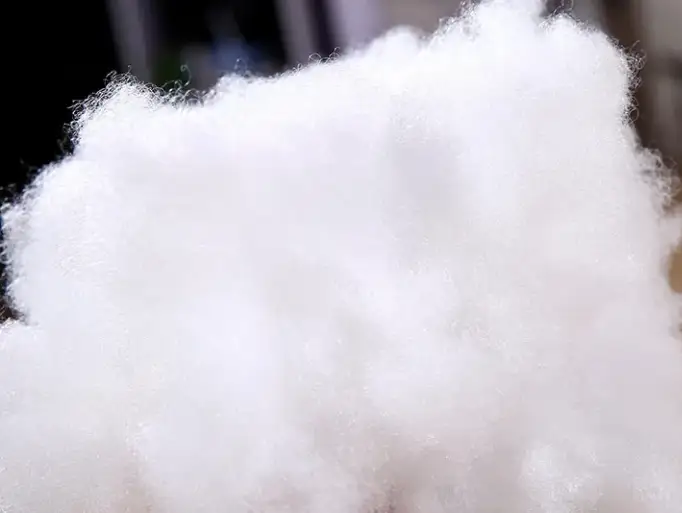
Virgin polyester fiberfill, commonly referred to in the industry as PP cotton, remains the standard filling material for the vast majority of plush toys due to its low cost, consistent loft, hypoallergenic properties, and washability. Recycled polyester fiberfill, made from post-consumer plastic bottles or textile waste, typically carries a modest cost premium over virgin fiberfill, though this gap has narrowed in many regions as recycled fiber supply chains have matured, making it an increasingly accessible option for brands with sustainability commitments.
Specialty Filling Materials
Bean-bag style fillings — typically PP pellets or occasionally natural materials in some regions — add cost and require additional safety consideration around choking hazard and seam strength, since loose pellet filling escapes more readily through a compromised seam than fiberfill. Glass or plastic microbead filling, used for weighted or sensory plush, carries a higher material cost than standard fiberfill and requires more rigorous seam and closure testing during compliance evaluation.
Memory foam and specialty comfort fillings are the most expensive filling category and are typically reserved for premium comfort-focused or therapeutic plush products where the filling itself is a marketed feature rather than a background material.
Plush Filling Material Cost and Application Comparison
| Filling Type | Relative Cost | Key Characteristic | Typical Application |
|---|---|---|---|
| Virgin polyester fiberfill (PP cotton) | Low (baseline) | Consistent loft, washable, hypoallergenic | Standard plush across nearly all categories |
| Recycled polyester fiberfill | Low to moderate | Comparable loft; sustainability positioning | Eco-marketed product lines |
| PP pellet / bean-bag filling | Moderate | Weighted, moldable feel | Bean-bag plush, weighted comfort toys |
| Glass or plastic microbeads | Moderate to high | Fine weighted texture | Sensory and weighted therapeutic plush |
| Memory foam/specialty foam | High | Slow-recovery cushioning feel | Premium comfort and therapeutic plush |
Filling Tip: If a product line is evaluating recycled fiberfill for sustainability positioning, request loft-retention test data from the filling supplier, not just cost quotes. Some early-generation recycled fiberfill loses loft faster under repeated compression than virgin fiberfill, which can affect the plush’s shape retention over its usable life.
Safety Components and Trims
Safety-critical components and decorative trims are individually low-cost items, but their combined cost — along with the labor required to attach them securely — can add up meaningfully on detail-heavy designs.
Eyes, Noses, and Joint Components
Safety-locked plastic eyes, required for any plush marketed to children under the relevant age thresholds in most safety standards, cost more per pair than simple embroidered or printed eyes but are non-negotiable for compliance on products where small-part regulations apply. Molded plastic noses follow a similar cost and compliance logic, while joint mechanisms — used in jointed teddy bears and posable plush — add cost through both the hardware itself and the additional labor required for precise joint assembly.
Embroidery vs. Printed Detailing
Embroidered detailing, commonly used for facial features, brand logos, or decorative patterns, carries a higher per-unit cost than screen printing or heat-transfer printing due to the machine time and thread cost involved, but it offers superior durability and a more premium tactile appearance that many licensed and collectible plush programs require. Printed detailing is significantly more economical and works well for large-area graphics or complex, multi-color designs that would be impractical or prohibitively expensive to embroider, though it generally shows wear faster under heavy handling than embroidery.
Plush Safety Component and Trim Cost Reference
| Component | Relative Unit Cost | Compliance Consideration |
|---|---|---|
| Safety-locked plastic eyes (pair) | Low to moderate | Pull-test force requirement under applicable toy safety standards |
| Embroidered or printed eyes | Low | Avoids small-part choking hazard entirely for the youngest age grades |
| Molded plastic nose | Low | Same pull-test requirement as safety eyes |
| Joint disc/rotation mechanism | Moderate | Requires reinforced seam and stress testing at joint attachment |
| Embroidered detailing (per design) | Moderate to high | No specific compliance impact; durability advantage |
| Printed / heat-transfer detailing | Low | Ink must meet applicable chemical and lead-content limits |
Compliance Tip: For plush products targeting the youngest age grades, budget for embroidered or printed facial features rather than safety-locked plastic eyes wherever the design allows. This removes an entire small-parts compliance risk category while often reducing both material and labor costs simultaneously.
Labor and Manufacturing Cost Factors
Labor is frequently the single largest cost category on detail-heavy or small-batch plush programs, and it is also the cost component most sensitive to design complexity and manufacturing location.
Sewing Complexity and Labor Hours per Unit
Panel count is one of the clearest predictors of labor cost: a simple plush built from four to six fabric panels requires far less cutting, matching, and sewing time than a complex character design built from fifteen or more panels with curved seams, multiple fabric types, and precise color-matching requirements at seam intersections. Hand-finishing steps — closing the final stuffing seam by hand, hand-attaching small trims, or hand-embroidering fine detail — add labor cost that scales directly with design intricacy and cannot generally be automated without sacrificing the quality level typically expected of premium plush.
Regional Labor Cost Differences
Labor cost per unit varies significantly by manufacturing region, driven by prevailing wage rates, factory efficiency, and typical order volume minimums, and this variation is frequently the largest single factor separating quoted prices between different sourcing regions for an otherwise identical design. Lower labor-cost regions can offer meaningful savings on labor-intensive designs, but buyers should weigh this against potential differences in lead time, minimum order quantity, quality consistency, and the logistics cost of shipping from a more distant manufacturing base.
Design Tip: Before finalizing a character design, count the fabric panels required and ask whether any two adjacent panels could reasonably be combined without compromising the silhouette. Reducing panel count by even two or three pieces on a mid-complexity plush can produce a measurable labor cost reduction across a large production run.
Packaging, Compliance Testing, and Overhead Costs
Beyond the physical toy itself, packaging materials and mandatory safety compliance testing represent a meaningful and sometimes underestimated share of total landed cost.
Packaging Material Costs
Polybag packaging with a printed header card is the most economical packaging option and remains standard for mass-market plush, while printed color boxes, window boxes that display the product, and specialty retail-ready packaging all add material and assembly cost that scales with box complexity and print run size. Sustainability-driven packaging shifts — recycled cardboard, reduced plastic film use, or FSC-certified paper stock — often carry a modest cost premium over standard packaging, though this gap continues to narrow as demand for sustainable packaging materials grows across the broader consumer goods industry.
Chemical and Safety Testing Costs
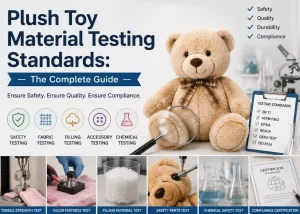
Mandatory compliance testing against applicable toy safety standards — covering mechanical and physical hazards, flammability, and chemical content limits including phthalates, lead, and other restricted substances — represents a fixed per-SKU cost that does not scale down proportionally on smaller production runs, making it a relatively larger percentage of unit cost on low-volume or sample-stage orders.
Testing scope and cost vary depending on the destination market’s specific regulatory requirements, and products intended for multiple markets simultaneously often require separate testing against each region’s applicable standard rather than a single universal test covering every market’s requirements. Consolidating testing across similar SKUs that share the same fabric, filling, and component suppliers — wherever the applicable standard permits representative testing — can meaningfully reduce this per-SKU overhead on product lines with several closely related size or color variants.
Typical Overhead Cost Allocation as a Share of Total Unit Cost
| Cost Category | Typical Share of Total Unit Cost | Key Driver |
|---|---|---|
| Fabric and filling materials | 30%–45% | GSM, fabric type, filling density |
| Direct labor (sewing, finishing) | 25%–40% | Panel count, hand-finishing steps, region |
| Safety components and trims | 5%–12% | Eye/joint hardware, embroidery vs. print |
| Packaging | 5%–10% | Polybag vs. printed box vs. retail-ready |
| Compliance testing and QC | 3%–8% (higher on small runs) | Number of markets, SKU count, order volume |
Licensing, Sampling, and Development Costs
Beyond recurring per-unit costs, plush toy programs often carry upfront development costs that must be amortized across the production run, and these are frequently underestimated when comparing quotes between manufacturing partners.

Licensing Royalties for Branded and Character Plush
Licensed plush — built around a film, television, gaming, or brand character — carries a royalty obligation that is typically calculated as a percentage of wholesale or retail price rather than a flat per-unit fee, meaning licensing cost scales with the product’s selling price rather than its physical bill of materials. Museum, zoo, and institutional-branded plush programs often negotiate different royalty structures than mainstream entertainment licensing, sometimes involving a flat licensing fee combined with a lower ongoing royalty percentage, which can materially change the total cost model compared to a standard entertainment license.
Sample Development and Pattern-Making Costs
Before a plush design reaches mass production, pattern development, first-sample construction, and typically two to four rounds of sample revision are required to finalize proportions, seam placement, and fabric behavior on the physical form. This development cost is generally a one-time or per-design fee rather than a recurring per-unit cost, but on smaller production runs it represents a proportionally larger addition to effective unit cost than on programs with production volumes large enough to fully amortize the development investment.
Buyers evaluating a manufacturing partner’s quote should confirm whether sample development cost is included in the quoted unit price, credited against a future production order, or charged as a fully separate line item, since this varies significantly between manufacturing partners and can create confusion when comparing quotes that appear similar at first glance.
Licensing Tip: When budgeting a licensed plush program, model the royalty cost separately from the manufacturing cost breakdown rather than blending the two, since the royalty percentage is tied to selling price rather than bill-of-materials cost and will scale differently as retail pricing strategy changes.
Freight, Duties, and Landed Cost Considerations
The manufacturing cost of a plush toy is only part of its total landed cost once freight, import duties, and destination-market handling are factored in, and these logistics costs can shift meaningfully based on product size, weight, and packaging density.
Ocean and Air Freight Cost Drivers
Plush toys are relatively lightweight but volumetrically inefficient to ship, since fiberfill and pile fabric both take up more cargo space per unit weight than denser product categories, meaning ocean freight cost for plush is typically driven more by cubic volume than by actual product weight. Large plush and heavily overstuffed designs consume disproportionately more container space per unit, which is why some manufacturers offer a compressed or vacuum-packed shipping option for select plush styles to improve container utilization, provided the fabric and filling combination can recover its intended loft after decompression at the destination.
Import Duties and Destination Market Costs
Import duty rates for plush toys vary by destination market and by the toy’s specific tariff classification, and duty cost is calculated as a percentage of declared value, meaning it scales directly with the manufacturing cost rather than representing a fixed per-unit amount. Buyers sourcing across multiple destination markets simultaneously should model duty rates per market individually rather than assuming a single blended landed cost figure applies uniformly, since even closely related product categories can fall under different tariff classifications with materially different duty rates.
Order Volume and Minimum Order Quantity Effects on Cost
Production volume interacts with nearly every cost category discussed above, since fixed costs such as sample development, testing, and initial setup are amortized across a smaller unit count on low-volume orders, while material and component pricing itself often improves at higher order volumes due to supplier-side volume discounts on fabric, filling, and trim purchases.
A buyer evaluating two quotes at different order volumes should normalize for this effect before comparing unit price directly, since a higher unit price on a smaller order does not necessarily indicate a less competitive manufacturing partner — it may simply reflect the mathematics of spreading fixed costs across fewer units. Many manufacturing partners publish tiered pricing that steps down at defined volume breakpoints, and understanding where those breakpoints fall relative to a program’s planned order size can reveal opportunities to adjust order quantity slightly to capture a meaningfully better unit price.

Total Cost Breakdown by Plush Size and Complexity
Size and complexity together drive most of the variation in total unit cost between plush programs, since larger plush consume proportionally more fabric and filling while more complex designs consume proportionally more labor regardless of size.
Relative Total Cost Breakdown by Plush Size and Complexity Tier
| Plush Category | Typical Size Range | Fabric & Filling Share | Labor Share | Other (Trims, Packaging, Testing) |
|---|---|---|---|---|
| Small economy plush | Under 20 cm | 35%–40% | 25%–30% | 30%–35% |
| Standard mid-size plush | 20–35 cm | 35%–45% | 30%–38% | 20%–30% |
| Large plush | 35–60 cm | 40%–48% | 28%–35% | 18%–28% |
| Jointed/posable plush | Any size | 30%–38% | 38%–48% | 18%–25% |
| Licensed / high-detail character plush | Any size | 28%–35% | 40%–50% | 20%–28% |
How to Reduce Plush Toy Material Costs Without Sacrificing Quality
Cost reduction efforts are most effective when targeted at the specific line items driving the highest share of total cost rather than applied as a blanket price negotiation across the entire program. Reviewing fabric GSM against actual tactile quality requirements per panel, evaluating whether embroidered detailing can be selectively replaced with high-quality printing on less prominent design elements, and simplifying panel count during the design phase rather than after tooling is committed are among the highest-leverage cost reduction actions available to buyers.
Consolidating filling specifications across multiple SKUs to qualify for better volume pricing from a single filling supplier, and timing compliance testing to cover multiple related SKUs under one representative test program, further reduce overhead without touching the core materials that customers actually see and feel. Requesting an itemized cost breakdown from manufacturing partners rather than accepting a single blended unit price makes it possible to identify exactly which component is driving cost above target and negotiate or redesign that specific element rather than guessing where the real savings opportunity lies.
Frequently Asked Questions
What percentage of a plush toy’s cost comes from fabric?
Fabric and filling combined typically account for 30% to 45% of total unit cost on a standard mid-complexity plush toy, with fabric generally representing the larger share of that combined figure. This percentage shifts higher on larger plush that consume more material per unit and shifts lower on highly detailed, labor-intensive designs where sewing and finishing labor becomes the dominant cost driver instead.
Is recycled polyester fiberfill more expensive than virgin fiberfill?
Recycled polyester fiberfill has historically carried a modest cost premium over virgin polyester fiberfill, though this gap has narrowed considerably in many regions as recycled fiber supply chains have matured and scaled. The exact premium varies by region and supplier, so it is worth requesting current quotes for both options rather than assuming a fixed cost differential when building a product cost model.
Why do jointed plush toys cost more than non-jointed plush toys?
Jointed plush toys cost more primarily due to labor rather than material, since precise joint assembly requires additional sewing steps, careful alignment, and often hand-finishing to ensure the joint rotates smoothly without compromising seam strength. The joint hardware itself also adds a modest material cost, but the labor required for accurate joint placement and reinforcement is typically the larger contributor to the overall cost increase.
How much does compliance testing add to plush toy unit cost?
Compliance testing typically represents 3% to 8% of total unit cost, but this percentage is highly volume-dependent since testing cost is largely fixed per SKU rather than scaling down with smaller order quantities. On small production runs or early sample orders, testing cost as a percentage of unit cost can be significantly higher than on a large, established production run where the fixed testing cost is spread across many more units.
Does higher fabric GSM always mean better plush quality?
Higher GSM fabric generally correlates with a denser, more huggable feel and greater durability under repeated handling, but GSM is only one factor in overall perceived quality alongside pile height, fiber content, finishing treatment, and construction quality. A well-constructed plush using mid-range GSM fabric can outperform a poorly finished plush using higher GSM fabric, so GSM should be evaluated alongside overall construction quality rather than as a standalone quality metric.
Are embroidered features always more expensive than printed features?
Embroidered detailing is generally more expensive than screen printing or heat-transfer printing on a per-unit basis due to the machine time and thread cost involved, but embroidery offers superior durability and a more premium tactile appearance that many programs specifically require for licensed or collectible products. For large-area, multi-color graphics, printing can also be more practical and cost-effective than embroidery, regardless of the durability tradeoff, since highly detailed multi-color designs are often impractical to embroider at production scale.
What is the most cost-effective way to reduce plush toy unit price?
The most cost-effective approach is typically to target the highest-cost line item directly rather than negotiating a blanket price reduction across the entire quote, since fabric, labor, and testing each respond to different levers. Reducing fabric panel count during the design phase, right-sizing fabric GSM to actual tactile requirements per panel, and consolidating compliance testing across related SKUs are generally the highest-leverage actions available without compromising core product quality or safety.
Do different filling materials require different safety testing?
Yes, filling material type affects both the seam strength and closure testing requirements applied during compliance evaluation, since loose-fill materials such as beans or microbeads pose a different choking hazard profile than solid fiberfill if a seam fails. Products using pellet or microbead filling typically require more rigorous seam integrity testing than standard fiberfill-filled plush to confirm the filling remains securely contained under stress and use conditions representative of the toy’s intended age grade.