Skip to content
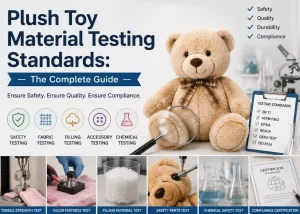
Everything product developers, quality managers, and sourcing teams need to know about testing plush toy fabrics, filling, dyes, and hardware against international safety and performance standards.
Plush toy material testing standards are the technical backbone of every safe, sellable stuffed animal, character plush, or soft toy sold in a regulated market. Before a plush toy ever reaches a shelf, its outer fabric, filling material, sewn-in eyes, embroidery thread, and any electronic or mechanical component must pass a defined battery of physical, mechanical, chemical, and flammability tests. These requirements are not a single universal checklist — they vary by destination market, buyer age grade, and the specific materials used in construction, which is why understanding the underlying testing framework matters as much as knowing any individual pass/fail number.
This guide walks through the full landscape of plush toy testing: the major international standards that govern soft toy safety, the specific fabric and filling tests labs run, chemical restriction limits, flammability testing methods, and the practical steps a product team takes to move a sample from concept through third-party lab certification. Reference data throughout is drawn from the standards most commonly cited in soft toy compliance documentation, including EN 71, ASTM F963, the CPSIA, ISO 8124, and GB 6675.
What Are Plush Toy Material Testing Standards?
Plush toy material testing standards are the codified technical requirements that define how the raw materials and finished construction of a stuffed toy must be evaluated before it can be legally sold to consumers, particularly children. They cover four broad categories of risk: physical and mechanical hazards (small parts, sharp points, entrapment), chemical hazards (heavy metals, restricted dyes, phthalates), flammability, and hygiene of the filling material.
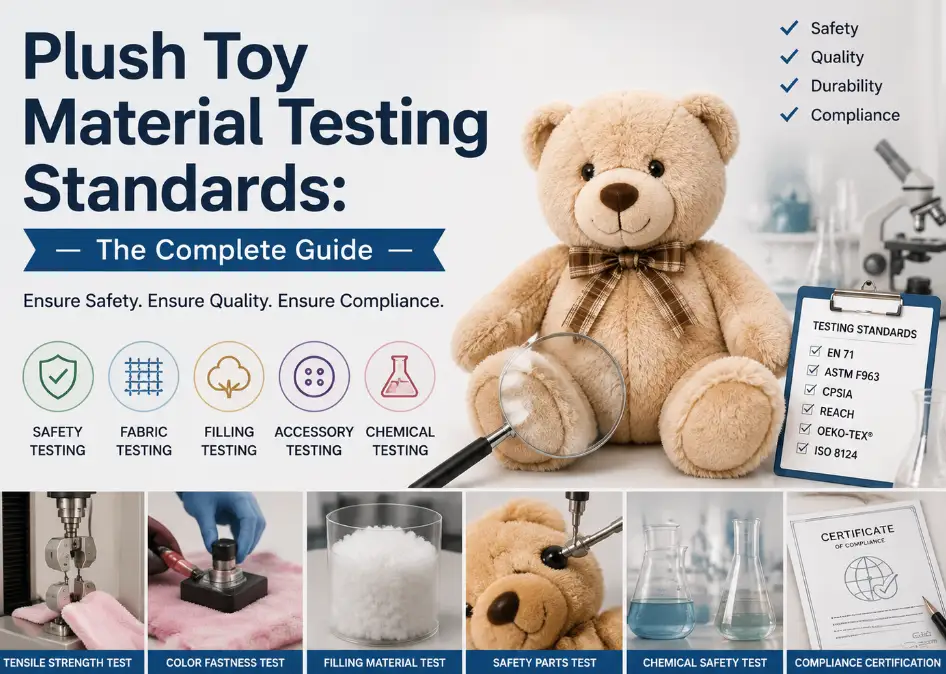
Unlike a single “plush toy standard,” material testing for soft toys is really a composite of overlapping regulatory frameworks. A toy destined for the European Union must satisfy EN 71 across multiple parts; a toy sold in the United States must satisfy ASTM F963 and the Consumer Product Safety Improvement Act (CPSIA); many other export markets reference ISO 8124 as a baseline, while China’s domestic market applies GB 6675. A well-run plush toy factory tests to the intersection — and often the strictest version — of every standard relevant to its buyer’s target markets.
Tip: Always request test reports scoped to the specific destination market, not a generic “safety tested” claim. A report passed under ISO 8124 does not automatically satisfy CPSIA tracking-label and lead-content requirements for US-bound shipments.
Why Material Testing Matters for Plush Toy Safety and Quality
Material testing protects three overlapping interests: the end user’s physical safety, the brand’s legal exposure, and the product’s durability under real-world handling. A plush toy is squeezed, chewed, washed, dropped, and — in the case of infant and toddler products — mouthed repeatedly. Fabric that fails a colorfastness test can bleed dye onto skin or bedding. Filling that fails a cleanliness test can introduce microbial contamination or foreign objects. An eye or nose component that fails a pull test can detach and present a choking hazard.
Beyond the safety dimension, rigorous material testing is what allows a plush toy to be legally imported, listed on major marketplaces, and sold through retail channels that require documented compliance. Retailers and e-commerce platforms increasingly demand current test reports as a condition of listing approval, independent of what any government regulator requires at the border.
Core International Testing Standards for Plush Toys
Five frameworks account for the overwhelming majority of plush toy compliance testing worldwide. Each defines its own sampling protocol, applicable age grades, and pass/fail thresholds, though there is significant overlap in the underlying test methods.
EN 71 (European Union)
EN 71 is the harmonized European toy safety standard, published in multiple parts. EN 71-1 covers mechanical and physical properties, EN 71-2 covers flammability, and EN 71-3 covers migration of certain elements (heavy metals). Plush toys sold in the EU must also carry a CE mark, which is a manufacturer’s declaration of conformity backed by testing evidence — CE marking itself is not a lab-issued certificate, but it depends entirely on underlying EN 71 test results.
ASTM F963 (United States)
ASTM F963 is the US consumer safety specification for toy safety, and compliance with it is mandatory under federal law for toys sold in the United States. It addresses small parts, sharp edges and points, flammability, and a defined list of heavy metals in accessible materials, including surface coatings and substrates.
CPSIA (United States)
The Consumer Product Safety Improvement Act layers additional requirements on top of ASTM F963, most notably strict lead content limits in substrate materials, phthalate restrictions in plasticized components, and mandatory third-party testing and tracking labels for children’s products. Any plush toy with sewn or printed accessories using plasticized inks or PVC-based trims falls squarely under CPSIA phthalate testing.
ISO 8124 (International)
ISO 8124 is the international toy safety standard used as a baseline in many markets that lack a fully developed domestic toy regulation. It closely mirrors the structure of EN 71 — mechanical and physical properties (ISO 8124-1), flammability (ISO 8124-2), and migration of certain elements (ISO 8124-3) — making it a practical common denominator for exporters serving multiple regions.
GB 6675 (China)
GB 6675 is the mandatory national safety standard for toys sold within mainland China. It covers mechanical and physical properties, flammability, and chemical migration, with thresholds broadly aligned to international norms but with distinct sampling and labeling requirements.
International Plush Toy Safety Standards Comparison
| Standard | Governing Region | Primary Scope | Typical Age Grading |
|---|---|---|---|
| EN 71 (Parts 1–3, 9–13) | European Union | Mechanical, flammability, chemical migration | 0–36 months; 36 months–14 years |
| ASTM F963 | United States | Mechanical, flammability, heavy metals | Under 3 years; 3+ years |
| CPSIA | United States | Lead content, phthalates, tracking labels | Applies to all children’s products |
| ISO 8124 (Parts 1–3) | International baseline | Mechanical, flammability, chemical migration | Under 3 years; 3+ years |
| GB 6675 | China (mandatory) | Mechanical, flammability, chemical migration | 0–3 years; 3–14 years |
Fabric and Fiber Content Testing
The outer shell fabric of a plush toy — whether short-pile plush, minky, velboa, or faux fur — is subject to its own set of textile-specific tests independent of the toy safety tests applied to the finished product. Fiber content testing confirms that the fabric matches its labeled composition (polyester, cotton, or blended fiber), which matters for both consumer labeling accuracy and for predicting how the fabric will behave under flammability and colorfastness testing.

Colorfastness Testing
Colorfastness testing evaluates whether dye in the fabric will transfer or bleed under conditions the toy is likely to encounter: rubbing (crocking), exposure to saliva and perspiration simulants, water immersion, and light exposure. A plush toy intended for infants is typically held to a stricter saliva and perspiration colorfastness threshold than one aimed at older children, because of the higher likelihood of mouthing.
Abrasion and Pilling Resistance
Abrasion resistance testing simulates repeated rubbing to predict how quickly a plush fabric’s pile will flatten, pill, or wear through at stress points like seams and appendages. This is primarily a durability and quality metric rather than a safety-critical test, but buyers frequently specify a minimum abrasion cycle count as part of their quality acceptance criteria.
Common Plush Fabric Testing Parameters
| Test Type | What It Measures | Typical Method Reference | Common Pass Criteria |
|---|---|---|---|
| Fiber content analysis | Actual fiber composition vs. label claim | ISO 1833 / AATCC 20 | Within declared tolerance of stated blend |
| Colorfastness to rubbing (crocking) | Dye transfer under dry/wet rubbing | ISO 105-X12 / AATCC 8 | Grade 4 or higher on gray scale |
| Colorfastness to saliva/perspiration | Dye migration under simulated body fluids | ISO 105-E04 / EN 71-9 related | Grade 4 or higher on gray scale |
| Colorfastness to water | Dye bleeding after water immersion | ISO 105-E01 | Grade 3–4 or higher |
| Abrasion resistance | Pile wear and pilling under repeated rubbing | Martindale method (ISO 12947) | Buyer-specified cycle count, commonly 10,000–20,000 |
Tip: Request colorfastness results separately for dark and bright colorways. High-saturation dyes, especially reds and blacks on light-colored plush fabric, are statistically more likely to fail rubbing and saliva colorfastness thresholds.
Physical and Mechanical Testing Requirements
Physical and mechanical testing addresses the risk that a component detaches and becomes a choking or ingestion hazard, or that a construction defect exposes sharp points, wire, or filling. The centerpiece of this category is the pull test (also called a tension or force test), applied to any attached component small enough to be a small parts hazard: plastic safety eyes and noses, embroidered or appliqued accessories, ribbons, bows, and any decorative hardware.
Pull Test / Tension Test
In a standard pull test, a fixed tensile force is applied along the most likely direction of pull for a specified duration, and the component must remain attached without separating. Force and duration thresholds differ by standard and by the age grade of the toy, with toys intended for children under 3 held to more conservative requirements than those for older age grades.
Small Parts Testing
Small parts testing uses a standardized cylinder gauge to determine whether any component — or any piece that could reasonably detach — fits entirely within the cylinder, which approximates the size that could lodge in a young child’s airway. Any part that fits the small parts cylinder is prohibited on toys intended for children under 36 months.
Seam Strength and Torque Testing
Seam strength testing evaluates the sewn seams of the plush shell under tension to confirm they will not split open under normal handling and reasonably foreseeable abuse, which would expose the filling material. Torque testing is applied to any rotating or twisting component, such as certain mechanical eyes or jointed limbs, to confirm the mechanism does not loosen or detach under repeated use.
Physical Testing Thresholds for Plush Toy Components
| Test | Applies To | Typical Requirement | Failure Consequence |
|---|---|---|---|
| Pull test (safety eyes/nose) | Plastic or glass safety eyes, noses | Withstand specified force (commonly 90N range) for 10 seconds without separation | Redesign attachment method or switch to embroidered features |
| Pull test (bows, ribbons, tags) | Attached decorative components | Withstand specified pull force without detaching | Reinforce stitching or relocate attachment point |
| Small parts cylinder test | Any detachable or breakable component | Must not fit fully within test cylinder for under-3 age grade | Component redesign or age-grade change to 3+ |
| Seam strength test | All sewn seams on the plush shell | No seam separation under specified tensile load | Increase stitch density or reinforce seam allowance |
| Sharp point/edge test | Wireframe, internal supports, hardware | No exposed sharp point or edge accessible to the user | Round, cap, or relocate the component |
Chemical Safety Testing
Chemical safety testing verifies that dyes, coatings, adhesives, and plastic components used in a plush toy do not release restricted substances above regulatory thresholds. This category consistently produces the highest rate of first-pass failures in plush toy compliance testing, largely because dye lots and trim components can vary between production runs even when the finished design is unchanged.

Heavy Metal Migration Testing
Heavy metal migration testing simulates the amount of a restricted element — lead, cadmium, mercury, arsenic, antimony, and others — that could be absorbed by the body if a child mouthed or ingested part of the toy. Testing is conducted separately on accessible substrate materials and any surface coatings.
Azo Dye and Restricted Substance Testing
Certain azo dyes can break down into aromatic amines linked to health concerns and are restricted or banned in textiles under multiple regulatory frameworks. Azo dye testing screens fabric and thread for these restricted compounds, and is particularly relevant for deeply saturated or dark-colored plush fabrics.
Phthalate Testing
Phthalate testing applies to any plasticized component — PVC trims, certain printed inks, and some plastic accessories — and screens for a defined list of phthalate plasticizers restricted under CPSIA and equivalent frameworks. Plush toys with minimal plastic content still commonly require phthalate testing on printed graphics, zipper pulls, or squeaker mechanisms.
Formaldehyde Testing
Formaldehyde testing checks for residual formaldehyde that can be introduced during fabric finishing or certain adhesive processes, since formaldehyde is a known skin and respiratory irritant at elevated concentrations.
Chemical Testing Limits for Plush Toy Materials
| Substance Category | Test Focus | Common Regulatory Reference | Typical Limit Basis |
|---|---|---|---|
| Lead | Substrate and coating migration | CPSIA / EN 71-3 / ASTM F963 | Trace-level limits, stricter for accessible substrates |
| Cadmium | Substrate and coating migration | EN 71-3 / GB 6675 | Trace-level limits |
| Phthalates (DEHP, DBP, BBP, DINP, DIDP, DNOP) | Plasticized components | CPSIA / REACH | Combined limit per restricted phthalate group |
| Azo dyes / aromatic amines | Fabric and thread dye composition | REACH / GB 6675 | Restricted or prohibited compound list |
| Formaldehyde | Fabric finishing residue | EN 71-9 / GB 6675 | Age-grade-dependent maximum residue level |
Tip: Chemical test results are dye-lot and supplier-batch specific. A fabric color that previously passed heavy metal migration testing is not guaranteed to pass again if the dye supplier or lot changes, even when the visible color looks identical.
Filling Material Testing Standards
The internal filling of a plush toy — most commonly polyester (PP) cotton, sometimes blended with recycled fiber or, in premium lines, natural fills — is subject to its own testing category focused on cleanliness, composition, and fiber integrity rather than the mechanical tests applied to the shell.
Filling cleanliness testing screens for foreign matter, excessive dust, microbial contamination, and non-fibrous debris that could have entered the filling during processing or storage. Fiber composition testing confirms the filling matches its declared material, since substituting lower-grade or recycled fiber without disclosure is both a labeling compliance issue and, in some cases, a quality inconsistency that affects loft, softness, and washability. Flammability testing of the filling material specifically is also required, independent of the shell fabric’s flammability rating, since the two materials can behave very differently when exposed to an ignition source.
Tip: For recycled or blended fiber filling, request a fiber composition certificate alongside the flammability test report. Recycled fiber blends can have meaningfully different burn characteristics than virgin polyester fiber of the same declared weight.
Flammability Testing for Plush Toys
Flammability testing evaluates how quickly and in what manner a plush toy’s materials ignite and burn when exposed to a small open flame under controlled laboratory conditions. Both the outer fabric and the internal filling are tested, since a slow-burning shell over a fast-burning filling can still fail overall flammability requirements.

Test methods generally measure flame spread rate across a mounted fabric sample and observe whether the material self-extinguishes, continues to burn, or exhibits characteristics like melting and dripping that create additional hazard. Certain fabrics — deep pile, brushed, or napped textiles in particular — are subject to a more stringent surface flash flammability assessment because loose fiber ends can ignite and propagate flame faster than a flat woven surface.
Flammability Test Methods by Standard
| Standard | Test Reference | Method Summary | Key Pass Criterion |
|---|---|---|---|
| EN 71-2 | Flame spread test | Vertical/horizontal flame exposure on shell and filling | Maximum flame spread rate not exceeded; no continued burning after ignition source removed within specified time |
| ASTM F963 | Flammability of solids | 16 CFR 1500.44-aligned burn test | Burn rate below specified threshold; self-extinguishing behavior |
| ISO 8124-2 | Flammability test | Mirrors EN 71-2 methodology | Maximum flame spread rate not exceeded |
| GB 6675 | Flammability requirements | Aligned burn rate methodology | Maximum flame spread rate not exceeded |
Age Grading and Choking Hazard Testing
Age grading determines which battery of tests applies and how strict the pass thresholds are, since a toy labeled for children under 3 is evaluated far more conservatively than one graded for older children or adults. Choking hazard testing sits at the intersection of small parts testing and pull testing: a component must both fail to fit the small parts cylinder and withstand the required pull force to be considered acceptable on an under-3 age grade.
Age grading is not simply a marketing decision — it is a testing input. Choosing an incorrect age grade, whether intentionally to avoid stricter testing or through oversight, is one of the most common root causes of recalled plush toys, because it means the product was tested against thresholds that did not match its actual likely user.
Tip: When a product line spans multiple age grades — for example, a mini keychain plush and a full-size version of the same character — test and certify each size and configuration separately. Passing results on the larger item do not transfer to the smaller one.
Third-Party Lab Testing and Certification Process
Third-party lab testing is conducted by an accredited, independent testing laboratory rather than by the manufacturer’s internal quality team, and is a mandatory requirement under most children’s product regulations, including CPSIA. The process typically follows a consistent sequence regardless of destination market: sample submission, test plan confirmation against the applicable standard and age grade, laboratory testing across the relevant categories, and issuance of a test report or certificate of compliance.
Test reports are generally tied to a specific production lot, factory, and material specification. Any material substitution — a new fabric supplier, a different dye lot, or a changed filling source — technically requires retesting of the affected components, even if the overall design is unchanged.
Typical Plush Toy Testing & Certification Timeline
| Stage | Activity | Typical Duration |
|---|---|---|
| Sample submission | Pre-production or production sample sent to accredited lab | 1–3 days shipping |
| Test plan confirmation | Lab confirms applicable standard, age grade, and test scope | 1–2 business days |
| Physical/mechanical testing | Pull test, small parts, seam strength, sharp points | 3–5 business days |
| Chemical testing | Heavy metals, phthalates, azo dyes, formaldehyde | 5–10 business days |
| Flammability testing | Shell and filling burn testing | 3–5 business days |
| Report issuance | Consolidated test report or certificate of compliance | 1–3 business days after final test completion |
Tip: Submit chemical and flammability samples in parallel with physical/mechanical samples rather than sequentially. Since chemical testing has the longest lead time, running categories in parallel can shave a week or more off the overall certification timeline.
How to Prepare Plush Toy Samples for Material Testing
Sample preparation has a direct effect on both testing accuracy and turnaround time. Labs test the sample as submitted, so a sample that does not accurately represent mass production materials and construction produces a report that does not protect the actual shipped goods.
- Submit samples from the intended production materials and supplier, not earlier prototypes built with different fabric, filling, or trims.
- Include one sample per colorway when color is achieved through different dye formulations, since colorfastness and chemical results can vary by color.
- Provide the lab with the intended age grade and destination market up front so the correct standard and test plan are applied from the start.
- Include all attached components exactly as they will ship — safety eyes, embroidery, tags, ribbons, and any battery or electronic module.
- Retain a duplicate reference sample in-house, sealed and labeled, matching the exact lot sent to the lab for future dispute resolution.
Tip: Label each submitted sample with the exact fabric roll, dye lot, and filling batch number. If a component later fails, batch-level records let the factory isolate the affected material instead of re-testing the entire product line.

Common Reasons Plush Toys Fail Material Testing
Certain failure patterns recur consistently across plush toy testing programs, and most are preventable with disciplined material sourcing and construction review before samples are ever submitted to a lab.
- Pull test failures on safety eyes: Often caused by an undersized shank, insufficient washer engagement, or fabric that is too thin to anchor the attachment securely.
- Heavy metal migration on painted or coated accessories: Frequently traced to a plastic component supplier switching resin or pigment source without notifying the buyer.
- Colorfastness failures on dark or saturated colors: Common on deep reds, blacks, and navy, particularly on brushed or long-pile fabrics with a larger dyed surface area.
- Small parts failures on decorative trims: Small bows, sequins, or plastic charms added late in design review without small parts testing consideration.
- Filling cleanliness failures: Usually linked to recycled fiber sourcing without adequate processing and quality screening at the filling supplier.
- Seam strength failures at appendage joints: Arms, legs, ears, and tails experience concentrated stress during play, and inadequate reinforcement stitching at these junctions is a common cause of seam separation under tensile load testing.
- Flammability failures on brushed or long-pile fabrics: Loose surface fiber on deep-pile or brushed textiles can ignite and propagate flame faster than a flat-woven equivalent, catching designs that were approved on a different fabric texture off guard during retesting.
Most of these failure modes share a common thread: they surface when a material, supplier, or construction detail changes after the original approved sample was tested, without a corresponding retest. Building a disciplined change-control habit — flagging any fabric, filling, dye, or trim substitution for review before it reaches production — prevents the majority of avoidable test failures before a sample ever reaches the lab.
Building Material Testing Into Ongoing Quality Assurance
A passing test report is a snapshot of a specific sample at a specific point in time — it is not a permanent guarantee that every unit produced afterward will meet the same standard. Mature plush toy manufacturing operations treat material testing as the anchor point of a broader, ongoing quality assurance system rather than a one-time gate to clear before shipment.
In practice, this means incoming fabric, filling, and hardware are checked against the specification sheet used for the original test submission before they are released to the cutting or sewing floor. Dye lot records, filling batch numbers, and accessory supplier certificates are retained and cross-referenced against the original test report so that any deviation can be traced quickly. In-line quality checks during sewing — verifying seam allowance, stitch density, and correct attachment torque on safety eyes — catch construction drift long before a finished unit would reach a random inspection sample.
Final random inspection, typically conducted before shipment using an accepted quality limit (AQL) sampling plan, is not a substitute for material testing but a complementary check that construction quality has remained consistent across the full production run. Where a buyer requires periodic retesting on a defined cycle, building that retesting calendar into the production planning process — rather than treating it as an ad hoc afterthought — helps avoid shipment delays caused by lapsed or expiring certificates.
Tip: Keep a simple cross-reference log linking each test report to the exact fabric roll numbers, filling batch numbers, and accessory lot numbers used in that submission. This single record is usually the fastest way to answer a buyer’s compliance audit request without re-testing.
Frequently Asked Questions
Q1. What is the difference between EN 71 and ASTM F963 for plush toy testing?
EN 71 is the harmonized toy safety standard for the European Union, structured across multiple parts covering mechanical, flammability, and chemical migration testing. ASTM F963 is the equivalent mandatory safety specification for toys sold in the United States. While the two standards test many of the same categories — small parts, pull force, flammability, heavy metals — the specific pass thresholds, sampling protocols, and required documentation differ, so a plush toy sold in both markets typically needs separate test reports against each standard rather than a single combined report.
Q2. Do all plush toys need third-party lab testing, or can a factory self-certify?
For children’s products sold in regulated markets such as the United States and the European Union, third-party lab testing by an accredited laboratory is generally mandatory rather than optional, particularly under frameworks like the CPSIA. Self-certification by the manufacturer alone is not accepted as compliance evidence in these markets. Even where a market technically permits a supplier’s declaration of conformity for adult-oriented items, most buyers and marketplaces still require an independent test report before listing approval.
Q3. How is the pull test conducted on plush toy safety eyes and other attached components?
A pull test applies a fixed tensile force to the attached component — most commonly plastic safety eyes, noses, bows, or embroidered patches — along the direction a child is most likely to pull it, and holds that force for a specified duration, typically around 10 seconds. The component must remain fully attached without separating, loosening, or exposing sharp edges underneath. Required force levels vary by standard and by the toy’s age grade, with under-3 age grades generally held to more conservative thresholds than toys intended for older children.
Q4. What heavy metals are tested in plush toy fabric and accessories?
Heavy metal migration testing on plush toys most commonly screens for lead, cadmium, mercury, arsenic, antimony, barium, chromium, and selenium, though the exact list depends on which standard is being applied. Testing is generally split between accessible substrate materials — such as plastic eyes, buttons, or hardware — and any surface coatings or paints, since migration limits and sample preparation differ between the two categories.
Q5. Why do plush toys need separate flammability testing for the shell fabric and the filling material?
The outer shell fabric and the internal filling can have very different burn characteristics even when the finished toy looks uniform. A shell fabric with a slow, self-extinguishing burn profile can still sit over a filling material that ignites and spreads flame quickly, or vice versa. Flammability standards such as EN 71-2 and ASTM F963’s flammability requirements account for this by requiring flame spread testing on both the shell and the filling independently rather than assuming one material’s result applies to the whole assembly.
Q6. What is the small parts cylinder test, and when does it apply to plush toys?
The small parts cylinder test uses a standardized test cylinder, roughly approximating the size of a young child’s airway, to determine whether a component or any piece that could reasonably detach fits entirely within it. If a plush toy is graded for children under 36 months and any part — including one exposed by reasonably foreseeable use or abuse, such as tearing — fits inside the cylinder, the toy fails small parts testing for that age grade, and either requires redesign or a revised age grading with clear labeling.
Q7. How often does a plush toy need to be retested after it initially passes material testing?
Retesting is generally required whenever a material, component, or supplier changes in a way that could affect test results — a new fabric dye lot, a different filling supplier, a revised safety eye vendor, or a construction change such as stitch density. Many compliance programs also require periodic retesting on a defined cycle, commonly annually, even without a known material change, since dye formulations and component sourcing can shift upstream without the factory being directly notified.
Q8. Are recycled polyester fillings held to the same testing standards as virgin polyester fiber filling?
Yes. Recycled polyester (often derived from post-consumer PET) filling must pass the same flammability, cleanliness, and fiber composition testing categories as virgin polyester filling. In practice, recycled fiber blends can exhibit different burn behavior and require closer quality screening for foreign matter, so buyers commonly request a fiber composition certificate alongside standard filling test reports when recycled content is used.
Q9. What documentation should accompany a plush toy’s material test reports for retail or marketplace listing?
A complete compliance package typically includes the full test report or certificate of compliance from the accredited lab, a declaration of conformity referencing the applicable standard and age grade, the tracking label information required under frameworks like the CPSIA, and material-level documentation such as fiber composition or fabric content certificates. Marketplaces and retailers increasingly request this full package rather than a summary pass/fail statement, since it allows them to verify the scope and age grade under which the toy was actually tested.