Skip to content
Plush toy packaging is not simply a container for shipping and shelf display — it is a functional, commercial, and compliance system that directly affects protection during transit, retail sell-through, e-commerce unboxing experience, and regulatory acceptance in the target market. The most effective plush toy packaging designs balance five requirements simultaneously: physical protection of a soft, compressible product, visual presentation that supports purchase decisions, efficient use of shipping and storage volume, compliance with labeling and safety requirements, and a cost structure that fits the product’s price point.
Many brands treat packaging design as a late-stage decision, addressed only after the plush toy itself has been finalized. This sequencing consistently produces weaker outcomes than treating packaging as a parallel design workstream from the earliest stages of product development, because packaging decisions interact directly with product decisions — a plush toy’s size, shape, softness, and accessory attachments all affect which packaging formats will protect it effectively and present it attractively, and packaging volume in turn affects shipping cost, master carton efficiency, and retail shelf footprint.
This guide walks through the core packaging design decisions that determine how well a plush toy protects its product, communicates its brand, and performs commercially — covering format selection, material choice, retail and e-commerce requirements, compliance and labeling, shipping efficiency, and sustainability considerations — with practical tips positioned at the decision points where they have the most impact.
Because plush toys span such a wide range of sizes, price points, and sales channels — from small keychain-scale accessories sold through impulse-purchase retail displays to large premium collectible plush shipped directly to consumers — there is no single packaging formula that fits every product. The decisions covered in this guide are best understood as a framework for evaluating tradeoffs specific to a given product and channel, rather than a fixed template to apply uniformly across an entire product line.
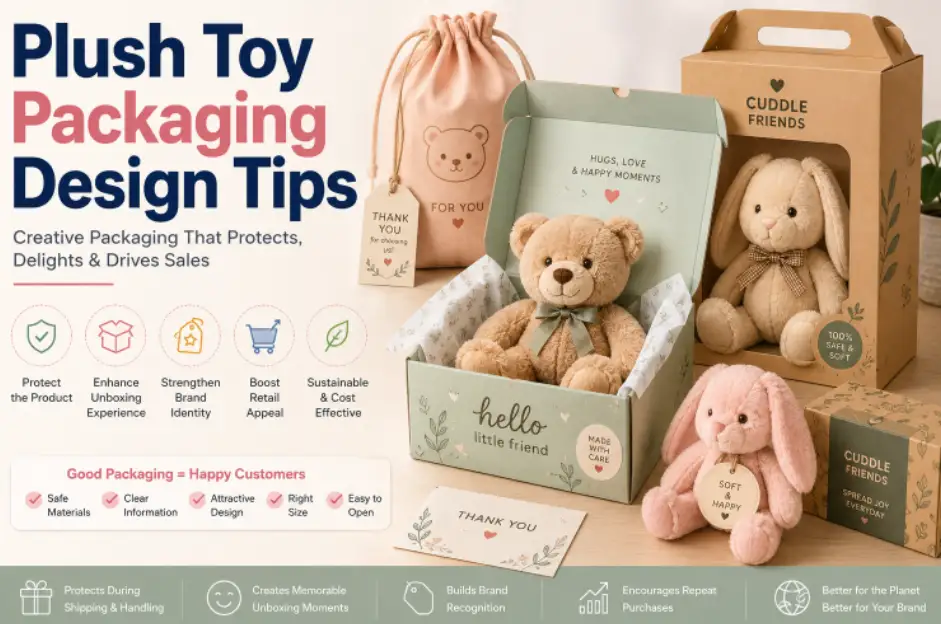
Why Does Packaging Design Matter for Plush Toy Products?
Packaging design matters for plush toy products because plush toys present a specific set of packaging challenges that rigid products do not — they are soft, compressible, irregularly shaped, and easily deformed by pressure, making them simultaneously more difficult to protect and more visually dependent on packaging to convey their shape and texture before a customer can touch them. A plush toy compressed under other cartons during transit can arrive misshapen, matted, or with displaced stuffing; a plush toy displayed only in a plain poly bag on a retail shelf competes poorly against products with informative, attractive packaging that helps customers understand size, softness, and character appeal before purchase.
Packaging also carries commercial weight beyond protection and presentation. For retail buyers, packaging communicates professionalism and category fit — a plush toy that arrives without proper labeling, barcode placement, or shelf-ready presentation creates friction in the retail buying and merchandising process regardless of the quality of the toy itself. For e-commerce sellers, packaging is the physical touchpoint of the unboxing experience, directly influencing customer reviews, repeat purchase likelihood, and social sharing. For compliance purposes, packaging is frequently where required safety warnings, age gradings, and care labeling are physically presented — meaning packaging design errors can create compliance exposure independent of the product itself.
The commercial cost of getting packaging design wrong is also easy to underestimate until it has already been incurred. A packaging format that crushes under normal transit stacking generates return and replacement costs that can exceed the packaging’s original savings many times over. A retail-bound shipment rejected at a distribution center because barcode placement does not meet the routing guide requirement can delay an entire order by weeks while corrected packaging is produced.
A packaging design that omits a required warning statement for a specific destination market can result in the product being held at customs or removed from an online marketplace listing entirely. None of these outcomes are hypothetical — they are recurring, well-documented failure patterns in plush toy sourcing, and each one is preventable through packaging design decisions made the first time correctly.
Tip: Bring packaging into the product design conversation at the concept stage rather than after the plush toy design is finalized. A character with an oversized head, delicate embroidered accessory, or unusual silhouette often needs a packaging format built specifically to protect and present that shape — a decision that is far easier and cheaper to make before tooling and packaging dies are committed than after.
What Should Professional Plush Toy Packaging Design Include?
A complete plush toy packaging design is built from several distinct elements that work together — the primary packaging that directly contains the product, the graphic and informational content printed on it, the protective interior components, and the outer carton system used for shipping and storage. Overlooking any one of these elements produces packaging that succeeds at some functions while failing at others — attractive but poorly protective, protective but not compliant, compliant but expensive to ship.
Core Elements of Professional Plush Toy Packaging
| Packaging Element | Function | Key Design Consideration |
|---|---|---|
| Primary container (box, bag, or header card) | Directly holds and displays the product | Matched to product size, softness, and retail channel |
| Window or viewing panel | Allows customers to see the actual product | PVC or PET film clarity, positioned to show the character’s face |
| Graphic printing and branding | Communicates brand, character, and product information | Color accuracy, print resolution, and shelf differentiation |
| Required labeling and warnings | Satisfies regulatory and safety disclosure requirements | Age grading, choking hazard warnings, care instructions |
| Interior protective components | Prevents compression, shifting, and shape distortion | Tissue wrap, insert cards, poly bag liners, or foam elements |
| Barcode and retail identifiers | Enables point-of-sale scanning and inventory tracking | UPC/EAN placement, scannable print quality |
| Outer master carton | Group units for shipping and storage | Cube efficiency, stacking strength, and drop protection |
Tags, Hang Tabs, and Retail Compliance Hardware
Beyond the primary container, several smaller packaging components carry outsized functional importance relative to their cost. Hang tabs — the small die-cut or reinforced holes used to display a package on a peg-hook fixture — must be positioned and sized to match the specific peg spacing used by the target retailer, and must be reinforced enough to bear the product’s weight without tearing during normal shelf handling.

Swing tags and care labels attached separately from the primary packaging need to be securely fastened using attachment methods that will not detach during shipping, since a swing tag that separates from the product in transit both loses required labeling information and can create a loose small-parts safety concern in its own right. Getting these smaller components right is a frequently overlooked source of retail compliance rejections, since buyers evaluating packaging quality often focus on the main container and print quality while overlooking whether tags and hardware meet the retailer’s specific technical requirements.
Window Box vs. Poly Bag vs. Header Card: Choosing the Right Primary Format
The three most common primary packaging formats for plush toys — window boxes, poly bags with header cards, and simple header-card-only presentations — each suit different product types, price points, and retail channels. Window boxes offer the strongest shelf presence and the best protection against compression, since the rigid box structure resists crushing under stacking pressure, but they cost more per unit and consume more shipping volume than softer formats.
Poly bags with printed header cards are the most common format for mid-market plush toys, offering a reasonable balance of visibility, basic protection, and cost efficiency, while remaining compact for shipping. Header-card-only presentations — where the plush toy is simply tagged rather than bagged — are the lowest-cost option and are common for premium plush intended to be touched and felt by the customer before purchase, but they offer essentially no protection against dust, moisture, or handling damage during transit and storage.
Tip: Match the primary packaging format to the actual retail environment the product will be sold in, not just to cost targets. A plush toy destined for a big-box retail shelf competing against dozens of other products generally needs the shelf presence of a window box or a fully printed poly bag, while a plush toy sold through a boutique gift channel where customers already intend to purchase may perform just as well — and more profitably — with a simpler header-card presentation.
How Does Packaging Material Choice Affect Protection, Cost, and Presentation?
Packaging material selection directly determines how well a package protects the plush toy during transit and storage, how much it costs per unit at various order volumes, and how the finished packaging appears on shelf or in an unboxing video. Because plush toys are soft and easily compressed, material rigidity and cushioning properties matter more than they would for a rigid molded product, where the product itself provides structural resistance to crushing.
Corrugated cardboard used in window boxes provides the strongest resistance to stacking pressure and is the standard choice where retail shelf presentation and transit protection are both priorities. Folding carton stock — thinner and less rigid than corrugated — is common for smaller plush accessories and premium presentation boxes where the product itself provides some structural support. Polyethylene and polypropylene poly bags are lightweight, low-cost, and moisture-resistant, but offer minimal crush resistance on their own and are usually paired with a header card or an internal stiffener for products that need some shape protection.
PVC and PET film, used for display windows, needs to be selected for clarity and resistance to yellowing over the shipping and storage period, since a window that clouds or yellows before the product reaches the shelf undermines the entire purpose of a see-through presentation.
How Does Packaging Color and Print Quality Affect Perceived Product Quality?
Print quality and color accuracy on plush toy packaging function as a direct, if often unconscious, signal of product quality to both retail buyers and end consumers. A package with muddy color reproduction, visible print banding, or colors that noticeably shift from the brand’s established palette creates an impression of lower product quality before a customer has even seen the plush toy itself — an impression that can suppress purchase intent regardless of the actual quality of the product inside.
Color accuracy is particularly important for licensed character products and established brand lines, where customers have a specific color expectation built from prior exposure to the character or brand elsewhere — packaging and character branding more broadly that deviates noticeably from established reference colors registers as a quality or authenticity problem even when the deviation is a printing inconsistency rather than an intentional design choice. Confirming Pantone color references for all key brand and character colors and requesting a physical color proof under standard D65 lighting before mass production is the most reliable way to prevent color drift between the approved design and the printed production packaging.

Print Resolution and Substrate Interaction
Print resolution requirements differ meaningfully depending on the packaging substrate being printed. Offset printing on coated carton stock can achieve fine detail and smooth color gradients well suited to detailed character illustration, while flexographic printing — more commonly used for poly bags and film — has coarser resolution limits that make very fine detail or subtle gradients more prone to visible banding or loss of definition. Matching the graphic design’s level of detail to the printing method’s actual capability, rather than designing artwork independently and adapting it to the printing process afterward, produces more consistent and predictable results across a production run.
Common Packaging Materials and Their Properties
| Material | Typical Use | Protection Level | Relative Cost |
|---|---|---|---|
| Corrugated cardboard (window box) | Retail shelf display, higher-value plush | High — resists compression and stacking pressure | Moderate to high |
| Folding carton stock | Small accessories, premium presentation boxes | Moderate | Moderate |
| Polyethylene (PE) poly bag | Mid-market and value plush toys | Low to moderate — moisture resistant, minimal crush resistance | Low |
| PVC/PET display window film | Window boxes and header card windows | Not protective — visual only | Low to moderate |
| Tissue paper / interior wrap | Cushioning and presentation inside boxes | Low — presentation and light protection only | Low |
| Molded pulp or foam inserts | Weighted or electronic plush toys | High — shape retention and impact protection | Moderate to high |
Tip: For plush toys with a delicate accessory — glasses, a hat, a removable outfit piece — request a packaging material and structure specifically evaluated for that accessory rather than assuming the standard packaging format used for the base plush will protect it. A small interior insert or a secondary compartment often costs very little to add but meaningfully reduces accessory damage and loss during transit.
What Packaging Formats Work Best for Different Plush Toy Categories?
Different categories of plush toys have distinct packaging requirements driven by their size, intended use, price point, and sales channel. A packaging format that works well for a small character keychain plush is entirely unsuited to a large weighted comfort plush, and a format designed for mass retail sell-through does not necessarily suit a premium collectible IP-licensed plush intended for display rather than everyday play. Recognizing which category a given product falls into — and being willing to depart from a brand’s existing standard packaging approach when a new product genuinely does not fit it — prevents the common outcome of forcing every new product into an existing packaging template regardless of fit.
Character and IP-Licensed Plush Toys
Character and IP-licensed plush toys generally warrant the strongest packaging investment, since these products are frequently purchased as collectibles or gifts where box condition matters to the buyer even when the product will eventually be removed from packaging. Window boxes with high-resolution printed graphics, clear branding, and a visible product window are the standard for this category, often supplemented with hang tabs for peg-hook retail display.
Gift and Seasonal Plush Toys
Gift-oriented and seasonal plush toys benefit from packaging that supports the gifting occasion directly — ribbon accents, seasonal graphic themes, and packaging shapes that suggest the product is ready to give without additional wrapping. Because these products are frequently purchased close to a specific date, packaging that clearly communicates the occasion at a glance shortens the customer’s in-store or online decision time.

Weighted and Comfort Plush Toys
Weighted plush toys require packaging engineered around their added mass and the need to keep internal filling — often glass or plastic beads — evenly distributed during shipping. Packaging for this category typically includes reinforced base support, either through a heavier carton grade or a molded insert, to prevent the added weight from stressing the packaging or shifting the product’s internal fill distribution during transit.
Subscription Box and Bulk-Ship Plush Toys
Plush toys destined for subscription boxes or bulk fulfillment programs are usually packaged more minimally than retail shelf products, since the packaging will not be displayed on a shelf and its primary function is protection rather than point-of-sale presentation. A simple, well-sealed poly bag combined with efficient master carton packing is typically the most cost-effective approach for this category.
Multi-Pack and Bundle Plush Toys
Plush toys sold as multi-packs or themed bundles — a full set of character friends, or a plush paired with a companion accessory — introduce packaging considerations beyond a single-item product, since the packaging needs to hold multiple soft, irregularly shaped items securely without allowing them to shift and abrade against each other during transit. Individual poly bagging of each item within a larger printed outer carton is a common solution, preventing color transfer and surface damage between adjacent plush pieces while still presenting the full set attractively as a combined offer.
Recommended Packaging Formats by Plush Toy Category
| Plush Toy Category | Recommended Primary Format | Key Priority |
|---|---|---|
| Character / IP-licensed plush | Window box with hang tab | Shelf presentation and brand fidelity |
| Gift and seasonal plush | Themed box or bag with ribbon accent | Occasion clarity and gift-readiness |
| Weighted / comfort plush | Reinforced box with base support insert | Weight support and fill distribution stability |
| Subscription / bulk-ship plush | Sealed poly bag, minimal branding | Cost efficiency and shipping density |
| Premium collectible plush | Rigid box with magnetic or ribbon closure | Perceived value and unboxing experience |
How Should Packaging Support Retail Shelf and E-Commerce Requirements?
Retail shelf sales and e-commerce fulfillment place different, sometimes conflicting demands on plush toy packaging, and a design optimized purely for one channel can underperform in the other. Understanding these channel-specific requirements before finalizing a packaging design prevents costly rework when a product intended for one channel is later extended into the other.
Retail shelf packaging needs to perform in a competitive, self-service environment where the package itself must do the selling work — clear branding, a visible product window, scannable barcode placement compatible with the retailer’s point-of-sale system, and a footprint that fits standard shelf and peg-hook dimensions are all functional requirements rather than aesthetic preferences.
E-commerce packaging, by contrast, does not need to compete visually against adjacent products on a shelf, since the customer has already made a purchase decision before the package arrives — but it carries the full weight of the unboxing experience, meaning interior presentation, protective packing, and the physical opening experience matter more than they do for shelf-facing packaging.
Retail Shelf vs. E-Commerce Packaging Priorities
| Requirement | Retail Shelf Priority | E-Commerce Priority |
|---|---|---|
| Visual shelf competition | Critical — must stand out among competitors | Not applicable — purchase already decided |
| Barcode/UPC placement | Critical — must scan cleanly at the point of sale | Useful but less critical for direct fulfillment |
| Unboxing experience | Secondary — customer opens at home | Critical — directly shapes reviews and repeat purchases |
| Shipping carton efficiency | Important for bulk retail freight | Critical — affects per-order shipping cost directly |
| Damage protection standard | Moderate — retail handling is generally controlled | High — parcel carrier handling is less predictable |
| Return-readiness of packaging | Less relevant | Important — resalable condition after a possible return |
Barcode and UPC Placement for Retail Scanning
Retail buyers reject shipments with barcode placement or print quality that fails to scan reliably at the point of sale, so barcode placement should be confirmed against the specific retailer’s routing guide requirements before mass production — including barcode size, quiet zone spacing, and placement location relative to the package’s natural orientation on shelf or at checkout.
Designing the Unboxing Experience for Direct-to-Consumer Sales
For direct-to-consumer and e-commerce sales, the moment of opening the package is a meaningful part of the product experience, and increasingly a source of social media content that extends a brand’s reach beyond the initial purchase. Interior presentation elements — printed tissue paper, a branded thank-you card, or a satisfying opening mechanism — meaningfully affect the perceived value and shareability of a plush toy purchase, particularly for premium and gift-positioned products.
Packaging for Third-Party Marketplace Fulfillment Programs
Plush toys fulfilled through third-party marketplace logistics programs face an additional set of packaging requirements specific to the fulfillment operator, including minimum and maximum package dimension limits, poly bag suffocation warning requirements for bagged items above a certain size, and packaging durability standards designed to withstand the operator’s automated sorting and handling equipment rather than manual retail handling.
These requirements are typically documented in the fulfillment program’s packaging and prep guidelines, and confirming compliance with the specific, current version of those guidelines before finalizing packaging design prevents shipments from being rejected or reworked at the fulfillment center — a correction that is both costly and disruptive to inventory availability.
Tip: If a plush toy will be sold through both retail and direct-to-consumer channels, consider whether a single packaging design can serve both, or whether the cost of maintaining two packaging variants is justified by the different priorities of each channel. Many brands successfully use one shelf-optimized design for retail and a lighter-weight, cost-efficient variant for e-commerce fulfillment, rather than compromising either channel with a single format.
What Compliance and Labeling Requirements Apply to Plush Toy Packaging?
Plush toy packaging is frequently where safety and regulatory disclosures are physically presented to the end consumer, making packaging design a compliance touchpoint independent of the product’s own material and construction compliance. Requirements vary meaningfully by destination market, and packaging designed for one market’s requirements is not automatically compliant when the same product is sold into a different market.
In the United States, plush toys intended for children generally require age grading, a tracking label under CPSIA requirements, and — where small parts or long strings are present — specific choking hazard warning language positioned prominently on the packaging. In the European Union, CE marking requirements, specific warning symbol formats defined under EN71, and multi-language care and content labeling are standard requirements. Other markets — the United Kingdom, Australia, and Canada among them — maintain their own specific labeling formats and required disclosure language that must be verified independently rather than assumed to align with US or EU requirements.

Beyond the specific warning language and marking requirements, maintaining documentation that traces which packaging artwork version was used for which production run and which destination market is an important, if less visible, compliance practice. When a labeling error is identified after a shipment has already left the factory — an incorrect age grading, a missing choking hazard statement — the ability to quickly identify exactly which units carry the affected packaging, based on production date and artwork version records, significantly narrows the scope of any required corrective action compared to a situation where affected and unaffected units cannot be distinguished.
Common Packaging Labeling Requirements by Market
| Market | Key Packaging Labeling Requirement | Typical Placement |
|---|---|---|
| United States | Age grading, CPSIA tracking label, choking hazard warning where applicable | Back panel or bottom of primary packaging |
| European Union | CE mark, EN71 warning symbols, multi-language content labeling | Back panel, clearly visible without opening the package |
| United Kingdom | UKCA marking, age grading, and warning language per UK toy safety regulations | Back panel or bottom of primary packaging |
| Canada | Bilingual (English/French) labeling, Health Canada compliance statements | Back panel, both languages equally prominent |
| Australia | Age grading, mandatory warning statements per Australian Consumer Law | Back panel or bottom of primary packaging |
Tip: Confirm packaging labeling requirements for every destination market before finalizing artwork, not after packaging has already gone to print. Because labeling requirements differ meaningfully between markets, a packaging design approved for one market’s compliance requirements is frequently not compliant for a different market without specific artwork revisions — and reprinting packaging after an order has shipped to the wrong market is a significantly more expensive correction than confirming requirements upfront.
How Can Packaging Design Reduce Shipping, Storage, and Damage Costs?
Packaging dimensions and structure directly determine how efficiently plush toys can be packed into shipping cartons and containers, and this efficiency has a compounding effect on total landed cost that is frequently larger than the packaging material cost itself. A packaging design that leaves excessive empty space in a master carton wastes shipping capacity on every single container, while a design engineered for efficient nesting or flat-pack folding can meaningfully increase the number of units shipped per container at the same freight cost.
Flat-pack or collapsible packaging formats — where a folding carton ships flat and is only assembled into its final shape at the retail or fulfillment stage — offer significant shipping density advantages over pre-assembled rigid boxes, since flat cartons stack far more efficiently than assembled three-dimensional shapes. This advantage needs to be weighed against the added labor cost of assembling packaging at the destination, which is not always practical for every supply chain configuration.
Master Carton Optimization
Master carton layout — how individual retail packages are arranged and packed into the shipping carton — should be planned alongside the primary packaging design rather than treated as a downstream logistics decision. A primary package dimension that does not divide evenly into standard carton dimensions leaves wasted void space in every single master carton shipped, a cost that compounds across thousands of cartons over a production run in a way that is easy to overlook when reviewing a single package’s design in isolation.
Balancing Protection Against Volume Efficiency
There is an inherent tension between the protective cushioning a plush toy needs and the shipping volume efficiency a brand wants to achieve, since the most protective packaging — rigid boxes with substantial interior cushioning — is also the bulkiest to ship. Resolving this tension requires testing actual transit performance rather than assuming that more packaging material automatically means more protection; in many cases, a well-engineered compact package with targeted reinforcement at known stress points performs as well in transit testing as a bulkier design with generalized cushioning throughout.
Palletization and Container Loading Efficiency
For ocean freight shipments, master carton dimensions should also be evaluated against standard pallet footprints and container interior dimensions, since a carton size that leaves unused space on a pallet layer or along a container wall wastes freight capacity in a way that compounds across every pallet and every container in a shipment.
Carton dimensions that divide evenly into standard pallet dimensions — allowing full, interlocking layers without partial rows — typically achieve meaningfully better container utilization than dimensions chosen without this consideration, and the resulting freight cost difference across a full container load is frequently larger than most brands initially expect from what appears to be a minor packaging dimension decision.
Tip: Run a basic drop-test and compression-test evaluation on any new packaging design before committing to full production tooling, using a sample master carton packed and stacked as it would be in actual freight. This kind of testing frequently reveals whether a design’s interior protection is proportionate to its actual risk exposure — and can identify opportunities to reduce packaging material and shipping volume without increasing damage rates.

How Do Sustainable Packaging Choices Affect Plush Toy Brand Perception and Cost?
Sustainable packaging choices — reduced plastic use, recyclable or recycled-content materials, and minimized packaging volume — have become an increasingly visible factor in how plush toy brands are perceived by both retail buyers and end consumers, particularly in markets where packaging waste has become a point of regulatory and consumer attention. Replacing PVC display windows with recyclable PET alternatives, reducing or eliminating single-use plastic poly bags in favor of recyclable paper-based packaging, and using soy-based or water-based inks for printed graphics are among the most commonly adopted sustainability improvements in this category.
These changes typically carry a modest cost premium relative to conventional packaging materials, and the premium varies depending on order volume and specific material substitution. Brands considering a shift toward more sustainable packaging should evaluate the change against their specific retail and consumer positioning — sustainability messaging resonates most strongly, and most credibly, when a brand’s actual packaging choices visibly reflect the claims made on the package, rather than treating sustainability language as a marketing addition without a corresponding material change.
Some sustainability-oriented changes also produce cost or logistics benefits independent of their environmental positioning. Reducing overall packaging volume to minimize material waste often produces the same shipping density benefits discussed in the previous section, meaning a sustainability-motivated redesign and a cost-motivated redesign frequently point toward the same practical packaging decisions.
Regulatory pressure is also an increasingly relevant factor in sustainable packaging decisions, independent of consumer preference or brand positioning. A growing number of jurisdictions have introduced or are considering extended producer responsibility regulations and restrictions on specific packaging materials, particularly single-use plastics, which can affect which packaging formats remain viable for sale in a given market over the medium term.
Brands planning packaging investments with a multi-year production life should factor in the plausible direction of this regulatory trend for their key markets, rather than designing solely around current requirements that may tighten before the packaging design’s useful life is complete.
Frequently Asked Questions
1. What is the most common packaging mistake made with new plush toy products?
The most common mistake is finalizing the plush toy design before considering packaging, which frequently produces a mismatch between the product’s actual shape or accessories and the packaging format later selected for it. This sequencing error is compounded by treating packaging as a purely cosmetic decision rather than a functional one, resulting in packaging that looks acceptable in early samples but performs poorly once real transit and handling conditions are introduced — crushed window boxes, shifted internal fill, or accessories that work loose and rattle inside a bag that was never designed to hold them securely. A closely related version of this mistake is approving packaging based on a single sample handled carefully in an office setting, rather than testing it under the stacking, compression, and drop conditions the packaging will actually experience across a full shipping and retail handling cycle.
2. How much does packaging typically add to the total cost of a plush toy?
Packaging cost as a proportion of total plush toy cost varies considerably by format and product category, generally ranging from a small single-digit percentage for minimal poly-bag packaging up to a meaningfully larger share of total cost for premium window boxes with high-resolution printing, ribbon accents, or rigid construction. Because packaging cost scales differently than product cost as order volume increases — packaging tooling and print setup costs amortize across the run in a similar way to product tooling — the proportion packaging represents typically decreases at higher order volumes even when the packaging format itself does not change.
3. Should plush toy packaging be designed differently for adult collectors versus children’s products?
Yes. Packaging for adult collector-oriented plush — typically premium character or IP-licensed products — generally emphasizes presentation quality, box condition preservation for display or resale value, and design language that signals the product’s collectible positioning, since many adult buyers value the packaging itself as part of the product. Packaging for children’s products places more emphasis on straightforward safety compliance, durability under less careful handling, and, in many cases, cost efficiency given the typically lower price point of mass-market children’s plush toys compared to premium collector items.
4. How do I know if my packaging window material will discolor before the product reaches the shelf?
PVC and PET window films can yellow or cloud over time, particularly when exposed to heat during shipping or extended storage before reaching the retail shelf. The most reliable way to confirm a specific window material’s stability is to request a sample and evaluate it after intentional heat and light exposure testing that approximates the conditions of a shipping container and warehouse storage period, rather than relying only on the film’s appearance at the time of initial sampling. Suppliers with genuine packaging material expertise should be able to provide stability data or accelerated aging test results for the specific film grade being used.
5. Is it worth using different packaging for the same plush toy sold in different countries?
In most cases, yes, because labeling and compliance requirements differ meaningfully between markets, and a single packaging design compliant everywhere often requires so much compromise — multiple languages, the most restrictive warning requirements from every target market — that it becomes cluttered and less effective in any single market compared to a design tailored to that market’s specific requirements. Brands selling into a small number of closely aligned markets sometimes successfully use a single multi-language design, but brands selling across meaningfully different regulatory environments — the US, EU, and Australia, for example — generally achieve better compliance clarity and shelf presentation with market-specific packaging variants.
6. What packaging format best protects a plush toy with a delicate embroidered face or small accessory?
Products with delicate embroidered details or small attached accessories generally benefit from a semi-rigid or rigid packaging format — a window box rather than a simple poly bag — combined with an interior element, such as a shaped insert or secured positioning tab, that holds the product in a fixed position rather than allowing it to shift freely inside the package during transit. Free movement inside a package is one of the most common causes of accessory damage or embroidery distortion, since repeated shifting and impact during shipping concentrate stress on the most delicate points of the product.
7. How far in advance of production should packaging design be finalized?
Packaging design should generally be finalized alongside the final product sample approval, since packaging dimensions, interior fit, and closure mechanisms need to be verified against the actual approved product rather than an early or preliminary sample that may differ in final dimensions. Finalizing packaging artwork and structural dies before the product sample is fully approved risks a dimensional mismatch that requires packaging rework — a correction that is considerably more disruptive to a production timeline than allowing an extra one to two weeks after sample approval to complete final packaging confirmation.
8. Can the same packaging structural design be reused across a full product line, or does each plush toy need a custom package?
A shared structural design — the same box dimensions, window placement, and closure mechanism — can often be reused across an entire product line of similarly sized plush toys, with only the printed graphics changing between individual characters or designs. This approach reduces tooling and setup costs considerably compared to developing a fully custom structure for every product. The approach breaks down when products in the line vary significantly in size, shape, or accessory complexity — forcing either an oversized package for smaller items in the line, which wastes material and shipping volume, or a compromised fit for larger items, which risks inadequate protection. Grouping product line items into two or three structural package sizes, rather than either one universal size or a fully custom size for every item, is generally the most practical middle path for lines with meaningful size variation.