Skip to content
Everything buyers, brand owners, and sourcing teams need to know about designing plush toy retail packaging that protects the product, satisfies safety regulations, and converts shelf browsers into buyers.
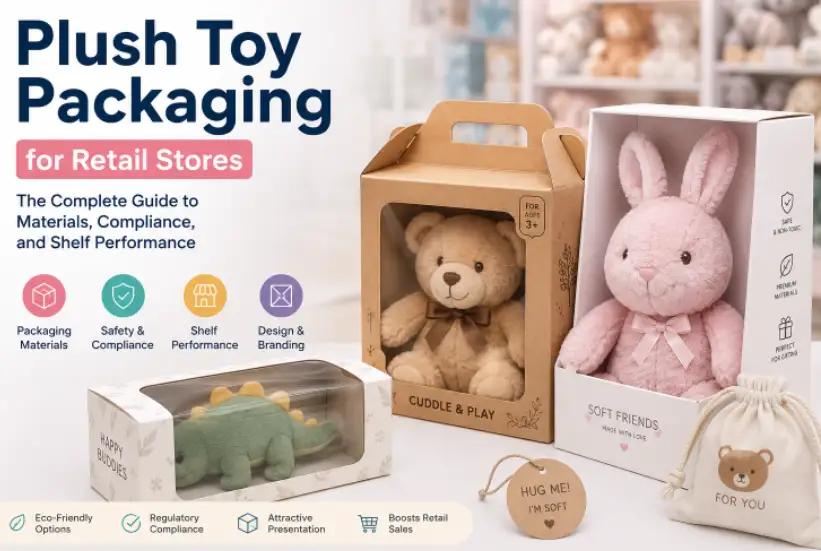
Plush toy packaging for retail stores is the layer of protection, presentation, and compliance information that stands between a finished soft toy and the moment a shopper picks it off the shelf. Packaging that is engineered correctly reduces returns, satisfies mandatory safety labeling, and lets the plush toy’s texture and character design sell itself under store lighting. Packaging that is engineered poorly leads to crushed ears, fogged poly bags, failed retailer compliance audits, and products that simply disappear into a crowded shelf.
This guide walks through every stage of plush toy packaging design — from material selection and structural formats to safety labeling, retail compliance, and sustainability — with reference data that sourcing and product teams can apply directly to a packaging brief.
What Is Plush Toy Packaging and Why Retailers Care About It
Plush toy packaging refers to the combination of primary packaging (the material touching the toy itself, such as a poly bag, header card, or window box), secondary packaging (the shipper carton or master case), and the printed compliance content required before a soft toy can legally enter a retail environment. A well-built plush toy packaging system does three jobs simultaneously: it protects a soft, compressible product through transit and handling, it communicates age grading and safety information clearly, and it presents the character or design in a way that performs under retail lighting and shelf density.
Retail buyers evaluate packaging almost as closely as the plush toy itself, because packaging failure is one of the most common causes of chargebacks and rejected shipments. A stuffed animal that arrives with a torn poly bag, a missing tracking label sticker, or a hang tag printed in the wrong language is treated as non-compliant stock, regardless of how well the toy itself was sewn.
Packaging Tip: Request a physical pre-production packaging sample — not just a digital mockup — before approving a full production run. Poly bag thickness, box board caliper, and window film clarity are difficult to judge accurately from a rendering, and a single physical sample can surface fogging or ply-collapse issues early.
Primary vs. Secondary Packaging in the Plush Toy Supply Chain
Primary packaging is what the end consumer unwraps or removes at the point of purchase or unboxing: a printed poly bag, a header card with a hang hole, a window box, or a fabric drawstring pouch used for premium plush lines. Secondary packaging is the shipper carton that groups multiple primary units for transit and case-pack storage on a retail backroom shelf. Both layers must be engineered together because a primary package that fits loosely inside its shipper carton will shift during transit and arrive with crushed seams, flattened ears, or dislodged safety eyes.
Core Plush Toy Packaging Materials and Formats
Choosing the right packaging format depends on the plush toy’s size, retail price tier, target channel, and required shelf presentation. The most common formats used across mass-market, licensed, and premium plush categories are compared below.
Plush Toy Packaging Format Comparison
| Packaging Format | Typical Use Case | Key Advantage | Limitation |
|---|---|---|---|
| Printed poly bag with header card | Mass-market plush, claw-machine stock, promotional plush | Low cost; fast to produce; lightweight for freight | Limited shelf presence; no structural crush protection |
| Die-cut window box | Mid-tier retail plush, gift-set plush, seasonal plush | Strong shelf presentation; protects shape during transit | Higher unit cost; requires more warehouse cube |
| Full-color printed carton (no window) | Licensed plush, blind-box plush, collector plush | Premium unboxing feel; supports surprise/reveal, mechanics | Consumers cannot inspect texture or color before purchase |
| Drawstring or ribbon-tie fabric pouch | Premium/gift plush, boutique retail, museum plush | Reusable packaging is perceived as high value | Least crush protection of any format |
| Shrink-wrapped flat pack (self-flat plush) | Licensed flat plush, keychain plush, travel-size plush | Very low cube; efficient for peg-hook display | Not suitable for fully stuffed 3D plush shapes |
| Clamshell blister pack | Small plush accessories, plush keychains, mini plush clips | Theft deterrence (hard to open on-shelf); strong hang-sell display | Harder to recycle; disliked by some sustainability-focused retailers |
Poly bag selection deserves particular attention because plush fabrics compress and release air as they are handled, which can cause thin poly film to balloon, wrinkle, or develop pinholes at stitched seams. Most plush toy retail packaging uses low-density polyethylene (LDPE) film in a 1.5–2.5 mil (38–64 micron) thickness range, with heavier plush or larger toys requiring the upper end of that range to resist puncture from stitched seam edges and safety eye backings.
Header Cards, Hang Tabs, and Peg-Hook Compatibility
Header cards attach to a poly-bagged plush toy and provide the printed real estate for branding, age grading, and the hang hole used on peg-hook or slat-wall retail displays. Retailers frequently specify an exact hang-hole diameter and placement — commonly a 6 mm (1/4 inch) round or keyhole-shaped punch positioned to keep the plush toy balanced when hanging — because a poorly centered hang hole causes the toy to tilt or rotate awkwardly on the peg, which reduces its visual appeal in a hanging display bay.
Packaging Tip: Confirm peg-hook hole placement and card weight (typically 250–350 gsm coated board) against the specific retailer’s planogram guidelines before finalizing artwork. Big-box retailers often reject shipments where the hang hole falls outside their approved tolerance window.

Structural Design Considerations for Protecting Plush Toys in Transit
Plush toys are lightweight but bulky, which creates a packaging engineering challenge that differs from rigid products: cube efficiency matters more than weight-bearing strength, but the toy’s soft structure still needs support to prevent seam distortion, ear or limb flattening, and shifting inside a shipper carton.
Cube Optimization and Compression Packing
Compression packing — lightly compressing a plush toy inside a sealed poly bag using a controlled vacuum or mechanical press before it fully re-lofts on the shelf — is widely used for larger plush items to reduce shipping cube by 15%–30% without damaging the toy’s structure. This technique works well for open-weave and standard-loft fiberfill but is not recommended for plush toys with rigid internal armatures, weighted bean-bag bottoms, or embedded electronics, since compression can shift internal components out of position.
Carton Fill and Void Management
Because plush toys are compressible, an underfilled shipper carton allows contents to shift and settle during transit, leading to crushed corners and torn header cards. Packaging engineers typically size shipper cartons to achieve a snug pack with less than 10% void space, using tissue interleaving or corrugated dividers rather than loose fill, which can trap moisture against plush fabric.
Packaging Tip: Run a drop test on the fully packed shipper carton — not just the primary package — from a height of at least 80 cm on all six faces and both corners. This single test surfaces most transit-damage risks before a full production run commits to a fixed carton size.
Key Reference Data: Plush Packaging Materials & Tolerances
| Parameter | Typical Value / Range | Why It Matters |
|---|---|---|
| LDPE poly bag thickness | 1.5–2.5 mil (38–64 microns) | Resists puncture from stitched seams and safety eye backings |
| Header card board weight | 250–350 gsm coated board | Supports hang-hook weight without tearing at the punch |
| Hang-hole diameter (standard) | 6 mm (1/4 inch) | Matches standard peg-hook and slat-wall display hardware |
| Compression packing cube reduction | 15%–30% | Reduces freight and warehouse storage cost per unit |
| Recommended carton void space | Less than 10% | Minimizes shifting, crushing, and header card damage in transit |
| Drop-test height (shipper carton) | ≥ 80 cm, all faces and corners | Standard benchmark for surfacing transit-damage risk pre-production |
Safety Labeling and Compliance Requirements on Plush Toy Packaging
Plush toy packaging is not only a protective and marketing layer — it is also the primary vehicle for mandatory safety and compliance information in most retail markets. Packaging that omits or misprints required labeling can cause an entire shipment to be held at customs or rejected by a retailer’s compliance department, regardless of how the toy itself performs in lab testing.
Age Grading and Choking Hazard Labeling
Age grading on plush toy packaging must reflect the small-parts and choking hazard testing results for that specific product, not a generic assumption based on the toy’s design intent. In the United States, the CPSIA framework requires a choking hazard warning label for toys intended for children under three that contain small parts, small balls, or marbles, while EU markets require the CE mark alongside the specific pictogram warnings defined under the Toy Safety Directive.
Packaging artwork should be finalized only after small-parts cylinder testing confirms the applicable age grade, since retrofitting a packaging run after mislabeling is discovered is far costlier than a short delay at the artwork stage.

Required Markings by Market
Retail-ready plush toy packaging typically needs to display several categories of mandatory information: the manufacturer or importer identification and traceable batch/lot code, country of origin, age grading and any choking hazard pictograms, material content declarations where required, and the applicable safety mark for the destination market. Multi-market packaging runs often print a universal symbol set with multilingual text to avoid running separate print jobs per country.
Plush Toy Packaging Compliance Markings by Market
| Market / Standard | Required Packaging Marking | Typical Placement |
|---|---|---|
| United States (CPSIA) | Tracking label with manufacturer, batch, and location/date of production; choking hazard warning where applicable | Printed directly on poly bag seam or attached hang tag |
| European Union (Toy Safety Directive) | CE mark, manufacturer/importer address, age warning pictograms | Header card or printed carton panel |
| United Kingdom (UKCA) | UKCA mark, importer details, age grading | Header card or printed carton panel |
| General retail (multi-market) | Country of origin, care/content declaration, recycling symbol | Rear panel of header card or box |
Packaging Tip: Build a single master packaging artwork file with swappable language and compliance-mark layers rather than designing separate artwork per market from scratch. This shortens revision cycles when a retailer requests a market-specific compliance change late in the production timeline.
Retail-Ready Packaging Standards and Shelf-Ready Packaging (SRP)
Many large retail chains now require shelf-ready packaging, meaning the shipper carton is designed to be placed directly on the sales floor and opened along a perforation to become its own display tray, rather than requiring staff to unpack individual units onto a shelf by hand. Shelf-ready plush toy packaging reduces in-store labor time and improves the consistency of how the display appears across store locations.
Retailers issuing SRP requirements typically specify a maximum case-pack quantity, a defined opening mechanism (perforated tear-strip or pre-scored lid), and a printed front-facing graphic panel that remains intact and on-brand once the tray is opened. Packaging engineers should confirm case-pack quantity against the retailer’s shelf depth and peg-hook spacing before finalizing carton dimensions, since a mismatch forces store staff to break cases apart manually, defeating the purpose of the SRP format.
Retailer-Specific Packaging Compliance Checklists
Most major retail buyers issue a vendor packaging manual covering barcode placement and scanability, minimum and maximum carton dimensions, palletization requirements, and prohibited materials such as excess loose-fill or non-recyclable clamshell plastics. Reviewing this checklist against the packaging design before committing to tooling avoids costly late-stage rework, particularly for die-cut window boxes where plate and die charges are non-recoverable once cut.
Sustainable and Eco-Friendly Plush Toy Packaging
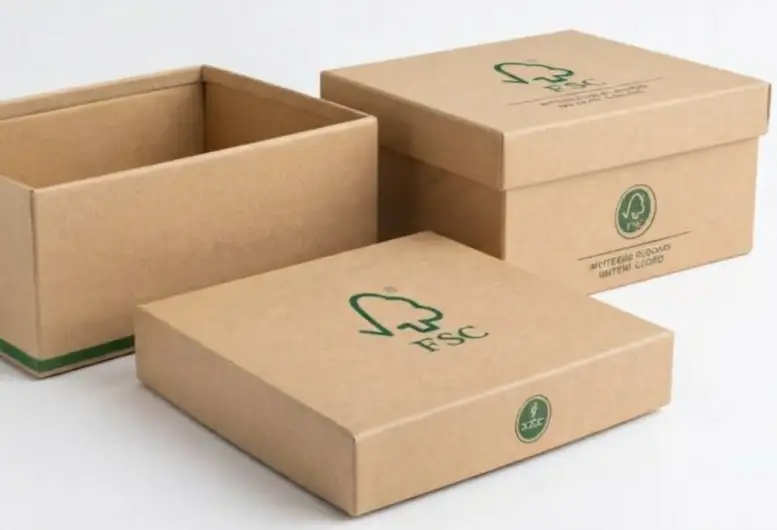
Sustainable plush toy packaging has moved from a differentiator to a baseline expectation among many retail buyers, driven both by consumer preference and by retailer-level packaging reduction commitments. Common sustainable packaging approaches for plush toys include replacing poly bags with FSC-certified recycled kraft header cards and paper bands, reducing film gauge to the minimum thickness that still passes transit testing, and switching from mixed-material clamshells to mono-material recyclable board wherever product visibility requirements allow.

Compostable and bio-based poly bag films are increasingly available as alternatives to standard LDPE, though buyers should confirm that any compostable film still meets the puncture-resistance and clarity requirements needed to protect the plush toy and pass retailer inspection, since early-generation compostable films were prone to premature brittleness in cold-chain and long-transit conditions.
Sustainable Packaging Options for Plush Toys
| Material Swap | Sustainability Benefit | Practical Consideration |
|---|---|---|
| Recycled kraft header card (vs. virgin coated board) | Reduces virgin fiber use; often FSC-certifiable | Slightly lower print vibrancy on uncoated stock |
| Reduced-gauge LDPE film | Lower plastic mass per unit | Must still pass puncture and seam-stress testing |
| Compostable/bio-based film | Reduces long-term landfill plastic | Verify cold-chain and long-transit durability before scale-up |
| Mono-material board (vs. mixed-material clamshell) | Easier for consumers to recycle curbside | Reduces theft-deterrent visibility, some retailers require |
| Soy or water-based inks | Lower VOC emissions during printing | Comparable cost to conventional inks at most print volumes |
Packaging Tip: When switching to a lighter-gauge or compostable film, re-run the full drop-test and humidity-exposure protocol rather than assuming the new material performs identically to the previous poly bag. Film substitutions are one of the most common causes of unexpected in-transit failures after a packaging redesign.
Branding, Presentation, and Shelf Appeal in Plush Toy Packaging Design
Beyond protection and compliance, packaging is the plush toy’s first point of visual contact with a shopper, which means color contrast, window placement, and typography hierarchy on the header card directly influence purchase conversion at the shelf. Window openings on boxed plush should be sized to reveal the toy’s face and most distinctive texture or color feature, since shoppers consistently respond to visible facial detail more strongly than to a fully enclosed graphic-only package.
Packaging copy hierarchy should place the product name and character identity at the top of the visual field, followed by a short benefit or material callout such as fabric softness or hypoallergenic filling, with mandatory compliance text positioned consistently on a rear or side panel so it does not compete visually with the front-facing sales graphic.
Licensing and Artwork Approval Considerations
Licensed plush toy packaging typically requires a formal brand-style guide review and licensor sign-off before print production, covering approved color values, character proportion accuracy, and logo lock-up placement. Building in a realistic licensor approval buffer — commonly two to four weeks depending on the licensor — prevents the artwork stage from becoming the critical-path bottleneck in an otherwise on-schedule production timeline.
Bringing It Together: A Practical Plush Toy Packaging Development Workflow
A disciplined plush toy packaging development process typically follows a sequence: confirm the target retail channel and any SRP or planogram requirements, select the packaging format based on price tier and product size, finalize safety and compliance labeling based on completed lab testing results, run structural and drop testing on a physical sample, and only then commit to final print production and tooling. Skipping directly to artwork before compliance testing is complete is one of the most common causes of last-minute packaging rework across plush toy programs.
Packaging decisions made early in a plush toy program — poly bag gauge, header card weight, carton cube, and compliance layout — carry forward through the entire production run, so investing engineering time at the design stage consistently costs less than correcting packaging failures after a shipment has already left the factory.
Frequently Asked Questions
What poly bag thickness is recommended for plush toy retail packaging?
Most plush toy retail packaging uses LDPE film in a 1.5–2.5 mil (38–64 micron) range. Larger or more heavily stuffed plush toys, and those with stitched safety eyes or embroidered details that can create sharp interior points, generally require film toward the thicker end of that range to resist puncture and seam stress during handling and transit.
Does plush toy packaging need to display a choking hazard warning?
A choking hazard warning is required on packaging when the plush toy is intended for children under the applicable age threshold and contains small parts, small balls, or similar components identified during small-parts cylinder testing. The exact wording and pictogram depend on the destination market’s regulatory framework, so packaging artwork should be finalized only after age-grading test results are confirmed.
What is shelf-ready packaging (SRP), and is it required for all retail plush toys?
Shelf-ready packaging is a shipper carton designed to open into its own display tray on the sales floor, reducing the labor needed to stock individual units. It is not universally required, but many large retail chains mandate it as part of their vendor packaging compliance program, so it is worth confirming with the specific retail buyer before finalizing carton design.
How much can compression packing reduce shipping costs for plush toys?
Compression packing commonly reduces shipping cube by 15%–30% for standard-loft plush toys, which lowers freight and warehouse storage costs per unit. It is generally not suitable for plush toys with rigid armatures, weighted bottoms, or embedded electronic components, since compression can shift internal parts out of position.
What information is legally required on plush toy packaging in the United States and the European Union?
In the United States, CPSIA requires a tracking label with manufacturer or private labeler identity, batch information, and location and date of production, along with any applicable choking hazard warning. In the European Union, packaging must display the CE mark, the manufacturer or importer address, and required age-warning pictograms under the Toy Safety Directive.
Should I use a window box or a fully printed carton for licensed plush toys?
Window boxes let shoppers see the plush toy’s face and texture directly, which tends to support conversion for character-driven and mass-market licensed plush. Fully printed cartons without a window are more common for blind-box or collector plush programs, where the surprise-reveal mechanic is itself part of the product’s appeal.
How do I test whether plush toy packaging will survive shipping without damage?
Run a drop test on the fully packed shipper carton, not just the primary poly bag or box, from a height of at least 80 cm across all six faces and both corners. This should be combined with void-space checks to ensure less than 10% empty space inside the carton, since underfilled cartons allow plush toys to shift and arrive crushed or misshapen.