Skip to content
A stage-by-stage look at how plush toys move from finished product to retail-ready package — materials, compliance, shelf appeal, cost, and quality control.
A finished plush toy is only half the product. How it is packaged determines whether it survives shipping without crushing or matting, whether it clears customs and retailer compliance checks, and whether it actually gets picked up off a shelf or a product page. Buyers who focus entirely on the toy itself and treat packaging as an afterthought routinely discover, late in the process, that packaging decisions have their own lead times, their own cost structure, and their own compliance requirements — all of which need to be planned alongside the toy, not after it.
This guide walks through the plush toy packaging process from start to finish: the core production stages, the materials most commonly used, the compliance and safety requirements that apply specifically to packaging, the techniques that improve retail shelf appeal, how packaging cost is actually calculated, and the quality control checkpoints that catch problems before a shipment leaves the factory.
One point worth establishing before getting into the individual stages: packaging planning and toy production planning are not sequential tasks that can be handled one after the other without cost. Packaging artwork approval, material sourcing, and compliance label verification all have their own lead times, and in many cases those lead times run in parallel with toy production rather than after it. Buyers who wait until the toy is finished before starting the packaging conversation frequently find that packaging becomes the bottleneck that delays an otherwise on-time shipment — not because packaging itself is slow, but because it was started too late to run alongside everything else.

Why Does Packaging Design Matter for Plush Toys?
Packaging design matters for plush toys because it performs three distinct functions simultaneously — physical protection during transit and storage, regulatory and retailer compliance, and point-of-sale marketing — and a package that succeeds at one function while failing another creates real commercial problems. A package that protects the toy but looks generic will not compete on a crowded shelf. A package that looks appealing but does not adequately protect a long-pile fabric surface will arrive at the retailer with matted fur and crushed shape. A package that satisfies neither retailer packaging guidelines nor import labeling requirements can be rejected or delayed at the point where a delay is most expensive to absorb.
Plush toys present packaging challenges that rigid products do not. Soft, textured surfaces are prone to compression and pile flattening under stacking pressure. Irregular character silhouettes rarely fit neatly into standard box dimensions without either wasted space or a custom-shaped insert. And because plush toys are frequently purchased as gifts or impulse items, the unboxing and shelf presentation experience carries more commercial weight than it does for many other product categories. Addressing these challenges requires packaging decisions to be made early, in parallel with the toy design itself, rather than treated as a final step once the toy is finished.
What Are the Core Stages of the Plush Toy Packaging Process?
The plush toy packaging process moves through a consistent sequence of stages regardless of the specific packaging format selected: finished-goods inspection, individual protective wrapping, header card or label attachment, secondary packaging assembly, carton packing, and export labeling. Each stage exists to solve a specific problem — protecting the toy, communicating product information, organizing units for shipping, and preparing the shipment for customs and retail intake — and skipping or rushing any one of them typically surfaces as a defect, a compliance gap, or a damaged shipment further down the chain.
Core Stages of the Plush Toy Packaging Process
| Stage | What Happens | Primary Risk If Skipped |
|---|---|---|
| Finished-goods inspection | Toys are checked for defects before packaging begins | Defective units get sealed into finished packaging |
| Individual protective wrapping | Poly bag or tissue wrap applied to protect fabric and shape | Pile matting, dust contamination, and shape distortion |
| Header card/label attachment | Branding, barcode, and compliance labels affixed | Missing barcode or safety label blocks retail intake |
| Secondary packaging assembly | Toy placed into box, blister, or gift packaging | Inconsistent presentation across the production run |
| Carton packing | Units grouped into export cartons by case pack quantity | Overpacking causes compression damage during transit |
| Export labeling | Shipping marks, carton numbers, and customs information applied | Customs delays and misrouted shipments |
Skipping the finished-goods inspection stage is the single most common root cause of packaging-stage rework, since defects caught after sealing require the package to be reopened and redone.
Tip: Request that finished-goods inspection and packaging happen as two visibly separate stages, with a sign-off point between them. Combining inspection and packaging into a single rushed step is one of the most common reasons defective units slip through into sealed retail packaging.
What Packaging Materials Are Commonly Used for Plush Toys?
Packaging materials for plush toys are selected based on the balance between protection, cost, and presentation that a given product and sales channel requires. A budget-oriented bulk toy destined for a wholesale buyer has very different packaging material needs from a premium collectible plush destined for a boutique retail shelf, and understanding the trade-offs between common material options is essential before finalizing a packaging specification.
Material choice also increasingly reflects buyer and retailer expectations around recyclability and plastic reduction. Recycled-content poly film, FSC-certified paperboard for header cards and boxes, and soy- or water-based inks are now common substitution requests, particularly for retailers with their own sustainability procurement standards. These substitutions are generally achievable without high cost or lead-time impact when specified early, but requesting them as a late change to an already-approved packaging specification typically requires a new material sourcing cycle and a fresh compliance check, since recycled and virgin materials do not always share identical performance characteristics such as film clarity or tear resistance.
Poly Bags and Individual Wrapping
Poly bags — typically low-density polyethylene (LDPE) film — are the most common individual protective layer for plush toys, providing dust and moisture protection at low cost. Poly bags used for products intended for children under three generally require ventilation holes or a suffocation warning label, depending on the target market’s specific regulation, which makes bag specification a compliance decision as much as a packaging one.

Header Cards and Hang Tabs
Header cards are printed cardstock inserts, typically stapled or heat-sealed to a poly bag, that carry branding, barcode information, and safety labeling while allowing the toy to be displayed on a peg hook or shelf strip. Header cards are the standard format for mass-market retail plush sold in big-box and specialty toy stores, since they allow high shelf density without requiring individual boxes.
Window Boxes and Blister Packaging
Window boxes — printed cartons with a clear film or die-cut window — offer stronger brand presentation and better protection than a poly bag alone, at a meaningfully higher per-unit cost. Blister packaging, where a clear plastic shell is heat-sealed around the toy against a printed card backing, offers the highest tamper resistance and shelf security but is less common for plush specifically, since the sealing process can flatten pile fabric if not carefully tensioned.
Gift Boxes and Premium Packaging
Gift boxes — rigid or folding cartons, often with ribbon, tissue, or foam inserts — are reserved for premium and collector-oriented plush products where the unboxing experience is part of the product’s perceived value. This packaging tier carries the highest material and labor cost per unit and is generally reserved for products with a retail price point that can absorb it.
Comparison of Common Plush Toy Packaging Formats
| Packaging Format | Typical Use Case | Relative Cost | Protection Level |
|---|---|---|---|
| Poly bag only | Wholesale, bulk, and budget-tier products | Lowest | Basic — dust and moisture only |
| Poly bag + header card | Mass-market peg-hook retail | Low to moderate | Basic protection, strong shelf visibility |
| Window box | Mid-tier retail and licensed products | Moderate | Good — rigid outer structure |
| Blister pack | Collectible and security-sensitive retail | Moderate to high | High — tamper-resistant seal |
| Gift box | Premium, collector, and gifting-focused products | Highest | Highest — rigid structure plus internal cushioning |
Tip: Match the packaging format to the actual sales channel before finalizing artwork. A gift box designed for boutique retail adds cost with little benefit if the product is actually destined for wholesale distribution, while a poly-bag-only format under-protects a product intended for a premium retail shelf.
How Does Packaging Affect Compliance and Safety?
Packaging is subject to its own compliance requirements that are separate from, but related to, the safety requirements applied to the toy itself. Regulations covering plastic film thickness and ventilation, choking hazard warnings, country-of-origin labeling, and age-grading disclosure apply specifically to how a product is packaged and labeled — meaning a fully compliant toy can still be non-compliant if the packaging around it does not meet the applicable requirements.
Common Packaging Compliance Requirements by Category
| Requirement Category | What It Covers | Typical Trigger |
|---|---|---|
| Plastic film safety | Minimum film thickness or ventilation holes to reduce suffocation risk | Poly bags large enough to cover a child’s head |
| Choking hazard warning | Small-parts warning label for products with detachable components | Products not intended for children under three |
| Country-of-origin labeling | Country of manufacture disclosed on packaging or a permanent label | Required by most import markets regardless of product type |
| Age grading disclosure | Minimum recommended age printed on packaging | Required under most toy safety regulatory frameworks |
| Care and content labeling | Fiber content and cleaning instructions | Required in several markets for textile-based products |
Requirements vary by destination market, and a packaging specification approved for one country cannot be assumed to satisfy the labeling rules of another without specific verification.
Tip: Confirm packaging compliance requirements separately for each destination market before finalizing artwork files. Reprinting header cards or labels after a shipment has already been produced is far more expensive than confirming label content during the design stage.
What Packaging Techniques Improve Retail Shelf Appeal?
Retail shelf appeal for plush toys is driven by a combination of visual presentation, tactile accessibility, and information clarity — and small packaging decisions consistently have an outsized effect on how a product performs against comparable items on the same shelf. Clear film windows that let a shopper see and, where the format allows, touch the actual fabric texture consistently outperform fully opaque packaging for plush specifically, because texture and softness are core parts of the plush buying decision that photography alone communicates poorly.

Color and contrast on header cards and window boxes should be tested against the specific retail environment the product will occupy, since a header card designed to stand out against a white studio background can disappear into a shelf full of similarly colored competing products. Barcode and pricing information should be positioned consistently across a product line so that retail staff can scan and restock efficiently, which is a functional consideration that is easy to overlook when packaging design is treated purely as a branding exercise.
Packaging that allows a limited amount of physical interaction — a small open window, a soft-touch film finish, or a partially visible plush surface — tends to perform better for impulse-purchase plush categories than fully sealed packaging, since shoppers who can gauge softness before buying convert at a meaningfully higher rate than those relying on packaging graphics alone.
Package size itself is a shelf-appeal decision with a direct cost consequence that is easy to overlook. Larger packaging with generous white space and dramatic product presentation photographs well and can command more shelf attention, but it also reduces the number of units that fit in a standard shipping carton and on a standard shelf facing, which raises the effective landed cost per unit and can limit how much shelf-facing space a retailer is willing to allocate to the product. The most effective retail plush packaging tends to be sized as tightly as the presentation goals allow — generous enough to showcase the character clearly, but not so oversized that it becomes a logistics and shelf-space liability relative to competing products.
Tip: Test packaging artwork against an actual retail shelf photo or mockup, not just a plain studio background. Colors and contrast that look strong in isolation frequently blend into a crowded shelf environment once surrounded by competing packaging.
How Is Packaging Cost Calculated and Controlled?
Packaging cost is calculated as the sum of material cost, print and finishing cost, labor cost for assembly, and the amortized cost of any custom tooling — such as a die-cut mold for a window box or a custom blister form — spread across the order volume. Because several of these cost components are fixed regardless of order size, packaging cost per unit decreases meaningfully as order volume increases, which makes packaging format selection particularly sensitive to production volume in a way that is easy to underestimate at the quoting stage.
Typical Packaging Cost Components by Format
| Cost Component | Poly Bag + Header Card | Window Box | Gift Box |
|---|---|---|---|
| Material cost | Low | Moderate | High |
| Print and finishing | Low | Moderate to high | High |
| Assembly labor | Low | Moderate | Moderate to high |
| Tooling (die-cut or mold) | Minimal or none | One-time die-cut cost | One-time die-cut or mold cost |
| Typical cost sensitivity to volume | Low | Moderate | High |
Controlling packaging cost without compromising protection or compliance generally comes down to a small number of practical levers: standardizing carton and box dimensions across a product line to reduce custom tooling costs, consolidating print runs across multiple SKUs where artwork templates allow it, and right-sizing the packaging format to the actual sales channel rather than defaulting to a premium format across an entire catalog. Buyers who review packaging cost as a distinct line item — rather than folding it into an undifferentiated unit price — are consistently better positioned to identify which of these levers applies to their specific order.
Tip: Ask for packaging cost as a separate line item from the toy unit price, even when a single combined quote is offered. Separating the two makes it possible to compare packaging options independently of production cost, and to identify exactly where cost reduction opportunities exist.
What Quality Control Steps Apply to Plush Toy Packaging?
Quality control for plush toy packaging covers a distinct set of checkpoints from the quality control applied to the toy itself, focused on whether the packaging protects the product correctly, presents it consistently, and carries accurate compliance information. A toy that passes every construction and safety check can still fail a shipment-level quality review if its packaging is inconsistent, mislabeled, or inadequately protective for the transit conditions it will face.
These checkpoints are most effective when they happen at two distinct points rather than only at the very end of the process: a mid-production check once the first batch of packaged units is complete, which catches systemic issues — a mislabeled barcode, a seal that is not holding, a print color that has drifted from the approved proof — while there is still time to correct the remaining production run, and a pre-shipment check on the fully packed cartons, which focuses on carton-level issues such as pack count accuracy and compression damage. Relying solely on a single pre-shipment inspection means that a systemic packaging defect present from the first unit is only caught after the entire order has already been packaged, at which point correcting it requires reopening and redoing a much larger volume of finished work.
Standard Quality Control Checkpoints for Plush Toy Packaging
| Checkpoint | What Is Verified |
|---|---|
| Bag and seal integrity | No tears, incomplete seals, or trapped moisture inside individual packaging |
| Label accuracy | Barcode scans correctly; age grading and country-of-origin text is correct |
| Print consistency | Color and print quality is consistent across the full production run |
| Carton pack count | Case pack quantity matches the specification on every carton |
| Compression resistance | Sample cartons checked for crushing or pile matting after stacking simulation |
| Export marking accuracy | Shipping marks and carton numbering match the shipment documentation |
A random-sample carton opening check — rather than relying solely on external carton inspection — is the most reliable way to catch compression or matting damage before a shipment leaves the factory.
Conclusion
The plush toy packaging process is not a final, low-stakes step tacked onto the end of production — it is a sequence of decisions with its own compliance requirements, its own cost structure, and its own capacity to make or break a product’s retail performance. Planning packaging format, materials, and compliance requirements alongside the toy design itself, rather than after production is already underway, consistently produces packaging that protects the product, satisfies the destination market’s regulatory requirements, and gives the toy a genuine competitive edge on the shelf or the product page.
Buyers who treat packaging cost, compliance, and shelf appeal as three separate but connected questions — and who build quality control checkpoints specifically for packaging into their production timeline — are the ones who avoid the most common and most expensive packaging-related surprises: rejected shipments, damaged goods, and products that simply do not stand out where it matters most.
Frequently Asked Questions
Q1: What is the most common packaging mistake buyers make when ordering plush toys for the first time?
The most common mistake is finalizing the toy design and production timeline without planning packaging materials, format, and compliance requirements in parallel. Packaging artwork, label content, and material specifications have their own lead times and their own approval cycles, and treating packaging as a late-stage add-on frequently causes shipment delays that have nothing to do with the toy itself being ready. A related and equally common mistake is selecting a packaging format based on appearance alone without confirming it against the compliance requirements of the actual destination market.
Q2: Do all plush toys require a suffocation warning or ventilation holes on their poly bag packaging?
Not all plush toys require this, but it depends on the size of the bag relative to a child’s head and the specific regulation of the destination market rather than on the product category itself. Many markets apply film thickness or ventilation requirements once a poly bag exceeds a certain size threshold, regardless of what product is inside it. Because these thresholds and requirements differ by country, the safest approach is to confirm the specific packaging film requirement for each destination market before finalizing the bag specification, rather than assuming a single standard applies universally.
Q3: How much does packaging typically add to the total unit cost of a plush toy?
Packaging cost as a share of total unit cost varies significantly by format, ranging from a small percentage for a simple poly bag and header card to a much larger share for gift boxes with printed inserts and custom tooling. Because several packaging cost components are fixed rather than scaling with volume, the percentage impact is also highly sensitive to order size — the same packaging format can represent a very different share of unit cost at a small order quantity compared to a large one. Requesting packaging cost as its own line item, rather than a cost folded into the toy’s unit price, is the most reliable way to understand this specific impact for a given order.
Q4: Can the same packaging design be used across multiple plush toy characters in a product line?
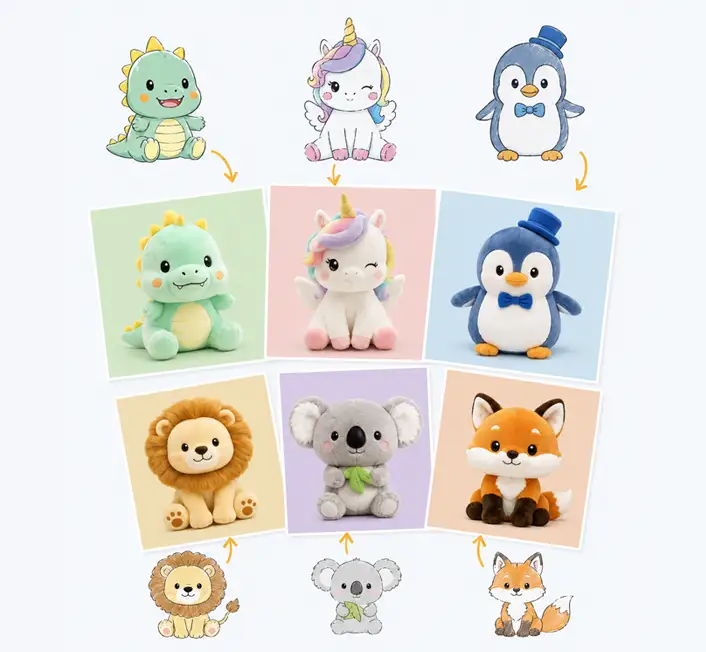
A shared packaging template — consistent header card layout, box dimensions, and branding elements with a character-specific window or printed panel — is a common and cost-effective approach for product lines with multiple characters at a similar size and price point. This approach reduces tooling and print setup costs by allowing multiple SKUs to share a base template. It works best when the characters in the line are reasonably similar in size and shape; characters with significantly different proportions or silhouettes may not fit a shared box or window dimension without either wasted space or a visibly awkward fit, which can undercut the shelf appeal the shared template was meant to support.
Q5: How does packaging protect plush toys with long-pile or delicate fur during shipping?
Long-pile and delicate fabric surfaces are primarily protected through a combination of individual wrapping that prevents direct fabric-to-fabric contact between units, careful carton pack density that avoids excessive compression, and, in some cases, tissue paper or a light internal liner that keeps pile fibers from being crushed flat during transit. Overpacking a carton to reduce shipping cost is one of the most common causes of pile matting, since compressed fabric does not always fully recover its original texture after extended pressure, even after the toy is removed from packaging.
Q6: What packaging information is typically required for customs clearance on plush toy shipments?
Customs clearance generally requires accurate country-of-origin labeling, correct product classification information, and shipping marks on the export carton that match the shipment’s commercial invoice and packing list. Requirements can vary by destination country and by whether the shipment includes any licensed characters or trademarked branding, which may require additional documentation. Confirming the specific customs labeling requirements for the destination market before cartons are packed and sealed avoids the far more costly scenario of a shipment being held at customs for label or documentation corrections.
Q7: Is it worth investing in premium packaging, such as a gift box, for a mid-priced plush toy?
Whether premium packaging is worth the added cost depends primarily on the sales channel and the price point the product is expected to command. For products sold through a channel where unboxing experience and gifting appeal directly influence purchase decisions — direct-to-consumer, boutique retail, or licensed collector products — premium packaging can support a meaningfully higher price point and stronger brand perception. For products sold through high-volume, price-sensitive channels such as wholesale or mass-market retail, the added packaging cost is less likely to be recovered through price, since the purchase decision in those channels is driven more by unit economics than by unboxing presentation. Matching the packaging investment to the channel is generally a more reliable guide than applying a single packaging standard across an entire product catalog.