Skip to content
How to map, measure, and improve every stage of the plush toy manufacturing process — from pattern grading and cutting through sewing, stuffing, quality control, and packaging — to reduce lead time, cut defect rates, and increase output without sacrificing product quality.
Plush toy production workflow optimization is the systematic process of analyzing every stage of stuffed toy manufacturing — design, cutting, sewing, stuffing, finishing, quality control, and packaging — to eliminate bottlenecks, shorten lead times, reduce defect rates, and lower per-unit cost without compromising safety or softness quality.
What Is Plush Toy Production Workflow Optimization?
Plush toy production workflow optimization refers to the deliberate redesign of a factory’s operating sequence so that materials, labor, and machine time move through the plant with minimal idle time, rework, and wasted motion. Unlike rigid-goods manufacturing, plush toy production is unusually labor-intensive: fabric cutting, sewing, hand-stuffing, embroidery, and final trimming all rely heavily on skilled operators rather than fully automated lines. This makes workflow design — not just equipment investment — the primary lever available to a plush toy factory that wants to raise throughput.
A poorly sequenced workflow shows up as familiar symptoms: sewing lines waiting on cut components, stuffing stations backed up behind quality holds, embroidery machines idle because artwork approval is late, and finished goods sitting in a staging area because packaging materials have not cleared customs. Each of these delays compounds. A single day lost at the cutting stage rarely stays a single day by the time an order reaches the export dock.
Optimizing the workflow does not mean simply working faster. It means restructuring the sequence, balancing capacity between stations, tightening handoffs between departments, and building quality checks into the process rather than only at the very end. Done well, workflow optimization in plush toy manufacturing can compress lead times by several weeks on a standard order and meaningfully reduce the defect rate that reaches final inspection.
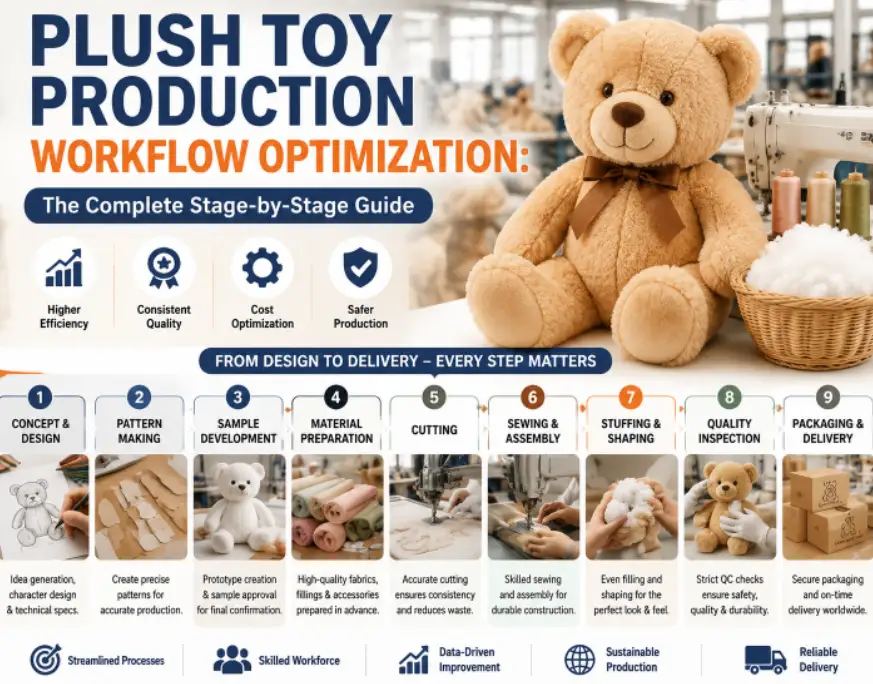
The scope of workflow optimization also extends beyond the factory floor itself. Communication delays between design teams and production planners, slow sample approval cycles with buyers, and disconnected data between the cutting room and the sewing floor all contribute to the same lost time that shows up later as a missed ship date. A workflow map that only covers physical production stages, without accounting for these coordination gaps, misses a meaningful share of the total delay a plush toy order typically experiences between order confirmation and shipment.
The remainder of this guide walks through each stage of a typical plush toy manufacturing workflow in sequence, identifies where delays and quality variation most commonly originate, and outlines the specific adjustments — sequencing changes, checkpoint placement, line balancing, and selective automation — that experienced production teams use to keep the workflow moving efficiently from raw material to finished, packaged product.
Mapping the Plush Toy Production Workflow: Stage-by-Stage Architecture
Before any stage can be optimized, it has to be mapped accurately. Most plush toy manufacturing workflows follow a broadly consistent sequence, though the relative time spent at each stage varies by product complexity, fabric type, and whether the toy includes electronics or accessories.
Core Production Stages in a Standard Plush Toy Manufacturing Workflow
| Stage | Primary Activity | Typical Share of Total Cycle Time |
|---|---|---|
| Design & pattern development | 2D pattern drafting, 3D prototype review, grading for size variants | 5%–8% (one-time per style) |
| Material sourcing & incoming inspection | Fabric, filling, and trim procurement; GSM and colorfastness checks | 10%–15% |
| Cutting | Fabric layup and cutting into pattern pieces | 8%–12% |
| Sewing & assembly | Panel stitching, joint assembly, leaving a stuffing opening | 30%–38% |
| Stuffing & filling | Manual or semi-automated filling to target density | 10%–14% |
| Embroidery & surface finishing | Facial embroidery, appliqué, brushing, trimming loose threads | 8%–12% |
| Quality control | In-line spot checks and final AQL inspection | 6%–9% |
| Packaging & labeling | Poly-bagging, hang-tagging, carton packing, labeling by market | 7%–10% |
Sewing and assembly consistently consume the largest share of cycle time because it is the most operator-dependent stage and the one with the most quality-sensitive steps — seam allowance consistency, joint reinforcement, and leaving a correctly sized stuffing opening all affect downstream stations. Any workflow optimization plan should therefore start with sewing line analysis, since improvements there have the largest absolute effect on total throughput.
Tip: Before changing anything on the floor, time-study each stage separately for at least three production runs of the same style. A workflow bottleneck that looks like a sewing problem is sometimes actually a cutting problem — undersized or inconsistent cut pieces slow sewing operators down even though the delay is recorded against the sewing line.
Design and Pre-Production Planning Optimization
Workflow inefficiencies are frequently locked in before a single piece of fabric is cut. Pattern development, grading, and sample approval set the ceiling on how efficiently the rest of the line can run.
Pattern Grading and Digital Sampling
Traditional plush toy pattern grading — manually redrafting a pattern for each size variant — is slow and prone to accumulated error across a size range. Digital pattern grading software applies proportional scaling rules consistently across every panel, reducing the risk that a grading mistake surfaces only after cutting has already begun. Factories that shift from manual to digital grading typically cut sample development time significantly and reduce the number of pattern-related sewing defects that appear once mass production starts.
Material Sourcing Lead Time Reduction
Fabric and filling procurement is one of the most common sources of hidden delay in the plush toy production workflow. Custom fabric colors, specialty pile heights, and imported synthetic fills often carry longer lead times than the finished-goods production schedule assumes. Building a buffer into the master schedule for fabric dyeing and delivery — rather than assuming fabric will be on hand the moment cutting is scheduled to start — prevents the single most common cause of a delayed production start date.
Locking fabric and filling specifications at the same time the pattern is approved, rather than treating material selection as a detail to finalize later, prevents one of the most frequent causes of re-cutting, re-grading, and missed ship dates in plush toy manufacturing: a late-stage fabric substitution that invalidates work already completed on the pattern and sample.

Sample Approval Cycles and Communication Bottlenecks
Even a well-graded, technically sound pattern can stall a workflow if the sample approval cycle with the buyer or design owner drags on. Each round of sample revision — a color correction, a proportion adjustment, an embroidery placement change — resets the clock on cutting and sewing planning, since production scheduling cannot commit floor time to an unapproved style. Factories that consolidate feedback into a single structured review round, rather than allowing revisions to trickle in one comment at a time, typically compress the total sample-to-approval window considerably.
Photographing and logging each sample revision alongside the specific change requested also prevents a common and costly error: reverting to an earlier, already-rejected version of a detail because the history of what was approved and why was not clearly documented. This is a small administrative habit, but it prevents rework that can otherwise cost a full sampling cycle.
Cutting and Fabric Preparation Efficiency
The cutting stage determines the raw material efficiency of the entire order and directly affects sewing line speed, since inconsistent cut pieces slow down every downstream stitching operation. Three cutting methods dominate plush toy production, each with different tradeoffs for speed, precision, and fabric waste.
Comparison of Cutting Methods Used in Plush Toy Manufacturing
| Cutting Method | Best Suited For | Precision | Relative Fabric Waste |
|---|---|---|---|
| Manual scissor cutting | Small runs, sample development, irregular trims | Operator-dependent | Higher (5%–10%) |
| Die-cutting (press knife) | Repeat styles with stable pattern shapes | High, consistent | Moderate (3%–6%) |
| Computerized fabric cutting (CNC/laser) | Complex panel shapes, mixed-fabric layups, large volumes | Very high | Low (2%–4%, via nesting software) |
Computerized cutting systems that use nesting software to arrange pattern pieces across a fabric roll consistently deliver the lowest material waste, which matters because fabric typically represents a substantial share of total plush toy material cost. For factories running frequent style changes, the setup time for computerized cutting can offset some of the material savings on very small orders, which is why manual and die-cutting methods remain common for sample runs and low-volume specialty items.
Because fabric is one of the largest single cost components in most plush toy styles, even a small improvement in nesting efficiency compounds meaningfully across a full production run. A style cut at 92% fabric utilization instead of 85% effectively reduces the fabric cost per unit by a proportional amount once multiplied across several thousand units, which is why many mid-sized and larger plush toy factories justify the investment in computerized cutting equipment primarily on fabric savings rather than on labor savings alone.
Tip: Batch cutting by fabric type rather than strictly by order. Grouping cutting jobs that share the same fabric reduces machine changeover time and allows leftover fabric from one order to be nested against the next, lowering aggregate waste across the production week.
Sewing Line Balancing and Throughput
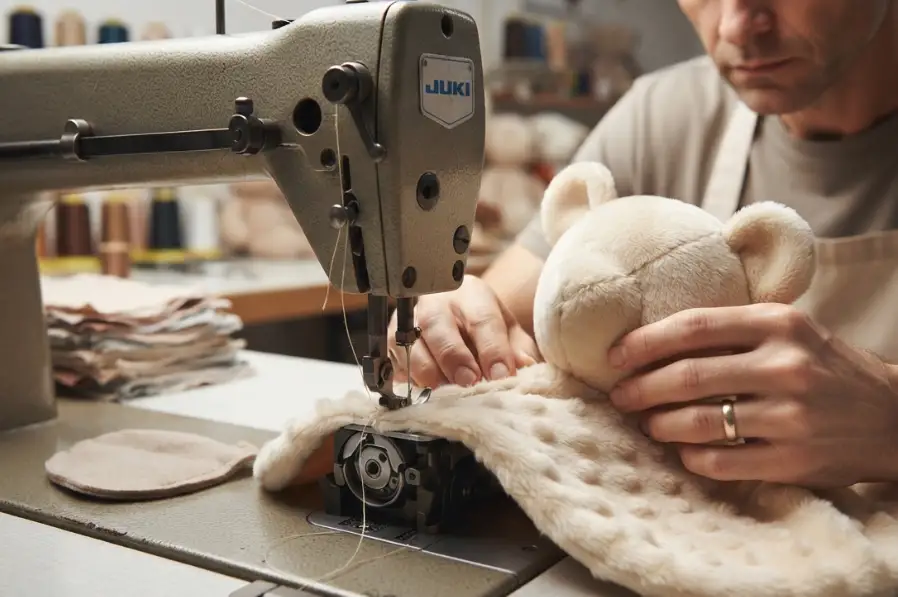
Sewing is the operator-intensive core of plush toy manufacturing, and it is also where workflow optimization delivers the largest measurable gains. Line balancing — assigning operations to workstations so that no single station becomes a chronic bottleneck — is the central technique.
Identifying and Resolving Sewing Line Bottlenecks
A sewing line is only as fast as its slowest station. If facial embroidery attachment or limb assembly consistently takes longer than adjacent operations, work-in-progress piles up at that station regardless of how fast the rest of the line runs. Line balancing addresses this by redistributing sub-operations, cross-training operators to cover multiple stations, or adding a second machine at the constrained step.
Common Sewing Line Bottlenecks and Corrective Actions
| Bottleneck Symptom | Likely Root Cause | Corrective Action |
|---|---|---|
| Work-in-progress accumulating at one station | Station cycle time exceeds line takt time | Split the operation across two stations or add a machine |
| Frequent thread breaks or skipped stitches | Incorrect needle size or tension for fabric weight | Standardize machine settings per fabric type in a setup sheet |
| Operators idle waiting for cut pieces | Cutting output not synchronized with sewing takt time | Stage a rolling buffer of cut components ahead of the line |
| High rework rate on seam allowance | Inconsistent cutting or lack of stitch guides | Add stitch guides/jigs and tighten cutting tolerance |
| Uneven output across shifts | Skill variation between shift teams | Cross-train and rotate lead operators across shifts |
Takt time — the pace at which a unit must be completed to meet demand — is the reference point for line balancing. Once takt time is known, every station’s cycle time can be measured against it, and any station running meaningfully slower than takt time is a candidate for rebalancing before it becomes a permanent constraint on the line’s output.
Tip: Recalculate takt time every time order volume or product mix changes significantly. A line balanced for a 5,000-unit order of a simple bear style will not be balanced correctly for a 5,000-unit order of a character plush with multiple embroidery colors and an accessory attachment.
Cross-Training and Multi-Skill Operator Coverage
Even a well-balanced sewing line loses efficiency quickly when a single skilled operator is absent, since many plush toy sewing operations — attaching a specific limb, closing a specific seam type — are often performed by only one or two people trained on that step. Cross-training operators across two or three adjacent operations reduces this fragility and gives supervisors the flexibility to shift labor toward whichever station is running behind takt time on a given day.
Cross-training also shortens the ramp-up period when a new style enters production, since operators who already understand adjacent operations pick up a related new task faster than someone trained on only a single, narrow step. Factories that formalize a skills matrix — tracking which operators are qualified on which operations — can identify coverage gaps before they cause a line stoppage rather than discovering them the day an operator is unexpectedly absent.
Stuffing and Filling Process Optimization
Stuffing directly affects both the tactile quality of the finished toy and its compliance weight for age-grading and safety standards, which makes this stage a frequent source of both quality variation and throughput loss if it is not standardized.
Manual stuffing remains dominant for smaller or irregularly shaped plush toys because operators can feel and correct density variation as they work. Semi-automated stuffing machines — which meter filling by weight or volume through a nozzle — increase throughput and reduce density variation for high-volume, regularly shaped styles such as basic bears or simple animal forms, but require calibration whenever fill material, toy size, or target firmness changes.
Reference Stuffing Density Ranges by Plush Toy Category
| Toy Category | Typical Fill Density | Primary Consideration |
|---|---|---|
| Soft/huggable plush (infant, comfort toys) | Lower density, loose fill | Softness and safety compliance for younger age grades |
| Standard collectible plush | Medium density | Shape retention balanced with tactile softness |
| Firm-pose or display plush | Higher density | Structural rigidity and pose stability |
| Weighted/sensory plush | Medium density plus internal weighted insert | Even weight distribution; insert must meet containment and safety requirements |
Standardizing fill weight per style — rather than relying purely on operator judgment — reduces both the variation in finished-toy weight and the rate of under-filled or over-filled units flagged at quality control. A written fill-weight target per style, checked periodically with a scale rather than only by touch, closes most of the gap between manual and machine-metered consistency.
Stuffing density also interacts directly with age-grading and safety compliance. Toys intended for younger age grades are typically held to different softness, seam-strength, and small-parts standards than toys aimed at older children or adult collectors, and the target fill density for a given style should be set with the intended age grade and the applicable safety standard in mind from the earliest sampling stage, not adjusted after mass production has already begun.
Tip: Weigh a sample of stuffed units at the start of every shift and again mid-shift. Fill density tends to drift as operators fatigue or as fill material settles in the feed hopper, and a mid-shift check catches drift before an entire day’s output is affected.
Embroidery, Surface Finishing, and Assembly Optimization
Facial embroidery, appliqué attachment, and surface finishing (brushing pile fabric, trimming stray threads, steam-pressing seams) sit between stuffing and final quality control. This stage is often underestimated in workflow planning because individual operations look quick, but the cumulative handling time across multiple finishing touchpoints adds up on complex character styles.
Sequencing embroidery before stuffing, wherever the panel shape allows it, is one of the more reliable workflow improvements available: embroidering a flat panel is faster and more precise than embroidering a stuffed, three-dimensional form, and it reduces the risk of needle damage to an already-completed toy. Where the design requires post-stuffing embroidery or attachment — such as adding a bow or accessory after the body is filled — batching those units together rather than interleaving them with standard-finish units keeps the finishing line’s changeover time low.
Embroidery digitizing — converting artwork into a stitch-by-stitch machine program — is itself a workflow step worth planning for separately, since a poorly digitized file causes slow stitching, thread breaks, and inconsistent facial expressions across a production run. Approving the digitized stitch file against a physical stitched sample, rather than against a screen preview alone, catches these issues before an entire batch of panels is embroidered with the same flawed program.
Tip: Wherever the pattern allows, move embroidery and appliqué work to the flat, pre-sewn panel stage instead of the fully assembled toy. This single sequencing change is one of the most consistent throughput gains available in plush toy finishing.
Quality Control Checkpoints Across the Workflow
A workflow that only inspects at the very end of the line concentrates all of its quality risk into a single, expensive checkpoint: by the time a defect is caught at final inspection, the fabric, labor, filling, and embroidery time invested in that unit are already spent, and a large batch may share the same root cause. Distributing quality checkpoints across the workflow catches defects earlier, when the cost of correction is lowest.

Quality Control Checkpoints Through the Plush Toy Production Workflow
| Checkpoint | Stage Location | What Is Verified |
|---|---|---|
| Incoming material inspection | Before cutting | Fabric GSM, colorfastness, filling cleanliness, trim component compliance |
| Cutting inspection | After cutting, before sewing | Pattern accuracy, panel count, fabric grain alignment |
| In-line sewing spot checks | During sewing/assembly | Seam strength, joint attachment security, symmetry |
| Post-stuffing check | After stuffing, before closing seam | Fill weight/density, absence of foreign objects, closure strength |
| Pull and tension testing | After finishing, before packaging | Eye/nose/limb attachment strength against pull-force standards |
| Final AQL inspection | Pre-shipment, on sampled cartons | Overall workmanship, labeling accuracy, packaging integrity |
Pull and tension testing on attached components — plastic eyes, noses, bows, and other small parts — is especially important to keep as a dedicated checkpoint rather than folding it into general final inspection, since attachment failures are one of the leading causes of post-shipment recalls and customer complaints in plush toy manufacturing.
Final inspection is typically carried out against a statistical sampling plan rather than by checking every unit in a shipment, since 100% inspection is impractical at production volume. The sampling plan defines how many cartons to pull from a shipment, how many units to inspect within each carton, and the acceptable number of defects before the batch is rejected. Choosing an appropriately strict sampling level for the product’s age grade and risk profile — and applying it consistently across every order rather than loosening it under schedule pressure — is what keeps the final checkpoint meaningful rather than a formality.
Tracking defect data by checkpoint, rather than only by final AQL result, is equally important. A style that repeatedly fails at the post-stuffing checkpoint but still passes final inspection is signaling a process issue worth correcting before volume scales up, even though that issue never shows up in the final pass/fail rate.
Packaging and Final Assembly Line Optimization
Packaging is frequently treated as an afterthought in workflow design, but poly-bagging, hang-tagging, carton assembly, and market-specific labeling can consume a meaningful share of total cycle time — particularly for orders shipping to multiple countries with different labeling and warning-text requirements.
Preparing labeling artwork and packaging materials in parallel with production, rather than waiting until finished units reach the packaging station, prevents a common late-stage delay where fully finished toys sit in a staging area waiting on printed hang tags or country-specific compliance labels. For multi-market orders, segregating cartons by destination market during packing — rather than packing generically and relabeling later — avoids costly rework at the export stage.
Tip: Confirm country-specific labeling requirements (age warnings, choking hazard text, care instructions, fiber content) before mass production begins, not at the packaging stage. Reprinting hang tags after units are already finished is one of the more expensive and avoidable delays in the workflow.
Applying Lean Manufacturing Principles to Plush Toy Production
Lean manufacturing frameworks, originally developed for automotive and electronics assembly, translate well to plush toy production once adapted for its labor-intensive, low-automation character. The core lean concept — identifying and removing the seven classic categories of manufacturing waste — maps cleanly onto specific, recognizable problems on a plush toy factory floor.
The Seven Wastes of Lean Manufacturing Applied to Plush Toy Production
| Waste Category | How It Appears in Plush Toy Manufacturing |
|---|---|
| Overproduction | Cutting or sewing more components than the current order requires, ahead of a confirmed schedule |
| Waiting | Sewing operators idle while waiting for cut pieces or embroidery-approved artwork |
| Transport | Excess movement of work-in-progress between distant cutting, sewing, and stuffing areas |
| Overprocessing | Extra finishing steps (double-stitching, redundant pressing) beyond what the specification requires |
| Inventory | Excess fabric or filling stock tying up cash and warehouse space beyond near-term needs |
| Motion | Operators reaching for poorly placed tools, trims, or bins during repetitive sewing tasks |
| Defects | Rework and scrap from stuffing density errors, attachment failures, or cutting inaccuracy |
Waiting and defects are typically the two highest-impact categories to address first in a plush toy factory, since both are directly visible in daily production data — idle time logs and defect/rework logs — and both respond quickly to the workflow changes described earlier in this guide, such as staged cutting buffers and distributed quality checkpoints.
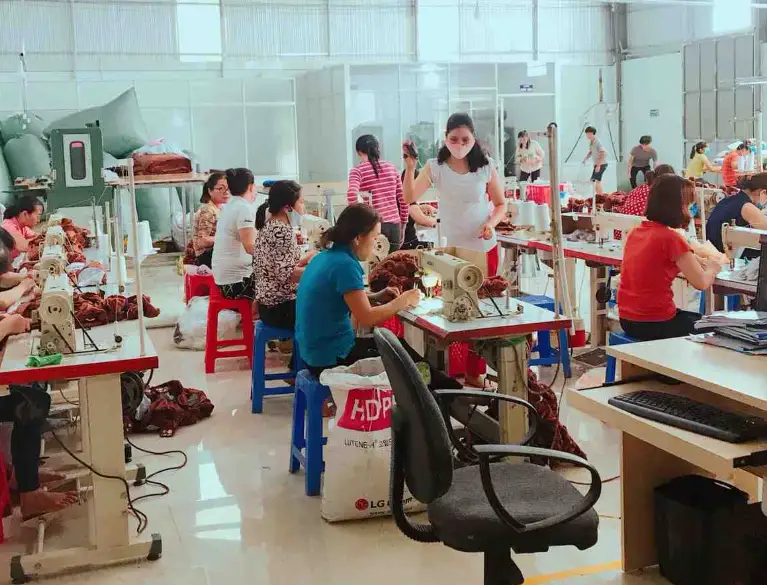
Lean manufacturing works best as a continuous discipline rather than a one-time cleanup exercise. Short, regular reviews — sometimes called kaizen sessions — where line supervisors and operators discuss what slowed the line down that week keep waste identification current as product mix and order volume shift. These reviews do not need to be elaborate; a fifteen-minute weekly discussion anchored around the seven waste categories, with specific examples from that week’s production, is often more sustainable and more effective than an infrequent, large-scale workflow audit.
Tip: Walk the physical floor layout with the seven wastes list in hand before investing in new equipment. Many plush toy factories find that relocating a stuffing station closer to the sewing line, or repositioning trim bins within an operator’s reach, removes more wasted time than any single machine purchase would.
Technology and Automation Opportunities in Plush Toy Manufacturing
Full automation remains limited in plush toy production because soft, irregular materials are difficult for robotic systems to handle with the same reliability as rigid components. Automation is best applied selectively, at specific stages where the material behaves predictably.
Automation and Technology Opportunities by Production Stage
| Stage | Automation Option | Practical Fit |
|---|---|---|
| Design & grading | Digital pattern grading and 3D prototyping software | High — reduces sample cycles and grading error |
| Cutting | CNC/laser cutting with nesting software | High for repeat styles and larger orders |
| Sewing | Automated seam guides, programmable stitch patterns | Moderate — supports but does not replace operators |
| Stuffing | Metered filling machines | High for regularly shaped, high-volume styles |
| Quality inspection | Metal/needle detection scanners, digital pull-test rigs | High — safety-critical and well suited to automation |
| Packaging | Automated poly-bagging and carton sealing lines | High for standardized packaging formats |
Metered filling machines and metal/needle detection are generally the highest-value automation investments for a mid-sized plush toy factory: both address stages where manual variation directly affects finished-product safety and consistency, and both have a relatively short payback period compared to attempting to automate sewing, which remains the hardest stage to mechanize reliably.
When evaluating any automation investment, it is worth weighing payback period against product mix stability. Equipment that is highly efficient for a single, stable style — a fixed-shape stuffing nozzle calibrated for one bear body, for example — can lose much of its advantage on a production floor that changes styles frequently, since recalibration and changeover time eat into the throughput gain. Automation investments generally deliver the strongest return on styles and stages with the most volume and the least frequent specification change.
Measuring Workflow Performance: KPIs Worth Tracking
Workflow optimization is only sustainable if it is measured. Without ongoing metrics, improvements made during a single push tend to erode as staff turns over and order mixes change. A small, consistent set of workflow KPIs is more useful than a large dashboard that nobody reviews regularly.
- Cycle time per unit, by stage — tracked separately for cutting, sewing, stuffing, finishing, and packaging so a slowdown can be traced to its source rather than blamed on the wrong department.
- First-pass yield — the percentage of units that clear every quality checkpoint without rework, a strong leading indicator of overall process health.
- Line efficiency against takt time — how closely actual sewing line output tracks the pace required to meet the schedule.
- Fabric utilization rate — actual fabric consumed against the theoretical minimum from nesting software, a direct measure of cutting-stage efficiency.
- On-time delivery rate — the percentage of orders shipped within the originally confirmed window, which captures the cumulative effect of every upstream workflow decision.
Reviewing these metrics weekly, rather than only at the end of a production cycle, allows a factory to catch a developing bottleneck — such as a fabric utilization rate that is quietly drifting downward — before it affects an entire season’s output.

Common Bottlenecks and How Factories Resolve Them
Certain bottlenecks recur across plush toy factories regardless of scale, and most trace back to a handful of root causes: uneven line balancing, poor synchronization between cutting and sewing, insufficiently distributed quality checkpoints, and late-arriving packaging materials. Addressing these four areas in sequence — starting with sewing line balance, since it consumes the largest share of cycle time — typically produces the largest early gains, with the remaining stages yielding smaller but still meaningful improvements once the core bottleneck is resolved.
It is worth noting that workflow optimization is not a one-time project. Product mix, fabric sourcing conditions, and order volume all shift over time, and a workflow balanced for one season’s product line may develop new bottlenecks when the next season introduces a more complex character style or a new safety testing requirement. Treating workflow review as a recurring discipline — not a single redesign — is what keeps the gains from eroding.
Frequently Asked Questions
What is the single most effective first step in optimizing a plush toy production workflow?
Time-studying each production stage separately is usually the most effective starting point. Many factories assume they know where their bottleneck is, but a formal stage-by-stage time study frequently reveals that a delay attributed to sewing actually originates upstream at cutting or material sourcing. Without this baseline data, workflow changes are guesses rather than targeted fixes, and resources can be spent correcting a stage that was never the real constraint.
How much can workflow optimization reduce plush toy lead times?
The improvement varies by starting condition and product complexity, but factories that address sewing line balance, cutting-to-sewing synchronization, and distributed quality checkpoints together typically see meaningful reductions in total lead time compared to a workflow with a single end-of-line inspection and no formal line balancing. The largest gains usually come from eliminating waiting time between stages rather than from speeding up any single operation.
Should quality control be concentrated at the end of the line or spread across the workflow?
Distributing quality checkpoints across the workflow — at incoming materials, post-cutting, in-line sewing, post-stuffing, and pull-testing, in addition to final inspection — is more effective than relying on a single final checkpoint. Catching a defect early, before additional labor and materials are invested in the unit, is both cheaper to correct and faster to trace back to its root cause than discovering the same defect only at final inspection.
Is full automation realistic for plush toy manufacturing?
Full automation is not realistic with current technology because soft, irregularly shaped fabric and filling materials are difficult for robotic systems to handle with the reliability that sewing and hand-finishing require. Selective automation — metered stuffing machines, CNC/laser cutting with nesting software, and automated metal/needle detection — delivers strong returns at specific stages, but sewing and detailed finishing remain predominantly manual across the plush toy manufacturing industry.
What causes the most variation in finished plush toy weight and firmness?
Inconsistent manual stuffing is the most common source of weight and firmness variation, particularly when operators rely solely on touch rather than a written fill-weight target checked periodically with a scale. Fill density can also drift over the course of a shift as operators fatigue or as filling material settles in a feed hopper, which is why mid-shift weight checks are a practical safeguard even on lines that are otherwise well trained.
How does line balancing improve sewing throughput?
Line balancing distributes sewing operations across workstations so that no single station’s cycle time significantly exceeds the line’s takt time. When one station is chronically slower than the rest, work-in-progress accumulates in front of it regardless of how efficiently every other station performs, and the line’s total output is capped by that single constrained step. Rebalancing — by splitting an operation, adding a machine, or cross-training operators — removes that ceiling.
Why does embroidery sequencing matter for workflow efficiency?
Embroidering a flat, pre-sewn fabric panel is faster, more precise, and less risky than embroidering a fully stuffed, three-dimensional toy, since a flat panel feeds through embroidery equipment more predictably and avoids the risk of needle damage to already-completed units. Wherever the pattern design allows facial or surface embroidery to happen before stuffing, sequencing it earlier in the workflow is one of the more reliable throughput improvements available in plush toy finishing.
What role does packaging play in overall workflow lead time?
Packaging is often underestimated in workflow planning, but poly-bagging, hang-tagging, and market-specific labeling can consume a meaningful share of total cycle time, especially on multi-market orders with different compliance labeling requirements per destination. Preparing labeling artwork and packaging materials in parallel with production — rather than after units are already finished — prevents finished toys from sitting idle in a staging area waiting on printed materials.
How often should a plush toy factory revisit its workflow optimization plan?
Workflow optimization should be treated as an ongoing discipline rather than a one-time redesign, since product mix, fabric sourcing conditions, and order volume shift over time. A workflow balanced for a simpler product line can develop new bottlenecks when a more complex character style, added electronics, or a new compliance requirement enters the mix. Reviewing core KPIs — cycle time by stage, first-pass yield, line efficiency, fabric utilization, and on-time delivery — on a regular weekly or monthly cadence helps catch a developing bottleneck before it affects an entire production season.