Skip to content
Everything toy brand owners, product developers, and sourcing teams need to know about building a reliable quality assurance system for plush toy manufacturing — from incoming material checks to final random inspection and certification.
What Is a Quality Assurance System for Plush Toy Manufacturing?
A quality assurance system for plush toys is the structured set of inspections, tests, and documentation checkpoints applied across every stage of production — from raw material receiving through cutting, sewing, stuffing, finishing, and final packing — designed to catch defects and safety issues before a shipment leaves the factory. Unlike a single final inspection performed at the end of a production run, a proper QA system is layered, meaning problems are caught as early as possible in the process, when they are cheapest and fastest to correct.
Plush toys carry a particular quality assurance burden compared to many other product categories because they combine textile manufacturing risk (seam strength, fabric flammability, colorfastness), mechanical safety risk (small parts, pull-force resistance on eyes and attachments), and chemical safety risk (dye compliance, stuffing material purity) into a single soft-goods product that is frequently marketed to very young children. A weak QA system does not just create cosmetic defects — it creates genuine safety exposure and regulatory risk.
This guide walks through each layer of a comprehensive plush toy QA system, the testing standards commonly referenced at each stage, and the documentation practices that make a QA program defensible and auditable rather than just a checklist performed informally on the factory floor.

Quality Assurance System Components at a Glance
Before examining each stage individually, the table below summarizes the core layers of a complete plush toy QA system and what each layer is designed to catch.
Core Layers of a Plush Toy Quality Assurance System
| QA Layer | When It Occurs | Primary Purpose |
|---|---|---|
| Incoming material inspection | Before cutting begins | Verify fabric, fiber fill, and component quality before they enter production |
| In-process quality control | During cutting, sewing, and stuffing | Catch construction defects while they are still cheap to correct |
| Pull testing and mechanical safety testing | Sample-based, throughout production | Confirm eyes, noses, and attachments resist separation forces |
| Final random inspection (AQL) | Before shipment, on finished packed goods | Statistically verify the overall shipment meets defect tolerances |
| Third-party lab testing | Pre-production and periodic retesting | Certify compliance with applicable toy safety regulations |
| Metal detection and contamination control | Final stage, unit by unit | Screen for broken needles or foreign metal objects inside the toy |
| Documentation and traceability | Ongoing across all stages | Create an auditable record linking each shipment back to its inspection history |
Incoming Material Inspection
Every effective QA system starts before a single piece of fabric is cut. Incoming material inspection screens raw fabric rolls, fiber fill, and hardware components against agreed specifications, since a defect introduced at the material stage propagates into every unit produced from that batch.
Fabric and Fiber Inspection Criteria
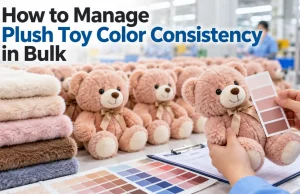
Fabric rolls are typically checked for color consistency against an approved lab dip or swatch standard, pile height and density uniformity for faux fur and minky-type materials, and physical defects such as thin spots, dye streaks, or weaving flaws. Fiber fill — whether polyester hollow-fiber stuffing, recycled fill, or specialty fill for weighted plush — is checked for cleanliness, loft recovery, and absence of foreign material or clumping, since inconsistent fill directly affects both the tactile quality and the shape retention of the finished toy.
Component Inspection (Eyes, Noses, and Accessories)
Hardware components such as safety eyes, noses, joints, and any snap or button accessories are inspected against dimensional specifications and, critically, against pull-force performance requirements before they are approved for use on the line. Any component batch that fails incoming inspection should be quarantined and rejected rather than allowed onto the cutting or sewing floor, since downstream rework after a defective component has already been sewn into a partially finished toy is dramatically more expensive than catching it at receiving.
Tip: Require a signed incoming inspection record for every fabric and component lot, not just a verbal pass/fail from the line supervisor. A documented, batch-linked record is what allows a defect to be traced back to its source lot if a problem surfaces later in production or after shipment.
In-Process Quality Control During Production
In-process quality control, sometimes called DUPRO (during production) inspection, monitors the toy as it moves through cutting, sewing, and stuffing rather than waiting until the finished product is complete. This layer is where the majority of correctable defects are actually caught in a well-run facility.
Cutting and Sewing Line Checkpoints
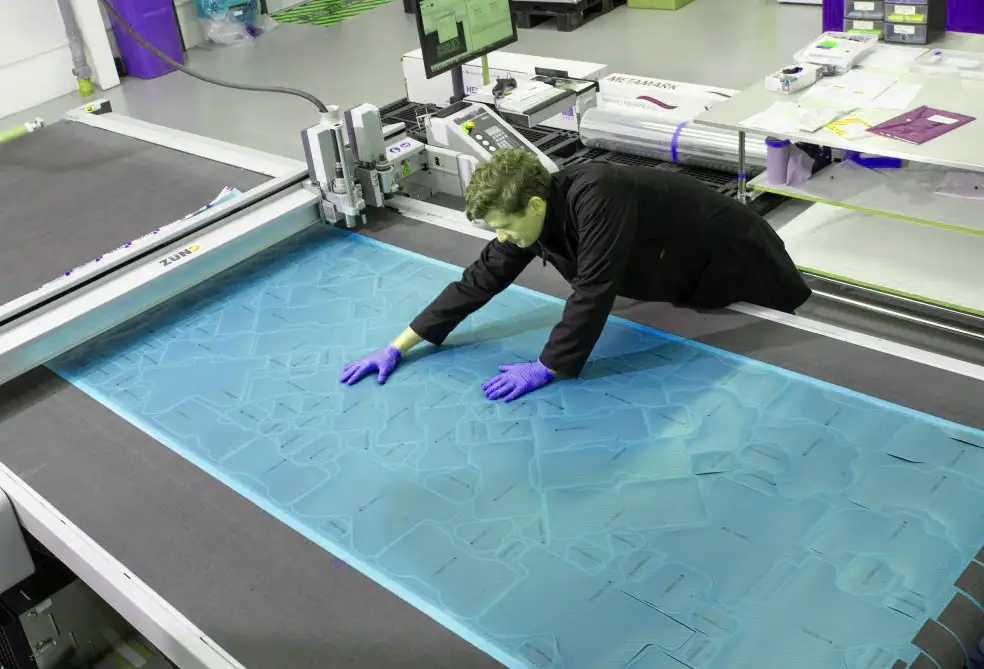
Cutting checkpoints verify that pattern panels are cut accurately, that fur or pile direction is consistent across panels destined for the same toy, and that fabric flaws identified during incoming inspection have not been cut into visible areas of the finished piece. Sewing line checkpoints monitor seam allowance consistency, stitch density and tension, and proper reinforcement at stress points — particularly around limb attachments, neck seams, and any point where a safety eye or accessory penetrates the fabric.
Stuffing and Weight Control
Stuffing density directly affects both the tactile feel of the finished plush and its compliance with weight-related safety and shipping requirements. Many QA systems specify a target fill weight range per unit by size category, checked periodically during the stuffing stage with a calibrated scale, since underfilled units feel cheap and floppy while overfilled units can stress seams prematurely or exceed target unit weight for cost and shipping calculations.
Tip: Set fill-weight checkpoints at fixed intervals (for example, every 30th to 50th unit) rather than relying only on visual assessment by the stuffing operator. Weight drift tends to happen gradually across a shift and is much easier to catch with periodic scale checks than by eye.
Pull Testing and Mechanical Safety Testing
Pull testing verifies that safety eyes, noses, bows, ribbons, and any other attached component can withstand a specified tension force without separating from the plush body — a direct simulation of a child pulling or tugging at the component. This is one of the most safety-critical tests in the entire QA system, since a detached small part is a primary choking hazard mechanism in soft toys.
Common Mechanical Safety Testing Benchmarks for Plush Toys
| Test Type | What It Evaluates | Typical Benchmark | Referenced Standard |
|---|---|---|---|
| Tension (pull) test | Force required to detach eyes, noses, or accessories | Approx. 90 N sustained without separation (age 3+ products) | ASTM F963, EN 71-1 |
| Torque test | Resistance to twisting force on attached components | Component-specific torque threshold, no rotation-induced failure | EN 71-1, ISO 8124 |
| Small parts cylinder test | Whether a detached component fits entirely within a small-parts test cylinder | Fail if component fits fully within the cylinder (age-dependent) | ASTM F963, 16 CFR 1501 |
| Seam strength test | Resistance of sewn seams to bursting or separating under stress | Minimum sustained load without seam failure | Internal QA spec, often aligned with EN 71-1 |
| Flammability test | Rate of flame spread across fabric surface | Must not exceed specified burn rate threshold | 16 CFR 1610, EN 71-2 |
Pull testing should be applied at multiple points in the production timeline, not only during pre-production sample approval. A component and fabric combination that passes testing on an early sample can behave differently on a bulk production batch if fabric weight, washer type, or insertion pressure drifts even slightly, which is why in-line pull testing during mass production is considered a baseline requirement rather than an optional extra.
Tip: Retest pull-force performance whenever any input variable changes — a new fabric lot, a substitute washer type, or a different eye supplier — even if the original combination previously passed. Pull-force results are specific to the exact material combination tested, not to the component alone.
Final Random Inspection (AQL) and Statistical Sampling
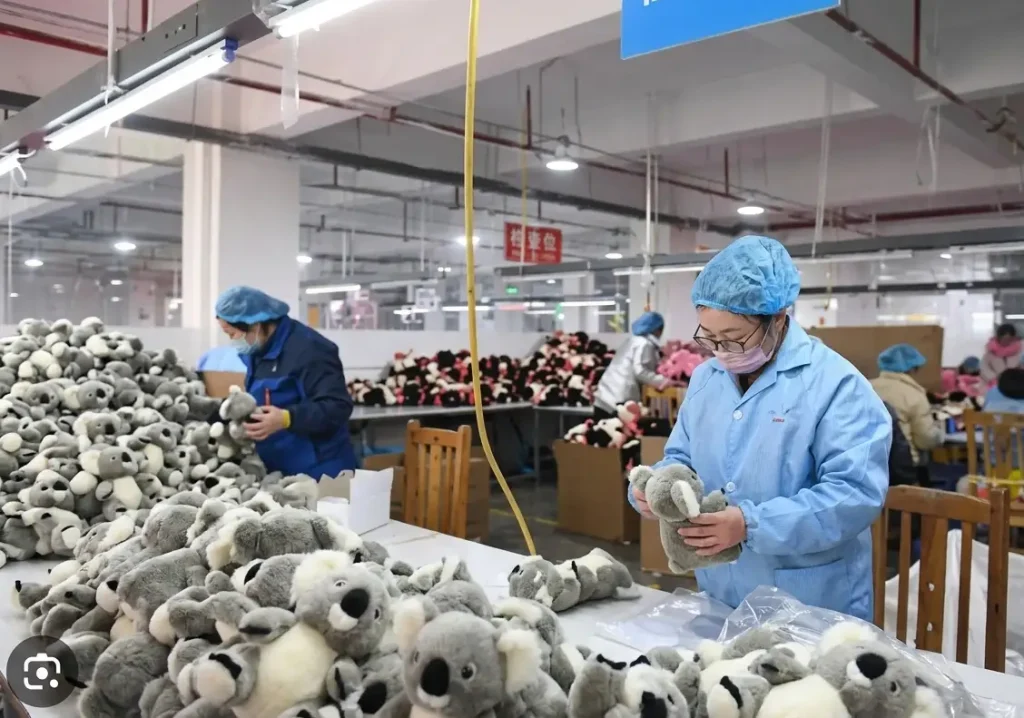
Final random inspection applies statistical sampling methodology, most commonly based on Acceptable Quality Limit (AQL) tables, to a finished and packed shipment before it leaves the factory. Rather than inspecting every single unit — which is rarely practical at production volume — a statistically representative sample is drawn and inspected, and the defect count found in that sample determines whether the full shipment passes or fails.
Common AQL Levels Used in Plush Toy Final Inspection
| Defect Classification | Typical AQL Level | Example Defects |
|---|---|---|
| Critical defects | 0 (zero tolerance) | Sharp points, exposed wires, choking hazards, non-compliant labeling |
| Major defects | 2.5 | Visible seam failure, significant color mismatch, missing safety label |
| Minor defects | 4.0 | Loose thread, minor stain, slight asymmetry, small packaging blemish |
A shipment with even one critical defect found in the sample typically results in an automatic failed inspection, reflecting the zero-tolerance approach applied to genuine safety hazards, while major and minor defect categories use a calculated acceptance number based on sample size. Sample size itself scales with total shipment quantity according to standardized sampling tables, meaning larger orders require proportionally larger inspection samples rather than a fixed inspection quantity regardless of order size.
Third-Party Lab Testing and Certification
While in-house and in-line QA checks catch the majority of production defects, independent third-party laboratory testing provides the formal compliance documentation required to legally sell a plush toy in most target markets. Third-party labs test finished samples against the full battery of applicable toy safety standards, covering mechanical, chemical, and flammability requirements simultaneously.
Common Certifications and Test Reports for Plush Toys by Market
| Market / Region | Applicable Standard | Covers |
|---|---|---|
| United States | ASTM F963, CPSIA | Mechanical, physical, flammability, and chemical (lead, phthalates) requirements |
| European Union | EN 71 (Parts 1, 2, 3), CE marking | Mechanical/physical, flammability, and migration of certain chemical elements |
| United Kingdom | UKCA marking, EN 71 alignment | Equivalent framework to EU requirements post-transition |
| International reference | ISO 8124 | Mechanical and physical properties, widely referenced across export markets |
| General chemical safety | REACH (EU), CPSIA (US) | Restricted substance limits in dyes, coatings, and stuffing materials |
Certification is not a one-time event. Most retailers and regulatory frameworks expect periodic retesting, particularly whenever a material, supplier, or construction detail changes, since a certificate issued for one specific product configuration does not automatically extend to a modified version of that product.
Metal Detection and Contamination Control
Metal detection is typically the final physical checkpoint before packing, screening every individual unit for broken needle fragments or other metallic contamination that could have entered the toy during sewing. Given that sewing machine needles occasionally break during high-volume stitching, and a fragment can become lodged inside stuffing without being visually detectable, unit-by-unit metal detection is considered a non-negotiable step for any plush toy production run, not an optional add-on reserved for premium orders.
Effective contamination control also extends beyond metal detection to general housekeeping discipline on the production floor — controlled needle inventory counts at the start and end of each shift, immediate reporting and documentation of any broken needle, and a clear hold-and-inspect protocol for any unit produced in the affected time window if a needle break is discovered mid-shift.
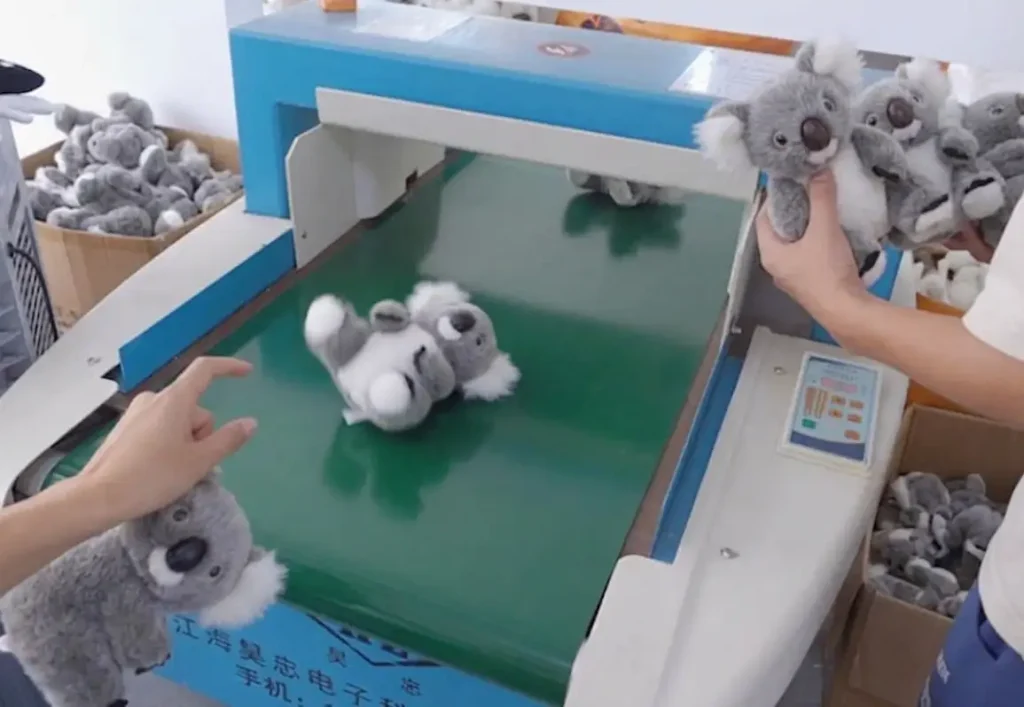
Tip: Log every needle breakage incident with a timestamp and the specific machine and unit range affected. This turns metal detection from a blanket final-stage screen into a targeted, traceable control that can isolate exactly which units need additional scrutiny.
Documentation, Traceability, and QA Reporting
A quality assurance system is only as strong as its documentation. Without records, individual inspections become isolated events rather than a connected system capable of identifying patterns, tracing a defect back to its source, or demonstrating due diligence if a compliance question arises after shipment.
Key Documentation Types in a Plush Toy QA Program
| Document Type | Purpose | Retention Consideration |
|---|---|---|
| Incoming material inspection records | Link raw material lots to specific production batches | Retained for the product’s full sales and warranty life |
| In-process inspection logs | Track defect rates and checkpoint results during production | Useful for identifying recurring line-level issues over time |
| Pull test and mechanical test reports | Demonstrate safety compliance for specific component/fabric combinations | Retained and cross-referenced with material lot changes |
| AQL final inspection reports | Formal pass/fail record for each shipment | Typically required by retailers and customs authorities |
| Third-party lab certificates | Regulatory compliance documentation for target markets | Retested and reissued whenever product configuration changes |
| Needle/metal detection logs | Traceability for contamination control incidents | Referenced in case of any post-shipment safety inquiry |
Tip: Store all QA documentation in a format that allows a single finished shipment to be traced backward through every checkpoint — material lot, in-process log, pull test result, and final AQL report. This “full traceability chain” is what separates a genuinely audit-ready QA system from a collection of disconnected paperwork.
Common Plush Toy Defects and QA Detection Methods
Understanding which defects tend to occur at which stage helps a QA system allocate inspection effort efficiently rather than spreading equal attention across every possible issue.
Common Plush Toy Defects and Where They Are Typically Caught
| Defect | Typical Root Cause | QA Layer That Catches It |
|---|---|---|
| Color/shade mismatch | Dye lot variation, uncontrolled fabric sourcing | Incoming material inspection |
| Loose or detaching eyes | Incorrect washer, insufficient insertion pressure | Pull testing, in-process spot checks |
| Uneven or thin stuffing | Inconsistent fill weight, operator variance | In-process weight checks |
| Seam puckering or gapping | Incorrect tension, mismatched panel curves | In-process sewing checkpoints |
| Off-grain fur direction | Cutting error, incorrect nesting orientation | Cutting stage inspection |
| Foreign metal contamination | Broken sewing needle fragment | Metal detection, final stage |
| Odor or chemical non-compliance | Non-certified fill or dye source | Third-party lab testing |

Building a QA System for Your Plush Toy Program
Assembling these layers into a coherent program does not require every checkpoint to be equally elaborate from day one. A practical starting sequence usually looks like this:
- Lock incoming material specifications for fabric, fill, and hardware components, with clear accept/reject criteria communicated to suppliers in advance.
- Define in-process checkpoints at cutting, sewing, and stuffing stages, with a fixed inspection frequency rather than discretionary spot-checking.
- Establish pull-force and mechanical testing protocols both at sample approval and at intervals throughout mass production.
- Set AQL levels appropriate to the product’s risk category, applying zero tolerance to any safety-critical defect class.
- Schedule third-party certification and retesting aligned with target market requirements and any material or design change.
Programs targeting infant-safe or 0+ age positioning should generally apply the strictest version of every layer described above, since the margin for error narrows considerably when the end user cannot self-report discomfort or avoid putting a small part in their mouth. For general retail plush aimed at older age groups, the same framework still applies, though testing thresholds and AQL tolerances may be calibrated differently based on the product’s actual risk profile and target market regulations.
Frequently Asked Questions
Q1. What is the difference between in-process quality control and final random inspection?
In-process quality control happens continuously during cutting, sewing, and stuffing, catching construction defects while a unit is still being built and while corrections are relatively cheap. Final random inspection, typically based on AQL sampling, happens after production is complete and units are packed, statistically sampling the finished shipment to verify it meets defect tolerances before it ships. Both layers are necessary; in-process control prevents defects from accumulating, while final inspection verifies the overall shipment quality before it leaves the factory.
Q2. How often should pull testing be performed during production?
Pull testing should be performed at pre-production sample approval and then repeated at intervals throughout mass production, not treated as a one-time check. It should also be retested any time an input variable changes — a different fabric lot, washer type, or component supplier — since pull-force performance is specific to the exact combination of materials tested rather than to any single component in isolation.
Q3. What AQL level is appropriate for plush toys sold to infants?
Critical defects — anything that presents a genuine safety hazard, such as a detachable small part or exposed sharp point — should always be held to a zero-tolerance AQL level regardless of the product’s target age. For major and minor defect categories, brands marketing to infants often apply tighter AQL levels than standard retail plush, reflecting the reduced margin for error when the end user cannot self-report discomfort or reliably avoid putting components in their mouth.
Q4. Why is metal detection necessary if the sewing process is carefully controlled?
Even in a well-controlled sewing environment, needles occasionally break during high-volume stitching, and a broken fragment can become lodged inside stuffing without being visible from the outside. Because this risk cannot be fully eliminated through process control alone, unit-by-unit metal detection at the final stage is considered a standard, non-negotiable safeguard rather than an optional extra reserved for specific orders.
Q5. Does passing third-party lab certification guarantee that every unit in a production run is safe?
No. Third-party certification confirms that a specific tested sample, built from a defined material and construction combination, meets the applicable safety standard at the time of testing. It does not by itself guarantee every unit in a mass production run performs identically, which is why certification is paired with in-process quality control, in-line pull testing, and final AQL inspection rather than relied upon as the sole safeguard.
Q6. What documentation should a factory be able to provide for a completed shipment?
A well-documented shipment should be traceable through incoming material inspection records, in-process inspection logs, pull test and mechanical test reports, the final AQL inspection report, relevant third-party lab certificates, and metal detection or needle-tracking logs. Together, these documents allow a single finished shipment to be traced backward through every quality checkpoint it passed through during production.
Q7. How does incoming material inspection prevent downstream production problems?
Incoming material inspection screens fabric, fiber fill, and hardware components against agreed specifications before they enter the cutting or sewing line. Catching a defective fabric roll or a substandard component batch at receiving is significantly cheaper and faster than discovering the same defect after it has already been cut, sewn, or stuffed into a partially completed toy, which is why this layer is treated as the foundation of the entire QA system.
Q8. What causes most seam-related defects, and at what stage are they typically caught?
Seam-related defects such as puckering, gapping, or premature seam failure are most often caused by incorrect stitch tension, mismatched panel curves from pattern or cutting error, or insufficient reinforcement at stress points like limb attachments. These issues are generally caught during in-process sewing checkpoints, since visual and structural seam quality is far easier to assess and correct while the unit is still on the line than after final packing.
Q9. How does AQL sample size scale with total shipment quantity?
AQL sampling uses standardized tables that increase the required inspection sample size as total shipment quantity grows, rather than applying a fixed sample size regardless of order volume. This means larger production runs require proportionally larger inspection samples to maintain the same statistical confidence level, ensuring that the sampling methodology remains representative of the full shipment as order size scales up.