Skip to content

A practical breakdown of the mechanical, chemical, flammability, and labeling certifications that govern plush toy imports into the United States, European Union, United Kingdom, Canada, and Australia — plus the documentation buyers should request before goods ship.
Plush toy safety certification is the set of test standards, documentation, and labeling requirements that a stuffed toy must satisfy before it can legally enter a given market. For buyers sourcing from overseas factories, understanding which certifications apply — and which test reports actually prove compliance — is the difference between a smooth customs clearance and a shipment held at port, a retailer chargeback, or a product recall.
This guide walks through the certification landscape market by market, explains what chemical and mechanical testing actually measures, and lists the documents a buyer should have in hand before placing a production order. It is written for import managers, product developers, and retail buyers who need working knowledge of plush toy compliance rather than a legal reference.
What Plush Toy Safety Certifications Actually Cover
A plush toy safety certification is not a single certificate — it is a bundle of test results against several standards, each addressing a different category of risk. Regulators generally group requirements into four buckets: mechanical and physical safety (choking hazards, sharp points, durability of eyes and seams), chemical safety (heavy metals, phthalates, flammable finishes), flammability, and labeling or age grading. A plush toy that passes only one of these categories is not compliant; full certification requires passing all applicable categories for the destination market, and the required tests differ from country to country.

For toy buyers, certification serves three practical purposes. First, it is a legal precondition — most target markets prohibit the sale of toys that have not been tested against the relevant standard. Second, it is a risk-management tool — a documented, third-party test report is the buyer’s primary evidence of due diligence if a product safety issue is ever raised. Third, it is a sourcing filter — factories that maintain current, batch-specific test reports and understand which standards apply to which markets are generally the same factories that run disciplined quality systems overall.
It also helps to understand how certification differs from a general quality inspection. A quality inspection checks whether a plush toy matches the approved sample — stitch density, stuffing weight, color accuracy, packaging presentation. Certification testing checks something narrower and more consequential: whether the toy, as constructed from the specific materials used, meets a legal safety threshold in the destination market. A toy can pass every quality inspection point and still fail certification if, for example, the dye lot used for a fabric batch carries elevated lead content, or a new trim supplier’s plastic eyes were not re-tested for tension strength. Buyers who conflate the two checks often assume a “quality-approved” sample is automatically safety-certified, which is not a safe assumption to carry into a purchase order.
Core Safety Standards by Target Market
Plush toys destined for different regions are governed by different national or regional toy safety frameworks. Buyers selling into multiple markets from a single production run need to identify the strictest applicable requirement for each risk category and test to that level, rather than assuming one country’s certificate satisfies another’s regulator.
United States: CPSIA, ASTM F963, and CPSC Requirements
In the United States, plush toys fall under the Consumer Product Safety Improvement Act (CPSIA) and the mandatory toy safety standard ASTM F963, which is enforced by the Consumer Product Safety Commission (CPSC). ASTM F963 sets mechanical and physical requirements — small parts testing, tension and torque testing on attached components such as eyes, noses, and bows, sharp point and edge testing, and cord and elastic length limits for toys intended for children under three. CPSIA layers on additional chemical limits, most notably total lead content in substrate materials and lead content in surface coatings, plus restrictions on eight specific phthalates in accessible plasticized components.
Every children’s product sold in the US requires a Children’s Product Certificate (CPC) based on testing performed by a CPSC-accepted third-party laboratory, and permanent tracking labels identifying the manufacturer, production location, and production date. Buyers importing into the US should treat the CPC and the underlying lab reports as non-negotiable shipping documents, not optional paperwork.
Tip: Ask the factory for the CPC and the full third-party lab report — not just a one-page summary certificate. A summary can omit which specific components were tested, which is exactly the detail a buyer needs to confirm coverage of trims, closures, and any electronic inserts.
European Union: EN 71, REACH, and the Toy Safety Regulation
The EU governs toys under the Toy Safety Regulation, supported by the harmonized EN 71 series of standards. EN 71-1 covers mechanical and physical properties, EN 71-2 covers flammability, and EN 71-3 covers migration of specific elements such as lead, cadmium, arsenic, and mercury from accessible materials. EN 71-9, 71-10, and 71-11 address organic chemical compounds including certain flame retardants, plasticizers, and colorants used in textiles and stuffing. REACH regulation adds a broader chemical restriction list covering substances of very great concern, which applies to trims, printed graphics, and any plastic or electronic components attached to the plush body.
Compliant plush toys carry the CE mark, supported by a Declaration of Conformity and a technical file that the manufacturer or importer must be able to produce on request. As of 2024, the EU’s General Product Safety Regulation (GPSR) also requires an EU-based responsible person and additional traceability information for products sold into the bloc, including online marketplace listings.
United Kingdom: UKCA and Post-Brexit Divergence
Since the UK’s departure from the EU single market, toys sold in Great Britain generally require the UKCA mark rather than CE, based on UK-specific toy safety regulations that mirror EN 71 in substance but carry separate conformity assessment and marking requirements. Northern Ireland continues to accept the CE mark under the Windsor Framework. Buyers selling into both the EU and UK from the same production run typically need to secure both markings, even though the underlying test methods overlap substantially.
Canada: CCPSA and SOR/2011-17
Canada regulates plush toys under the Canada Consumer Product Safety Act (CCPSA) and the specific toy regulations set out in SOR/2011-17. Requirements closely parallel ASTM F963 for mechanical testing but apply Canada’s own limits for surface coating materials and require French-and-English bilingual labeling. Health Canada does not operate a mandatory third-party certification scheme comparable to the CPC, but importers remain legally responsible for demonstrating compliance if a product is investigated.
Australia and New Zealand: AS/NZS ISO 8124
Toys sold in Australia and New Zealand are tested against AS/NZS ISO 8124, a multi-part standard covering mechanical and physical safety (Part 1), flammability (Part 2), and specific element migration (Part 3), broadly aligned with the international ISO 8124 series. Australia’s mandatory toy safety standard incorporates AS/NZS ISO 8124-1 by reference, making compliance a legal requirement rather than a voluntary benchmark.
Other Markets Worth Tracking
Beyond the five markets summarized above, buyers shipping globally should be aware of a handful of additional national schemes. Japan applies the ST (Safety Toy) mark, a voluntary but widely expected certification administered against Japanese-specific test methods that parallel ISO 8124 in substance. South Korea requires KC certification under its Product Safety Framework Act, with mandatory pre-market testing through a Korea-recognized lab. China’s own domestic market applies the CCC (China Compulsory Certification) mark to certain toy categories sold within mainland China, which is a separate requirement from any export certification the same factory arranges for overseas buyers. None of these substitute for US, EU, UK, Canadian, or Australian requirements — they apply only when the finished goods are sold into those specific domestic markets.
Certification Requirements by Target Market
| Market | Governing Standard(s) | Required Marking | Key Documentation |
|---|---|---|---|
| United States | ASTM F963, CPSIA | Tracking label | Children’s Product Certificate (CPC), CPSC-accepted lab report |
| European Union | EN 71-1/2/3/9/10/11, REACH | CE mark | Declaration of Conformity, technical file, EU responsible person details |
| United Kingdom | UK Toys (Safety) Regulations | UKCA mark | UK Declaration of Conformity, UK-based responsible person |
| Canada | CCPSA, SOR/2011-17 | Bilingual label | Test records held by importer; no mandatory third-party certificate |
| Australia / New Zealand | AS/NZS ISO 8124 (Parts 1–3) | Compliance label | Test report from accredited lab; supplier declaration of conformity |
Requirements shown are the primary frameworks currently in force; buyers should confirm the latest amendments with their compliance team or testing lab before finalizing a production order, as toy safety regulations are updated periodically.
Chemical Safety Testing: What Gets Measured and Why
Chemical safety testing is where most first-time buyers underestimate the scope of certification. Because plush toys combine textile, stuffing, plastic trims, printed graphics, and sometimes electronic components, each material category can introduce a different chemical risk, and a single toy may require a dozen separate chemical assays before it clears certification.
Most chemical assays follow a two-stage logic: total content testing establishes how much of a restricted substance is present in the material overall, while migration or extraction testing simulates how much of that substance could realistically transfer to a child’s body through mouthing, skin contact, or ingestion of a small fragment. A material can carry a restricted substance in trace amounts and still pass, provided the migration result stays under the destination market’s limit — this is why raw material total-content figures and finished-product migration figures are reported separately on a full lab report, and why buyers should not assume a “zero detected” total content result and a “pass” migration result mean the same thing.

Heavy metals are tested primarily through total lead content in substrate materials, lead and other elements in surface coatings and printed inks, and migration testing that simulates how much of a restricted element could be absorbed if a child mouthed or ingested the material. Phthalates — plasticizers used to soften PVC components such as squeaker inserts, eyes, or vinyl trims — are restricted individually under both US and EU rules, with limits typically set at 0.1% by weight for each restricted phthalate.
Azo dyes, used in some fabric coloring processes, are restricted because certain azo compounds can break down into carcinogenic aromatic amines; EU and several other markets require azo dye testing on any dyed textile component. Formaldehyde, sometimes present as a byproduct of certain fabric finishing or adhesive processes, is tested because prolonged exposure is linked to respiratory and skin irritation.
Tip: Request XRF (X-ray fluorescence) screening data as a first-pass check during sampling, then confirm any borderline results with full wet-chemistry lab testing. XRF is fast and non-destructive, but it is a screening tool, not a substitute for the certified lab report a customs authority or retailer will ultimately require.
Chemical Safety Test Parameters and Common Limits
| Test Parameter | Applies To | Typical Limit / Standard |
|---|---|---|
| Total lead content | Fabric, stuffing, plastic substrate | ≤90–100 ppm depending on market |
| Lead in surface coatings | Printed trims, painted plastic eyes/noses | ≤90 ppm (US); ≤23 mg/kg soluble migration (EU) |
| Restricted phthalates | PVC components, vinyl trims, squeakers | ≤0.1% by weight per restricted phthalate |
| Azo dyes | Dyed textile and fabric components | Prohibited aromatic amines per EU list |
| Formaldehyde | Fabric finishing, adhesives | Market-dependent; typically low ppm thresholds |
| Cadmium and other elements | Fabric, trims, coatings | Migration limits per EN 71-3 / ASTM F963 |
Exact numeric limits vary by regulation version and material category; a buyer’s testing lab should confirm current thresholds against the specific standard version cited on the test report.
Mechanical and Physical Safety Testing
Mechanical testing addresses the risk that a physical component of the plush toy could detach, injure, or be swallowed by a child. For toys intended for children under three, or toys without an age grading that restricts them to older children, the small parts cylinder test is the foundation: any component that fits entirely inside a standardized test cylinder — approximating the size of a young child’s airway — fails the toy for that age category. This governs the design of eyes, noses, bows, buttons, and any small decorative trim.
Tension and torque testing evaluates whether attached components can be pulled or twisted off with a defined force, simulating a child tugging or biting at an eye, limb, or embroidered patch. Sharp point and sharp edge testing checks seams, wire armatures (used in some posable plush designs), and any exposed hardware. Cord, string, and elastic length limits restrict drawstrings, hanging ribbons, and neck cords on toys for young children, because long cords present a strangulation risk. For interactive or electronic plush toys with sound modules, motors, or LED components, additional testing covers battery compartment security — the compartment must resist opening with commonly available tools — and battery accessibility limits specific to small button-cell batteries.
Tip: Specify component attachment method in the product brief, not just the finished look. Embroidered or heat-pressed eyes generally pass tension testing more reliably than glued plastic eyes, and this decision is far cheaper to make at the design stage than after a failed lab report.
Mechanical and Physical Safety Test Requirements
| Test | What It Evaluates | Primary Risk Addressed |
|---|---|---|
| Small parts cylinder test | Whether a detached component fits inside a standardized airway-sized cylinder | Choking hazard |
| Tension test | Force required to pull off eyes, noses, bows, or trims | Component detachment |
| Torque test | Force required to twist off rotating or threaded components | Component detachment |
| Sharp point / sharp edge test | Exposed wire, seam edges, hardware | Laceration risk |
| Cord and elastic length test | Length of drawstrings, hanging cords, neck ribbons | Strangulation risk |
| Battery compartment security test | Resistance of battery covers to opening by a child | Battery ingestion risk |
Flammability Testing Requirements
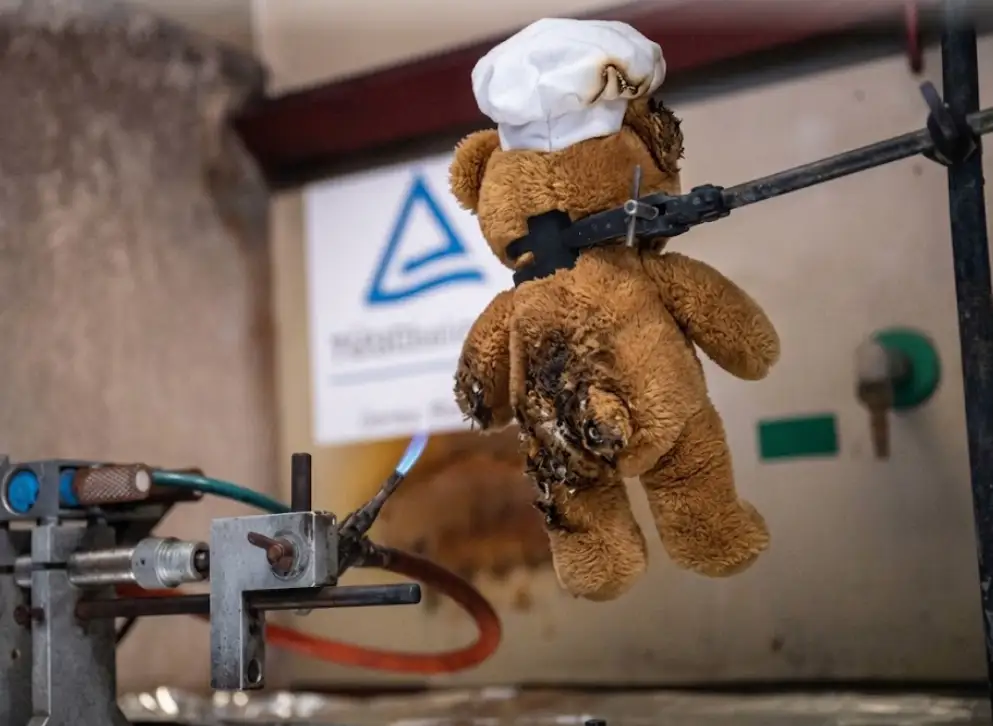
Flammability testing measures how quickly a fabric surface ignites and how fast a flame spreads across it once lit. Standards generally prohibit textiles that flash-burn or that support rapid, sustained flame spread, and most frameworks require testing on the actual pile or plush fabric used in production rather than a generic swatch, since pile height, fiber content, and stuffing density all affect burn behavior. Fur-like or high-pile fabrics are tested with particular attention because loose fiber surfaces can ignite differently from woven or knit fabrics.
US requirements sit within CPSC flammability rules referenced by ASTM F963, EU requirements are set out in EN 71-2, and Australia/New Zealand apply AS/NZS ISO 8124-2. While the underlying test methods are broadly similar — controlled ignition source, timed observation, measured burn rate — the pass/fail thresholds and reporting formats differ, so a flammability report generated for one market should not be assumed to satisfy another without review by the destination market’s testing standard.
Flammability Standards by Market
| Market | Standard | Fabric Types Requiring Extra Scrutiny |
|---|---|---|
| United States | CPSC flammability rules / ASTM F963 | High-pile plush, brushed fur fabrics |
| European Union | EN 71-2 | Pile fabrics, loose-fiber textures |
| United Kingdom | UK Toys (Safety) Regulations | Pile fabrics, loose-fiber textures |
| Australia / New Zealand | AS/NZS ISO 8124-2 | High-pile plush, faux fur |
Labeling and Age Grading Requirements
Labeling requirements are frequently the last item reviewed and the most common reason for a compliant product to be rejected at customs or by a retailer’s incoming inspection. At minimum, most markets require: country of origin, manufacturer or importer identity and contact information, age grading or age warning where applicable, material content declaration in some jurisdictions, and choking hazard warnings for toys containing small parts or balloons that are age-graded for children three and older but include small-part components.
The US additionally requires permanent tracking labels — printed or attached in a way that survives normal use — encoding the manufacturer, production location, and production date range, so that a specific batch can be traced in the event of a recall. The EU requires the CE mark plus manufacturer and importer identification directly on the product or packaging where the product size allows, and Canada requires bilingual French/English text on both the product packaging and any included instructions.
Tip: Review labeling artwork as a controlled document, the same way you would review a chemical test report. A misprinted age grading or a missing tracking label can hold an otherwise fully-tested shipment at customs just as effectively as a failed lab result.
Labeling and Documentation Requirements by Market
| Market | Required Label Elements | Language |
|---|---|---|
| United States | Tracking label (maker, location, date), age grading, choking hazard warning where applicable | English |
| European Union | CE mark, manufacturer/importer ID, age warning, material content in some categories | Local language of sale |
| United Kingdom | UKCA mark, responsible person details, age warning | English |
| Canada | Bilingual product and packaging text, age warning | English and French |
| Australia / New Zealand | Compliance label, age warning, supplier identification | English |
Documentation Buyers Should Request Before Shipping
A finished plush toy that “should be compliant” is not the same as a plush toy with documentation proving compliance. Buyers should build a standard document checklist into every purchase order and treat missing items as a hold on shipment, not a follow-up item to chase after goods have left the factory.
- Third-party lab test reports covering every applicable mechanical, chemical, and flammability standard for the destination market, dated within the validity window the destination regulator or retailer requires.
- Children’s Product Certificate (CPC) for US-bound shipments, referencing the specific product and the lab report that supports it.
- Declaration of Conformity for CE or UKCA-marked products, listing the specific directives and standards claimed.
- XRF screening records from incoming material inspection, useful as an internal quality checkpoint even when not legally mandatory.
- Batch or lot traceability records connecting the tested sample to the specific production run being shipped, since a test report on an earlier sample does not automatically cover a later production batch made with substituted materials.
- Material safety data sheets for stuffing fill, particularly for recycled or alternative fill materials where source consistency can vary between suppliers.
Tip: Re-test after any material substitution — a different fabric supplier, a new stuffing source, or a change in trim vendor can each independently invalidate a prior chemical test result, even if the toy’s design and appearance stay identical.
Pre-Production Testing Versus Ongoing Batch Testing
Certification testing happens at more than one point in the production cycle, and buyers benefit from understanding what each stage is meant to catch. Pre-production or golden sample testing occurs before mass production begins and validates the design, material selection, and component construction against the target standard. This is the appropriate stage to catch a fundamentally non-compliant design decision — an oversized small part, an untested trim, a fabric that has not been screened for restricted dyes — while changes are still inexpensive.
Once mass production is underway, batch or lot testing verifies that the actual production run matches the tested sample. This distinction matters because raw material suppliers sometimes substitute inputs between the sample stage and bulk production — a different fabric mill, a different stuffing lot, a different trim vendor offering a lower price — without necessarily informing the buyer. A pre-production pass does not guarantee the bulk shipment was made from identical materials, which is why many retailers and import compliance programs require periodic batch retesting for ongoing product lines rather than accepting a single historical report indefinitely.
Tip: Build a testing checkpoint into the purchase order itself — for example, requiring a batch test report before final payment releases — rather than relying on the factory to volunteer retesting on its own initiative. Payment terms tied to documentation are one of the most reliable ways to keep certification current across repeat orders.
Common Certification Mistakes Buyers Make
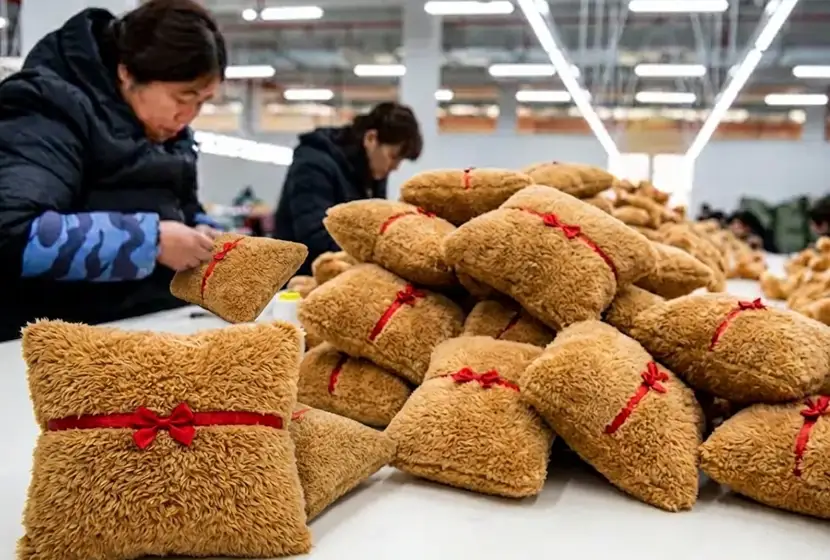
The most frequent compliance failure is treating a single test report as permanent coverage for an ongoing product line. Test reports are tied to a specific sample, from a specific production batch, tested against a specific standard version. A factory that reuses last year’s report for this year’s reorder — especially after a material or component substitution — is presenting outdated evidence, not current compliance.
A second common mistake is assuming that a product certified for one market automatically satisfies another. EN 71 and ASTM F963 overlap substantially in method but differ in specific numeric limits, required documentation, and marking. A third mistake is under-scoping the test plan to exclude trims, electronic inserts, or packaging components, all of which can independently trigger chemical or mechanical failures even when the core plush body passes.
Finally, buyers sometimes accept a certificate without confirming the testing laboratory’s accreditation status for the specific standard cited — an accredited lab for mechanical testing is not automatically accredited for chemical migration testing, and destination regulators can reject reports from unaccredited scopes. Report cost is not a reliable proxy for this — an efficiently run accredited lab can price competitively without cutting corners, while an unaccredited lab can charge similar rates for a report a customs authority will not accept. The relevant question is always whether the issuing lab holds current accreditation for the exact standard and test method cited, not what the report costs.
What Certification Discipline Signals About a Factory
A factory’s approach to certification is one of the clearest signals of its overall quality culture. Facilities that proactively flag which standards apply to a buyer’s target market, maintain current accredited test reports without being asked, and document batch-level traceability are generally the same facilities that run tighter process control on stitching, stuffing density, and packaging. Conversely, a factory that treats test reports as a one-time formality, resists sharing full lab documentation, or cannot explain which specific components were covered by a given report is showing a certification red flag that often correlates with broader quality risk.
During factory evaluation, it is reasonable to ask to see test reports for a product similar to the one being sourced, before committing to a sample order. A factory’s response — fast, complete, and specific about which components were covered — tells a buyer more about its compliance discipline than any verbal assurance will, and it is one of the simplest diligence steps available before capital is committed to tooling or bulk fabric purchase.
Frequently Asked Questions
Do all plush toys need chemical testing, even simple designs with no electronics?
Yes. Chemical testing requirements apply based on materials used, not product complexity. A simple plush toy with dyed fabric, stuffing, and stitched or glued trims still requires testing for lead content, restricted phthalates in any plasticized components, and azo dyes on dyed textiles. The absence of electronics reduces the scope of mechanical and battery-related testing, but it does not exempt the toy from chemical safety requirements in any of the major target markets.
How long is a plush toy test report valid before it needs to be renewed?
There is no universal fixed expiration date written into most standards, but test reports are considered valid only for the specific production batch and material specification tested. Best practice — and the expectation of most retailers and customs authorities — is to retest whenever there is a material change (fabric, stuffing, trim supplier, or dye lot), and to conduct periodic batch retesting even without a known material change, commonly every six to twelve months for ongoing production, to catch unannounced supplier substitutions.
Can one test report cover both US and EU markets?
Generally no. While ASTM F963 and the EN 71 series share similar test methods for many mechanical and chemical parameters, the specific numeric limits, required standard editions, and documentation formats differ. A report generated solely against ASTM F963 will not satisfy EU customs or retailer requirements for CE marking, and vice versa. Buyers selling into both markets typically need separate test reports referencing each region’s specific standard, even if the physical testing procedure overlaps substantially.
What is the difference between a test report and a Children’s Product Certificate?
A test report is the laboratory’s detailed record of the specific tests performed and their results. A Children’s Product Certificate (CPC) is the legal document required for US-bound children’s products that certifies the product complies with all applicable children’s product safety rules, and it must cite the underlying test report(s) that support that certification. A CPC without an accessible, matching lab report behind it does not provide the documentation a buyer needs to demonstrate due diligence.
Are interactive plush toys with sound or motion sensors tested differently from standard plush toys?
Yes. Interactive plush toys with embedded electronics require additional testing beyond the standard mechanical, chemical, and flammability battery of tests. This typically includes battery compartment security testing to confirm the compartment resists opening by a child, electrical safety testing on the circuit and wiring, and, in some markets, electromagnetic compatibility testing if the product includes wireless or Bluetooth functionality. These additional requirements sit on top of, not instead of, the core plush toy safety certifications.
Who is legally responsible for certification — the factory or the importer?
Responsibility varies by market, but in most jurisdictions the importer of record carries primary legal responsibility for placing a compliant product on the market, even when the factory performed or arranged the testing. In the EU, this responsibility is formalized through the requirement for an EU-based responsible person. In the US, the importer is generally responsible for ensuring a valid Children’s Product Certificate exists before goods clear customs. Buyers should not treat factory-arranged testing as a transfer of legal liability, but rather as one input into their own compliance record.
What happens if a plush toy shipment fails certification testing after production is complete?
A failed test on a completed production run typically forces one of several outcomes: rework of the specific failing component if it is physically separable (for example, replacing a non-compliant trim), destruction or diversion of the batch to a market with different requirements, or, in the most severe cases, a full loss of the production run. This is why pre-production material testing and mid-production inspection are far less costly than post-production certification failure, and why buyers should build testing checkpoints into the production timeline rather than treating certification as a final-stage formality.