Skip to content
Everything product developers, importers, and retail buyers need to know about designing, testing, and sourcing plush toys that hold up to real dog and cat play while meeting current safety expectations.
What Does Plush Toy Safety for Pet Toys Actually Mean?
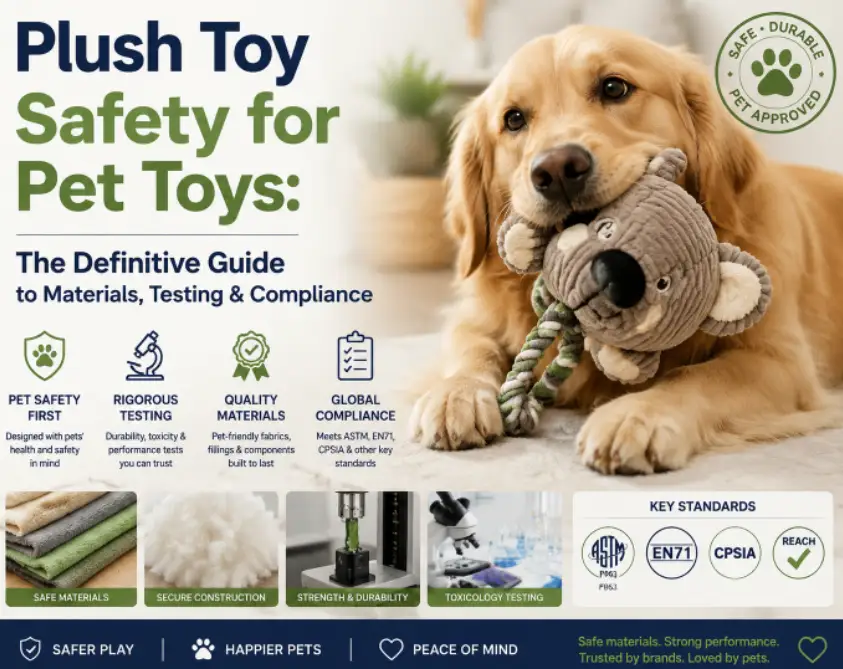
Plush toy safety for pet toys is the set of material choices, construction methods, and testing protocols that keep stuffed pet toys from becoming a choking hazard, an internal blockage risk, or a source of chemical exposure during normal chewing, shaking, and tugging.
Unlike a plush toy made for a child, a pet plush toy is expected to be bitten, shaken violently, dragged across floors, soaked in saliva, and — eventually — torn apart. Safety engineering for this category has to start from the assumption that the toy will fail structurally at some point, and the goal is to control how it fails so that failure does not create loose parts small enough to swallow or fabric that unravels into long strings a dog can ingest.
Pet plush toy safety sits at the intersection of three disciplines: materials science (fabric, fiberfill, thread), mechanical testing (bite force simulation, seam strength, pull testing), and regulatory or retail compliance (labeling, chemical restrictions, choking hazard warnings). A toy that scores well in only one of these areas is not a safe toy — it is a toy that has not yet failed in front of the wrong reviewer.
Why Pet Plush Toys Need a Different Safety Standard Than Children’s Toys
Many buyers assume that if a plush item passes children’s toy safety testing, it is automatically safe for pets. This assumption is incorrect, and it is one of the most common sourcing mistakes in the category.
Children’s plush toy standards, such as ASTM F963 and EN 71, are written around a human child’s mouth, bite force, and typical play behavior — mouthing, hugging, occasional chewing on an edge. A dog’s bite force, repetitive tearing motion, and intent to destroy the toy represent a fundamentally different mechanical stress profile. A seam that easily survives a toddler’s grip can open within minutes under a 30 kg dog’s jaw pressure.
Pet-specific durability testing therefore layers additional mechanical stress tests — tensile pull testing on seams and appendages, simulated chew cycles, and squeaker retention testing — on top of, or in place of, the chemical and choking-hazard testing inherited from children’s toy standards. Treating “child-safe” as synonymous with “pet-safe” overlooks the mechanical dimension entirely.
Breed and individual temperament add another layer of variability that children’s toy standards were never built to account for. A terrier bred for tugging and shaking behavior applies stress in a very different pattern than a retriever that carries a toy gently, and a determined chewer of any breed can defeat a seam that would comfortably outlast years of light play in another home. Safety testing that only reports a single pass/fail outcome, without noting the force or bite-cycle count used, tells a buyer very little about how the toy will actually perform once it reaches a range of real dogs.
Sourcing Tip: When a factory says a plush pet toy “passed safety testing,” always ask which standard and which test method was used. A toy tested only against a children’s chemical safety standard has not been evaluated for bite-force durability at all.
Materials and Construction: Building Safety Into the Toy From the Inside Out
Material selection is where pet plush toy safety is won or lost. Every layer of the toy — outer fabric, seam thread, stuffing, and internal reinforcement — contributes to how the toy behaves under repeated biting and shaking.
Outer Fabric Selection
Outer fabric needs to resist puncture and tearing while remaining soft enough to be appealing to the animal. Heavier fabric weights, measured in grams per square meter (GSM), generally correlate with higher tear resistance, though weave structure matters as much as weight. Ripstop-style weaves, double-layered plush, and canvas-reinforced panels on high-wear zones (ears, tails, limbs) extend usable life meaningfully compared to a single layer of standard short-pile plush.
Stuffing and Fill Materials
Polyester fiberfill remains the dominant stuffing material for pet plush toys because it is inexpensive, non-allergenic for most animals, machine-washable, and does not support mold growth when it gets wet — an important consideration given how often pet toys end up in a water bowl or outside in the rain. Fill density affects both the toy’s shape retention and how quickly it collapses under repeated crushing bites; underfilled toys tend to develop weak points faster because there is less material to distribute bite pressure.
Stitching, Seams, and Reinforcement
Seam failure is the single most common first point of failure in pet plush toys. Double-stitched or triple-stitched seams, combined with bar-tack reinforcement at stress points such as limb joints and tail attachments, dramatically increase the number of bite cycles a seam can withstand before opening. Thread type matters too — nylon or polyester bonded thread resists abrasion and heat generated by friction far better than standard cotton-wrapped thread.
Access Panels and Zipper Safety
Some pet plush toys include a zippered or hook-and-loop access panel, usually intended to let an owner remove and replace an internal squeaker. This feature introduces its own safety considerations: a zipper pull, slider, or exposed hook-and-loop edge is itself a rigid or abrasive component that can be chewed loose. When an access panel is included, the closure should be positioned away from the primary bite zone, backed by a fabric flap that prevents direct tooth contact with the hardware, and secured with a bar-tacked stitch line rather than adhesive alone. Toys designed for heavy chewers are often better served by omitting an access panel entirely and sealing the squeaker permanently inside the inner shell.
Material Selection Reference for Pet-Safe Plush Construction
| Component | Common Option | Durability Consideration | Safety Relevance |
|---|---|---|---|
| Outer fabric | Standard short-pile plush | Moderate tear resistance | Suitable for light chewers only |
| Outer fabric | Ripstop nylon or canvas panel | High puncture resistance | Reduces risk of rapid shredding |
| Stuffing | Polyester fiberfill | Retains shape, dries quickly | Low allergen risk, mold-resistant |
| Stuffing | Recycled fiber blends | Variable density consistency | Requires added QC checks for lumping |
| Seam thread | Cotton-wrapped thread | Lower abrasion resistance | Higher risk of early seam failure |
| Seam thread | Bonded nylon/polyester thread | High abrasion and heat resistance | Extends time to seam failure significantly |
| Reinforcement | Single-stitch seam | Lower bite-cycle tolerance | Recommended for supervised play only |
| Reinforcement | Double-stitch with bar-tack | Higher bite-cycle tolerance | Preferred for aggressive chewers |
Choking Hazards: Squeakers, Eyes, and Small Components
The component parts most likely to separate from a pet plush toy and create a choking or blockage hazard are squeakers, plastic eyes and noses, and any small decorative embellishment attached to the surface.

Squeaker Safety and Retention
A squeaker is a rigid plastic or metal component and is one of the most frequently swallowed parts once a toy is torn open. Squeaker safety design focuses on two things: retention (keeping the squeaker enclosed inside a sealed inner pocket so it is not the first thing exposed when the outer fabric tears) and size (a squeaker large enough that it cannot pass a standard small-parts cylinder test, reducing the odds it can be swallowed whole even if exposed). Some manufacturers now use a soft-shell or fabric-wrapped squeaker specifically to reduce the risk of a hard object being ingested.
Eyes, Noses, and Decorative Embellishments
Embroidered or appliqued eyes and noses are considered significantly safer than glued-on or screw-locked plastic eyes for pet plush toys, since plastic eyes can be pulled free with a hard enough bite regardless of the locking mechanism used. Any decorative element — bows, tags, sewn-on patches — should be evaluated with the same pull-force testing applied to limbs and appendages, not treated as a purely cosmetic afterthought.
Common Small-Part Choking Hazards in Pet Plush Toys and How Each Is Mitigated
| Component | Hazard If Exposed | Common Mitigation |
|---|---|---|
| Squeaker | Swallowing, airway obstruction | Enclosed inner pocket, oversized shell, soft-shell design |
| Plastic eyes/nose | Choking, sharp-edge injury if cracked | Embroidered or appliqued alternative; recessed lock-washer mounting |
| Sewn-on bows/tags | Detachment and swallowing | Reinforced bar-tack stitching; pull-force testing before approval |
| Internal squeak bladder | Puncture releasing small internal parts | Double-wall bladder design; placement away from primary bite zones |
Design Tip: Whenever possible, specify embroidered eyes and noses instead of plastic components on any plush toy intended for dogs. This single change removes one of the most common failure points reported in post-market safety reviews.
Chemical Safety: Dyes, Coatings, and Restricted Substances
Because pet plush toys spend extended time in an animal’s mouth and are frequently chewed rather than simply held, chemical safety testing carries real weight beyond a compliance checkbox. Dyes used on outer fabric, any surface coating, and adhesives used in construction should be evaluated for lead, phthalates, and other restricted substances, following limits set out in applicable consumer product chemical safety regulations.
Colorfastness testing is also relevant from a safety standpoint, not just an aesthetic one: dye that transfers onto saliva-soaked fabric and is subsequently ingested during chewing should not contain substances above restricted thresholds. Water-based, non-toxic dye systems are the standard choice across reputable plush toy production for this reason.
Flame retardant treatments, sometimes applied to plush fabric for unrelated regulatory reasons in other product categories, deserve specific scrutiny in a pet toy context, since some flame retardant chemical classes carry restrictions or recommended avoidance guidance distinct from general textile use. Cats add a further wrinkle: cats groom obsessively after contact with a toy, meaning any surface residue — dye, adhesive, or coating — is far more likely to be ingested through licking than through the more occasional mouthing typical of a child’s play. Chemical safety specifications for plush toys marketed to cat owners should be written with this grooming behavior explicitly in mind rather than borrowed unmodified from a dog-toy chemical spec.
Key Test Methods Referenced in Pet Plush Toy Safety Evaluation
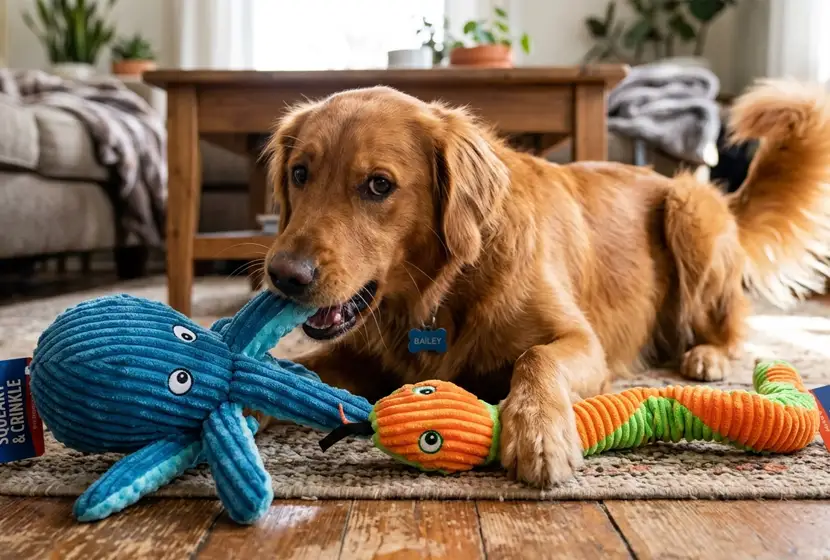
| Test Category | What It Measures | Typical Method Reference |
|---|---|---|
| Small parts / choking hazard | Whether a detached component fits inside a standardized small-parts cylinder | Small parts cylinder test (adapted from children’s toy testing) |
| Seam and appendage strength | Force required to detach a limb, tail, or embellishment | Mechanical pull/tensile test |
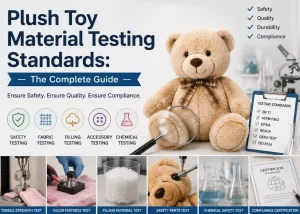
| Chemical restricted substances | Lead, phthalates, and other restricted substances in fabric, dye, and components | Laboratory chemical analysis against applicable limits |
| Squeaker retention | Number of bite/crush cycles before the squeaker becomes exposed | Simulated bite-cycle durability test |
| Colorfastness | Dye transfer under saliva/moisture exposure | Wet and dry rub colorfastness test |
Cat Plush Toys vs. Dog Plush Toys: Where Safety Requirements Diverge
Cat plush toys and dog plush toys are frequently grouped together under a single “pet toy” safety checklist, but the two categories present genuinely different risk profiles. Cats generally apply far lower bite and shake force than dogs, so tensile pull thresholds calibrated for dog toys are usually unnecessarily conservative — and, in some cases, result in an overbuilt toy too stiff for a cat to grip and play with comfortably.
The bigger safety concern with cat plush toys tends to be small, protruding attachments: catnip pouches, feather accents, bells, and dangling cords used to encourage batting and pouncing behavior. These elements are exactly the kind of small, detachable parts that create a swallowing risk, and cats are more likely than dogs to bat a toy repeatedly against a hard surface, which accelerates wear on any externally attached embellishment. Any cord, string, or ribbon incorporated into a cat toy should be short, securely anchored at both ends, and evaluated with the same pull-force standard applied to limbs on a dog toy — string ingestion is a well-documented veterinary hazard distinct from the choking risk more commonly associated with rigid small parts.
Durability Testing: Simulating Real Dog and Cat Play
Laboratory chemical and choking-hazard testing tells you whether a toy is safe when new and intact. Durability testing tells you how quickly it stops being intact — which, for a pet toy, is the more important question in practice, since almost every pet plush toy will eventually be torn open.
A meaningful durability test program for pet plush toys typically includes a tensile pull test on every limb, tail, ear, and attached decoration, a simulated bite-cycle test that repeatedly compresses the toy with a defined force to mimic jaw pressure, and a shake/tug test that measures how the toy’s structure responds to the whipping motion dogs commonly use during play. Toys intended for larger or more aggressive chewers should be tested against a higher force threshold than toys marketed for small breeds or light chewers, since the mechanical stress a large dog applies can be several times greater.
Wash durability is an often-overlooked companion to bite-force durability, given how frequently pet plush toys are laundered after being carried outside, dropped in mud, or soaked with saliva. Repeated machine washing can weaken thread bonding and reduce fabric tear strength over time, so a toy that performs well in a single bite-cycle test when new may lose a meaningful margin of its durability after a handful of wash cycles. Testing programs that include a “wash then re-test” step provide a far more realistic picture of how the toy will hold up across its actual service life than testing a brand-new sample alone.
Testing Tip: Ask for durability test results broken down by breed size or bite-force category rather than a single pass/fail result. A toy that easily passes testing calibrated for a small dog may fail quickly against a large, determined chewer.
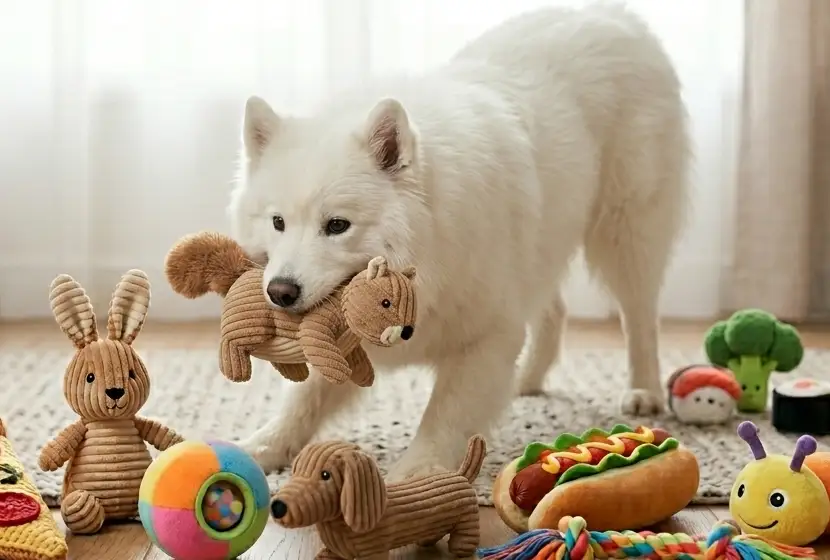
Sizing the Toy Correctly for the Intended Animal
Size mismatch is an underrated safety issue in pet plush toy design. A toy sized for a small dog can become a choking hazard for a large dog capable of fitting more of it into the mouth at once and applying far greater compressive force. Conversely, an oversized toy given to a small or toy-breed dog may be difficult to grip properly, leading to unusual chewing angles that concentrate stress on a single seam rather than distributing it evenly.
Packaging and product listings should clearly state the intended animal size range, and manufacturers producing a toy line across multiple sizes should scale not only the overall dimensions but also seam reinforcement and squeaker sizing proportionally, rather than simply shrinking or enlarging a single base pattern.
A useful practical guideline is to size the toy so it cannot be fully enclosed within the animal’s mouth in a single bite — leaving enough surface area exposed that the toy remains an object to chew rather than something that can be swallowed whole in a moment of overexcited play.
Labeling and Compliance Requirements for Pet Plush Toy Importers
Labeling requirements for pet plush toys vary by destination market and are frequently less standardized than requirements for children’s toys, which creates real compliance risk for importers who assume a single label format works everywhere.
At minimum, compliant labeling typically needs to identify the material content of the fabric and fill, country of origin, any applicable choking hazard or supervision warning, and washing or care instructions. Retailers in some markets also expect a clear statement of intended pet size or weight range on the packaging itself, separate from any marketing copy.
Typical Labeling Elements Requested Across Major Retail Markets
| Label Element | Common in US Retail | Common in EU Retail | Notes |
|---|---|---|---|
| Material content statement | Yes | Yes | Fabric and fill composition, by percentage where applicable |
| Country of origin | Yes | Yes | Required for customs clearance regardless of retail requirement |
| Supervision/choking warning | Common | Common | Often requested even without a strict legal mandate |
| Intended pet size/weight range | Increasingly requested | Increasingly requested | Reduces size-mismatch liability for retailers |
| Care/washing instructions | Yes | Yes | Relevant given frequent washing of chewed, saliva-soaked toys |
Common Defects That Compromise Pet Plush Toy Safety
Most pet plush toy safety incidents trace back to a small, recurring set of manufacturing defects rather than a fundamentally flawed design. Recognizing these defect patterns during quality inspection catches problems before they reach a shelf.
- Inconsistent stuffing density — uneven fill creates weak, thin fabric zones that tear faster than the surrounding material.
- Skipped or loose stitches — a visually acceptable seam can still contain skipped stitches invisible without close inspection, creating a hidden failure point.
- Squeaker misplacement — squeakers positioned too close to a seam edge are exposed faster once that seam begins to open.
- Inadequate curing of adhesives — glued components (some eyes, noses, or decorative trims) that have not fully cured can detach with far less force than the specification assumed.
- Undersized small parts — decorative elements manufactured slightly under spec may pass an initial visual check but fail a small-parts cylinder test.
- Fabric substitution mid-run — a factory switching to a similar-looking but lighter-weight fabric partway through a production run without flagging the change to the buyer, silently reducing tear resistance for part of the order.
- Inconsistent squeaker sourcing — swapping squeaker suppliers between production runs without re-verifying size and retention performance against the original approved sample.
Most of these defects are difficult to catch through a final visual inspection alone, since the toy can look identical to an approved sample while containing a substituted material or component underneath. Pull-testing and destructive teardown sampling on a percentage of units from every production batch — not just the pre-production sample — remains the most reliable way to catch a defect pattern before it reaches a full shipment.
Evaluating a Manufacturing Partner on Pet Plush Toy Safety Practices
When assessing whether a manufacturing partner takes pet plush toy safety seriously, the presence of a certificate is only a starting point. More informative signals include whether the factory maintains its own in-house pull-testing equipment rather than outsourcing every test to a third party, whether quality control checkpoints exist at the stuffing and stitching stages rather than only at final inspection, and whether the factory can produce batch-level test records rather than a single reference report used across an entire product line indefinitely.
It is also worth asking directly how the factory handles a failed durability test — whether the finding results in a design or process change, or whether the same defect recurs across production runs. A factory willing to share failure data, not just passing results, is generally a stronger long-term safety partner.

Sample retention practices are another useful, if less obvious, signal. A factory that keeps a labeled golden sample and matching test report on file for every production run — rather than relying on institutional memory or a single reference sample used across multiple seasons — is far better positioned to trace a field complaint back to a specific batch, material lot, or process change. This traceability matters most in exactly the moment it is needed least conveniently: after a product is already on shelves and a safety question is raised.
Evaluation Tip: Request photos or video of an actual pull test or bite-cycle test in progress, not just the final certificate. Watching the test method confirms the force and technique used match what the report claims.
Building a Safety-First Approach Into Product Development
The most durable and defensible approach to pet plush toy safety treats testing as part of the design process rather than a final gate before shipment. Building in tensile pull requirements, squeaker retention targets, and chemical restrictions at the specification stage — before the first sample is even sewn — costs far less than discovering a structural weakness after tooling, packaging, and inventory commitments are already in place.
Combined with clear size-matching guidance for consumers and honest, test-method-specific labeling, a safety-first development process reduces the two outcomes every pet product business wants to avoid: product recalls and, more importantly, a genuine injury to an animal in someone’s home.
Frequently Asked Questions
Is a plush toy that passes children’s toy safety testing automatically safe for dogs?
No. Children’s toy safety standards evaluate chemical safety and choking hazards based on a child’s typical mouthing behavior and bite force, not the sustained tearing and much higher bite pressure a dog applies. A toy can fully comply with a children’s standard and still fail quickly under pet-specific mechanical stress. Pet plush toys need separate durability testing — tensile pull tests, bite-cycle testing, and squeaker retention checks — in addition to any chemical safety testing carried over from children’s toy standards.
What is the biggest choking hazard in a pet plush toy?
Squeakers are generally the component most frequently swallowed once a toy is torn open, because they are rigid, often small enough to pass a standard airway, and positioned in the center of the toy where most bite pressure concentrates. Plastic eyes and noses are the second most common hazard, particularly on toys that use glued or press-fit components rather than embroidered detailing. Reducing both risks starts with material and construction choices made at the design stage, not warning labels added afterward.
How is pet plush toy durability actually tested?
Durability testing for pet plush toys typically combines a tensile pull test on every limb, tail, ear, and attached decoration to measure the force required for detachment, a simulated bite-cycle test that repeatedly compresses the toy to mimic sustained jaw pressure, and a shake/tug test that evaluates how the seams and internal structure respond to the whipping motion common in dog play. Results are most useful when reported against a specific force threshold tied to breed size or bite-force category, rather than a single generic pass or fail.
Are embroidered eyes safer than plastic eyes on pet plush toys?
Yes, embroidered or appliqued eyes and noses are widely considered safer than glued or screw-locked plastic components for pet plush toys, since a hard enough bite can pull plastic eyes free regardless of the locking mechanism used, while embroidered detailing has no rigid piece to detach and swallow. Many manufacturers now default to embroidered facial detailing specifically for toys marketed toward dogs, reserving plastic components for lighter-use toys aimed at small or less destructive chewers.
What stuffing material is safest for pet plush toys?
Polyester fiberfill is the most common choice for pet plush toys because it is non-allergenic for the large majority of animals, dries quickly after the frequent washing pet toys require, and resists mold growth better than natural fiber alternatives. Fill density matters for safety as much as fill type — underfilled toys develop weak, thin fabric zones faster, which shortens the time before a seam or fabric panel gives way under repeated biting.
What labeling information should a pet plush toy include?
At minimum, compliant labeling should state the material content of the fabric and stuffing, the country of origin, care and washing instructions, and a supervision or choking hazard warning where applicable. Many retailers also now expect a clearly stated intended pet size or weight range on the packaging itself, since size mismatch between the toy and the animal is one of the more overlooked safety risks in this category. Requirements differ across markets, so labeling should be reviewed per destination rather than assumed to be universal.
How do I tell if a manufacturer takes pet plush toy safety seriously?
Look beyond a single certificate and ask whether the factory maintains its own in-house pull-testing and durability-testing equipment, whether quality checkpoints exist at the stuffing and stitching stages rather than only at final inspection, and whether test records are generated per batch rather than referenced from one report used indefinitely across an entire product line. A factory that willingly shares failed test data and describes the resulting design or process changes is generally a more reliable long-term safety partner than one that only shows passing results.