Skip to content
Plush Toys With Sound Modules bring soft toys to life by combining creative designs, interactive sound features, and safe manufacturing processes to create engaging experiences for children and collectors.
Everything product developers, importers, and retail buyers need to know about integrating electronic sound modules into plush toys — from chip selection and battery safety to waterproofing, durability testing, and compliance.
What Are Sound Modules in Plush Toys?
A sound module is the electronic component embedded inside a plush toy that produces audio — anything from a simple pre-recorded animal sound triggered by pressure, to a motion-activated chip that plays different clips depending on how the toy is handled, to a fully recordable voice module a parent or pet owner can program themselves.
Sound modules represent a meaningful step up in complexity from a mechanical squeaker. Where a squeaker is a purely mechanical bellows-and-reed system with no electronic parts, a sound module typically includes a small printed circuit board, a speaker, a battery or battery compartment, and one or more sensors — pressure switches, tilt switches, or motion sensors — that determine when the audio plays. This added complexity introduces an entirely new category of design and safety considerations that a purely mechanical plush toy never has to address: battery containment, moisture ingress, electrical component durability under repeated impact, and sound output level.
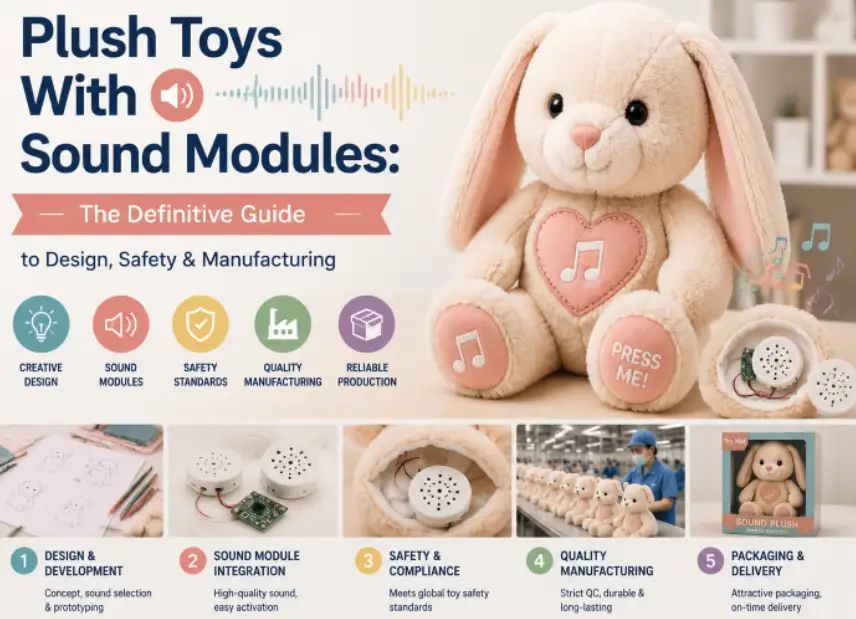
Demand for sound-enabled plush toys spans several very different markets — infant and toddler comfort toys, pet toys designed to hold a dog’s attention through novelty sounds, and licensed character plush that plays a signature phrase or sound effect. Each market applies a different safety standard and a different tolerance for cost, but the underlying engineering challenge of housing electronics safely and durably inside soft fabric is shared across all of them.
The commercial appeal of sound modules is straightforward: a plush toy that reacts audibly to handling creates a stronger perceived value and a more memorable play experience than a silent toy of similar size and material quality, which is why sound-enabled variants routinely command a meaningfully higher retail price point than their non-electronic counterparts. That price premium, however, only holds up commercially if the module performs reliably across the toy’s expected lifespan — a sound module that stops working after a few weeks, or one that raises a battery-access safety concern, damages the entire product line’s reputation far more than a simple mechanical defect would.
Types of Sound Modules Used in Plush Toy Manufacturing
Not all sound modules are built the same way, and the type selected has downstream effects on cost, durability, and the safety testing required.
Pressure-Activated Sound Chips
The simplest and most common sound module type triggers a pre-recorded sound clip when the toy is squeezed, using a basic pressure switch wired to a small sound chip and speaker. These modules are inexpensive, have very few failure points, and are widely used across both infant plush and pet plush categories because the trigger mechanism has no moving mechanical parts beyond the switch itself.
Motion and Tilt-Activated Modules
More advanced sound modules use a tilt switch or a basic motion sensor to trigger sound in response to movement rather than direct pressure — useful for toys meant to react when picked up, shaken, or rolled. These modules add a small additional component cost and a slightly more complex assembly step, since the sensor’s orientation inside the toy affects how reliably it triggers.
Recordable Voice Modules
Recordable modules allow an owner to record and play back a custom audio clip — commonly a parent’s voice for an infant comfort toy, or a pet owner’s voice for a toy intended to soothe separation anxiety. These modules include a microphone, onboard memory, and typically a simple button interface, which raises the component count and the number of potential points of electronic failure compared to a fixed pre-recorded chip.
Multi-Trigger and Interactive Sound Modules
A further category combines several trigger inputs — pressure, tilt, and sometimes a simple light or proximity sensor — into a single module capable of playing different sound clips depending on how the toy is handled. These multi-trigger modules are the most technically ambitious option, typically used in premium interactive plush lines, and require the most extensive calibration during manufacturing to ensure each trigger responds consistently across a full production run. The additional sensors also mean additional potential ingress points for moisture and additional solder joints that can fail under repeated flexing, so the durability and sealing considerations discussed later in this guide apply with even greater weight to multi-trigger designs.
Design Tip: Match the sound module type to the toy’s expected handling intensity before finalizing the housing design. A recordable module with exposed buttons is a poor fit for an aggressive pet chewer, even though it may be ideal for a child’s comfort toy handled gently.
Battery Safety: The Highest-Priority Design Consideration
Battery safety is, without question, the single most scrutinized aspect of any plush toy with an embedded sound module — and for good reason. Small batteries, particularly button and coin cell batteries used in compact sound modules, present a serious ingestion hazard if a child or pet gains access to them, and lithium coin cells specifically can cause severe internal chemical burns within hours if swallowed.
Because of this risk, battery compartment design is held to a stricter standard than almost any other component in the toy. A compliant battery compartment for a plush toy is secured with a screw closure — never a simple snap-fit or adhesive seal — requiring a tool such as a small screwdriver to open. The compartment housing itself is typically molded from rigid plastic rather than soft fabric, sewn or heat-sealed permanently into the plush shell so it cannot be pulled free even under significant tugging force.
Battery Type Selection
Where the sound module design allows flexibility, selecting a larger battery format — AA or AAA cells rather than button or coin cells — meaningfully reduces the ingestion risk profile, since larger batteries are far less likely to pass a standard small-parts cylinder test even if a compartment were somehow compromised. Rechargeable battery packs, sealed permanently into the module during manufacturing with no user-accessible compartment at all, represent the highest safety tier but add cost and remove any ability for the end user to replace a depleted battery.

Battery life expectations should also factor into the format decision at the design stage rather than being treated as an afterthought. A module drawing continuous low-level current for a motion sensor will deplete a small coin cell far faster than a simple pressure-activated chip that only draws power when actively playing a sound, and a mismatch between expected battery life and the format selected is a common source of early customer dissatisfaction even when no safety issue is present at all.
Battery Format Comparison for Plush Toy Sound Modules
| Battery Format | Ingestion Risk If Exposed | Typical Compartment Requirement | Common Use Case |
|---|---|---|---|
| Coin/button cell | High — passes small-parts cylinder easily | Screw-locked compartment, mandatory | Compact recordable modules |
| AA/AAA cell | Lower — larger size reduces ingestion risk | Screw-locked compartment, still recommended | Larger pressure-activated modules |
| Sealed rechargeable pack | Lowest — no user-accessible compartment | Permanently sealed into module housing | Premium or pet-durability-focused modules |
| Replaceable rechargeable pack | Moderate — depends on housing security | Screw-locked compartment with tamper resistance | Reusable interactive plush lines |
Safety Tip: Whenever a design brief allows for it, specify a screw-locked battery compartment as a non-negotiable requirement rather than a preference. This single specification eliminates the majority of battery-access safety failures reported across the interactive plush category.
Waterproofing and Moisture Resistance for Embedded Electronics
Plush toys are regularly exposed to drool, spilled liquids, and — for pet toys especially — outdoor moisture, which makes moisture ingress one of the leading causes of sound module failure. Unlike a purely mechanical squeaker, which has no circuitry to short out, a sound module’s circuit board and battery contacts are vulnerable to corrosion and short-circuiting if moisture reaches them.
Effective moisture protection starts with a fully sealed module housing, typically an injection-molded shell that fully encloses the circuit board, speaker, and battery compartment, leaving only the speaker grille as a controlled opening. A conformal coating applied directly to the circuit board provides a secondary layer of protection against condensation and minor moisture intrusion even if the outer housing seal is imperfect. For pet-oriented sound modules expected to face heavier moisture exposure, an IPX-rated splash resistance target — even if not formally certified — gives engineering teams a concrete design benchmark to test against.
Adhesive selection for sealing the housing shell matters as much as the shell design itself. A rigid adhesive that becomes brittle over repeated temperature cycling — moving from a warm indoor environment to a cold outdoor one, for a pet toy left outside — can crack at the seam line and create an unintended entry point that would not appear in a single-condition lab test. Sealing methods validated across a realistic temperature and humidity range, rather than only at standard room-temperature test conditions, produce a more reliable real-world moisture barrier.
Speaker Grille Design
The speaker grille is unavoidably the weakest point in a sealed module housing, since sound has to pass through it. Grille designs that use a fine mesh or a series of small offset holes rather than a single large opening reduce direct liquid ingress while still permitting adequate sound output, and a thin acoustically transparent membrane behind the grille adds meaningful protection against splashes without materially reducing audio volume.
Chemical and Electrical Safety Compliance
Beyond battery containment, plush toys with sound modules must meet the same chemical safety expectations as any other plush toy — restricted substance limits on fabric dyes, adhesives, and any plastic components — while also satisfying electrical safety expectations specific to the embedded electronics.
Electrical safety evaluation for a sound module typically covers maximum sound output level (to avoid hearing damage risk, particularly relevant for toys marketed to infants), circuit insulation and short-circuit protection, and battery compartment access-force testing, which measures how much force and what tool requirement is needed to open the compartment. Sound output level limits are a frequently overlooked compliance area — a module that seems appropriately loud in a quiet testing room can exceed safe output thresholds when measured at the close range a child typically holds a toy.
The applicable standard also shifts depending on the target market for the toy. Infant and toddler comfort toys are generally evaluated against children’s toy electrical and acoustic safety requirements, while pet-marketed sound toys are more often assessed against general consumer electronics safety principles combined with the mechanical durability expectations specific to animal chewing, since dedicated pet-electronics regulatory frameworks remain less standardized across markets than children’s toy regulation. Buyers sourcing a sound-enabled plush toy for a specific market should confirm which standard the factory is actually testing against rather than assuming a single universal electrical safety benchmark applies everywhere.
Key Test Methods Referenced in Sound Module Safety Evaluation
| Test Category | What It Measures | Typical Method Reference |
|---|---|---|
| Battery access force | Force and tool requirement needed to open the battery compartment | Mechanical access-force test on the compartment closure |
| Sound output level | Maximum decibel output at close and normal listening range | Acoustic measurement against age-appropriate output limits |
| Small parts / choking hazard | Whether a detached module component fits a standardized small-parts cylinder | Small parts cylinder test |
| Circuit insulation and short-circuit protection | Electrical safety of the circuit board under normal and fault conditions | Electrical safety bench testing |
| Chemical restricted substances | Lead, phthalates, and other restricted substances in fabric, dye, and housing plastic | Laboratory chemical analysis against applicable limits |
Durability Testing for Electronic Plush Components
A sound module has to survive the same crushing, dropping, and repeated-impact play that any plush toy endures, but with the added constraint that its internal electronics cannot tolerate the same abuse a purely fabric-and-fiberfill toy can. Durability testing for sound modules generally includes a repeated compression cycle test that simulates hundreds or thousands of squeeze-and-release cycles, a drop test that evaluates whether the circuit board or battery contacts loosen or fail after repeated impacts onto a hard floor, and a housing integrity test confirming the module shell does not crack or separate under sustained biting pressure for pet-oriented products.

Speaker durability deserves its own attention, since a speaker cone can fatigue and distort well before the rest of the module fails structurally. A module tested only for mechanical survival — does it still play a sound at all — can pass while audio quality has already degraded to a level that would concern a quality-conscious buyer.
Connector and wire durability rounds out a thorough test program. The wires connecting the battery compartment, switch, and speaker to the main circuit board are subjected to repeated flexing every time the toy is squeezed, shaken, or dropped, and solder joints at each connection point are a common long-term failure location even when every other component of the module remains fully functional. A flex-cycle test that repeatedly bends the wire harness at the same angles produced by normal play reveals connector weaknesses that a single drop test or compression test would miss entirely.
Testing Tip: Request durability test data broken out by component — housing, circuit board, speaker, and battery contacts separately — rather than a single overall pass/fail. A module can pass an overall functional check while one internal component is already close to failure.
Assembly and Placement Within the Plush Shell
Where the sound module sits inside the plush toy affects both durability and perceived sound quality. Placing the module too close to a primary bite zone on a pet toy accelerates housing wear and increases the odds of the module being exposed if the fabric tears. Placing it too deep within dense stuffing, on the other hand, can muffle sound output even when the module itself is functioning correctly.
A common approach positions the module within a semi-rigid internal pocket, stitched securely to the inner seam structure rather than left to shift freely within the loose stuffing, which keeps the speaker oriented consistently and prevents the module from migrating toward an exposed seam over time. For pet-oriented toys, this pocket should be constructed from the same reinforced fabric used for high-wear panels elsewhere in the toy, rather than the lighter-weight material sometimes used for cosmetic-only sections.
Access for future repair or battery replacement should also inform placement decisions. A module buried deep within densely packed stuffing may be acoustically and structurally sound, but nearly impossible for a consumer to locate and service through an external access panel without disturbing the surrounding fill. Positioning the module in a location that balances secure anchoring with reasonable access — typically along the torso rather than in a limb or extremity — tends to produce the best outcome across durability, sound quality, and serviceability simultaneously.
Labeling and Compliance Requirements for Sound-Enabled Plush Toys
Sound-enabled plush toys carry labeling obligations beyond those of a standard plush toy, since the presence of a battery and electronic components triggers additional disclosure expectations in most retail markets. At minimum, compliant labeling typically needs to state the battery type and whether it is replaceable, include a battery disposal or recycling note where required, and carry any age-appropriateness or supervision warning tied to small battery components.
Retailers and importers should also confirm whether the destination market requires electromagnetic compatibility documentation for the sound module’s circuit, since even a simple pressure-activated chip contains a small radiating circuit that can fall under electronics-specific import requirements distinct from general toy safety regulation.
Packaging copy also deserves review alongside the formal label itself. Marketing language describing a sound feature as “voice-activated” or “smart” when the module only responds to a basic pressure switch can create a mismatch between consumer expectation and actual product function, which in turn drives returns and negative reviews even when the product itself performs exactly as engineered.
Typical Labeling Elements for Plush Toys With Embedded Sound Modules
| Label Element | Common in US Retail | Common in EU Retail | Notes |
|---|---|---|---|
| Battery type and replaceability statement | Yes | Yes | Distinct from general material content labeling |
| Battery disposal/recycling note | Common | Required in many jurisdictions | Applies specifically to removable battery formats |
| Age-appropriateness/supervision warning | Yes | Yes | Tied to small battery and small-parts risk |
| Sound output disclosure | Occasionally requested | Increasingly requested | Relevant for infant-marketed sound toys |
| Country of origin | Yes | Yes | Required for customs clearance regardless of retail requirement |
Common Defects in Sound Module Plush Manufacturing
Most safety and quality incidents involving sound-enabled plush toys trace back to a recurring, identifiable set of manufacturing defects rather than a fundamentally flawed module design. Recognizing these patterns during inspection catches problems before a shipment reaches retail.
- Improperly torqued compartment screws — a screw-locked battery compartment that is under-tightened during assembly defeats the entire purpose of the closure design.
- Incomplete housing seals — a module housing that is not fully seated or sealed during assembly allows moisture ingress that would otherwise have been prevented by the design.
- Wire strain at solder joints — repeated flexing of the plush fabric around the module can fatigue wire connections at solder points if strain relief is inadequate.
- Speaker grille blockage — excess adhesive or fabric backing applied during assembly can partially block the grille, muffling sound output without an obvious external defect.
- Inconsistent sensor calibration — pressure or tilt switches calibrated inconsistently across a production run cause some units to trigger far more easily or less reliably than the approved sample.
- Substituted sound chip supplier mid-run — a factory swapping to an alternate chip supplier without re-validating output level and trigger sensitivity against the originally approved sample.
Most of these defects are difficult to catch through a final functional check alone, since a module can play sound successfully in a quick test while still containing an under-torqued screw, a partially blocked grille, or a fatigued solder joint that will fail after a modest amount of real-world use. Destructive teardown sampling — physically opening finished units from a production batch rather than relying solely on external functional testing — remains the most reliable way to catch these hidden defects before a full shipment ships.
Evaluating a Manufacturing Partner on Sound Module Safety Practices
Assessing whether a manufacturing partner handles sound module integration responsibly requires looking past a general plush toy quality certificate toward electronics-specific competency. Useful signals include whether the factory has a dedicated electronics assembly line or subcontracts module assembly to a specialized supplier, whether battery compartment access-force testing is performed on a sample from every production batch rather than only the pre-production sample, and whether the factory can document conformal coating application and speaker grille sealing as discrete, verified process steps rather than an assumed outcome of general assembly.

It is also worth asking how the factory sources sound chips and modules — whether from a single qualified supplier with consistent specifications, or opportunistically from whichever supplier offers the lowest price on a given order — since inconsistent module sourcing is a common root cause of the sensor calibration and housing seal defects described above.
Traceability documentation is worth requesting explicitly. A factory that can tie a specific sound module batch back to a specific chip lot, assembly date, and inspector is far better equipped to isolate the cause of a field complaint than one relying on general production records that only identify the finished toy’s batch number without any electronics-specific detail layered underneath it.
Evaluation Tip: Ask to see the battery compartment access-force test performed live on a sample unit, rather than relying only on a written certificate. Watching the test confirms the closure genuinely requires a tool to open, not just that a report claims it does.
Building a Safety-First Approach to Sound Module Integration
The most defensible approach to sound-enabled plush toy development treats battery containment, moisture sealing, and sound output limits as specifications locked in before the first working sample is built, not adjustments made after a safety concern surfaces during testing. Combined with batch-level compartment testing, honest battery and disposal labeling, and a manufacturing partner with genuine electronics assembly competency, a safety-first process meaningfully reduces the two outcomes every interactive plush toy program wants to avoid: a battery-access recall and a genuine injury.
Frequently Asked Questions
What is the biggest safety risk in a plush toy with a sound module?
Battery access is the leading safety risk, particularly with small button or coin cell batteries, which present a serious ingestion hazard and, in the case of lithium coin cells, a chemical burn risk if swallowed. This is why battery compartments in compliant sound-enabled plush toys are secured with a screw closure that requires a tool to open, rather than a snap-fit or adhesive seal that a child or pet could defeat with hands or teeth alone.
What is the difference between a mechanical squeaker and an electronic sound module?
A mechanical squeaker is a purely bellows-and-reed system with no electronic parts, producing sound entirely through air displacement when squeezed. An electronic sound module includes a circuit board, speaker, battery or battery compartment, and typically a sensor such as a pressure or tilt switch, allowing it to play pre-recorded audio clips, respond to motion, or in some cases record and play back custom sound. This added complexity gives sound modules far more design flexibility but introduces battery safety, moisture resistance, and electrical safety considerations a mechanical squeaker never has to address.
How is battery compartment safety tested in plush toys?
Battery compartment safety is evaluated through an access-force test that measures how much force, and what specific tool, is required to open the compartment closure. Compliant designs use a screw-locked closure that cannot be opened by hand pressure or typical mouthing and chewing behavior. Testing should be repeated on samples from every production batch rather than only the original pre-production sample, since assembly inconsistencies such as under-tightened screws can defeat an otherwise compliant design.
Can plush toys with sound modules get wet or be washed?
It depends entirely on the module’s sealing design. A fully sealed module housing with a properly sealed speaker grille and conformal coating on the circuit board can tolerate incidental moisture such as drool or light splashing, but most sound modules are not designed to survive full immersion or machine washing. Product labeling should clearly state the module’s moisture tolerance and washing limitations, since owners frequently assume an entire plush toy is machine washable without realizing the internal electronics have separate limits.
What sound output level is considered safe for infant-marketed plush toys?
Safe sound output limits for infant-marketed toys are generally set well below levels associated with hearing damage risk, measured specifically at the close range a child typically holds a toy against their ear or face rather than at a distance. This close-range measurement matters because a module that seems moderately loud in a standard testing setup can exceed safe thresholds at the proximity infants commonly use, making close-range acoustic testing an essential part of sound module compliance rather than an optional check.
Why do sound modules fail after repeated use in pet plush toys?
The most common failure causes are moisture ingress through an incompletely sealed housing, wire strain at solder joints from repeated flexing of the surrounding fabric, and mechanical fatigue of the speaker cone after extensive compression cycling from biting and chewing. Pet-oriented sound modules generally need a more robust housing, stronger strain relief on internal wiring, and a higher-durability speaker component than modules designed for gentler infant or display use, since the mechanical stress profile is substantially higher.
What should I ask a manufacturer to confirm sound module safety before placing an order?
Ask for battery compartment access-force test results specific to the exact module and housing used in your order, confirmation of the sound chip and module supplier and whether sourcing stays consistent across production runs, evidence of conformal coating and housing seal verification as discrete process steps, and durability test data broken out by component — housing, circuit board, speaker, and battery contacts — rather than a single overall pass/fail result. A manufacturer able to answer all four specifically, with batch-level rather than one-time documentation, demonstrates a meaningfully higher level of process control.