Skip to content
Recycled polyester in plush toy manufacturing has moved from a niche green initiative to a mainstream material standard. Driven by retailer sustainability mandates, consumer demand for eco-conscious products, and tightening global regulations on virgin plastic consumption, toy brands and stuffed animal manufacturers are increasingly specifying recycled polyester — commonly called rPET — across both outer fabric and internal fill.
Understanding how this material performs, how it is certified, and where it changes production economics is essential for anyone sourcing or producing plush toys today.
What recycled polyester is and how it enters plush production
From post-consumer plastic to plush fabric
Recycled polyester is produced by mechanically or chemically breaking down post-consumer PET materials — primarily plastic bottles, but increasingly post-industrial textile waste — into polymer chips or melt, which are then extruded into fine filament fibers. For plush toy manufacturing, these fibers are processed into two primary forms: woven or knitted pile fabric (used for the outer shell) and fiberfill (used for internal stuffing). A single standard 500ml PET bottle yields approximately 27 grams of fiber — enough to contribute meaningfully to the fill of a small stuffed animal.
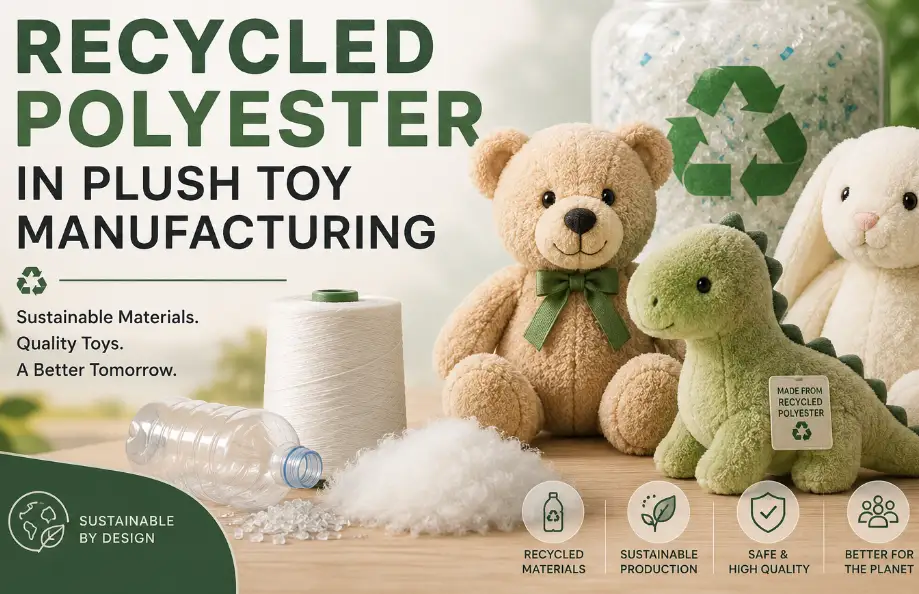
The mechanical recycling pathway dominates current production. Post-consumer bottles are collected, sorted by resin type, shredded into flakes, washed, melted, and extruded. Chemical recycling — depolymerizing PET back to its monomer building blocks before re-polymerization — is gaining traction for textile-to-textile applications but remains a smaller fraction of global rPET supply entering toy manufacturing.
rPET fiber performance vs virgin polyester: production metrics
| Property | Recycled polyester (rPET) | Virgin polyester |
|---|---|---|
| Carbon footprint (fiber production) | ~32% lower CO₂ vs virgin | Baseline reference |
| Energy consumption (processing) | 30–50% less energy per kg | Baseline reference |
| Water usage | Significantly reduced (no petrochemical feedstock) | Higher (crude oil extraction stage) |
| Tensile strength | Comparable to virgin pile fabric | Marginally higher in raw filament |
| Softness/hand feel | Equivalent in quality rPET; varies by supplier | Consistent across grades |
| Colorfastness | Good; dyeing behavior similar to virgin | Excellent baseline |
| Typical cost premium | 5–20% over virgin (market-dependent) | Baseline price |
Why toy brands are specifying rPET at scale
Retailer mandates and supply chain pressure
Major global toy retailers and licensing partners have embedded sustainability criteria directly into vendor qualification requirements. Brands supplying plush toys to large retail chains in Europe, North America, and Australia routinely face requirements specifying minimum recycled content percentages — often 50% to 100% rPET in both shell fabric and fill. Manufacturers that cannot demonstrate material traceability through a recognized certification framework risk disqualification from key retail programs regardless of price competitiveness.
Consumer and brand perception
Sustainability claims on plush toy packaging — “made with recycled bottles,” “X bottles diverted from landfill” — have demonstrated measurable conversion impact in retail environments. For gift purchases, which represent a significant portion of stuffed animal category sales, the environmental story provides a differentiating narrative that supports premium price positioning. Brands using recycled polyester in plush toy manufacturing can quantify and communicate the environmental benefit in bottle-equivalent units, making the sustainability message concrete and emotionally resonant for end consumers.

Industry data
| Certification | What it verifies | Relevance to plush toys |
|---|---|---|
| GRS (Global Recycled Standard) | Chain-of-custody for recycled input material; social and environmental facility criteria | Primary certification for rPET fabric and fill is required by most major retailers |
| OEKO-TEX STANDARD 100 | Absence of harmful substances in finished textile | Confirms rPET fabric is free from harmful chemical residues, critical for children’s products |
| OEKO-TEX RECYCLED CLAIM STANDARD | Verifies recycled content percentage claims | Supports marketing claims on packaging and product labels |
| bluesign | Resource efficiency and chemical safety in textile production | Emerging requirement among premium plush toy brands |
| ISO 14021 | Environmental labeling — self-declared claims | Governs the accuracy of “recycled content” claims on toy packaging |
Production and quality considerations for manufacturers
Fiber consistency and pile uniformity
One of the most common technical challenges in using recycled polyester in plush toy manufacturing is achieving consistent pile height, density, and softness across production batches. Because rPET feedstock quality varies depending on the source stream — bottle grades, industrial textile waste, and blended streams behave differently through the fiber extrusion and fabric knitting process — manufacturers must apply stricter incoming quality control protocols than they would with virgin polyester. Partnering with GRS-certified fiber suppliers who offer documented batch traceability significantly reduces this variability risk.

Dyeing and colorfastness
Recycled polyester fibers can be dyed using the same disperse dye systems applied to virgin polyester, and at comparable temperatures. However, the presence of optical brighteners or residual additives in some rPET feedstocks can affect dye uptake consistency. Reputable manufacturers conduct dye lot testing and wash fastness evaluation (per ISO 105-C06 or equivalent) to ensure that rPET plush fabric meets the same colorfastness standards as virgin material — a non-negotiable requirement for branded plush programs.
Fill performance and toy loft
rPET fiberfill is now the standard stuffing material in most sustainably positioned plush toys. Compared to virgin polyester fill, quality rPET fill performs equivalently in terms of loft recovery, compressibility, and tactile softness when the product is squeezed and released — the key sensory test for stuffed animals. The fill’s spiral-crimp or hollow-conjugate construction determines loft characteristics independently of whether the raw material is virgin or recycled. Manufacturers specify fill weight in grams per toy to control firmness, with ranges typically between 40g and 300g, depending on toy size.
Industry data
| Toy size/weight | Typical fill (rPET) | Equivalent PET bottles diverted |
|---|---|---|
| Mini (10–15 cm) | 20–50g fill | 1–2 standard 500ml bottles |
| Small (15–25 cm) | 50–120g fill | 2–4 bottles |
| Medium (25–40 cm) | 120–250g fill | 4–9 bottles |
| Large (40–60 cm) | 250–500g fill | 9–18 bottles |
| Oversized (60 cm+) | 500g–1.2kg fill | 18–44 bottles |
Cost implications and sourcing strategy
rPET fabric and fill typically carries a 5% to 20% cost premium over virgin polyester equivalents, though this gap has narrowed significantly as rPET production capacity has expanded globally — particularly in China, Taiwan, and South Korea, which collectively supply the majority of rPET pile fabric used in plush toy manufacturing. For high-volume programs, brands can often negotiate rPET pricing to near-parity with virgin material when locking in supply agreements with GRS-certified mills. The premium is more pronounced for shorter runs and specialty constructions such as anti-pill fleece or sherpa-effect recycled fabric.

| Strategic note: Brands that consolidate rPET fabric and fill sourcing through the same certified mill or supply chain partner often achieve better pricing consistency and simpler certification documentation than those sourcing the two material streams independently. |
Industry data
| Sourcing scenario | Cost vs virgin polyester | Key trade-off |
|---|---|---|
| Spot market rPET fabric | +10–20% premium | Flexibility; higher variability risk |
| Long-term mill agreement (rPET fabric) | +3–8% premium | Price stability requires volume commitment |
| rPET fill (fiberfill) | +5–12% premium | Now near-parity at scale with major suppliers |
| Integrated fabric + fill (same supplier) | +4–10% blended | Simplified GRS documentation; best value |
| Chemical rPET (textile-to-textile) | +25–50% premium | Highest sustainability credentials; limited supply |
Frequently asked questions
1. Is recycled polyester safe for children’s plush toys?
Yes — when sourced from certified suppliers, recycled polyester is safe for children’s plush toys and meets the same chemical safety requirements as virgin polyester. The key is ensuring that rPET fabric and fill carry OEKO-TEX STANDARD 100 certification or equivalent, which verifies the absence of harmful substances, including heavy metals, formaldehyde, and restricted azo dyes. Toy safety standards such as EN 71 and ASTM F963 apply equally to products made with recycled or virgin fiber, and reputable rPET materials pass these evaluations without modification.
2. What certifications should a plush toy manufacturer hold to credibly claim recycled polyester content?
The Global Recycled Standard (GRS) is the primary certification required to substantiate recycled polyester claims in plush toy manufacturing. GRS certifies the entire chain of custody from post-consumer source material through fiber production, fabric manufacturing, and the finished goods manufacturer. Brands should verify that their supplier holds a valid GRS scope certificate covering both fabric and fill. Supplementary certifications such as OEKO-TEX STANDARD 100 for chemical safety and ISO 14021 compliance for environmental labeling claims round out a credible sustainability documentation package.
3. Does rPET fiberfill feel the same as virgin polyester fill in a stuffed animal?
High-quality rPET fiberfill is indistinguishable from virgin polyester fill in terms of softness, loft, and tactile appeal when the toy is handled and squeezed. The fill’s sensory properties are determined primarily by fiber denier, crimp structure (spiral or hollow conjugate), and fill weight rather than by whether the raw material is recycled or virgin. Lower-grade rPET fill from inconsistent feedstock streams can feel coarser or pack more quickly over time, which is why sourcing from GRS-certified suppliers with documented fiber specifications is important.
4. How many plastic bottles does a typical stuffed animal contain?
The number varies by toy size. A small plush toy (15–25 cm) typically contains fill and fabric equivalent to roughly 3 to 6 standard 500ml PET bottles. A medium-sized stuffed animal (25–40 cm) commonly diverts 6 to 12 bottles from the waste stream when both shell fabric and fiberfill are fully recycled polyester. Large oversized plush toys can incorporate the equivalent of 20 or more bottles. Manufacturers can calculate exact bottle-equivalent figures from material weight specifications, which is useful for consumer-facing sustainability messaging on packaging.
5. Is there a cost difference between rPET and virgin polyester for plush toy production?
Currently, rPET fabric and fill carry a 5% to 20% cost premium over virgin polyester equivalents in most markets, though this gap has narrowed substantially as global rPET production capacity has expanded. High-volume buyers working on long-term supply agreements with GRS-certified mills can often secure rPET pricing within 3% to 8% of virgin polyester. The premium varies by fabric construction, fiber denier, and market conditions. At sufficient scale, the cost difference is frequently absorbed into the retail price positioning without consumer resistance, particularly in sustainability-conscious retail channels.
6. Can recycled polyester plush toys be washed, and how does the material hold up?
rPET plush fabric and fill perform comparably to virgin polyester through repeated laundering. Pile fabric made from quality recycled polyester maintains its texture and color through standard machine washing cycles (30°C–40°C, gentle cycle) and retains loft after drying when handled correctly. The key durability factors — fiber diameter, pile construction, and knit structure — are the same for rPET and virgin material. Brands should specify wash care instructions based on actual fabric testing rather than assumptions about the recycled material’s behavior.
7. What is the difference between mechanical and chemical recycling of polyester for plush toys?
Mechanical recycling — the dominant current method — shreds post-consumer PET (primarily bottles) into flakes, melts it, and extrudes new fiber. It is energy-efficient and widely available, but is limited by feedstock quality and cannot easily process mixed or colored textile waste. Chemical recycling depolymerizes PET back to its monomer components before re-polymerizing, producing fiber with properties essentially identical to virgin polyester and capable of processing textile-to-textile waste streams. Chemical rPET carries a higher cost premium (25–50% over virgin) but offers superior sustainability credentials and is increasingly specified by premium plush toy brands with ambitious circular economy commitments.
8. How do toy manufacturers communicate recycled polyester content to consumers effectively?
The most effective consumer communication strategies combine a specific, quantified claim with a tangible reference point. Rather than “made with recycled materials,” top-performing packaging uses language such as “stuffed with fiber from X recycled plastic bottles” alongside a visual icon. This approach is more credible, more memorable, and more emotionally engaging than abstract percentage claims. Manufacturers must ensure that all on-pack claims are supported by GRS certification documentation and comply with ISO 14021 or applicable regional environmental labeling regulations to avoid greenwashing risk.