Skip to content
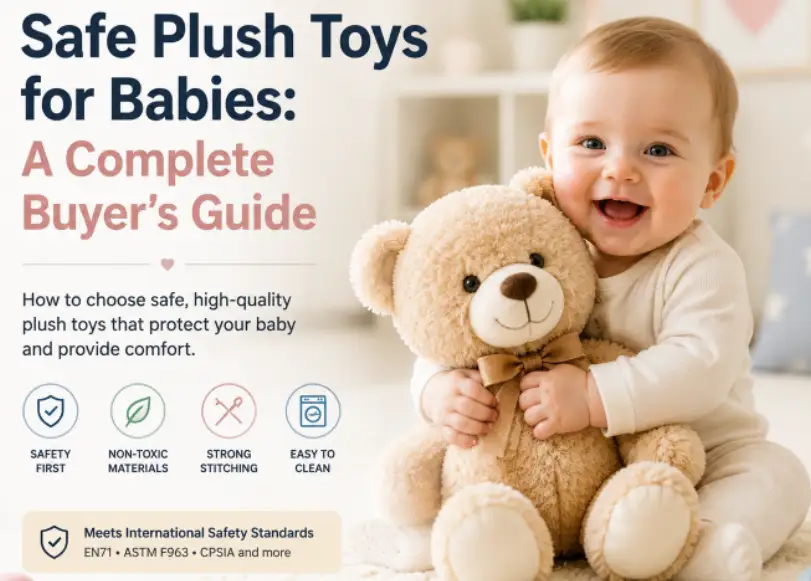
Safe Plush Toys for Babies are designed with soft, non-toxic materials, secure components, and strict safety standards to provide comfort, companionship, and peace of mind for young children. What actually makes a plush toy safe for an infant, which certifications and construction features to look for, and which common design choices should be avoided for children under twelve months.
What Makes a Plush Toy Safe for Babies?
A plush toy is genuinely safe for a baby when it satisfies four conditions simultaneously: every material in contact with the skin and mouth is non-toxic and allergy-conscious, no component can detach and become a choking hazard, the construction withstands the pulling, mouthing, and washing that infant use involves, and the product carries testing and labeling that confirms it meets the applicable regulatory standard for the age group it is marketed to. A toy that satisfies only some of these conditions is not an infant-safe toy — it is a toy that happens to look soft and harmless.
Infants explore almost exclusively through their mouths during the first year of life, which changes the safety calculus completely compared with toys designed for toddlers or older children. A small plastic eye that would pose a minor risk to a five-year-old is a serious choking hazard to a six-month-old who cannot yet reliably avoid swallowing small objects. This is why infant-specific plush toys are built to a different, stricter standard than general “kids’ toys,” even when the two categories look similar on a shelf.
The safety considerations for infant plush toys also differ from those for older children in how they play. A toddler or preschooler primarily handles a toy with their hands and, occasionally, their mouth. An infant under twelve months treats nearly every object within reach as something to be mouthed, gummed, and sometimes chewed for extended stretches — often unsupervised for short periods, and often during teething, when the drive to mouth objects intensifies. A plush toy designed with this specific behavior pattern in mind — rather than adapted from a general toy line — is far more likely to hold up safely to how an infant will actually use it.
Why Infant Age Grading Matters More Than General Kid-Safe Labels
Age grading — typically expressed as “0+,” “0-12 months,” or a specific age range printed on the packaging — is not a marketing detail. It reflects a specific set of testing requirements that differ meaningfully by age band. A toy graded for ages 3 and up is legally permitted to include small parts that would fail testing for an infant-grade product, because regulatory small-parts testing assumes a different developmental stage and a different likelihood of mouthing behavior. Buying a toy labeled for general “kids” use, rather than specifically for infants, can mean the product was never tested against the stricter infant small-parts and mouthing requirements at all.
Tip: Always check the specific age grading printed on the packaging or product label rather than assuming a soft, cute-looking toy is automatically appropriate for a newborn or infant. A toy without a clear age grade, or one graded only “3+,” should not be assumed safe for a child under twelve months regardless of how it is marketed or displayed.
Material Safety Standards and Certifications for Infant Plush Toys
Because infants mouth, chew, and sleep against their plush toys for extended periods, material safety certification is the foundation that every other safety feature builds on. A handful of internationally recognized standards and testing frameworks govern the chemical and physical safety of children’s soft toys, and understanding what each one actually covers helps buyers interpret product labeling accurately rather than assuming all safety claims are equivalent.
Common Safety Standards and Certifications for Infant Plush Toys
| Standard / Certification | Region | What It Covers |
|---|---|---|
| CPSIA (Consumer Product Safety Improvement Act) | United States | Lead and phthalate limits, small parts testing, tracking labels, third-party lab testing requirement |
| ASTM F963 | United States | Physical and mechanical safety, flammability, small parts, sharp edges, choking hazard warnings |
| EN 71 (Parts 1–3) | European Union | Mechanical and physical properties, flammability, migration of specific chemical elements |
| REACH | European Union | Restriction of hazardous chemical substances across all product materials |
| OEKO-TEX Standard 100 | International, voluntary | Textile-specific testing for harmful substances in fabric and thread |
| CCPSA | Canada | General consumer product safety requirements including toys and children’s products |
What Chemical Testing Actually Verifies
Chemical testing for infant plush toys screens for substances such as lead and other heavy metals in dyes and printed components, phthalates in any plastic or vinyl parts, formaldehyde in fabric finishing treatments, and restricted azo dyes in colored fabric and thread. Because infants mouth their toys directly and for extended periods, the allowable limits for many of these substances are set more conservatively for products marketed to children under three than for general consumer textiles.
Why Voluntary Certifications Still Matter
Not every safety-relevant certification is legally mandatory in every market. OEKO-TEX certification, for example, is a voluntary textile standard rather than a government requirement, yet it provides an additional layer of assurance specifically about the fabric and thread used in a plush toy, which regulatory frameworks like CPSIA test at the finished-product level rather than the raw-material level. A product carrying both mandatory regulatory compliance and a relevant voluntary certification generally reflects a more thorough safety testing process than one relying on regulatory compliance alone.
Choking Hazard Prevention: Small Parts and Attachment Requirements
Choking hazards are the single most serious and most common safety concern with plush toys intended for infants, because any small, detachable component — a plastic eye, a nose, a bow, a button — can separate from the toy and be swallowed. Infant-safe plush toy design addresses this risk primarily through material substitution and attachment method rather than through warning labels alone.
Safe vs. Unsafe Feature Attachment Methods for Infant Plush Toys
| Feature | Infant-Safe Approach | Approach to Avoid for Infants |
|---|---|---|
| Eyes | Embroidered or printed directly onto fabric | Plastic safety eyes, glued or screw-locked eyes |
| Nose and mouth | Embroidered detail | Sewn-on felt or plastic appliqué pieces |
| Bows, buttons, and trims | Omitted entirely, or printed/embroidered | Sewn-on decorative buttons, ribbons with beads |
| Internal noisemakers | Fully enclosed, tested rattle insert with no small loose parts | Bells, loose beads, unsealed noisemaker components |
| Tags and labels | Securely stitched flat against a seam | Loosely attached tags that can be pulled free |
Why Embroidered Features Are the Infant-Safe Standard
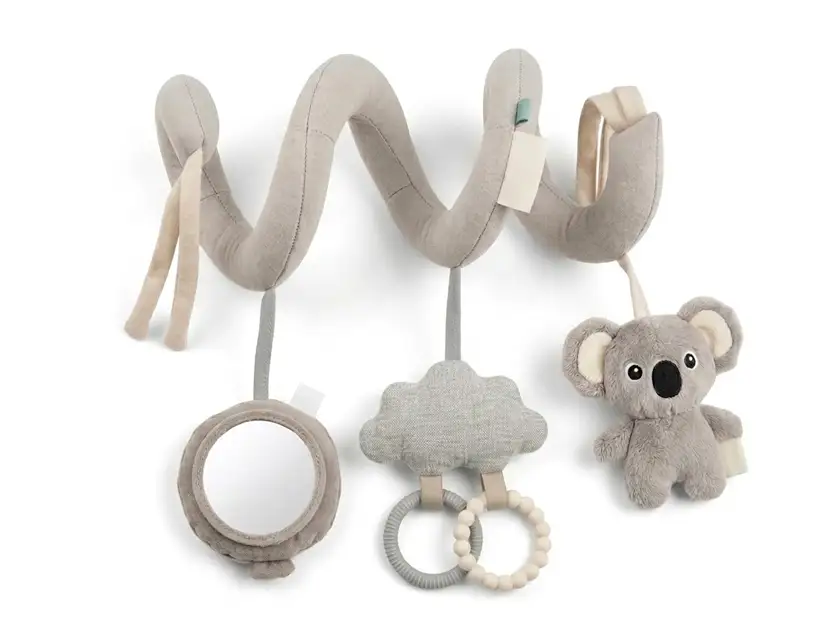
Embroidered or printed facial features have effectively become the default standard for genuinely infant-safe plush toys, because they eliminate the choking hazard category entirely rather than merely reducing it. A well-attached plastic eye is still a plastic eye — under enough mechanical stress, adhesive fails, thread wears through, or a locking washer loosens over months of washing and handling. An embroidered eye has no attachment point to fail, because there is nothing separate from the fabric to detach in the first place.
Tip: When shopping for a plush toy intended for a child under twelve months, run a hand over the face and body before purchasing. If you can feel any small, hard, separately attached component under the fabric — even one that looks secure — treat it as a choking risk and choose an embroidered-feature alternative instead.
Small Parts Testing and the Toilet Paper Roll Standard
Regulatory small parts testing typically uses a standardized cylinder — approximately the diameter of a toilet paper roll tube — to determine whether a component is small enough to present a choking hazard for a young child. Any part of a toy that fits entirely within this test cylinder, or that can be pulled free and does fit within it, fails small parts testing for the infant age category. This is the practical, physical basis behind why buttons, small plastic accessories, and beaded decorations are excluded from genuinely infant-graded plush toy design rather than simply discouraged.
Fabric and Filling Materials That Are Safe for Infant Skin
Beyond choking prevention, infant plush toys must account for sensitive skin, frequent mouthing contact, and the reality that a young baby’s immune and respiratory systems are still developing. Fabric and filling material selection directly determines how well a plush toy performs against these concerns.
Fabric and Filling Materials Commonly Used in Infant-Safe Plush Toys
| Material | Common Use | Infant Safety Consideration |
|---|---|---|
| Organic or GOTS-certified cotton | Outer fabric, especially for newborn lines | Free of pesticide residue and synthetic finishing chemicals |
| Minky or plush polyester fabric | Outer fabric for softness and texture | Should be tested for dye migration and formaldehyde-free finishing |
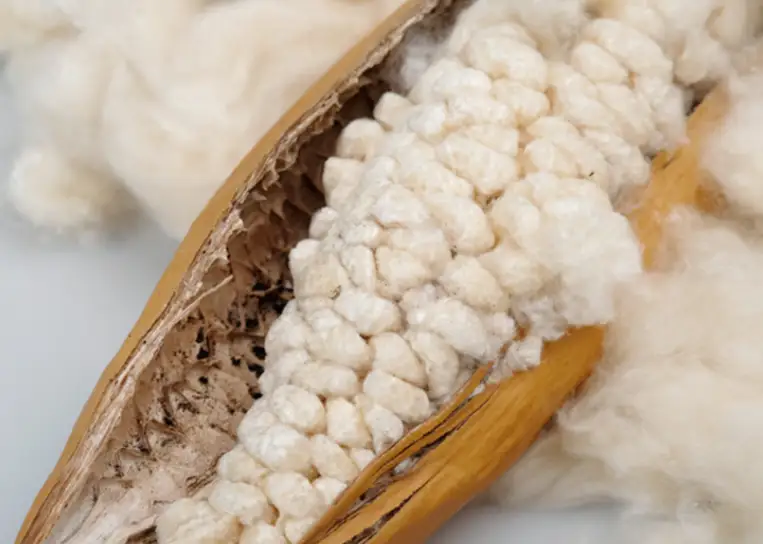
| Hypoallergenic polyester (PP cotton) filling | Internal stuffing | Non-allergenic, machine-washable, holds shape without lumping |
| Bamboo or organic cotton blend fabric | Outer fabric for sensitive-skin product lines | Naturally breathable, lower risk of skin irritation |
| Recycled polyester filling | Internal stuffing, sustainability-focused products | Must still meet the same chemical safety testing as virgin fiber |
Why Fiber Content Alone Is Not a Safety Guarantee
A common misconception is that “natural” or “organic” fiber content automatically means a fabric is infant-safe, while synthetic fiber content does not. In practice, the finishing process — the dyes, softeners, and chemical treatments applied to raw fiber during manufacturing — determines chemical safety at least as much as the base fiber does. An organic cotton fabric finished with non-compliant dye can fail chemical testing just as a synthetic fabric can, and a well-tested synthetic minky fabric with certified formaldehyde-free finishing can be entirely appropriate for infant use. This is why certification and lab testing results matter more than fiber type alone when evaluating material safety.
Seam Strength and Construction Requirements for Infant Plush Toys
An infant plush toy is handled with far more mechanical stress than an adult might expect — pulled, chewed, gripped, thrown, and repeatedly washed. Construction quality that would be entirely adequate for a decorative or display plush toy is not automatically adequate for a product that will be mouthed daily and machine-washed weekly for months.
Reinforced Seams and Stress Points
Infant-grade plush construction typically reinforces high-stress points — limb attachments, ear and tail bases, and any seam near the head — with double stitching or bar-tack reinforcement rather than a single pass of straight stitching. These are the points most likely to be gripped, pulled, or chewed repeatedly, and standard single-pass seams that would be acceptable elsewhere on the product are more likely to weaken under this concentrated, repeated stress.
Filling Density and Escape Prevention
Internal filling must be enclosed by seams strong enough to prevent any escape of stuffing material, even under sustained chewing and pulling. This is closely related to, but distinct from, general seam strength — a seam can be strong enough to hold the toy’s overall shape together while still being vulnerable to small-scale fiber leakage at a chewed corner if the stitch density in that specific area is inadequate.
Tip: Before giving any plush toy to an infant, gently but firmly tug on the head, limbs, ears, and any protruding features. A properly constructed infant-safe toy should show no give, popping, or loosening at these stress points. If any part shifts, stretches, or feels like it could separate under repeated pulling, do not give the toy to the child unsupervised.
Washability and Hygiene for Infant Plush Toys
Because infant plush toys are mouthed, dropped, and handled constantly, hygiene maintenance is a practical safety consideration alongside material and construction safety. A toy that cannot be cleaned regularly and thoroughly becomes a vector for bacteria, mold, and allergens regardless of how safe its original materials were.
Washability and Hygiene Features to Look For in Infant Plush Toys
| Feature | Why It Matters for Infants | What to Check Before Buying |
|---|---|---|
| Machine-washable construction | Enables frequent, thorough cleaning without damaging the toy | Care label specifying machine wash, not spot-clean only |
| Quick-drying filling | Reduces the risk of mold or mildew developing inside the toy | Polyester-based filling rather than natural fibers that retain moisture |
| Colorfast dye | Prevents dye bleeding or fading during repeated washing | Consistent color retention claims or visible wash-test information |
| Sealed internal components | Prevents water damage to any internal noisemaker or insert | Confirmation that internal inserts are wash-safe if present |
| No externally glued elements | Prevents adhesive failure and detachment during washing | Absence of glued-on trims, appliqués, or decorative pieces |
Establishing a Regular Washing Routine
Beyond the toy’s inherent washability, establishing a consistent washing routine — particularly during the early months when an infant is frequently sick, teething, or mouthing everything within reach — meaningfully reduces the bacterial and allergen load a plush toy accumulates. A toy that is technically machine-washable but rarely actually washed provides little practical hygiene benefit over one that is spot-cleaned occasionally.
Size and Design Features to Avoid for Infant Plush Toys
Beyond material safety and construction quality, certain size and design choices carry elevated risk specifically for infants and should be avoided or carefully evaluated regardless of how well a product otherwise meets safety standards.
Many of these risks are less about the toy’s manufacturing quality and more about how the design interacts with an infant’s specific physical limitations — limited head control, an inability to reposition themselves during sleep, and a strong reflexive mouthing instinct. A design feature that would be entirely reasonable for a two-year-old can carry real risk for a six-month-old precisely because the younger child cannot yet respond to or escape a hazard the way an older child could.
- Long ribbons, cords, or straps longer than a few centimeters present a strangulation risk, particularly for toys placed in a crib or attached to a stroller.
- Toys small enough to fully cover an infant’s nose and mouth should be avoided in the sleep environment, since suffocation risk from soft objects in a crib is a well-established safety concern for infants under twelve months.
- Toys with battery compartments that are not fully secured with a screw-locked cover introduce both a choking risk from small button batteries and a chemical burn risk if a battery is accessed.
- Toys with strong scents or added fragrance can trigger respiratory sensitivity in some infants and are generally unnecessary for a product intended for mouthing contact.
- Overly rigid internal structures such as wire armatures or hard plastic frames inside a plush body are inappropriate for infant products, since they defeat the soft, forgiving structure that makes plush toys appropriate for young children in the first place.
Sleep Environment Safety Guidance
Pediatric safety organizations generally recommend keeping soft toys, including plush toys, out of a sleeping infant’s crib or bassinet during unsupervised sleep, regardless of how well the toy meets material and construction safety standards. This guidance is separate from product safety certification — a plush toy can be fully compliant with every applicable chemical and mechanical safety standard while still being inappropriate to leave in a crib during sleep, because the suffocation risk from any soft object relates to sleep positioning rather than the object’s inherent construction quality.
How to Verify Safety Before Buying an Infant Plush Toy
With material, construction, and design factors all contributing to overall safety, buyers benefit from a consistent verification process rather than relying on a single indicator such as price or brand reputation alone.
- Confirm the age grading matches the intended child’s age, not just a general “children’s toy” label.
- Check for applicable safety certification marks relevant to the purchasing region — CPSIA compliance in the United States, CE marking with EN 71 testing in the European Union.
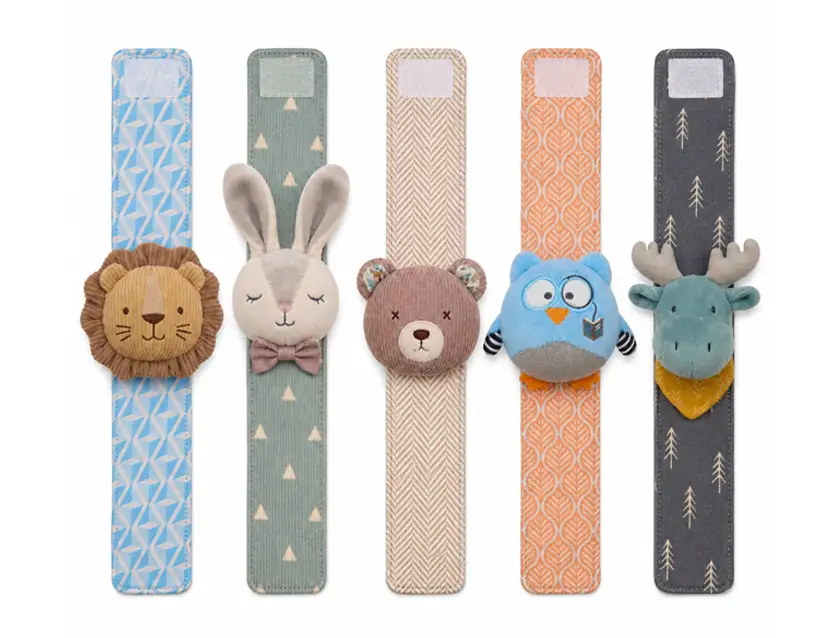
- Inspect facial features and attachments for embroidered rather than sewn-on or glued components.
- Test seam strength manually at stress points before first use, particularly for gifted or secondhand items without visible testing documentation.
- Review the care label to confirm machine washability and appropriate drying instructions.
- Check for any recall history associated with the specific product or brand before purchasing, particularly for lesser-known or marketplace-only sellers.
Tip: For secondhand or hand-me-down plush toys, do not assume the same safety standard applies simply because the toy appears to be in good physical condition. Inspect it as thoroughly as a new purchase — checking attachments, seams, and any age-related material degradation — since older manufacturing standards may not meet current infant safety requirements.
Frequently Asked Questions
At what age can a baby safely have a plush toy in their crib?
Pediatric safety guidance generally recommends keeping soft objects, including plush toys, out of a sleeping infant’s crib until around twelve months of age, when the risk of suffocation from soft bedding and toys during sleep decreases substantially as the infant develops the physical ability to move and reposition themselves. Before this age, plush toys can still be safely used for supervised playtime outside the crib, but should not be left in the sleep environment during unsupervised sleep.
Are plastic safety eyes ever acceptable on a plush toy for a baby?
Plastic safety eyes, even the locking-washer type marketed as secure, are generally not recommended for plush toys intended for children under three years old, and many infant-specific product lines avoid them entirely in favor of embroidered or printed features. While a properly installed safety eye can pass initial pull-force testing, repeated washing, chewing, and mechanical stress over months of use can weaken the attachment over time in ways that are not always visible from the outside. Embroidered features eliminate this risk category entirely and are the more conservative choice for infant products.
How can I tell if a plush toy meets CPSIA requirements before buying it?
Look for a tracking label — required under CPSIA for children’s products sold in the United States — that includes manufacturer information, production date, and batch information, along with any stated compliance with ASTM F963 testing. Reputable sellers typically make third-party lab test reports available on request, particularly for online marketplace listings, and a product’s packaging or listing should specify an age grade consistent with infant use rather than a general, unspecified children’s category. The absence of any tracking label or age grading information is itself a signal to look for a different, properly labeled product.
Is organic cotton filling safer than polyester filling for babies?
Not inherently — safety depends more on how the material was processed and tested than on whether it is natural or synthetic. Polyester (PP cotton) filling is hypoallergenic, holds shape well, dries quickly after washing, and is the most common filling in infant-safe plush toys precisely because of these practical hygiene advantages. Organic cotton offers a natural-fiber alternative that some parents prefer, but it must still be verified for finishing chemical safety and tends to retain more moisture during washing, which can be a hygiene consideration. Both materials can be entirely appropriate when properly tested and certified.
What should I do if I find a loose part on a plush toy my baby already has?
Remove the toy from the child’s access immediately, since any component that has become loose — an eye, a nose, a bow, or a seam that has begun to separate — presents an active choking or ingestion risk regardless of how the toy performed when new. Do not attempt to reattach the component yourself and continue using the toy, since a home repair is unlikely to meet the original manufacturing standard for attachment strength. If the toy was purchased recently, check the manufacturer’s or retailer’s return and safety policy, and consider reporting the issue if the product appears to have a design or manufacturing defect rather than simple wear.
Do all plush toys need to be flame-resistant to be safe for babies?
Flammability testing is a standard component of both CPSIA-related testing in the United States and EN 71 testing in the European Union, and any properly certified infant plush toy will have been tested against the applicable flammability standard for children’s soft toys as part of its overall safety compliance. This does not mean the fabric is flameproof in an absolute sense, but that it meets the burn rate and ignition resistance requirements defined for children’s textile products. Buyers do not need to separately verify flame resistance beyond confirming that the product carries appropriate regional safety certification, since flammability testing is included within those broader compliance frameworks.
How often should an infant’s plush toys be washed?
There is no single universal interval, since washing frequency reasonably depends on how often and how directly the toy is mouthed, whether the infant is currently teething or ill, and the household’s general hygiene practices. As a practical guideline, plush toys in frequent daily use benefit from washing roughly every one to two weeks, with more frequent washing appropriate during illness or heavy teething periods when mouthing contact increases significantly. Toys used only occasionally can reasonably be washed less often, but should still be checked and cleaned before being reintroduced after any period of storage.