Skip to content
A travel pillow plush toy sits at the intersection of two very different product categories that most manufacturers treat separately: a functional support cushion engineered around ergonomic compression and rebound, and a soft, character-driven plush toy engineered around surface texture, huggability, and visual appeal. Producing one successfully requires satisfying both sets of requirements at once — a shape that genuinely supports the neck during travel, wrapped in a fabric and character construction that still reads as a plush toy rather than a medical support product.
This guide explains what travel pillow plush toy manufacturing involves, which materials and filling combinations are used to balance comfort with plush appeal, how the production process differs from a standard stuffed animal, what quality standards apply, and where the most common defects occur in this specific product category.
What Is Travel Pillow Plush Toy Manufacturing?
Travel pillow plush toy manufacturing is the production of a soft, huggable character or animal-shaped plush product that also functions as a neck or head support cushion during travel, typically combining a shaped or contoured filling core with an outer plush fabric shell finished to the same standard as a conventional stuffed animal. Unlike a standard plush toy, which is judged almost entirely on softness, character accuracy, and huggability, a travel pillow plush toy must additionally hold a specific ergonomic shape under repeated compression and rebound cycles, since its core function is physical neck or head support rather than display or companionship alone.
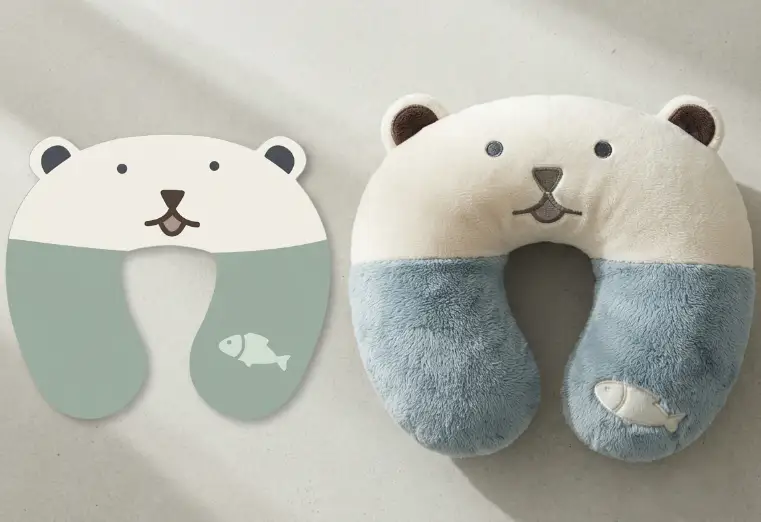
This dual requirement shapes nearly every manufacturing decision in the product, from filling material selection through to the internal construction method used to keep the support shape stable after hundreds of compression cycles in a suitcase or under a sleeping traveler’s head.
What Materials Are Used in Travel Pillow Plush Toys?
Material selection in travel pillow plush toy manufacturing differs from standard plush production primarily at the filling layer, where the material must provide genuine ergonomic support and shape recovery rather than simple soft loft, while the outer fabric layer generally follows the same material logic used across the broader plush category.
Outer Fabric Selection
The outer fabric shell of a travel pillow plush toy is typically constructed from the same fabric families used across conventional plush production — minky, velboa, or short-pile faux fur — selected for softness against the skin and colorfastness under repeated handling, since the fabric will be in direct, extended facial and neck contact during use rather than incidental contact typical of a shelf-displayed plush toy.
Filling and Core Material Selection
The filling and core material is where travel pillow plush toys diverge most significantly from conventional stuffed animals. A standard plush toy uses PP cotton or polyester fiberfill selected purely for loft and huggable softness, with no requirement for structural shape recovery under sustained load. A travel pillow plush toy requires a filling or core material capable of compressing under head or neck weight and then recovering its supportive shape repeatedly over the product’s service life, which has led to several distinct material approaches within the category.
Filling and Core Material Options for Travel Pillow Plush Toys
| Filling Type | Support Characteristics | Typical Use Case |
|---|---|---|
| Standard PP cotton fiberfill | Soft, minimal shape recovery, compresses without rebounding firmly | Decorative travel pillow plush toys with light support needs |
| Memory foam bead or shredded memory foam fill | Moderate to strong contouring support, gradual recovery | Functional neck support with plush exterior |
| Microbead fill | Firm, quick-recovery support with a distinct textured feel | Products emphasizing malleable, moldable support |
| Molded foam core with plush outer shell | Consistent, engineered support shape | Ergonomic U-shaped or contoured neck pillows |
| Hybrid fill (foam core plus fiberfill outer layer) | Structural support at the core, soft, huggable exterior | Products balancing plush appeal with functional support |
Tip: Match the filling type to the product’s actual support claim before finalizing the tech pack. A travel pillow plush toy marketed primarily as a soft companion toy with incidental support can use standard fiberfill without issue, but a product marketed with an explicit ergonomic support claim requires a filling or core material tested for compression recovery over repeated use cycles. Confirming which claim applies before filling material is finalized prevents a mismatch between the marketing claim and the physical performance of the finished product.
How Are Travel Pillow Plush Toys Designed for Function and Comfort?
Design in this category has to reconcile two competing priorities: an ergonomic shape effective enough to provide genuine neck or head support, and a silhouette soft and rounded enough to preserve the character appeal expected of a plush toy rather than reading as a clinical support product.

Neck Support Shapes
Neck support shape design in travel pillow plush toys generally follows one of a small number of established ergonomic silhouettes — the classic U-shaped neck pillow, a contoured crescent shape, or a wraparound design — each adapted to incorporate a plush character’s head, limbs, or other recognizable features without compromising the underlying support geometry. The support shape is typically established first as a functional pattern, with the character design elements layered onto that base shape during pattern development, rather than starting from a character silhouette and attempting to retrofit ergonomic support afterward.
Compressibility and Packability
Because travel pillows are, by definition, intended to be packed into luggage or carried in confined spaces, compressibility and packability are functional design requirements distinct from the support performance itself. A filling or core material selected purely for support firmness may compress poorly into a suitcase or backpack, while a material selected purely for packability may not hold sufficient shape to provide real neck support — making this trade-off one of the more consequential material and construction decisions in the category.
Common Travel Pillow Plush Shape Styles Compared
| Shape Style | Support Function | Packability |
|---|---|---|
| Classic U-shaped neck pillow | Circumferential neck support prevents head lolling | Moderate; benefits from an inflatable or foldable core variant |
| Contoured crescent shape | Targeted side and rear neck support | Good; typically more compressible than full U-shapes |
| Wraparound/plush character body pillow | Broader upper body and head support | Lower; larger overall volume when packed |
| Flat huggable plush with minimal support core | Light headrest support only | Excellent; compresses close to a standard plush toy |
Tip: Request a compression-recovery sample test before committing to full production. Filling and core materials that feel adequately supportive in a single showroom test can behave very differently after repeated compression cycles that simulate weeks of actual travel use. Requesting a sample that has been mechanically compressed and released a set number of times — rather than evaluating only a fresh, unused sample — gives a much more realistic picture of how the support shape will hold up over the product’s intended service life.
How Does the Manufacturing Process Work for Travel Pillow Plush Toys?
The manufacturing process for travel pillow plush toys follows the same broad sequence used in conventional plush production — cutting, sewing, filling, closing, and finishing — but with additional process steps and controls introduced specifically to manage the support core and its interaction with the outer plush shell.
Travel Pillow Plush Toy Production Process Stages
| Process Stage | What Happens | Category-Specific Consideration |
|---|---|---|
| Fabric cutting | Outer plush fabric panels cut according to the pattern | Panels must accommodate the support shape’s contours without distorting under fill pressure |
| Sewing and assembly | Panels sewn together, leaving an opening for filling or core insertion | Reinforced seams are needed at high-compression zones where the support load concentrates |
| Core or filling insertion | Memory foam, microbead, or molded core placed inside the plush shell | Core alignment must be verified so the support shape is centered correctly within the plush exterior |
| Closing and finishing | Filling opening sewn closed, character features (face, limbs) attached | Closure seam must withstand repeated compression without failing over the product’s service life |
| Quality inspection | Visual, dimensional, and functional checks performed | Includes support, shape verification, and compression testing specific to this product category |
Core Alignment and Shell Fit
Core alignment and shell fit refer to how precisely the internal support core sits within the outer plush shell once assembled, a consideration that does not exist in standard plush production where filling simply follows the shape of the outer shell rather than needing to align with a pre-formed internal structure. A misaligned core can produce a plush toy that looks correct on visual inspection but fails to deliver support in the intended location, which is why dimensional verification during assembly is treated as a distinct quality checkpoint in this category rather than being folded into general filling inspection.
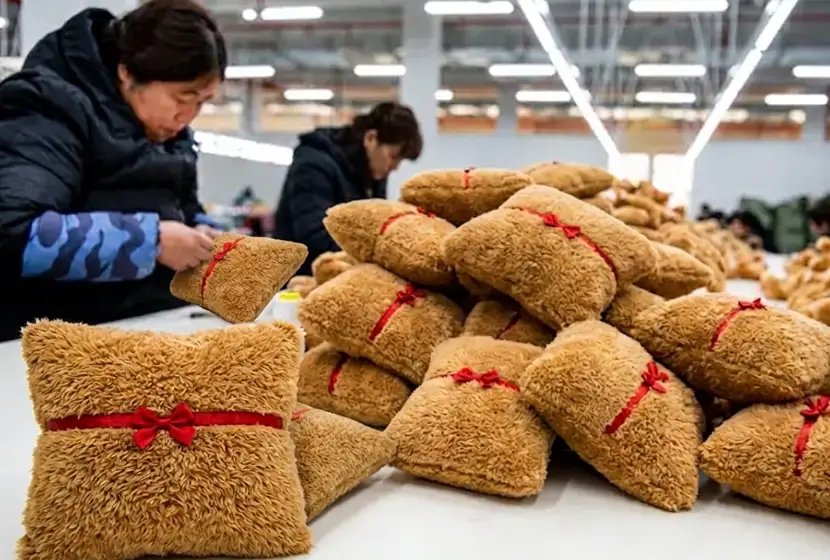
Tip: Specify a maximum acceptable core-shift tolerance during quality documentation. Because core alignment is invisible from the outside of the finished product, it is easy for a shifted or off-center core to pass a purely visual inspection. Specifying a measurable core-shift tolerance — checked through periodic dissection sampling or fill-weight-distribution testing — gives quality control a concrete standard to inspect against, rather than relying on subjective assessment of whether a sample “feels” correctly supportive.
What Quality and Safety Standards Apply to Travel Pillow Plush Toys?
Travel pillow plush toys are subject to the full range of toy safety standards applicable to conventional plush toys, since they remain, first and foremost, soft toys with the associated choking hazard, flammability, and chemical compliance requirements, while also being evaluated against additional performance expectations tied to their functional support claims.
Quality and Safety Standards Relevant to Travel Pillow Plush Toys
| Standard/Test | What It Verifies | Relevance to This Category |
|---|---|---|
| CPSIA / ASTM F963 (US) | Mechanical safety, small parts, flammability | Applies fully; face and limb attachments are common small-part risk points |
| EN71 (EU) | Mechanical, chemical, and flammability safety | Applies fully, including filling material chemical compliance |
| Compression/fatigue testing | Support shape retention after repeated compression cycles | Specific to functional support products, not standard in conventional plush QC |
| Seam strength testing | Seam integrity under repeated load and compression | More critical here than in standard plush due to compression cycling |
| Fill material compliance testing | Chemical and material safety of foam, microbead, or fiberfill core | Applies especially to foam and microbead cores, which require separate compliance verification from standard PP cotton |
Tip: Verify chemical compliance separately for foam and microbead fill materials. Foam and microbead filling materials used for support cores are chemically distinct from standard PP cotton fiberfill and are not automatically covered by a compliance certificate written for conventional plush filling. Confirming that chemical and flammability compliance testing has been performed specifically on the foam or microbead material used in the support core, rather than assuming coverage under a general plush toy safety certificate, closes a compliance gap that is specific to this product category.
What Are Common Defects in Travel Pillow Plush Toy Production and How Are They Prevented?
Travel pillow plush toys are exposed to defect risks that overlap with conventional plush production but also include several failure modes specific to their support function, most of which emerge only after the product has been used and compressed repeatedly rather than being visible at the point of initial inspection.

Common Defects in Travel Pillow Plush Toy Manufacturing
| Defect | Root Cause | Typical Fix |
|---|---|---|
| Loss of support shape over time | Filling or foam core with poor compression-recovery characteristics | Select a higher-recovery foam grade or increase core density |
| Seam failure at high-compression zones | Standard seam construction not reinforced for repeated load | Add reinforced or double-stitched seams at load-bearing zones |
| Off-center or shifted support core | Inconsistent core placement during assembly | Add a core alignment verification step to the assembly process |
| Lumpy or uneven surface appearance | Microbead or foam fill is distributed unevenly within the shell | Add internal baffles or chambers to control fill distribution |
| Fabric pilling or wear at friction points | Lower-durability fabric used in a product with frequent skin and surface contact | Select a more abrasion-resistant fabric grade for high-contact zones |
Conclusion
Travel pillow plush toy manufacturing succeeds when a manufacturer treats the product as genuinely dual-purpose rather than defaulting to standard plush production methods with a support-shaped pattern layered on top. Filling and core material selection has to satisfy real compression-recovery performance, not just softness. Shape design has to balance ergonomic support with character appeal and packability. Assembly has to verify core alignment as a distinct quality checkpoint.
And safety and quality testing have to extend beyond standard plush compliance into compression fatigue and support-specific fill material verification. Manufacturers and buyers who understand these category-specific requirements are far better positioned to specify, evaluate, and produce a travel pillow plush toy that performs as well as it looks.
FAQ
Q1: What is the main difference between a travel pillow plush toy and a standard stuffed animal?
The main difference is functional intent. A standard stuffed animal is designed and filled purely for softness, huggability, and visual character appeal, with no requirement to hold a specific shape under sustained load. A travel pillow plush toy must additionally function as a support cushion, meaning its filling or internal core has to compress under head or neck weight and then recover its shape reliably over repeated use, which introduces material selection, construction, and testing requirements — such as compression-recovery performance and core alignment verification — that do not apply to conventional plush production.
Q2: Can memory foam be used inside a plush toy without making it feel stiff or unlike a soft toy?
Yes, when the foam is used as an internal core wrapped in a separate soft plush outer shell rather than being the only material in direct contact with the user. A common approach uses a molded or shredded memory foam core for structural support, layered beneath or surrounded by a softer fiberfill layer directly under the plush fabric surface, so the exterior still feels soft and huggable while the underlying foam provides the actual support function. The specific ratio of foam to soft filling is typically tuned during sample development to balance support performance against the plush, huggable feel expected of the product category.
Q3: How is the support shape of a travel pillow plush toy tested before mass production?
Support shape performance is typically verified through compression-recovery testing, in which a sample is mechanically compressed a specified number of cycles — simulating weeks or months of packing and use — and then measured against its original dimensions and support characteristics to determine how much shape retention has been lost. This testing is usually performed during the sample approval stage, before tooling for mass production filling equipment is finalized, since a filling or core material that fails this test would require a material substitution that is far easier to make before bulk material has been purchased for full production.
Q4: Are travel pillow plush toys held to different safety standards than regular plush toys?
The core toy safety standards — mechanical safety, small parts, flammability, and chemical restriction requirements such as CPSIA in the United States or EN71 in the European Union — apply equally to travel pillow plush toys as they do to conventional stuffed animals, since both are fundamentally soft toy products. What differs is the additional testing relevant to the support function itself, including compression fatigue testing and, importantly, separate chemical compliance verification for foam or microbead filling materials, which are chemically distinct from standard polyester or PP cotton fiberfill and are not automatically covered by a compliance certificate written for conventional plush filling.
Q5: Why do some travel pillow plush toys develop a lumpy or uneven feel after a period of use?
This is most commonly caused by loose-fill materials, such as microbeads or shredded foam, migrating or settling unevenly within the outer plush shell over repeated compression and handling, particularly if the internal construction does not include baffles or internal chambers to control fill distribution. Products using a solid molded foam core rather than loose fill are generally less prone to this specific issue, since a solid core cannot shift or redistribute internally the way loose fill material can. Manufacturers addressing this defect typically add internal stitched chambers or baffle walls to restrict how far loose fill can migrate within the shell.
Q6: How much does using a memory foam or molded core increase production cost compared to standard fiberfill?
Cost impact varies by the specific core type and sourcing arrangement, but molded foam cores and higher-recovery memory foam fill generally carry a meaningful cost premium over standard PP cotton fiberfill, driven both by the higher raw material cost of specialty foam and by the additional processing steps — core molding or shredding, alignment verification during assembly, and compression testing — required to properly integrate a support core into a plush shell. Buyers evaluating this trade-off typically weigh the cost premium against the product’s positioning: a travel pillow plush toy marketed with an explicit ergonomic support claim generally justifies the added cost, while a more decorative, lightly supportive product may perform adequately with standard fiberfill at a lower cost.
Q7: What causes the seams on a travel pillow plush toy to fail before the seams on a standard plush toy would?
Seam failure in travel pillow plush toys occurs more readily at specific high-compression zones — typically where the support core presses most directly against the seam during normal use — because these zones experience repeated mechanical load that a standard plush toy’s seams, which mainly bear the static weight of loose fiberfill, are not designed to withstand. Standard single-line stitching that performs adequately in conventional plush construction can gradually loosen or fail under this repeated compressive stress. This is why reinforced seam construction, such as double stitching or bar-tacking at identified high-load zones, is a common and effective preventive measure specific to this product category rather than a universal requirement across all plush production.