Skip to content
A structured breakdown of the major toy categories — material, construction, compliance burden, and sourcing implications — for teams deciding what to develop, import, or manufacture next.
Ask ten people in the toy industry to define “types of toys,” and you will get ten different answers — because toys can be classified by material, by age group, by mechanism, by distribution channel, or by manufacturing process, and each classification system answers a different business question. A retail buyer classifies toys by aisle. A regulator classifies toys by hazard profile. A factory classifies toys by tooling and process. A brand deciding what to develop next needs all three lenses at once, because the category a product falls into determines its compliance burden, its minimum order quantity, its development timeline, and its margin structure before a single unit has been produced.
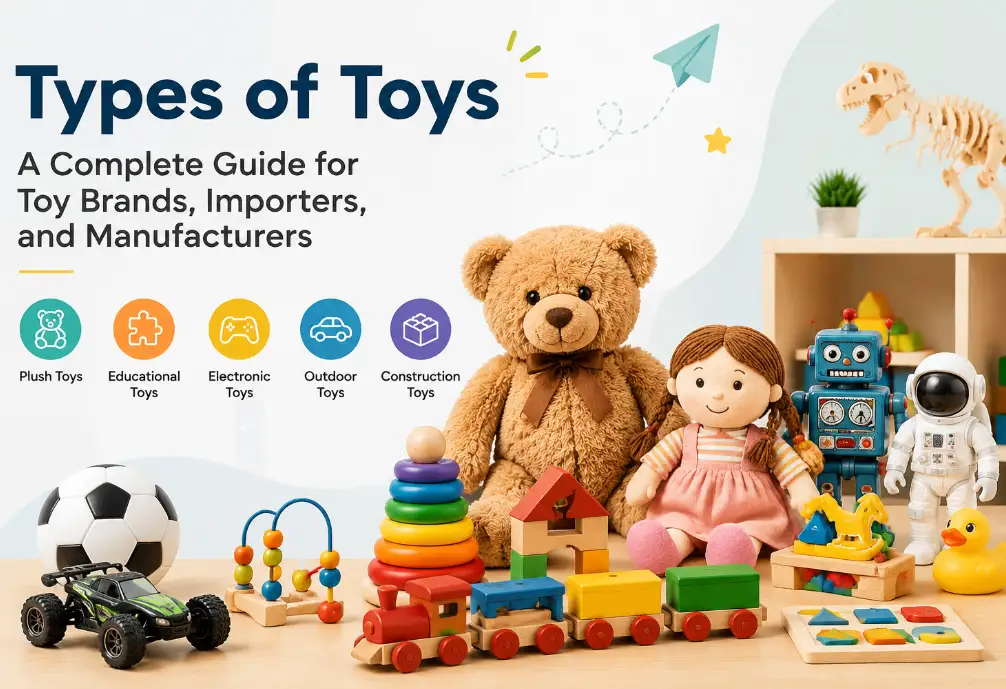
This guide organizes the toy landscape the way a sourcing or product team actually needs it — by material and manufacturing process first, since that is what determines cost, lead time, and factory selection, with compliance and market-fit considerations layered onto each category. It covers plush and soft toys, plastic and injection-molded toys, wooden toys, electronic and interactive toys, die-cast and metal toys, blind box and vinyl collectibles, educational and building toys, outdoor and ride-on toys, and puzzle and paper-based toys — along with the comparative framework needed to decide which category fits a given brand, budget, and market.
Why Toy Type Classification Matters for Sourcing and Compliance Decisions
Toy type is not a marketing detail — it is the variable that determines almost every operational decision that follows a product concept. The material and construction method of a toy determines which factories can produce it, what tooling investment is required, what the realistic minimum order quantity will be, how long development takes, and which safety standards apply. Two products that look similar on a mood board — a plush character and a vinyl figure of the same character, for example — can have completely different cost structures, lead times, and compliance pathways once the material and process are fixed.
Toy type classification matters because it is the first filter that narrows a nearly unlimited product concept space down to a specific, produceable, compliant product. A brand that skips this step and moves straight from concept sketch to supplier outreach frequently discovers, weeks into development, that the intended toy type does not fit the target price point, cannot meet the required compliance standard for age grade, or requires a production process none of the contacted suppliers actually run. Establishing toy type early — with its cost, compliance, and lead time implications understood — prevents this category of costly redirection.
Common Toy Classification Systems and What Each One Is Used For
| Classification System | Basis | Primary User | What It Determines |
|---|---|---|---|
| By material/process | Plush, plastic, wood, metal, electronic, paper | Sourcing and product teams | Factory selection, tooling, cost, lead time |
| By age grade | 0–3, 3–6, 6–12, 12+ years | Regulators, retailers | Applicable safety standards, small-parts rules |
| By function | Educational, active play, collectible, comfort | Marketing, retail buyers | Positioning, channel fit, price expectation |
| By distribution channel | Mass retail, specialty, e-commerce, gift | Sales and brand teams | Packaging requirements, MOQ expectations |
| By IP status | Original design, licensed, generic/OEM | Legal, brand management | Licensing cost, exclusivity, design freedom |
Tip: Before approaching any factory, decide the toy’s material and construction category, not just its concept. “A collectible fox character” is not enough information for a supplier to quote. “A collectible fox character in soft PVC vinyl, 12cm, blind box format” is — and it will route the inquiry to the right type of factory on the first attempt instead of the third.
Plush and Soft Toys
Plush toys — fabric-covered, fiber-filled products ranging from classic teddy bears to licensed character collectibles — remain one of the largest and most accessible toy categories for new brands, largely because tooling investment is minimal compared to hard-material categories. Production is pattern-based rather than mold-based: a new design requires a paper pattern, fabric cutting, sewing, and stuffing rather than an injection mold or die-casting tool, which keeps the barrier to entry for a first design relatively low.
The trade-off is that plush production is labor-intensive rather than capital-intensive. Unit cost is driven primarily by fabric grade, fill density, and the complexity of construction — embroidery detail, multiple fabric panels, jointed limbs, or added electronics all add direct labor hours rather than being absorbed by tooling amortization the way plastic parts are. This makes plush toys comparatively forgiving for low first-order volumes but comparatively slow to gain the same economies of scale that injection-molded products achieve at high volume.
Sub-Categories Within Plush
The plush category itself spans a wide range of sub-types with different cost and compliance profiles: classic stuffed animals, licensed character plush, weighted/anxiety plush with glass or plastic bead filling, interactive plush with embedded sound or motion modules, crochet/amigurumi-style plush, and plush combined with functional items such as blankets, pillows, or bags. Each sub-type carries a different compliance load — weighted plush requires additional seam-strength and containment testing, interactive plush requires electronics safety testing on top of standard textile and mechanical testing, and any plush intended for children under three must meet stricter small-parts and choking-hazard requirements regardless of sub-type.
Plush Toy Sub-Categories at a Glance
| Sub-Category | Typical MOQ | Relative Unit Cost | Added Compliance Burden |
|---|---|---|---|
| Classic stuffed animal | 300–1,000 units | Baseline | Standard textile/mechanical testing |
| Licensed character plush | 500–2,000 units | Baseline + licensing fee | IP approval process, standard testing |
| Weighted/anxiety plush | 500–1,000 units | +15–25% | Seam strength, fill containment testing |
| Interactive/electronic plush | 1,000–3,000 units | +40–80% | Electronics/battery safety testing |
| Crochet/amigurumi plush | 200–500 units | +20–35% (hand labor) | Standard testing, small-parts review on details |
Fabric and Fill Selection Within Plush
Within any plush sub-category, fabric and fill selection is the primary lever for both cost and perceived quality. Short-pile plush fabrics in the 3–5mm range are common for smaller, budget-oriented products, while long-pile or high-density fabrics in the 8–15mm range are typically reserved for premium positioning because they consume more raw material per unit and require more careful cutting and sewing to avoid visible seams. Fill material follows a similar logic — standard polyester (PP cotton) fiberfill remains the most common and cost-effective option, while alternatives such as memory foam beads, natural cotton, or recycled PET fiberfill each carry a cost premium tied to sourcing and, in some cases, certification requirements.
Buyers new to the category sometimes assume that fabric and fill are interchangeable specification details that a factory will simply match to a target price point. In practice, fabric and fill choice materially affects how a design translates from concept art to physical product — a character designed with crisp, angular features will not read correctly in a long-pile fabric that softens edges, and a design relying on a compact silhouette will not hold its shape with a low-density fill. Reviewing fabric swatches and fill samples against the design intent before finalizing the specification avoids a mismatch that only becomes obvious once the first sample arrives.
Plastic Toys and Injection-Molded Products
Plastic toys — produced primarily through injection molding — form the largest toy category by volume worldwide, covering everything from simple figurines and building blocks to complex mechanized vehicles and role-play sets. Unlike plush, plastic toy production is capital-intensive at the front end: a mold must be designed and built before a single unit can be produced, and this tooling cost is the primary factor separating small custom orders from large-scale plastic toy programs.
Mold cost varies enormously with part complexity, size, and cavity count — a simple single-cavity mold for a small figurine might run a few thousand dollars, while a complex multi-cavity mold for a detailed vehicle with moving parts can run into the tens of thousands. Because this cost is fixed regardless of order volume, plastic toys favor programs with either a long product life (the mold is used across many production runs) or high initial volume that amortizes the tooling cost across enough units to keep the per-unit price competitive.

Resin Selection and Its Effect on Toy Category
The resin used in a plastic toy affects both its feel and its compliance profile. ABS is common for structural components and building sets because of its impact resistance and dimensional stability. PP is favored for parts requiring flexibility, such as living hinges or snap-fit closures. PVC remains widely used for soft, squeezable figures and bath toys, though its use is subject to increasing restriction around phthalate plasticizers in many markets. TPE and TPR are used where a rubber-like, softer feel is required without the compliance complications associated with certain PVC formulations.
Tip: Treat mold cost as a strategic decision, not a sunk cost to minimize. A slightly more expensive multi-cavity mold that produces four parts per shot can cut per-unit cost significantly at volume — but only pays off if the order volume justifies it. For a first production run under roughly 5,000 units, a single-cavity mold with a lower upfront cost is usually the more capital-efficient choice, even though the per-unit price is higher.
Injection Molding vs. Blow Molding vs. Rotational Molding
Injection molding is the default process for most solid plastic toy components, but it is not the only plastic manufacturing process relevant to toys, and choosing the wrong one for a given product shape leads to either an unworkable design or an unnecessarily expensive one. Blow molding is the appropriate process for hollow, thin-walled parts such as balls, bottles, or large hollow figures, and it uses a fundamentally different tooling approach than injection molding, generally at a lower tooling cost for large hollow shapes.
Rotational molding (rotomolding) is used for larger hollow parts that need thicker, more durable walls than blow molding can economically achieve — ride-on toy bodies and large outdoor play structures are common rotomolded products — and it trades a slower cycle time for the ability to produce large, seamless, impact-resistant shells without the higher tooling cost of large multi-part injection molds.
Plastic Molding Process Selection Guide
| Process | Best Suited For | Relative Tooling Cost | Relative Cycle Time |
|---|---|---|---|
| Injection molding | Solid, detailed parts of any size | Moderate to high | Fast |
| Blow molding | Hollow, thin-walled parts | Low to moderate | Fast |
| Rotational molding | Large hollow parts, thick walls | Low to moderate | Slow |
Bringing the correct molding process into the conversation early — rather than defaulting to injection molding because it is the most familiar term — is one of the more common gaps between how a brand describes a product concept and how a factory needs to hear it described in order to quote accurately.
Wooden and Natural-Material Toys
Wooden toys occupy a distinct position in the market — often positioned at a premium price point and marketed on sustainability, tactile quality, and design heritage rather than feature count. Construction methods range from simple laser-cut or CNC-routed flat pieces to fully turned and jointed three-dimensional pieces, with the manufacturing complexity and finishing process (painting, oiling, lacquering) driving most of the cost variation within the category.

Wooden toys carry a different compliance emphasis than plastic or plush toys. Surface coatings — paints, stains, and lacquers — are subject to strict lead and heavy-metal content limits, and any coating must be tested and documented separately from the substrate wood. Splinter risk, edge and corner radii, and the strength of any glued or doweled joints are mechanical hazard categories that reviewers scrutinize closely, particularly for products intended for children under three.
Certified Wood Sourcing
Increasingly, brands selling wooden toys in North American and European markets are expected to document the sourcing chain for the wood itself — FSC (Forest Stewardship Council) chain-of-custody certification is the most commonly requested credential, and its absence is becoming a genuine barrier to entry in some retail channels and government procurement programs, independent of the toy’s safety compliance status.
Wooden Toy Construction Methods Compared
| Construction Method | Typical Products | Tooling Requirement | Relative Lead Time |
|---|---|---|---|
| Laser/CNC flat-cut | Puzzles, flat figures, shape sorters | Low — digital file, no mold | Short |
| Turned/lathe-formed | Blocks, rattles, stacking toys | Low to moderate | Moderate |
| Jointed/mechanized | Pull toys, articulated figures | Moderate — custom jigs | Longer |
| Multi-piece assembled sets | Play kitchens, dollhouses | Higher — multiple components | Longest |
Electronic and Interactive Toys
Electronic toys — anything incorporating sound modules, lights, motors, sensors, or connectivity — represent the fastest-growing and most compliance-intensive category in the toy market. This category spans a wide range, from a simple plush toy with an embedded sound chip to a fully programmable robotics kit with app connectivity, and the compliance and engineering requirements scale accordingly.
What distinguishes electronic toys operationally is that they combine two separate compliance domains: standard toy safety testing (mechanical, chemical, flammability) and electronics-specific testing (battery safety, electromagnetic compatibility, and — for connected products — data privacy and wireless certification). A toy with a lithium battery, for instance, requires UN38.3 transport testing in addition to standard toy safety testing before it can be shipped internationally, and products that connect to apps or the internet increasingly trigger children’s data privacy regulations such as COPPA in the United States, independent of the toy’s physical safety status.

Battery Type as a Category-Defining Decision
The choice between replaceable alkaline batteries, built-in rechargeable lithium cells, and coin-cell batteries is not just an engineering decision — it defines a different compliance and safety pathway. Coin-cell batteries in particular have triggered increasingly strict containment requirements in multiple markets following ingestion-hazard incidents, and battery compartments for any product intended for children under eight now typically require tool-required, two-step opening mechanisms as a baseline design standard rather than an optional safeguard.
Tip: If a product concept includes any electronic component, budget for a separate electronics compliance testing line item and a longer development timeline from the outset — retrofitting battery containment or EMC compliance into a design that was engineered without it in mind is far more expensive than designing for it from the first prototype.
Connectivity and Data Privacy Considerations
Toys that connect to a smartphone app, Wi-Fi network, or Bluetooth device introduce a compliance dimension that has nothing to do with physical safety: children’s data privacy regulation. In the United States, any connected toy that collects data from a child under 13 falls under COPPA (the Children’s Online Privacy Protection Act), which imposes specific requirements on data collection disclosure, parental consent, and data retention. Comparable child-data-privacy frameworks exist in the European Union under GDPR’s provisions for children’s data and in several other markets, and the specific requirements are not uniform across jurisdictions.
This means a connected toy’s compliance scope extends beyond the toy itself into the companion app, the backend data handling practices, and the privacy policy presented to parents — none of which are addressed by standard toy safety testing labs and all of which typically require separate legal and technical review. Brands entering the connected-toy category for the first time frequently underestimate this dimension because it does not appear in a conventional toy safety testing report, and it is worth scoping explicitly and separately from physical product testing, at the concept stage.
Die-Cast and Metal Toys
Die-cast toys — vehicles, model figures, and collectibles produced primarily from zinc alloy (zamak) — occupy a specialized niche defined by high perceived value relative to their size and by a collector-driven market that rewards accuracy and finish quality over feature count. Tooling for die-cast production is a significant upfront investment, generally higher than an equivalent-size plastic injection mold, because die-cast tooling must withstand higher pressures and temperatures associated with molten metal.
This higher tooling cost pushes the die-cast category toward products with long production lifespans and strong repeat-purchase or collector dynamics — a single tool is typically expected to produce far more units over its life than a plastic toy mold before the investment pays off. Finishing — painting, chrome plating, and assembly of separately molded plastic components such as windows and interiors — adds labor cost on top of the metal casting itself.
Compliance Considerations Specific to Metal Toys
Die-cast toys carry compliance considerations that differ from plastic and plush categories: sharp edge and point testing is particularly important given the rigidity of the material, and surface coatings are subject to the same heavy-metal content limits that apply to painted wooden toys. Small die-cast pieces and detachable components are scrutinized closely under small-parts regulations, since metal components do not compress or deform the way soft materials do during choke-hazard testing.
Assembly quality is a further consideration specific to this category. Die-cast vehicles typically combine a metal body with separately molded plastic components — windows, interior details, wheel hubs — and the mechanical attachment of these components (rivets, pins, or adhesive) must withstand pull and torque testing well beyond what the individual materials would suggest, since a detached window or wheel becomes a small-parts hazard independent of how securely the base metal casting itself is finished. Buyers new to the category sometimes evaluate die-cast quotes primarily on paint finish and casting detail while giving less attention to the assembly and attachment methods, which is often where quality differences between suppliers are most consequential.
Blind Box, Vinyl, and Collectible Art Toys
Blind box and designer vinyl toys have grown into one of the most commercially significant toy categories over the past several years, built around a distinct business model — randomized distribution within a defined character series, rarity tiers, and a collector culture that drives repeat purchase behavior distinct from traditional single-purchase toys. Materials range from soft PVC and ABS for standard figures to resin for premium limited editions.

The manufacturing process for blind box figures resembles standard plastic injection molding in its tooling requirements, but the business model layers additional operational complexity on top: series planning (typically 6 to 12 characters per series with defined rarity ratios), randomized packing and quality control to prevent rarity-ratio manipulation, and packaging design that must conceal the contents while remaining visually compelling on retail shelves.
Blind Box Series Planning Considerations
| Element | Typical Range | Operational Impact |
|---|---|---|
| Characters per series | 6–12 designs | Determines total mold count and development cost |
| Rarity tiers | Common, rare, secret/chase | Requires controlled randomized packing process |
| Secret figure ratio | Typically 1:72 to 1:144 | Affects perceived collectibility and resale value |
| Material | Soft PVC, ABS, resin (premium) | Drives per-unit cost and finish quality |
Tip: If entering the blind box category, finalize the full character series and rarity structure before tooling begins. Adding a character mid-series after molds are already cut disrupts both the rarity ratio math and the packaging design, and is one of the most common causes of delayed launches in this category.
Educational, STEM, and Building Toys
Educational and STEM toys — construction sets, coding robots, science kits, and building-block systems — are defined less by a single material or process than by a functional promise: the toy is marketed on a learning or skill-development outcome rather than purely on play value. This category spans multiple materials (plastic building elements, wooden puzzle sets, electronic circuit kits) but shares a common compliance and development characteristic — the marketing claims made about the toy’s educational benefit increasingly attract regulatory and retailer scrutiny alongside the physical safety testing.

Building sets in particular carry a compliance consideration distinct from other plastic toy categories: interlocking compatibility. A building system with hundreds of small, precisely dimensioned components requires exceptionally tight dimensional tolerances across every mold, since parts must interlock reliably across the entire set and across production batches, which raises tooling precision requirements and quality control standards above what a typical single-piece plastic toy requires.
Age-Grading Complexity in the STEM Category
STEM kits frequently include small components — gears, circuit boards, magnets, or chemistry-set materials — that are inherently unsuitable for young children, which pushes most of this category toward the 6-and-up or 8-and-up age grade rather than the broader age ranges achievable in simpler toy categories. Magnetic building sets deserve particular attention: small high-powered magnets have been the subject of specific regulatory action in multiple markets due to the severity of internal injury when multiple magnets are swallowed, and products in this sub-category face testing requirements substantially stricter than standard small-parts rules.
Interlocking building systems also raise a practical sourcing question that is easy to overlook: cross-compatibility claims. A brand that markets its building elements as compatible with a major existing building-block ecosystem takes on both a trademark risk, if the compatibility claim references a protected brand name, and a dimensional-tolerance burden, since claimed compatibility invites direct side-by-side comparison by consumers and reviewers. Brands entering this space generally fare better establishing an internally consistent, clearly differentiated system than leaning on compatibility claims that a factory’s tolerances may not reliably support across every production batch.
Outdoor, Ride-On, and Large-Format Toys
Outdoor and ride-on toys — tricycles, scooters, playhouses, wagons, and pool or sand play equipment — form a category defined by size, structural load requirements, and weather exposure rather than by a single material. Most products in this category combine multiple materials: rotomolded or blow-molded plastic bodies, metal frames or axles, and rubber or foam components for grips and wheels.
The defining compliance concern for this category is structural and mechanical: load-bearing capacity, stability testing (tip-over resistance), and durability under repeated stress cycles matter far more here than in most other toy categories, because product failure under load carries a materially higher injury risk than a failure in a stationary tabletop toy. UV stability of plastics is also a specific consideration for outdoor products that plastic toys intended for indoor use are not typically tested against, since prolonged sun exposure degrades many common toy resins over time.
Structural Testing Emphasis by Product Type
| Product Type | Primary Structural Concern | Additional Consideration |
|---|---|---|
| Ride-on vehicles | Load capacity, tip-over stability | Wheel/axle durability, brake function if applicable |
| Playhouses/large structures | Panel strength, assembly stability | Wind/weather resistance if outdoor use claimed |
| Swings and climbers | Suspension/anchor point strength | Fall-height and impact-surface guidance |
| Wagons/pull toys | Frame and joint fatigue resistance | Pinch-point protection at moving joints |
Tip: For any outdoor or ride-on product, request the factory’s structural test data — not just the material certificates — before committing to tooling. A material can be individually compliant while the assembled structure still fails a load or stability test, and structural testing typically has to happen after a working sample exists, which means it belongs early in the development timeline rather than as a final pre-shipment step.
Puzzles, Board Games, and Paper-Based Toys
Puzzles, board games, card games, and other paper- or cardboard-based products form a category with a fundamentally different cost structure from every other type discussed so far — printing and die-cutting replace injection molding or sewing as the core production process, which means tooling cost is minimal (a custom die-cutting form rather than an injection mold) and the largest cost driver is paper/board stock quality and print run size.

This category rewards volume more directly than most others, because print and paper costs benefit from steep economies of scale — a run of 500 units and a run of 10,000 units of the same puzzle can have dramatically different per-unit economics, more so than the volume-cost curve typically seen in plastic or plush categories. This makes the category attractive for brands testing new IP or designs at low initial risk, but less forgiving for brands that need to launch at very low volume and still hit an aggressive retail price point.
Component Complexity in Board Games
Board games in particular can straddle multiple material categories within a single product — printed board and cards, molded plastic tokens or miniatures, wooden or metal game pieces, and sometimes electronic components for games with sound or timer functions. Each additional component type adds a separate supplier relationship, separate quality control checkpoint, and separate compliance testing requirement to the overall project, which is why complex board games frequently take longer to bring to market than their apparent physical simplicity would suggest.
Paper and board stock quality is worth specifying with the same precision applied to fabric or resin grades in other categories, because it is not a single interchangeable input. Card stock thickness (commonly measured in gsm) affects both the tactile quality of a card game and its durability under repeated shuffling, while box board thickness and lamination finish affect how the packaging holds up in retail handling and repeated home use. A puzzle’s board thickness and the precision of its die-cutting jointly determine how well pieces fit and how the puzzle holds together during assembly and disassembly — a detail that is easy to underspecify in a brief but immediately noticeable to the end consumer.
How to Match Toy Type to Brand Positioning and Sourcing Strategy
With the major categories established, the practical question for a brand or importer is which type — or combination of types — fits a specific product concept, target price point, and target volume. This decision should weigh four factors together rather than in isolation: tooling investment required, realistic minimum order quantity, compliance complexity, and how well the category supports the brand’s intended price and margin position.
Toy Type Comparison Across Key Sourcing Variables
| Toy Type | Tooling Investment | Typical MOQ | Compliance Complexity | Best Fit For |
|---|---|---|---|---|
| Plush/soft toys | Low (pattern-based) | 300–1,000 | Moderate | New brands, character-led products |
| Plastic (injection molded) | Moderate to high | 1,000–5,000+ | Moderate to high | Long product lifecycles, functional toys |
| Wooden toys | Low to moderate | 500–2,000 | Moderate (coating focus) | Premium/sustainability-positioned brands |
| Electronic/interactive | Moderate to high | 1,000–3,000 | High (dual compliance domains) | Tech-forward, feature-driven brands |
| Die-cast/metal | High | 2,000–5,000+ | Moderate to high | Collector-driven, long-life SKUs |
| Blind box/vinyl | Moderate (per character) | 3,000–10,000+ per series | Moderate | IP-driven collector brands |
| Puzzles/board games | Low | 500–2,000 | Low to moderate | Low-risk IP testing, gift/specialty channel |
Reading the Comparison Correctly
The table above is a starting point, not a determinative answer — the “best fit” column reflects typical patterns rather than fixed rules, and plenty of successful brands deliberately choose a category outside their apparent natural fit for strategic reasons. What the comparison is most useful for is surfacing mismatches early: a startup brand planning a first product run of 300 units in the electronic/interactive category, for example, is working against the category’s typical MOQ and compliance cost structure and should either adjust the volume expectation, simplify the electronic feature set, or reconsider the category before investing further in the concept.
It is also worth noting that the categories in this table are not mutually exclusive market positions — many established toy brands operate across several categories simultaneously as a deliberate portfolio strategy, using a lower-tooling-cost category such as plush or puzzles to test new IP and character concepts at lower financial risk, then extending successful concepts into higher-tooling categories such as plastic or die-cast once demand is validated. Viewed this way, toy type selection is not only a per-product decision but a sequencing decision across a brand’s broader product roadmap.
Tip: When a product concept could reasonably be executed in more than one category — a character that could be plush, vinyl, or a small plastic figure, for instance — quote all viable options before committing. The cost, MOQ, and compliance differences between categories for the same underlying character concept are often larger than the differences between suppliers within a single category.
Regulatory and Compliance Differences Across Toy Types
While every toy sold in a regulated market must meet baseline safety requirements, the specific standards and testing emphasis differ meaningfully by category — and understanding which standards apply to a given toy type before development begins prevents the far more expensive scenario of discovering a compliance gap after tooling or bulk fabric cutting has already been committed.
Primary Compliance Standards by Toy Type and Market
| Toy Type | US Standard | EU Standard | Category-Specific Focus |
|---|---|---|---|
| Plush/soft toys | ASTM F963, CPSIA | EN71 Parts 1–3 | Seam strength, fill material, flammability |
| Plastic toys | ASTM F963, CPSIA | EN71 Parts 1–3, EN71-9 | Small parts, sharp edges, chemical migration |
| Wooden toys | ASTM F963, CPSIA | EN71 Parts 1–3 | Coating heavy metals, splinter/edge risk |
| Electronic/interactive | ASTM F963, FCC, UN38.3 | EN71, EN62115, RED | Battery safety, EMC, data privacy where connected |
| Die-cast/metal | ASTM F963, CPSIA | EN71 Parts 1–3 | Sharp edges/points, coating heavy metals |
| Ride-on/outdoor | ASTM F963, F1148/F2914 (category-specific) | EN71, EN71-14 (trampolines etc.) | Structural load, stability, UV durability |
Age Grading as a Cross-Category Compliance Multiplier
Regardless of toy type, age grading is the single variable that most changes the applicable compliance standard. Products intended for children under three face materially stricter small-parts testing across every category described above — a wooden puzzle, a plastic figure, and a plush toy aimed at this age group are all evaluated against the same choke-hazard cylinder test, even though they are otherwise governed by different category-specific standards. Brands developing products across multiple toy types for a consistent age range benefit from establishing the age-grade compliance requirements once, at the concept stage, rather than re-deriving them separately for each category.

Age grading also interacts with labeling and marketing requirements in ways that extend beyond the physical product itself. A toy labeled for ages 3 and under is subject to specific choking-hazard warning requirements if it contains small parts unsuitable for that age group, while a toy marketed as suitable for older children but that also appeals visually to younger children — a common tension in character-driven and collectible categories — invites additional regulatory scrutiny over whether the marketing and the actual age grade are consistent.
This is a particular consideration for blind box and collectible categories, where packaging and character design are often intentionally appealing across a broad age range even when the physical product, because of small detachable parts, is only appropriately labeled for older children.
Tip: Confirm the intended age grade before finalizing the toy type, not after. A product designed as a 3+ toy that testing later shows must be labeled for ages 6 and up — because of a small removable component, for example — can undermine the entire retail and marketing plan built around the younger age range, and catching this early is far cheaper than catching it during pre-shipment testing.
Common Mistakes Brands Make When Selecting a Toy Type
Across the categories described in this guide, a recurring set of mistakes shows up repeatedly in early-stage toy development — most of them stemming from treating toy type as a downstream production detail rather than an upfront strategic decision.
- Designing the concept before confirming category economics. A detailed character design or mechanical concept is fully locked before anyone checks whether the implied toy type fits the target retail price and volume — leading to a costly redesign once real quotes come back.
- Assuming compliance standards are uniform across categories. Teams that have sourced one toy type successfully sometimes assume the same testing scope applies to a new category, missing category-specific requirements such as battery safety for electronics or coating tests for wood and metal.
- Underestimating the MOQ implications of tooling-heavy categories. A brand planning a cautious, low-volume first order discovers midway through supplier outreach that the chosen category — die-cast or complex injection-molded plastic, for example — structurally requires a higher volume commitment than planned.
- Mixing categories without budgeting for compounded compliance testing. A multi-material product is treated, for testing budget purposes, as though it belongs to a single category, understating the actual testing scope required.
- Finalizing age grade after the design is complete rather than before. A design intended for a broad age range turns out, once tested, to require a narrower age grade because of a component that fails small-parts testing — undermining the retail and marketing plan built around the original age range.
Conclusion
Toy type is the foundational decision that shapes every downstream choice in product development — which factories can be considered, how much tooling investment is required, what minimum order quantity is realistic, how long development will take, and which compliance standards apply. Treating toy type as a strategic decision rather than an afterthought to a creative concept is what separates development processes that move smoothly from concept to shelf from those that discover a category mismatch only after time and capital have already been committed.
The categories covered in this guide — plush, plastic, wood, electronics, die-cast, blind box/vinyl, educational/building, outdoor/ride-on, and paper-based products — each carry a distinct cost structure, compliance profile, and sourcing pathway. Matching a product concept to the category that genuinely fits its target price, volume, and market — rather than the category that fits the initial creative vision alone — is the analytical step that gives a new toy the best chance of reaching production on schedule and on budget.
For teams evaluating a new concept, the most useful next step is usually to run the concept through the classification and comparison frameworks in this guide before the design is finalized — confirming material category, realistic MOQ, applicable compliance standards, and age grade as a set, rather than resolving each one separately as it becomes unavoidable later in development. That upfront discipline is consistently what separates a toy program that reaches the shelf on the first attempt from one that has to be reworked mid-development.
FAQ
Q1: How do I decide between plush and hard plastic for a new character-based toy concept?
The decision usually comes down to three factors: target price point, target texture/play pattern, and initial order volume. Plush suits lower initial volumes because tooling cost is minimal, and it fits a comfort- or huggable-oriented play pattern. Plastic suits higher volumes where mold amortization brings the unit cost down, and it fits play patterns involving articulation, accessories, or more durable outdoor use. If the character concept and target retail price could support either, requesting quotes for both from category-appropriate suppliers — rather than assuming one is obviously correct — is the most reliable way to make the decision, since the actual cost gap at a specific volume is often smaller or larger than intuition suggests.
Q2: Can one toy combine multiple categories, and does that multiply the compliance requirements?
Yes, and this is increasingly common — a plush toy with an embedded sound module, a wooden puzzle with a magnetic closure, or a die-cast vehicle with plastic window components all combine categories within one product. Compliance requirements are not simply additive but do compound in complexity: each material and mechanism present in the finished product must individually meet its applicable standard, and the combination must also be assessed as an assembled whole for interactions between components — a magnet near a battery compartment, for example, or an embroidery detail on an electronic plush that could become a choking hazard if a battery-powered seam fails. Multi-category toys generally require more testing line items and a longer compliance review than single-category products.
Q3: Which toy type has the fastest path from concept to first production run?
Puzzles, paper-based games, and simple plush toys are typically the fastest categories to bring from concept to production, because they do not require mold tooling and their compliance testing scope is comparatively narrow. A straightforward plush design or a printed puzzle can often move from finalized artwork to bulk production in a matter of weeks once a factory is confirmed. Categories requiring custom tooling — plastic, die-cast, and most electronic products — inherently add mold design, mold fabrication, and mold sampling and revision time before bulk production can begin, which typically adds several weeks to months depending on tooling complexity.
Q4: How much does toy type affect minimum order quantity, and is MOQ negotiable across categories?
Toy type has a significant effect on realistic MOQ because it reflects the underlying cost structure of the category — categories with high fixed tooling costs need higher volumes to bring the amortized unit cost to a competitive level, while pattern- or print-based categories can be produced economically at lower volumes. MOQ is negotiable within a category to some degree, particularly with factories that have spare capacity or are interested in a new client relationship, but negotiating MOQ down significantly below a factory’s standard threshold typically comes with a higher unit price that offsets some of the volume flexibility gained. Brands with genuinely low-volume needs are usually better served by choosing a category with an inherently low MOQ structure than by negotiating hard against a category that structurally requires higher volumes.
Q5: Do licensed characters change which toy type is the best fit?
Licensing terms can meaningfully influence toy type selection, independent of the product concept itself. Some licensors specify approved materials, minimum quality standards, or even approved toy categories as part of the licensing agreement, particularly for well-established franchises with existing brand guidelines. Licensing fees and minimum guarantee structures also interact with category economics — a category with a lower per-unit cost and lower MOQ may be preferable when a fixed licensing fee needs to be amortized across a smaller initial production run. Reviewing the licensor’s brand and category guidelines before finalizing the toy type avoids a scenario where a fully developed product concept is rejected at the licensing approval stage for using a non-approved material or category.
Q6: How should a brand budget for compliance testing differently across toy types?
Compliance testing budgets should scale with the number of distinct material and mechanism categories present in the product, not simply with the toy’s retail price or perceived complexity. A single-material plush toy or wooden toy typically requires a narrower testing scope than a multi-material electronic toy, which needs both standard toy safety testing and electronics-specific testing such as battery safety and EMC. As a general planning approach, budgeting for testing as a percentage of first-run production cost — rather than a fixed dollar figure — helps account for the fact that testing cost does not scale down proportionally at low volumes, since most tests have a fixed cost regardless of how many units are produced.
Q7: Is it common for brands to change toy type mid-development after starting with one category?
It happens, though it is a costly enough decision that most brands try to avoid it by finalizing category early. The most common triggers for a mid-development category change are discovering that the intended category’s MOQ or tooling cost does not fit the available budget, or discovering a compliance obstacle specific to the original category — a material restriction, for instance, that rules out the planned construction. When a category change does happen, work already completed on artwork, character design, and packaging concepts is usually reusable, but pattern development, mold design, or tooling investment specific to the original category is typically a sunk cost. This is the core reason for investing time in category selection at the concept stage rather than treating it as a detail to resolve once development is already underway.