Skip to content

Everything brand owners, independent designers, and sourcing teams need to know about ordering low-quantity custom plush — from minimum order quantities and cost structure to design simplification, material choices, sampling workflow, quality control, and scaling up.
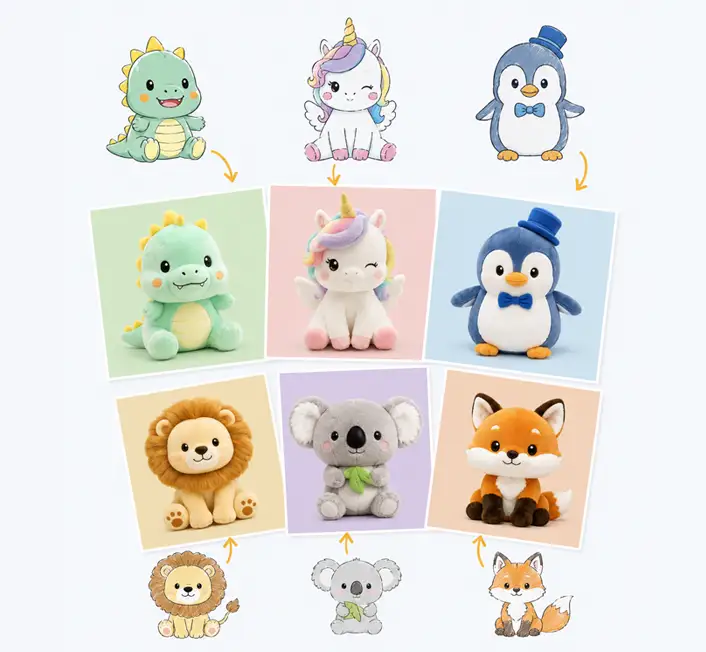
Small batch plush toy production has become the standard entry point for a growing share of the custom plush market. Independent designers launching a first character, crowdfunding creators fulfilling backer rewards, boutique retailers testing a private label line, event organizers ordering mascots, and early-stage brands validating demand all share one need: a few hundred high-quality plush toys, not twenty thousand. Producing in small quantities limits inventory risk, protects cash flow, and allows a design to be tested in the market before a larger commitment is made.
Small runs are also where buyers make the most expensive mistakes. Factories price small orders differently from large ones because the fixed costs of production — pattern making, sampling, machine setup, fabric minimums, and inspection — are spread across fewer units. A buyer who does not understand this cost logic often compares quotes incorrectly, chooses a design that is too complex for the quantity, or discovers that a low unit price came with hidden setup charges.
This guide explains how small batch plush toy production actually works. It covers what qualifies as a small batch, what minimum order quantities are realistic, how per-unit costs are built, how to design a plush toy that stays efficient at low volume, how materials are sourced for small runs, what the production workflow looks like from first sketch to delivery, how quality is controlled when order sizes are modest, and when it makes sense to scale up. Seven practical tips are included at the points where they matter most.
What Is Small Batch Plush Toy Production and How Does It Differ From Mass Production?
Small batch plush toy production is the manufacture of custom plush toys in limited quantities — typically 50 to 1,000 units per design — using the same professional pattern-making, sewing, stuffing, and inspection processes as large-scale production, but with order sizes chosen to limit upfront inventory and financial risk.
The production method is not fundamentally different. A small batch still begins with a design brief, moves through pattern development and sampling, and ends with bulk sewing, stuffing, finishing, and packing. What changes is the economic structure. In mass production, a factory can amortize a pattern, a set of embroidery files, and a production line setup across tens of thousands of pieces. In a small batch, the same fixed costs are divided by a few hundred units, which raises the per-unit price and makes design efficiency far more important.
Small Batch vs. Mass Plush Production: Key Differences
| Dimension | Small Batch (50–1,000 pcs) | Mass Production (5,000+ pcs) |
|---|---|---|
| Unit price | Higher, because fixed costs are shared by fewer units | Lower, with setup and sampling costs diluted |
| Financial risk | Low; limited inventory exposure | High; large capital tied up in stock |
| Fabric sourcing | Often drawn from in-stock rolls or remnant lots | Usually dyed or milled to order for the project |
| Design flexibility | High; easy to revise between runs | Low; changes are costly once tooling and patterns are locked |
| Production scheduling | Fits into gaps between larger orders | Dedicated line time is reserved |
| Best use case | Market testing, crowdfunding, boutique and event orders | Retail rollouts, licensed programs, proven bestsellers |
Who Typically Orders Small Batches
Small batch buyers fall into several recognizable groups. Independent artists and illustrators turn original characters into plush for conventions and online shops. Crowdfunding campaigns need exact backer-count quantities. Small retailers and gift shops want a private label item without the burden of a large order. Corporate buyers order branded mascots for promotions, and brands entering the market use a small first run to confirm pricing, quality, and customer response before committing to larger volume.
What Is a Realistic Minimum Order Quantity for Small Batch Plush Production?
A realistic minimum order quantity for small batch plush production is usually between 100 and 500 pieces per design for fully custom work, with some factories accepting 50 to 100 pieces for simple designs made from stock fabrics and standard components.
Minimum order quantity, or MOQ, is not an arbitrary number. It reflects the point at which a production run becomes economically workable for the factory. Fabric suppliers sell in roll quantities, embroidery machines require file setup and thread changes, and production lines need enough pieces to justify organizing workers around a single design. When a buyer asks for a quantity below the factory’s natural threshold, the factory either declines, raises the unit price sharply, or adds a small-order surcharge.
Factors That Influence Plush Toy MOQ
| MOQ Factor | Lower MOQ Condition | Higher MOQ Condition | Typical Range Effect |
|---|---|---|---|
| Fabric type | Stock fabric in available colors | Custom-dyed or custom-printed fabric | 50–200 vs. 500–1,000+ |
| Design complexity | Few panels, simple shape | Many panels, appendages, mixed materials | 100–300 vs. 300–800 |
| Embroidery content | Minimal facial embroidery | Large multi-color embroidered areas | Moderate impact |
| Accessories | Standard eyes, noses, ribbons | Custom molded parts or custom-printed labels | Can add 300–1,000 pieces |
| Packaging | Poly bag and hang tag | Custom printed box or window gift box | Often 500+ for printed boxes |
| Size | Small plush under 20 cm | Large plush over 50 cm | Larger sizes often allow lower MOQs due to higher value per piece |
Understanding which factors drive the MOQ gives a buyer real leverage. A design that uses stock fabrics, standard accessories, and a simple pattern can often be produced at a much lower quantity than one requiring custom-dyed fur, a molded component, and a printed gift box. Adjusting these variables before requesting quotes is the most reliable way to reach a small batch target.
Tip: Separate the Plush From the Packaging When Calculating MOQ
Many buyers assume the plush itself sets the minimum order quantity, when the packaging is often the real constraint. Printed boxes, custom header cards, and branded polybags are frequently produced by separate suppliers with their own minimums, commonly 500 to 1,000 pieces. If your run is 200 units, ask for a quote using plain poly bags and a small printed hang tag or sticker label instead. You can upgrade to custom boxes on the second run when volume justifies it. Requesting two separate quotes — one for the plush alone and one for each packaging option — also reveals exactly how much of the total price is packaging, which makes comparison between suppliers far more accurate and prevents a low plush price from hiding an expensive packaging line.
How Are Small Batch Plush Toy Costs Structured Per Unit?
Small batch plush toy costs are structured as a combination of one-time fixed costs — sampling, pattern making, and embroidery file setup — and variable per-unit costs for fabric, filling, labor, accessories, and packaging, with the fixed portion becoming a much larger share of the total when quantities are low.
This structure explains why unit prices fall steeply between 100 and 500 pieces and then flatten at higher volumes. At 100 units, a sample development fee and pattern charge may represent a third or more of the total order cost. At 1,000 units, those same charges become a small fraction. Understanding where each cost sits allows a buyer to decide which charges are negotiable, which are fixed, and which can be reduced through design choices.
Small Batch Plush Cost Structure by Component
| Cost Component | Type | Typical Share of Small Batch Cost | How to Reduce It |
|---|---|---|---|
| Sample development | Fixed | 5–15% | Provide a clear tech pack; limit revision rounds |
| Pattern making | Fixed | 3–8% | Simplify the silhouette and panel count |
| Fabric | Variable | 20–30% | Choose stock fabric; optimize cutting layout |
| Filling | Variable | 5–10% | Specify standard PP cotton at a defined weight |
| Labor (cutting, sewing, stuffing, finishing) | Variable | 20–30% | Reduce panel count and hand-finished details |
| Embroidery and accessories | Variable | 5–12% | Use standard eyes; limit thread colors |
| Labels and packaging | Variable | 5–15% | Use simple bags and woven labels at first |
| Testing and inspection | Fixed and variable | 3–8% | Test only in the markets you actually sell in |
How Unit Price Changes With Quantity
The relationship between quantity and price is not linear. The steepest price reduction happens as an order moves from the factory’s minimum to roughly three times that minimum, because the highest fixed costs are being absorbed quickly. Beyond that, further savings come mainly from fabric purchasing efficiency and improved line productivity. The table below illustrates the general pattern, using index values rather than fixed currency amounts because actual prices depend heavily on size, fabric, and detail.
Illustrative Unit Price Index by Order Quantity (500 pcs = 100)
| Order Quantity | Relative Unit Price Index | Fixed Cost Share of Total | Typical Buyer Situation |
|---|---|---|---|
| 100 pcs | 130–160 | Very high | First test run; conventions; small events |
| 300 pcs | 105–120 | High | Crowdfunding rewards; boutique launches |
| 500 pcs | 100 (baseline) | Moderate | Standard small batch target |
| 1,000 pcs | 88–95 | Low | Early retail or online store restock |
| 3,000 pcs | 75–85 | Very low | Transition to mass production |
Tip: Ask for Tiered Quotes at Three Quantities
Never request a quote for a single quantity. Ask every supplier to price the same design at three levels — for example, 200, 500, and 1,000 pieces — with fixed charges listed separately from the per-unit price. This shows you exactly where the price curve bends and whether stepping up to a slightly larger run is worth it. Often a modest increase in quantity lowers the unit price enough that the total cost rises only slightly while your cost per sellable unit drops considerably. It also exposes suppliers who bury setup fees inside the unit price at low quantities. A transparent breakdown lets you compare quotes fairly and decide whether the best choice is the cheapest total order or the lowest cost per unit.
How Should You Design a Plush Toy for Efficient Small Batch Production?
Designing a plush toy for efficient small batch production means reducing the number of panels, limiting hand-finished details, using standard components, and choosing a silhouette that can be cut and sewn quickly without sacrificing the character’s recognizable appearance.
Design choices determine a large share of labor cost, and labor is one of the two biggest cost drivers in a small run. A character with thirty pattern pieces, a separately sewn tail, ruffled clothing, and a dozen embroidered details may take several times longer to produce than a simplified version of the same character. At low volume, there is no line efficiency gained from repetition, so every extra operation translates almost directly into price.
Design Decisions That Affect Small Batch Efficiency
| Design Element | Higher-Cost Choice | Efficient Alternative | Effect on Small Batch |
|---|---|---|---|
| Panel count | 25+ pieces with many darts | 8–14 pieces with simple curves | Reduces cutting and sewing time significantly |
| Facial features | Large multi-color embroidery | Safety eyes plus small embroidered nose and mouth | Lowers embroidery setup and thread cost |
| Surface effects | Airbrushing, appliqué layers | Flat color blocking | Cuts hand labor and defect risk |
| Clothing and accessories | Removable outfits with fasteners | Sewn-in simple scarf or bow | Avoids extra small components |
| Fabric mix | Four or more fabric types | One or two coordinated fabrics | Reduces material minimums |
| Limbs and appendages | Jointed or posable limbs | Sewn-in fixed limbs | Removes assembly steps |
Keep Character Recognition, Reduce Operations
Simplifying a design does not mean weakening it. Most characters are recognized through silhouette, color, and two or three defining features such as ears, eyes, or a signature mark. Identifying those features and protecting them while simplifying everything else gives a plush that still feels faithful to the artwork. A factory’s development team can usually suggest which details are worth keeping when they review a design before pattern work begins.
Tip: Design the First Run for the Factory, Then Upgrade
Treat your first small batch as a market test, not the final product. Choose a version of the design that uses the fewest panels and details needed to be recognizable, and note which features you would add if demand is strong. Customers rarely compare a first-run plush with an unseen premium version, but they do respond to quality and consistency. Once sales confirm interest, the second run can add custom fabric, a printed box, or extra embroidery with confidence. This staged approach also means pattern and sampling costs are paid once and reused, since the base pattern remains valid when you add features rather than rebuild the design from the beginning.
How Does Material Selection Work When Ordering Small Quantities?
Material selection for small quantities works by choosing from fabrics, fillings, and accessories that the factory already holds or can buy in small lots, because custom-dyed or custom-printed materials usually require roll-based minimums far larger than a small batch can consume.
A standard plush fabric roll may contain 30 to 60 meters, and a mill may require several rolls for a custom color. A 300-piece order of a 25 cm plush may need only a fraction of one roll, so ordering custom-dyed fabric would leave a large amount of unused material that the buyer effectively pays for. Factories that serve small-batch customers therefore keep stocks of common colors in popular fabrics such as short pile plush, minky, velboa, and faux fur, and they use these as the default selection for low-quantity projects.
Material Availability for Small Batch Plush Orders
| Material | Small Batch Availability | Typical Constraint | Recommendation |
|---|---|---|---|
| Short pile plush in stock colors | Excellent | Limited to existing color range | Best default for first runs |
| Minky and velboa | Very good | Color choices vary by season and stock | Good for soft, smooth finishes |
| Faux fur and long pile | Good | Higher waste when cutting; pile direction matters | Allow slightly more fabric allowance |
| Custom-dyed fabric | Poor | Roll minimums often exceed the entire run | Reserve for second or third run |
| Custom-printed fabric | Poor to moderate | Digital printing may allow lower minimums | Ask about digital print options |
| PP cotton filling | Excellent | None at small scale | Specify target fill weight |
| Safety eyes and standard accessories | Excellent | Limited sizes and colors | Choose from the standard catalog |
Matching a Color Without Dyeing New Fabric
When a brand color is essential, there are several alternatives to custom dyeing. A factory can compare the brand’s reference color against stock fabrics and choose the closest match, accepting a small deviation. Embroidery thread and printed labels can carry exact brand colors even when the body fabric is a near match. In some cases, digitally printed fabric allows exact artwork at lower minimums than traditional dyeing. Discussing color priorities openly during the quotation stage prevents expensive surprises later.
Tip: Ask for the Stock Fabric Swatch Book Before You Finalize Colors
Before committing to any color scheme, request the factory’s current stock swatch book or physical swatches for the fabrics you are considering. Color on a screen rarely matches the physical fabric, and a design finalized around a color that is not in stock may force a custom dye that doubles your minimum quantity. Match your palette to available fabrics first, then adjust artwork if needed. Record the exact fabric code and color number in your tech pack so the bulk order uses the same material as the approved sample. This single step prevents many of the color disputes and delays that affect small runs.
What Does the Small Batch Plush Production Workflow Look Like From Concept to Delivery?
The small batch plush production workflow runs from design brief and quotation through pattern making, sampling, sample approval, bulk production, inspection, packing, and shipping, with total timelines typically ranging from six to ten weeks depending on sampling rounds and shipping method.
The sequence matches larger production, but the schedule is shaped by the factory’s sampling capacity and the time between decisions. Small batch projects are slowed most often not by sewing time but by waiting — for feedback on a sample, for a fabric decision, or for payment confirmation. Buyers who respond quickly and consolidate their feedback into single clear messages consistently finish faster than those who send piecemeal comments.
Small Batch Plush Production Timeline
| Stage | Key Activities | Typical Duration | Buyer Responsibility |
|---|---|---|---|
| 1. Brief and quotation | Share artwork, size, quantity, and target price | 2–5 days | Provide complete, clear design files |
| 2. Pattern and first sample | Pattern development, fabric selection, sample sewing | 7–12 days | Confirm fabric and color choices |
| 3. Sample revision | Adjust proportions, features, stuffing | 5–10 days per round | Give consolidated written feedback |
| 4. Sample approval | Sign off on a golden sample | 1–3 days | Approve in writing with photos |
| 5. Bulk production | Cutting, sewing, embroidery, stuffing, finishing | 15–25 days | Monitor progress updates |
| 6. Inspection and packing | Quality checks, labeling, carton packing | 3–5 days | Review inspection photos or arrange a third-party check |
| 7. Shipping | Air, express, or sea freight | 5–35 days depending on method | Choose a method balancing cost and urgency |
The Golden Sample as the Quality Reference
The approved sample becomes the physical standard against which the whole production run is measured. Every dimension, color, stuffing firmness, and feature position should match it within agreed tolerances. A written approval accompanied by photographs and key measurements protects both sides, because any later disagreement about quality can be settled against a documented reference rather than memory or opinion.
Tip: Consolidate Sample Feedback Into One Numbered List
Each sampling round costs time and sometimes money, so make every round count. After receiving a sample, review it fully against your artwork before responding, then send all feedback in a single numbered list with photos and measurements, such as “head width 2 cm narrower” or “move eyes 5 mm lower.” Avoid vague language like “make it cuter.” Mark which points are essential and which are preferences, so the factory can prioritize. Sending feedback in fragments over several days invites misunderstandings and extra revision rounds. Most small batch projects should reach approval within two sample rounds when feedback is organized this way.
How Do You Maintain Quality in Small Plush Production Runs?
Maintaining quality in small plush production runs requires defined acceptance standards, an approved golden sample, first-piece inspection at the start of production, and a final inspection based on sampling, because small orders receive less line attention unless expectations are documented clearly.
A common misconception is that small orders are inspected less rigorously because there are fewer pieces. In reality, the risk is different rather than smaller. In a 200-piece run, a single systematic error — a misplaced eye, an incorrect fill weight, a wrong thread color — may affect most of the order before anyone notices. Early checks matter more than late ones, because there is little room to replace defective pieces without delaying delivery.
Quality Checkpoints for Small Batch Plush Production
| Checkpoint | Timing | What Is Checked | Action if Failed |
|---|---|---|---|
| Incoming material check | Before cutting | Fabric color, pile direction, accessory size | Replace or reject material |
| First-piece inspection | After first completed units | Match to golden sample: size, features, fill weight | Stop and correct before continuing |
| In-line checks | During sewing and stuffing | Seam strength, stitch density, stuffing consistency | Correct on the line immediately |
| Safety checks | Before packing | Eye and nose attachment, needle detection, loose threads | Rework or scrap affected units |
| Final random inspection | After packing | Sample of cartons against agreed acceptance level | Hold shipment pending rework |
Compliance and Safety for Small Quantities
Safety regulations apply regardless of order size. A plush toy intended for children and sold in the United States must meet applicable requirements such as CPSIA, and products sold in Europe need to comply with EN71 and related rules. Testing costs are fixed per product, so they weigh heavily on small runs. Buyers should confirm the target market early and plan the test budget accordingly rather than treating compliance as an afterthought.
Tip: Require Photos of the First Finished Pieces Before the Run Continues
Ask the factory to send photos and measurements of the first three to five completed pieces, compared directly against the golden sample, before the remaining units are sewn. This single checkpoint catches the errors most likely to repeat across a whole small batch: mispositioned eyes, wrong fill weight, incorrect seam allowances, or a thread color mismatch. Correcting a problem after five pieces costs minutes; correcting it after two hundred can cost the entire order. Include this requirement in your purchase agreement or order confirmation so it is an agreed step rather than a favor, and request the photos with a ruler or scale visible for accurate comparison.
How Do You Choose a Factory for Small Batch Plush Toy Orders?
Choosing a factory for small batch plush toy orders means evaluating whether the supplier genuinely welcomes low quantities, offers in-house development support, communicates clearly, and has a documented quality process, rather than simply selecting the lowest quoted unit price.
Not every plush manufacturer is suited to small runs. Large factories optimized for high volume may accept a small order only reluctantly, assign it low priority, or quote a price that reflects that reluctance. Smaller specialist factories, or those with dedicated sample and small-order departments, often provide better service at low volume because their workflows are built around it.
Supplier Evaluation Criteria for Small Batch Plush Orders
| Evaluation Criterion | What to Look For | Warning Sign |
|---|---|---|
| Stated MOQ policy | Clear MOQ with defined options below it | Vague answers or sudden MOQ increases after sampling |
| Development capability | In-house pattern makers and sample room | Subcontracted sampling with long delays |
| Quote transparency | Itemized fixed and variable costs | A single unit price with unexplained extras later |
| Communication | Fast, specific, written responses with photos | Slow or generic replies; no named contact |
| Quality documentation | Defined inspection process and sample records | No written standards or inspection reports |
| Experience with similar orders | Examples of comparable quantities and styles | Only large-volume references |
| Compliance knowledge | Familiar with target-market safety rules and testing | Dismisses safety questions |
Tip: Test a Supplier With a Paid Sample Before Committing to the Run
Before placing a small batch order, pay for a sample and use it to judge more than craftsmanship. Observe how quickly the factory answers questions, whether the sample matches your artwork, how clearly they explain problems, and whether the final quote matches the earlier estimate. A supplier who handles a sample professionally is likely to handle a small production run the same way. If the sample arrives late, deviates from your brief without explanation, or the price changes unexpectedly, you have learned this at a small cost. Comparing two or three suppliers through paid samples is a modest investment that often saves far more than it costs.
How Do Packaging, Labeling, and Shipping Work for Small Plush Orders?
Packaging, labeling, and shipping for small plush orders work best when kept simple at first — standard polybags, sewn-in woven labels, and hang tags — with freight chosen according to total carton volume and delivery urgency rather than a fixed rule.
Packaging is the area where small batch buyers most often overspend. Custom printed boxes, window cartons, and branded inserts are typically produced by outside suppliers with minimums that can exceed the plush quantity itself. A buyer ordering 250 plush toys and 1,000 printed boxes pays for 750 boxes that may never be used. Sewn-in labels follow similar logic: woven labels and printed care labels are inexpensive per piece but still carry small setup charges, and the compliance information they must contain depends on the destination market.
Shipping is the second variable. A small batch of 300 mid-sized plush toys may fill only a handful of cartons, which makes express courier or air freight practical and often faster than consolidating sea freight. Plush toys are bulky relative to their weight, so carriers charge by volumetric weight, and compressing products in vacuum bags can reduce carton size meaningfully. Buyers should request carton dimensions and gross weight early, then compare delivered costs rather than comparing freight rates alone.
Packaging and Shipping Options for Small Batch Plush Orders
| Option | Best For | Typical Constraint | Small Batch Recommendation |
|---|---|---|---|
| Individual polybag with hang tag | Online sales, conventions, early retail | Less premium presentation | Default choice for first runs |
| Custom printed gift box | Gift retail, collectors | Printing minimums often 500+ pieces | Delay until demand is proven |
| Vacuum compression bag | Reducing shipping volume | Not suitable for all fillings or fur types | Useful for e-commerce shipments |
| Express courier | Urgent deliveries under 100 kg | Higher cost per kilogram | Best for samples and very small runs |
| Air freight | Time-sensitive launches | Volumetric weight charges | Good for 200–1,000-piece orders |
| Sea freight (LCL) | Cost-sensitive, non-urgent orders | Long transit; port handling fees | Consider only orders of roughly 1,000 pieces or more |
Planning Labels and Documentation Early
Labels are easy to overlook until production is underway. Required content may include fiber content, manufacturer or importer identification, tracking information, age grading, and warning statements, depending on where the toys will be sold. Preparing the label artwork and wording before bulk production begins prevents last-minute changes that delay packing. Shipping documents such as the commercial invoice, packing list, and any test reports should also be prepared in advance so customs clearance does not hold up delivery of a small, time-sensitive order.
What Are the Main Risks in Small Batch Plush Production and How Can They Be Managed?
The main risks in small batch plush production are inconsistent quality, hidden costs, schedule delays, misunderstood specifications, and intellectual property exposure, and each can be managed through clear documentation, itemized agreements, early inspection, and written approvals.
Risk in a small run is concentrated rather than reduced. With only a few hundred pieces, one defect pattern can affect a large share of the order, and a delay of one week can cause a buyer to miss an event, a campaign deadline, or a retail window. Unlike a large program, a small batch rarely has the commercial weight to demand special treatment, so prevention through clear agreements is more reliable than negotiation after a problem appears.
Small Batch Plush Production Risk Register
| Risk | Typical Cause | Preventive Measure | Evidence to Request |
|---|---|---|---|
| Bulk differs from sample | Material or pattern changes after approval | Document the golden sample and fabric codes | Photos and measurements against the sample |
| Hidden extra charges | Unclear quote structure | Itemized quotation with all fixed fees listed | Written quotation confirmed before payment |
| Missed deadline | Slow approvals or material shortages | Build buffer time; confirm material stock early | Weekly progress updates |
| Safety noncompliance | Wrong test scope for the target market | Confirm market and tests before production | Test report for the finished product |
| Design leakage | Shared artwork without agreement | Use a confidentiality agreement before sharing files | Signed agreement on file |
| Quantity shortfall | Defective pieces removed without replacement | Agree on an overage allowance of 2–5% | Final packing list with piece counts |
Why Written Agreements Matter More at Low Volume
A short written order confirmation covering the specification, quantity, overage allowance, delivery date, inspection method, and payment terms resolves most disputes before they begin. Verbal understandings and scattered chat messages are difficult to rely on when a disagreement about color, size, or delivery date occurs. Even a one-page confirmation signed by both sides gives each party a reference point and signals that the buyer expects professional standards.
When and How Should You Scale From Small Batch to Larger Production?
You should scale from small batch to larger production when sales data confirm steady demand, the design has been proven in the market, and the savings from a larger run clearly outweigh the added inventory and cash flow risk.
Scaling too early ties up cash in stock that may not sell, while scaling too late means paying small batch prices on a proven product. The best signal is repeat sell-through: when a small batch sells out within a predictable period, and customers ask for more, the data supports a larger order. At that point, the same pattern, approved sample, and supplier relationship can be carried forward, which keeps the transition quick and low risk.
Signals for Scaling Beyond Small Batch Plush Production
| Scaling Signal | What It Indicates | Recommended Next Step |
|---|---|---|
| First batch sells out quickly | Demand exceeds supply | Reorder at roughly two to three times the original quantity |
| Steady monthly sales | Predictable demand | Plan a 1,000–3,000 piece run with custom fabric |
| Wholesale or retailer inquiries | Channel expansion | Upgrade packaging and confirm compliance testing |
| Slow sell-through | Weak product-market fit | Revise design or pricing before reordering |
| Frequent small restocks | Costly repeated setup | Consolidate into a single larger order |
Frequently Asked Questions
Q1: What is the smallest quantity of custom plush toys I can order?
The smallest practical quantity depends on fabric, design complexity, and the factory’s policy. Many manufacturers set a minimum of 100 to 500 pieces for fully custom designs, while some accept 50 to 100 pieces when the plush uses stock fabrics, standard accessories, and a simple pattern. Orders below 50 pieces are possible at certain workshops but usually carry a significantly higher unit price and may not include full quality processes.
Q2: Why is the unit price so much higher for small batch orders?
Fixed costs such as sample development, pattern making, embroidery file setup, and production line preparation do not shrink when the order is small. When those costs are divided across 100 pieces instead of 5,000, each unit carries a much larger share. Fabric purchased in small lots and lower production efficiency also add to the price. Simplifying the design and using stock materials are the most effective ways to bring the unit price down.
Q3: How long does a small batch plush order take from start to delivery?
A typical timeline is six to ten weeks. Pattern making and the first sample generally take one to two weeks, each revision round adds roughly one week, bulk production takes two to four weeks, and shipping ranges from several days by air to about a month by sea. Quick feedback and early approval of the golden sample are the biggest factors that shorten the schedule.
Q4: Can I use custom colors or printed fabric in a small run?
It is possible but often costly. Custom-dyed fabric typically requires roll minimums that can exceed the entire quantity needed for a small run, so the buyer pays for unused material. Options include matching the closest stock color, carrying exact brand colors through embroidery thread and labels, or exploring digital printing, which may allow lower minimums than traditional dyeing. Discuss color priorities before sampling begins.
Q5: Do small batch plush toys need safety testing?
Yes. Safety rules apply to the product, not the quantity. Plush toys sold to children in the United States must meet relevant requirements such as CPSIA, and products sold in Europe must comply with EN71 and associated regulations. Testing fees are largely fixed per product, so they represent a larger share of small batch costs. Confirm your target market early so that the right tests are planned and budgeted.
Q6: How many sample rounds should I expect?
Most projects reach approval in one to three rounds. A clear tech pack, accurate reference images, and consolidated written feedback often limit the process to two rounds. Complex characters, unusual proportions, or changing requirements add rounds. Because every round costs time and sometimes sample fees, finalizing the design decisions before sampling begins is the best way to keep the process efficient.
Q7: Is it better to start with a small batch or go straight to a large order?
For most new designs and new brands, a small batch is the more prudent starting point. It validates quality, pricing, and customer response with limited risk, and the pattern and approved sample can be reused for later runs. A large first order only makes sense when demand is already proven, such as an established license, a confirmed retailer purchase order, or strong pre-sales that justify the volume.
Q8: Should I add an overage allowance when ordering a small batch?
Yes. Because small runs have little spare inventory, a few rejected or damaged pieces can leave you short of a committed quantity, such as backer rewards or a retailer order. Many buyers agree on an allowance of two to five percent extra pieces at the same unit price, or require the factory to replace any units removed for defects. Stating this clearly in the order confirmation prevents disputes when the final piece count is reconciled at packing.
Conclusion
Small batch plush toy production is not a lesser version of mass production; it is a different strategy with its own economics. Fixed costs weigh heavily, so unit prices are higher, but financial risk is lower, and flexibility is greater. Success depends on understanding how MOQs are set, how costs are built, and how design and material choices change both price and feasibility.
Buyers who simplify their first design, choose stock materials, request tiered and itemized quotes, give organized sample feedback, and require early inspection evidence consistently achieve better results and stay within budget. They also build a stronger foundation for scaling, because the pattern, approved sample, and supplier relationship carry forward into larger runs. Treating the first small batch as a structured market test, rather than a compromise, is the most reliable way to turn a plush toy idea into a sustainable product line.