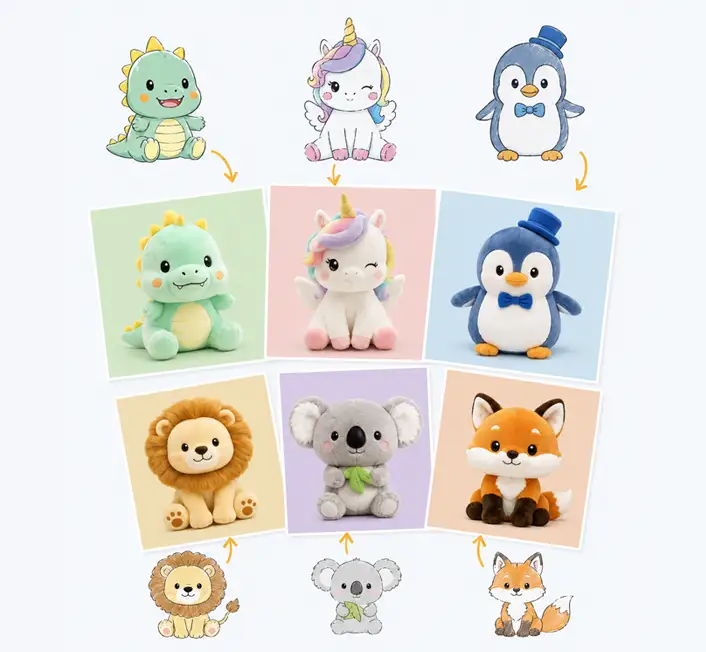
Understanding plush toy manufacturing lead times is essential for effective production planning, helping brands deliver high-quality products on schedule and within budget. If you’re sourcing custom plush toys for the first time, the timeline can feel unpredictable.
Ask three factories the same question, and you’ll often get three different answers. Lead times in plush toy manufacturing depend on a layered set of variables — material sourcing, complexity, order volume, certifications, and the factory’s current capacity — and understanding how they interact is the difference between a smooth product launch and a costly delay.
This guide breaks down every stage of the production process, explains the real drivers behind lead time variation, and gives you a reliable framework for planning your next plush order.
What “Lead Time” Actually Means in Plush Manufacturing
Lead time refers to the total elapsed time from the moment you place a confirmed order to the moment goods are ready to ship from the factory. It is not the same as transit time, and it is not the same as the time to receive a quote.
Most buyers make the mistake of treating lead time as a single fixed number. In practice, it is composed of several sequential phases, each with its own minimum duration and risk of extension. A factory that quotes “45 days” is typically counting only bulk production — not sampling, approval rounds, or pre-shipment testing.
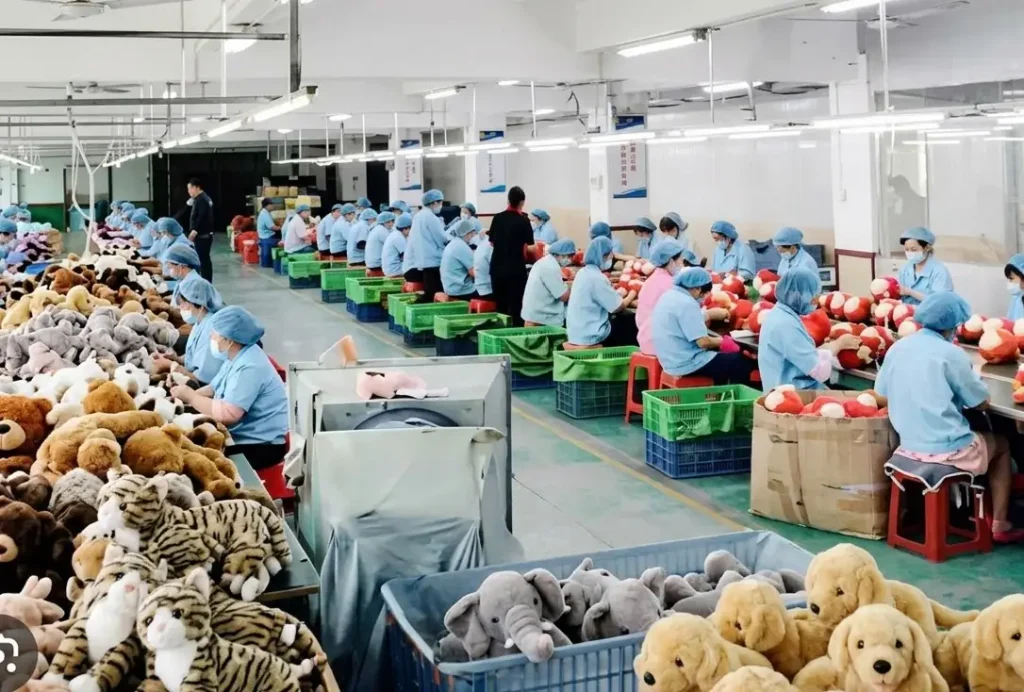
Phases of a standard plush toy order and typical durations
| Phase | Typical Duration | Description |
|---|---|---|
| Design confirmation | 3–7 days | Tech packs, reference images, and material specs are finalised between buyer and factory |
| Material sourcing | 7–15 days | Fabric, stuffing, eyes, accessories, and trims are ordered or confirmed from suppliers |
| Pre-production sample | 10–20 days | First physical prototype produced for buyer approval |
| Sample approval & revision | 5–15 days | Buyer reviews, requests changes; factory revises (each round adds 5–10 days) |
| Bulk production | 25–50 days | Full quantity manufactured at line speed, dependent on complexity and order size |
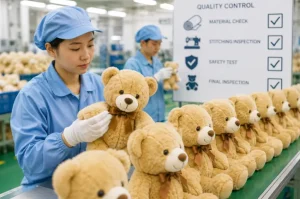
| QC inspection | 2–4 days | Internal or third-party inspection; needle detection for all products |
| Packaging & labelling | 3–7 days | Hangtags, polybags, carton packing, export documentation |
When you add these phases together, a realistic end-to-end timeline for a new custom plush toy — from design finalisation to factory-ready-to-ship — is typically 60 to 120 days. Rush orders with pre-approved designs and in-stock materials can compress this to 30–40 days, but these are the exception, not the rule.
How Order Complexity Affects Production Time
Not all plush toys are manufactured equal. A simple round bear in a single colour with embroidered eyes has an entirely different production profile than a 45-piece anime character with gradient fabric, articulated limbs, removable accessories, and sound modules.
Fabric and Material Complexity
The type of plush fabric selected has a significant impact on sourcing lead time and workability at the sewing stage. High-pile sherpa and minky fabrics are generally in stock at major fabric markets, while custom-dyed velboa or special-order printed fleece can require 15–25 additional days of sourcing lead time. Gradient and tie-dye effects on plush pile fabric are particularly challenging, as they are typically produced in small dye lots and require advance coordination with specialist fabric mills.
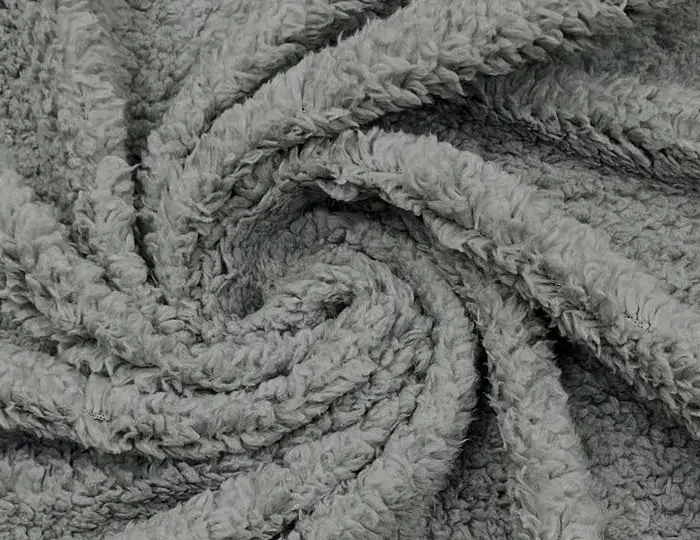
| Tip: When working with a new factory, always confirm whether your selected fabric is a standard stock item or a custom order. Stock fabrics can save 2–3 weeks on total lead time and reduce minimum order risk. |
Design Element Count and Sewn Parts
Every sewn seam, gusset, dart, and panel in a plush toy adds to both the cut-and-sew time and the potential for quality variation. High-complexity designs with 20+ pattern pieces require longer line setup, more skilled operators, and more QC touchpoints.
Table 2 — Complexity tiers and their estimated bulk production lead time impact
| Complexity tier | Characteristics | Pattern pieces | Production time premium |
|---|---|---|---|
| Basic | Single body, embroidered face, 1 fabric type | 4–8 | Baseline (0 days added) |
| Standard | Multi-part body, simple accessories, 2–3 fabric types | 9–16 | +5–10 days |
| Complex | Articulated limbs, multiple textures, printed panels | 17–28 | +10–20 days |
| High-end / IP | Licensed character accuracy, sound/light modules, removable parts | 28+ | +20–35 days |
Sampling: The Most Underestimated Phase
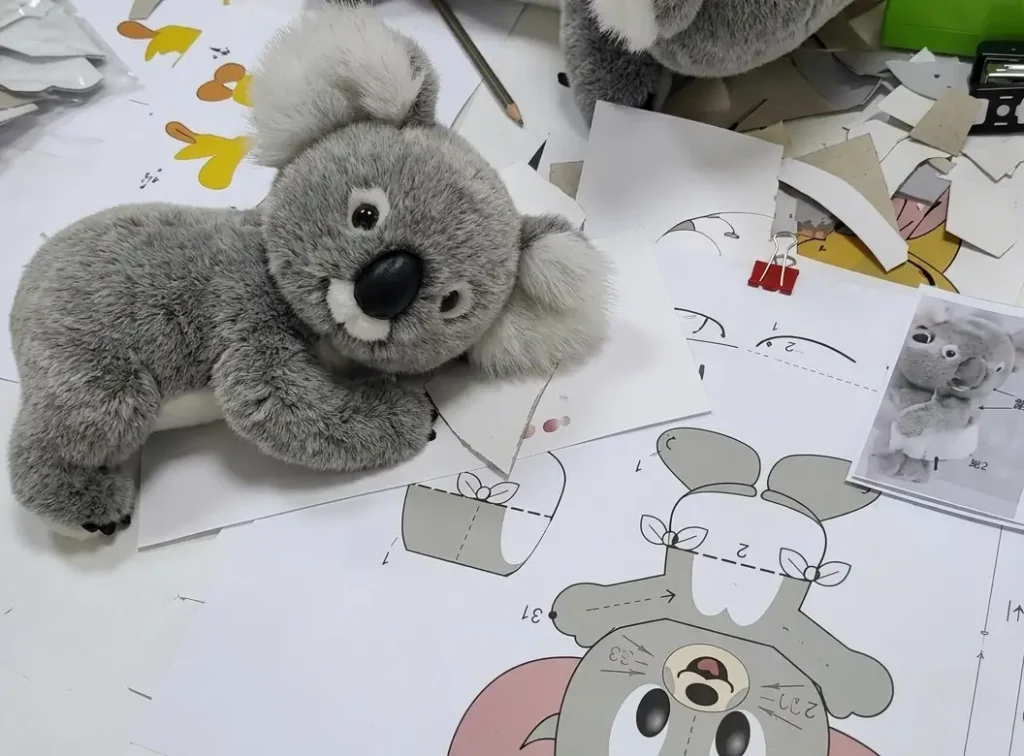
The pre-production sample phase is consistently where new buyers lose the most time. Many enter negotiations expecting a single sample round and are unprepared for the reality that two to three revision cycles are standard — and four or more are not uncommon for complex or IP-accurate designs.
Why Revision Rounds Add Up
Each sample revision requires the factory to pause, read feedback, re-source or modify materials if needed, resew the affected components, restuff, and reship the sample — a cycle that typically takes 7–12 days per round for factories in southern China. Expedited courier adds cost but saves 2–3 days per round at most.
How to Reduce Sample Rounds
The single most effective way to reduce sampling iterations is to provide a highly detailed tech pack before any physical sampling begins. A quality plush toy tech pack should include scaled front/back/side views, Pantone or physical fabric swatches, exact measurements for all key dimensions (height, width, limb length, eye diameter), and clear callouts for stitching, fill density, and finishing standards.
| Tip: Include a “priority annotation” on your tech pack that flags which elements are non-negotiable versus those where the factory has discretion. This dramatically reduces back-and-forth on minor details while protecting the aspects that matter most to your brief. |
Safety Testing and Certification Timelines
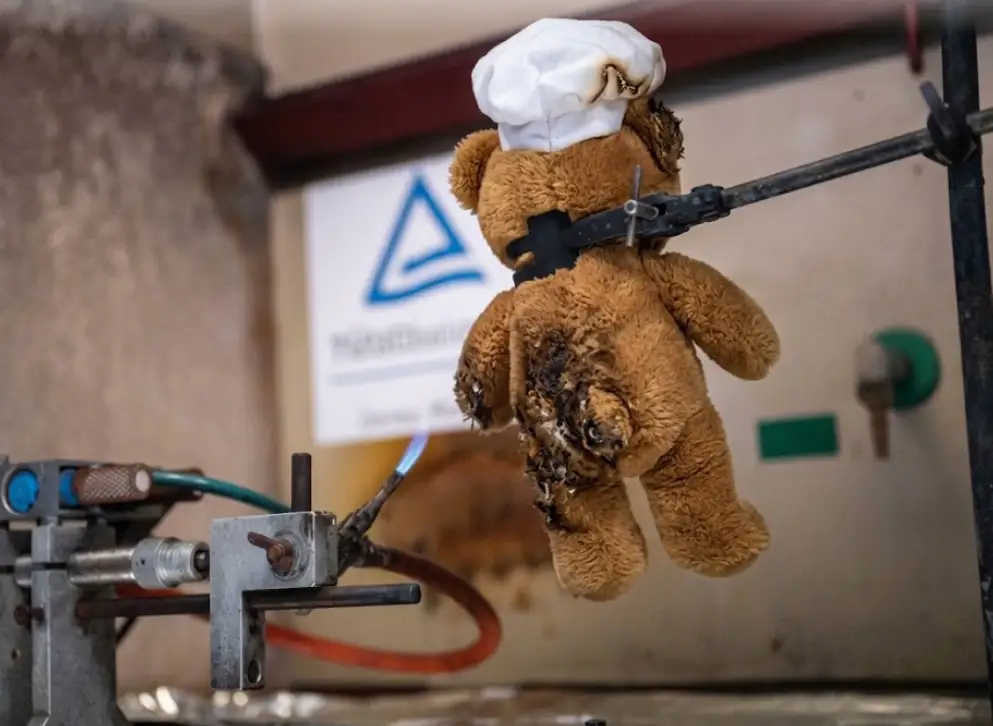
If your plush toys are destined for markets with mandatory safety standards — EN 71 for Europe, ASTM F963 for the United States, or AS/NZS 8124 for Australia — third-party testing must be factored into your overall timeline.
Table 3 — Key plush toy safety standards by market and typical testing duration
| Market | Standard | Typical test scope | Lab turnaround |
|---|---|---|---|
| European Union | EN 71 (Parts 1, 2, 3) | Mechanical safety, flammability, chemical migration | 10–18 business days |
| United States | ASTM F963 / CPSIA | Mechanical hazards, flammability, heavy metals, phthalates | 10–15 business days |
| United Kingdom | BS EN 71 | Aligned with EU standard post-Brexit | 10–18 business days |
| Australia / NZ | AS/NZS 8124 | Mechanical, physical, flammability | 12–20 business days |
| Canada | Canada Consumer Product Safety Act | Chemical, mechanical, labelling | 12–18 business days |
Testing is typically done on bulk production samples, which means it runs in parallel with the packaging phase, not before bulk production begins. However, any test failure requiring design or material changes can extend the overall timeline by 3–6 weeks, as it may require a production change and re-test.
Seasonal Demand and Factory Capacity
Plush toy manufacturing is heavily seasonal, concentrated around factory capacity for Q4 holiday goods and Q2 pre-summer stocking. Understanding the factory capacity calendar is essential for realistic planning.
Peak Season Constraints
Chinese New Year (typically late January to mid-February) is the single largest production disruption in the global plush manufacturing calendar. Factories close for 2–4 weeks, material suppliers may close for 3–5 weeks, and pre-holiday order backlogs can extend effective lead times by 3–5 weeks beyond stated capacity. Orders that miss the pre-CNY cutoff typically don’t enter production until early to mid-March.
Seasonal capacity calendar for plush toy factories (South China)
| Period | Capacity status | Planning implication |
|---|---|---|
| Jan (late) – Feb (mid) | Factory closed (CNY) | Avoid production start; add 3–5 weeks buffer to adjacent orders |
| March – April | Ramp-up; moderate delays | Expect 10–15% longer lead times than quoted |
| May – July | Peak capacity | Most reliable window; factories running full lines |
| August – September | High demand, pre-holiday rush | Book production slots 90+ days ahead for Q4 goods |
| October – November | Near-full / holiday overflow | Late changes are costly; lock specs early |
| December – Jan (early) | Winding down; some early CNY leave | Confirm cutoff dates with factory by November |
| Tip: For any order with a fixed retail or event deadline, count backwards from the required in-store date, subtract transit time, then subtract your total lead time estimate. Add a 15% time buffer. If the resulting production start date has already passed, you need to escalate to a factory with confirmed available capacity, not just a good price. |
MOQ and How Order Size Influences Lead Time
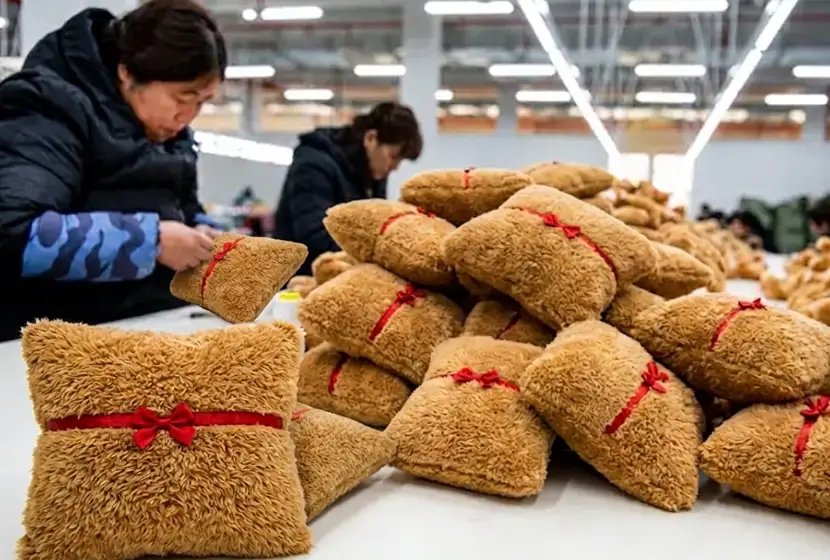
Order quantity affects lead time in both directions. Very small orders (under 200 units) often sit in a factory queue waiting to be batched with other production runs, which can add 1–3 weeks of unpredictable waiting time. Very large orders (5,000 units and above) require the factory to plan staffing and material procurement in advance, which can extend the material sourcing window but ultimately leads to more predictable scheduling.
Order quantity ranges and their typical scheduling dynamics
| Order quantity | Factory scheduling approach | Lead time implication |
|---|---|---|
| Under 200 units | Often batched or deprioritised; may be handled by smaller workshops | Unpredictable; add 1–3 weeks buffer |
| 200–500 units | Minimum viable run for most mid-sized factories | Standard lead time applies |
| 500–2,000 units | Preferred range; fits within standard line scheduling | Most reliable; quoted times generally accurate |
| 2,000–5,000 units | May require advance planning and material pre-order | Add 5–10 days for material procurement lead |
| 5,000+ units | Dedicated line scheduling; full pre-production planning | Longer upfront planning; faster and more predictable execution |
Frequently Asked Questions
What is a realistic total lead time for a custom plush toy from scratch?
For a new design with no pre-existing samples or approved materials, expect 75 to 120 days from design confirmation to ready-to-ship. This includes two to three sample rounds, bulk production, QC, and packaging. Simpler designs with stock fabrics can complete in 60 days; complex IP-accurate characters may take longer.
How many sample rounds should I budget for?
Budget for two to three rounds as a baseline. Each round takes 7–12 days. A highly detailed tech pack supplied before sampling begins is the most reliable way to reduce revision cycles. Buyers who provide only a reference photo typically experience three to five rounds.
Does safety testing delay shipment?
Testing typically runs in parallel with packaging, not sequentially after production. If testing is scheduled correctly, it adds only 5–7 days to total lead time. A test failure, however, can cause a 3–6 week extension if a material or design change is required and a re-test is needed.
What is the best time of year to place a plush toy order?
May through July is the most reliable production window in South China, when factory capacity is at its peak and CNY disruption has fully cleared. For Q4 holiday products, production should start no later than July to allow buffer for ocean freight transit.