Skip to content
How plush toy factories ensure consistency is achieved through strict quality control, standardized production steps, skilled workers, and carefully monitored manufacturing processes to keep every plush toy uniform and reliable. A look inside the systems, checkpoints, and standards that keep every plush toy in a production run matching the approved sample — from pattern cutting to final shipment.
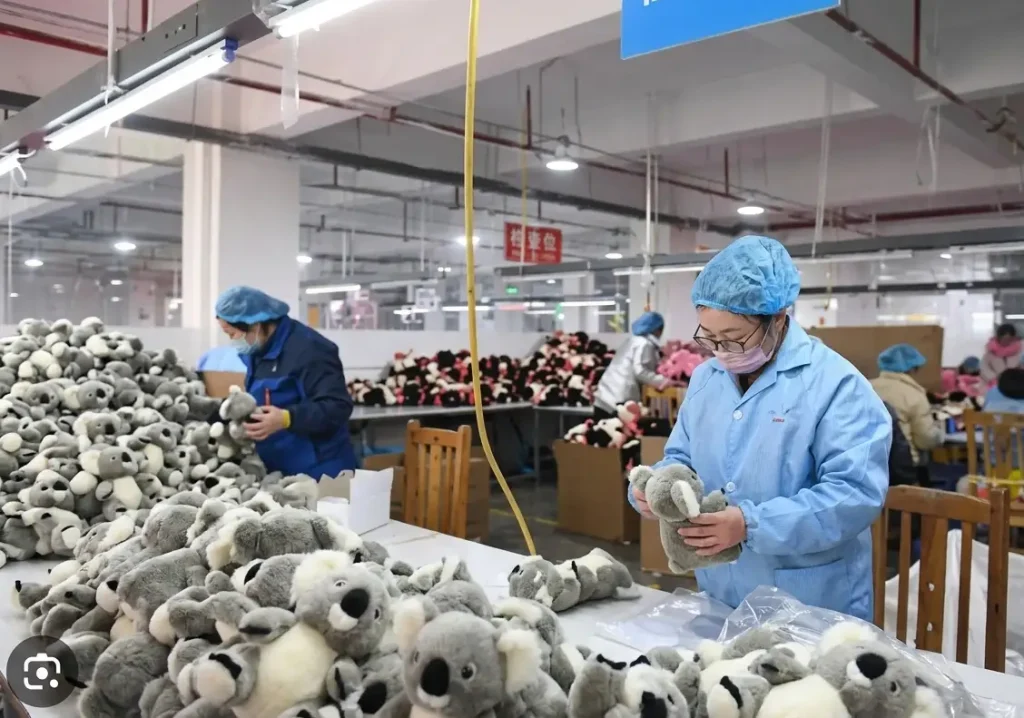
Consistency is one of the hardest things to achieve in plush toy manufacturing precisely because so much of the process depends on skilled manual labor. Cutting, sewing, stuffing, and finishing are all performed by hand, cycle after cycle, across a production run that can span tens of thousands of units.
Ensuring consistency means every one of those units — regardless of which cutting table, sewing line, or shift produced it — matches the approved sample closely enough in size, color, stuffing feel, and construction quality that a customer receiving unit number one and unit number ten thousand would never notice a difference.
This guide explains the specific systems plush toy factories use to achieve that outcome: standardized patterns, controlled material sourcing, calibrated stuffing processes, in-line inspection checkpoints, and the training and equipment maintenance practices that hold it all together.
Why Consistency Is Difficult in Plush Toy Production
Unlike injection-molded plastic parts, where a single steel cavity produces geometrically identical parts shot after shot, plush toys are built through a sequence of manual and semi-manual operations: fabric cutting, panel sewing, turning, stuffing, closing, and finishing. Each of these steps introduces natural human variation — a slightly different stitch tension, a marginally different amount of stuffing packed into a limb, a small variance in how tightly a seam is closed. Left unmanaged, these small variations compound across a production run into noticeable inconsistency between units.
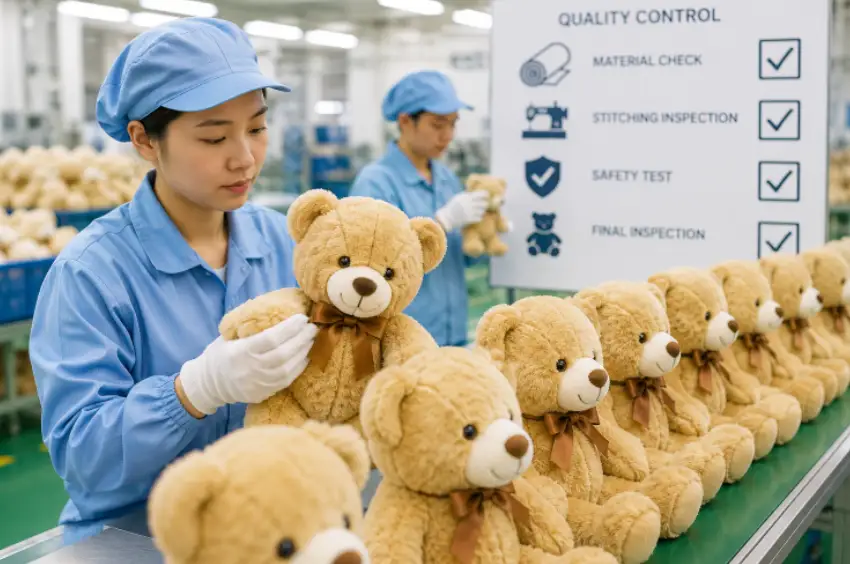
The challenge is compounded by the fact that plush toys are typically produced across multiple sewing lines, sometimes multiple shifts, and occasionally multiple facilities for very large orders. Without a deliberate system to standardize inputs and check outputs at defined intervals, the natural drift that occurs between different operators, different equipment, and different points in a long production run becomes visible in the finished product — inconsistent firmness, mismatched fabric shading, or size variation between otherwise identical toys.
Consistency, in this context, is not a single control but a layered system: standardized inputs (patterns, materials, work instructions), calibrated processes (stuffing weight, stitch settings, cutting dies), and verification checkpoints (in-line inspection, final AQL sampling) working together throughout the production sequence rather than relying on any single stage to catch every deviation.
Standardized Patterns and Cutting Processes
Pattern Grading and Master Templates
Every plush toy design begins with a master pattern — the precise set of fabric panel shapes that, when sewn together, produce the toy’s finished silhouette. This master pattern is graded and locked before production begins, and every cutting operation throughout the run references the same approved pattern rather than allowing individual cutters to interpret or freehand panel shapes. Any pattern revision during a production run, whether for a design correction or a size adjustment, must be formally re-approved and redistributed to every cutting station simultaneously to prevent a mix of old and new pattern panels entering the sewing line.
Die-Cutting vs. Manual Cutting
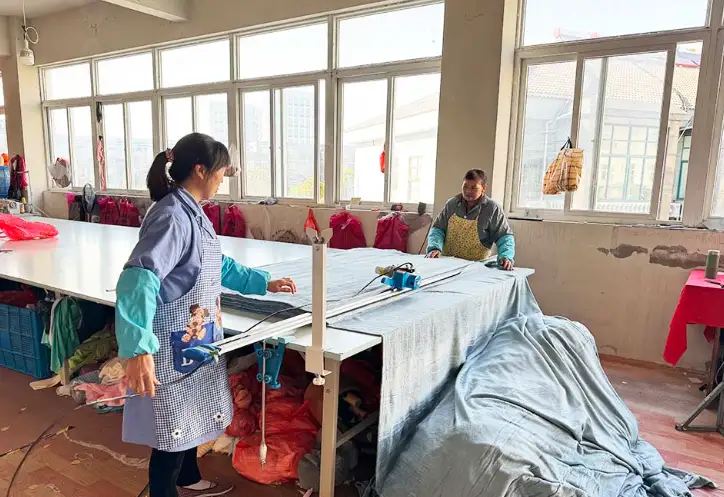
Die-cutting, where a steel-rule cutting die stamps out fabric panels in a single controlled motion, produces far more consistent panel dimensions than manual cutting with scissors or a rotary blade against a paper pattern, particularly across high fabric-layer counts. Manual cutting remains common for smaller production runs or highly complex panel shapes where a custom die is not cost-justified, but it depends much more heavily on individual cutter skill and consistency, making it a higher-variability process that requires closer inspection oversight than die-cutting.
Fabric Layup Control
Fabric is typically layered in multiple plies before cutting to improve cutting efficiency, but excessive layer height or inconsistent layer tension can cause panel dimensions to drift, particularly at the edges of a large layup stack where fabric pile can compress unevenly under the cutting blade. Controlling layup height, ply tension, and fabric grain alignment during the layup stage is a foundational, if often overlooked, consistency control that directly affects every downstream sewing and finishing step.
Tip: Pull and measure panels from the top, middle, and bottom of a cutting stack, not just the top layer. Dimensional drift across a tall layup is a common, easily missed source of size inconsistency that only becomes visible once panels from different positions in the stack are compared directly against each other.
Cutting Method Comparison for Plush Toy Panel Production
| Cutting Method | Dimensional Consistency | Best Suited For | Key Requirement |
|---|---|---|---|
| Steel-rule die cutting | Very high | High-volume, standard panel shapes | Die maintenance and layup height control |
| Computerized (CNC/laser) cutting | Very high | Complex shapes, frequent pattern changes | Regular calibration and fabric alignment |
| Manual cutting (rotary blade/scissors) | Moderate, operator-dependent | Small runs, highly custom shapes | Skilled, experienced cutting staff and close inspection |
Material Sourcing and Fabric Lot Control
Approved Supplier Lists and Material Specifications
A consistent finished product starts with consistent raw material, which is why established plush production relies on an approved supplier list paired with a documented material specification for each fabric, fiberfill, and hardware component used in a given design. Sourcing from unapproved or substitute suppliers, even when the substitute material appears visually similar, introduces risk of subtle differences in pile density, colorfastness, or fiber content that may not be apparent until parts are compared side by side or subjected to testing.
Dye Lot Matching and Color Consistency
Fabric dye lots vary slightly from batch to batch even within the same supplier and color specification, which is why large production runs typically require dye lot matching — ensuring that panels destined for the same toy, and ideally the same production batch, are cut from fabric within a single dye lot or from lots verified to fall within an acceptable color tolerance. A spectrophotometer, which measures color numerically against a reference standard, is the standard tool for verifying dye lot consistency objectively rather than relying on visual comparison alone, which is prone to inconsistency under different lighting conditions.
Incoming Material Inspection
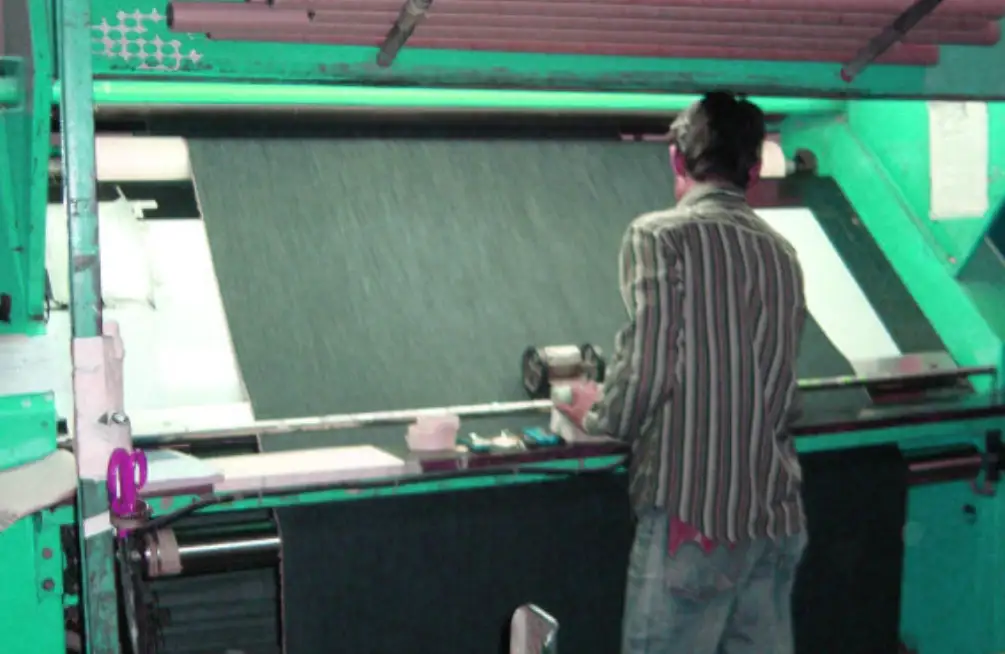
Before fabric, fiberfill, or hardware components enter production, incoming material inspection verifies that each shipment matches the approved specification for weight, width, pile density, and any relevant test certifications. Rejecting or quarantining a non-conforming material lot at the incoming inspection stage is dramatically less costly than discovering the same inconsistency after it has already been cut, sewn, and stuffed into finished units.
Tip: Keep a physical reference swatch card for every approved fabric color, stored away from light exposure, and use it for direct comparison against each new incoming fabric lot rather than relying on memory or photographs. Fabric color perception shifts significantly under different lighting and can drift gradually enough between production runs that the change goes unnoticed without a fixed physical reference point.
Incoming Material Quality Control Checkpoints
| Material | Key Inspection Parameter | Typical Verification Method |
|---|---|---|
| Pile fabric | Color match, pile density, fiber content | Spectrophotometer, visual comparison, density gauge |
| Fiberfill | Fiber weight (denier), loft, cleanliness | Sample weighing, loft recovery test, visual inspection |
| Safety eyes/noses | Dimensional accuracy, locking mechanism strength | Caliper check, pull-force testing |
| Thread | Tensile strength, color match | Break-strength testing, visual comparison |
| Backing/lining fabric | Weight, tear strength | Sample weighing, tear-strength testing |
Standard Operating Procedures and the Golden Sample System
The Golden Sample as a Physical Reference Standard
Nearly every plush toy production run is anchored by a golden sample — a fully approved, physical reference unit that represents the exact target for color, size, stuffing feel, and construction quality. Rather than relying purely on written specifications, which can be interpreted differently by different operators, the golden sample gives every workstation a tangible, unambiguous reference to compare against throughout the run. Golden samples are typically kept at multiple points along the production line — cutting, sewing, stuffing, and final inspection — so deviation can be caught and corrected at the earliest possible stage rather than only at final inspection.
Documented Work Instructions
Standard operating procedures translate the golden sample and technical specification into step-by-step work instructions at each workstation: seam allowance measurements, stitch type and stitches-per-inch targets, stuffing sequence and target weight, and closing stitch method. Documenting these instructions, rather than relying on informal verbal training passed between operators, is what allows a factory to maintain consistency even as individual workers rotate between stations or as new staff is onboarded mid-production.
Stitch Type and Machine Setting Standardization
Sewing machine settings — stitch length, tension, and stitch type — are specified and locked for each seam type on a given design, and machines are checked periodically against these settings to catch drift caused by normal wear or operator adjustment. Inconsistent stitch tension is one of the most common and most visually subtle sources of quality variation between units, since a seam that looks acceptable in isolation may differ noticeably in tightness and strength from the same seam on a unit produced at a different point in the run.
Tip: Update the golden sample formally whenever a design revision is approved, and immediately retire the previous version from all workstations. A factory floor with two slightly different “approved” reference samples in circulation — even briefly during a transition — is a common and easily preventable source of split-batch inconsistency.
Stuffing Weight and Fill Density Control
Weighing Stations and Target Fill Weight
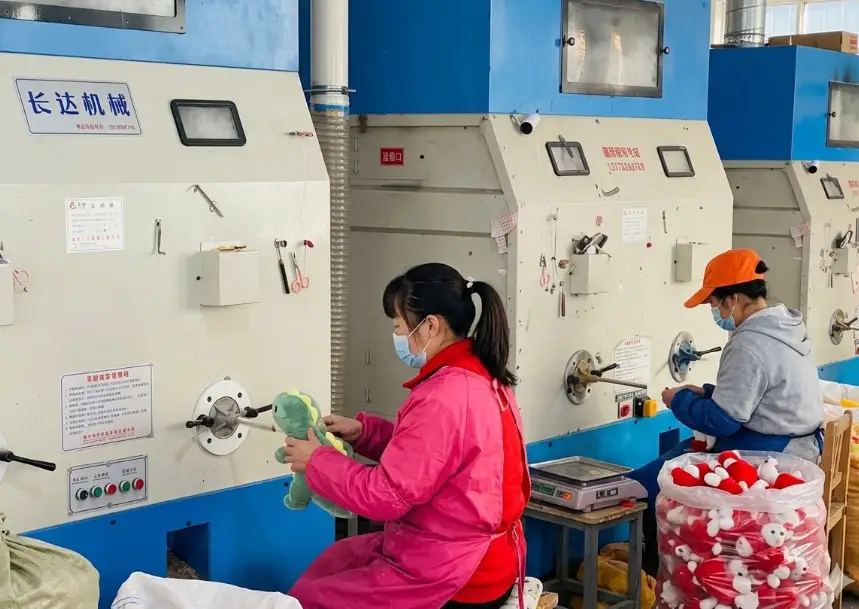
Stuffing consistency is controlled primarily through defined target fill weights, established during sample approval and verified using calibrated scales at the stuffing station rather than left to operator judgment or “feel” alone. Each toy design has a specific target weight range, often broken down by section for larger or more complex toys, and stuffing operators are trained to hit that target consistently rather than approximating based on visual fullness, which can vary significantly between operators.
Fill Distribution and Sectional Stuffing
For toys with narrow extremities — ears, tails, limbs — stuffing is often performed in a defined sequence, packing these narrow sections first with carefully measured amounts before filling the main body, since it’s far easier to correct an underfilled body than to redistribute fill that has already settled unevenly into narrow, hard-to-access extremities. This sectional approach reduces the lumping and thin-spot inconsistency that free-form stuffing tends to introduce, particularly on complex character shapes with many small appendages.
Firmness Calibration Against the Golden Sample
Beyond weight alone, stuffing firmness — how the toy feels and responds to squeezing — is periodically calibrated against the golden sample through direct hand comparison, since two toys can weigh the same on a scale while feeling noticeably different if fill is packed more loosely or tightly during the stuffing process. This tactile check is one of the few quality parameters in plush production that resists full automation and continues to depend on trained human judgment calibrated against a fixed physical reference.
Typical Stuffing Weight Tolerance Ranges by Toy Size Category
| Toy Size Category | Typical Target Fill Weight | Typical Acceptable Tolerance |
|---|---|---|
| Small (under 20 cm) | 15–40 g | ±5% |
| Medium (20–40 cm) | 80–200 g | ±5%–7% |
| Large (40–60 cm) | 250–500 g | ±7%–10% |
| Extra-large (over 60 cm) | 600 g and above | ±10% |
In-Line Quality Control Checkpoints
First-Piece Inspection
At the start of each production run, and after any significant changeover such as a shift change or machine adjustment, a first-piece inspection compares the earliest units produced against the golden sample and technical specification before the line is allowed to continue at full volume. Catching a deviation at this stage prevents an entire shift’s output from being produced out of specification, which is dramatically more costly to correct after the fact than adjusting the line immediately following first-piece inspection.
In-Process Spot Checks
Throughout the production run, quality inspectors perform periodic spot checks at defined intervals — for example, pulling a sample unit every set number of pieces or at fixed time intervals — checking stitching, stuffing feel, dimensional accuracy, and cosmetic appearance against the golden sample. These checkpoints are designed to catch gradual drift, such as a sewing machine tension setting slipping mid-shift, before it accumulates into a large batch of out-of-specification units.
Final AQL Inspection Before Shipment
Before a completed order ships, a final inspection is typically performed using an Acceptable Quality Limit (AQL) sampling plan, which defines how many units from a given lot size must be inspected and how many defects of each severity level are permitted before the lot is rejected. AQL inspection at this stage serves as a final consistency verification across the entire completed run, catching any systemic issue that may have developed at some point during production and gone undetected by earlier in-process checks.
| Lot Size Range | Typical Sample Size (AQL 2.5, General Level II) | Acceptable Major Defects |
|---|---|---|
| 501–1,200 units | 80 | 5 |
| 1,201–3,200 units | 125 | 7 |
| 3,201–10,000 units | 200 | 10 |
| 10,001–35,000 units | 315 | 14 |
Tip: Track defect types over time, not just pass/fail results, for each AQL inspection. A lot that passes inspection but shows a recurring minor defect pattern — for example, a specific seam consistently trending toward the tolerance limit — is an early warning signal worth investigating before it develops into a lot-failing defect rate on a future run.
Worker Training and Skill Standardization
Skill Certification by Operation Type
Because sewing and stuffing quality depend directly on operator skill, many factories maintain a form of internal skill certification, qualifying individual workers for specific operation types — straight seam sewing, curved seam sewing, precision stuffing, hand-finishing — based on demonstrated, tested performance rather than tenure alone. Assigning workers to operations that match their certified skill level, rather than rotating staff freely across all operation types, reduces the variability that comes from less-experienced operators performing the most consistency-sensitive tasks.
Cross-Training and Line Balancing
While skill certification limits which operators perform which tasks, cross-training multiple workers on each certified operation type provides flexibility to cover absences or rebalance a line without falling back on undertrained substitutes. The balance between specialization, which improves per-operation consistency, and cross-training, which protects against single points of failure on a production line, is one of the ongoing management decisions that shapes how consistently a given factory floor performs across a full production cycle.
New Employee Onboarding Standards
New sewing and stuffing operators typically progress through a structured onboarding period, working under close supervision and producing sample pieces that are checked against the golden sample before being cleared to contribute directly to production output. Skipping or shortening this onboarding period is a common, identifiable root cause when a factory experiences a sudden, otherwise unexplained increase in inconsistency on a specific line.
Tip: When staffing a new or unusually large production run, stagger the introduction of new or newly rotated operators rather than placing several on the same line simultaneously. Concentrating inexperienced operators together on one line removes the natural quality buffer that comes from being paired alongside more experienced coworkers during the early learning curve.
Machine Calibration and Equipment Maintenance
Scheduled Sewing Machine Maintenance
Sewing machines require regular maintenance — needle replacement, tension adjustment, timing checks, and general cleaning — to maintain consistent stitch quality over time, since normal wear gradually shifts stitch tension and needle performance in ways that are not always obvious to the operator running the machine day to day. A scheduled maintenance program, rather than reactive repair only after a visible problem appears, catches this gradual drift before it produces a measurable batch of inconsistent seams.
Cutting Die and Blade Sharpness
Cutting dies and blades dull gradually with use, and a dulling blade produces increasingly ragged or imprecise panel edges well before the tool is obviously worn out to visual inspection. Scheduled blade sharpening or die replacement intervals, based on cut count rather than a purely visual assessment, keep panel edge quality consistent across the full length of a production run rather than allowing a slow decline toward the end of a long cutting job.
Scale and Measurement Instrument Calibration
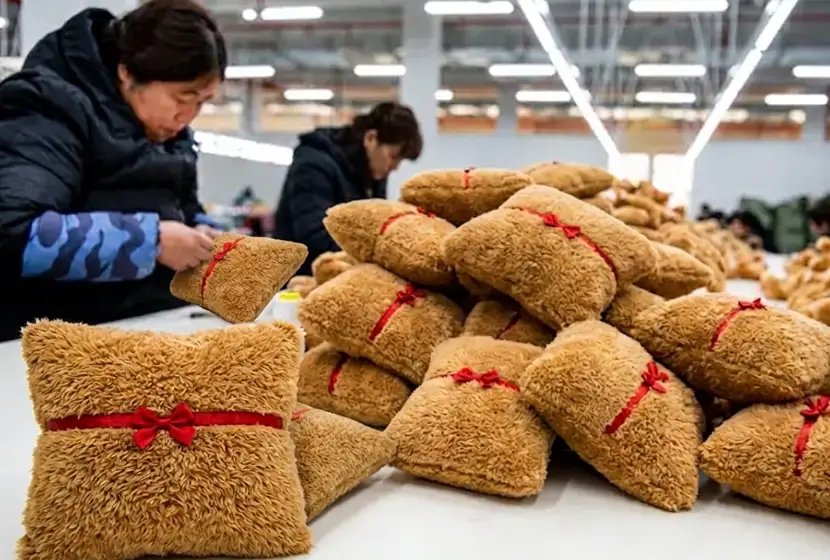
Every scale used for stuffing weight verification and every measurement instrument used for dimensional inspection requires periodic calibration against a certified reference standard to ensure the readings being used to enforce consistency are themselves accurate. An uncalibrated scale can silently pass an entire production run of underfilled or overfilled toys if its reading has drifted from true weight, which is why calibration schedules for measurement equipment are treated as seriously as the process controls they support.
Equipment Calibration and Maintenance Reference
| Equipment | Typical Maintenance/Calibration Interval | What It Prevents |
|---|---|---|
| Sewing machines | Daily cleaning; tension/timing check on a set cycle | Stitch tension drift, needle-related seam defects |
| Cutting dies/blades | Sharpening or replacement based on cut count | Ragged panel edges, dimensional drift |
| Digital scales (stuffing) | Calibration against certified reference weights on a set cycle | Under/overfilled toys passing undetected |
| Spectrophotometers | Calibration before each significant color-matching session | Inaccurate dye lot and color consistency verification |
Color and Print Consistency Control
Beyond fabric dye lot matching, printed or embroidered design elements introduce their own consistency requirements. Screen printing and heat transfer processes are checked periodically against a color reference standard, since ink viscosity, press temperature, and screen wear can all gradually shift printed color output over a long run. Embroidery consistency depends on thread tension calibration and periodic inspection of stitch density and placement accuracy, since a digitized embroidery pattern can still produce visibly inconsistent results if machine tension or thread quality varies between production batches.
Pantone or similar standardized color matching systems are typically used to specify exact target colors numerically rather than relying on subjective descriptions like “light blue,” giving every supplier and workstation in the process an unambiguous, measurable target rather than one open to individual interpretation.
Packaging and Final Audit Consistency
Consistency does not end once a toy passes final quality inspection. Packaging processes — poly bagging, header card attachment, carton packing configuration — are also subject to standardized work instructions and periodic spot checks, since inconsistent packaging can damage otherwise conforming product during shipping or create a mismatched presentation across units within the same shipment. A pre-shipment audit typically verifies not only product quality but also correct labeling, accurate carton counts, and packaging configuration against the approved specification before a shipment is authorized to leave the facility.
This final audit stage also serves as a last opportunity to catch documentation and labeling errors that have nothing to do with the physical toy itself but would still create a real problem for the buyer — an incorrect care label, a missing compliance mark, or a carton count that does not match the packing list. Because these errors are easy to overlook once attention has shifted entirely to product-level quality, a structured pre-shipment checklist that explicitly covers labeling and documentation, not just physical defects, closes a gap that purely product-focused inspection would otherwise miss.
Pre-Shipment Audit Checklist Categories
| Audit Category | What Is Verified |
|---|---|
| Product conformity | Random sample check against golden sample and AQL results |
| Labeling accuracy | Care labels, age grading, and safety certifications are correctly attached |
| Packaging configuration | Poly bag, header card, and carton packing match the approved specification |
| Carton count and marking | Unit counts per carton match packing list; shipping marks correct |
| Documentation completeness | Test reports, compliance certificates, and packing list are complete and accurate |
Continuous Improvement and Defect Feedback Loops
Sustained consistency over time, across many production runs rather than a single order, depends on feeding inspection and defect data back into the process rather than treating each inspection checkpoint as an isolated pass/fail event. Recurring defect patterns identified through AQL inspection data, in-process spot checks, or customer feedback are investigated for root cause — whether that’s a specific machine, a specific operator, a material lot, or a pattern design issue — and corrective action is documented and rolled into updated work instructions or training. This feedback loop is what allows a plush toy manufacturing operation to improve consistency progressively across successive production runs rather than experiencing the same categories of inconsistency repeatedly without ever addressing their underlying cause.
Many operations track defect data over time using a simple categorized log — defect type, location on the line, shift, and suspected cause — reviewed on a regular cycle rather than only after a lot fails inspection. This turns quality data from a purely reactive gatekeeping function into a genuine improvement tool, since patterns that would never trigger an individual lot rejection can still reveal a slow, systemic drift worth addressing before it grows into a larger problem.
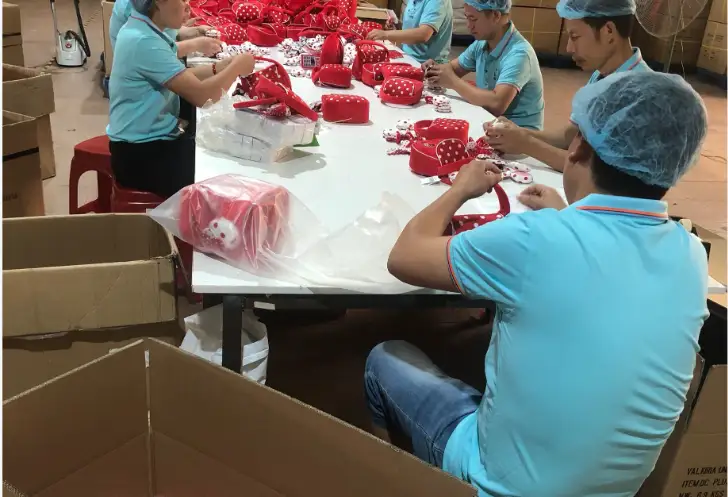
A factory that treats consistency as an evolving discipline, continually refining patterns, work instructions, and training based on real production data, tends to show measurable improvement in defect rates over successive seasons, while one that treats each inspection as a standalone checkpoint often sees the same recurring issues resurface order after order.
Frequently Asked Questions
Q1. What is a golden sample and why is it important for consistency?
A golden sample is a fully approved, physical reference unit representing the exact target for a given plush toy design — its color, size, stuffing firmness, and construction details. It matters because written specifications alone can be interpreted differently by different operators, while a physical sample gives every workstation an unambiguous, tangible standard to compare against throughout production. Golden samples are typically placed at multiple points along the production line so that deviation can be caught and corrected as early as possible rather than only being discovered during final inspection.
Q2. How do factories keep fabric color consistent across a large production run?
Color consistency is maintained primarily through dye lot matching, ensuring panels for the same toy or production batch are cut from fabric within a single dye lot or from lots verified to fall within an acceptable color tolerance. A spectrophotometer is used to measure color numerically against a reference standard, providing an objective verification method that removes the inconsistency inherent in relying on visual comparison alone, which can vary significantly depending on lighting conditions at the time of inspection.
Q3. How is stuffing weight controlled to keep toys feeling the same?
Stuffing weight is controlled through defined target fill weights established during sample approval, verified using calibrated scales at the stuffing station rather than relying purely on operator judgment. Larger or more complex toys are often broken down into sectional weight targets, particularly for narrow extremities like ears and tails, which are prone to uneven fill distribution if stuffed without a defined process. Firmness is also periodically checked by hand against the golden sample, since two toys can share identical weight while feeling different if fill is packed more loosely or tightly.
Q4. What is an AQL inspection, and how does it relate to consistency?
AQL, or Acceptable Quality Limit, inspection is a statistical sampling method that defines how many units from a completed production lot must be inspected and how many defects of each severity level are permitted before the lot is rejected. It serves as a final consistency check across an entire completed run, verifying that the standardization efforts applied throughout cutting, sewing, and stuffing actually held up across the full lot rather than only in the specific units checked earlier in-process spot checks.
Q5. Why does the cutting method affect consistency between plush toy units?
The cutting method directly determines how precisely and repeatably fabric panels match the master pattern dimensions. Die-cutting stamps out panels in a single controlled motion, producing highly consistent dimensions across large volumes, while manual cutting depends much more heavily on individual cutter skill and is inherently more variable, particularly across a long production run or when multiple cutters are working simultaneously. Even fabric layup height matters, since excessive stack height can cause dimensional drift between panels cut from the top versus the bottom of a tall layup.
Q6. How do factories prevent stitching quality from varying between different sewing lines?
Stitching consistency across multiple sewing lines depends on locking and documenting machine settings — stitch length, tension, and stitch type — for each seam type on a given design, then periodically checking machines against those settings to catch drift from normal wear or unauthorized adjustment. Combined with standardized work instructions and skill-certified operators assigned to specific operation types, this approach keeps seam quality comparable across different lines, shifts, and even facilities working on the same order.
Q7. What happens when a consistency problem is discovered during production?
When in-process spot checks or first-piece inspection identify a deviation from the golden sample or specification, the affected line is typically stopped or adjusted immediately to correct the root cause — whether that’s a machine setting, a material lot, or an operator technique issue — before production continues at volume. Units already produced during the affected period are reviewed and, depending on severity, either reworked, sorted for a lower-tier use, or scrapped. The root cause is then documented and fed back into work instructions or training so the same issue is less likely to recur on future runs.