Skip to content
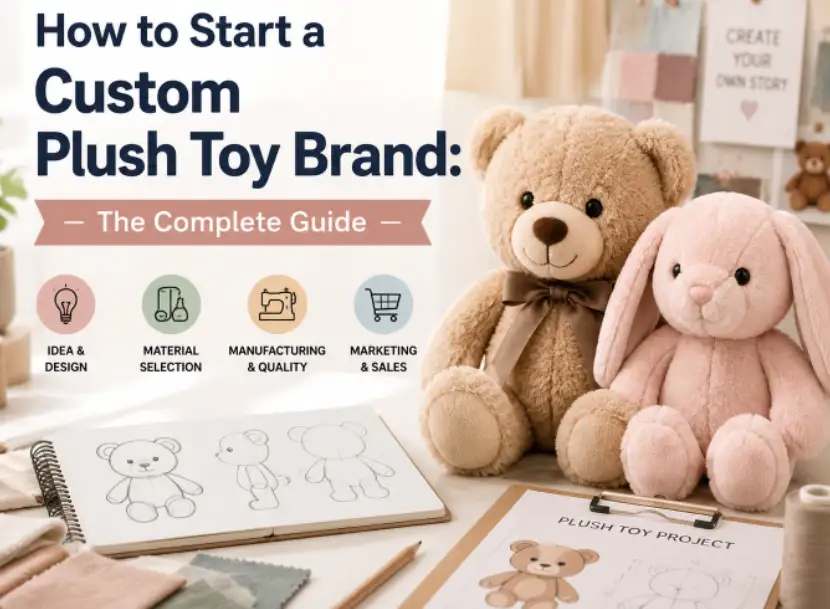
How to Start a Custom Plush Toy Brand requires careful planning, creative character design, high-quality materials, reliable manufacturing partners, and effective marketing strategies to turn your unique plush toy ideas into successful products for global customers.
Everything a first-time founder or established brand owner needs to know about designing, sourcing, manufacturing, and launching a custom plush toy line — from concept sketch to first shipment.
Starting a custom plush toy brand sits at the intersection of creative product design and a fairly technical manufacturing process, and founders who understand both sides tend to move faster and avoid the most expensive early mistakes. A plush toy brand is not simply a character and a logo — it is a supply chain decision, a materials and safety compliance obligation, and a go-to-market plan that has to account for lead times measured in months rather than days.
This guide walks through the full path of custom plush toy brand development: defining a viable concept, moving from sketch to a manufacturable pattern, choosing fabric and filling, working with a factory through sampling and mass production, meeting toy safety testing requirements, and building a launch strategy that gets the finished product in front of buyers. Reference data throughout reflects the ranges most commonly cited across plush toy manufacturing and toy industry sourcing guidance.
What Does It Mean to Start a Custom Plush Toy Brand?
A custom plush toy brand is a company built around original, brand-owned soft toy designs — as opposed to reselling stock or generic plush products sourced from a catalog. Custom development means the character design, pattern, fabric selection, and often the packaging are unique to the brand, which is what allows a plush toy line to be trademarked, differentiated on a crowded marketplace listing, and defended against copycats.
Building a plush toy brand from scratch requires decisions across three interlocking domains: product development (design, pattern, sampling), manufacturing (sourcing, production, quality control, compliance), and commercialization (positioning, pricing, sales channel, marketing). Founders who treat these as sequential rather than parallel tracks often lose months waiting on one when the others could have been advancing simultaneously.
Tip: Start compliance research — target market, age grade, and applicable toy safety standards — at the same time as character design, not after the first sample is approved. Safety requirements can influence construction choices like eye attachment method and fabric selection.
Defining a Viable Plush Toy Concept
Every successful plush toy brand starts from a concept that is distinctive enough to stand out and simple enough to manufacture consistently at scale. A concept that looks compelling as a 2D illustration does not always translate cleanly into a three-dimensional soft toy — proportions that read well on paper can be difficult to pattern, stuff evenly, or produce at a target price point.
Character and Silhouette Development
Strong plush toy characters usually have a clear, recognizable silhouette that reads at a distance and scales well across sizes, from a small keychain plush to a full-size collectible. Overly intricate details — thin limbs, small facial features, or fine appendages — increase both manufacturing difficulty and the likelihood of small parts and pull test failures during safety testing.
Target Age Grade and Market Positioning
Deciding early whether the line targets infants, older children, or adult collectors shapes nearly every downstream decision, from safety eye versus embroidered eye construction to fabric texture and packaging. Adult-oriented collectible plush, for instance, has more design freedom on small or delicate components but still needs to meet general consumer product safety expectations even outside strict children’s toy regulation.
Researching Market Demand Before Committing to a Design
Validating that a concept has genuine audience appeal before committing to sampling and tooling costs meaningfully reduces the risk of a first production run. This can include informal social media testing of concept art, competitive research into adjacent character brands’ pricing and positioning, and direct outreach to potential wholesale buyers or retail contacts to gauge interest ahead of a full launch. Founders who skip this step and move straight from sketch to mass production are effectively betting the full development and production budget on an unvalidated concept.
From Sketch to Manufacturable Pattern
Turning a 2D character design into a production-ready plush toy pattern is a specialized step usually handled by a pattern maker experienced in soft toy construction. The pattern maker translates the character’s proportions into flat fabric panels that, when cut and sewn, produce the intended 3D shape once stuffed.
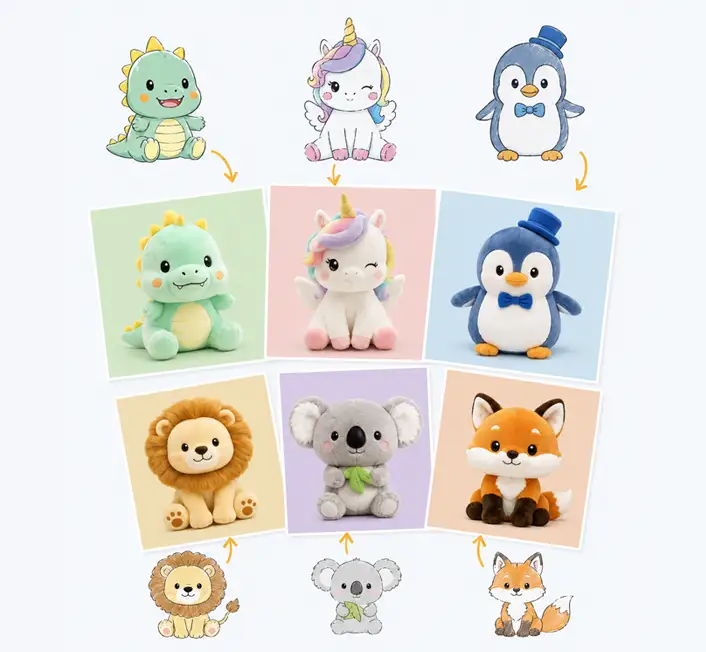
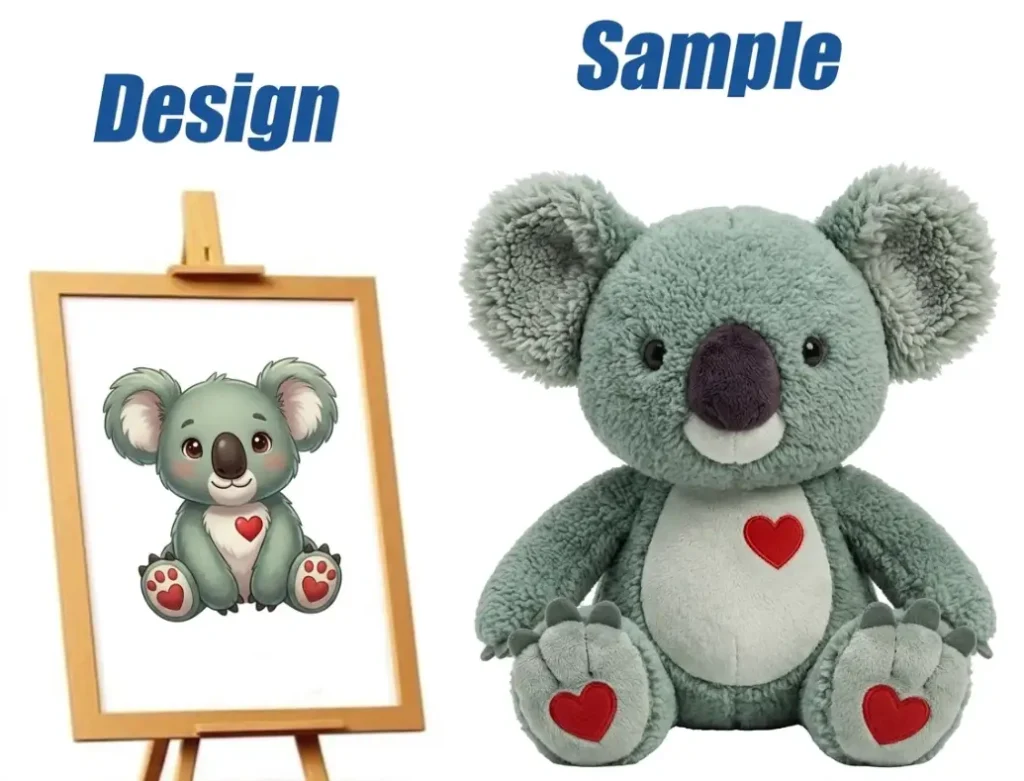
2D Design to 3D Prototype
The first physical output of pattern development is typically a rough prototype or “first sample,” built to test proportions, seam placement, and overall silhouette before investing in refined tooling like die-cut cutting patterns. This stage is where founders confirm the character actually looks right in three dimensions and make adjustments before locking the pattern.
Digital Pattern Making
Many modern plush toy manufacturers use digital pattern making software to refine panel shapes with greater precision than hand-drafted patterns, which also makes it easier to grade a design up or down to different sizes without redrawing the pattern from scratch. Digital patterns additionally speed up revisions between sample rounds, since adjustments can be made and re-cut quickly.
Tip: Budget for at least two to three sample rounds before mass production. Even experienced pattern makers rarely nail proportions, seam placement, and stuffing density on the very first attempt.
Custom Plush Toy Development Stages
| Stage | Primary Activity | Typical Output | Common Timeline |
|---|---|---|---|
| Concept & sketch | Character design, silhouette, colorway planning | 2D reference artwork | 1–3 weeks |
| Pattern development | Flat pattern drafting from 2D design | Cutting pattern / digital pattern file | 1–2 weeks |
| First sample | Initial 3D prototype construction | Rough sample for proportion review | 2–3 weeks |
| Sample revision rounds | Adjustments to pattern, fabric, stuffing density | Revised samples for approval | 2–4 weeks per round |
| Pre-production sample | Final approved sample matching mass production materials | Golden sample | 2–3 weeks |
Choosing Fabric, Filling, and Construction Details
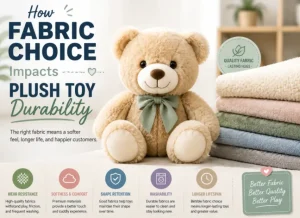
Material selection directly affects unit cost, tactile quality, durability, and how the finished plush toy performs in safety testing. The main fabric families used in plush toy manufacturing include short-pile plush, minky, velboa, and faux fur, each with a different hand feel, sheen, and price point.
Fabric Selection Considerations
Short-pile plush and velboa are common choices for character plush aimed at a broad price range, offering a smooth, consistent surface that takes print and embroidery detail well. Faux fur and long-pile fabrics create a more premium, realistic texture but generally cost more per yard and require more careful flammability and colorfastness testing due to their exposed fiber surface.
Filling Material and Density
Polyester (PP) fiber filling is the industry standard for most plush toys due to its low cost, washability, and consistent loft. Filling density affects both the toy’s huggability and its shape retention over time — underfilled plush toys can look flat and lose shape quickly, while overfilled designs can strain seams and distort the intended silhouette.
Eyes, Noses, and Accessory Construction
Safety eyes and noses (plastic components with a locking washer) are common on plush toys aimed at older children and adults, while embroidered or appliqued features are typically required for infant and toddler age grades due to stricter small parts and pull test thresholds. This single construction decision has significant downstream effects on both cost and the applicable safety testing scope.

Common Plush Fabric Options by Use Case
| Fabric Type | Typical Feel | Best Use Case | Relative Cost |
|---|---|---|---|
| Short-pile plush | Smooth, low nap | Character plush, promotional plush, mid-range price point | Low–moderate |
| Velboa | Very smooth, slight sheen | Vibrant print detail, mascot plush | Low–moderate |
| Minky | Soft, dense pile | Baby and infant-safe lines, comfort items | Moderate |
| Faux fur (short/long pile) | Realistic, textured | Premium collectibles, animal-realistic designs | Moderate–high |
Tip: Request fabric swatches under both natural and warm indoor lighting before final approval. Plush colors, especially deep or muted tones, can shift noticeably in appearance depending on the light source.
Working With a Plush Toy Manufacturer
Choosing the right manufacturing partner is one of the highest-leverage decisions a new plush toy brand makes, since factory capability directly determines sample quality, production consistency, and the brand’s ability to meet safety compliance obligations.
OEM vs ODM Manufacturing
OEM (original equipment manufacturing) production builds the brand’s own original design exactly as specified, while ODM (original design manufacturing) starts from the factory’s existing design library, which the brand then customizes. New brands with a genuinely original character concept typically need OEM production, while brands looking to move faster with a lower development cost sometimes start with an ODM base design and customize colorways, fabric, or accessories.
Minimum Order Quantities and Cost Structure
Minimum order quantities (MOQs) for custom plush toys vary significantly by factory, design complexity, and whether tooling like custom cutting dies is required. Unit cost is driven primarily by fabric type, size, level of embroidery or print detail, filling volume, and the number of separate components requiring assembly, such as multiple fabric panels or attached accessories.
Quality Control and Factory Auditing
Ongoing quality control — both in-line checks during production and a final random inspection before shipment — protects against the drift that can occur between an approved sample and a full production run. For brands sourcing internationally, a factory audit evaluating production capability, quality systems, and compliance history is a standard due diligence step before committing to a larger order.
Communicating Design Intent Clearly Through Sample Rounds
Miscommunication between brand and factory during sampling is one of the more avoidable causes of delay in plush toy development. Detailed technical packs — including measured proportions, color references tied to a standard color matching system, stitch and seam specifications, and stuffing density notes — reduce the number of revision rounds needed and help ensure the factory’s interpretation of a design matches the brand’s intent. Written, itemized feedback on each sample round, rather than general verbal notes, also creates a clear record the factory can act on precisely.
Tip: Ask for references or case studies of comparably complex designs the manufacturer has previously produced, not just generic plush samples. A factory strong in simple round character plush is not automatically equipped for designs with jointed limbs, mechanisms, or unusual proportions.

Meeting Toy Safety and Compliance Requirements
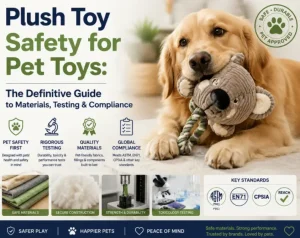
Every custom plush toy brand selling into a regulated market needs to satisfy the applicable toy safety standards before the product reaches consumers, and compliance requirements should shape design and material decisions well before mass production begins, not just before shipment.
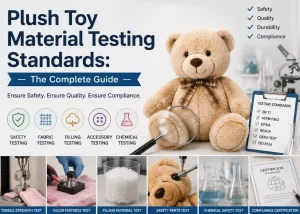
Depending on the destination market, this typically means testing against frameworks such as EN 71 in the European Union, ASTM F963 and the CPSIA in the United States, or ISO 8124 as a broader international baseline. Testing categories generally cover mechanical and physical safety (pull tests, small parts, seam strength), chemical safety (heavy metals, phthalates, restricted dyes), and flammability of both the shell fabric and the filling material.
Third-party lab testing by an accredited laboratory is typically required rather than optional for children’s products, and test reports are tied to the specific materials, factory, and production lot tested — meaning a fabric, filling, or accessory substitution after initial testing generally requires retesting the affected components.
Tip: Build testing lead time into the production calendar from day one. Chemical and flammability testing alone commonly takes one to two weeks at an accredited lab, and starting this process only after mass production begins can delay a launch date by several weeks.
Core Toy Safety Testing Categories for a New Plush Toy Brand
| Testing Category | What It Verifies | Common Standard Reference |
|---|---|---|
| Mechanical/physical | Pull test strength, small parts, seam integrity, sharp points | EN 71-1 / ASTM F963 / ISO 8124-1 |
| Chemical | Heavy metals, phthalates, azo dyes, formaldehyde | EN 71-3 / CPSIA / REACH |
| Flammability | Flame spread rate of shell fabric and filling | EN 71-2 / ASTM F963 / ISO 8124-2 |
| Labeling & tracking | Tracking labels, care labels, age grading disclosure | CPSIA / market-specific labeling rules |
Protecting the Design: Intellectual Property Basics
A custom plush toy character represents real creative and financial investment, and protecting that investment against copying is worth planning for early rather than treating as a later-stage legal task. Intellectual property protection for a plush toy brand generally involves a combination of trademark protection for the brand name and logo, and copyright or design protection for the character’s original artwork and three-dimensional form.
Working with a manufacturer under a clear agreement about design ownership matters as much as any formal registration. Founders should confirm in writing that the factory will not reuse the pattern, tooling, or character design for other clients, and that any custom cutting dies or molds developed for the design remain under the brand’s control rather than becoming shared factory tooling.
Tip: Register core trademarks — the brand name and primary logo — before large-scale marketing or crowdfunding launches, since public exposure without registered protection increases the risk of a competitor filing first in a key market.
Branding, Packaging, and Positioning
A custom plush toy’s brand identity extends beyond the character design itself into packaging, naming, and the story the product tells on a retail shelf or product listing page. Packaging decisions — a printed header card, a branded gift box, or a simple polybag with a hang tag — affect both unit cost and perceived value, and should be planned alongside the toy design rather than as an afterthought once samples are approved.
Positioning determines pricing strategy and target sales channel. A premium collectible line sold direct-to-consumer through a branded website supports a materially different price point and packaging investment than a mass-market character line intended for wide retail distribution.

Launch Strategy and Sales Channels
Getting a finished plush toy design to market involves choosing the right combination of sales channels for the brand’s positioning and production scale. Common paths include direct-to-consumer e-commerce, wholesale to specialty and gift retailers, marketplace listings, crowdfunding for initial validation and capital, and licensing partnerships for established characters.
Crowdfunding as a Launch Strategy
Crowdfunding platforms allow a new plush toy brand to validate demand and raise initial production capital before committing to a full mass production order, which can meaningfully de-risk the first manufacturing run for founders without existing sales history.
Wholesale and Retail Distribution
Moving into wholesale distribution typically requires a completed compliance package — test reports, tracking labels, and often product liability insurance — since retail buyers generally will not list a children’s product without documented safety testing in place.
Tip: Photograph and film product samples against a neutral, well-lit background as soon as the pre-production sample is approved. High-quality product imagery is often the single biggest lever in early marketplace and crowdfunding conversion rates, and it is far easier to shoot before mass production timelines create pressure to launch immediately.
Common Sales Channels for a New Plush Toy Brand
| Channel | Typical Use Case | Key Requirement |
|---|---|---|
| Direct-to-consumer e-commerce | Full margin control, brand storytelling | Marketing budget, fulfillment capability |
| Marketplace listings | Broad discovery, lower marketing lift | Compliance documentation for listing approval |
| Crowdfunding | Demand validation, initial capital raise | Compelling campaign assets, realistic delivery timeline |
| Wholesale/retail distribution | Scale and shelf presence | Full safety compliance package, liability insurance |
| Licensing partnerships | Established IP or character extension | Licensing agreement, brand guideline compliance |
Budgeting and Financial Planning for a First Production Run
Financial planning for a first plush toy production run needs to account for far more than the per-unit factory quote, and founders who budget narrowly around unit cost alone are frequently surprised by the total capital required to get inventory into a customer’s hands. A realistic budget spans product development, the production order itself, compliance, logistics, and the marketing spend needed to actually sell through the resulting inventory.
Product Development Costs
Development costs include pattern making fees, sample rounds, and any custom tooling such as cutting dies for a complex silhouette. These costs are largely fixed regardless of order size, which is one reason unit economics improve significantly as production volume scales — the development investment is amortized across more units.
Production and Landed Cost
Beyond the factory’s quoted unit price, landed cost includes freight, import duties, and any warehousing or fulfillment fees before the product reaches the end customer. New brands sourcing internationally sometimes underestimate freight costs, particularly for bulky, low-density items like plush toys, which occupy significant shipping volume relative to their weight and value.
Compliance and Testing Costs
Safety testing costs scale with the number of distinct materials, colorways, and components requiring separate test reports, since chemical and flammability testing are typically priced per sample rather than per SKU as a whole. Brands launching multiple colorways of the same character should budget for testing each color separately where dye formulation differs, since chemical results are not guaranteed to transfer between colors.
Typical Budget Categories for a First Plush Toy Production Run
| Budget Category | What It Covers | Cost Behavior |
|---|---|---|
| Product development | Pattern making, sample rounds, custom tooling | Largely fixed, amortizes with volume |
| Production order | Factory unit cost × order quantity | Scales with order volume; per-unit cost drops at higher MOQs |
| Safety testing & compliance | Lab testing per material/colorway, labeling, certification | Scales with number of distinct materials and colorways |
| Freight & logistics | Ocean or air freight, duties, warehousing | Sensitive to shipping volume; plush toys are bulky relative to weight |
| Packaging | Header cards, boxes, hang tags, poly bags | Scales with order volume; design cost is largely fixed |
| Marketing & launch | Photography, advertising, crowdfunding campaign costs | Variable; typically ongoing rather than one-time |
Tip: Request an all-in landed cost estimate from the manufacturer or freight forwarder before finalizing pricing strategy, not just the factory-gate unit price. Freight and duties can add a meaningful percentage to the true cost of a bulky, low-density product like plush.
Common Mistakes First-Time Plush Toy Founders Make
- Skipping compliance research until after production: Discovering a construction detail fails safety testing after mass production has begun is far more costly than designing around it from the start.
- Underestimating sample rounds: Budgeting for only one sample round almost always leads to rushed approval of a design that has not been fully refined.
- Choosing MOQ before confirming demand: Committing to a large minimum order quantity before validating market interest through pre-orders or crowdfunding increases financial risk unnecessarily.
- Underpricing based on unit cost alone: Pricing that accounts only for factory unit cost without fully loading in shipping, duties, packaging, and marketing spend erodes margin quickly.
- Neglecting packaging and photography budget: Treating packaging and product photography as an afterthought after prioritizing the toy itself often undermines conversion at the point of sale.
- Overlooking freight and landed cost: Pricing a product line around the factory-gate unit cost alone, without accounting for freight, duties, and warehousing, frequently leads to margin surprises once the first shipment actually lands.
None of these mistakes are unusual, and most established plush toy brands made at least one of them on their first production run. The founders who recover fastest are typically the ones who built in enough financial and timeline buffer to absorb a revision round, a delayed test result, or an unexpectedly high freight quote without derailing the entire launch plan.

Frequently Asked Questions
Q1. How much does it cost to start a custom plush toy brand?
Startup costs vary widely depending on design complexity, sample rounds, minimum order quantity, and sales channel investment, but the core cost drivers are consistent across most new brands: pattern development and sampling fees, the mass production order itself (driven by unit cost multiplied by MOQ), safety testing and certification, packaging, freight and landed cost, and initial marketing or launch spend. Founders who validate demand through pre-orders or crowdfunding before committing to a full production run generally reduce upfront financial risk compared to self-funding a large first order outright, since early sales data can also inform which colorways or sizes deserve the largest share of the initial budget.
Q2. What is the difference between OEM and ODM manufacturing for a plush toy brand?
OEM (original equipment manufacturing) production builds the brand’s fully original character design from scratch, based on the brand’s own concept art and pattern. ODM (original design manufacturing) starts from a design the factory already has in its library, which the brand then customizes with different fabric, colorways, or accessories. A brand with a genuinely unique character concept generally needs OEM production to protect its intellectual property and differentiate on the market, while ODM can offer a faster, lower-cost path for brands prioritizing speed over full design originality.
Q3. How long does it take to go from concept to a finished, sellable plush toy?
A realistic end-to-end timeline from initial character concept through an approved pre-production sample commonly runs eight to fourteen weeks, depending on how many sample revision rounds are needed. Mass production, safety testing, and shipping typically add several additional weeks beyond that, meaning most new plush toy brands should plan for a four- to six-month runway from concept to inventory in hand, particularly for a first production run with an unfamiliar factory.
Q4. Do I need safety testing if I’m only selling adult collectible plush toys?
Even when a plush toy is marketed exclusively to adult collectors rather than as a children’s toy, general consumer product safety expectations still apply, and many marketplaces and retailers request some form of safety or quality documentation regardless of stated age grade. If there is any realistic likelihood the product could end up in a child’s hands — which regulators generally assume unless clearly and consistently marketed and packaged for adults — full children’s toy safety testing is the safer compliance posture.
Q5. What is a minimum order quantity, and can I start with a smaller batch?
A minimum order quantity (MOQ) is the smallest production run a manufacturer will accept for a given design, and it is typically driven by the fixed costs of sampling, custom cutting dies, and setting up a production line for a new pattern. Some manufacturers offer lower MOQs for simpler designs or established fabric and construction combinations, while highly custom designs with unique patterns generally carry higher MOQs to offset tooling and setup costs. Negotiating a smaller initial batch, sometimes at a higher per-unit cost, is a common strategy for first-time brands validating a new design before committing to a larger order.
Q6. Should I choose safety eyes or embroidered eyes for my plush toy design?
The choice depends primarily on the target age grade. Safety eyes (plastic components secured with a locking washer) are generally acceptable for toys aimed at older children and adults, subject to passing pull test requirements. For infant and toddler age grades, embroidered or appliqued eyes are typically required instead, since they eliminate the small parts and detachment risk that a mechanically attached component carries under stricter under-3 safety thresholds.
Q7. What sales channel is best for launching a new plush toy brand?
There is no single best channel — the right choice depends on the brand’s capital position, target price point, and available marketing capability. Crowdfunding suits brands seeking to validate demand and raise initial production capital before a full manufacturing commitment. Direct-to-consumer e-commerce offers full margin control but requires sustained marketing investment. Wholesale and retail distribution offer scale but require a complete safety compliance package and often liability insurance before buyers will list the product. Many successful plush toy brands combine two or more channels rather than relying on a single path to market.