Plush Toy Compliance Checklist for Importers is essential for anyone sourcing or manufacturing soft toys for global markets, helping ensure safety, labeling accuracy, and full regulatory compliance before shipping.
Importing plush toys without a rigorous compliance strategy exposes your business to border holds, product recalls, retailer delisting, and legal liability. This authoritative checklist walks importers through every mandatory standard, testing protocol, labelling requirement, and documentation process across the world’s key markets.
Why Plush Toy Compliance Is Non-Negotiable for Every Importer
The global plush toy trade is governed by an increasingly complex web of safety standards, chemical regulations, mechanical testing protocols, and customs documentation requirements. For importers — whether sourcing private-label stuffed animals, licensed character plush, or promotional soft toys — navigating this landscape is not optional. A single non-compliant shipment can result in seizure at the port of entry, mandatory product recalls, retailer contract termination, and significant financial penalties.
Beyond legal risk, compliance is now a commercial differentiator. Major retailers in the European Union, the United States, the United Kingdom, and Australia increasingly require suppliers to demonstrate third-party test certification before orders are placed — not as an afterthought during the shipping phase. Importers who build compliance into their sourcing and production workflow from the design stage outperform those who treat testing as a box to check at the end of the process.
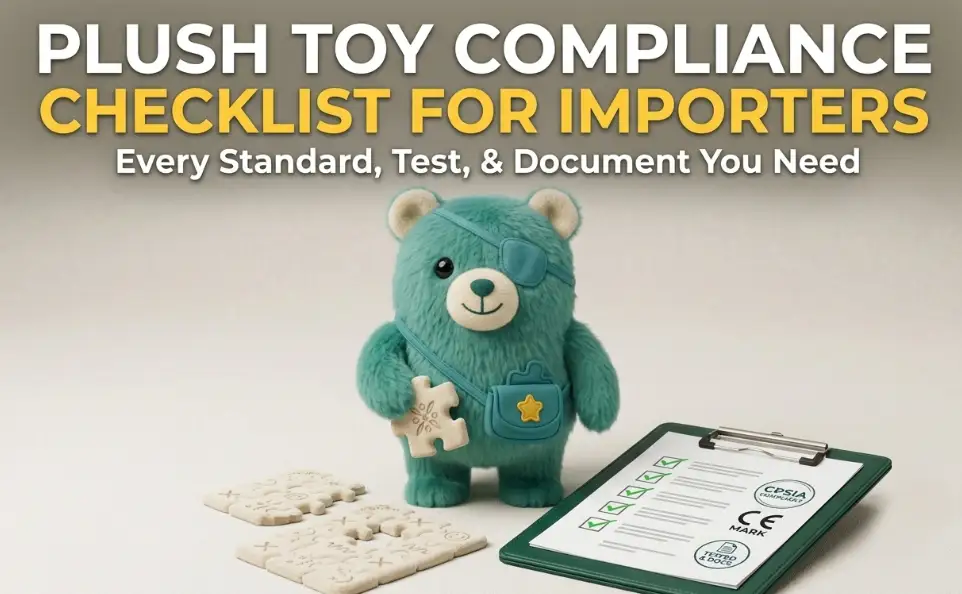
This guide is structured as a working checklist. Each section covers a distinct compliance domain: mechanical and physical safety, chemical restrictions, flammability, labelling, documentation, and market-specific requirements. Use it in conjunction with your factory’s quality control team and an accredited third-party testing laboratory to build a compliance programme that protects your product, your brand, and your customers.
Key Regulatory Markets and Primary Toy Safety Standards for Plush Toy Importers
| Market | Primary Standard | Regulatory Body | Mandatory Marking | Key Scope |
|---|---|---|---|---|
| European Union | EN 71 (Parts 1, 2, 3 minimum) | European Commission / National Market Surveillance Authorities | CE Mark | Mechanical safety, flammability, and chemical migration |
| United States | ASTM F963-17 / CPSIA | CPSC (Consumer Product Safety Commission) | CPC / Tracking Label | Mechanical hazards, lead, phthalates, flammability |
| United Kingdom | UK Toy Safety Regulations 2011 (as amended) | OPSS / Trading Standards | UKCA Mark | Aligned with EN 71; separate UKCA process post-Brexit |
| Australia / New Zealand | AS/NZS 8124 (equivalent to ISO 8124) | ACCC / Commerce Commission NZ | None mandatory; warning labels required | Mechanical safety, flammability, and noise limits |
| Canada | Canada Consumer Product Safety Act / Toys Regulations | Health Canada | Bilingual warning labels (EN/FR) | Mechanical safety, chemical restrictions, and age warnings |
| China (domestic) | GB 6675 (Mandatory Toy Safety Standard) | SAMR / CCC Certification System | CCC Mark | Physical, mechanical, chemical, and flammability |
| Japan | ST Mark Standard / Product Liability Act | Japan Toy Association / METI | ST Mark (voluntary but expected by retailers) | Safety, durability, and flammability for children’s products |
Mechanical Safety
Mechanical and Physical Safety Testing: What Every Plush Toy Must Pass
Mechanical and physical testing is the foundation of toy safety compliance. For plush toys, the primary concerns are component detachment (creating choking hazards), sharp edges or points introduced by internal structural elements, and the structural integrity of the toy under normal and foreseeable abuse conditions. Both EN 71 Part 1 and ASTM F963 address these concerns through standardised test methods that replicate real-world child interaction.
Choking Hazard and Small Parts Testing
Any component that can be detached from a plush toy through normal use or foreseeable abuse must be evaluated as a potential choking hazard if it fits within the small parts cylinder — a standardised test cylinder defined in both EN 71 and ASTM F963 that approximates the airway dimensions of a child under 3 years of age. For plush toys, this most commonly applies to sewn-on eyes, noses, buttons, decorative appliqués, swing tags that remain attached, and any internal structural pellets or beans that might be accessible if the seam is compromised.
The critical implication for plush toy importers: a toy that contains small parts, or from which small parts can be separated under the specified test force (a 90 N pull force applied for 10 seconds in EN 71), cannot be marketed to children under 36 months without a prominent choking hazard warning. Many importers choose instead to redesign components to pass the pull-force test, eliminating the age restriction and its associated labelling obligations.
Pull Force and Torque Testing Requirements
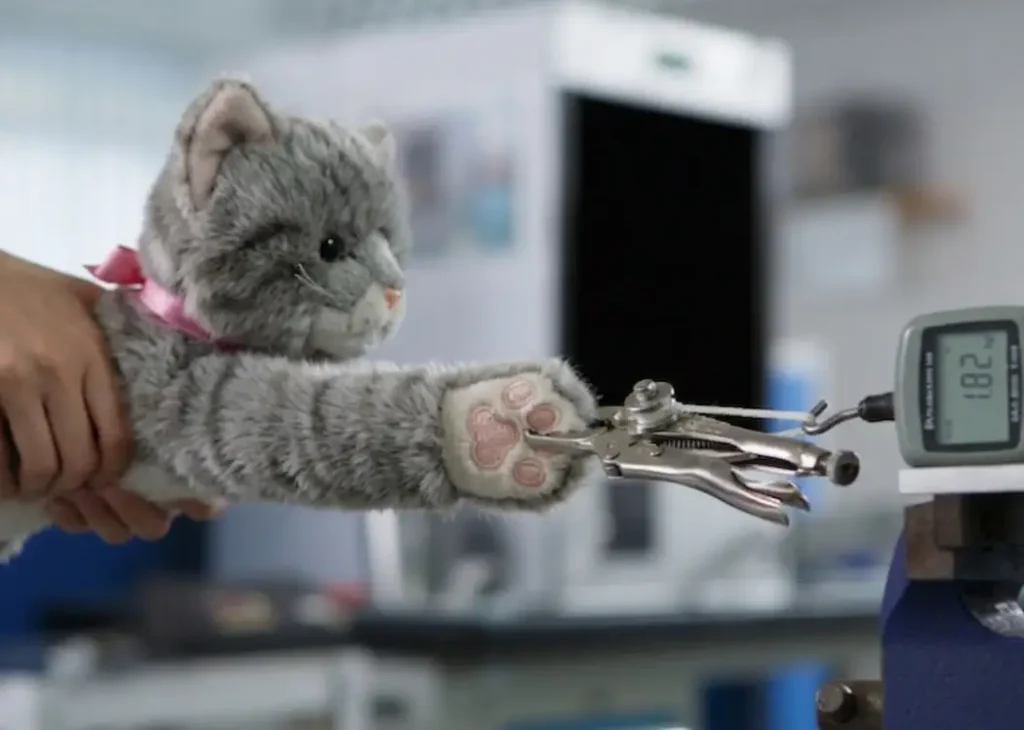
All attached features — safety eyes, nose components, buttons, ribbons, decorative bows, and accessories — must be subjected to both pull force and torque testing. In EN 71 Part 1, a 90 N pull force is applied for 10 seconds, followed by a 0.34 Nm torque for 10 seconds. Any component that detaches or becomes accessible in a manner that creates a hazardous small part constitutes a test failure. Importers should specify these test requirements explicitly in purchase contracts and request documented test evidence from factories before shipment.
Importer Tip
Request pull-force test data from your factory for every production batch, not just the pre-production sample. Stitching quality and attachment methods can vary significantly between the approved sample and production units, particularly when production is subcontracted. Insist on in-line quality control checks at the factory that mirror the standard test parameters.
Fabric Tension and Seam Integrity Testing
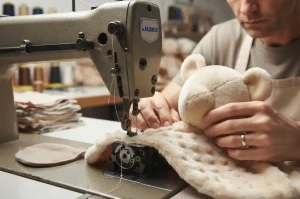
For plush toys, seam integrity is particularly important because stuffing material — typically hollow-fibre polyester — is exposed if a seam fails. While stuffing material itself is generally not a regulated hazard for older children, loose fibres accessible to infants present an ingestion risk. Both EN 71 and ASTM F963 include fabric and seam tension tests. Importers should ensure that all seam thread counts, stitch densities, and seam allowances are documented in the technical pack and verified during pre-shipment inspection.
Mechanical and Physical Test Methods Applicable to Plush Toys
| Test Type | EN 71 Reference | ASTM F963 Reference | Pass Criterion | Most Relevant Plush Components |
|---|---|---|---|---|
| Pull force test | EN 71-1 Clause 8.9 | ASTM F963-8.8 | No hazardous small part released after 90 N / 10 s | Eyes, noses, buttons, ribbons, accessories |
| Torque test | EN 71-1 Clause 8.10 | ASTM F963-8.9 | No component separates under 0.34 Nm / 10 s | Rotatable or protruding features |
| Drop test | EN 71-1 Clause 8.5 | ASTM F963-8.6 | No hazardous edges, points, or small parts exposed | Internal pellets, wire frames, sound modules |
| Bite test (squeeze toys) | EN 71-1 Clause 8.11 | ASTM F963-8.10 | No part becomes accessible that creates a hazard | Soft squeakers, embedded sound elements |
| Small parts cylinder | EN 71-1 Annex A | ASTM F963-8.4 | Detached parts must not fit in the cylinder (for 0–3-year products) | All removable or separable components |
| Sharp edges/points | EN 71-1 Clause 8.7 / 8.8 | ASTM F963-8.7 | No accessible sharp edge or point post-test | Internal wire, plastic stiffeners, armatures |
| Fabric/seam tension | EN 71-1 Clause 8.9 (fabric) | ASTM F963-8.14 | Fabric must not tear to expose hazardous material | All outer fabric seams, opening/closure points |
Chemical Restrictions
Chemical Compliance: REACH, Heavy Metals, Phthalates, and Azo Dyes
Chemical compliance is among the most technically demanding aspects of plush toy import compliance. Fabrics, dyes, filling materials, plastic safety eyes, printed labels, and decorative elements can all introduce chemical substances that are regulated under European, US, and international frameworks. For importers, the critical principle is that chemical compliance cannot be assumed — it must be demonstrated through third-party laboratory testing.
REACH Regulation and the SVHC List
The European Union’s REACH regulation (Registration, Evaluation, Authorisation and Restriction of Chemicals) imposes obligations on importers of all products containing chemical substances above defined thresholds. For plush toy importers selling into the EU, the most operationally significant element of REACH is Article 33, which requires disclosure to customers if a product contains a substance of very high concern (SVHC) at a concentration above 0.1% by weight of the article.

The SVHC candidate list is updated twice yearly by the European Chemicals Agency (ECHA), currently containing over 230 substances. Relevant SVHCs for plush toys include certain plasticisers in plastic components, formaldehyde-based textile treatments, and specific heavy metals in dyes. Importers must maintain a continuous monitoring process for SVHC list updates and audit their supply chain for exposure at each list revision.
Heavy Metal Migration Limits Under EN 71 Part 3
EN 71 Part 3 sets migration limits for 19 chemical elements across three material categories: dry, brittle, powder-like, or pliable toy material; liquid or sticky toy material; and scraped-off toy material. For plush toys, the most relevant category is scraped-off material (for fabric and surface coatings) and dry material (for plastic components such as safety eyes). Lead, cadmium, chromium VI, barium, and antimony are among the most commonly tested elements. Compliance requires that migration levels remain below defined limits when tested according to the specified extraction method.
Phthalates and Restricted Substances Under CPSIA
In the United States, the Consumer Product Safety Improvement Act (CPSIA) permanently restricts the concentration of certain phthalates to no more than 0.1% by weight in children’s toys. While plush toys consist primarily of textile and fibre materials, phthalates can be present in plastic components (safety eyes, nose inserts, sound modules, PVC print inks) and in certain coating treatments. Third-party testing to CPSC requirements must be conducted by a CPSC-accepted laboratory.
Chemical Compliance Tip
Do not rely solely on factory-provided compliance documentation or declarations of conformity for chemical testing. SVHC and heavy metal testing must be conducted on the actual production materials — not on reference samples or generic fabric types. Specify that chemical testing reports must reference the exact batch codes of materials used in your production run, and request that the testing laboratory is named and accredited to ISO/IEC 17025.
Key Chemical Restrictions Applicable to Plush Toy Imports by Market
| Substance / Class | EU (REACH / EN 71) | US (CPSIA / CPSC) | UK | Typical Plush Toy Risk Source |
|---|---|---|---|---|
| Heavy metals (Pb, Cd, Cr VI, Ba, Sb, As, Se, Hg) | EN 71-3 migration limits | Lead: ≤100 ppm total (CPSIA) | UK EN 71-3 limits | Dyes, plastic eyes, surface coatings, print inks |
| Phthalates (DEHP, DBP, BBP, DINP, DIDP, DNOP) | REACH Annex XVII ≤0.1% | CPSIA ≤0.1% (DEHP, DBP, BBP, DINP, DIBP, DPENP) | UK REACH aligned | Plastic components, PVC elements, and squeeze toys |
| Formaldehyde | REACH: some EU member state limits on textiles | No federal limit for toys, but California Prop 65 | No specific toy standard; general product safety | Textile treatments, wrinkle-resistant finishes |
| Azo dyes (carcinogenic arylamines) | REACH Annex XVII ≤30 mg/kg | No federal standard; California restrictions emerging | UK REACH aligned | Fabric dyes, printed surface designs |
| Flame retardants (TBBPA, HBCD, etc.) | REACH SVHC; POPs Regulation | Certain flame retardants are restricted under the CPSC | UK REACH / UK POPs | Filling materials, backing treatments on fabrics |
| Nickel (in accessible metal parts) | REACH Annex XVII ≤0.5 μg/cm²/week migration | No specific toy restriction | UK REACH aligned | Metal closures, zips, decorative fittings |
Flammability Requirements
Flammability Testing: The Standard That Catches Importers Off Guard
Flammability testing is one of the most commonly overlooked compliance requirements for plush toy importers, yet it is a mandatory element of EN 71 Part 2, ASTM F963, and most national toy safety frameworks. Plush toys are inherently composed of materials — textile pile fabrics, PP cotton filling, and fabric linings — that can exhibit widely varying burning behaviour depending on fibre composition, pile height, and surface treatment.
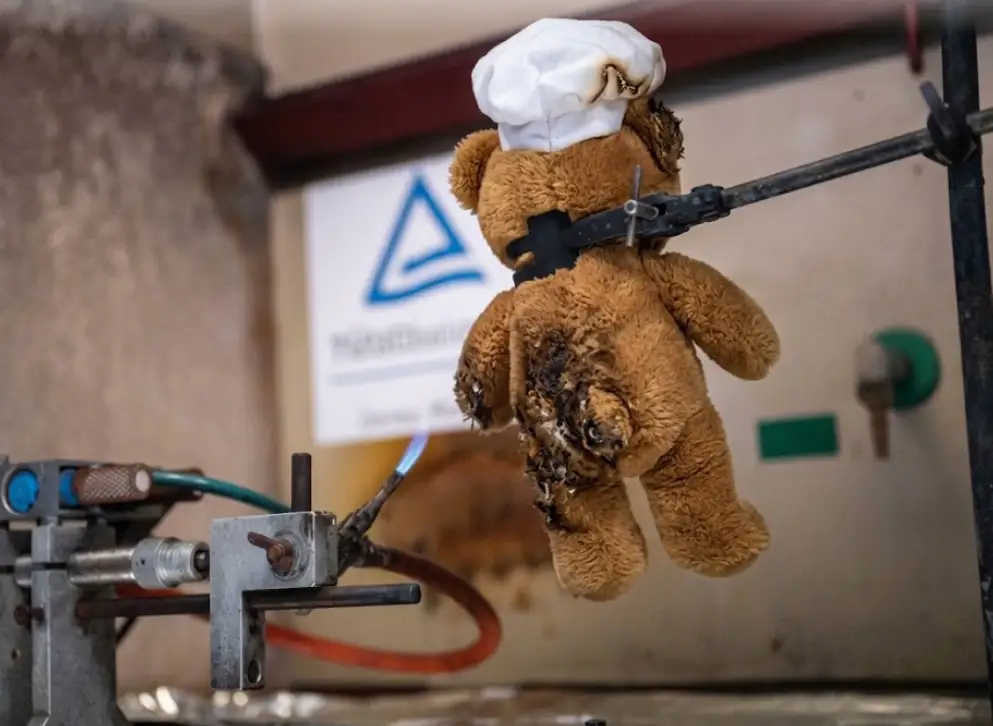
EN 71 Part 2: Flammability of Stuffed Toys
EN 71 Part 2 classifies soft, stuffed, and pliable toys — including all standard plush toys — as requiring flammability testing. The standard defines specific test methods for fabric surface flammability and for the burning behaviour of filling materials. Under EN 71 Part 2, a plush toy fabric must not ignite in a manner that causes flame to spread beyond a defined distance within a defined time. Additionally, the filling material must not sustain combustion once an ignition source is removed.
Long-pile plush fabrics present a particular flammability risk because the extended pile surface area increases ignitability. Importers sourcing products with pile heights above 8 mm should specifically request flammability test results, not merely a general declaration of conformity, and should verify that the tested sample reflects the actual pile height and fibre composition of production goods.
US Flammability Requirements: 16 CFR Part 1610 and ASTM F963
In the United States, fabric flammability for children’s sleepwear is governed by 16 CFR Parts 1615 and 1616, but these do not directly apply to most plush toys (which are not sleepwear). General apparel fabric flammability under 16 CFR Part 1610 may apply where plush toys incorporate substantial textile elements marketed as wearable accessories. ASTM F963 Section 4.2 addresses flammability of toy materials directly and requires that materials used in toys meet specific burn rate criteria. Importers should confirm with their testing laboratory which flammability requirements apply to their specific product based on its design and marketing claims.
Important Notice
Flame retardant chemical treatments are not a compliant solution to failing flammability tests in most markets. Many commonly used flame retardant compounds are themselves restricted under REACH, CPSIA, or national chemical regulations. If your plush toy fails initial flammability testing, the correct response is to source an inherently flame-retardant fibre blend or to adjust the pile height and fabric construction — not to apply a chemical finish.
Labelling Requirements, CE Marking, and the Documentation Stack Every Importer Needs
Regulatory compliance for plush toys is not only demonstrated through testing — it must also be communicated through accurate labelling on the product and its packaging, and substantiated through a defined documentation package that importers must maintain and, in some markets, make available to authorities on request.
CE Marking for the European Union
The CE mark is the visible declaration that a toy complies with the EU Toy Safety Directive (2009/48/EC) and applicable harmonised standards (principally EN 71). Crucially, CE marking is the legal responsibility of the importer (or the EU-established responsible person) when the product is manufactured outside the EU. Affixing a CE mark without the underlying technical documentation constitutes a serious legal violation, carrying potential criminal liability in some EU member states.
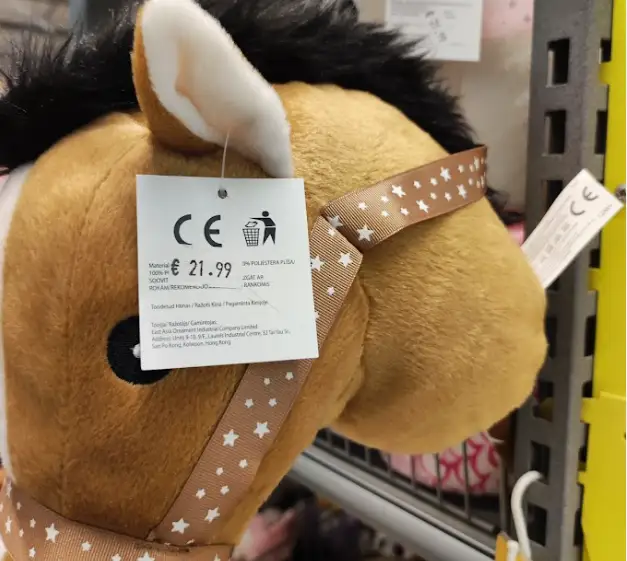
To lawfully CE-mark a plush toy, the importer must: complete a conformity assessment demonstrating compliance with all applicable EN 71 parts; compile a Technical File containing the product description, design drawings, test reports, and risk assessment; issue a Declaration of Conformity (DoC) signed by an authorised representative; and affix the CE mark visibly and legibly to the product or its packaging. The Technical File must be retained for at least 10 years from the date the toy is placed on the market.
UKCA Marking for Great Britain
Following the UK’s departure from the European Union, products placed on the market in Great Britain (England, Scotland, and Wales) must carry the UKCA mark rather than CE from 1 January 2025. The UKCA marking process closely mirrors CE marking but requires a separate UK Declaration of Conformity referencing designated UK standards, and a UK-established responsible person if the manufacturer is based outside Great Britain. Northern Ireland has different requirements and continues to accept CE marking under the Windsor Framework.
Product Labelling Content Requirements
Beyond regulatory marks, plush toy labelling must communicate specific information mandated by market regulations. This includes the importer’s name and address (EU/UK), age warning symbols and text, fibre content declarations for textile articles, care instructions, and country of origin. In Canada, all mandatory warnings and instructions must appear in both English and French. In Australia, warning labels must meet the prescribed format and wording set out in the relevant consumer product safety standard.
Documentation Tip
Build your Technical File template before your first production run begins, not after. Include placeholder sections for: product description, technical drawings with dimensions, bill of materials (with fabric composition and GSM), EN 71 / ASTM test reports, Declaration of Conformity, risk assessment, and QC inspection reports. A completed Technical File structure makes each subsequent product faster to document and dramatically reduces preparation time if a market surveillance authority requests your file.
Mandatory Labelling and Documentation Requirements by Market for Plush Toy Importers
| Requirement | EU | US | UK | Australia | Canada |
|---|---|---|---|---|---|
| Regulatory mark | CE Mark | CPC + Tracking Label | UKCA Mark | No specific mark | No specific mark |
| Importer name & address | Required | Required | Required | Recommended | Required |
| Age warning (e.g., “Not suitable for children under 3 years”) | Required | Required | Required | Required | Required |
| Fibre content declaration | Required (EU Textile Regulation) | Required (Textile Fiber Products Identification Act) | Required | Not mandatory for toys | Required |
| Country of origin | Recommended; required by some member states | Required (CBP) | Required | Recommended | Required |
| Declaration of Conformity | Required (on file) | CPC required | Required (on file) | Not mandatory | Not mandatory |
| Third-party test reports | Required (for all toys) | Required (CPSC-accepted lab) | Required | Strongly recommended | Strongly recommended |
| Bilingual labelling | Local language required in country of sale | English only (federal) | English | English | English and French |
Choosing Accredited Testing Laboratories and Managing Pre-Shipment Inspection
Third-party laboratory testing is the evidentiary backbone of plush toy compliance. A Declaration of Conformity without supporting test reports from an accredited laboratory has no regulatory validity in the EU, UK, or US markets. Selecting the right laboratory partner and managing the testing timeline efficiently is a critical operational competency for plush toy importers.
What Accreditation to Require From Your Testing Lab
All third-party testing laboratories used for toy compliance testing must be accredited to ISO/IEC 17025 — the international standard for testing and calibration laboratory competence. In the United States, laboratories conducting testing for CPSIA compliance must additionally be accepted by the CPSC. The CPSC publishes and maintains a searchable database of accepted third-party laboratories on its official website. In the EU, while there is no mandatory accreditation scheme for all EN 71 testing, accreditation to ISO/IEC 17025 by a national accreditation body (such as UKAS in the UK or DAkkS in Germany) is the recognised standard.
Managing Testing Timelines to Avoid Shipment Delays
Testing lead times at major accredited laboratories typically run 10–20 working days for a standard plush toy test package (EN 71 Parts 1, 2, 3, plus REACH screening). Express testing services are available at premium rates but add cost. Importers who submit samples for testing only after pre-production samples are approved — rather than building testing into the pre-production approval process — routinely experience shipment delays waiting for test reports. The solution is to initiate laboratory testing on the pre-production sample simultaneously with the factory’s own QC review, so that test reports and sample approval arrive concurrently.
Testing Strategy Tip
Establish a standing account relationship with your preferred accredited laboratory at the start of each sourcing season. Labs that know your product range can provide faster turnaround, standing test protocols tailored to your product type, and proactive notifications when relevant standards are updated. Ad hoc testing requests from new clients consistently receive lower prioritisation during peak seasons (Q3 and early Q4) when volume is highest.
Pre-Shipment Inspection: What to Check Beyond Compliance Documents
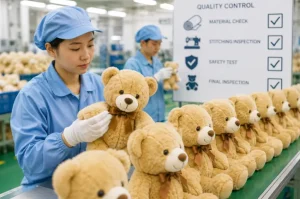
Pre-shipment inspection (PSI) conducted by a qualified third-party inspection agency provides a physical verification that production goods match the approved sample, labelling is correctly applied, and no obvious quality or compliance deviations have occurred during manufacturing. For plush toys, a rigorous PSI should include: visual and dimensional comparison against the golden sample; random pull-force testing of attached components; label content and placement verification; carton marking and shipping document review; and a random check that the correct stuffing material (type and density) has been used. AQL (Acceptable Quality Level) sampling standards — typically AQL 2.5 for major defects and AQL 4.0 for minor defects — should be specified in the inspection instructions.
Inspection Tip
Never use the same entity for both factory quality control and third-party pre-shipment inspection. Factory QC serves the factory’s interests; independent PSI serves yours. Specify in your purchase contract that pre-shipment inspection is a condition of payment release, and that the inspection will be conducted by an independent agency of your choice at a date and time selected by you, not pre-announced to the factory more than 24 hours in advance.
Recommended Plush Toy Testing Package by Target Market
| Test Area | Standard Referenced | Required For | Typical Turnaround |
|---|---|---|---|
| Mechanical & physical safety | EN 71-1 / ASTM F963 | EU, UK, US, AU, CA | 10–15 working days |
| Flammability | EN 71-2 / ASTM F963 §4.2 | EU, UK, US, AU | 5–10 working days |
| Chemical migration (heavy metals) | EN 71-3 | EU, UK | 10–15 working days |
| REACH SVHC screening | REACH Regulation (EC) 1907/2006 | EU, UK | 15–20 working days |
| Phthalates | CPSIA / REACH Annex XVII | US, EU, UK | 7–12 working days |
| Lead content (total) | CPSIA / CPSC | US (mandatory for children’s products) | 5–10 working days |
| Azo dyes | REACH Annex XVII / EN ISO 14362 | EU, UK | 10–15 working days |
| Formaldehyde (textile) | EN ISO 14184 / Oeko-Tex Standard 100 | EU (recommended); Oeko-Tex certification | 7–12 working days |
| Colour fastness | ISO 105 series | EU, UK (recommended); retail buyer requirements | 5–10 working days |
| Noise/sound levels | EN 71-1 §4.21 / AS/NZS 8124 | Products with built-in sound; EU, AU | 5–8 working days |
Plush Toy Compliance for Importers: Key Questions Answered
What is the difference between EN 71 and ASTM F963, and do I need to comply with both?
EN 71 is the European harmonised toy safety standard, published by the European Committee for Standardisation (CEN) and referenced under the EU Toy Safety Directive. ASTM F963 is the American toy safety standard, published by ASTM International and referenced under US CPSIA (Consumer Product Safety Improvement Act) regulations. The two standards address similar hazard categories — mechanical safety, flammability, and chemical restrictions — but differ in specific test methods, threshold values, and procedural requirements. They are not interchangeable: EN 71 compliance does not automatically satisfy ASTM F963 requirements, and vice versa. If you intend to sell in both EU and US markets, you must obtain separate test certifications against each standard. Many importers commission both test packages simultaneously on the same sample to minimise cost and timeline.
As an importer based outside the EU, am I responsible for CE marking my plush toys?
Yes. Under the EU Toy Safety Directive (2009/48/EC), if you import toys into the EU from a manufacturer located outside the EU, you take on the legal obligations of the responsible person. This means you are legally responsible for ensuring the toy complies with all applicable requirements, compiling and maintaining the Technical File, issuing the Declaration of Conformity, and affixing the CE mark. If you do not have an established entity within the EU, you must appoint an EU-based authorised representative who can fulfil these obligations on your behalf. Selling CE-marked toys into the EU without the required documentation constitutes a serious legal violation and can result in market withdrawal orders, fines, and reputational damage.
How often do I need to retest my plush toys once they have passed compliance testing?
Retesting is required whenever there is a material change to any aspect of the product that could affect compliance — including changes to fabric composition, supplier, dye batch, filling material, plastic component supplier, or construction method. Beyond change-triggered retesting, it is best practice to retest products on a defined schedule (typically annually for ongoing product lines) to account for changes in the SVHC candidate list, updates to underlying standards, and batch-to-batch variation in materials. In the US, CPSIA requires importers to maintain a testing programme for children’s products. If a standard is updated or revised (for example, EN 71-3 was significantly revised in 2013 and again subsequently), products must be re-evaluated against the new version before being placed on the market.
What is Oeko-Tex Standard 100, and should my plush toys have it?
Oeko-Tex Standard 100 is a globally recognised independent certification system for textiles, certifying that every component of a textile product — including fabric, thread, filling, and accessories — has been tested for harmful substances and found to be harmless to human health. For plush toys, Oeko-Tex Standard 100 certification (specifically Product Class I, applicable to articles for babies and young children) signals a premium level of chemical safety that goes beyond the mandatory minimum required by EN 71 or CPSIA. While Oeko-Tex certification is not legally mandatory in any major market, it is increasingly required by premium retailers as a condition of listing, and is highly valued by parents in the infant and toddler toy segment. Obtaining Oeko-Tex certification on your core fabric and filling materials is a worthwhile investment if your target market is quality-conscious parents or ethical retail channels.
Can my factory’s test reports be used for compliance, or do I need my own?
In most cases, factory-commissioned test reports can be used for compliance purposes, provided they meet all other requirements: conducted by an accredited laboratory (ISO/IEC 17025; CPSC-accepted for the US market), referencing the correct standards and versions, covering all required test parameters, and clearly identifying the product tested by description, material composition, and relevant identifiers. However, there is a significant practical risk in relying solely on factory-provided test reports: you cannot independently verify that the sample tested matches your actual production goods, or that the laboratory relationship is genuinely arm’s length. Many importers commission their own parallel test on a sample retained from the pre-production approval, using a laboratory of their own selection. This provides an independent assurance layer and protects the importer’s legal position if a compliance dispute arises.
What happens if my plush toys are detained at customs for compliance reasons?
A customs detention for compliance concerns can have several outcomes depending on the market and the nature of the issue. In the US, Customs and Border Protection (CBP) may detain a shipment while requesting documentation (test reports, CPC, country of origin evidence). If documentation is provided and satisfies the inquiry, the shipment is typically released. If the product is found non-compliant, CBP can order the shipment refused entry and returned to the country of origin, or destroyed at the importer’s expense. In the EU, national customs authorities can refer detained products to market surveillance authorities, which may conduct their own testing and issue mandatory withdrawal orders. The financial and reputational cost of a border detention — demurrage charges, potential destruction of goods, retailer contract penalties for late delivery — significantly exceeds the cost of pre-shipment compliance testing. A complete and organised documentation package that can be transmitted electronically within hours is the most effective tool for resolving a detention quickly.
Are promotional plush toys and branded merchandise subject to the same compliance requirements as retail toys?
Yes, in virtually all major markets. Promotional plush toys — items distributed as gifts with purchase, event giveaways, or marketing premiums — are classified as toys if they are clearly intended for use in play by children, regardless of whether they are sold through traditional retail channels or distributed free of charge. The EU Toy Safety Directive applies to toys placed on the EU market, regardless of the commercial mechanism by which they reach the consumer. Similarly, CPSIA in the US applies to all children’s products, including those distributed as promotional items. The common misconception that promotional goods are exempt from toy safety requirements has resulted in numerous enforcement actions and product recalls. Always apply the same compliance standard to promotional plush toys as you would to retail products.