Skip to content
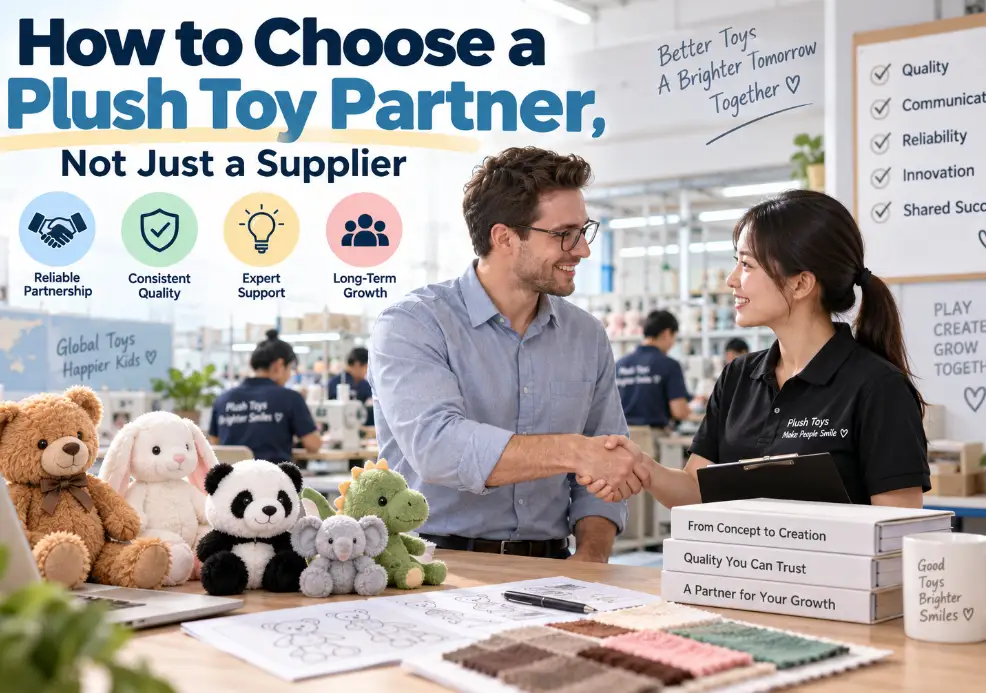
Choosing the right How to Choose a Plush Toy Partner means finding a reliable manufacturer who offers consistent quality, clear communication, flexible production, and long-term support.
Most plush toy sourcing decisions are made the same way: a buyer sends a brief to several factories, receives quotes and sample photos back, and selects based on some combination of price, sample quality, and gut feeling about responsiveness during the inquiry stage. This process is fast, familiar, and almost entirely blind to the single factor that determines whether a sourcing relationship actually succeeds over multiple orders — whether the factory on the other end is capable of functioning as a partner rather than a transaction.
The distinction matters more in plush toy manufacturing than in many other product categories, because plush toys are development-intensive products. Every new design requires pattern-making judgment, material selection expertise, and iterative sampling that a purely transactional factory — one optimized to quote fast and produce whatever specification is handed to it — is structurally unequipped to support well. Buyers who select suppliers on first-order metrics like unit price and initial responsiveness frequently discover, somewhere around the second or third design revision, that they have chosen a factory that can produce plush toys but cannot help them develop good ones.
This guide lays out how to tell the difference between a plush toy supplier and a plush toy partner before committing to a relationship — what capabilities and behaviors actually distinguish the two, what to look for during evaluation, and how to build a structured assessment that reveals partnership potential rather than just price competitiveness.
Why Does the Distinction Between a Supplier and a Partner Matter in Plush Toy Sourcing?
A supplier fulfills a specification. A partner helps define the right specification in the first place, flags problems before they become expensive, and treats the buyer’s commercial success as connected to their own. This is not a sentimental distinction — it produces measurably different outcomes across the lifecycle of a plush toy product line.
The distinction matters because plush toy development is rarely a single clean transaction. A new design typically requires two to four sampling rounds before it is production-ready, ongoing quality management across every production run, responsiveness when compliance requirements shift, and often multiple product lines developed over years rather than one order placed once. A relationship built on a transactional foundation accumulates friction at every one of these touchpoints — friction that a genuine partnership resolves faster and at lower cost.
Supplier Relationship vs. Partner Relationship: Practical Differences Over Time
| Situation | Transactional Supplier Behavior | Manufacturing Partner Behavior |
|---|---|---|
| Design has an unclear specification | Guesses or quotes the cheapest interpretation | Asks clarifying questions before quoting |
| Sample doesn’t match approved reference | Reships with minimal explanation | Explains the discrepancy and how it will be corrected |
| Compliance requirement changes | Waits for the buyer to raise it | Proactively flags the change and its cost impact |
| Production hits a quality issue | Minimizes or delays disclosure | Discloses early with a corrective plan |
| Buyer’s order volume drops for a season | Deprioritizes without communication | Communicates capacity implications directly |
The Compounding Cost of Choosing Wrong
The cost of choosing a transactional supplier when a partner was needed does not show up as a single bad invoice — it compounds across every subsequent interaction. Extra sampling rounds, quality disputes that consume management time, compliance gaps discovered late, and a communication style that requires constant follow-up all add friction costs that are invisible in the unit price comparison but very visible in the buyer’s total time and stress investment over a year of working together.
What Separates a Transactional Supplier From a True Manufacturing Partner?
The differences between a transactional supplier and a genuine partner are visible well before the first production order, if a buyer knows what to look for during the evaluation stage. They show up in how a factory responds to ambiguity, how it discusses its own limitations, and how much initiative it takes without being asked.
Willingness to Say No or Flag a Problem
One of the clearest partnership signals is a factory’s willingness to tell a buyer something they do not want to hear — that a requested material is not compliant for the target market, that a design element is likely to fail durability testing, that a timeline is unrealistic given current capacity. Transactional suppliers tend to agree to whatever is asked in order to win the order, deferring the consequences of an unrealistic request to a later stage when it becomes the buyer’s problem to solve. Partners raise the issue at the point where it is cheapest to fix — before the order is confirmed.
Depth of Questions Asked During the Inquiry Stage
The quality and specificity of the questions a factory asks in response to an initial inquiry is a strong early indicator of its development orientation. A factory that responds to a design brief with a unit price and nothing else is signaling that it treats the inquiry as a quoting exercise. A factory that responds with questions about intended use, target market compliance requirements, expected order volume pattern, and specific construction preferences is signaling that it treats the inquiry as the beginning of a development process.
Tip: Pay close attention to the very first email or message a factory sends back after receiving your design brief. A reply that only contains a price and a delivery estimate is a transactional signal. A reply that asks two or three specific, relevant questions about your product or market is a development signal — and it is one of the fastest, lowest-cost evaluation signals available before any sample has even been produced.
How Should Buyers Evaluate a Plush Toy Factory’s Development Capability?
Development capability — the ability to take a rough concept, sketch, or reference image and turn it into an accurate, production-ready pattern — is the single most partnership-defining capability in plush toy manufacturing, because it is where the largest quality and cost variance between factories actually originates.
Pattern-Making Expertise as the Foundation
Plush toy pattern-making is a specialized skill distinct from general garment or textile pattern work, because it must account for filling behavior, seam placement that survives stuffing pressure, and proportional accuracy that reads correctly at three-dimensional scale from a two-dimensional reference. Factories with dedicated, experienced pattern makers consistently achieve higher first-sample accuracy than factories where pattern work is handled ad hoc by production staff, and this difference is one of the most reliable predictors of how many sampling rounds a new design will require.
Signals of Strong vs. Weak Development Capability
| Evaluation Area | Strong Development Capability | Weak Development Capability |
|---|---|---|
| Pattern-making team | Dedicated, experienced pattern makers | Production staff handle patterns as a side task |
| First-sample accuracy | Close match to reference on first attempt | Multiple rounds needed to approach reference |
| Material recommendation | Proactively suggests alternatives with trade-offs explained | Uses whatever is on hand without discussion |
| Design feasibility feedback | Flags construction risks before sampling begins | Attempts the design as specified without comment |
| Sample documentation | Provides clear notes on what changed between rounds | Ships revised samples with no explanation |
Material Knowledge and Proactive Recommendation
A factory with genuine development capability does not simply execute a material specification handed to it — it applies its own material knowledge to suggest alternatives when the buyer’s initial specification is unavailable, non-compliant, or suboptimal for the intended use, and explains the trade-offs of each alternative clearly enough for the buyer to make an informed decision. This proactive material guidance is a strong indicator of a factory that has invested in genuine textile and filling expertise rather than simply sourcing whatever a buyer names.
How to Test Development Capability Before Committing to a Full Order
The most reliable way to evaluate development capability is to commission a paid sample of a design with some genuine complexity — not a simple, generic shape that any factory could execute well, but a design with at least one element that requires real pattern-making judgment, such as an asymmetrical pose, a layered accessory, or a proportion that is easy to get visually wrong. The quality of the first sample, the specificity of the factory’s questions before producing it, and the clarity of communication around any needed revisions together provide a much more reliable capability signal than any conversation about capability in the abstract.

Design Iteration Speed as a Related but Distinct Signal
Beyond first-sample accuracy, the speed and clarity with which a factory turns around a requested revision is its own valuable signal. A factory with strong development capability typically explains precisely what changed between sample rounds — which seam was adjusted, which filling density was modified, which proportion was corrected — rather than simply shipping a new sample and leaving the buyer to compare it against the previous version unaided. This documentation habit reduces the total number of rounds needed to reach an approved sample, because each round builds on a clearly understood starting point rather than requiring the buyer to re-diagnose what changed and what still needs work.
A useful practice during evaluation is to ask the factory to send a short written note alongside any revised sample, listing exactly what was changed from the previous round. Factories with strong development discipline will already do this without being asked. Those that need to be prompted every time, or that respond with a vague summary rather than specifics, are revealing a documentation gap that will slow down every future development cycle, not just the current one.
What Does Strong Quality Control Culture Look Like in a Potential Partner?
Quality control culture is different from a quality control system. Many factories can describe an inspection process, an AQL standard, and a checklist. Far fewer have a culture where quality issues are surfaced honestly, addressed structurally, and treated as information rather than as something to hide from the buyer.
Inspection Infrastructure as a Baseline, Not a Differentiator
Most established plush toy factories can describe some form of in-line and final inspection process, often referencing recognized AQL sampling standards. This baseline infrastructure is necessary but not sufficient to differentiate a true quality culture — the differentiator is what happens when inspection finds a problem, and how transparently that problem is communicated to the buyer.
Distinguishing Quality Control Infrastructure From Quality Control Culture
| Dimension | Infrastructure Question | Culture Question |
|---|---|---|
| Inspection process | Does an inspection process exist? | Are findings reported honestly, including failures? |
| Defect handling | Is there a rework process? | Is rework root-caused or just patched? |
| Documentation | Are inspection reports generated? | Are reports shared proactively or only on request? |
| Repeat defects | Is there a corrective action process on paper? | Do the same defects recur across orders? |
Root-Cause Orientation vs. Symptom Patching
A factory with a genuine quality culture treats a recurring defect as a signal to investigate and correct the underlying process cause — a machine calibration issue, a supplier material inconsistency, an operator training gap. A factory without this orientation treats each defect occurrence as an isolated event to be reworked, without the underlying cause ever being addressed, which produces a pattern where the same type of defect resurfaces across multiple production runs despite repeated promises that it has been fixed.
Tip: During factory evaluation, ask directly: “Tell me about a quality issue you found in your own production recently, and what you did about it.” A factory confident in its quality culture will answer this specifically and without defensiveness — naming the actual issue and the corrective action taken. A factory that responds vaguely, claims it never has quality issues, or becomes visibly uncomfortable with the question is revealing more about its quality culture than any inspection report could.
Third-Party Inspection Compatibility
A factory’s attitude toward third-party inspection arranged by the buyer is a strong and low-cost signal of quality culture. Factories confident in their own quality standards generally accommodate third-party inspectors without friction, because an inspection confirming good quality is free reputational reinforcement. Factories that resist, delay, or attempt to restrict a buyer’s access for third-party inspection are signaling a quality confidence gap worth investigating before placing a significant order.
How Important Is Communication Style When Choosing a Plush Toy Partner?
Communication style is frequently underweighted in factory evaluation because it feels like a soft, subjective factor compared with price and sample quality. In practice, communication quality has direct commercial consequences, because plush toy development and production both involve a continuous stream of decisions, clarifications, and occasional problems that must be resolved efficiently across a language and time zone gap.
Response Speed vs. Response Quality
Fast responses are often mistaken for good communication, but response speed and response quality are different dimensions that should be evaluated separately. A factory that replies within an hour but with generic, non-specific answers is less valuable as a partner than one that replies within a day with a precise, considered answer that actually addresses the question asked. The ideal partner combines reasonable response speed with genuine substance — but when the two must be traded off, substance is the more important factor for a development-intensive product like plush toys.
Communication Signals Worth Evaluating Before Order Commitment
| Communication Signal | What It Reveals |
|---|---|
| Answers the specific question asked, not a generic version of it | Attentiveness and genuine understanding of the request |
| Proactively flags issues rather than waiting to be asked | Partnership orientation vs. reactive order-taking |
| Provides written confirmation of verbal or chat agreements | Process discipline and reduced miscommunication risk |
| Consistent point of contact across the relationship | Organizational stability and accountability |
| Comfortable delivering unwelcome information | Honesty under pressure, a key partnership trait |
The Value of a Consistent, Named Point of Contact
Factories that route buyer communication through a single, consistent contact — rather than a rotating cast of sales staff or a shared inbox handled by whoever is available — consistently produce fewer miscommunications and faster issue resolution, because that contact accumulates institutional knowledge about the buyer’s specific requirements, past issues, and preferences over time. A factory that cannot maintain this consistency, particularly as an order relationship grows, is signaling an organizational structure not built around relationship continuity.
Language Fluency vs. Communication Clarity
Buyers sometimes conflate strong English fluency with strong communication, but these are not the same thing. A contact with moderate English proficiency who consistently confirms understanding, asks for clarification when something is ambiguous, and follows up written agreements with a summary is a more reliable communicator than a highly fluent contact who answers quickly but frequently misses the substance of what was actually asked. When evaluating communication quality, buyers should weigh accuracy and confirmation habits at least as heavily as fluency, since it is miscommunication about substance — not imperfect grammar — that actually causes costly production errors.
Tip: Send a moderately complex, multi-part request during the evaluation stage — for example, a message covering a material substitution, a labeling change, and a delivery date question in the same email — and see whether the factory’s reply addresses all three parts specifically or only responds to one and ignores the rest. This single test reveals more about a contact’s real communication reliability than weeks of simple back-and-forth on straightforward questions.
How Should Buyers Assess a Factory’s Compliance and Risk Management Maturity?
Compliance maturity is one of the most concrete, verifiable dimensions of partnership potential, because it can be assessed through documentation and track record rather than relying purely on impression or conversation quality.
Proactive vs. Reactive Compliance Posture
A mature compliance posture means a factory understands the regulatory requirements of the markets it ships to without needing the buyer to specify every applicable standard, and flags compliance implications of a design or material choice before the buyer has to ask. A reactive compliance posture means the factory only addresses compliance requirements when explicitly instructed, and treats compliance as the buyer’s responsibility to define and manage rather than a shared area of expertise.

Compliance Maturity Indicators During Factory Evaluation
| Indicator | Mature Compliance Posture | Immature Compliance Posture |
|---|---|---|
| Standards knowledge | References relevant standards unprompted (ASTM F963, EN71, CPSIA) | Only responds when standard is named by buyer |
| Documentation availability | Test reports and certificates readily available on request | Documentation delayed, incomplete, or unavailable |
| Material sourcing | Uses certified material suppliers with traceable documentation | Material origin and certification unclear |
| Regulatory change awareness | Proactively flags known upcoming regulatory changes | Unaware of or silent on regulatory developments |
Reviewing Actual Compliance Documentation, Not Just Claims
Verbal assurances about compliance capability are not a substitute for reviewing actual documentation — recent test reports for comparable products, material certification records, and evidence of the factory’s internal compliance process. Buyers evaluating a new factory relationship should request sample compliance documentation from a comparable existing product before placing a first order, since the willingness and speed with which this is provided is itself informative, independent of the documentation’s content.
Tip: Ask a prospective factory to walk you through what happens internally, step by step, when a new regulatory requirement is announced for one of their key export markets. A mature, partnership-oriented factory will describe an actual internal process — who monitors regulatory changes, how affected products are identified, how clients are notified. A factory with no clear answer to this question is likely handling compliance reactively, order by order, rather than as a managed organizational capability.
What Role Does Production Capacity and Flexibility Play in Partner Selection?
Capacity and flexibility determine whether a factory can grow with a buyer’s business over time, or whether it will become a bottleneck the moment order volumes increase, seasonal demand spikes, or a buyer needs to adjust an order after production has begun.
Understanding a Factory’s Current Capacity Utilization
A factory’s current capacity utilization — how much of its available production capacity is already committed to existing clients — is one of the most useful and most commonly overlooked pieces of information in partner evaluation. A factory running near full capacity has little room to absorb a growing buyer’s increasing order volumes, accommodate urgent requests, or manage production complications without pushing back timelines. A factory with meaningful spare capacity has more room to prioritize a developing relationship and respond flexibly to changing needs.
Capacity Considerations for Long-Term Partnership Fit
| Capacity Factor | Why It Matters for Partnership |
|---|---|
| Current utilization rate | Predicts flexibility for growth and urgent requests |
| Seasonal demand pattern | Reveals when the factory is most and least able to prioritize your orders |
| Minimum order quantity trajectory | Shows whether MOQ will scale sensibly as your volume grows |
| Multi-line production capability | Indicates whether the factory can support a growing product catalog |
| Willingness to discuss capacity honestly | A transparency signal that predicts future communication quality |
Flexibility Under Changed Circumstances
Every sourcing relationship eventually encounters a moment where circumstances change after an order is already confirmed — a design revision request, a quantity adjustment, an urgent timeline compression. How a factory responds to these moments, rather than how it performs when everything goes according to the original plan, is often the clearest test of whether it is functioning as a partner. Factories that treat every changed circumstance as a rigid contract violation to be resisted are behaving as suppliers. Factories that engage constructively to find a workable solution — even when the accommodation has a real cost — are behaving as partners.
Subcontracting Transparency
Many plush toy factories subcontract certain processes — specialized embroidery, electronic component assembly for interactive plush, or overflow production during peak demand — to other workshops rather than performing every step in-house. This is a normal and often reasonable practice, but it becomes a risk factor when it is not disclosed. A factory that is transparent about which elements of an order are subcontracted, and that maintains its own quality oversight over subcontracted work, is behaving as a partner managing its supply chain responsibly. A factory that conceals subcontracting and only reveals it after a quality issue traces back to an unfamiliar workshop is withholding information the buyer needed for an accurate risk assessment from the start.
How Do Pricing Philosophy and Long-Term Value Differ Between Suppliers and Partners?
Pricing philosophy is one of the more subtle but consequential differences between transactional suppliers and genuine partners, because it shapes the incentive structure underlying every future interaction in the relationship.
Race-to-the-Bottom Pricing vs. Value-Based Pricing
A transactional supplier’s pricing strategy is typically built around winning the initial order at the lowest possible headline price, with margin recovered through quality shortcuts, scope narrowing, or aggressive upselling once the relationship is established. A genuine partner’s pricing reflects the actual cost of the quality, compliance, and development support being provided, and is generally more stable and predictable across the life of the relationship because it is not built on an initial underpricing strategy that must be corrected later.
Pricing Philosophy Signals During Evaluation
| Signal | Supplier-Oriented Pricing | Partner-Oriented Pricing |
|---|---|---|
| Initial quote relative to market | Notably below typical market range with no clear reason | Consistent with market range, with rationale if it differs |
| Price stability over time | Increases sharply after the relationship is established | Adjusts predictably with material cost or scope changes |
| Transparency on cost breakdown | Resists itemizing cost components | Willing to explain what drives the price |
| Handling of scope changes | Uses changes as an opportunity to renegotiate unfavorably | Quotes changes fairly against the original basis |
Why an Unusually Low First Quote Deserves Scrutiny, Not Celebration
A quote significantly below the range offered by comparable factories should prompt investigation rather than immediate acceptance, because it typically signals one of a small number of underlying realities — a lower material or compliance standard than assumed, a factory that is undercosting the true expense of the order and will recover it later through quality shortcuts or price increases, or a genuine efficiency advantage that is worth understanding and verifying rather than simply accepting at face value. Buyers who treat the lowest quote as automatically the best decision are the ones most likely to discover, several orders into the relationship, that the low price was never sustainable in the first place.

Payment Terms as a Partnership Signal
The payment terms a factory proposes, and its willingness to discuss them, are also informative beyond their direct cash flow impact. A factory that insists on rigid, non-negotiable terms regardless of order history or relationship length is treating every transaction as isolated and low-trust. A factory that is willing to adjust deposit percentages or extend more favorable terms as a relationship matures and demonstrates reliable payment history is signaling that it views the relationship as cumulative — where trust built over time translates into concrete commercial flexibility rather than being reset with every new purchase order.
Tip: Ask a prospective factory directly whether payment terms can evolve as order history builds, and listen for whether the answer describes an actual policy or simply defers the question indefinitely. A factory with a genuine graduated terms structure — for established clients with a track record — is one more piece of evidence that it is organized around long-term relationships rather than treating every order as a one-off negotiation.
What Questions Should Buyers Ask During Factory Evaluation to Reveal Partnership Potential?
The right evaluation questions are designed to surface behavior and reasoning, not just capability claims. Generic questions like “do you have a quality control system?” invite generic, uninformative answers. Specific, scenario-based questions produce far more diagnostic responses.
Diagnostic Questions for Evaluating Plush Toy Partnership Potential
| Question | What a Strong Answer Reveals |
|---|---|
| What would you change about this design before sampling it? | Development judgment and willingness to offer honest feedback |
| Tell me about a client relationship where something went wrong. | Honesty and problem-resolution orientation |
| What is your current production capacity utilization? | Transparency and realistic flexibility expectations |
| How do you handle a design that fails compliance testing? | Compliance maturity and corrective process discipline |
| Can I speak with an existing client as a reference? | Confidence in relationship quality and willingness to be verified |
| How would you handle an urgent quantity increase mid-production? | Flexibility and operational problem-solving capability |
Why Reference Checks Are Underused and Highly Informative
Speaking directly with a factory’s existing clients is one of the most informative and most underused steps in plush toy partner evaluation. Reference conversations reveal information that no amount of direct factory communication can substitute for — actual sampling round counts on past projects, actual on-time delivery performance, and how the factory behaved during a real quality dispute or timeline pressure situation. Factories confident in their client relationships generally accommodate reasonable reference requests without hesitation.
Tip: When speaking with a factory’s reference client, ask specifically about the worst experience they have had with that factory, not just the best. Every long-term manufacturing relationship has encountered at least one real problem — a delay, a quality dispute, a miscommunication. How the factory responded to that specific problem is far more revealing of true partnership potential than a general satisfaction rating, because it shows behavior under pressure rather than performance under ideal conditions.
How to Build a Structured Evaluation Framework for Choosing a Plush Toy Partner?
Bringing together every dimension covered in this guide into a single structured framework allows buyers to compare prospective factories on partnership potential systematically, rather than relying on impression or price alone.
Plush Toy Partner Evaluation Scorecard Framework
| Evaluation Dimension | What to Assess | Weight Recommendation |
|---|---|---|
| Development capability | Pattern-making skill, first-sample accuracy, material knowledge | High |
| Quality control culture | Root-cause orientation, transparency about defects | High |
| Communication quality | Substance, proactivity, consistency of contact | High |
| Compliance maturity | Standards knowledge, documentation readiness | High |
| Capacity and flexibility | Utilization rate, responsiveness to changed circumstances | Medium |
| Pricing philosophy | Market consistency, transparency, stability over time | Medium |
| Reference feedback | Verified performance and problem-handling history | High |
Scoring Prospective Factories Consistently
Applying a consistent scoring approach — even a simple one-to-five scale across each dimension — across every factory under evaluation prevents the common failure mode where a buyer’s assessment is dominated by whichever factor was most memorable in a given conversation, such as an unusually fast initial reply or an unusually polished sample photo. A structured scorecard forces equal consideration of dimensions that are easy to overlook, such as compliance maturity or capacity utilization, alongside the more visible dimensions like sample quality and price.
Weighting the Framework to the Buyer’s Specific Situation
Not every dimension carries equal importance for every buyer. A buyer developing a complex, accessory-heavy design line should weight development capability and quality control culture especially heavily. A buyer planning rapid volume growth should weight capacity and flexibility more heavily than a buyer planning a single, stable order size. Adjusting the framework’s weighting to reflect the buyer’s actual sourcing situation, rather than applying a generic weighting scheme, produces a more useful final comparison across prospective factories.

Conclusion
Choosing a plush toy manufacturer on unit price and sample photos alone answers a narrower question than most buyers realize — it identifies who can produce a single order competitively, not who can support a growing, evolving product line over years of development, quality management, and changing market requirements. The distinction between a supplier and a partner is visible well before a first production order, in the depth of questions a factory asks, its honesty about problems, its compliance posture, and how it behaves when circumstances change.
Buyers who build a structured evaluation around these dimensions — rather than relying on price and first impressions — consistently end up in sourcing relationships that get easier and more valuable over time rather than more frustrating. At Ken Wang Toys, this partnership orientation is treated as the actual product being offered alongside the plush toys themselves, because a factory that only knows how to fulfill an order is fundamentally a different kind of business than one built to grow alongside its clients.
Frequently Asked Questions
Q1: How long does it typically take to determine whether a factory is a true partner rather than just a transactional supplier?
Some signals are visible immediately — the depth of questions asked at the inquiry stage, the specificity of the first quotation, and the tone of early communication. But a full assessment of partnership potential generally requires observing the factory through at least one complete development and production cycle, including how it handles a sample revision, how it communicates a quality issue if one occurs, and how it responds when the buyer needs to adjust something mid-process. Reference checks with existing clients can compress this timeline significantly, since they provide insight into behavior across multiple past cycles without the buyer needing to experience each one directly.
Q2: Is it reasonable to expect partnership-level behavior from a factory on a small first order?
Yes, though expectations should be calibrated to what a small first order can reasonably reveal. A factory does not need a large order to demonstrate genuine development engagement, honest communication, and compliance attentiveness — these behaviors are visible at any order size. What a small first order cannot fully reveal is how the factory handles the pressures of scale, such as managing multiple simultaneous production lines or accommodating rapid volume growth. Buyers should treat a small first order as a genuine evaluation opportunity for behavioral signals, while recognizing that some capacity-related questions require a larger order history to answer with confidence.
Q3: Should buyers avoid factories that push back on unrealistic requests, or does that indicate a difficult working relationship?
A factory that pushes back on a genuinely unrealistic request — an unworkable timeline, a material combination that will not perform as intended, a compliance shortcut that carries real risk — is generally demonstrating exactly the kind of honest, development-oriented behavior that distinguishes a partner from a transactional supplier. The distinction to watch for is how the pushback is delivered: a factory that explains its reasoning clearly and offers an alternative is behaving constructively, while one that is simply rigid or unhelpful without explanation is a different and more concerning signal. Buyers should be more cautious of a factory that agrees to everything without question than one that raises thoughtful objections.
Q4: How many factories should a buyer evaluate in parallel before selecting a long-term partner?
Evaluating three to five factories in parallel is generally sufficient to reveal meaningful differences across the dimensions covered in this guide without making the evaluation process unmanageably time-consuming. Evaluating fewer than three limits the buyer’s ability to identify what is a genuine market norm versus an outlier response, while evaluating significantly more than five tends to produce diminishing returns relative to the time invested, since most of the differentiating information becomes clear well before that many factories have been assessed in depth.
Q5: Can a transactional supplier relationship evolve into a genuine partnership over time, or is this determined from the start?
Relationships can evolve, but evolution generally requires an active decision by both sides rather than happening automatically through repeated orders. A factory that has operated transactionally because that is what the buyer’s own communication and expectations have signaled may genuinely shift toward a more collaborative, proactive style if the buyer begins engaging more like a partner — sharing more context about business goals, asking for input rather than just issuing instructions, and giving direct feedback rather than simply switching suppliers when problems arise. However, some factories are structurally organized around high-volume, low-touch transactional service and are unlikely to shift their operating model regardless of how the buyer engages, which is why the initial evaluation described in this guide remains valuable even when a relationship might theoretically evolve over time.
Q6: What is the single most reliable early indicator of partnership potential if a buyer only has time to evaluate one thing?
If forced to rely on a single indicator, the quality and specificity of the questions a factory asks in response to an initial design brief is among the most reliable and fastest to observe. This single interaction reveals development orientation, attentiveness, and genuine engagement with the buyer’s actual product, all without requiring a sample, a reference call, or an extended evaluation period. It is not a complete substitute for a full evaluation across all the dimensions in this guide, but as a fast initial filter, it is unusually informative relative to how little time it takes to observe.
Q7: How should a buyer weigh a strong evaluation score against a noticeably higher price compared to other candidates?
The evaluation framework in this guide is designed to surface the total value of a relationship, not just its unit price — development efficiency, quality reliability, compliance risk reduction, and communication ease all have real financial value even when they are harder to quantify than a per-unit cost. A factory that scores meaningfully higher across development capability, quality culture, and compliance maturity is likely to produce a lower total cost of ownership over the life of a product line even at a higher unit price, for the same reasons explored in total cost comparison frameworks for plush toy quotes generally. The right approach is to treat a high evaluation score and a higher price as a trade-off to be assessed deliberately against the buyer’s specific risk tolerance and growth plans, rather than defaulting to the lower price without weighing what the evaluation score is actually predicting.