Skip to content
The distinction between OEM and ODM plush toy manufacturing determines who owns the design, who controls the development process, how long it takes to get to market, and what your IP exposure is.
Getting this decision right at the start of a sourcing relationship is one of the most consequential structural choices a buyer makes — yet it is one of the least clearly explained in most industry resources. This guide covers both models in full: what they mean in practice, where each one works best, and what every buyer needs to understand before committing to either path.
What Do OEM and ODM Actually Mean in Plush Toy Sourcing?
OEM and ODM are manufacturing relationship models that describe where design authority sits in the buyer-manufacturer relationship. They are not quality tiers, price tiers, or factory categories — they are contractual and operational frameworks that determine who creates the product design, who owns it, and what role each party plays in the development process.
OEM — Original Equipment Manufacturing — means the buyer provides the design. In a plush toy OEM relationship, the buyer supplies the design brief, technical specifications, character sheets, material requirements, and approval standards. The manufacturer’s role is to execute that design in production: to engineer the pattern, source the specified materials, produce samples for approval, and manufacture the bulk order to the buyer’s defined specification. The design belongs to the buyer. The manufacturer is providing production capability, not creative input.
ODM — Original Design Manufacturing — means the factory provides the design. In a plush toy ODM relationship, the manufacturer has developed its own product catalog — designs, patterns, material specifications, and production standards — and the buyer selects from that catalog, typically with some degree of surface customization: changing colors, adding a brand logo, modifying minor details, or applying custom packaging. The underlying design engineering belongs to the manufacturer. The buyer is purchasing access to a completed design and the right to brand it as their own.
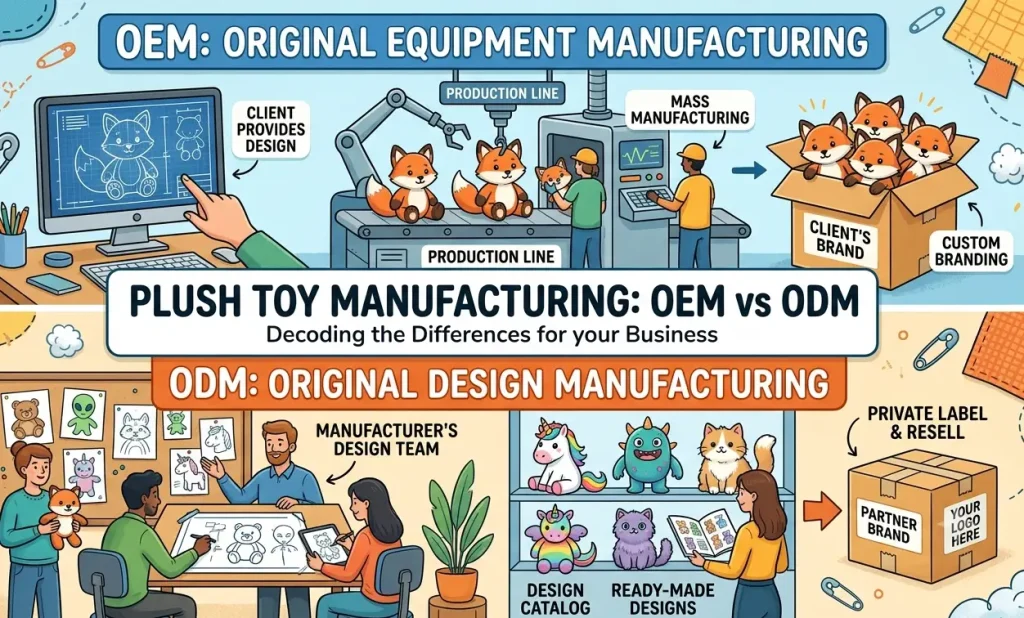
The distinction matters commercially because it determines design exclusivity, development cost, time to market, IP ownership, and what happens when you want to reorder or switch suppliers. Neither model is categorically superior — each is optimal for specific buyer situations — but treating them as interchangeable is one of the most common structural errors in plush toy sourcing.
Core definition comparison: OEM vs ODM plush toy manufacturing
| Dimension | OEM (Original Equipment Manufacturing) | ODM (Original Design Manufacturing) |
|---|---|---|
| Who creates the design | The buyer — provided as a brief, illustration, or technical package | The manufacturer, from its existing catalog or R&D capability |
| Who owns the design | The buyer retains full design IP | The manufacturer owns the underlying design; the buyer may have branding rights |
| Buyer’s role | Design authority — defines every element of the product | Selection and customization — chooses from available options |
| Factory’s role | Production execution — pattern engineering, sampling, bulk production | Design creator and manufacturer — full product development ownership |
| Product exclusivity | High design is unique to the buyer | Limited — same base design may be sold to multiple buyers under different branding |
| Time to first sample | Longer — full pattern development required | Faster — existing patterns used; surface modifications only |
| Development investment | Higher sampling fees, revision rounds, and full design engineering | Lower — limited customization fees on an existing base design |
How OEM and ODM Compare Across the Key Decision Dimensions
Choosing between OEM and ODM requires evaluating the trade-offs across several dimensions simultaneously — not just cost, and not just speed. The decision that makes sense for a buyer launching a licensed character product is different from the one that makes sense for a buyer testing the plush category for the first time. Understanding the full comparison across all relevant dimensions is what allows buyers to make a genuinely informed structural choice.
Detailed OEM vs ODM comparison across commercial and operational dimensions
| Dimension | OEM | ODM | Commercial Implication |
|---|---|---|---|
| Design exclusivity | Full design is unique | Partial — base design may be shared | OEM protects brand differentiation; ODM risks market overlap with competitors using the same base |
| Time to first saleable product | 14–22 weeks are typical for a new design | 6–12 weeks with limited customization | ODM is significantly faster for market entry or seasonal deadlines |
| Sampling and development cost | $200–$800 per design, 1–4 revision rounds | $50–$200 for customization samples | OEM carries a higher upfront development cost; ODM amortizes the factory’s prior investment |
| Minimum order quantity | Typically 500–2,000 units per design | Typically 200–800 units per colorway | ODM often allows entry at a lower volume; OEM MOQ reflects fixed-cost recovery |
| Customization depth | Unlimited — every element specified by the buyer | Limited — surface details, color, logo, packaging | OEM is the only model for precise character reproduction or proprietary design features |
| IP ownership and portability | Buyer owns the design; can switch factories | The factory owns the base design; switching requires redesign | OEM creates supply chain flexibility; ODM creates factory dependency |
| Quality consistency | Defined by buyer spec; consistent if spec is clear | Defined by the factory’s existing standard | OEM requires the buyer to invest in spec quality; ODM inherits the factory’s established quality baseline |
| Compliance responsibility | Buyer specifies; factory executes | The factory typically holds existing test documentation | ODM may offer a faster compliance path if the factory’s existing tests cover the buyer’s market |
The pattern that emerges from this comparison is consistent: OEM offers greater control, greater exclusivity, and greater IP security — at the cost of higher development investment and longer time to market. ODM offers faster access and lower entry cost — at the cost of design exclusivity and factory dependency. The right choice is not the one with the better-looking column; it is the one whose trade-offs align with what the buyer’s specific situation actually requires.
OEM Plush Toy Manufacturing: Design Ownership and the Production Path
In an OEM plush toy relationship, the buyer is the design authority. Everything about the product — the character’s proportions and features, the fabric type and pile height, the filling density, the color specifications, the size, the accessories, the embroidery placement, the safety eye style, the packing format — is defined by the buyer’s brief. The manufacturer’s job is to translate that brief into a production-ready product with accuracy and consistency.
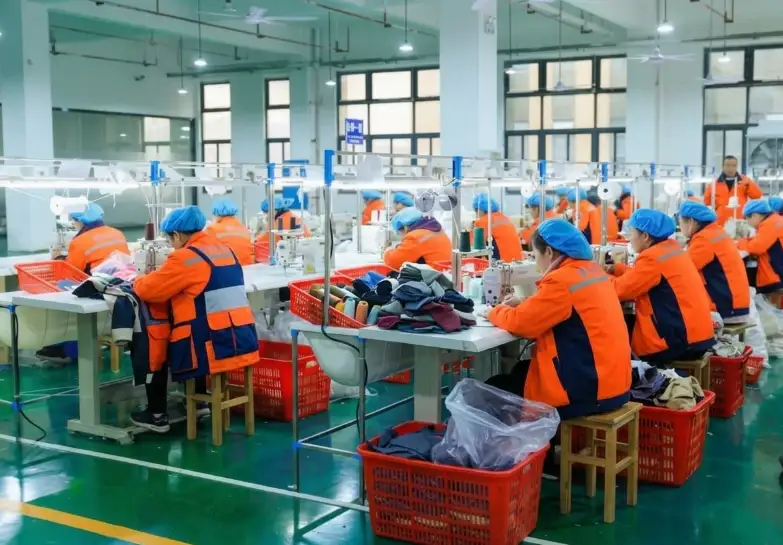
This sounds straightforward, but the execution demands significantly more from the buyer than most first-time OEM buyers anticipate. A design brief that leaves ambiguities — an illustration without measurements, a material description without grade specifications, a color reference without Pantone codes — produces a first sample that requires multiple revision rounds before it accurately reflects the buyer’s intent. The quality and completeness of the buyer’s brief is the single largest determinant of how many revision rounds OEM sampling requires, and therefore how long and how expensive the pre-production stage becomes.
What a Complete OEM Brief Looks Like in Practice
Professional plush toy OEM buyers develop a standard technical package — a document set that communicates every element of the product specification with enough precision that a pattern maker who has never seen the design before can engineer an accurate first sample. The closer the brief is to a complete technical package, the closer the first sample is to the approved standard, and the fewer revision rounds are required.
Table 3 — Required elements of a complete OEM plush toy technical brief
| Brief Element | What to Include | Why It Matters | Common Omission Cost |
|---|---|---|---|
| Design reference | Multi-angle character sheet; front, back, side, 3/4 view; detail callouts | A pattern maker must engineer a 3D form from 2D references | Single-view designs produce distorted first samples; adds 1–2 revision rounds |
| Overall dimensions | Seated height, standing height, arm span; tolerances acceptable | Stuffed toy size changes with filling density; must be specified | Samples at the wrong size require full pattern re-engineering |
| Fabric specification | Fabric type, pile height (mm), weight (gsm), color reference (Pantone or physical swatch) | The factory will default to the cheapest option if not specified | Wrong fabric produces a product that looks and feels different from the intent |
| Filling specification | PP cotton grade, density requirement, or alternative fill type | Fill density determines shape, firmness, and weight | Under-filled or over-filled samples require re-production |
| Safety accessories | Eye type (safety washer, embroidery, printed), size in mm, color | Affects appearance and compliance; size determines choking hazard classification | The wrong eye size may trigger compliance re-testing |
| Embroidery details | Thread color codes, stitch type, placement coordinates | Embroidery is a major feature on most character plushes | Incorrect embroidery is the most common single-element revision trigger |
| Compliance requirements | Target market, intended age group, applicable standards (ASTM F963, EN71, etc.) | Determines material sourcing requirements | Non-specified compliance produces samples on non-compliant materials |
| Packing specification | Polybag size, hang tag design and placement, carton configuration | Affects retail presentation and logistics efficiency | Wrong packing requires rework after production |
OEM and Design IP: What Ownership Means Across Multiple Orders
Design IP ownership in OEM manufacturing has practical consequences that extend beyond the initial order. When a buyer owns the design, the approved pattern and material specification belong to the buyer — not to the factory. In principle, this means the buyer can take the technical package to a different manufacturer if the original factory raises prices, misses quality standards, or becomes unavailable. In practice, patterns developed by a factory are engineered in that factory’s specific system, and transferring them to a new factory typically requires a period of re-engineering and re-sampling rather than a clean handover.
This is not a reason to avoid OEM — it is a reason to understand what “owning the design” realistically means in terms of supply chain portability, and to factor this into supplier selection and relationship management. Buyers with multiple high-volume OEM products benefit from periodically running small parallel sampling exercises with a secondary factory, so that the supply chain has a fallback that does not require starting completely from scratch.
Tip: In OEM manufacturing, always request that the final approved technical spec sheet — including the confirmed pattern dimensions, material grades, and color standards — be documented in a format you retain, not only in the factory’s internal system. This document is your IP. It gives you meaningful leverage to resample with an alternative factory if needed, and it ensures that a staff change at the factory does not result in your production standards being lost.
ODM Plush Toy Manufacturing: Factory-Led Design and Customization Limits
In an ODM plush toy relationship, the manufacturer is the design originator. The factory has invested in developing a product catalog — characters, animals, shapes, and forms that have been pattern-engineered, sampled, and made production-ready — and offers those designs to buyers who want to bring a plush product to market without the full investment of original design development.
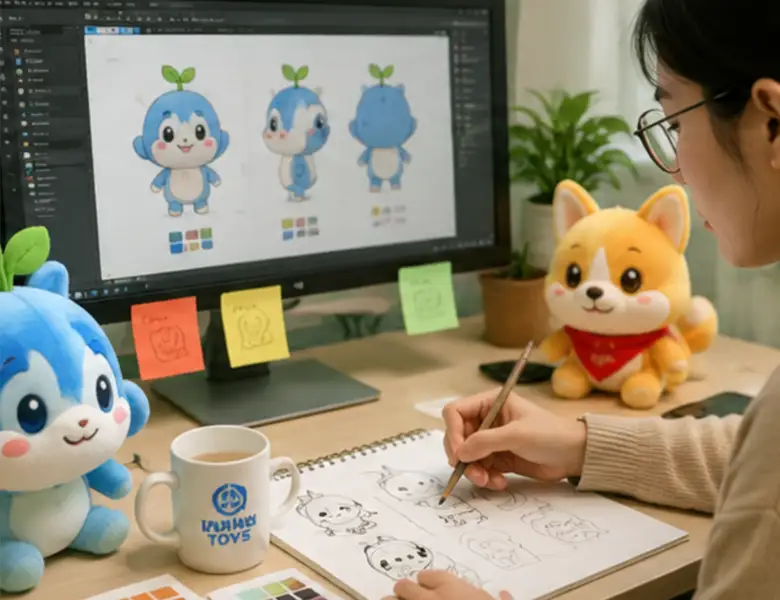
ODM is frequently misunderstood as “generic” or “lower quality” compared to OEM. Neither characterization is accurate. ODM designs are fully engineered products — sometimes of very high quality — developed by experienced pattern makers who have built and refined them through multiple production runs. What ODM lacks is not quality; it is exclusivity. The same base design may be available to multiple buyers simultaneously, typically differentiated only by color, fabric choice, or surface branding.
What Can and Cannot Be Customized in an ODM Arrangement
Understanding the precise scope of customization available in an ODM product is essential before selecting this model. ODM factories offer customization at different depths — some provide only color and label changes, while others allow more substantial modification of surface features, proportions, or material choices within a base design architecture. The limits of customization in any specific ODM relationship should be explicitly established before sampling begins, because requesting modifications that exceed the factory’s ODM customization boundary effectively converts the project into an OEM engagement — with the associated development cost and timeline.
ODM plush toy customization scope: what is typically available at each level
| Customization Level | What Changes | What Stays Fixed | Typical Additional Cost |
|---|---|---|---|
| Surface branding only | Hang tag, label, embroidered logo, polybag print | All product elements: shape, fabric, color, fill | Minimal — label tooling only ($50–$150) |
| Color customization | Fabric color, eye color, embroidery thread color | Shape, pattern, proportions, fill type | Low — fabric dyeing or alternative fabric sourcing ($80–$200) |
| Material upgrade | Fabric grade, fill density, accessory quality level | Underlying shape and pattern architecture | Medium — material differential plus re-sampling ($150–$350) |
| Feature modification | Accessory style, embroidery detail, minor proportion adjustment | Core pattern dimensions and construction method | Medium-high — partial re-engineering and new sample ($200–$500) |
| Structural modification | Size change, limb repositioning, opening/closing mechanism | General design concept only | High — approaching OEM development cost ($400–$800+) |
The Factory Dependency Risk in ODM Relationships
The most significant structural risk in ODM sourcing is supplier dependency. Because the underlying design belongs to the factory, a buyer who has built a product line around ODM designs cannot readily transfer production to a different manufacturer without starting the design process over — or paying a new factory to reverse-engineer the existing product, which is both legally and commercially problematic.
This dependency is manageable if the ODM relationship is performing well. It becomes a commercial problem when the factory raises prices substantially, misses quality or timeline standards, or discontinues a design that the buyer has built marketing investment around. Buyers building significant business volume around ODM products should account for this dependency in their relationship management — maintaining open communication with the factory about long-term continuity and having contingency options in mind even when the primary relationship is functioning well.
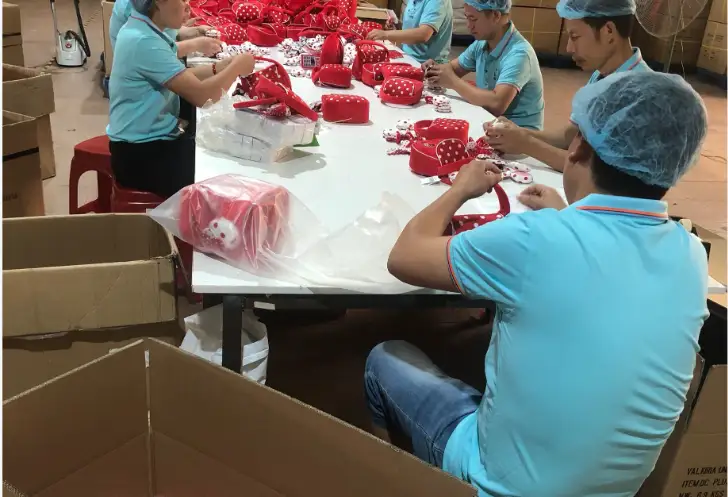
Tip: Before committing to a high-volume ODM order, explicitly ask the factory: “Is this design available exclusively, and what are the terms?” Some factories offer design exclusivity — the right to be the only buyer purchasing a specific ODM base design in a defined territory or category — for an additional fee or minimum volume commitment. For buyers building a brand identity around their plush product line, this exclusivity arrangement significantly reduces the ODM model’s primary risk without requiring the full investment of OEM development.
Design Protection and IP Risk in OEM vs ODM Plush Toy Manufacturing
Intellectual property management in plush toy manufacturing operates differently from IP in most other industries because the products themselves are inherently visual and three-dimensional, making copying detectable but also relatively straightforward. The IP risks in OEM and ODM are fundamentally different in nature and require different management approaches.
In OEM manufacturing, the primary IP risk is unauthorized reproduction of the buyer’s proprietary design. When a buyer shares a design brief with a factory, that factory’s employees see the design, the pattern is engineered in the factory’s system, and samples of the product exist on the factory floor. A factory with poor IP discipline could — in principle — produce additional units of the buyer’s design for other parties, or adapt design elements for other clients. In practice, professional manufacturers understand that this behavior destroys the long-term client relationships that are the foundation of their business model. But it is a risk that warrants management: through a signed NDA before design sharing, through reference-checked supplier selection, and through awareness of the signals that indicate a factory’s IP practices.
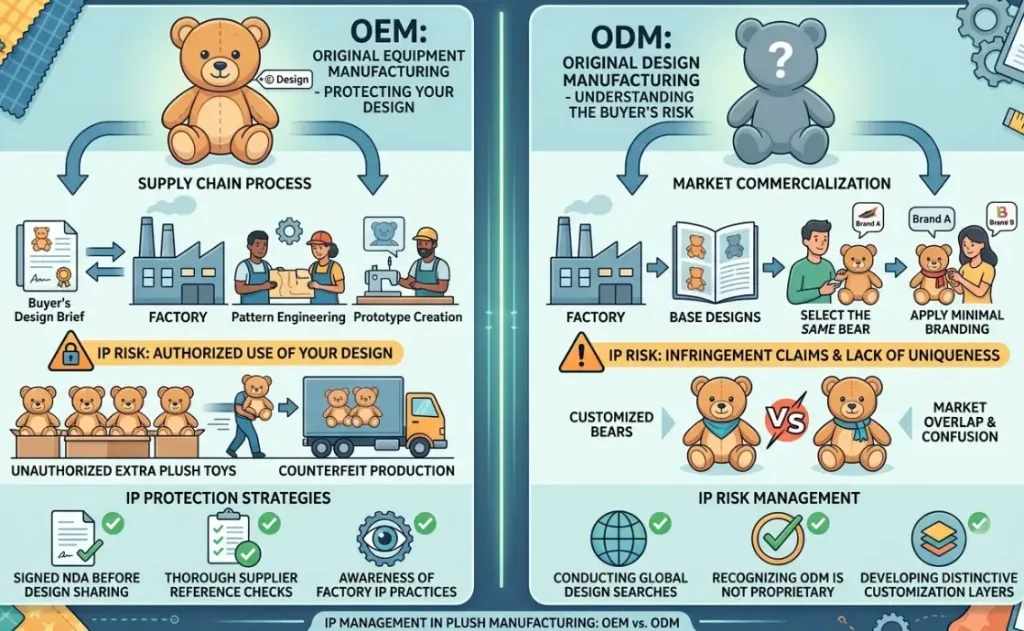
In ODM manufacturing, the primary IP risk sits with the buyer, not the factory. If a buyer customizes an ODM product with branding and then presents it as an original proprietary design, they may be exposed to claims by other ODM buyers who have purchased the same base design, particularly if the underlying design has any distinctive features that are recognizable across the customization layer.
IP risk comparison and mitigation strategies in OEM vs ODM plush manufacturing
| IP Risk Category | OEM Risk Level | ODM Risk Level | Mitigation Approach |
|---|---|---|---|
| Unauthorized design reproduction by the factory | Medium — factory has access to proprietary brief | Low — factory owns design; no proprietary buyer input | OEM: NDA + reference-checked supplier selection |
| Design sold to competing buyers | Low if NDA is signed and enforced | High — ODM designs typically available to multiple buyers | ODM: Request territorial or category exclusivity clause |
| IP portability if the factory relationship ends | High — buyer owns design; can re-sample elsewhere | Low — factory owns design; buyer starts over | OEM: Document technical spec sheet independently |
| Risk of infringing existing third-party IP | Medium — buyer is responsible for the originality of their brief | Low — factory responsible for the originality of the catalog | Both: Confirm no existing trademark or design rights conflict |
| Exposure if the product is recalled or fails compliance | Buyer bears compliance specification responsibility | Shared — factory holds existing test documentation | OEM: Specify compliance in brief; ODM: Request test reports |
Cost Structure Differences Between OEM and ODM Plush Toy Manufacturing
The cost difference between OEM and ODM plush toy manufacturing is most significant at the pre-production stage, less significant in bulk unit economics, and sometimes reversed at the total project cost level when all factors are included. Understanding where the cost differences actually originate — and how they interact with order volume — is essential for building a realistic budget model for either approach.
OEM carries higher development costs because the entire design engineering process — pattern creation, initial sampling, revision rounds, material sourcing, and specification documentation — must be completed for each new design. This investment is fixed regardless of the eventual production volume, which means it has a much larger per-unit impact at low volumes than at high volumes. A $500 development investment amortized over 500 units adds $1.00 per unit; amortized over 5,000 units, it adds $0.10. The economics of OEM development investment improve substantially at higher volumes, which is one reason established buyers with validated product lines favor OEM despite its higher upfront cost.
ODM carries lower development costs because the factory’s design investment is already sunk — the buyer is paying only for the customization work on top of an existing base. This makes ODM significantly more cost-effective for market validation, for seasonal test products, or for buyers who need to move quickly without the capital for full OEM development. The trade-off is that the factory recovers its design investment through the ongoing margin on all ODM sales, which means ODM unit prices are not necessarily lower than OEM unit prices for comparable quality products — the cost structure is different, not unambiguously cheaper.
Table 6 — Illustrative total cost comparison: OEM vs ODM at 1,000-unit first order
| Cost Component | OEM (New Custom Design) | ODM (Color + Logo Customization) | Notes |
|---|---|---|---|
| Design development/sampling fee | $350–$600 | $80–$180 | OEM includes full pattern engineering; ODM covers customization, sample only |
| Revision rounds (estimated) | 2–3 rounds × $120–$180 | 0–1 rounds × $80–$120 | OEM typically requires more iterations on the new design |
| Compliance testing | $500–$1,200 | $0–$500 (factory may hold partial test docs) | Depends on the market; OEM requires a new product test |
| Unit price at 1,000 units | $5.50–$9.00 | $5.00–$8.00 | Comparable for similar quality; OEM may command a slight premium for exclusivity |
| Production cost at 1,000 units | $5,500–$9,000 | $5,000–$8,000 | Unit economics converge at moderate volumes |
| Total project cost (estimated) | $7,190–$12,360 | $5,160–$9,060 | OEM premium is primarily in pre-production; narrows at higher volumes |
| Per-unit total cost impact | $7.19–$12.36 | $5.16–$9.06 | At 5,000 units, the gap narrows significantly as fixed costs amortize |
Tip: When evaluating the cost difference between OEM and ODM for a specific project, calculate the total project cost — not just the unit price — and run the calculation at your realistic order volume, not at the factory’s quoted MOQ. The OEM premium is primarily a fixed development cost that shrinks per unit as volume increases. For buyers planning to scale, the OEM development investment often pays back within two or three reorders through better price leverage, exclusive design control, and eliminated switching costs.
How to Choose Between OEM and ODM for Your Specific Project
The right manufacturing model for a plush toy project is determined by the intersection of the buyer’s design situation, market strategy, timeline, budget, and volume expectations. No single model is universally correct — but there are clear patterns that indicate which model is the better structural fit for specific buyer situations.
OEM is the appropriate model when the buyer has a proprietary design that cannot be adequately represented by anything in a factory’s existing catalog — a licensed character, a brand-specific mascot, a design with distinctive features that are part of the product’s market differentiation, or a product where precise replication of specific design elements is commercially critical. OEM is also the right model when the buyer expects to scale the product significantly, because the design IP investment creates leverage that compounds over time. And it is the right model when supplier portability matters — when the buyer wants to maintain the ability to switch manufacturers without losing the design.
ODM is the appropriate model when the buyer is entering the plush category for the first time and needs to validate market demand before committing to full design development investment. ODM is right when the timeline is the primary constraint — a buyer with a seasonal deadline that cannot accommodate a full OEM development cycle should use ODM for that season and develop OEM products for the following one. ODM is also appropriate when the buyer’s brand differentiation comes primarily from marketing, packaging, and customer experience rather than from the product’s physical design — in which case customizing a high-quality ODM base may serve the buyer’s commercial objectives as well as a proprietary OEM design at significantly lower cost and risk.
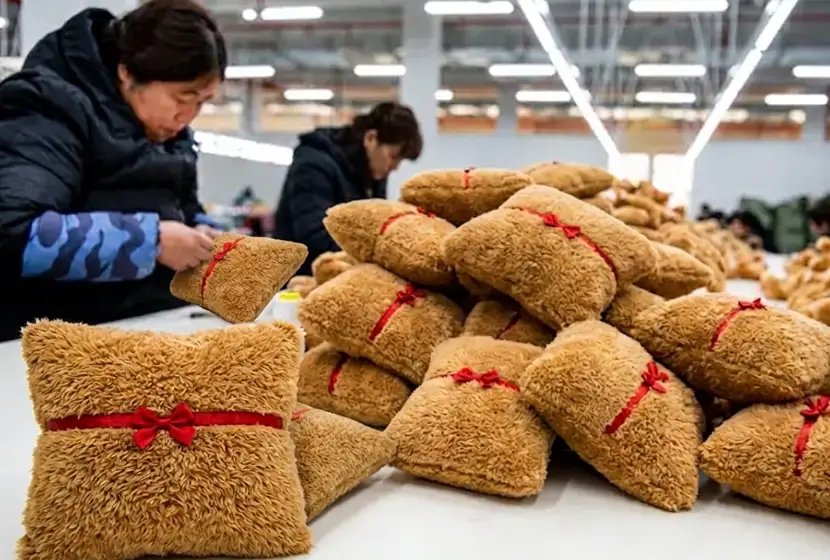
Decision Framework: OEM or ODM?
The following questions help buyers identify which model fits their specific situation. A clear majority of answers pointing in one direction is a strong signal; a split result suggests the hybrid approach discussed in the next section may be the most appropriate path.
Questions that point toward OEM: Does your product design involve a licensed IP or proprietary character that must be reproduced precisely? Is design exclusivity commercially important to your market position? Do you expect to scale this product to 3,000+ units per order within two years? Is supplier portability important to your supply chain risk management? Does your product require materials or construction techniques that are unlikely to match anything in an ODM catalog?
Questions that point toward ODM: Are you entering the plush category for the first time? Do you have a seasonal deadline within the next 12–14 weeks? Is your initial budget for product development below $1,000? Is your brand differentiation primarily expressed through marketing and packaging rather than product design? Are you testing multiple plush products simultaneously and need to spread development investment across them?
The Hybrid Approach: How Experienced Buyers Combine OEM and ODM
The OEM vs ODM framing is useful as an analytical distinction, but experienced plush toy buyers rarely commit exclusively to one model across their entire product range. The most commercially sophisticated approach is a deliberate hybrid — using ODM for market entry, product testing, and speed-to-market requirements while investing in OEM development for hero products, licensed characters, and high-volume repeatable lines.
This hybrid strategy allows buyers to maintain a continuously refreshed catalog without the full development investment of making every product an OEM project, while ensuring that their most commercially significant products — the ones worth protecting and scaling — are built on OEM foundations that the buyer controls.
In practice, the transition from ODM to OEM often happens naturally. A buyer starts with an ODM product that performs well in the market. As the product gains traction, the buyer develops an OEM version — with better materials, more distinctive design features, and full IP ownership — that replaces the ODM version in the catalog while the ODM product moves to a lower price point or is retired. The ODM phase served its purpose: it validated the market and generated cash flow that funded the OEM investment. This is not a compromise — it is a sequenced strategy that manages capital and risk efficiently.
Tip: If you are using ODM products as market validation before committing to OEM development, document what customers respond to most strongly — specific colors, scale, texture, feature elements — and use those validated preferences as the brief for your OEM design. ODM market testing gives you empirical data about what your customers actually want; OEM development lets you build the best possible version of that validated product with full design ownership. This sequence is more capital-efficient than committing to OEM before any market signal exists.
Frequently Asked Questions
Q1: Can I switch from an ODM product to an OEM version of the same design — and how do I handle the transition?
Transitioning from an ODM product to an OEM version of the same concept is entirely feasible, but it requires treating the OEM development as a new design project rather than a transfer of the existing ODM design. Because the ODM base design belongs to the factory, you cannot simply take that pattern and have it reproduced elsewhere — doing so would use the factory’s proprietary engineering without authorization. The correct approach is to commission a new OEM design that achieves the same commercial outcome — the character type, size, fabric feel, and visual character that worked in your ODM product — through new pattern engineering.
This is not a disadvantage; it is an opportunity to improve on the ODM version with better materials, more precise features, or construction refinements that the ODM base did not allow. Most experienced buyers find that the OEM version they develop based on ODM market learnings is meaningfully better than the original ODM product — because they now know exactly what their customers respond to and can design to that brief with precision.
Q2: If I provide a design brief to a factory for OEM production, who legally owns the resulting product?
In an OEM relationship, the design IP — the creative concept, character design, and visual specifications provided by the buyer — belongs to the buyer. The buyer created it and provided it to the factory for production purposes. However, the pattern engineering — the technical production documents the factory develops to manufacture the design — occupies a grayer area. Most professional OEM relationships address this in the contract: buyers should ensure that the OEM manufacturing agreement explicitly states that the buyer owns the design and that the technical package created to produce it is either owned by the buyer or licensed exclusively for the buyer’s production. Without a clear contractual provision, factory-developed patterns exist in an ambiguous space that can complicate supplier transitions. Standard practice is to include a design IP clause in the manufacturing agreement before production begins, establishing clear ownership of both the creative design and the production technical documentation.
Q3: How do I verify that an ODM factory is not selling the same design I am using to my direct competitors?
Absolute verification that an ODM factory is not selling the same design to competitors is not easily achievable through external investigation, because ODM factories sell to many clients and do not typically disclose their client lists. The most effective approaches are contractual and relational. Contractually, requesting a territorial or category exclusivity clause — in which the factory agrees not to sell the same base design to buyers in the same product category or geographic market — provides a legal basis for recourse if copying is discovered. Relationally, working with manufacturers who have a documented reputation for relationship integrity — verified through reference checks with existing clients who are not your direct competitors — provides a practical risk reduction. Market monitoring is also valuable: periodically searching retail platforms and trade shows for products that closely resemble your ODM designs can surface instances of design overlap early. If your business model is highly sensitive to design exclusivity, OEM is ultimately a more structurally sound foundation than ODM, regardless of exclusivity contract terms.
Q4: Does choosing ODM mean accepting lower-quality products than OEM?
No — ODM does not inherently mean lower quality. The quality of a plush toy is determined by the materials used, the construction standards applied, and the quality control systems in place — none of which are structurally different between OEM and ODM production at a given factory. Many ODM factories produce high-quality products in their catalog, using certified fabrics, high-density filling, and reinforced construction, because their catalog is a permanent showcase of their manufacturing capability. What ODM lacks is design exclusivity and buyer-specified customization depth — not quality. Buyers evaluating ODM factories should assess quality using the same criteria they would use for OEM: requesting material certification documentation, reviewing QC process documentation, and asking for reference checks with existing clients. The decision between OEM and ODM should be based on design strategy, not on an assumption that one model produces better products than the other.
Q5: Can an ODM manufacturer produce a product that meets CPSIA and ASTM F963 requirements for the US children’s market?
Yes — ODM products can meet CPSIA and ASTM F963 requirements, provided the factory has sourced certified materials for those specific products and has conducted the required third-party testing. Some ODM manufacturers maintain existing test reports for their catalog products from accredited laboratories, which can significantly accelerate the compliance pathway for buyers entering the US market. However, buyers should verify several things before relying on a factory’s existing ODM test documentation: that the test reports cover the specific product they are purchasing (not just a similar design), that the test was conducted by a CPSC-accepted laboratory, that the test dates are within the acceptable window for the applicable standards, and that the product being purchased has not been modified in any way that would invalidate the existing test results. When any of these conditions are not met, a new product test is required regardless of the manufacturing model.
Q6: How does the OEM vs ODM choice affect my ability to sell on Amazon and major retail platforms?
The OEM vs ODM choice affects platform selling primarily through two channels: brand registry eligibility and compliance documentation. For Amazon Brand Registry — which provides access to A+ content, storefront features, and counterfeit protection tools — the buyer must hold a registered trademark for the brand applied to the product.
This is independent of whether the product was manufactured under OEM or ODM; what matters is trademark registration, not manufacturing model. For compliance, Amazon and major retail platforms require products to meet applicable safety standards (ASTM F963 for children’s toys in the US) and may require Certificates of Compliance or third-party test reports as part of listing setup. OEM products will always require their own product-level testing. ODM products may be able to leverage existing factory test documentation if it covers the specific product, though many platforms require the documentation to be in the selling brand’s name, which means the buyer may need to conduct a new test regardless. Buyers planning to sell through major retail channels under either model should plan for product-level compliance testing as a standard project cost.
Q7: Is it possible to negotiate exclusivity on an ODM design, and what does that typically cost?
Yes — exclusivity on ODM designs is negotiable with many factories, and it is more commonly available than buyers realize because factories have a commercial incentive to secure committed volume from a single buyer rather than distributing the same design across many smaller orders. Exclusivity arrangements typically take one of three forms: territorial exclusivity (the factory agrees not to sell the design to buyers selling in the same geographic market), category exclusivity (the factory agrees not to sell the design to buyers in the same product category or trade channel), or full exclusivity (the factory agrees not to sell the design to any other buyer for a defined period).
The cost of exclusivity varies significantly. Some factories provide territorial or category exclusivity in exchange for a minimum volume commitment — agreeing to order 2,000+ units per year, for example. Others charge a design exclusivity fee — typically $300 to $1,500, depending on the design’s commercial significance and the scope of exclusivity requested. Full permanent exclusivity, which effectively converts the ODM arrangement into a proprietary design relationship, is uncommon but available from some factories and typically commands the highest premium or volume commitment. Before entering into any ODM exclusivity arrangement, have the terms reviewed by a legal advisor familiar with international manufacturing contracts, as the enforceability of these provisions depends significantly on how they are drafted.