Skip to content
How to protect original plush toy designs, characters, and proprietary patterns throughout the sourcing, sampling, and manufacturing process.
IP protection for custom plush toys is the combined set of legal agreements, manufacturing controls, and registration strategies that a brand uses to prevent its original character designs, surface patterns, mold sculpts, and packaging from being copied, leaked, or resold without authorization. Because plush toy development typically involves sharing detailed digital sculpts, pattern files, and physical prototypes with an outside factory, the manufacturing relationship itself becomes one of the most significant points of intellectual property exposure in the entire product lifecycle.
Unlike categories where the manufacturing process is largely mechanical and undifferentiated, custom plush toy production depends on a chain of highly reproducible assets — 3D character sculpts, flat pattern pieces, face embroidery digitization files, colorways, and fabric specifications — that can be manufactured by any competent factory once they exist in digital form. This makes plush toys a category where design theft, unauthorized overruns, and gray-market resale are recurring, well-documented risks rather than rare edge cases. A brand that treats IP protection as an afterthought after the design is finished, rather than as a structural part of the sourcing process from the first sketch onward, is taking on avoidable risk.
This guide covers the specific categories of intellectual property relevant to plush toy design, the points in the development and manufacturing process where exposure is highest, the legal instruments brands use to protect their work, how to vet a manufacturer’s IP practices before signing a production agreement, and the practical steps to take if a design is copied.
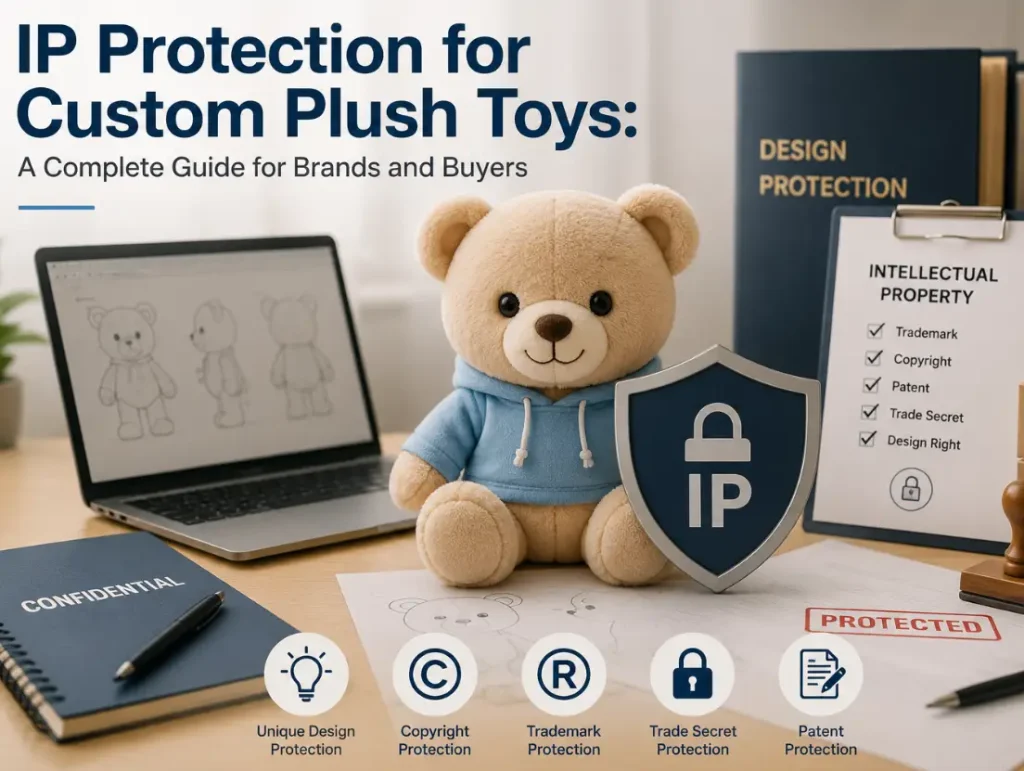
What Counts as Intellectual Property in Custom Plush Toy Manufacturing?
Plush toy intellectual property is rarely a single, unified asset. In practice, a single character or product line usually contains several distinct categories of protectable IP, each governed by different legal mechanisms and each requiring a different protection strategy.
Categories of IP Relevant to Custom Plush Toy Design
| IP Category | What It Covers | Primary Legal Mechanism |
|---|---|---|
| Character design / sculpt | The overall three-dimensional shape, proportions, and expression of the plush figure | Copyright; design patent in some jurisdictions |
| Surface pattern and print | Printed or embroidered graphics, fabric patterns, and colorways | Copyright |
| Brand name and logo | Product line name, company name, and associated marks | Trademark |
| Packaging and trade dress | Distinctive packaging appearance, hang tags, and product presentation | Trade dress; copyright on artwork |
| Pattern files and technical sculpts | The underlying digital pattern pieces and 3D files used to manufacture the toy | Trade secret; contractual confidentiality |
| Proprietary mechanisms | Novel functional features, such as weighted inserts or sound modules | Utility patent |
The distinction between these categories matters because each carries a different registration process, a different geographic scope, and a different enforcement mechanism. A brand that only trademarks its character’s name, for example, has done nothing to prevent a factory from reproducing the character’s physical sculpt and selling it under a different name entirely.
It is also worth noting that these categories frequently overlap on a single product without being interchangeable in a legal sense. A plush toy’s face embroidery, for instance, may be protectable both as an element of the overall copyrighted artwork and, separately, as a distinctive feature contributing to the product’s trade dress if it becomes strongly associated with the brand in the marketplace. Treating each asset as though a single registration covers everything is one of the most common misunderstandings brands bring into their first manufacturing relationship, and it often surfaces only after a dispute has already begun.
Tip: Before starting development, make a simple inventory of every IP asset your plush toy will include — sculpt, face design, surface pattern, name, and packaging — and note which protections already exist for each one. Brands frequently discover mid-development that they have trademarked a name but never registered copyright on the character artwork itself, leaving the most copied asset unprotected.
Common IP Risks in Plush Toy Production
Because plush toy development requires sharing detailed design files with a manufacturing partner well before a product ever reaches the market, the risk window extends far earlier than most brands assume. Understanding where exposure actually occurs is the first step in building an effective protection strategy.
Where IP Exposure Occurs in the Plush Toy Development Timeline
| Development Stage | IP Exposure Risk |
|---|---|
| Initial design brief and sketches | Concept shared with multiple factories during quoting, before any agreement is signed |
| 3D sculpt and pattern development | Digital files transferred to the factory’s design team for grading and pattern-making |
| Sample and prototype review | Physical samples photographed or shared beyond the intended review team |
| Mass production | Unauthorized overruns produced beyond the contracted order quantity |
| Post-production | Retained molds, patterns, or digitized files reused for a different client |
| Marketplace monitoring | Counterfeit or knockoff listings appearing on e-commerce platforms after launch |
The most underestimated risk on this list is the quoting stage, when brands routinely share detailed concept art and even physical reference samples with several competing factories before selecting a manufacturing partner — often without any confidentiality agreement in place at all. By the time a brand signs a production contract with its chosen factory, the design may have already circulated to two or three competitors during the bidding process.

Tip: Treat the quoting stage with the same confidentiality discipline as the production stage. Require a simple mutual NDA before sending detailed sketches, sculpts, or samples to any factory for a quote — not just the factory you ultimately select. A one-page NDA signed in a day costs far less than a design that leaks during a competitive bidding process.
NDA and NDNR Agreements: Your First Line of Defense
A Non-Disclosure Agreement (NDA) restricts a manufacturer from sharing your design information with third parties. A Non-Disclosure, Non-Use, Non-Circumvention agreement (NDNR or NNN agreement) goes further, also prohibiting the factory from using your design for its own purposes and from bypassing your brand to sell directly to your customers, distributors, or retail partners. For plush toy manufacturing relationships with factories based outside your home jurisdiction, an NNN agreement drafted to be enforceable under the manufacturer’s local law is significantly more effective than a generic Western-style NDA.
NDA vs. NNN Agreement for Plush Toy Manufacturing
| Agreement Type | What It Restricts | Typical Use Case |
|---|---|---|
| Standard NDA | Disclosure of confidential design information to third parties | Early-stage quoting and initial design discussions |
| NNN Agreement | Disclosure, unauthorized use, and circumvention (selling direct to your customers) | Active production relationships with an overseas factory |
| Manufacturing Agreement with IP clauses | Ownership of designs, tooling, unauthorized overruns, and post-termination obligations | Long-term or exclusive manufacturing partnerships |
An enforceable NNN agreement should be written in the language of the jurisdiction where the manufacturer is located, specify a court or arbitration venue in that jurisdiction, and include liquidated damages clauses that are realistic enough to be enforced rather than symbolic. A boilerplate NDA downloaded from a template site and never adapted to the manufacturer’s home jurisdiction offers considerably less real protection than brands often assume.
Tip: If your manufacturer is based in China, ask specifically for an NNN agreement rather than a standard NDA, and confirm it is governed by Chinese law with a Chinese-language version as the controlling text. An English-only NDA governed by your home country’s law is often difficult or impossible to enforce against a factory with no assets or presence in that jurisdiction.
Design Patents vs. Copyright for Plush Toy Designs
Brands frequently confuse design patents and copyright when protecting a plush toy’s physical appearance, but the two mechanisms differ significantly in scope, cost, and duration. Understanding which protection fits which asset prevents brands from either over-investing in the wrong registration or leaving a valuable design unprotected.
Design Patent vs. Copyright for Plush Toy Protection
| Factor | Design Patent | Copyright |
|---|---|---|
| What it protects | The specific ornamental appearance of the physical product | Original creative expression, including artwork, sculpts, and prints |
| Registration required | Yes, formal application and examination | Automatic upon creation in most jurisdictions; registration strengthens enforcement |
| Typical cost | Moderate to high, varies by jurisdiction | Low, especially for registration-only filings |
| Typical protection term | 15–20 years depending on jurisdiction | Life of the author plus decades, or a fixed term for corporate works |
| Best suited for | A distinctive physical sculpt or product silhouette | Character artwork, surface prints, and packaging design |
| Enforcement speed | Slower to obtain, but strong once granted | Immediate protection, useful for fast-moving product launches |
In practice, many plush toy brands pursue both protections in parallel: copyright registration covers the character artwork and any 2D reference materials the moment they are created, while a design patent application is filed once the physical sculpt is finalized, providing stronger protection against a competitor manufacturing a near-identical physical product.
Timing matters here as well. Because a design patent application generally must be filed within a limited window after a product’s first public disclosure in many jurisdictions, brands that showcase prototypes at trade shows or share preview images on social media before filing risk losing patent eligibility entirely. Coordinating the filing timeline with the marketing and launch calendar, rather than treating IP filing as a purely legal afterthought handled once the product is already on shelves, avoids this easily preventable loss of protection.
Trademark Protection for Plush Toy Brands and Characters
Trademark protection covers the brand name, product line name, logo, and any distinctive character name used in marketing and packaging. For plush toy brands building a recognizable character or mascot, the character’s name is frequently as commercially valuable as the physical design itself, and it requires separate registration.
What to Trademark in a Plush Toy Product Line
| Asset | Why It Matters |
|---|---|
| Company or brand name | Prevents competitors from using a confusingly similar business name |
| Product line or collection name | Protects the marketing identity distinct from any single character |
| Individual character names | Prevents unauthorized use of a specific character’s name on unrelated products |
| Logo and wordmark | Protects the visual identity used across packaging and marketing |
| Tagline or slogan (if distinctive) | Protects marketing phrases strongly associated with the brand |
Trademark registration is jurisdiction-specific, and a brand selling internationally should prioritize registration in its primary sales markets first, followed by its primary manufacturing country, since a trademark registered only in the country of manufacture offers little protection against sales in a brand’s actual retail markets.

Tip: Register your trademark in your manufacturer’s home country in addition to your primary sales markets. This closes a common loophole where a former factory partner registers a similar mark locally after a relationship ends, then blocks the original brand from manufacturing under its own name in that country in the future.
Protecting Proprietary Patterns and Molds During Manufacturing
Beyond formal registrations, the physical assets used to manufacture a plush toy — pattern pieces, cutting dies, embroidery digitization files, and any custom molds for accessories — represent a category of exposure that trademark and copyright registration alone do not address. These assets are the actual blueprint a factory needs to reproduce your product, and control over their storage, transfer, and disposal after a production run ends is a core part of IP protection.
Manufacturing Asset Ownership and Control Practices
| Asset | Recommended Control Practice |
|---|---|
| Digital pattern files | Transferred under written agreement specifying ownership and deletion terms |
| Physical cutting dies | Marked as client property; returned or destroyed at contract end per written terms |
| Embroidery digitization files | Ownership clause specifying the brand retains rights, not the digitizer |
| Custom accessory molds | Stored under an agreement preventing reuse for other clients without consent |
| Sample archive | Return, destruction, or documented storage terms specified in writing |
Without explicit contractual language, ownership of pattern files and physical tooling can become ambiguous, particularly when a factory’s design team makes technical modifications to a brand’s original sculpt to make it production-ready. Some manufacturing agreements default to treating any factory-modified pattern as the factory’s own work product unless the contract specifies otherwise — a gap that has caused real disputes when brands later switch manufacturers and request their files.
This issue tends to surface at the worst possible moment: when a brand decides to move production to a new factory, often precisely because of a quality or capacity problem with the original partner, and then discovers that the outgoing factory is unwilling to hand over final, production-ready pattern files without additional payment or negotiation. Establishing file ownership and delivery obligations at the start of the relationship, rather than at its potential end, removes this leverage entirely and keeps a brand free to change manufacturing partners without losing access to its own designs.
Tip: Specify in writing, before production begins, that all pattern files, digitized embroidery files, and grading work — even where the factory’s technicians made technical adjustments to your original design — are considered work made for hire and remain your exclusive property. Request the final, production-ready files at the end of every order, not just at the end of the relationship.
How to Vet a Manufacturer’s IP Protection Practices
Not every plush toy factory has the same internal discipline around client confidentiality, and a brand’s own contracts are only as effective as the manufacturing partner’s actual operational practices. Vetting a factory’s IP handling before signing a production agreement reduces risk far more effectively than pursuing legal remedies after a leak has already occurred.
Questions to Ask When Vetting a Manufacturer’s IP Practices
| Question | What a Strong Answer Looks Like |
|---|---|
| Do you sign NNN agreements before receiving design files? | Yes, as standard practice, without hesitation or pushback |
| How are client pattern files stored and access-controlled? | Segregated client folders with restricted internal access |
| What happens to tooling and patterns after a contract ends? | Documented return, destruction, or agreed storage terms |
| Can you provide references from other brand clients? | Willing to share verifiable references without evasion |
| How do you prevent unauthorized overruns? | Documented material reconciliation and production quantity controls |
| Do you work with competing brands on similar characters? | Transparent disclosure of any potential conflicts |
A factory’s willingness to sign strong confidentiality terms without negotiation is itself a useful signal. Manufacturers with genuine, established IP discipline typically have standard NNN templates ready and treat the request as routine, while reluctance or repeated attempts to weaken confidentiality language during contract negotiation are a meaningful warning sign worth taking seriously before committing to a production run.
It is also worth speaking directly with a factory’s existing brand clients where possible, rather than relying solely on the factory’s own description of its confidentiality practices. A reference client who has run multiple seasons of production with the same manufacturer can usually speak candidly about whether pattern files were handled carefully, whether quantities matched what was ordered, and whether any similar designs later appeared elsewhere in the market. This kind of informal due diligence often surfaces information that a factory’s own sales team would never volunteer.
Contract Clauses That Protect Your Plush Toy IP
A well-drafted manufacturing agreement does more work to protect a brand’s IP than registration alone, because it governs the day-to-day realities of the manufacturing relationship — quantities, tooling ownership, and what happens if the relationship ends. The following clauses are the ones most frequently missing from plush toy manufacturing contracts that later become sources of dispute.

Essential IP Protection Clauses in a Plush Toy Manufacturing Agreement
| Clause | What It Should Specify |
|---|---|
| Ownership of designs and files | Brand retains full ownership of all sculpts, patterns, and digitized files |
| Production quantity limits | Explicit order quantity with penalties for unauthorized overruns |
| Subcontracting restrictions | Written consent required before work is passed to a third-party subcontractor |
| Tooling and mold custody | Ownership and post-contract disposition of dies, molds, and jigs |
| Confidentiality survival period | Confidentiality obligations continue for a defined period after contract termination |
| Non-circumvention | Factory prohibited from selling directly to the brand’s customers or retailers |
| Governing law and venue | Dispute resolution jurisdiction specified in an enforceable location |
Production quantity limits deserve particular attention in the plush toy category, where the marginal cost of producing extra units on an already-running line is low, creating a financial incentive for unauthorized overruns that are then sold through secondary channels. A contract that specifies exact quantities, requires material usage reconciliation, and imposes a defined penalty for units produced beyond the agreed order gives a brand a concrete basis for action if overruns are discovered.
Tip: Include a material reconciliation clause requiring the factory to account for fabric, filling, and trim usage against the contracted order quantity, with an agreed tolerance for normal production waste. Large, unexplained gaps between materials purchased and units delivered are one of the most reliable early indicators of an unauthorized overrun.
International IP Protection: Key Jurisdictional Considerations
Because most custom plush toys are manufactured in one country and sold in others, effective IP protection requires thinking across at least two, and often three, legal jurisdictions: the country of manufacture, the primary sales markets, and any secondary markets where counterfeit risk is elevated.
IP Protection Considerations by Jurisdiction Type
| Jurisdiction | Key Consideration |
|---|---|
| Country of manufacture | Register trademarks and file NNN agreements enforceable under local law |
| Primary sales markets | Register copyright, design patents, and trademarks in each significant retail territory |
| Marketplace-heavy regions | Enroll in e-commerce platform brand protection programs to enable takedown requests |
| Trade show and exhibition markets | Confirm registration is in place before exhibiting, since public display can affect novelty in some patent systems |
Because intellectual property rights are territorial, a registration obtained in one country generally provides no enforcement power in another. Brands that manufacture in one country, sell primarily in a second, and exhibit at trade shows in a third are effectively managing three separate protection strategies simultaneously, and treating any one of them as sufficient on its own leaves clear gaps.

What to Do If Your Plush Toy Design Is Copied
Despite strong upfront protections, design copying still occurs in the plush toy industry, whether through a marketplace knockoff, a former factory partner producing unauthorized units, or a competitor’s design that appears suspiciously similar. Responding methodically, rather than reactively, improves the odds of a successful resolution.
Response Steps When a Plush Toy Design Is Copied
| Step | Action |
|---|---|
| 1. Document the infringement | Screenshot listings, save physical samples, and record dates of discovery |
| 2. Confirm your own registrations | Verify which protections (copyright, trademark, design patent) actually apply and where |
| 3. Identify the source | Determine whether the copy traces to your own factory, a former partner, or an unrelated third party |
| 4. Send a cease-and-desist letter | Formal notice, typically drafted by counsel, demanding the infringing activity stop |
| 5. File a marketplace takedown | Use the relevant e-commerce platform’s IP infringement reporting process |
| 6. Evaluate legal action | Assess whether formal litigation or arbitration is warranted based on scale of harm |
In many cases, a documented cease-and-desist letter combined with a marketplace takedown request resolves the immediate commercial harm without the time and cost of formal litigation, particularly against small-scale marketplace sellers rather than organized counterfeit operations. Reserving litigation for cases involving significant commercial harm, a former manufacturing partner with clear contractual obligations, or a pattern of repeated infringement is generally the more proportionate response.
Where the infringement traces back to a former manufacturing partner rather than an unrelated third party, the existence of a well-drafted NNN agreement and manufacturing contract becomes especially valuable, since it gives a brand a clear contractual breach to point to rather than relying solely on the slower and more uncertain process of establishing IP infringement from scratch. This is one of the strongest practical arguments for investing in solid contract language at the outset of a manufacturing relationship, well before any dispute is anticipated.
Tip: Keep a simple, dated record of your design’s development process — early sketches, sculpt revisions, sample photos, and email correspondence with your factory — from the very first concept. This documentation is often the single most persuasive piece of evidence in establishing that your design predates a competitor’s copy, whether the dispute is resolved informally or through formal legal channels.
IP Protection Costs and Timeline
Budgeting realistically for IP protection helps brands prioritize which registrations to pursue first, particularly for smaller companies that cannot pursue every available protection simultaneously. Costs and timelines vary meaningfully by protection type and jurisdiction, but the following ranges provide a general planning reference.
Typical IP Protection Costs and Timelines
| Protection Type | Typical Timeline | Relative Cost |
|---|---|---|
| NNN / NDA agreement drafting | Days to a few weeks | Low |
| Trademark registration (single jurisdiction) | Several months to over a year | Low to moderate |
| Copyright registration | Weeks to a few months | Low |
| Design patent application | Several months to over a year | Moderate to high |
| Multi-jurisdiction trademark filing | Extends with each additional country | Scales with number of jurisdictions |
| Enforcement action (cease-and-desist through litigation) | Weeks for a letter; months to years for litigation | Low for a letter; high for full litigation |
For most early-stage plush toy brands, the highest-value initial investment is a strong NNN agreement with the manufacturing partner and trademark registration in the brand’s primary sales market, both of which are relatively low-cost and address the most common and highest-probability risks. Design patents and multi-jurisdiction trademark filings typically become priorities as a product line proves commercially successful and the cost of potential copying grows alongside sales volume.
It is worth budgeting for these costs as an ongoing part of product development rather than a one-time expense tied to a single launch. A brand that continues to introduce new characters, seasonal designs, or licensed collaborations will accumulate a growing portfolio of assets that each require their own protection decision, and building a simple internal checklist — confirming NNN coverage, copyright registration, and trademark status for every new release before it goes into production — keeps this manageable as a product line scales rather than becoming an overwhelming backlog to address later.
Factory Audits and Ongoing Monitoring During Production
Contracts and registrations establish a brand’s legal rights, but detecting a problem early still depends on active monitoring during the production run itself. Waiting until a shipment arrives, or until a suspicious listing appears online, to discover an IP issue is considerably more costly than catching it while the goods are still on the factory floor.
Ongoing Monitoring Practices During Active Production
| Practice | Purpose |
|---|---|
| Unannounced production line visits | Verify actual output matches contracted specifications and quantities |
| Material purchase order review | Cross-check fabric and filling purchases against expected unit output |
| Pre-shipment inspection by a third party | Independent verification of quantity, quality, and design accuracy before payment |
| Serialized packaging or hang tags | Makes it easier to distinguish authorized units from unauthorized overruns in the market |
| Periodic marketplace sweeps | Early detection of counterfeit or gray-market listings after launch |
Third-party pre-shipment inspection services, commonly used for general quality control, can also be briefed to flag quantity discrepancies or unauthorized design deviations as part of their standard checklist. This gives a brand an independent set of eyes inside the factory without requiring the brand’s own staff to travel for every production run, which is particularly valuable for smaller companies managing overseas manufacturing relationships remotely.

Serialized hang tags or packaging codes offer an additional layer of traceability, allowing a brand to distinguish its own authorized units from units that surface later through unauthorized channels. This becomes particularly useful when investigating whether a suspicious marketplace listing originated from a legitimate but diverted shipment or from an entirely unauthorized production run.
Working with Designers, Digitizers, and Freelancers: Work-for-Hire Considerations
Many plush toy brands rely on external designers, 3D sculptors, or embroidery digitizers at some stage of development, whether as independent freelancers or as a factory’s in-house design team. Ownership of the resulting work product is not automatic in every jurisdiction, and brands that assume they own everything they paid for sometimes discover otherwise when a dispute arises.
Work-for-Hire Considerations with External Designers
| Consideration | Why It Matters |
|---|---|
| Written work-for-hire agreement | In many jurisdictions, ownership defaults to the creator unless a written agreement assigns it to the commissioning brand |
| Scope of assignment | Specify whether the assignment covers only the final deliverable or also intermediate drafts and revisions |
| Freelancer confidentiality | Independent designers should sign the same confidentiality terms as a manufacturing partner |
| Portfolio use restrictions | Clarify whether the designer may display the work in their own portfolio, and under what conditions |
| Source file delivery | Require delivery of editable source files, not only flattened or export-only formats |
A common gap occurs when a brand commissions a freelance sculptor or digitizer without a written agreement at all, relying instead on an informal understanding that the paid work belongs to the brand. In many jurisdictions, without an explicit written assignment, the default legal position is that the creator retains copyright even after being paid for the commission, which can leave a brand unable to prevent that designer from reusing or reselling a very similar design to another client later.
This exposure is easy to close and rarely requires more than a short paragraph added to a standard freelance agreement. Brands that build a simple assignment clause into every design commission, regardless of how small or informal the engagement feels at the time, avoid a dispute that becomes considerably harder to resolve after a design has already shipped to market.
Balancing Protection with a Practical Sourcing Relationship
IP protection measures work best when they are proportionate to the actual risk and value at stake, rather than applied uniformly to every interaction regardless of scale. Overly aggressive legal terms early in a relationship, before any real trust has been established, can sometimes make it harder to find a manufacturing partner willing to work with a smaller or first-time brand, while insufficient protection leaves valuable designs exposed unnecessarily.
Calibrating IP Protection to Brand Stage and Risk
| Brand Stage | Recommended Protection Priority |
|---|---|
| Early concept, pre-sourcing | Basic NDA before sharing detailed sketches with any factory during quoting |
| First production run with a new factory | NNN agreement, clear quantity limits, and pattern file ownership clause |
| Established product line with proven sales | Trademark and design patent registration in primary markets |
| Multi-market expansion | Jurisdiction-specific registration and active marketplace monitoring |
| Licensing to third parties | Formal licensing agreements with defined scope, royalties, and quality control rights |
A practical approach is to treat IP protection as a layered system that grows alongside the brand and the product line, rather than a single upfront investment that must be maximized on day one. The baseline layer — confidentiality agreements and clear contractual ownership terms — should be in place for every manufacturing relationship regardless of scale, since these cost relatively little and address the highest-probability risks. Formal registrations and active enforcement infrastructure can then be added as a product line proves its commercial value and the potential cost of infringement grows correspondingly.
Frequently Asked Questions
Q1. Does copyright automatically protect my plush toy character design?
In most jurisdictions, copyright exists automatically the moment an original creative work — including a character sculpt or artwork — is created, without requiring formal registration. However, registering that copyright with the relevant national office significantly strengthens your ability to enforce it, particularly when seeking statutory damages or filing a marketplace takedown request.
Q2. What is the difference between an NDA and an NNN agreement for plush toy manufacturing?
A standard NDA restricts a manufacturer from disclosing your confidential design information to third parties. An NNN agreement adds two further restrictions: the factory cannot use your design for its own purposes, and it cannot circumvent your brand by selling directly to your customers or retail partners. For overseas manufacturing relationships, an NNN agreement drafted under local law is generally far more enforceable than a generic NDA.
Q3. Can a factory legally keep my pattern files after our contract ends?
This depends entirely on what your manufacturing agreement specifies. Without an explicit ownership clause, some factories treat pattern files — especially those their own technicians modified for production — as their own work product. Brands should specify in writing that all pattern and digitization files remain their exclusive property and request the final files at the end of every order.
Q4. Should I trademark my plush toy character’s name separately from my brand name?
Yes, if the character is likely to become commercially significant on its own, separate from your overall brand. A character name used across multiple product lines, licensing deals, or marketing campaigns benefits from its own trademark registration, since a brand-name-only trademark does not necessarily prevent a competitor from using a similar character name on unrelated products.
Q5. How do I prevent a factory from producing extra units beyond my order?
The most effective safeguard is a manufacturing agreement with an explicit production quantity limit, a material usage reconciliation clause, and a defined financial penalty for units produced in excess of the contracted quantity. Combining this with periodic factory audits and unannounced inspections during active production runs further reduces the practical opportunity for unauthorized overruns.
Q6. Is it worth pursuing a design patent for a plush toy, or is copyright sufficient?
It depends on the asset. Copyright protects the creative expression of a character’s artwork and sculpt design, while a design patent protects the specific ornamental appearance of the physical manufactured product and generally provides stronger protection against a near-identical physical copy. Brands with a highly distinctive, commercially valuable sculpt often pursue both protections in parallel.
Q7. What should I do if I discover a knockoff of my plush toy on an online marketplace?
Document the listing with screenshots and dates, confirm which of your IP registrations apply, and file a takedown request through the marketplace’s brand or IP infringement reporting process. For repeated or large-scale infringement, a formal cease-and-desist letter and, where warranted, escalation to legal counsel are the appropriate next steps.
Q8. How early in the design process should I start thinking about IP protection?
From the very first concept sketch. The highest-risk exposure window is often the quoting stage, when brands share design concepts with multiple factories before selecting a manufacturing partner and before any confidentiality agreement is in place. Establishing basic NDA protection before sharing detailed sketches or samples closes this early and frequently overlooked gap.