Skip to content
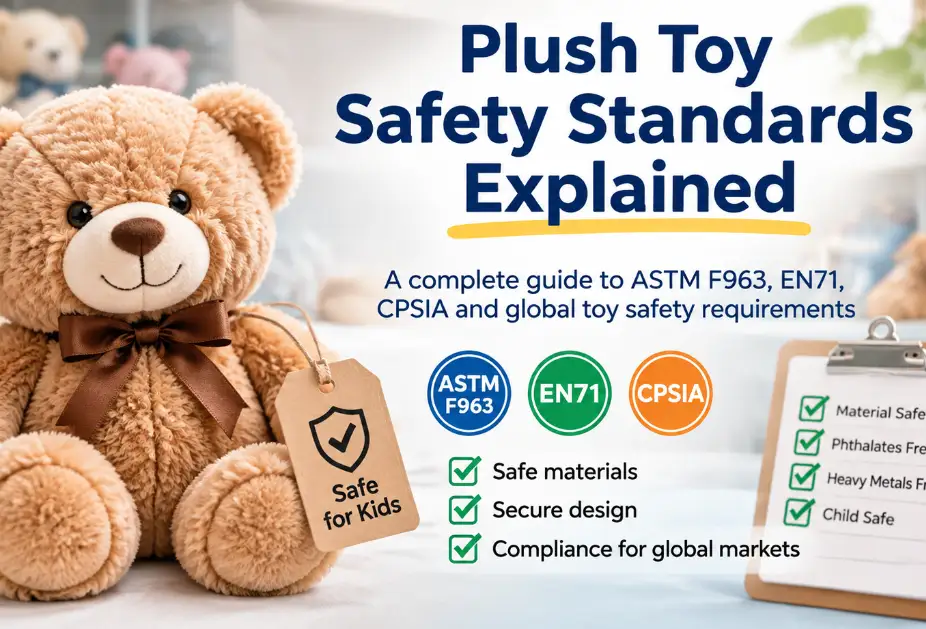
A complete guide to the safety, chemical, flammability, and mechanical standards that govern plush toy production — and how buyers can verify real compliance before an order ships.
A plush toy that passes visual inspection can still fail the standard that actually determines whether it is safe to sell. Softness, stitching quality, and finished appearance are the things buyers notice first — but none of them are what regulators, retailers, or customs authorities check when a shipment is reviewed. What gets checked is whether the toy meets the specific mechanical, chemical, and flammability requirements written into the safety standard that applies in the market where it will be sold.
This gap between what looks safe and what is certified safe is where most compliance problems in plush toy sourcing originate. A buyer who assumes that a well-made sample implies a compliant product is making an assumption that safety standards do not support. Compliance is not a byproduct of good craftsmanship — it is a distinct set of technical requirements that must be engineered into the product from material selection through final inspection, and verified through documented testing against the specific standard that governs the target market.
This guide explains exactly what plush toy safety standards require, how the major standards differ across markets, where compliance failures most commonly occur, and how buyers can verify that a supplier’s safety claims are backed by real testing rather than assumption.
Why Do Plush Toy Safety Standards Exist, and Why Do They Matter for Buyers?
Plush toy safety standards exist because stuffed toys present a specific combination of risks that general product safety rules do not adequately address — small detachable components that can be swallowed or lodged in a child’s airway, filling materials that can be inhaled if a seam fails, fabric and dye chemistry that comes into extended contact with skin and mouth, and flammability characteristics that matter for a product designed to be held, carried, and often slept with. Each safety standard is built around addressing these specific risk categories through defined test methods and pass/fail thresholds.
Safety standards matter for buyers because compliance is not optional documentation — it is the legal condition for selling a plush toy in a regulated market. A toy that has not been tested and certified against the applicable standard cannot legally be sold in the United States, the European Union, the United Kingdom, or most other developed markets, regardless of how well it is constructed. Retailers, marketplaces, and customs authorities all require proof of compliance before a product can reach a shelf or a warehouse, and the absence of that proof — not just an actual safety failure — is enough to block a shipment, trigger a delisting, or expose a buyer to liability.
Beyond the legal requirement, safety standards function as the shared technical language between buyers and factories. When a buyer specifies “ASTM F963 compliant” or “EN71 tested,” they are communicating a precise, verifiable set of requirements rather than a general expectation of quality — which is what makes safety standards enforceable in a way that vaguer quality expectations are not.
Tip: Always specify the exact standard and edition by name in your purchase agreement — for example, “ASTM F963-23” rather than “US safety standard.” Standards are revised periodically, and a supplier working from an outdated edition may pass tests that no longer reflect current requirements.
How ISO 8124 Functions as the International Reference Point
ISO 8124 occupies a distinct position among plush toy safety standards because it is not itself a legally binding requirement in most markets — it functions instead as the international reference framework that many national standards are built from or aligned with. Countries developing or updating their own toy safety regulations frequently use ISO 8124 as the technical baseline, adapting specific thresholds and documentation requirements to local legal and enforcement structures.
For buyers sourcing into markets without a mature, independently developed toy safety framework, requesting ISO 8124 testing provides a reasonable general assurance of safety performance, even where it is not the specific mandatory standard. However, ISO 8124 compliance should never be treated as a substitute for the specific mandatory standard in a regulated market such as the US or EU — it is a useful supplementary reference, not an equivalent legal certification.
What Are the Core Plush Toy Safety Standards Buyers Need to Know?
Plush toy safety is governed by a small number of major standards, each tied to a specific market or region, and each covering a similar set of risk categories through its own specific test methods and thresholds. Understanding which standard applies to which market — and what each one actually covers — is the starting point for any compliance conversation with a supplier.
The core plush toy safety standards buyers need to know are ASTM F963 for the United States, EN71 (parts 1, 2, and 3) for the European Union, ISO 8124 as the international reference standard that many national standards are modeled on, and a set of regional variants including AS/NZS 8124 for Australia and New Zealand, and toy safety requirements enforced under UKCA marking in the United Kingdom post-Brexit. CPSIA operates alongside ASTM F963 in the United States, adding specific requirements around lead content, phthalates, and third-party testing and certification.
Major Plush Toy Safety Standards by Market
| Standard | Market / Region | What It Primarily Covers | Legal Status |
|---|---|---|---|
| ASTM F963 | United States | Mechanical, physical, flammability, and select chemical requirements | Mandatory federal standard under CPSIA |
| CPSIA | United States | Lead content, phthalates, third-party testing, tracking labels | Federal law |
| EN71-1 | European Union | Mechanical and physical properties | Mandatory under Toy Safety Directive |
| EN71-2 | European Union | Flammability | Mandatory under Toy Safety Directive |
| EN71-3 | European Union | Migration of certain elements (heavy metals) | Mandatory under Toy Safety Directive |
| ISO 8124 | International reference | Mechanical, flammability, and chemical properties | Voluntary unless adopted nationally |
| AS/NZS 8124 | Australia / New Zealand | Mechanical, physical, and flammability properties | Mandatory under consumer product safety law |
| UKCA Toy Safety | United Kingdom | Equivalent scope to EN71 parts 1–3 | Mandatory post-Brexit marking requirement |
These standards overlap substantially in intent — all of them address choking hazards, sharp points, flammability, and toxic substances — but they differ in specific test thresholds, sampling procedures, and documentation requirements. A product that passes EN71 testing is not automatically compliant with ASTM F963, and treating the standards as interchangeable is one of the most common and costly assumptions buyers make when sourcing for multiple markets.
Why Multi-Market Sellers Cannot Rely on a Single Certification
Buyers selling the same plush toy design into both the US and EU markets sometimes assume that a single round of testing can cover both markets, since the underlying safety concerns are similar. This assumption does not hold up under actual regulatory review. Each market requires testing against its own standard, performed by a testing body accredited for that specific standard, with documentation formatted to that market’s requirements. A CPSIA-compliant tracking label has no relevance to EU customs, and a CE-marked Declaration of Conformity carries no legal weight for a US Consumer Product Safety Commission review.
The practical implication is that multi-market sellers should budget for separate testing per target market from the outset of a project, rather than treating additional-market testing as an afterthought once a product is already selling successfully in one region.
How Do Physical and Mechanical Safety Standards Work for Plush Toys?
Physical and mechanical safety requirements address the risk category that causes the most serious plush toy safety incidents — small parts and components that detach and present choking hazards, particularly for children under three years old. These requirements are tested through defined mechanical procedures that simulate the stresses a toy experiences during normal use and reasonably foreseeable abuse.
Physical and mechanical safety standards for plush toys work by subjecting components — eyes, noses, bows, embellishments, and any attached accessory — to standardized force testing that determines whether they can be pulled, twisted, or impacted loose. A component that detaches under the applied force and is small enough to fit inside a small parts test cylinder fails the standard, regardless of how securely it appeared to be attached during visual inspection.

Core Mechanical Test Methods Applied to Plush Toy Components
| Test | What It Simulates | Typical Requirement | Applies To |
|---|---|---|---|
| Tension (pull) test | A child pulling on an attached component | Withstand specified force (commonly 90N) without detaching | Eyes, noses, bows, limbs, appliqués |
| Torque test | Twisting force applied to a component | Withstand specified torque without detaching | Rotating or jointed components |
| Impact test | The toy being dropped or struck | No release of hazardous small parts | Rigid inserts, mechanisms |
| Small parts cylinder test | Choking risk assessment | Detached components must not fit fully inside test cylinder for age 0–3 products | All small components |
| Sharp point/edge test | Risk of laceration or puncture | No accessible sharp points or edges after reasonable use | Wire armatures, seams, plastic components |
| Seam strength test | Filling escape risk from stress | Seams withstand specified force without opening | All external seams |
Tip: Request the actual pull-test force values used, not just a pass/fail summary. A component that passes at 70N when the standard requires 90N is a documentation gap, not a compliance certificate — and this level of detail only shows up in the raw test report, not the summary certificate.
Why Component Attachment Method Determines Pass or Fail More Than Component Choice
Buyers often assume that using a certified “safety eye” or “safety nose” component is sufficient to pass mechanical testing. In practice, the attachment method — the washer configuration, the stitching pattern, the adhesive reinforcement, and the fabric density the component is anchored into — determines pass or fail as much as the component itself. A certified safety eye attached with an undersized washer into thin fabric can still fail a pull test, because the failure point shifts from the component to the fabric tearing around it.
This is why mechanical testing must be performed on the finished, assembled product rather than on individual components in isolation, and why a factory’s construction technique — not just its component sourcing — is a legitimate compliance question to raise during supplier evaluation.
How Often Should Mechanical Testing Be Repeated During a Production Run?
A single pull-test result taken from a pre-production sample does not guarantee that every unit across a run of several thousand pieces will meet the same threshold. Stitching tension can drift as machine operators change shifts, washer supplies can shift between batches, and fabric density can vary slightly between fabric rolls. For this reason, mechanical testing performed only once, before production begins, provides weaker assurance than testing repeated at defined intervals across the run — commonly at the start of production, at a mid-run checkpoint, and again on the pre-shipment sample pulled under an AQL sampling plan.
Buyers working with higher-volume orders should ask specifically whether mechanical testing is a single pre-production event or a repeated in-process control, since this distinction has a direct bearing on how confidently the pre-shipment test result can be extrapolated across the full quantity being shipped.
What Do Flammability Standards Require for Plush Toys?
Flammability standards exist because plush toys are textile products that are handled, carried, and kept in close proximity to children for extended periods, including situations involving open flame sources such as candles or fireplaces. Flammability testing determines how a material behaves when exposed to a small flame — specifically, how quickly it ignites and how fast the flame spreads across the surface.
Flammability standards for plush toys require that the outer fabric and any exposed filling material not support rapid flame spread when tested under standardized conditions — typically measured as the time required for a flame to travel a specified distance across the fabric surface after a defined ignition exposure. Materials that burn too quickly, or that continue to flame or glow after the ignition source is removed, fail the standard regardless of how the finished product otherwise performs.
Flammability Requirements Across Major Standards
| Standard | Test Reference | Key Threshold | Materials Covered |
|---|---|---|---|
| ASTM F963 (US) | 16 CFR 1610 / plush-specific method | No rapid, intense burning across surface | Outer fabric, trim, filling |
| EN71-2 (EU) | EN71-2 flammability clause | Flame spread rate below defined threshold; no rapid surface flash | Outer fabric, hair-like fibers, filling |
| ISO 8124-2 | ISO 8124 Part 2 | Comparable flame spread limits to EN71-2 | Outer fabric, filling |
| AS/NZS 8124.2 | AS/NZS flammability clause | Comparable to ISO 8124-2 thresholds | Outer fabric, filling |
Fabric type has a direct and significant effect on flammability performance. Synthetic pile fabrics with longer, looser fiber structures generally present a higher flame-spread risk than tightly woven or shorter-pile fabrics, which is why flammability testing must be performed on the specific fabric and pile height being used in production — not on a generic fabric category assumed to behave similarly.
Tip: Re-test flammability whenever a fabric supplier, dye lot, or pile height changes — even slightly. Flammability performance is sensitive to fiber density and finishing treatments, and a fabric substitution that looks identical can perform differently under flame testing.
How Do Chemical Safety Standards Regulate Plush Toy Materials?
Chemical safety requirements address substances that may be present in dyes, fabric treatments, filling materials, printing inks, and accessory components — substances that pose a risk through skin contact, mouthing, or, in rare cases, ingestion. These requirements are among the most technically demanding to verify because the substances being tested for are not visible or detectable without laboratory analysis.

Chemical safety standards regulate plush toy materials by setting maximum allowable concentrations for specific substances — heavy metals such as lead, cadmium, and antimony; phthalates used as plastic softeners; azo dyes that can release banned aromatic amines; and formaldehyde used in certain fabric treatments — and requiring laboratory testing to confirm that finished materials fall within these limits before the product can be certified compliant.
Key Chemical Substances Regulated in Plush Toy Materials
| Substance Category | Where It May Appear | Regulated Under | Typical Limit Type |
|---|---|---|---|
| Heavy metals (lead, cadmium, antimony, mercury) | Dyes, plastic components, coatings | CPSIA, EN71-3, ISO 8124-3 | Migration limit in mg/kg |
| Phthalates | Plastic accessories, printed elements | CPSIA, REACH | Maximum concentration percentage |
| Azo dyes / aromatic amines | Fabric and thread dyeing | REACH, EN71-related national rules | Prohibited above trace threshold |
| Formaldehyde | Fabric finishing treatments | REACH, various national limits | Maximum concentration in fabric |
| Total lead content | Surface coatings, accessible components | CPSIA | Maximum ppm in accessible material |
How REACH Compliance Fits Alongside Toy-Specific Chemical Standards
Buyers selling into the European Union encounter two overlapping but distinct chemical compliance frameworks — EN71-3, which sets migration limits specifically for toys, and REACH, the EU’s broader chemical regulation covering substances of very great concern across all consumer products, not just toys. A plush toy sold in the EU must satisfy both frameworks, and passing one does not automatically satisfy the other, since REACH covers a wider substance list, including certain flame retardants, plasticizers, and dye chemicals that fall outside the specific scope of EN71-3.
In practice, this means a complete EU chemical compliance package for a plush toy includes both the EN71-3 migration test report and confirmation of REACH compliance for restricted substances relevant to textile and filling materials — most commonly documented through a REACH declaration from the material supplier combined with the finished-product test report. Buyers who request only EN71-3 testing and assume REACH is automatically covered are working from an incomplete compliance picture.
Why Chemical Testing Must Be Repeated for Every Material Batch, Not Just Every Design
A common misunderstanding among buyers is that chemical testing performed on an approved sample remains valid for the life of the product design. Chemical composition varies between fabric dye lots, between filling material batches, and between accessory production runs — even when the supplier, color, and specification remain nominally the same. A dye lot from a different production run can carry different trace heavy metal levels depending on the water source and dyeing process used that week.
This is why rigorous compliance programs require periodic re-testing of chemical properties across production runs, not a single test at the design approval stage — and why a buyer relying on a chemical test report that is more than twelve months old, or that predates a material or supplier change, is relying on documentation that may no longer reflect the current product.
Tip: Ask specifically whether chemical test reports are batch-specific or design-general. A report tied to a specific fabric lot number is meaningfully more reliable than a general report that simply references the fabric type by name.
How Do Safety Standards Differ Across Age Grading?
Age grading is the mechanism through which safety standards calibrate their requirements to the developmental stage of the intended user — because the risks a plush toy presents to a six-month-old infant are meaningfully different from the risks it presents to an eight-year-old child. Getting age grading right is not a labeling formality; it determines which set of test thresholds actually applies to the product.
Safety standards differ across age grading primarily through small parts requirements, cord and string length limits, and presence restrictions on certain accessory types. Products intended for children under three years old are subject to the strictest small parts thresholds under all major standards, because this age group is developmentally most likely to mouth objects and least able to recognize choking hazards. Products graded for older age ranges are permitted design elements — smaller decorative components, longer cords, certain electronic features — that would fail testing if the same product were graded for the under-three category.

How Core Requirements Shift Across Age Grading Categories
| Age Category | Small Parts Rule | Cord/String Limit | Additional Considerations |
|---|---|---|---|
| 0–36 months | Strictest — no parts fitting small parts test cylinder | Generally restricted or prohibited on functional cords | No hard plastic eyes; embroidered or soft safety eyes preferred |
| 3–8 years | Moderate — small parts test applies with some exceptions | Length limits apply, less restrictive than infant category | Some rigid accessories permitted with testing |
| 8+ years | Most permissive within toy safety scope | Standard general toy cord limits apply | Electronic and battery components subject to separate rules |
Age grading also determines the applicable warning label content and format, which varies by market — a choking hazard warning statement is legally required on packaging for products containing small parts intended for children aged three to six under both US and EU frameworks, using specific wording defined by the applicable regulation.
Tip: Grade conservatively when a product’s design sits near an age boundary. Grading a toy for “0+” when its actual component sizing only clears the 3+ threshold does not make the product more compliant — it exposes it to testing under the stricter category it was not designed to pass.
How Do Safety Standards Differ Across Markets, and What Does That Mean for Buyers Sourcing Internationally?
Beyond the standards themselves, the surrounding compliance infrastructure — who is legally responsible for compliance, what documentation must accompany a shipment, and how enforcement actually happens — varies meaningfully between markets. Understanding these structural differences is as important as understanding the technical test requirements.
Safety standards differ across markets in enforcement mechanisms as much as in technical content. The United States relies primarily on third-party accredited laboratory testing with a Children’s Product Certificate, combined with CPSC market surveillance and recall authority. The European Union relies on a CE marking self-declaration system backed by a technical file and Declaration of Conformity, with market surveillance conducted at the member-state level. The United Kingdom operates a parallel UKCA marking system with its own documentation requirements following its departure from the EU framework.
Compliance Infrastructure Differences by Market
| Market | Certification Mechanism | Required Documentation | Enforcement Body |
|---|---|---|---|
| United States | Third-party lab testing, Children’s Product Certificate | CPC, tracking label, test reports | Consumer Product Safety Commission |
| European Union | CE marking, manufacturer self-declaration | Declaration of Conformity, technical file | Member-state market surveillance authorities |
| United Kingdom | UKCA marking | Declaration of Conformity (UK format), technical file | Office for Product Safety and Standards |
| Australia / New Zealand | Supplier self-assessment against AS/NZS 8124 | Test reports, compliance declaration | Australian Competition and Consumer Commission |
Why “CE Marked” Is Often Misunderstood by First-Time Buyers
CE marking is frequently treated by first-time buyers as equivalent to independent government certification, similar to how a US Children’s Product Certificate implies third-party lab verification. This is a misunderstanding of how the EU system actually works. CE marking is fundamentally a manufacturer’s self-declaration — the party placing the product on the EU market is asserting compliance and must be able to produce supporting technical documentation on request, but no government body pre-approves the product before it enters the market.
This structural difference means the burden of ensuring genuine compliance falls more heavily on the buyer and supplier relationship in the EU system than the US system, where third-party lab testing provides an independent verification layer before the product enters commerce. Buyers selling into the EU should treat CE marking as a starting point for compliance verification, not as proof of it, and should request the underlying test reports and technical file rather than relying on the marking alone.
Tip: Never accept a CE mark or Declaration of Conformity as sufficient evidence of compliance on its own. Always request the underlying EN71-1, EN71-2, and EN71-3 test reports from an accredited laboratory that the declaration is based on.
How Customs and Import Documentation Interact With Safety Compliance
Safety test reports and customs clearance documentation serve related but distinct functions, and confusing the two creates shipment risk at the border rather than at the retail or regulatory level. Customs authorities in the US, EU, and most other markets do not typically inspect every shipment for underlying safety test data at the point of entry — but they do have the authority to request it, and importers of record bear legal responsibility for ensuring the imported goods meet applicable safety requirements regardless of whether documentation was checked at the border.
This means the absence of a customs hold on a given shipment is not evidence that the shipment was compliant — it simply means it was not selected for the specific review that would have caught a documentation gap. Buyers should maintain complete compliance files for every shipment independent of whether customs review occurs, since retailer audits, marketplace compliance reviews, and post-market surveillance checks all draw on the same documentation that customs clearance does not always require upfront.
How Should Factories Build Safety Compliance Into the Production Process?
Safety compliance that is verified only at final inspection is compliance that arrives too late to prevent the underlying problems — by that stage, non-compliant material has already been purchased, cut, and assembled into finished units. Effective compliance is built into the production process at multiple stages, each designed to catch a specific category of risk before it compounds into a finished-goods failure.
Factories build safety compliance into production by integrating checkpoints at material sourcing, incoming inspection, in-process component testing, and final random-sample testing — rather than relying on a single inspection event at the end of the production run. Material-stage controls verify that fabric, filling, and accessory suppliers can provide compliant, tested materials before purchase orders are placed. In-process controls verify that construction techniques — stitching, attachment methods, seam allowances — are being executed to the specification that the original compliance testing was based on.

Compliance Checkpoints Across the Production Process
| Stage | What Is Verified | Typical Method |
|---|---|---|
| Material sourcing | Fabric, filling, and accessory compliance status | Supplier certification review, material test reports |
| Incoming inspection | Received materials match approved, tested specification | Visual and physical spot-check against reference sample |
| In-process construction | Attachment methods, seam allowances match tested build | Line supervisor checkpoints, sample pull tests |
| Pre-shipment testing | Finished units meet mechanical, chemical, flammability limits | Random sample testing per AQL sampling plan |
| Documentation compilation | Full test and certification package assembled | Compliance file matched to shipment and PO |
A production line that changes fabric mid-run, substitutes an accessory supplier for a stockout, or adjusts stitch density to save time without re-verifying that these changes fall within tested parameters is a line where the original compliance testing no longer describes the product actually being shipped. This is why compliance-mature factories maintain change-control procedures that trigger re-testing whenever a material or construction variable shifts from the tested baseline.
Tip: Ask suppliers directly what their change-control policy is — specifically, what triggers a re-test when a fabric lot, filling supplier, or construction detail changes mid-production. A factory without a clear answer to this question is a factory where compliance drift is likely to go unnoticed.
How Should Buyers Verify a Supplier’s Safety Compliance Before Placing an Order?
Verifying compliance before an order is placed is the single highest-leverage action a buyer can take to prevent safety-related shipment problems — because the cost of catching a compliance gap before production begins is a fraction of the cost of discovering it after a batch has failed pre-shipment testing or, worse, after it has reached a customer.
Buyers should verify a supplier’s safety compliance by requesting specific, dated, and product-matched documentation rather than accepting general assurances of compliance capability. This means requesting the actual test reports for the specific product and material combination being ordered — not a generic compliance certificate for the factory as a whole — along with the testing laboratory’s accreditation status, the test date, and confirmation that the tested sample matches the current production specification.
Compliance Verification Checklist for Buyers
| Document / Question | What to Confirm |
|---|---|
| Test report scope | Report covers the specific product design and material lot, not a generic product category |
| Laboratory accreditation | Testing lab holds accreditation (such as ISO 17025) for the specific test method used |
| Test date | Report is recent and predates any material or design change |
| Standard and edition | Test was performed against the current edition of the applicable standard |
| Full test scope | Report covers mechanical, flammability, and chemical testing — not one category alone |
| Change-control policy | Factory has a defined process for re-testing after material or construction changes |
Why a Factory-Level Certificate Is Not the Same as a Product-Level Test Report
Some factories present a general compliance certificate — confirming that the facility has passed a social or quality audit, or that it has produced compliant products in the past — as evidence of safety compliance for a new order. This is a meaningfully different document from a product-specific test report, and buyers who accept the former in place of the latter are accepting a lower standard of evidence than the order requires.
A facility-level certificate speaks to the factory’s general capability and management systems. It does not confirm that the specific fabric, filling, dye lot, and construction method used in the buyer’s current order have been tested and found compliant. Only a product-specific test report, tied to the actual materials and specification being produced, provides that confirmation — and this is the document buyers should request and retain for every new design and every significant material change.
How Much Does Plush Toy Safety Testing Typically Cost, and How Long Does It Take?
Testing costs and timelines vary by standard, scope, and testing laboratory, but buyers benefit from having a general planning baseline before entering supplier negotiations. A single-market, full-scope test package — covering mechanical, flammability, and chemical testing under one standard such as ASTM F963 or the combined EN71 series — typically costs in a range from several hundred to just over a thousand dollars per product design, with turnaround times commonly running from one to three weeks depending on the laboratory’s queue and whether any retesting is required after an initial failure.

Multi-market testing multiplies this cost roughly in proportion to the number of standards being tested against, since each market’s standard requires its own dedicated test cycle even where the underlying product is identical. Buyers planning a simultaneous US and EU launch should budget for both cost and timeline accordingly, and should build testing into the project schedule early enough that a first-round failure — which is common enough to plan for rather than treat as exceptional — does not compress the shipping timeline into an unmanageable window.
What Are the Most Common Plush Toy Safety Standard Failures, and How Can They Be Prevented?
Certain categories of safety failure recur across the plush toy industry with enough regularity that understanding them in advance allows buyers to ask targeted questions during supplier evaluation, rather than discovering the same problems after production.
The most common plush toy safety standard failures involve component attachment strength falling short of pull-test thresholds, chemical migration limits being exceeded in dyed fabric or accessory components, and flammability performance shifting after an unreported fabric or fiber-density change. Each of these failure categories has a specific, identifiable prevention approach rooted in the production controls discussed earlier in this guide.
Common Safety Failures and Their Prevention Measures
| Failure Type | Typical Root Cause | Prevention Measure |
|---|---|---|
| Component detachment (eyes, noses, bows) | Undersized washer, thin fabric anchor, inconsistent stitching | Pull-test finished samples at production start and mid-run |
| Heavy metal migration exceedance | Dye lot variation, uncertified accessory plastic | Batch-specific chemical testing, certified material sourcing |
| Flammability threshold failure | Fabric or fiber substitution without re-testing | Change-control policy triggering flammability re-test |
| Seam failure / filling escape | Insufficient seam allowance or stitch density | Seam strength testing at construction stage |
| Missing or incorrect warning labels | Age grading mismatch or market-specific label omission | Label content verified against target market requirement before print |
Most of these failure categories share a common underlying pattern — a change occurred somewhere in the material or construction chain that was not communicated to whoever was responsible for compliance verification, and the product shipped based on test results that no longer described what was actually being produced. The strongest single prevention measure available to buyers is establishing, in writing, that any material or construction change requires notification and re-testing before production continues — and confirming that the supplier has the internal process to honor that requirement.
It is also worth noting that these failure categories rarely occur in isolation from broader production discipline. A factory with weak change-control habits around fabric substitution is statistically more likely to also have gaps in component attachment consistency and label accuracy, since all three stem from the same underlying issue — a production system that does not treat the tested specification as a fixed reference point once production is underway.
This is why supplier evaluation focused narrowly on test report review, without also assessing general production discipline and communication practices, captures only part of the risk picture. The buyers with the strongest compliance track records tend to be the ones who evaluate both dimensions together, rather than treating documentation review as a complete substitute for understanding how a factory actually operates day to day.
Conclusion
Plush toy safety standards are not a single checklist item to confirm and move past — they are a layered set of technical requirements covering mechanical strength, flammability, and chemical composition, each calibrated differently across age grading and market, and each dependent on production controls that extend from material sourcing through final inspection.
Buyers who treat compliance as a documentation exercise, verified once at sample approval and assumed to hold for the life of the product, are exposed to the same recurring failure patterns that account for most plush toy compliance problems — component detachment, chemical migration from an unmonitored material change, and flammability drift from an unreported fabric substitution. Buyers who instead treat compliance as an ongoing verification process — requesting product-specific, dated test reports, confirming laboratory accreditation, and establishing change-control expectations in writing — are the ones who consistently avoid these failures.
The standards themselves are publicly available, and the test methods they specify are well established. What differentiates a reliably compliant sourcing relationship from a risky one is not access to the standards, but the discipline of verifying, for every order and every material change, that the specific product being shipped is the same product the compliance documentation actually describes.
Frequently Asked Questions
Q1: If a plush toy passes CPSIA and ASTM F963 testing for the US market, does it also meet EN71 requirements for the EU?
No. Passing CPSIA and ASTM F963 testing confirms compliance with US requirements only. EN71 parts 1, 2, and 3 use different test methods, different sampling requirements in some cases, and different chemical migration limits than the US framework. A product must be separately tested against EN71 by a laboratory qualified for that standard before it can be legally sold in the European Union, even if it has already passed equivalent-seeming US testing. Buyers selling into both markets should plan for two distinct sets of testing costs and timelines rather than assuming one test can be extended to cover both.
Q2: How often should chemical and mechanical safety testing be repeated for an ongoing product that has already passed initial certification?
Testing should be repeated whenever a material, dye lot, component supplier, or construction method changes from what was originally tested — not on a fixed calendar schedule alone. In practice, many compliance-mature buyers also set a maximum validity window, commonly twelve months, after which even an unchanged product is re-tested to account for undocumented supply chain drift that may not have been formally reported. The combination of change-triggered testing and a maximum validity window provides more reliable ongoing assurance than either approach used alone.
Q3: Are electronic or battery-operated components in interactive plush toys covered by the same safety standards as standard plush toys?
Standard plush toy safety standards cover the mechanical, flammability, and chemical aspects of the toy generally, but electronic components — sound modules, motors, sensors, and battery compartments — are subject to additional, specific requirements within the same standards framework. These include battery compartment security testing to prevent access without a tool, electrical safety limits, and specific small parts rules for battery cells given their choking and chemical burn risk if swallowed. A plush toy with electronic features requires the base standard testing plus these additional electronic-specific test clauses, and should not be treated as compliant based on standard plush testing alone.
Q4: What is the practical difference between a toy that is “tested” and one that is “certified” to a safety standard?
“Tested” means samples of the product were subjected to the relevant test methods and the results are documented in a test report — this confirms the tested sample met the requirements at the time of testing. “Certified,” particularly in the US context through a Children’s Product Certificate, is a formal declaration that relies on that testing but also requires the certifying party to attest to ongoing compliance responsibilities, including maintaining records and responding to any subsequent compliance issues. In practice, buyers should request both — the underlying test report for technical verification and the formal certification document for the legal declaration it represents — rather than treating either one alone as sufficient.
Q5: How should a buyer respond if a supplier’s test report is for a similar but not identical product design?
A test report for a similar but not identical design should not be treated as sufficient evidence of compliance for the actual product being ordered. Safety performance — particularly component attachment strength and flammability — is sensitive to design-specific details such as component size, fabric pile height, and construction method, which means results from a similar product do not reliably predict results for the actual design. The appropriate response is to request that testing be performed on the specific design being ordered, treating any existing report for a similar product as background context rather than a substitute for product-specific verification.
Q6: Do handmade or small-batch plush toy orders need to meet the same safety standards as large mass-production orders?
Yes. Safety standards apply based on the market where the product will be sold and the age group it is intended for, not based on production volume. A small-batch or handmade plush toy sold commercially into a regulated market is subject to the same mechanical, flammability, and chemical requirements as a mass-produced equivalent. Smaller order volumes do sometimes make per-unit testing costs proportionally higher, since core testing fees are largely fixed regardless of order size, which is a cost factor small-batch buyers should plan for rather than a reason to reduce testing scope.
Q7: What should a buyer do if pre-shipment testing reveals a compliance failure on a completed production run?
A pre-shipment compliance failure means the affected units cannot legally be shipped to the regulated market in question until the underlying issue is resolved. The immediate steps are identifying the specific failure point — which test category failed and by what margin — determining whether the failure is isolated to a specific batch or affects the full run, and deciding between rework, material replacement, or, in cases where correction is not feasible, write-off of the affected units. Any correction must be followed by re-testing before the units can be cleared for shipment. This scenario is precisely why pre-shipment testing should be scheduled with enough lead time before the shipping deadline to accommodate a rework and re-test cycle if needed, rather than treated as a final formality with no schedule buffer.