Skip to content
Choosing embroidery vs printing on plush toys is one of the most impactful decisions a toy brand, promotional merchandise buyer, or custom stuffed animal manufacturer will make.
The decoration method affects durability, tactile appeal, minimum order quantities, cost per unit, and — crucially — how a product performs over years of washing, play, and handling. This guide breaks down every key dimension so you can make a confident, informed choice.
Understanding the two core decoration methods
What is embroidery on plush toys?
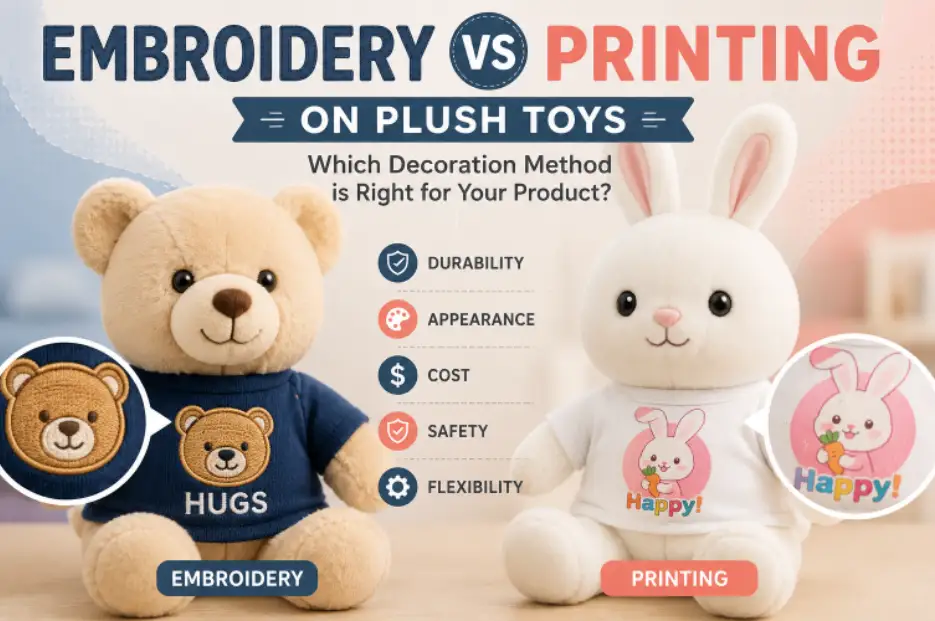
Embroidery uses thread — typically polyester or rayon — stitched directly into the fabric surface of a stuffed animal using computerized multi-needle machines. The design is digitized into a stitch file that controls needle penetration depth, stitch type (satin, fill, running), and thread color changes. The result is a raised, tactile graphic that is physically part of the plush material rather than sitting on top of it.
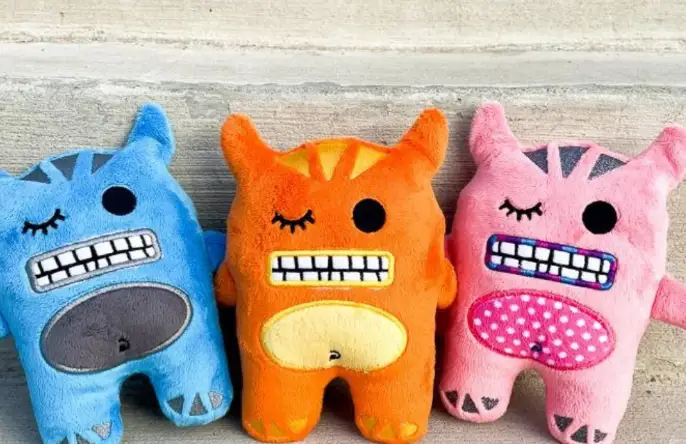
For facial features, brand logos, and character details on plush toys, embroidery has long been the industry benchmark. Its permanence, soft texture, and premium appearance justify the higher setup cost for most mid-to-high volume programs.
What is printing on plush toys?
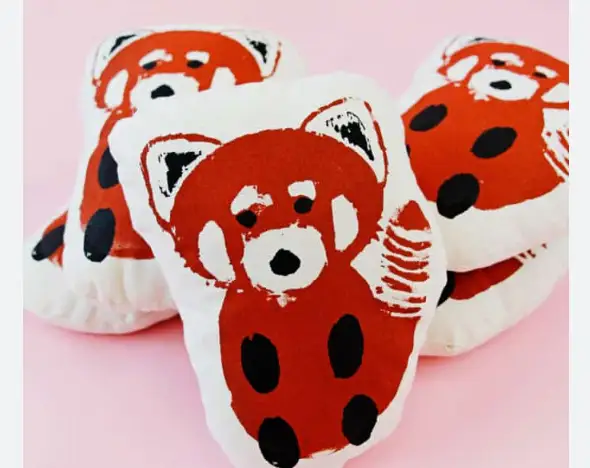
Printing on plush toys encompasses several processes — most commonly heat transfer printing, sublimation printing, and screen printing applied to the fabric before or after construction. Digital printing technologies have advanced significantly, enabling photorealistic imagery, gradient color fills, and fine-line detail that embroidery physically cannot reproduce at small scales.
Printing excels when a design contains complex color blends, photographic elements, or very small text. It also carries lower setup costs, making it attractive for short runs, personalized products, and rapid prototyping. The trade-off is durability: printed surfaces are more vulnerable to fading, cracking, and pilling under repeated laundering and abrasion.
Side-by-side comparison: key production metrics
| Attribute | Embroidery | Printing |
|---|---|---|
| Setup cost (digitizing/screens) | $50–$200 per design | $0–$80 (digital); $30–$150 (screen) |
| Typical MOQ | 300–500 units | 12–200 units (digital); 200+ (screen) |
| Unit cost premium vs base | +15–40% over printing | Lower baseline; rises with color count |
| Wash durability (cycles) | 500+ cycles without degradation | 50–150 cycles (varies by method) |
| Color range | Up to 15 thread colors per design | Unlimited (digital/sublimation) |
| Fine detail / small text | Limited below 4mm stroke width | Reproduces fine lines and gradients |
When embroidery on plush toys is the better choice
Safety and regulatory compliance
For toys intended for children under 36 months, EN 71, ASTM F963, and similar safety standards place strict requirements on surface coatings and colorants. Embroidery avoids the chemical migration risks associated with certain printing inks and binders. Because the color is entirely in the thread fiber rather than a topical coating, embroidered decorations are generally easier to certify for infant and toddler plush categories.
Brand premiumization and perceived value
Retailers, collectors, and gift buyers respond to the tactile dimension that embroidery adds. A stitched eye or logo has a three-dimensional quality — slight relief, visible thread texture — that communicates craftsmanship. For licensed plush products, promotional corporate gifts, and retail-ready stuffed animals competing at price points above $15, embroidery typically signals quality that printing cannot replicate.
Industry data
| Application type | Recommended method | Primary reason |
|---|---|---|
| Facial features (eyes, nose, mouth) | Embroidery | Safety — no loose parts; tactile premium |
| Brand logo on chest or foot pad | Embroidery | Durability through repeated washing |
| Photorealistic artwork / all-over print | Printing (sublimation) | Color fidelity; gradient reproduction |
| Personalized name/text | Printing (digital) | Low MOQ; variable data capability |
| Children’s toy (0–3 years) | Embroidery | Ink migration safety standards |
| Promotional giveaway (low volume) | Printing | No setup cost; fast turnaround |
When printing on plush toys makes more sense
Complex artwork and photorealistic designs
Sublimation and digital heat transfer printing can reproduce full-color photographic imagery across large fabric panels with no color count limitation. For plush toys featuring character artwork, illustrated scenes, or licensed imagery with fine gradients, printing is the only viable route. Attempting to replicate a 12-color gradient in embroidery would result in stitch counts so high that the fabric would pucker and the material would become rigid — defeating the purpose of a soft toy.
Short runs, sampling, and product development
During the new product introduction (NPI) phase, brands frequently need small quantities — sometimes as few as 12 to 50 units — for retail buyer presentations, trade show samples, or crowdfunding campaigns. Printing’s low setup cost and compatibility with on-demand production workflows make it the practical choice for validation before committing to a full embroidery program at volume.
Industry data
| Durability factor | Embroidery performance | Printing performance |
|---|---|---|
| Machine wash (40°C / 104°F) | Excellent — thread colorfast to 500+ cycles | Moderate — fading common after 50–100 cycles |
| Abrasion resistance | High — thread embedded in substrate | Lower — topical ink layer susceptible to cracking |
| UV/light exposure | Good with polyester thread | Variable — sublimation more stable than transfer |
| Child chewing/saliva | Safe — no coating to degrade | Risk-dependent on ink type and certification |
Cost modeling: Embroidery vs printing on plush toy
For runs under 200 units, printing nearly always wins on total cost due to zero or minimal digitizing fees and lower per-unit labor. The crossover point typically falls between 300 and 500 units, where embroidery’s lower variable cost per piece amortizes the upfront setup fee. At 1,000 units and above, embroidery’s superior durability also reduces returns and replacement costs — an often-overlooked component of total lifetime cost for plush toy programs.
| Practical tip: many manufacturers recommend a hybrid approach — embroidery for key brand elements and safety-critical facial features, combined with printed panels for complex background artwork. This preserves compliance and durability where it matters while keeping design flexibility wide open. |
| Order quantity | Lower total cost method | Notes |
|---|---|---|
| 1–99 units | Digital printing | No setup; on-demand compatible |
| 100–299 units | Printing (screen or digital) | Set up amortization still favors printing |
| 300–499 units | Break-even zone | Evaluate design complexity and wash requirements |
| 500–2,000 units | Embroidery | Setup cost amortized; durability reduces returns |
| 2,000+ units | Embroidery (or hybrid) | Lowest per-unit cost; best lifecycle value |
Frequently asked questions
1. Which is safer for infant plush toys — embroidery or printing?
Embroidery is generally the safer choice for infant and toddler plush toys. Because the color comes entirely from the thread fiber rather than a topical ink or binder, there is no risk of chemical migration from surface coatings. Standards such as EN 71-3 (migration of certain elements) and ASTM F963 are more straightforwardly satisfied with embroidered decorations than with printed ones, particularly for toys likely to be mouthed or heavily handled.
2. Can you combine embroidery and printing on the same plush toy?
Yes, and many professional plush manufacturers recommend this hybrid approach. A common configuration uses sublimation or digital printing for complex background artwork on fabric panels, with embroidery applied separately for facial features, brand logos, or signature details. The panels are printed before cutting and sewing, while embroidery is applied to the finished or semi-finished toy. This preserves design flexibility while keeping critical elements durable and compliant.
3. What is the minimum order quantity difference between embroidery and printing for plush toys?
Digital printing for plush toys can often be done in quantities as low as 12 to 50 units, making it ideal for samples, prototypes, and short promotional runs. Embroidery typically requires a minimum of 300 to 500 units to make the digitizing setup fee economically viable. Some manufacturers offer lower embroidery MOQs — as few as 100 units — but at a significantly higher per-unit cost that reflects the unchanged setup expense spread across fewer pieces.
4. How many wash cycles can an embroidered plush toy withstand compared to a printed one?
Embroidered designs on plush toys can withstand 500 or more machine wash cycles at standard temperatures (30°C–40°C) with no meaningful color degradation, assuming quality polyester or rayon thread. Printed designs vary significantly by technology: sublimation prints are the most durable at 100–200+ cycles, while heat transfer vinyl and screen prints typically show visible fading or cracking between 50 and 150 cycles, depending on wash conditions, detergent chemistry, and the specific ink system used.
5. Does embroidery add significant weight or stiffness to a plush toy?
For small, well-designed embroidery — typical logo placements, facial features, or simple brand marks — the added weight is negligible, and the stiffness is minimal. However, large-area fill embroidery covering significant portions of the toy surface can noticeably stiffen the plush fabric and add measurable weight, which may affect the toy’s feel and appeal. This is one reason complex full-coverage artwork is better executed through printing rather than embroidery on soft toys.
6. How long does the setup and sampling process take for each method?
Embroidery setup requires a digitizing step — converting artwork into a stitch file — which typically takes 2 to 5 business days, followed by a physical sample run. The total sampling lead time is usually 2 to 4 weeks for embroidered plush. Printing setup is faster: digital printing requires no physical screens or digitizing, so sampling can often be completed within 5 to 10 business days. Screen printing falls in between, requiring screen production (3–7 days) before the first sample can be produced.