Skip to content
In this guide, we’ll walk through CPSIA compliance for plush toys. The Consumer Product Safety Improvement Act — universally known as CPSIA — fundamentally reshaped the landscape of children’s product safety in the United States when it was signed into law in 2008. For plush toy manufacturers, importers, and private-label brands selling into the U.S. market, CPSIA compliance is not optional and not a one-time checkbox.
It is an ongoing legal obligation that touches product design, material sourcing, third-party laboratory testing, documentation, and labeling — at every production run. Failing to meet CPSIA requirements can result in mandatory recalls, civil penalties reaching millions of dollars, import bans, and reputational damage that is difficult to recover from.
This guide explains what CPSIA requires specifically for plush toys, how the testing and certification framework works, and what manufacturers need to have in place before their product reaches a U.S. retailer or consumer.
What CPSIA Covers and Why Plush Toys Are a Priority Category
Scope of the law and who it applies to
CPSIA applies to any “children’s product” — defined as a consumer product primarily intended for children aged 12 and under. Plush toys fall squarely within this definition, and most plush products are further subject to the heightened requirements that apply to toys intended for children under 3 years of age, where mouthing, chewing, and prolonged skin contact with materials are expected use behaviors.
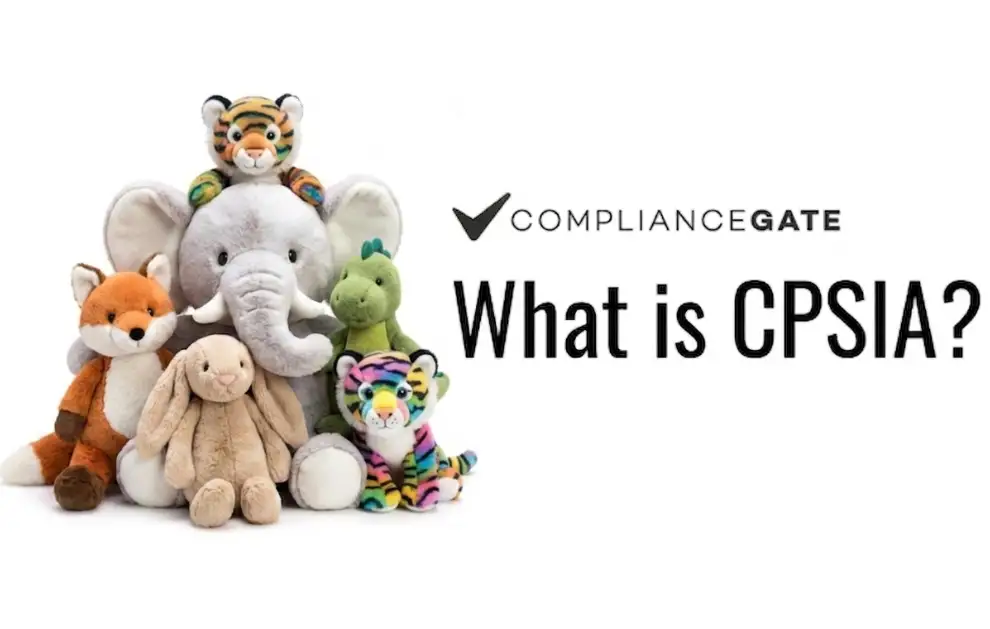
The law applies to every party in the supply chain that sells into U.S. commerce: domestic manufacturers, foreign manufacturers exporting to the U.S., importers, and retailers. There is no exemption for small businesses on the substantive safety requirements, though the CPSC has issued some limited exemptions on third-party testing obligations for very small batch manufacturers meeting specific criteria.
CPSIA works in conjunction with, rather than replacing, existing mandatory CPSC standards. For plush toys, the most directly relevant referenced standard is ASTM F963, the Standard Consumer Safety Specification for Toy Safety, which is incorporated by reference into federal regulation and carries mandatory status under CPSIA. Compliance with CPSIA means compliance with all applicable mandatory standards — not just the chemical limits that CPSIA itself is best known for.
The relationship between CPSIA, ASTM F963, and CPSC regulations
Understanding how these regulatory instruments relate to each other is essential for anyone building a compliance program. CPSIA establishes the overarching legal framework: it sets the lead and phthalate limits that apply to all children’s products, mandates third-party testing and Children’s Product Certificates (CPCs), and gives the CPSC authority to issue mandatory safety standards.
ASTM F963 covers the mechanical and physical safety of toys — things like small parts, sharp points, flammability, and fabric tensile strength — and is incorporated into mandatory federal regulation under 16 CFR Part 1250. The CPSC also issues specific mandatory standards outside of ASTM F963 for particular hazards, such as the mandatory phthalate regulations under 16 CFR Part 1307. Plush toys must satisfy all applicable layers simultaneously.
Key regulatory instruments applicable to plush toys sold in the U.S.
| Regulation / Standard | What it covers | Mandatory status |
|---|---|---|
| CPSIA Section 101 | Lead content limits in substrate and surface coatings | Mandatory — federal law |
| 16 CFR Part 1307 | Phthalate prohibitions in children’s toys | Mandatory — federal regulation |
| ASTM F963 (via 16 CFR 1250) | Mechanical, physical, flammability, and chemical toy safety | Mandatory — incorporated by reference |
| 16 CFR Part 1109 | Third-party testing and certification requirements | Mandatory — federal regulation |
| 16 CFR Part 1130 | Tracking label requirements for durable infant/toddler products | Mandatory for applicable products |
| 16 CFR Part 1115 | Substantial product hazard reporting obligations | Mandatory — federal regulation |
Lead and Phthalate Limits: The Core Chemical Requirements
Lead limits for children’s products
CPSIA Section 101 establishes two separate lead limits that apply to children’s products. The total lead content limit — 100 parts per million (ppm) — applies to the substrate materials of the product: the plush fabric, stuffing, eyes, nose components, and any other material that is part of the product’s physical structure. The surface coating lead limit — also 100 ppm — applies to any paint, coating, lacquer, or similar surface finish applied to accessible components.
For most plush toys made from textile fabric and polyester fiberfill, the substrate lead limit is the operative one, and modern polyester and textile materials routinely meet it without difficulty. The greater compliance risk for plush toys lies in the trims and components — embroidered patches with metallic thread, decorative buttons, painted plastic noses, and printed surface elements — where lead content must be verified through testing.
Phthalate prohibitions and their application to plush toys
CPSIA permanently prohibits eight specific phthalate compounds in children’s toys and child care articles at concentrations above 0.1 percent (1,000 ppm) in any component of the product. Phthalates are plasticizers commonly used in PVC and other soft plastic materials to impart flexibility, and they are a particular concern in plush toys because many trims and components — soft plastic noses, PVC-coated zipper pulls, flexible sewn-in labels, and decorative vinyl appliqués — may contain phthalates if not specifically formulated to exclude them.
The prohibition applies to each component individually, not to the product as a whole, so testing must cover every accessible plastic or soft material component. Manufacturers sourcing components from multiple suppliers must have phthalate test data for each part.
CPSIA chemical limits at a glance
| Substance/group | Limit (ppm) | Applies to | Regulation |
|---|---|---|---|
| Total lead — substrate | 100 ppm | All accessible substrate materials | CPSIA §101 |
| Lead — surface coating | 90 ppm | Paints and surface coatings | CPSIA §101 / 16 CFR 1303 |
| DEHP, DBP, BBP (permanent ban) | 1,000 ppm each | All plastic components in toys | 16 CFR Part 1307 |
| DINP, DIBP, DPENP, DHEXP, DCHP (permanent ban) | 1,000 ppm each | All plastic components in toys | 16 CFR Part 1307 |
Third-Party Testing and the Children’s Product Certificate
What third-party testing requires
CPSIA mandates that children’s products be tested by a CPSC-accepted third-party conformity assessment body — commonly called a CPSC-accepted laboratory — before being sold in U.S. commerce. Self-certification or supplier declarations are not sufficient for children’s products in the mandatory testing categories. The manufacturer or importer must use a laboratory that has been specifically accepted by the CPSC for each test method being performed. Lists of accepted laboratories are published on the CPSC website and are updated regularly.
Major accredited testing organizations active in toy compliance include SGS, Bureau Veritas, Intertek, TÜV SÜD, and UL Solutions, among others. The testing must be performed on a production sample representative of the product being sold — not a custom-built engineering sample — and must reflect the actual materials, components, and finishes in the final product.
Testing frequency is another critical compliance consideration. A new round of third-party testing is required whenever there is a material change to the product — a change in supplier, a substitution of fabric or filling material, a new component source, or a change in a surface decoration element. Many manufacturers establish a periodic retesting schedule (commonly annual for stable product lines) as a baseline, with event-triggered retesting whenever a supply chain change occurs.
The Children’s Product Certificate and what it must contain
Every children’s product subject to a mandatory safety rule must be accompanied by a Children’s Product Certificate (CPC) — a document created by the manufacturer or importer that certifies the product complies with all applicable mandatory safety rules. The CPC must be in English, must be available to the CPSC and U.S.
Customs and Border Protection on request, and must contain specific required information. The certificate does not need to be physically attached to each product, but it must be on file and immediately producible. Importers are the responsible party for CPC availability at point of entry into U.S. commerce.
Required contents of a Children’s Product Certificate (CPC) for plush toys
| Required element | Details |
|---|---|
| Product identification | Name and description sufficient to identify the product the certificate covers |
| Applicable mandatory rules | Each CPSC rule, ban, standard, or regulation the product is being certified to comply with |
| Manufacturer/importer identity | Name and contact information of the U.S. importer or domestic manufacturer issuing the certificate |
| Country of manufacture | Country where the product was manufactured |
| Date and place of manufacture | Specific production date or date range and manufacturing location |
| Third-party test results reference | Date and place of third-party testing; name and contact of the CPSC-accepted laboratory |
| CPC issuer identity | Name, title, and contact of the individual certifying on behalf of the manufacturer or importer |
ASTM F963 Requirements Specific to Plush Toys
Small parts, fabric integrity, and stuffing safety
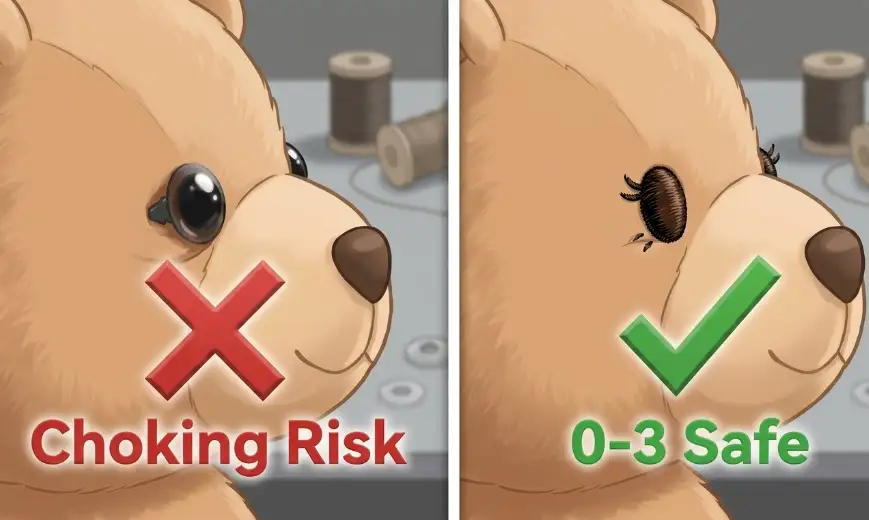
ASTM F963 contains numerous provisions directly relevant to plush toy construction. The small parts requirement — Section 4.6 — prohibits any toy intended for children under 3 from containing small parts or generating small parts through normal use and reasonably foreseeable abuse. For plush toys, this means that sewn-on eyes, buttons, decorative trims, and any attachable component must be assessed using the CPSC small parts cylinder (a tube 1.25 inches in diameter and 2.25 inches deep).
Components that fit entirely within the cylinder are classified as small parts and are prohibited in toys for children under 36 months. Plush toys intended for this age group typically use embroidered eyes and noses rather than plastic components precisely to comply with this requirement.
Fabric tensile strength requirements under Section 4.13 specify minimum force thresholds for fabric seams and attachments — relevant to any sewn element that a child might pull or bite. Stuffing material must be clean, non-toxic, and free from hard or sharp objects under Section 4.4. Flammability requirements under Section 4.2 require that textile materials used in the toy not ignite and spread flame in a manner that creates a burn hazard, with testing methods specified for both fabric and stuffing materials.
Tracking labels and production traceability
CPSIA Section 14(a)(5) requires that children’s products bear a permanent, distinguishable mark — commonly called a tracking label — that identifies the manufacturer or private labeler, the location and date of production, batch or run number, and any other information that facilitates identifying the source of the specific unit. For plush toys, the tracking label is typically a sewn-in woven label or an ink-printed label on the care tag.
The requirement exists so that, in the event of a safety incident or recall, specific production lots can be identified and targeted for retrieval rather than requiring a broad market-wide action. Tracking labels must be permanent for the useful life of the product — they cannot be removable hang tags or stickers.
ASTM F963 sections most relevant to plush toy compliance
| F963 Section | Requirement | Plush toy implication |
|---|---|---|
| Section 4.2 | Flammability of fabric and stuffing | All textile materials must pass flame spread tests |
| Section 4.4 | Stuffing material safety | Fill must be clean, non-toxic, free of sharp inclusions |
| Section 4.6 | Small parts prohibition (<3 yr) | No component that fits the CPSC small parts cylinder |
| Section 4.13 | Fabric and seam integrity | Minimum tensile strength for sewn seams and attachments |
| Section 4.19 | Toy chests / soft-sided storage | Applies if plush toy is part of a storage product |
| Section 4.35 | Projectile toys | Not typically applicable; relevant if toy includes launcher |
| Section 5 | Chemical requirements | Covers heavy metals in materials per ASTM F963-17+ |
Common Compliance Failures and How to Avoid Them
Supply chain gaps that create testing liability
The most common CPSIA compliance failure for plush toy importers is not a deliberate violation — it is an undocumented supply chain change that voids the existing test coverage. A factory substitutes a thread supplier, changes the source of polyester fiberfill, or switches to a different plastic for safety eyes without notifying the buyer.
The test reports on file no longer reflect the actual product in commerce, and any compliance claim based on those reports is invalid. Preventing this requires active supplier quality management: written material change notification requirements in every supplier contract, incoming material verification against approved specifications, and periodic audit visits to verify that production matches documentation.
A second common failure point is component-level phthalate testing. Importers sometimes test only the primary fabric and stuffing of a plush toy, overlooking the PVC zipper pull, the flexible sewn-in label printed with ink on a vinyl substrate, or the decorative rubber charm attached to the hang tag. Each accessible plastic or soft material component must be individually tested. The CPSC has cited importers for exactly this kind of selective testing coverage, and the enforcement record makes clear that the obligation extends to every component, not just the most obvious ones.
Frequently Asked Questions
1. Does CPSIA apply to plush toys sold only online, or only those in physical retail stores?
CPSIA applies to all children’s products sold in U.S. commerce, regardless of the sales channel. Online sales — whether through a brand’s own website, Amazon, Etsy, or any other platform — are fully subject to CPSIA requirements including third-party testing, Children’s Product Certificates, and tracking labels. The CPSC has taken enforcement action against online sellers, including small businesses and individual sellers on marketplace platforms, for non-compliant children’s products.
The channel through which a product reaches the consumer does not affect the legal obligation. Importers and manufacturers should also be aware that major online marketplaces are increasingly requiring CPSIA documentation as a condition of listing children’s products, making compliance a practical marketplace access requirement in addition to a legal one.
2. How often does a plush toy need to be third-party tested under CPSIA?
Third-party testing is required before a children’s product enters U.S. commerce for the first time, and it must be repeated whenever there is a material change to the product or its production. A material change includes switching fabric suppliers, changing stuffing material sources, modifying any component (eyes, nose, trims, labels), altering surface decoration methods, or shifting production to a new factory.
In practice, most compliant manufacturers establish a baseline annual retesting schedule for ongoing product lines combined with event-triggered retesting for any supply chain change. The CPSC has made clear that a test report from a prior production run does not automatically cover a subsequent run if any material input has changed, even if the finished product appears identical.
3. What is a Children’s Product Certificate and who is responsible for creating it?
A Children’s Product Certificate (CPC) is a written document that certifies a children’s product complies with all applicable mandatory CPSC rules and standards, based on third-party test results from a CPSC-accepted laboratory. The CPC must be created by the manufacturer or importer — it is not issued by the testing laboratory. For products manufactured outside the United States, the U.S. importer is the responsible party.
The CPC does not have a prescribed format but must contain specific required elements including product identification, applicable standards, manufacturer and importer identity, country and date of manufacture, and third-party test results reference. It must be available to the CPSC and U.S. Customs on request and does not need to be physically attached to the product, but it must be immediately accessible.
4. Are there any CPSIA exemptions for small batch plush toy manufacturers or craft sellers?
The CPSC has established a limited third-party testing exemption for small batch manufacturers — defined as those with annual gross revenues of $1 million or less from the sale of children’s products — under certain conditions. Qualifying small batch manufacturers may be able to use alternative testing approaches, including reliance on component testing from suppliers, rather than full finished-product third-party testing.
However, this exemption does not waive the substantive safety requirements themselves: lead limits, phthalate prohibitions, ASTM F963 compliance, tracking label requirements, and CPC obligations still apply. The exemption is narrow, conditions apply, and the CPSC guidance should be reviewed carefully before relying on it. Sellers on craft platforms like Etsy are not automatically exempt simply because they are small businesses.
5. What are the penalties for selling non-compliant plush toys in the U.S. market?
The penalties for CPSIA violations are substantial and can be applied per violation per day. Civil penalties for knowing violations of CPSC rules can reach up to $100,000 per violation, with a maximum of $15 million for a related series of violations under a single proceeding. In addition to financial penalties, the CPSC can order mandatory recalls, require corrective action plans, seek injunctive relief, and refer cases to the Department of Justice for criminal prosecution in cases involving knowing and willful violations.
Importers face the additional risk of the CPSC working with U.S. Customs and Border Protection to detain and refuse entry to non-compliant shipments at the border. Retailers who discover they have sold non-compliant children’s products also have mandatory reporting obligations to the CPSC under Section 15(b) of the Consumer Product Safety Act.