Skip to content
The plush toy stuffing process sits at the heart of every plush toy’s identity. It dictates how a toy feels when squeezed, whether it holds its shape after a thousand bedtimes, and whether it clears the safety thresholds required to reach retail shelves. Yet among buyers, brand managers, and even experienced sourcing teams, it remains one of the most under-specified steps in the soft toy supply chain.
This guide covers everything from fill material science and machine selection to density control, multi-zone techniques, and post-stuffing quality inspection — giving you the production-level knowledge needed to make better decisions at every stage of custom plush development.
Understanding why stuffing material choice defines the final product
A plush toy’s perceived quality is shaped more by what is inside it than by any surface treatment. The filling material determines total weight, tactile softness, recovery after compression, washability, and long-term loft retention. Specify the wrong fill and a toy that photographs beautifully can feel stiff and cheap in hand, or collapse after its first machine wash.
Most experienced manufacturers distinguish between two fill categories: primary fill, which forms the structural bulk of the toy’s body, and secondary or specialty fill, used in internal pellet pouches, weighted bases, aromatherapy inserts, or firm-core components. Matching each category to the correct material is the foundation of a well-designed stuffing specification.

Polyester fiberfill — the industry standard
Polyester fiberfill — widely known as PP cotton in manufacturing contexts — is the dominant stuffing material across commercial plush toy production. It is extruded from polyester polymer into fine fibers, then opened and lofted into a cloud-like fill. Virgin PP cotton offers superior loft, consistent denier, excellent moisture resistance, and strong chemical compliance profiles. Recycled PET fiberfill, derived from post-consumer plastic bottles, is increasingly specified by sustainability-focused brands, though it demands more rigorous third-party testing for residual chemical contaminants before it can be certified for children’s toys.
Beyond standard polyester, the industry uses PP pellets for weighted components, slow-rebound memory foam for ergonomic and therapeutic applications, GOTS-certified organic cotton for premium natural product lines, and shredded foam offcuts in low-cost promotional plush. Each material carries a distinct cost structure, handling requirement, and compliance burden.
Stuffing materials — core properties compared
| Material | Trade name | Washability | Loft retention | Best application |
|---|---|---|---|---|
| Virgin polyester fiberfill | PP cotton | Excellent | High — 5–7 yr | Standard retail plush, bears |
| Recycled PET fiberfill | Eco fill | Good | Moderate | Sustainability-certified brands |
| PP pellets/beads | Bean fill | Good (in pouch) | N/A — weighted | Weighted bases, fidget toys |
| Memory foam | Slow-rebound foam | Spot clean only | Very high | Therapeutic, ergonomic plush |
| Organic cotton | Natural fill | Good | Low–moderate | GOTS / organic-certified toys |
| Shredded foam offcuts | Foam crumble | Poor | Low | Budget / promotional items |
The stuffing process from shell to finished toy
Commercial plush toy stuffing follows a clearly structured workflow. Each stage builds on the previous one, and a breakdown at any point — a missed pre-inspection, an uncalibrated machine, an undertrained hand-stuffer — propagates into defects that are expensive to catch at final audit and almost impossible to fix post-shipment.
Pre-stuffing shell inspection
Before any filling enters a shell, it passes through in-process quality control (IPQC). Operators check for missed seams, stitch skips, fabric pulls, and label placement errors. Features like embroidered facial details or heat-transferred prints are verified against the approved golden sample at this stage. Shells that fail move to a repair station; only cleared units advance. Skipping this checkpoint is one of the leading causes of costly end-of-line rejects in soft toy factories.
Machine stuffing vs. hand stuffing
The two primary stuffing methods — pneumatic machine and manual hand stuffing — each serve distinct production scenarios, and most professional factories use both in a hybrid workflow.
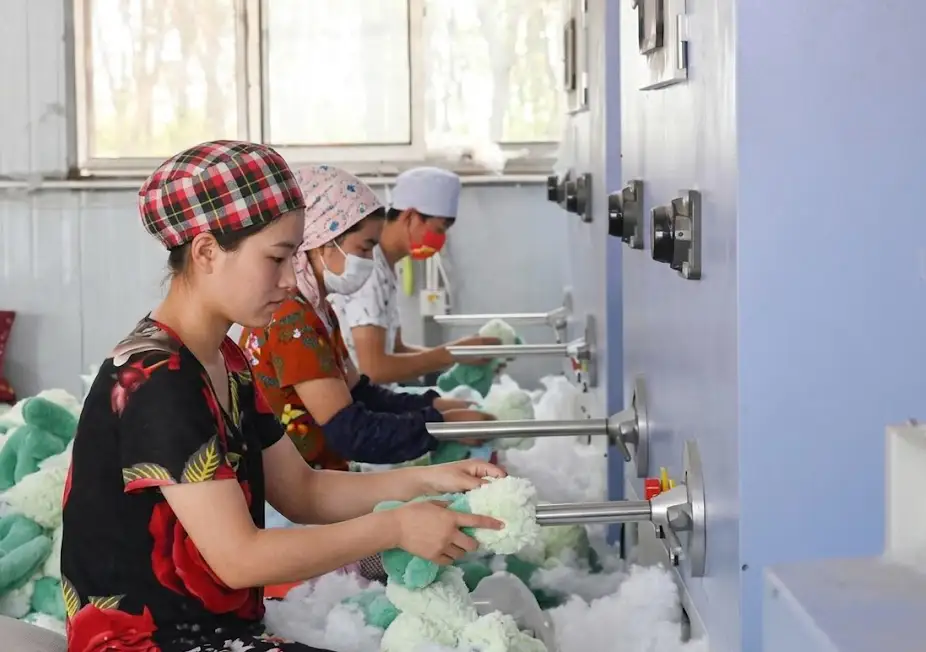
Pneumatic stuffing machines use compressed air to drive loosened fiberfill through a nozzle into the toy body. Output rates range from 200 to 400 units per hour depending on toy size and body complexity. Machines excel at stuffing open, accessible body cavities at consistent fill weights. They struggle with narrow limbs, tapered tails, small ears, and any appendage a nozzle cannot reach without compressing the shell.
Hand stuffing — inserting small, layered handfuls of fiberfill by hand — is slower at 30 to 80 units per hour but offers precision control that no machine matches. In a hybrid workflow, a machine packs the main body torso while trained operators hand-pack the head, limbs, and character-specific protrusions. This approach is standard for licensed character plush and any design where shape accuracy is a primary quality criterion.
Production note: Pneumatic machines require daily calibration. A 10% variance in air pressure can shift stuffed toy fill weight by 15–20 grams — enough to cause consistent spec failures and shape inconsistency across a production run.
Machine vs. hand stuffing — production characteristics
| Factor | Pneumatic machine stuffing | Hand stuffing |
|---|---|---|
| Output rate | 200–400 units/hr | 30–80 units/hr |
| Fill weight consistency | High — machine-controlled | Variable — operator-dependent |
| Limb & detail access | Limited by nozzle diameter | Full — finger-packing possible |
| Labor cost per unit | Lower at scale | Higher — intensive |
| Ideal for | High volume, open body shapes | Complex anatomy, small runs |
Stuffing density specification and fill weight control
Stuffing density is the single most under-specified parameter in most plush toy tech packs — and the one most directly responsible for shape failures, seam stress defects, and poor consumer perception. Density is expressed as a target fill weight in grams with an acceptable production tolerance, such as 85 g ± 5 g for a standard 25 cm character plush.
Under-stuffed toys lose definition at the neck and extremities, creating a deflated appearance inconsistent with the approved golden sample. Over-stuffed toys feel hard, fail the softness expectations set by consumer research, and generate internal pressure that stresses seam allowances — directly increasing the probability of seam burst failure during testing. Responsible factories perform fill weight monitoring every 20–30 units during production using calibrated digital scales, logging results against the tolerance band specified in the tech pack.
Specialized stuffing methods for complex and functional designs
Compartmental stuffing for multi-zone toys
High-complexity plush designs — poseable dolls with firm torsos and soft limbs, or floor plush with rigid base structures and cloud-soft upper bodies — require compartmental stuffing. Internal fabric barriers or divider seams segregate the body into zones, each filled with a different material or density level.
This prevents fill migration between zones over time and allows a single toy to deliver meaningfully different tactile experiences across its body. The technique is standard in premium character plush and in therapeutic weighted toys that combine PP pellet pouches with polyester fiberfill surrounds.
Weighted plush and pellet fill integration
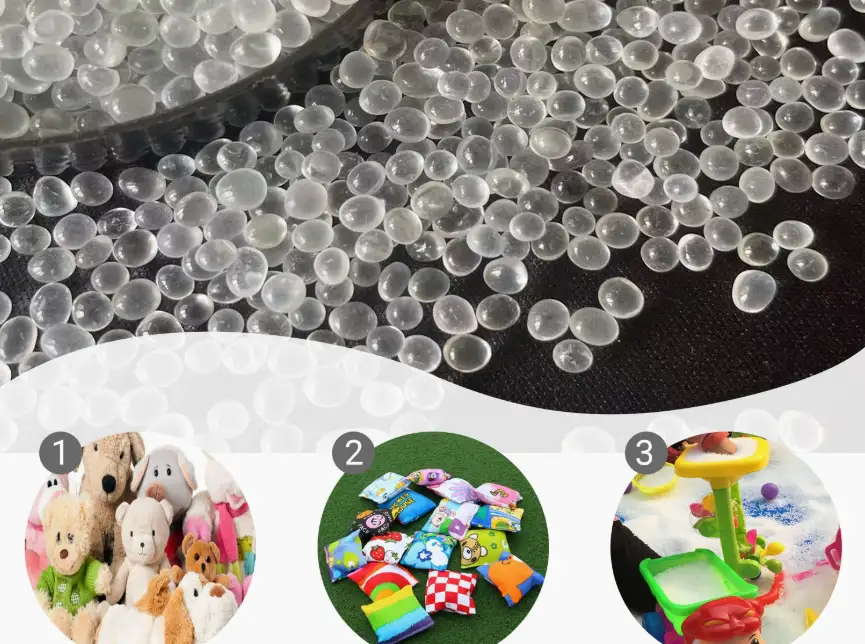
Weighted plush toys for sensory and anxiety-reduction applications use sealed inner pouches filled with PP beads (typically 3–5 mm diameter) to add controlled mass. The pouch must be fabricated from tightly woven fabric and sewn with a double-stitch construction to prevent bead escape — a requirement with direct safety implications.
Under ASTM F963 and EN 71 Part 1, beads or pellets that can be released from a toy and ingested are classified as choking hazards. Weighted plush is typically age-gated at 3+ and labeled accordingly, with the inner pouch sewn to the shell interior to prevent localized weight migration during use.
Fill weight reference by toy size — production standards
| Toy height | Target fill weight | Firmness profile | Typical category |
|---|---|---|---|
| 10–15 cm (keychain mini) | 15–35 g | Soft–medium | Bag charms, mascots |
| 20–30 cm (standard) | 60–120 g | Medium | Retail plush, gifts |
| 35–50 cm (large) | 150–300 g | Medium–firm | Display, collectibles |
| 60–90 cm (jumbo) | 400–800 g | Firm | Floor plush, pillows |
| Weighted sensory toys | 500 g–2 kg total | Heavy / structured | Therapeutic, sensory use |
Closing, finishing, and post-stuffing quality assurance
Ladder stitch closure and surface finishing
The stuffing opening — usually placed at the toy’s lower back or base seam — is closed by hand using a ladder stitch, also called a slip stitch. Executed correctly, this hand-sewing technique produces an invisible closure indistinguishable from machine-sewn seams on the exterior.
The ladder stitch is consistently among the first elements examined during third-party final random inspection (FRI), as its quality is a reliable proxy for overall factory workmanship standards. Some budget operations substitute machine bar-tacking, which is faster but visually prominent. Premium and licensed character plush almost always specifies hand closure.
After closing, operators trim all thread tails, inspect pile direction and surface texture, and verify that any post-stuffing accessories — clip-on hang tags, swing labels, sewn-on bows — are attached correctly and securely.
Final quality control checkpoints
Post-stuffing QC follows a multi-point inspection framework. Stuffed toys are weighed on calibrated scales; firmness is assessed against the golden sample by touch; closing seams are manually pulled; and a sample percentage of units undergoes seam burst testing per EN 71-1 or ASTM F963 protocols. Safety eye and nose security receives particular attention — small components must withstand a minimum 90 N axial pull force to pass applicable toy safety requirements in both the US and EU markets.
Compliance note: All stuffing materials must be declared on a material safety data sheet and supported by third-party test reports. Undeclared or inadequately documented fill materials are among the most common reasons for customs detention and product recall actions in both the US and EU markets.
Post-stuffing QC inspection checklist
| Checkpoint | What is verified | Standard or method |
|---|---|---|
| Fill weight check | Stuffed unit weighed against spec band | Calibrated scale, ± 2–5 g tolerance |
| Shape and firmness | Visual and tactile vs. golden sample | Approved reference unit on line |
| Closure seam integrity | Ladder stitch gap-free, no thread tails | Visual inspection + manual pull |
| Seam burst test | Force applied to highest-stress seams | EN 71-1 / ASTM F963 seam strength |
| Surface and pile inspection | Fabric pulls, pile direction, stitch skips | Visual under standard D65 lighting |
| Small part security | Eyes, noses, buttons pull-tested | Min. 90 N axial force per EN 71-1 |
Frequently asked questions
What is PP cotton and why does it dominate plush toy stuffing?
PP cotton is a polyester fiberfill named for its cotton-like texture despite being fully synthetic. It is produced by extruding polyester polymer into fine fibers that are then crimped and lofted. It dominates commercial plush production because it is hypoallergenic, odorless, resistant to mold and moisture, machine-washable, and substantially cheaper than natural alternatives at scale.
Virgin PP cotton also rebounds reliably after compression — a property called loft retention — meaning the toy springs back to shape after years of squeezing and washing rather than packing flat.
How do I specify stuffing density in a plush toy tech pack?
Specify a target fill weight in grams with a tolerance band — for example, 90 g ± 5 g for a 28 cm toy. Pair this with a written firmness descriptor (“soft and squishy,” “medium firm with defined head shape”) and a reference to an approved physical golden sample kept at the factory.
For complex designs with multiple body zones, specify fill weight and material separately for each zone. Some buyers also include a fill volume measurement in cubic centimeters for pillow-style or irregular-shape plush where weight alone does not fully constrain density.
Is recycled polyester fiberfill safe for children’s toys?
It can be, but it requires more documentation than virgin fill. Recycled PET fiberfill must be tested by an accredited lab — SGS, Intertek, Bureau Veritas, or equivalent — for heavy metal migration, residual chemical content, and physical contaminants before it can be declared compliant with EN 71-3 or ASTM F963. Do not accept verbal compliance assurances from suppliers. Request the actual test certificates, verify lab accreditation, and check that the test scope covers the specific recycled fill grade you are purchasing. OEKO-TEX STANDARD 100 certification on the fill material provides an additional layer of confidence for sensitive-age product categories.
What causes lumpy or uneven stuffing in finished plush toys?
Three root causes account for almost all lumpy stuffing defects. First, low-quality fiberfill with short, irregular fiber lengths that tangle into clumps instead of distributing evenly. Second, inadequate fiber opening — professional machines run compressed fiber bale material through an opener before stuffing, and skipping this step results in dense, uneven clusters entering the shell.
Third, undertrained hand-stuffers who push fill in large masses rather than building up the toy in small, dispersed handfuls. To prevent all three, specify virgin fiberfill in the 3D–7D denier range, require documented machine-opening procedures in your tech pack, and include photographic no-lump references in your QC criteria.
Are weighted plush toys safe for young children?
Weighted plush toys can be made safely, but they require stricter construction standards than standard polyester-filled toys. The inner pellet pouch must use densely woven fabric and double-stitched seams to contain beads under sustained use and washing stress.
Under EN 71-1 and ASTM F963, any bead or pellet small enough to fit through a cylindrical test aperture (approximately 31.7 mm) that can escape a toy is classified as a choking hazard. For this reason, weighted plush intended for retail sale is typically age-restricted to 3 years and over, labeled clearly on the product, and subjected to a separate pouch integrity test protocol before shipment approval.
What is the difference between siliconized and non-siliconized fiberfill?
Siliconized fiberfill has a thin silicone coating applied to each fiber during manufacturing. This coating reduces inter-fiber friction, allowing the fill to flow freely through machine nozzles during production and giving the finished toy a particularly smooth, silky softness — sometimes described as a “cloud feel.” Non-siliconized fill offers slightly more resistance between fibers, producing a denser, more structured feel that many buyers associate with a “huggable” quality.
Siliconized fill is the preferred choice for infant toys and premium character plush. Non-siliconized is standard in mid-range commercial production. Both types are considered safe, with no adverse effect on washability or regulatory compliance.
Can over-stuffing cause a toy to fail safety testing?
Yes — and this is one of the most commonly overlooked connections in plush production QA. Over-stuffing generates sustained internal pressure against every seam in the toy. When that toy is then subjected to seam burst testing per EN 71-1 (which applies forces up to 70–90 N to high-stress seam points), the combination of internal pressure and external test force can cause seam failure that would not have occurred at correct fill weight.