Skip to content
Today, let us talk about the topic, ASTM F963 vs EN 71 plush toy standards, so you will have a full picture after reviewing this article. If you manufacture, source, or sell plush toys in the United States or the European Union, two regulatory frameworks define the baseline of every safety decision you make: ASTM F963 and EN 71.
These standards govern everything from the pull force required to keep a safety eye attached to the maximum permissible concentration of lead in a painted surface.
Understanding how they differ — and where they overlap — is not a box-checking exercise. It is the foundation of a defensible product compliance program that protects consumers, reduces recall risk, and keeps your products on shelves in the world’s two largest toy markets.
What ASTM F963 and EN 71 actually are
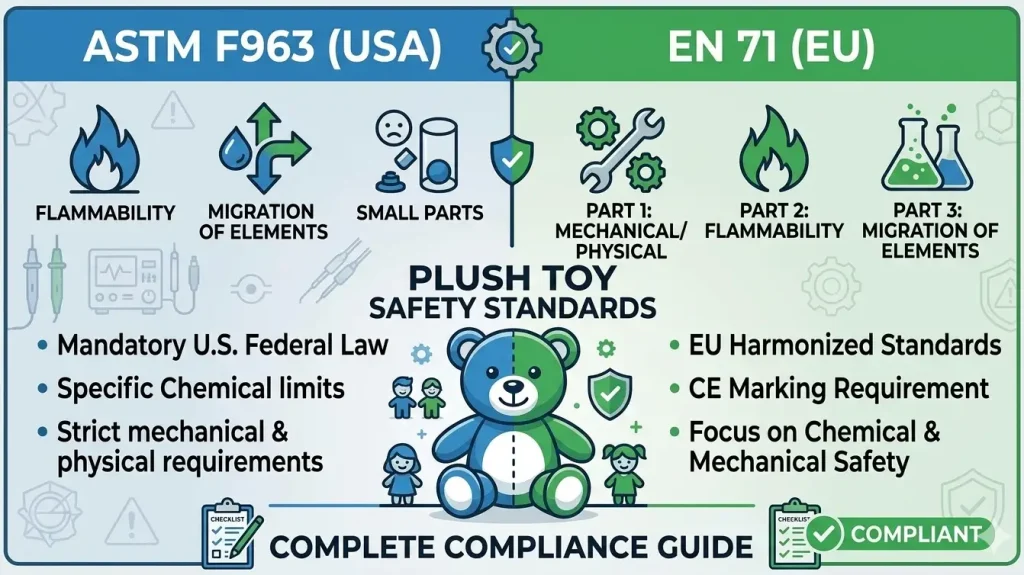
ASTM F963 is the Standard Consumer Safety Specification for Toy Safety, developed and maintained by ASTM International and enforced in the United States through the Consumer Product Safety Improvement Act (CPSIA) of 2008. Under CPSIA, compliance with ASTM F963 is legally mandatory for toys intended for children under 14 years old sold in the US market.
The current active version is ASTM F963-17 (with subsequent amendments), and manufacturers are required to issue a Children’s Product Certificate (CPC) backed by third-party laboratory testing from a CPSC-accepted lab.
EN 71 is a multi-part European standard developed by CEN (the European Committee for Standardization). It forms the technical basis for CE marking of toys across the European Economic Area, governed by the EU Toy Safety Directive 2009/48/EC. Unlike ASTM F963, which is a single consolidated document, EN 71 is structured as a series of separate parts — each addressing a specific hazard category.
For plush toys, the most relevant parts are EN 71-1 (mechanical and physical properties), EN 71-2 (flammability), and EN 71-3 (migration of certain elements). Manufacturers selling in the EU must complete a technical file and issue a Declaration of Conformity (DoC) supported by test reports from a notified body or accredited laboratory.
Regulatory framework overview — ASTM F963 vs EN 71
| Dimension | ASTM F963 (United States) | EN 71 (European Union) |
|---|---|---|
| Governing body | ASTM International / CPSC | CEN / European Commission |
| Enabling legislation | CPSIA 2008 | EU Toy Safety Directive 2009/48/EC |
| Document structure | Single consolidated standard | Multi-part series (EN 71-1 through 14) |
| Required compliance document | Children’s Product Certificate (CPC) | Declaration of Conformity (DoC) |
| Age scope | Children under 14 years | Children under 14 years |
| Third-party lab requirement | CPSC-accepted lab mandatory | Accredited/notified body recommended |
| Market marking | No physical mark required | CE mark mandatory on product/packaging |
Mechanical and physical safety requirements for plush toys
Both standards apply extensive mechanical testing to plush toys, targeting the same fundamental hazards — choking, strangulation, puncture, and entrapment — but differ meaningfully in test methodology and threshold values. Understanding these differences is critical when designing a test plan that must satisfy both markets simultaneously.
Small parts and choking hazard testing
Under both ASTM F963 and EN 71-1, any component that fits entirely within a small parts cylinder (approximately 57 mm long × 31.7 mm diameter) constitutes a choking hazard for children under 36 months. For plush toys, this directly governs the design of safety eyes, noses, buttons, and decorative accessories. Components must either be too large to fit the cylinder or must withstand prescribed pull and torque forces without detaching.
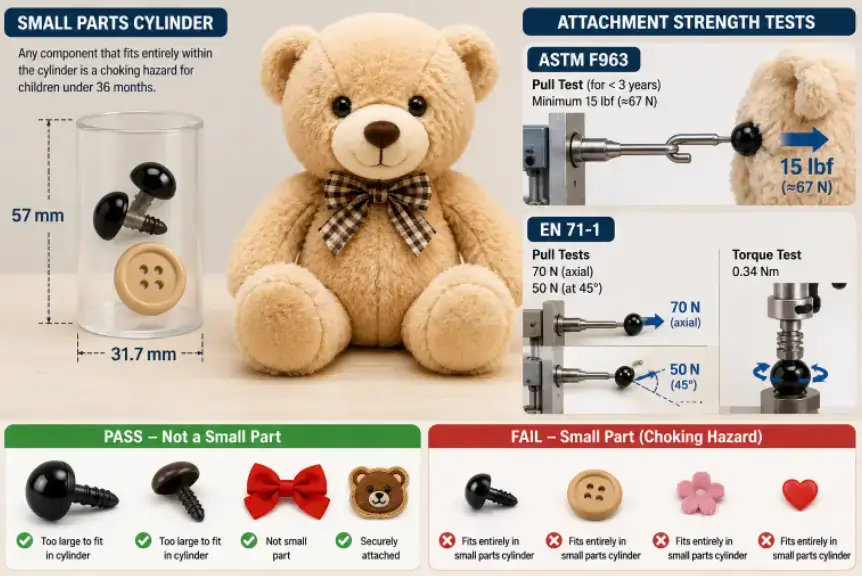
ASTM F963 specifies a minimum 15 lbf (approximately 67 N) pull force for attached components on toys intended for children under 3 years. EN 71-1 applies a comparable pull test of 70 N axially and 50 N at a 45-degree angle. The EN 71 test also includes a torque test of 0.34 Nm that ASTM F963 does not specifically require at the same threshold — a meaningful difference when engineering safety eye attachment systems for dual-market products.
Seam strength and stuffing integrity
Both standards require that plush toy seams withstand defined pull forces without failure. ASTM F963 specifies that fabric seams must resist a 15 lbf tension force, while EN 71-1 applies a 70 N seam pull test. In practical terms, these forces are approximately equivalent, but EN 71-1 additionally specifies a bite test simulation on soft-filled toys — applying a 50 N compression force to assess whether the shell can rupture and release stuffing material accessible as a hazard to young children.
Stuffing fill material itself is also regulated. Both standards prohibit stuffing materials that contain toxic substances, sharp objects, or small parts that could become accessible through reasonably foreseeable abuse. EN 71-3 goes further by specifying migration limits for elements including lead, cadmium, chromium, and mercury in any material a child could place in their mouth — including the outer fabric of a plush toy.
Mechanical test comparison — plush toy critical parameters
| Test parameter | ASTM F963 requirement | EN 71-1 requirement |
|---|---|---|
| Small parts cylinder | 57 mm × 31.7 mm (same geometry) | 57 mm × 31.7 mm (same geometry) |
| Axial pull force (small parts) | 15 lbf (≈ 67 N) for under 3 yrs | 70 N axial |
| Torque test | Not separately specified at EN level | 0.34 Nm applied to components |
| Seam pull test | 15 lbf (≈ 67 N) | 70 N tensile |
| Bite/compression test | Not specified for soft toys | 50 N bite simulation on soft toys |
| Cord and string length limit | Max 12 inches (≈ 305 mm) for under 3 | Max 220 mm for children under 36 months |
Flammability requirements — a key point of divergence
Flammability is one of the clearest areas of substantive difference between ASTM F963 and EN 71-2. Both standards require that plush toys not present an unacceptable fire hazard, but the test methods and acceptable burn rate thresholds diverge in ways that can require manufacturers to use different fabric specifications for US and EU markets.
ASTM F963 flammability testing
ASTM F963 references the US Consumer Product Safety Commission’s flammability requirements under 16 CFR Part 1610 (for textile fabrics) and the FF 3-71 standard for children’s sleepwear. For standard plush toys not intended as sleepwear, ASTM F963 Section 4.2 classifies toys by flame spread characteristics. Fabric used in plush toys must not flash-burn — meaning it cannot propagate flame rapidly across its surface. Most commercially produced plush fabrics (polyester pile, fleece, velboa) inherently pass this requirement, but specialty materials, particularly natural fiber fabrics, may require flame-retardant treatment to comply.

EN 71-2 flammability requirements
EN 71-2 applies a more comprehensive and prescriptive flame test methodology for soft-filled toys. It classifies toy materials based on measured burning rates and requires that all materials used in a toy’s exterior be tested. The standard specifically prohibits the use of material that burns at a surface spread rate exceeding 30 mm per second. For plush toys, EN 71-2 testing is mandatory for all exterior fabric and any trim materials, including ribbons, bows, and decorative appliqués. This requirement captures components that ASTM F963 might classify as incidental trim and subject to less stringent testing.
Practical note: Most standard polyester pile and velboa plush fabrics pass both flammability standards without treatment. However, novelty natural-fiber or metallic-thread accents should always be independently flammability-tested — they are a common cause of EN 71-2 failures on otherwise compliant products.
Chemical safety — where EN 71-3 sets a higher bar
Chemical safety is arguably the area of greatest practical difference between the two standards for plush toy manufacturers. While both frameworks prohibit the use of toxic materials, the testing regime under EN 71-3 is considerably more granular and — in several element categories — sets stricter migration limits than the corresponding requirements under ASTM F963.
EN 71-3 element migration limits
EN 71-3 specifies migration limits for 19 elements across three material categories: dry/brittle/powder-like materials, liquid or sticky materials, and scraped-off material. For plush toys, this most directly affects surface coatings, printed fabrics, dyed fibers, and any painted or screen-printed decorative features. Elements regulated include antimony, arsenic, barium, cadmium, chromium (III and VI), cobalt, copper, lead, manganese, mercury, nickel, selenium, strontium, tin, and zinc.
Critically, EN 71-3 distinguishes between total element content and migration — the amount that can leach out under simulated oral contact conditions. This distinction matters because a fabric can contain a heavy metal as part of its dye structure yet still comply if migration below the threshold limit is demonstrated. Manufacturers sourcing colored faux fur or printed plush fabrics must test the actual production materials, not rely on generic fabric supplier declarations.
Chemical safety requirements — EN 71-3 vs ASTM F963 selected elements
| Element | EN 71-3 limit (scraped material, mg/kg) | ASTM F963 / CPSIA limit (mg/kg) | Relevance to plush toys |
|---|---|---|---|
| Lead (total) | 13.5 mg/kg (migration) | 100 mg/kg total content (CPSIA) | Surface paints, printed fabrics |
| Cadmium | 1.9 mg/kg | Not separately limited under F963 | Dyed fabrics, plastic accessories |
| Chromium (VI) | 0.053 mg/kg | Not specifically limited | Chrome-tanned leather accents |
| Nickel | 0.5 mg/kg | Not specifically limited | Metal zippers, clasps |
| Antimony | 45 mg/kg | 60 mg/kg | Flame-retardant treated fabrics |
| Barium | 4,500 mg/kg | 1,000 mg/kg | Pigments in surface coatings |
Labeling, documentation, and market access requirements
Beyond physical product testing, ASTM F963 and EN 71 create distinct documentation obligations that manufacturers must meet before products can legally enter each market.
US market — Children’s Product Certificate and tracking labels
CPSIA requires that every children’s product sold in the US — including plush toys — be accompanied by a Children’s Product Certificate (CPC). The CPC must identify the product, the applicable standard (ASTM F963), the manufacturer, the importer, the date and location of manufacture, and the CPSC-accepted laboratory that conducted the required third-party testing. Additionally, CPSIA Section 14(b) requires that all children’s products bear a permanent tracking label identifying the manufacturer, production location, date of manufacture, and batch or lot number. For plush toys, this label is typically sewn into a seam.
EU market — CE marking and technical file
To affix the CE mark and sell a toy in the EU, a manufacturer or EU-based importer must compile a technical file containing: a product description and photograph, a list of all applicable harmonized standards (including relevant EN 71 parts), test reports, a risk assessment, and a signed Declaration of Conformity. The technical file must be retained for 10 years after the last unit is placed on the market and must be made available to market surveillance authorities on request. CE marking does not require government pre-approval — it is a self-declaration of conformity supported by the technical file.
Documentation and labeling requirements by market
| Requirement | US (ASTM F963 / CPSIA) | EU (EN 71 / Toy Safety Directive) |
|---|---|---|
| Primary compliance document | Children’s Product Certificate (CPC) | Declaration of Conformity (DoC) |
| Product marking | Tracking label on product (CPSIA §14b) | CE mark on product or packaging |
| Test report basis | CPSC-accepted third-party laboratory | Accredited / EN ISO 17025 lab |
| Age warning required | “Not for children under 3” if applicable | Standardized age warning symbol |
| Record retention | CPC retained, no statutory period specified | Technical file retained 10 years |
| Importer responsibility | US importer can issue CPC | EU Responsible Person must be established |
Testing strategy for dual-market plush toy products
Manufacturers targeting both the US and EU markets face the practical challenge of satisfying two overlapping but non-identical testing frameworks within a single production timeline. The most efficient approach is to commission a unified test program with a dual-accredited laboratory — one that holds both CPSC acceptance for ASTM F963 testing and EN ISO 17025 accreditation for EN 71 testing. Labs such as SGS, Intertek, Bureau Veritas, and TÜV SÜD offer both capabilities and can issue a single test report addressing all relevant standard requirements simultaneously.
When building a test plan, prioritize the more stringent requirement for each parameter. For chemical testing, EN 71-3 is generally stricter for elements like cadmium and chromium VI, so passing EN 71-3 typically satisfies the CPSIA chemical content limits as well. For mechanical tests, run both the ASTM F963 and EN 71-1 protocols separately — some test methods differ sufficiently that passing one does not guarantee passing the other. For flammability, test per EN 71-2 as the baseline; if the product passes EN 71-2, it will typically satisfy ASTM F963 flammability requirements as well.
Compliance alert: Since January 2021, post-Brexit UK toy safety regulations have diverged from EU requirements. Products entering Great Britain require UKCA marking (replacing CE) and compliance with the UK Toys (Safety) Regulations 2011. Northern Ireland remains subject to EU toy safety rules. Dual-market EU/UK products may need both CE and UKCA marks.
Dual-market testing strategy — apply the more stringent requirement
| Test area | More stringent standard | Practical guidance |
|---|---|---|
| Small part pull force | Comparable (both ~70 N) | Run both protocols; document separately for each market CPC / DoC |
| Torque test | EN 71-1 (0.34 Nm) | Design attachment systems to pass EN 71-1 torque; ASTM F963 will follow |
| Flammability | EN 71-2 (30 mm/s limit) | Pass EN 71-2 first; ASTM F963 flammability satisfied by most EN 71-2 compliant fabrics |
| Lead total content | CPSIA (100 mg/kg total) | CPSIA total content limit differs from EN 71-3 migration; test both methods |
| Cadmium, Cr VI, Nickel | EN 71-3 | EN 71-3 migration limits for these elements exceed ASTM F963 scope; test per EN 71-3 |
| Tracking / CE label | Both required independently | Plan label layout to accommodate both CPSIA tracking label and CE mark simultaneously |
Frequently asked questions
Is ASTM F963 compliance legally mandatory in the United States?
Yes. Under the Consumer Product Safety Improvement Act (CPSIA) of 2008, compliance with ASTM F963 is a mandatory federal requirement for toys intended for children under 14 years old sold in the US. Compliance must be demonstrated through third-party testing at a CPSC-accepted laboratory, and manufacturers or importers must issue a Children’s Product Certificate (CPC) before any units are distributed in commerce.
Selling a children’s toy that does not comply with ASTM F963 exposes manufacturers and importers to CPSC enforcement action, civil penalties, mandatory recalls, and import detention by US Customs and Border Protection.
What parts of EN 71 apply specifically to plush toys?
Three EN 71 parts are most directly relevant to plush toys. EN 71-1 covers mechanical and physical properties, including small parts, seam strength, pull force tests for attached components, cords and strings, and bite simulation for soft-filled toys.
EN 71-2 covers flammability, requiring that all exterior fabric and trim materials be tested against burn rate limits. EN 71-3 covers migration of certain chemical elements from materials that a child could place in their mouth or that have mouthable surfaces. Some products may also trigger EN 71-8 (for activity toys if interactive) or EN 71-9 (organic chemical compounds) depending on their specific design, materials, and intended use.
Can a plush toy that passes EN 71 automatically be sold in the United States?
No. EN 71 compliance does not satisfy US requirements, and vice versa. The two standards overlap significantly but are legally independent frameworks administered by different authorities. Passing EN 71 testing does not relieve a manufacturer of the obligation to conduct ASTM F963 testing at a CPSC-accepted laboratory and issue a Children’s Product Certificate.
In practice, a unified test program at a dual-accredited lab is the most efficient path, but the test reports, compliance documents, and market marks remain completely separate obligations for each jurisdiction.
What is the CE mark and what does it actually guarantee?
The CE mark is a mandatory conformity marking for toys (and many other regulated products) sold in the European Economic Area. It signifies that the manufacturer or EU Responsible Person declares that the product complies with all applicable EU directives and harmonized standards — in the case of toys, primarily the Toy Safety Directive 2009/48/EC and its associated EN 71 standards.
Importantly, the CE mark is a manufacturer’s self-declaration; it is not a government approval or third-party certification mark. It does not guarantee that a product has been independently verified. Market surveillance authorities in EU member states have the power to investigate CE-marked products and remove them from the market if testing reveals non-compliance.
How do ASTM F963 and EN 71 treat age grading for plush toys?
Both standards use 36 months (3 years) as the primary threshold for heightened mechanical safety requirements — particularly for small parts, pull force tests, and cord length limits. Both require clear age warning labels on toys that are not suitable for children under 36 months due to small part hazards. Under CPSIA, the warning must read “WARNING: CHOKING HAZARD — Small parts.
Not for children under 3 years.” EN 71-1 specifies a standardized age warning symbol and requires the warning on both the product and its packaging. Neither standard automatically prohibits any specific feature for older age groups, but designers must conduct hazard assessments for any feature that could present a risk to the stated target age range.
What laboratory should I use to test plush toys for both US and EU markets?
For dual-market compliance, use a laboratory that holds both CPSC acceptance for ASTM F963 testing and EN ISO 17025 accreditation for EN 71 testing. The major global testing bodies — SGS, Intertek, Bureau Veritas, TÜV SÜD, and QIMA — all offer this dual capability and can issue consolidated test reports covering both standard sets.
When engaging a lab, request a formal test proposal that explicitly maps each test method to both the relevant ASTM F963 clause and the applicable EN 71 part. This ensures no test is missed and gives you documentation clearly linked to both CPC and DoC requirements. For initial pre-compliance testing on prototypes, some labs offer informal screening reports at lower cost before formal certification testing is commissioned.
Does changing a fabric color or supplier require new testing?
In most cases, yes — at least for chemical testing. Both ASTM F963 / CPSIA and EN 71-3 require that test reports reflect the actual production materials. A fabric color change introduces a new dye chemistry, which can alter the migration profile of regulated elements such as lead, cadmium, chromium VI, and nickel. Under CPSIA’s material change provisions, a change in material, supplier, or production location can trigger a retesting obligation.
Under EN 71, the technical file must reflect current production materials, so a supplier change requires updated test reports to maintain a defensible DoC. Best practice is to include a material change protocol in your quality management system that automatically flags any input material change for compliance review before production approval.
What are the penalties for selling non-compliant plush toys in the US or EU?
In the United States, CPSC has broad enforcement authority under CPSIA. Civil penalties can reach up to $100,000 per violation and up to $15 million for a related series of violations. The CPSC can order mandatory recalls, require corrective action plans, and refer cases to the Department of Justice for criminal prosecution in serious cases. Import shipments of non-compliant products can be detained and refused entry by US Customs and Border Protection.
In the EU, enforcement is carried out by national market surveillance authorities in each member state. Penalties vary by country but can include product withdrawal orders, import bans, mandatory recalls, and significant financial penalties. The EU’s General Product Safety Regulation (GPSR), which came into force in December 2024, has further strengthened market surveillance powers and penalties across all EU member states.