Skip to content
Plush Toy Manufacturing Costs Explained
Most buyers who approach custom plush toy manufacturing for the first time come with a straightforward question: how much does it cost to make a plush toy?
The honest answer is that this question cannot be answered without understanding what drives plush toy manufacturing costs — because those drivers vary significantly depending on material choices, design complexity, order volume, compliance requirements, and the development path from concept to bulk production. A plush toy that costs $2.80 per unit and one that costs $7.50 per unit can look superficially similar in a product photo but represent entirely different decisions about material quality, construction standards, safety compliance, and total production investment.
Buyers who understand what drives cost can make informed decisions about where to invest, where to economize without compromising quality, and how to evaluate quotes from multiple suppliers on a genuinely comparable basis. Those who do not understand the cost drivers end up either overpaying for specifications they did not need or underpaying for quality that does not survive the first customer return.
This guide explains every significant component of plush toy manufacturing cost — what it covers, what determines its size, how it interacts with other cost components, and what buyers can do to optimize it intelligently. By the time you finish reading it, the question “how much does it cost?” will be replaced with the more useful question: “What level of investment is appropriate for my specific product and market?”
Why Plush Toy Manufacturing Costs Cannot Be Reduced to a Single Unit Price
Understanding plush toy manufacturing costs requires accepting a fundamental reality that experienced sourcing professionals know well: the unit price on a factory quotation is not the cost of making a plush toy. It is one component of a multi-part cost structure that also includes development costs, compliance costs, quality management costs, and the risk-adjusted costs of working with a factory whose systems are — or are not — suited to your quality requirements.

Plush toy manufacturing costs cannot be reduced to a single unit price because the unit price only captures the per-unit production cost at a specific volume, based on specific material assumptions, and excluding the pre-production investment, compliance expenditure, and quality management overhead that every custom plush order requires. Buyers who compare suppliers on unit price alone consistently underestimate the true cost of the cheaper option and overestimate the true cost of the more expensive one.
Here is a practical illustration of how the real total cost of a 1,000-unit order differs from the apparent unit price comparison:
| Cost Component | Factory A (Lower Unit Price) | Factory B (Higher Unit Price) | Notes |
|---|---|---|---|
| Unit price at 1,000 units | $4.20 | $5.40 | A appears $1,200 cheaper |
| Sampling — 3 rounds vs. 1 round | $540 | $180 | B has higher first-sample accuracy |
| Compliance testing (excluded vs. included) | $750 | $0 | A excludes market compliance |
| Quality rework on defective units | $630 | $0 | A’s QC is weaker |
| Management time overhead | $480 | $80 | A requires more buyer oversight |
| Total effective project cost | $6,620 | $5,660 | B is $960 cheaper overall |
This example is not theoretical. It reflects patterns that play out regularly when buyers choose suppliers primarily on unit price without accounting for the full cost structure of the sourcing relationship. The $1,200 apparent saving from Factory A becomes a $960 net disadvantage when all real costs are included.
Why the Unit Price Hides More Than It Reveals
The unit price on a plush toy quotation is the output of dozens of upstream decisions that are not visible in the number itself. Every decision about material grade, filling density, accessory quality, QC system depth, compliance inclusion, and production process management gets encoded into the unit price in a way that makes two very different products look like direct price comparisons for the same product.
The only way to compare unit prices meaningfully is to first verify that the underlying decisions are identical — that both quotes are based on the same materials, the same compliance requirements, the same quality standards, and the same production approach. Without that verification, a unit price comparison is a comparison of outcomes without an understanding of causes.
What Are the Primary Cost Components of Plush Toy Manufacturing?
Every plush toy production order — regardless of design, volume, or complexity — involves a predictable set of cost components that combine to determine the total investment required. Understanding each component, what determines its size, and how it interacts with the others is the foundation of intelligent cost management in plush toy sourcing.

The primary cost components of plush toy manufacturing are: material costs (fabric, filling, accessories, and trims), labor costs (cutting, sewing, stuffing, finishing, and QC), overhead allocation (factory management, equipment depreciation, utilities, and administration), pre-production development costs (pattern making, sampling, and revision rounds), compliance and testing costs (safety certification and market entry compliance), and packaging and shipping costs. Together, these components determine the true total cost of a production run — not just the per-unit price at the production stage.
Here is an overview of each primary cost component and the key factors that determine its size:
| Cost Component | Typical Share of Unit Price | Key Size Determinants | Optimization Levers |
|---|---|---|---|
| Outer fabric | 25–35% | Pile type, density, certification status | Fabric grade selection, certified vs. uncertified |
| Filling material | 10–20% | Fill density, material grade, chemical compliance | Fill density specification, material sourcing |
| Accessories and trims | 8–15% | Safety classification, custom vs. standard | Standard accessory selection, pull-test grade |
| Labor | 20–30% | Design complexity, seam count, hand-finishing | Design simplification, construction efficiency |
| Factory overhead | 10–15% | Factory size, location, efficiency | Factory selection, volume commitment |
| Pre-production costs | Separate fixed cost | Number of revision rounds, design complexity | Clear brief, experienced factory |
| Compliance and testing | Separate fixed cost | Target market, number of product variants | Market-specific planning, factory compliance support |
| Packaging | 5–12% | Packaging type, custom vs. standard | Packaging specification, volume leverage |
How Do Material Choices Drive Plush Toy Manufacturing Costs?
Materials are the largest single driver of unit cost variation in plush toy manufacturing — and the component most frequently misunderstood or misrepresented in quotation comparisons. Materials typically represent 40 to 55 percent of the total unit price, making material specification the single most powerful lever available to buyers who want to understand and influence their cost structure.

Material choices drive plush toy manufacturing costs because the grade, certification status, and sourcing quality of the outer fabric, filling, and accessories directly determine both the per-unit production cost and the compliance risk profile of the finished product.
Buyers who specify higher-grade certified materials pay more per unit and receive a product with a stronger feel, better shape retention, and market-compliant safety properties. Buyers who accept uncertified lower-grade materials pay less per unit and receive a product with higher compliance risk, weaker durability, and potentially significant downstream cost exposure.
Here is a detailed breakdown of how material choices affect cost across the three primary material categories:
Outer Fabric: The Most Visible Cost Driver
The outer fabric is the most visible quality signal in any plush toy, and the material choice with the greatest impact on unit price. Plush fabrics range from entry-level short-pile materials at approximately $1.20 to $1.80 per meter to premium long-pile, high-density fabrics at $4.50 to $7.00 per meter or more — a range that translates directly into significant unit price variation for the same design.
| Fabric Type | Typical Cost Range | Common Applications | Compliance Notes |
|---|---|---|---|
| Standard short-pile plush (uncertified) | $1.20–$1.80/m | Entry-level products, promotional items | Not suitable for US/EU children’s toys |
| Standard short-pile (OEKO-TEX certified) | $1.80–$2.60/m | Children’s toys in regulated markets | Required for ASTM F963, EN71 compliance |
| Medium-pile plush, standard density | $2.20–$3.20/m | General retail plush toys | Grade-dependent certification |
| High-pile, high-density plush (certified) | $4.50–$7.00/m | Premium retail, IP character products | Full certification standard |
| Specialty fabrics (faux fur, velboa, minky) | $3.00–$8.00/m | Premium or specialty product lines | Varies by supplier certification |
The compliance dimension of fabric selection is as important as the quality and cost dimensions. Fabrics used in children’s toys sold in the United States must comply with CPSIA (Consumer Product Safety Improvement Act) and ASTM F963 requirements, including restrictions on certain chemical substances.
EU market products must comply with REACH regulations and EN71 safety standards. Fabrics that do not carry the appropriate compliance documentation — OEKO-TEX Standard 100 certification, REACH test reports, or equivalent — cannot be used in regulated market children’s products without generating compliance risk that may result in product recalls, platform delistings, or legal liability.
At Ken Wang Toys, all fabrics specified for regulated market products are sourced exclusively from certified suppliers with current OEKO-TEX and relevant compliance documentation — not as an optional premium but as a baseline standard for any product intended for the US or European market.
Filling Material: Invisible but Commercially Significant
Filling material is the most frequently underspecified cost component in plush toy sourcing. Because filling is not visible in the finished product, buyers sometimes accept filling specifications without scrutiny, which creates both quality risk and compliance risk that surfaces only after bulk production.
PP cotton (polypropylene fiber fill) is the most common filling material for custom plush toys. Grade variation within PP cotton — measured by density rating, fiber length, and chemical composition — creates significant differences in product feel, shape retention over time, and chemical safety compliance. Low-grade PP cotton at high volume can contain chemical residues that fail REACH or CPSIA chemical testing, generating the same compliance liability as a non-compliant outer fabric.

| Filling Type | Cost Per KG | Quality Characteristics | Compliance Considerations |
|---|---|---|---|
| Standard PP cotton (low-grade) | $1.50–$2.20 | Uneven feel, poor shape retention over time | May not meet REACH/CPSIA without testing |
| Standard PP cotton (mid-grade, certified) | $2.20–$3.00 | Consistent feel, reasonable shape retention | Test report from certified supplier required |
| High-grade PP cotton (premium certified) | $3.00–$4.20 | Excellent feel, long-term shape retention | Full chemical compliance documentation |
| Recycled fiber fill (rPET certified) | $2.80–$4.00 | Good feel, sustainability certification available | GRS certification available; REACH compliant |
| Pearl cotton/memory foam (specialty) | $4.00–$8.00+ | Premium feel, unique tactile characteristics | Specialist compliance testing required |
The fill density specification — how tightly the toy is filled — also affects cost significantly. A firmly stuffed 30cm bear uses measurably more filling material than a lightly stuffed version of the same design, which is directly reflected in material cost. Buyers who specify filling level through physical sample approval — rather than leaving this to factory judgment — have much better control over both the quality outcome and the material cost.
Accessories: The Highest Per-Unit Safety Risk
Safety accessories — plastic safety eyes, noses, buttons, and similar components — are the category with the highest per-unit safety risk in plush toy manufacturing. Accessory failure is the most common reason plush toys fail safety testing or generate product recalls, because small parts that detach under pull-testing become choking hazards for children under three.
Accessory cost variation is lower in absolute terms than fabric variation, but the quality difference between compliant and non-compliant accessories is not a quality difference — it is a safety and legal compliance difference. Safety eyes that meet EN71 and ASTM F963 pull-test requirements have a measurably different attachment mechanism from those that do not, and accepting lower-cost non-compliant accessories to reduce unit price is not a cost optimization — it is a liability acceptance.
How Does Design Complexity Affect Plush Toy Manufacturing Cost?
Design complexity is one of the least transparent cost drivers in plush toy manufacturing — yet it accounts for some of the most significant cost variation between products that appear superficially similar. A plush toy that involves more pattern pieces, more seam joins, hand-positioned accessories, embroidered features, multi-color panels, or articulated limbs requires significantly more skilled labor time per unit than a simple design with fewer components and less precision assembly.
Design complexity affects plush toy manufacturing cost because labor represents 20 to 30 percent of the unit price, and the amount of labor time required per unit is directly determined by the number of pattern pieces, the precision required in assembly, the quantity and type of accessories, and the finishing requirements of the design. A design that requires 30 minutes of skilled labor per unit costs significantly more in labor than one requiring 12 minutes, and this difference is only partially visible in the unit price without a detailed production analysis.

Here is a practical framework for understanding how specific design elements affect labor cost:
| Design Element | Labor Cost Impact | Typical Additional Time | Notes |
|---|---|---|---|
| Additional pattern pieces (per 2 extra pieces) | +8–15% on labor | +3–6 minutes per unit | Each seam join adds a precision requirement |
| Hand-positioned safety accessories | +5–10% on labor | +2–4 minutes per unit | Versus machine-positioned standard placement |
| Multi-color embroidery (complex) | +10–20% on labor | +4–8 minutes per unit | Complex designs require skilled embroidery operators |
| Articulated limbs (joints) | +15–25% on labor | +6–10 minutes per unit | Joint insertion is specialized, skilled work |
| Sound modules or electronic components | +20–35% on labor | +8–15 minutes per unit | Wiring, insertion, and testing add significant time |
| Custom printed fabric panels | +15% on material cost | — | Custom printing adds to material cost, not labor |
| Multiple fabric types in one design | +10–15% on labor | +4–6 minutes per unit | Different fabrics require different handling |
| Hand-finishing details (ribbons, accessories) | +5–12% on labor | +2–5 minutes per unit | Labor-intensive final stage additions |
Design Optimization: Reducing Cost Without Compromising Quality
Understanding the cost impact of specific design elements creates the opportunity to optimize designs for cost efficiency without compromising the quality characteristics that matter most for the target product and market.
The most effective design optimizations are those that reduce complexity in areas the consumer does not notice or value, while preserving the design elements that drive purchase decisions. A plush toy’s appeal to the end consumer is typically driven by its facial expression, color palette, and tactile softness — not by the number of separate pattern pieces or the complexity of its internal construction.
Designs that achieve a high-quality facial appearance and soft feel through efficient construction methods can deliver the same consumer value at meaningfully lower production costs.
At Ken Wang Toys, our design team works with buyers from the early concept stage to identify construction approaches that achieve the desired aesthetic at optimized cost — including recommending construction alternatives, accessory substitutions, and pattern approaches that reduce labor time without affecting the consumer-visible quality of the finished product.
What Role Does Order Volume Play in Plush Toy Manufacturing Cost?
Order volume is the most straightforward cost driver in plush toy manufacturing — and one that is frequently misunderstood in ways that create either unnecessary cost or inappropriate volume commitments. The unit price decreases as order volume increases because the fixed costs of production — machine setup, QC system overhead, pre-production investment — are spread across more units, reducing the per-unit allocation of those fixed costs.
Order volume plays a central role in plush toy manufacturing cost because the fixed costs of a production run are largely volume-independent, while the variable costs (materials, filling, direct labor) scale directly with unit count. This creates a unit cost curve that decreases meaningfully between small volume orders and large volume orders — but the relationship is not linear, and the most significant cost reductions occur at the transition from very low to moderate volumes rather than from large to very large volumes.

Here is a representative example of how unit price changes with volume for a mid-complexity plush toy design:
| Order Volume | Indicative Unit Price | Price Driver at This Volume | Practical Implications |
|---|---|---|---|
| 300–500 units | $7.50–$9.00 | High fixed cost allocation, premium for small run | Appropriate for market testing, limited editions |
| 500–1,000 units | $5.80–$7.50 | Moderate fixed cost absorption | Standard entry volume for new buyers |
| 1,000–3,000 units | $4.50–$6.00 | Good material purchase leverage | Optimal range for established product lines |
| 3,000–5,000 units | $3.80–$5.20 | Strong material sourcing leverage | Appropriate for proven high-demand products |
| 5,000–10,000 units | $3.20–$4.50 | Full material and labor efficiency | Large retail or promotional volume |
| 10,000+ units | $2.80–$4.00 | Maximum material purchase leverage | Enterprise volume, consistent demand required |
Note: These ranges are illustrative for a standard mid-complexity stuffed animal design with certified materials. Actual prices vary based on specific design complexity, material grade, compliance requirements, and market destination.
The Minimum Order Quantity (MOQ) Question
Minimum order quantities are one of the most practically significant aspects of plush toy manufacturing cost for buyers at the early stages of product development or market entry. A factory’s MOQ defines the lowest volume at which it will accept a production order for a custom design — and this threshold significantly affects both the accessible price range and the total investment required for a first order.
MOQs for custom plush toys from Chinese manufacturers typically range from 300 to 1,000 units per design per colorway. The specific MOQ reflects the factory’s economics — the cost of machine setup, pattern cutting, QC system overhead, and production management that must be recovered from the order value. Factories with lower MOQs often accommodate more development overhead per unit, which is reflected in a higher unit price. Factories with higher MOQs are distributing that overhead across more units, achieving a lower unit price while requiring a larger volume commitment.
Buyers who need lower MOQs to manage inventory risk or cash flow should expect to pay a higher unit price — which is not inefficiency but a genuine reflection of the economics of small-run production. The appropriate MOQ for a buyer is determined by the balance between unit price, total investment, inventory risk, and the confidence level they have in the product’s demand trajectory.
How Do Sampling and Development Costs Factor Into Total Manufacturing Cost?
Sampling and development costs are the most consistently underestimated component of total plush toy manufacturing costs. Buyers who build their budget around unit price and order value alone routinely discover that the development phase consumes a meaningful share of their total investment — an investment that is required before a single production unit is made and that varies significantly between factories depending on their sampling capability and process discipline.
Sampling and development costs factor into total manufacturing cost as fixed pre-production investments that must be recovered regardless of the eventual order volume. The development cost of a new plush toy design includes the initial sample fee, any revision round fees, sample shipping costs, and the internal time cost of reviewing and approving revisions. These costs are independent of unit price and must be added to the production cost to understand the true total investment.

Here is a detailed breakdown of typical development cost components:
| Development Cost Component | Typical Range | Key Determinants | How to Minimize |
|---|---|---|---|
| Initial sample fee | $120–$350 per design | Factory expertise, design complexity | Choose a factory with a strong sampling capability |
| Revision round fee | $80–$200 per round | Design clarity, factory first-sample accuracy | Clear brief, detailed reference materials |
| Estimated revision rounds (first design) | 1–4 rounds | Factory experience, design complexity | Factory reference checks on sampling accuracy |
| Sample shipping (each way) | $40–$100 | Origin, destination, service level | Consolidate revision shipping where possible |
| Pattern adjustment (complex changes) | $50–$150 per adjustment | Complexity of required modification | Get it right in the brief before sampling |
| Pre-production sample (if required) | $80–$200 | Market requirement, buyer protocol | Build into the budget for regulated markets |
| Total development cost (typical range) | $350–$1,500 | Across all factors above | Experienced factory + clear brief minimizes this |
Why Factory Sampling Capability Is a Cost Multiplier
The single most powerful variable in development cost is the factory’s first-sample accuracy — their ability to produce a sample that closely matches the buyer’s design intent without requiring multiple revision rounds. A factory with experienced pattern makers who have deep plush toy specialization consistently achieves higher first-sample accuracy than one where sampling is handled by production workers alongside their regular responsibilities.
The commercial impact of this difference is significant. A factory that requires three revision rounds to reach an approved sample adds $240 to $600 in revision fees and two to six additional weeks in development time compared to one that achieves approval in one round. Over multiple designs per year, the cumulative development cost difference between a high-accuracy and low-accuracy sampling factory can represent a material budget variance that is not visible in the unit price at all.
Buyers evaluating manufacturers should ask specifically about first-sample accuracy and request reference contacts from existing clients who can confirm the typical number of revision rounds their designs have required. This single data point has more impact on total development cost than any other factory characteristic.
What Are Compliance and Testing Costs in Plush Toy Manufacturing?
Compliance and testing costs are the most commercially serious hidden costs in plush toy manufacturing for buyers selling in the US or European markets, because they are simultaneously mandatory, substantial, and frequently excluded from quotation comparisons without the buyer realizing it.
Compliance and testing costs in plush toy manufacturing cover the safety testing, certification, and documentation required for products to legally enter and remain in regulated consumer markets. For children’s toys sold in the United States, compliance with ASTM F963 and CPSIA is mandatory and enforced by the Consumer Product Safety Commission.

For EU markets, EN71 compliance and CE marking are required. These are not optional enhancements — they are market entry requirements, and the cost of meeting them is a real project cost that will be incurred regardless of whether it is included in the factory’s quotation or not.
Here is a practical overview of compliance cost components for the most significant target markets:
| Compliance Requirement | Target Market | Typical Cost Range | What It Covers |
|---|---|---|---|
| ASTM F963 product testing | United States | $400–$800 per product | Mechanical, physical, and flammability safety |
| CPSIA compliance (General Conformity Certificate) | United States | Included in ASTM testing | Required for children’s products under 12 |
| EN71 product testing (Parts 1, 2, 3) | European Union | $500–$900 per product | Mechanical, flammability, and chemical safety |
| REACH chemical compliance | European Union | $200–$400 per material | Restricted substance testing |
| OEKO-TEX material certification | Both (at the material level) | Supplier cost — fabric premium | Fabric-level chemical safety |
| CA Prop 65 assessment | California (US) | $150–$300 additional | Chemical content warnings |
| UK CA marking (post-Brexit) | United Kingdom | $300–$600 per product | Equivalent to EU CE requirements |
The Compliance Failure Scenario: The Most Expensive Hidden Risk
The predictable cost of compliance testing is significant but manageable. The compliance failure scenario — where a product fails safety testing because materials or construction do not meet the required standards — represents a far larger and less predictable cost exposure.
When a product fails safety testing after bulk production, the consequences typically include: inability to ship the production batch, cost of identifying and replacing the non-compliant material, rework or destruction of affected units, retesting fees on corrected product, and expedited shipping costs to meet the delayed delivery timeline. Depending on order size and the nature of the non-compliance, this total cost ranges from $3,000 to $20,000 or more, transforming a cost-saving material choice into a significant financial loss.
The only reliable way to eliminate compliance failure risk is to source compliant materials from certified suppliers for all products destined for regulated markets — not as an optional upgrade but as a baseline sourcing standard. At Ken Wang Toys, compliance-first material sourcing is how we protect our clients from this risk category, and it is built into every quotation we provide for US and EU market products.
How Does Quality Control Infrastructure Affect the True Cost of Plush Toy Production?
Quality control infrastructure is one of the most significant cost drivers that buyers never see on a quotation — because it affects not the stated unit price but the actual defect rate, rework cost, and management overhead of the production relationship. Two factories can quote identical unit prices for the same design with entirely different quality control systems — and the total cost of working with them will differ substantially because of the downstream costs generated by quality differences.
Quality control infrastructure affects the true cost of plush toy production because defect rates, rework requirements, and inspection costs are real expenditures that vary significantly between factories with different QC system maturity. A factory with comprehensive inline quality control and an independent QC team consistently produces lower defect rates than one that relies primarily on final inspection, which means lower rework costs, fewer units rejected at destination inspection, and less management time invested in quality problem resolution.
Here is how QC system differences translate into cost differences for a typical 2,000-unit order:
| QC Scenario | Defect Rate | Units Requiring Rework | Rework Cost | Third-Party Inspection | Total QC Cost Burden |
|---|---|---|---|---|---|
| Full three-stage QC (IQC + IPQC + FQC) | 1–3% | 20–60 units | $100–$300 | Optional — typically not needed | $100–$300 |
| Basic final inspection only | 5–12% | 100–240 units | $500–$1,200 | Recommended — $300–$500 | $800–$1,700 |
| Minimal QC (primarily self-reported) | 10–20% | 200–400 units | $1,000–$2,000 | Essential — $500–$800 | $1,500–$2,800 |
These figures exclude the cost of quality problems that reach the end consumer — returns, negative reviews, platform penalties, and brand damage — which represent additional downstream costs that are impossible to quantify precisely but are commercially real.
The Three-Stage QC Framework That Defines Quality Manufacturing
A professionally organized plush toy factory operates quality control at three distinct stages: incoming material inspection (IQC), in-process inspection (IPQC), and final goods inspection (FQC). Each stage serves a different purpose and catches different categories of quality issues, and together they produce a level of quality consistency that no single-stage inspection approach can replicate.
Incoming quality control verifies that materials meet specifications before any cutting begins — ensuring that a fabric batch with color deviation or a filling lot with density inconsistency does not enter production and generate downstream defects.

In-process quality control monitors production output on a regular sampling basis throughout the production run — catching systematic errors early when they affect only a small number of units rather than discovering them after the entire order is complete. Final quality control performs AQL-based sampling on the complete packed batch before shipment — providing the last quality gate before goods leave the factory.
Buyers evaluating manufacturers should ask specifically about QC organizational structure — and in particular whether the QC team reports independently from production management. An independent QC team that reports directly to factory leadership, rather than to the production floor manager, is structured to make objective quality decisions without the conflict of interest that arises when QC personnel are managed by the same person accountable for production output volume.
What Is the Real Cost Impact of Packaging and Shipping on Plush Toy Manufacturing?
Packaging and shipping represent the final layer of manufacturing cost — and one that buyers sometimes treat as an afterthought, but that can add 10 to 25 percent to the total landed cost of a plush toy production run. Understanding these costs and making deliberate decisions about packaging specifications and shipping arrangements is an important part of total cost management.
Packaging cost for custom plush toys depends primarily on the type of packaging selected, the level of customization required, and the order volume. Shipping cost depends on the incoterm of the factory quotation, the destination market, the shipping method, and the dimensional weight of the packaged product.
| Packaging Type | Typical Per-Unit Packaging Cost | Notes |
|---|---|---|
| Polybag (plain, minimal) | $0.05–$0.15 | Lowest cost; minimal retail appeal |
| Polybag with header card (custom printed) | $0.20–$0.60 | Retail-suitable; good brand presentation |
| Hang tag + polybag | $0.15–$0.40 | Common for specialty retail and DTC |
| Box packaging (folding carton, custom printed) | $0.80–$2.50 | Premium presentation; higher cost; adds DIM weight |
| Display box/gift box | $1.50–$4.00 | High-end gifting; significant DIM weight impact |
| Window box (custom, printed) | $2.00–$5.00+ | Character or collectible products; the highest cost |
Understanding DIM Weight and Its Cost Impact
Dimensional weight (DIM weight) is the shipping industry’s standard for calculating freight charges on lightweight but bulky items, which plush toys typically are. The DIM weight calculation converts the volume of a package into a theoretical weight, which is then compared to the actual weight, and the higher of the two is used for pricing.
For plush toys, the DIM weight almost always exceeds the actual weight — meaning buyers pay for the volume of the shipment, not the weight. Packaging choices that increase package size — particularly deep box packaging with significant void fill — can meaningfully increase DIM weight and therefore freight cost. For large orders shipped by air freight, this effect can add thousands of dollars to the shipping cost compared to more compact packaging alternatives.
Buyers who are comparing landed costs between different packaging options should calculate the DIM weight of each option and include the shipping cost difference in the comparison — not just the per-unit packaging material cost.
How Should Buyers Build a Realistic Plush Toy Manufacturing Budget?
Understanding the individual cost components of plush toy manufacturing is necessary but not sufficient for effective cost management. The practical goal is to build a realistic total budget that accounts for all cost components in the right sequence — so that the total investment required is understood before the development process begins, not discovered incrementally as each cost category surfaces.
Buyers should build a realistic plush toy manufacturing budget by working through four sequential budget phases: the development phase (sampling, revision, and design finalization costs), the pre-production phase (compliance testing, tooling, and pre-production samples), the production phase (unit cost at target volume, packaging, QC), and the post-production phase (freight, import duties, and destination inspection). Each phase has a different timing, a different certainty level, and a different set of decisions that influence its size.
Here is a complete budget framework for a first custom plush toy order of 1,000 units:
| Budget Phase | Cost Component | Conservative Estimate | Optimistic Estimate | Notes |
|---|---|---|---|---|
| Development Phase | Initial sampling fee | $200 | $150 | Depends on the factory and complexity |
| Revision rounds (2–3 estimated) | $300 | $150 | Higher if the factory has lower first-sample accuracy | |
| Sample shipping (3 rounds) | $180 | $80 | Depends on the courier and urgency | |
| Development Subtotal | $680 | $380 | ||
| Pre-Production Phase | Compliance testing (ASTM F963) | $600 | $400 | Required for the US market |
| Tooling (if custom accessories) | $300 | $0 | Only if custom molds are required | |
| Pre-production sample | $150 | $0 | Optional but recommended | |
| Pre-Production Subtotal | $1,050 | $400 | ||
| Production Phase | Unit cost at 1,000 units | $5,500 | $4,500 | Based on $5.50–$4.50 per unit |
| Packaging (custom polybag + header) | $300 | $200 | At $0.30–$0.20 per unit | |
| Third-party inspection | $350 | $0 | Recommended for the first order | |
| Production Subtotal | $6,150 | $4,700 | ||
| Post-Production Phase | Ocean freight to the US/EU | $800 | $600 | Varies by destination and season |
| Import duties (approximate) | $250 | $200 | Duty rate depends on the destination | |
| Destination inspection (if required) | $200 | $0 | Platform or retailer specific | |
| Post-Production Subtotal | $1,250 | $800 | ||
| Total Project Budget | $9,130 | $6,280 | ||
| Effective Cost Per Unit | $9.13 | $6.28 | All-in landed cost per unit |
The Most Common Budget Mistakes — and How to Avoid Them
Budget mistakes in plush toy manufacturing are almost always errors of omission — not accounting for a cost category, rather than miscalculating one. The most common omissions are compliance testing costs (particularly for first-time buyers in regulated markets), revision round costs beyond the first sample, third-party inspection fees, and DIM weight shipping costs for packaged products.
The most effective way to prevent these omissions is to explicitly build all four budget phases into the initial financial model — even with estimated ranges for the uncertain components — so that the total investment required is understood before the design and factory selection decisions are made. Discovering compliance testing costs after production is complete does not change the requirement; it only reduces the buyer’s ability to plan for the expenditure.
How Can Buyers Reduce Plush Toy Manufacturing Costs Without Compromising Quality?
The most commercially valuable insight in cost management for plush toy manufacturing is the distinction between cost reduction that compromises quality — which is a false economy — and cost optimization that reduces investment in areas that do not affect product quality or market compliance. The former creates downstream problems; the latter creates genuine efficiency.
Buyers can reduce plush toy manufacturing costs without compromising quality by focusing optimization efforts on design efficiency, volume planning, packaging specification, supplier selection, and development process discipline — rather than on material grade reduction or compliance shortcutting, which represent quality and compliance risk rather than genuine cost optimization.
Here are the most effective cost optimization strategies organized by category:
Design Efficiency Optimizations: Simplify construction without affecting consumer-visible quality. Reducing the number of separate pattern pieces, replacing complex embroidery with simpler designs where the consumer value difference is minimal, and standardizing accessory placement to enable machine positioning rather than hand positioning all reduce labor cost without reducing the quality the end consumer experiences.
Volume Planning Optimizations: Understanding the volume tier structure of potential suppliers and planning initial orders at the minimum efficient scale — rather than at the minimum possible scale — meaningfully reduces unit price without requiring more inventory than demand supports. For buyers with multiple designs, consolidating development and production timelines to enable combined shipping reduces per-unit freight cost across the product range.
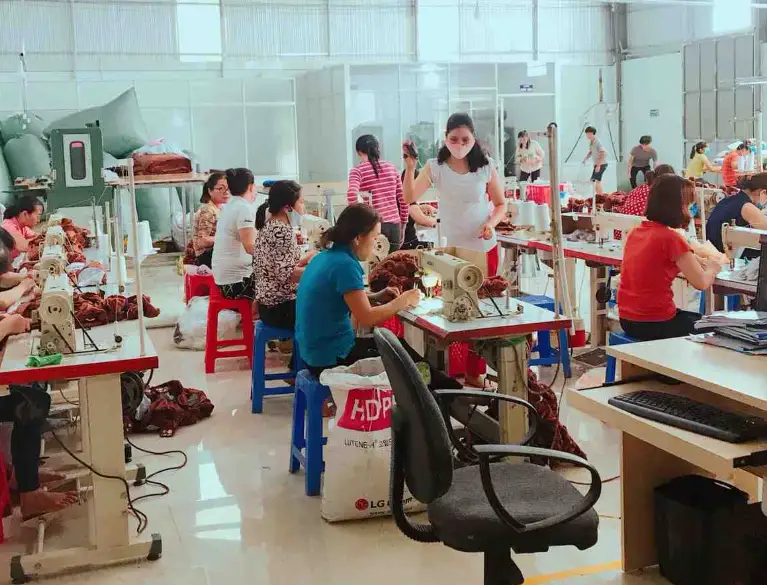
Packaging Specification Optimizations: Specifying packaging that meets the retail and consumer requirements of the target market without unnecessary premium features reduces both per-unit packaging cost and DIM weight shipping cost. For products sold primarily online, where packaging is opened before the consumer sees it, elaborate retail packaging adds cost without adding consumer value.
Supplier Selection Optimizations: Choosing a factory with strong sampling capability reduces total development cost by minimizing revision rounds. Choosing a factory with compliance-first material sourcing eliminates the risk of compliance testing failure that generates far higher costs than the premium materials would have. Choosing a factory with a comprehensive QC infrastructure reduces defect rates and downstream quality management costs.
Development Process Optimizations: Providing a clear, detailed design brief with precise color references, construction notes, and quality specifications reduces the number of revision rounds required. Approving samples promptly and consolidating feedback into each revision rather than drip-feeding changes across multiple rounds minimizes development timeline and revision cost.
Conclusion
Plush toy manufacturing costs are not a mystery — they are a predictable system of interconnected components that respond to identifiable decisions about materials, design, volume, compliance, quality management, and development process discipline. Buyers who understand this system make better sourcing decisions, build more accurate budgets, and develop more productive relationships with manufacturing partners.
The most expensive decisions in plush toy sourcing are not the ones that cost the most on the quotation. They are the ones that create compliance failures, quality problems, development inefficiencies, and management overhead that were not in the budget at all — because they were not visible in the unit price comparison that drove the supplier selection.
The buyers who source most effectively are those who manage total cost rather than unit price — who invest appropriately in materials, compliance, development quality, and QC infrastructure, and who measure the success of a sourcing relationship not by the number on the invoice but by the total investment required and the total value delivered.
At Ken Wang Toys, we structure our pricing and our client relationships around transparency — providing complete cost breakdowns that include material specifications, compliance status, development cost expectations, and QC system details, so that buyers can make genuinely informed decisions rather than discovering the true cost of a low-priced quotation after production begins.
If you are planning a custom plush toy development and want to understand the real cost structure of your project before committing to a production path, our team is available to walk through a detailed cost analysis for your specific design requirements.
FAQ
Q1: What is a realistic unit price range for a custom plush toy from a Chinese manufacturer in 2025–2026?
The honest answer is that unit price varies too significantly across design complexity, material grade, compliance requirement, and order volume to give a single useful number. As a practical reference: a simple, mid-size (25–30cm) plush toy design with certified materials at 1,000 units typically falls in the $4.50–$7.00 range.
A complex character design with multiple fabric types, electronic components, and full market compliance at the same volume is more likely to be $8.00–$15.00 or above. The most useful approach is to get a detailed quotation based on your specific design and specifications rather than benchmarking against a general range — because the specific decisions embedded in your product are the real determinants of your unit price.
Q2: Is it possible to get a quality plush toy at a very low unit price by finding the right factory?
The short answer is no — not for products intended for regulated markets. Unit price in plush toy manufacturing is fundamentally connected to the material, labor, and compliance decisions made in producing the product. A factory that offers a dramatically lower unit price than comparable factories for the same specification is either using lower-grade materials, has weaker quality systems that generate downstream costs, excludes compliance costs that the buyer will discover separately, or is in a position that will prove unsustainable over multiple orders. Genuine cost efficiency comes from design optimization, volume planning, and supplier capability — not from finding a factory willing to produce below the market cost of compliant quality.
Q3: How much should buyers budget for the development phase before production begins?
For a first custom design with a new manufacturing partner, a realistic development budget is $400 to $1,200, covering sampling fees, revision rounds, and sample shipping across two to four rounds. For buyers who provide very detailed, precise design briefs and choose factories with strong sampling capability, the lower end of this range is achievable. For buyers with less precise briefs or working with factories whose sampling accuracy is unverified, the higher end is more realistic. It is always better to budget the higher figure and spend less than to budget the lower figure and run short of development funds before an approved sample is achieved.
Q4: Do plush toys sold only online in the US still need to comply with ASTM F963 and CPSIA?
Yes, without exception. ASTM F963 and CPSIA compliance requirements apply to all children’s toys sold in the United States — including products sold exclusively through e-commerce channels. The distribution channel does not affect the compliance requirement. All products intended for children under 12 must have a General Conformity Certificate (GCC) and the required testing from a CPSC-accepted laboratory. Platforms, including Amazon, enforce these requirements and may remove listings or delist seller accounts for non-compliant products. This compliance cost should be built into every US market product budget, regardless of sales channel.
Q5: How do tariffs and import duties affect the landed cost of plush toys from China, and how should buyers account for them?
Import duties on plush toys from China vary by destination market and change periodically based on trade policy. For US buyers, plush toys (HTS code 9503) have historically carried a base duty rate of 0 to 6.8%, but Section 301 tariffs applied from 2018 onward added significant additional duties on many Chinese-manufactured goods — rates that have been adjusted multiple times and that buyers should verify with a licensed customs broker at the time of their order, as they are subject to policy change.
For EU buyers, duty rates on plush toys from China are typically 4.7%. UK buyers face a similar rate post-Brexit. The most reliable approach is to calculate a landed cost estimate using a confirmed current tariff rate from a customs professional rather than relying on historical figures that may have changed.
Q6: What is the most effective way to compare manufacturing costs across multiple factory quotations?
The most effective approach is a total cost framework that normalizes all quotations to the same specifications and adds all cost components, not just the unit price. Confirm that all quotations are based on identical material specifications, including compliance certification status.
Confirm that sampling fee and revision round policies are included. Confirm that compliance testing is either included or calculate the cost separately for each quote. Estimate quality management costs based on the QC system assessment of each factory. Add development, compliance, quality, and shipping costs to the production cost for each supplier before comparing. This total cost comparison consistently reveals that the apparent cheapest option — based on unit price alone — is frequently not the most cost-effective option when all real costs are included.